
Flat Steel Market Size and Share
Market Overview
| Study Period | 2021 - 2031 |
|---|---|
| Market Size (2026) | USD 748.93 Million |
| Market Size (2031) | USD 994.69 Million |
| Growth Rate (2026 - 2031) | 5.84 % |
| Fastest Growing Market | Asia-Pacific |
| Largest Market | Asia-Pacific |
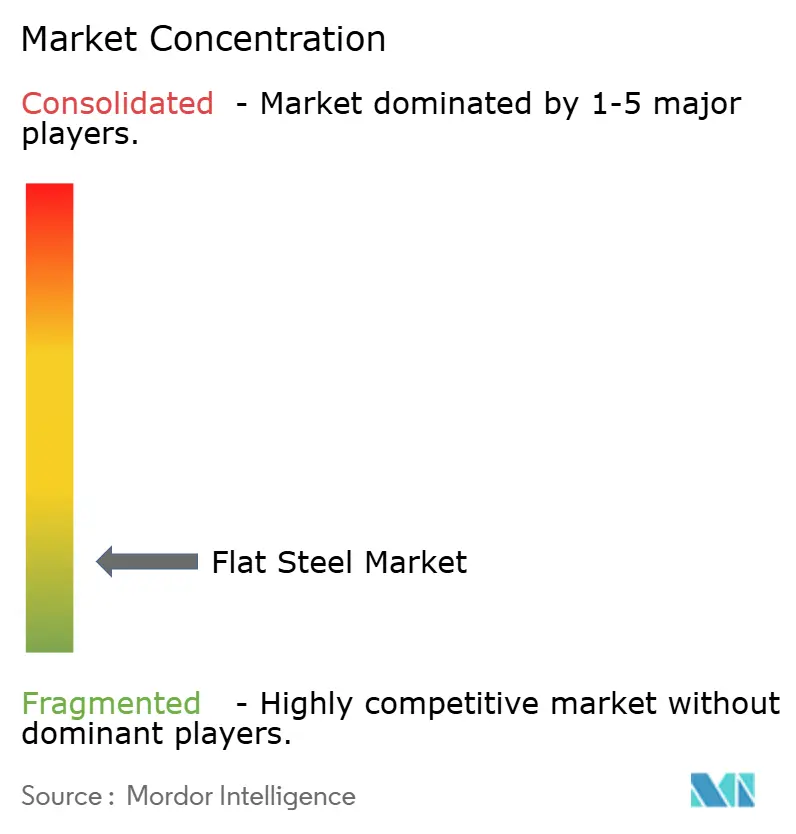
| Market Concentration | Low |
Major Players *Disclaimer: Major Players sorted in no particular order Image © Mordor Intelligence. Reuse requires attribution under CC BY 4.0. | |
Flat Steel Market Analysis by Mordor Intelligence
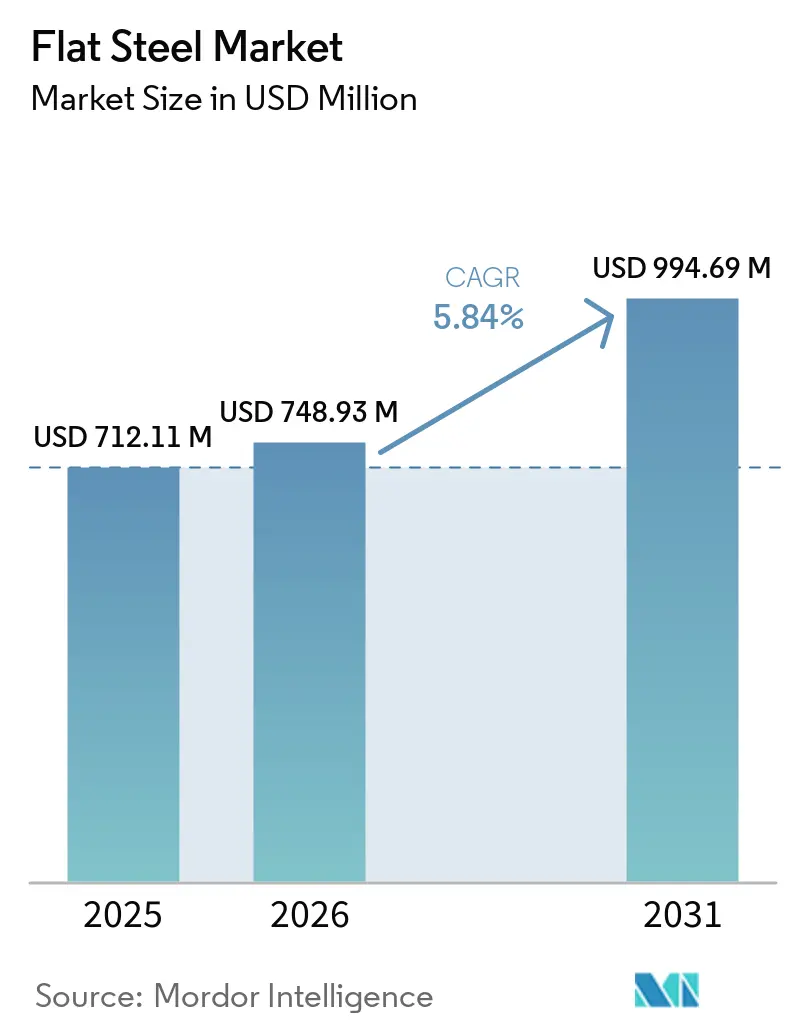
The flat steel market size was estimated at USD 712.11 million in 2025 and is estimated to grow from USD 748.93 million in 2026 to USD 994.69 million by 2031, at a CAGR of 5.84% during the forecast period (2026-2031). Infrastructure renewal, industrial construction, automotive production, and renewable energy equipment support demand across several regions. Construction remains the central demand base, while energy equipment and industrial buyers are increasing their purchases at a faster pace. This mix reduces reliance on residential construction in China, which had previously shaped global steel demand more strongly. Producers are responding by emphasizing coated, higher-strength, and lower-carbon products rather than relying solely on commodity output. The flat steel market also faces sustained pressure from excess capacity, export competition, and input cost volatility.
Key Report Takeaways
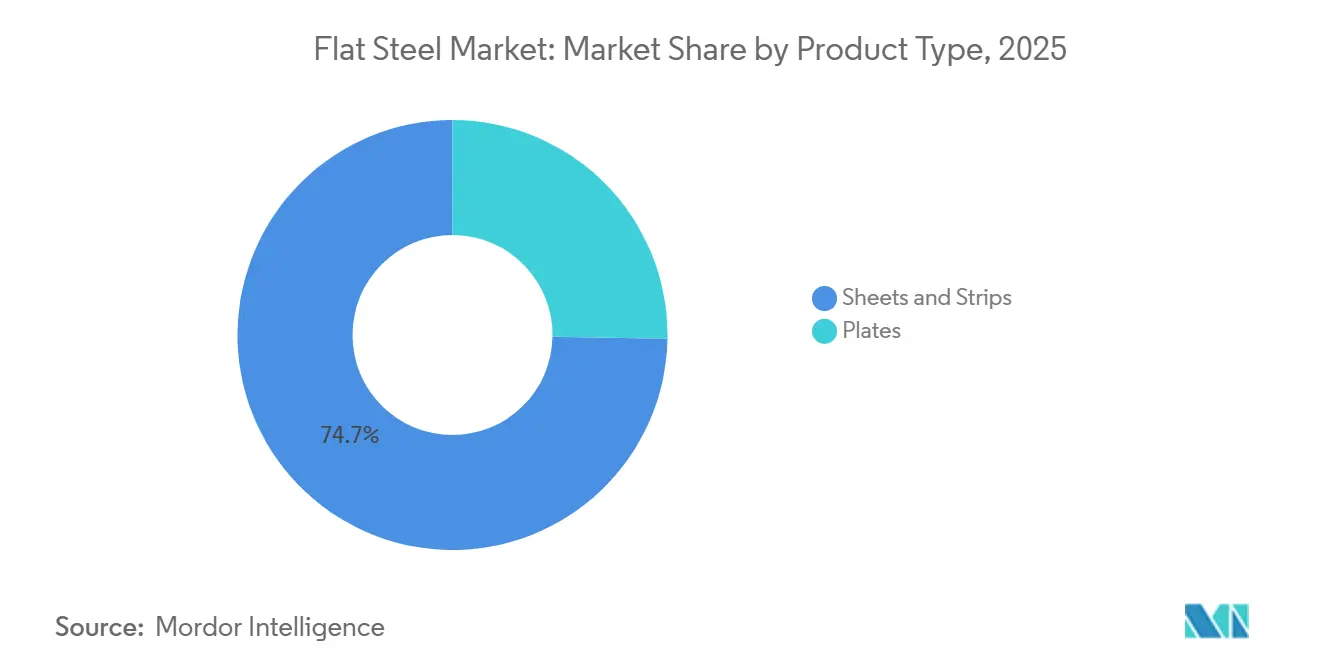
- By product type, sheets and strips held 74.73% of the flat steel market share in 2025 and are forecast to grow at a 6.34% CAGR through 2031.
- By production process, the basic oxygen furnace route held 75.25% of the flat steel market share in 2025, while electric arc furnaces are forecast to grow at a 6.75% CAGR through 2031.
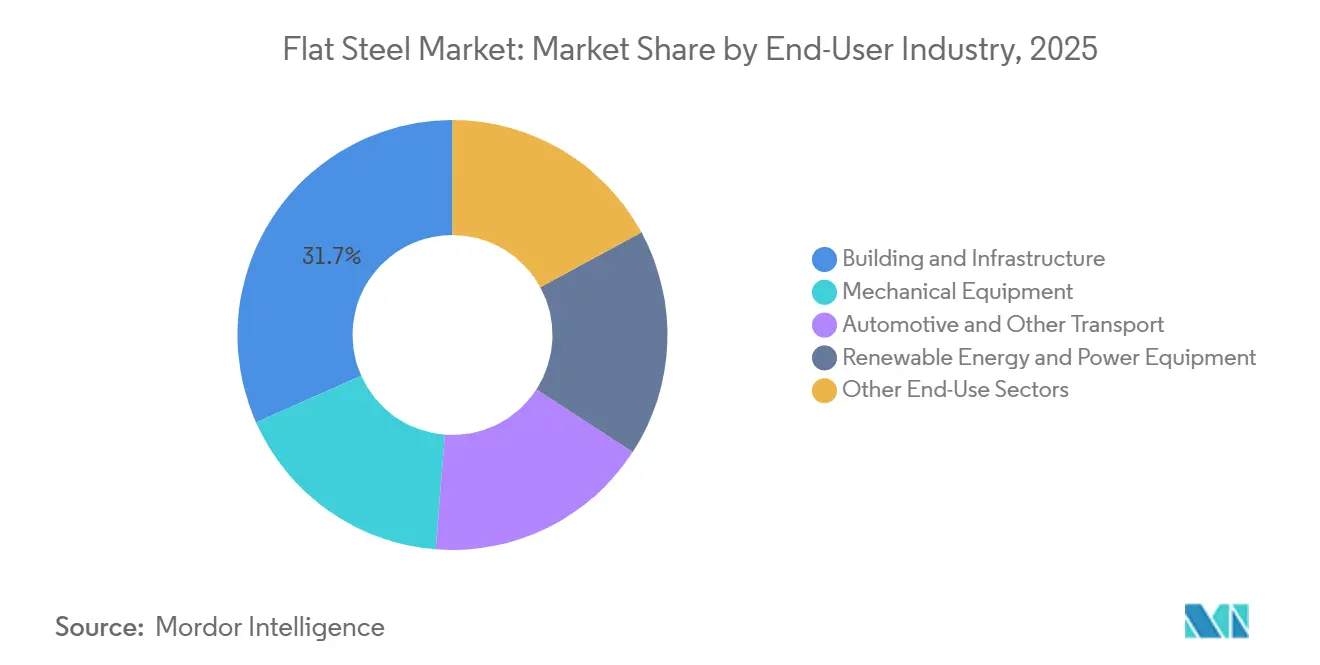
- By end-user industry, building and infrastructure held 31.67% of the flat steel market share in 2025, while renewable energy and power equipment are forecast to grow at a 6.83% CAGR through 2031.
- By geography, Asia-Pacific held 44.39% of the flat steel market share in 2025 and is forecast to expand at a 6.27% CAGR through 2031.
Note: Market size and forecast figures in this report are generated using Mordor Intelligence’s proprietary estimation framework, updated with the latest available data and insights as of January 2026.
Global Flat Steel Market Trends and Insights
Drivers Impact Analysis*
| Drivers | (~) % Impact on CAGR Forecast | Geographic Relevance | Impact Timeline |
|---|---|---|---|
| Infrastructure Renewal and Industrial Construction | +1.8% | Global, particularly South Asia, ASEAN, North America, and the Middle East | Long term (≥ 4 years) |
| Automotive Lightweighting and Electric Vehicle Production | +1.0% | Global; APAC core (China, India, South Korea), North America spillover | Medium term (2-4 years) |
| Renewable Energy and Grid Equipment Expansion | +0.9% | spillover to the Middle East and Africa (MEA) and South America | Medium term (2-4 years) |
| Growth of Coated and Corrosion-Resistant Flat Steel | +0.7% | Global: highest uptake in APAC, North America, and the EU | Long term (≥ 4 years) |
| Advanced High-Strength Steel Adoption | +0.6% | APAC, North America, and EU automotive hubs | Medium term (2-4 years) |
| Source: Mordor Intelligence | |||
Infrastructure Renewal and Industrial Construction
Government-backed capital spending remains a reliable source of demand for flat steel products used in building envelopes, bridge decks, warehouses, and industrial facilities. India's steel demand grew in 2025, supported by the National Infrastructure Pipeline and automotive production. The United States is directing public infrastructure spending and shipbuilding plans toward applications that use structural plate. America's Maritime Action Plan, released in February 2026, provides an additional channel for this demand. Prefabricated and modular construction uses coated and pre-painted sheets more frequently than site-formed sections, increasing the importance of product quality and finishing within the flat steel market.
Automotive Lightweighting and Electric Vehicle Production
Electric vehicle platforms create a different demand pattern for flat steel because battery packs add 400 to 800 kilograms of weight. Automakers use press-hardened steel, cold-rolled dual-phase grades, and advanced high-strength steel to manage vehicle weight and protect battery systems. Advanced high-strength steel can reduce vehicle structural weight by 15% to 25% compared with conventional steel[1]U.S. Department of Energy, “Lightweight Materials for Cars and Trucks,” U.S. Department of Energy, energy.gov.. These grades support crash performance while allowing thinner components in body structures. The product mix, therefore, shifts away from conventional hot-rolled coil and toward specialized materials with tighter certification requirements. This favors producers that can consistently supply automotive-grade products near major vehicle manufacturing centers.
Renewable Energy and Grid Equipment Expansion
Solar and wind projects require flat steel for ground-mount racking, transformer housings, tower sections, and related equipment. An onshore wind turbine requires 124 tons of steel per megawatt of installed capacity, while solar installations consume 45 tons per megawatt. China added more than 100 GW of wind capacity in 2025, supporting demand for tower sections and nacelle components. Utility-scale solar installations across ASEAN, the Middle East, and Africa also require structural steel for mounting systems. Renewable project procurement is commonly organized through engineering, procurement, and construction contractors that specify grades for each project. Suppliers that meet those technical specifications and delivery schedules are positioned to benefit from this demand.
Advanced High-Strength Steel Adoption
Third-generation advanced high-strength steel is used in B-pillars and door rings across global vehicle platforms. These grades can improve energy absorption by more than 35% while using lower section thickness. Demand is increasing because electric vehicles require structural protection around battery enclosures and must meet stricter crash-test requirements. Automotive producers are therefore placing greater value on high-grade cold-rolled and coated materials. European and North American safety requirements further reinforce demand for products that meet demanding performance specifications. The flat steel industry is moving further toward grade development, testing, and reliable supply arrangements with vehicle manufacturers.
Restraints Impact Analysis*
| Restraints | (~) % Impact on CAGR Forecast | Geographic Relevance | Impact Timeline |
|---|---|---|---|
| Global Steel Overcapacity and Export Pressure | -1.3% | Global, most acute in Europe, South America, and ASEAN | Short term (≤ 2 years) |
| Volatile Iron Ore, Coking Coal, and Scrap Costs | -0.7% | Global, with greater exposure to Basic Oxygen Furnace (BOF) producers in Asia and Europe | Medium term (2-4 years) |
| Carbon Compliance and Decarbonization Capital Expenditure | -0.5% | Global, particularly Europe, North America, and export-oriented BOF producers in Asia | Long term (≥ 4 years) |
| Source: Mordor Intelligence | |||
Global Steel Overcapacity and Export Pressure
Global excess steelmaking capacity reached 640 million tons in 2025 and is projected to rise to 745 million tons by 2028. China exported a record 131.2 million tons of steel in 2025, as weaker real estate activity redirected output toward export markets. This shift particularly affects producers in ASEAN, South America, and Europe that sell hot-rolled and cold-rolled flat products. China's semi-finished steel exports to Southeast Asia increased by 300% in 2025, and some of the material was re-exported after processing. The OECD recorded 75 new antidumping and countervailing duty investigations in 2025. Trade actions may limit some imports, but they do not address the underlying surplus or its effect on prices.
Volatile Iron Ore, Coking Coal, and Scrap Costs
Steelmaking costs remain exposed to commodity cycles that do not always align with finished-steel demand. Iron ore traded in a USD 100-110 per ton range in 2025, placing pressure on basic oxygen furnace producers as coil prices were constrained by export competition. Coking coal prices rose in 2025 after a mine accident in China's Shanxi province affected domestic supply. India's coking coal imports are expected to increase as capacity expands and domestic supplies remain limited. Electric arc furnace producers face a separate challenge, as 42 economies restrict exports of ferrous scrap. Uncertain input costs make long-term contracts more difficult to price and can limit buyer willingness to commit to multi-year contracts.
*Our forecasts treat driver/restraint impacts as directional, not additive. The impact forecasts reflect baseline growth, mix effects, and variable interactions.
Segment Analysis
By Product Type: Sheets and Strips Sustain Structural Primacy
Sheets and strips held 74.73% of the flat steel market share by value in 2025. This reflects their use in automotive body panels, appliance casings, building envelopes, and solar racking frames. Plates are used in more specialized applications, including pressure vessels, shipbuilding, and heavy machinery frames. The wider range of end uses for sheets and strips explains their dominant position. Commodity hot-rolled coil represents the larger-output, lower-margin segment within this product group. Cold-rolled and coated variants carry a higher value due to tighter requirements for surface quality, forming, and corrosion performance.
Sheets and strips are forecast to grow at a 6.34% CAGR from 2026 to 2031. This growth is supported by zinc-aluminum-magnesium-coated products used in roofing, solar substrates, and electric vehicle structures. Japan's industrial standards work has more closely aligned domestic production with automotive original equipment manufacturer requirements for advanced high-strength grades. Suppliers are responding to competitive pressure in commodity coil by expanding into value-added finishes and higher-grade products. The heavy reliance on sheets and strips means changes in coil prices continue to influence the broader flat steel market. Producers can reduce this exposure by growing sales in coatings, automotive grades, and other differentiated product categories.



By Production Process: Basic Oxygen Furnace (BOF) Dominance Persists While Electric Arc Furnace (EAF) Redefines the Value Chain
The basic oxygen furnace route held 75.25% of the production process share in 2025. This share is supported by integrated blast-furnace facilities in China, India, and Japan, which represent decades of investment in primary ironmaking and cannot be replaced quickly. Basic oxygen furnace mills remained important in 2025 and continue to be so in 2026 despite increasing decarbonization pressure. Slower construction demand in China has prompted some mills to shift flat-product output to export channels. Environmental requirements are also pushing producers to assess electric routes and reduce emissions from conventional production.
Electric arc furnaces are forecast to grow at a 6.75% CAGR from 2026 to 2031. The route accounted for 29% of global crude steel output in 2024 and benefits from greater availability of scrap, cleaner electricity supplies, and compliance requirements. The European Union entered the definitive phase of its Carbon Border Adjustment Mechanism on January 1, 2026, which changes the cost position of emissions-intensive flat steel imports into Europe. Electric arc furnaces benefit from reliable scrap supply and access to lower-carbon electricity. However, restrictions on scrap trade can slow this transition in regions with limited domestic scrap collection.
By End-User Industry: Construction Anchors Demand While Renewables Lead Growth
Building and infrastructure held 31.67% of the flat steel market share in 2025. Flat steel is used in framing, roofing, cladding, bridge components, and prefabricated building systems. Government-supported infrastructure programs make this demand less exposed to private residential construction cycles. The construction sector accounted for 37% of apparent steel consumption in the European Union in 2024. Mechanical equipment, automotive, and other transport are additional significant users of flat products, while consumer appliances, shipbuilding, and general manufacturing provide baseline output across the flat steel market.
Renewable energy and power equipment are forecast to grow at a 6.83% CAGR through 2031. This growth is driven by the steel intensity of wind towers, solar racking, and grid equipment. Wind towers require 124 to 190 tons of flat steel per megawatt of capacity, depending on hub height. China's 2025 wind additions, along with expanding solar projects in ASEAN, the Middle East, and Africa, supported demand for high-strength plates and sheets. Project buyers often work through engineering, procurement, and construction contractors that select steel grades for each project. Suppliers that provide compliant, consistent material are well-positioned in this end-use segment.
Geography Analysis
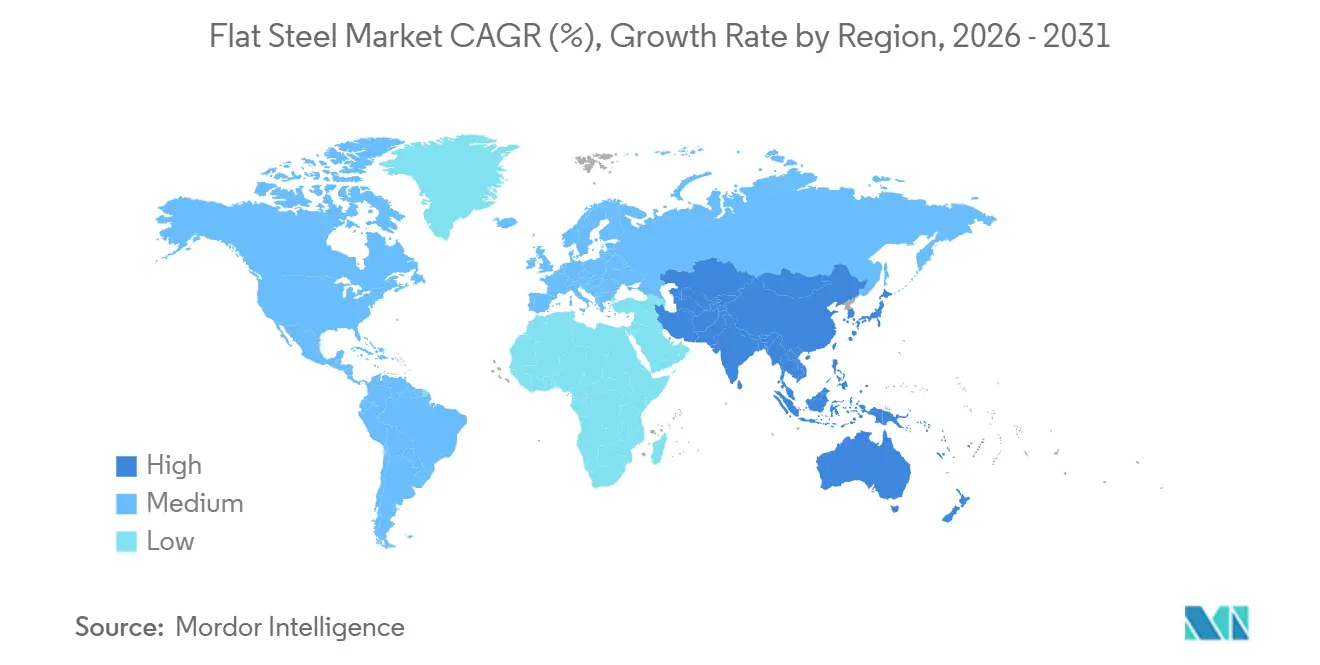
Asia-Pacific held 44.39% of the flat steel market share in 2025 and is forecast to grow at a 6.27% CAGR through 2031. China's domestic flat steel consumption declined 6.9% in 2025 as its real estate downturn continued. India's steel demand grew 9.8% in 2025. ASEAN demand grew 4.3% in 2025, supported by manufacturing investment and public infrastructure programs. South Korea and Japan recorded a combined 5.1% decline in demand in 2025.
North America is the second-largest region in the flat steel market. United States demand grew 0.7% in 2025, with industrial activity and public infrastructure spending helping to offset weak residential construction. Canada recorded 2.7% demand growth in 2025, while Mexico recorded a 4.6% decline. Section 232 tariffs, increased to 50% in June 2025, limited some import pressure on domestic producers. America's Maritime Action Plan is also expected to support plate demand from shipbuilding. Electric arc furnace producers accounted for 60% of domestic flat steel shipments in 2025, positioning the region strongly in this production route.
Europe's flat steel demand declined 1.2% in 2025, with France down 12.6% and Germany down 6.1%. The European Union raised above-quota steel tariffs from 25% to 50% in April 2026 and capped flat steel import quotas at 15% of European Union consumption[2]Ministère de l’Économie, “Post-Sauvegarde Acier,” Ministère de l’Économie, economie.gouv.fr.. South America's demand grew 0.7% in 2025. Middle East demand grew 6.4% in 2025, while Africa grew 16.1%, supported by construction and energy infrastructure investment.

Competitive Landscape
The flat steel market is fragmented. Baowu, ArcelorMittal, Nippon Steel, POSCO, and JSW Steel are among the most strategically active integrated producers. Regional and specialty markets remain more fragmented than global production figures suggest. Competition increasingly depends on high-specification, lower-carbon flat products rather than on commodity hot-rolled coil output alone. Product quality, decarbonization investment, and proximity to major end-use clusters shape supplier positioning, favoring producers that can combine scale with capabilities in automotive, energy, and coated sheet.
POSCO completed a 2.5 million-ton-per-year electric arc furnace in Gwangyang in June 2026 and is developing its HyREX hydrogen-based steelmaking process. Nucor commissioned a USD 4 billion sheet mill in West Virginia with electric arc furnace production and automotive-grade galvanizing capability. These investments reflect a broader trend among major producers toward lower-emission capacity and specialized flat products. Indian producers are also expanding cold-rolling and coating capacity to supply automotive manufacturers. The competitive emphasis is shifting toward products that meet both performance and carbon-related purchasing requirements.
Low-carbon certified flat steel for renewable energy projects and automotive applications remains an important area of competition. Coated sheet supply in ASEAN and South Asia is another area of focus, as demand is growing faster than domestic supply in some locations. Carbon footprint reporting frameworks are becoming more relevant in European and North American procurement practices, which may give a sales advantage to suppliers that can document product emissions and meet customer requirements. Commodity producers remain exposed to lower prices when surplus exports enter their regional markets. The flat steel market therefore combines large integrated producers with more fragmented regional and specialized supply positions.
Flat Steel Industry Leaders
BAOWU Metal
ARCELORMITTAL
Ansteel Group Corporation Limited
NIPPON STEEL CORPORATION
HBIS GROUP
- *Disclaimer: Major Players sorted in no particular order

Recent Industry Developments
- August 2026: Nucor Corporation announced a USD 59 million investment to expand its Vulcraft Indiana facility in St. Joe, Indiana. The expansion adds flat steel grating production capabilities and increases downstream fabricated flat steel product capacity.
- April 2026: JSW Steel and JFE Steel Corporation announced a 50:50 joint venture, JSW JFE Steel Ltd, to expand the Bhushan Power and Steel facility in Odisha to 6 million tons per annum of flat steel, with an investment of INR 32,000 crore (USD 3.8 billion). The joint venture aims to increase production of higher-grade and specialized flat steel products for domestic and export markets.


Global Flat Steel Market Report Scope
Flat steel is a major category of metal products manufactured by rolling steel slabs into flat, rectangular shapes, distinguishing it from long products such as wires or tubes. It primarily includes thin sheets, coiled strips, and heavy structural plates.
The flat steel market is segmented by product type, production process, end-user industry, and geography. By product type, the market is segmented into sheets, strips, and plates. By production process, the market is segmented into basic oxygen furnace, electric arc furnace, and others. By end-user industry, the market is segmented into building and infrastructure, mechanical equipment, automotive and other transport, renewable energy and power equipment, and other end-use sectors. The report also covers market size and forecasts for flat steel across 16 countries in major regions. The market sizes and forecasts are provided in terms of value (USD).
| Sheets and Strips |
| Plates |
| Basic Oxygen Furnace |
| Electric Arc Furnace |
| Others |
| Building and Infrastructure |
| Mechanical Equipment |
| Automotive and Other Transport |
| Renewable Energy and Power Equipment |
| Other End-Use Sectors |
| Asia-Pacific | China |
| India | |
| Japan | |
| South Korea | |
| ASEAN Countries | |
| Rest of Asia-Pacific | |
| North America | United States |
| Canada | |
| Mexico | |
| Europe | Germany |
| United Kingdom | |
| France | |
| Italy | |
| NORDIC Countries | |
| Russia | |
| Rest of Europe | |
| South America | Brazil |
| Argentina | |
| Rest of South America | |
| Middle East and Africa | Saudi Arabia |
| South Africa | |
| Rest of Middle East and Africa |
| By Product Type | Sheets and Strips | |
| Plates | ||
| By Production Process | Basic Oxygen Furnace | |
| Electric Arc Furnace | ||
| Others | ||
| By End-User Industry | Building and Infrastructure | |
| Mechanical Equipment | ||
| Automotive and Other Transport | ||
| Renewable Energy and Power Equipment | ||
| Other End-Use Sectors | ||
| By Geography | Asia-Pacific | China |
| India | ||
| Japan | ||
| South Korea | ||
| ASEAN Countries | ||
| Rest of Asia-Pacific | ||
| North America | United States | |
| Canada | ||
| Mexico | ||
| Europe | Germany | |
| United Kingdom | ||
| France | ||
| Italy | ||
| NORDIC Countries | ||
| Russia | ||
| Rest of Europe | ||
| South America | Brazil | |
| Argentina | ||
| Rest of South America | ||
| Middle East and Africa | Saudi Arabia | |
| South Africa | ||
| Rest of Middle East and Africa | ||


Key Questions Answered in the Report
What is current market size of Flat Steel Market?
The flat steel market size was estimated at USD 712.11 million in 2025 and is estimated to grow from USD 748.93 million in 2026 to USD 994.69 million by 2031, at a CAGR of 5.84% during the forecast period (2026-2031).
Which flat steel product type has the largest share?
Sheets and strips held a 74.73% share by value in 2025 and are forecast to grow at a 6.34% CAGR through 2031.
Why are electric arc furnaces gaining importance?
Electric arc furnaces are forecast to grow at a 6.75% CAGR due to increased scrap use, lower-emission electricity, and carbon compliance needs.
Which end-user industry is growing fastest for flat steel?
Renewable energy and power equipment are forecast to grow at a 6.83% CAGR through 2031, supported by wind, solar, and grid equipment.
Page last updated on:





