
Flash LiDAR Systems Market Size and Share
Market Overview
| Study Period | 2020 - 2031 |
|---|---|
| Market Size (2026) | USD 1.22 Billion |
| Market Size (2031) | USD 2.86 Billion |
| Growth Rate (2026 - 2031) | 18.58 % |
| Fastest Growing Market | Asia-Pacific |
| Largest Market | Asia-Pacific |
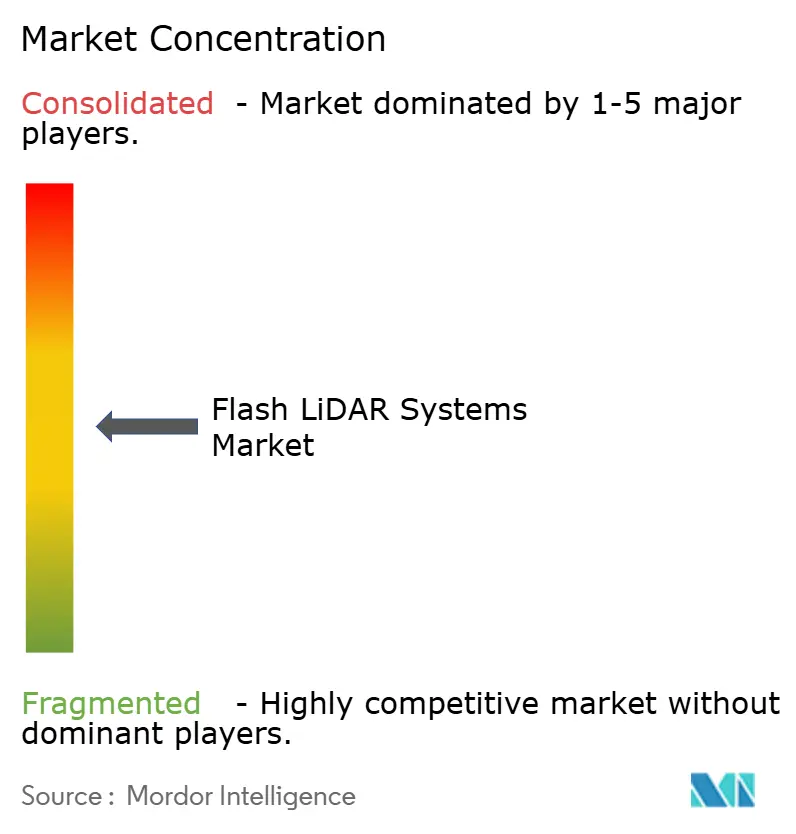
| Market Concentration | Medium |
Major Players *Disclaimer: Major Players sorted in no particular order Image © Mordor Intelligence. Reuse requires attribution under CC BY 4.0. | |
Flash LiDAR Systems Market Analysis by Mordor Intelligence
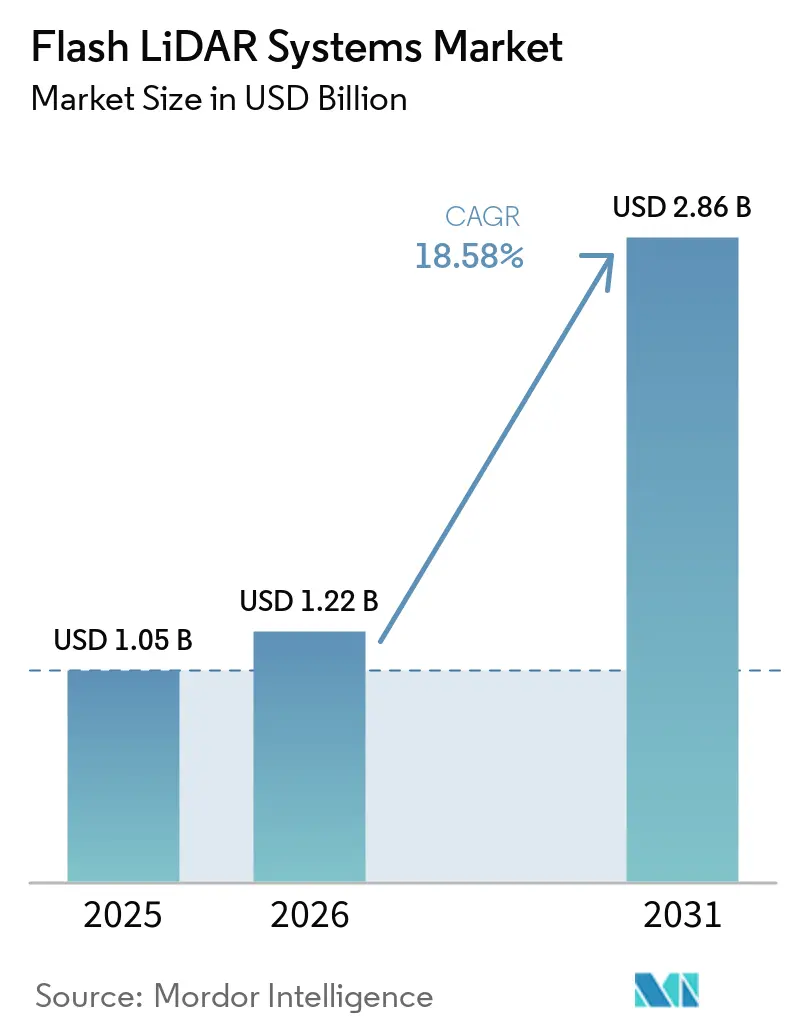
The Flash LiDAR systems market size was valued at USD 1.05 billion in 2025 and estimated to expand from USD 1.22 billion in 2026 to reach USD 2.86 billion by 2031, at an CAGR of 18.58% during the forecast period (2026-2031). Demand in the Flash LiDAR systems market is being shaped by warehouse automation, flexible manufacturing, and safety requirements for mobile robots operating near people. Solid-state designs can support continuous operation because they have no moving scan mechanism. Lower component costs are encouraging suppliers to integrate sensing, processing, and perception software into a single unit. This shift creates an opportunity for suppliers that can reduce deployment work for logistics and industrial customers. Competition in the Flash LiDAR systems market is also intensifying as cameras and 4D radar improve their performance under certain operating conditions.
Key Report Takeaways
- By range, the short range accounted for 43.81% of revenue in 2025, while the long range is projected to expand at a 19.18% CAGR through 2031.
- By product form, flash LiDAR modules accounted for 46.73% of the Flash LiDAR systems market in 2025, while integrated flash LiDAR perception systems are projected to expand at a 19.21% CAGR through 2031.
- By application, object and obstacle detection and classification accounted for 29.61% of revenue in 2025, while navigation and localization are projected to expand at a 19.98% CAGR through 2031.
- By end-user industry, automotive accounted for 25.43% revenue share in 2025, while third-party logistics and e-commerce are projected to expand at a 20.57% CAGR through 2031.
- By geography, Asia-Pacific accounted for 39.71% of revenue in 2025 and is projected to expand at a 19.54% CAGR through 2031.
Note: Market size and forecast figures in this report are generated using Mordor Intelligence’s proprietary estimation framework, updated with the latest available data and insights as of January 2026.
Global Flash LiDAR Systems Market Trends and Insights
Drivers Impact Analysis*
| Driver | (~) % Impact on CAGR Forecast | Geographic Relevance | Impact Timeline |
|---|---|---|---|
| Expansion of Autonomous Mobile Robots and Warehouse Automation | +4.3% | Global, strongest in Asia-Pacific and North America | Short term (≤ 2 years) |
| Industry 4.0 Adoption and Flexible Manufacturing | +3.6% | Global, core gains in China, Germany, and the United States | Medium term (2-4 years) |
| Declining Photonic Component Costs and Semiconductor Integration | +2.8% | Global, manufacturing concentrated in Asia-Pacific | Medium term (2-4 years) |
| Functional-Safety Requirements for Human-Robot Collaboration | +2.3% | Europe, North America, and Asia-Pacific | Medium term (2-4 years) |
| Embedded Perception Reducing System Integration Complexity | +1.9% | Global, with spillover to Middle East and Africa and South America | Long term (≥ 4 years) |
| Rising Demand for Velocity-Aware Perception in Dynamic Industrial Environments | +1.5% | Asia-Pacific, North America, and Europe | Long term (≥ 4 years) |
| Source: Mordor Intelligence | |||
Expansion of Autonomous Mobile Robots and Warehouse Automation
Logistics automation is a major near-term driver of demand for the Flash LiDAR systems market. Autonomous mobile robots need continuous three-dimensional awareness in crowded warehouse aisles and shared work zones. Full-scene capture can limit the gaps that occur when a scanning sensor moves away from a changing area. Hesai reported that robotics LiDAR shipments increased 193.4% year over year to 142,371 units in the second quarter of 2026. It also reported engagement with more than 50 companies in embodied artificial intelligence worldwide. Solid-state sensors can also suit multi-shift logistics operations because their design does not rely on rotating parts.
Industry 4.0 Adoption and Flexible Manufacturing
Flexible manufacturing supports the Flash LiDAR systems market because it requires three-dimensional sensing that can respond to changes in production cells or product mixes. Reconfigurable cells, collaborative robots, and real-time quality checks reduce the usefulness of fixed scene maps. Flash LiDAR can acquire scene geometry in a single frame, enabling faster adjustment after a cell change. Food and beverage lines, pharmaceutical packaging stations, and electronics assembly floors can face these conditions. The Flash LiDAR systems market can therefore benefit where manufacturers need sensing that does not depend on a stable layout. Automation hardware and sensor investments remain relevant as factories pursue more adaptable operations.
Declining Photonic Component Costs and Semiconductor Integration
SPAD array fabrication supports the Flash LiDAR systems market and is moving toward standard CMOS wafer lines. This approach allows module makers to use manufacturing methods developed for high-volume silicon devices. STMicroelectronics introduced the VL53L9 direct time-of-flight three-dimensional LiDAR module in June 2026. The module includes 2,268 sensing zones, on-chip processing, and a dedicated power-management integrated circuit in a 12.8 mm by 6.1 mm package.[1]STMicroelectronics, “STMicroelectronics Unveils New Compact Direct Time-of-Flight 3D LiDAR Module,” ST Newsroom, newsroom.st.com. Optica reported a 9,200-pixel three-dimensional stacked InGaAs/InP SPAD sensor that operated outdoors in 120 klux sunlight, showing progress in ambient-light rejection. Lower hardware costs can place greater value on embedded perception software and system integration.
Functional-Safety Requirements for Human-Robot Collaboration
Safety rules are making detection systems a specification requirement in shared human-robot areas within the Flash LiDAR systems market. ISO 3691-4:2023 covers safety requirements and verification for driverless industrial trucks and their systems. The standard increases the importance of personnel detection for autonomous guided vehicles and autonomous mobile robots. Safety-rated flash LiDAR modules can help operators meet detection requirements in these applications. Certified equipment can also reduce uncertainty for facilities that operate under formal safety and insurance obligations. This requirement can support demand for qualified hardware rather than optional guidance sensors.
Restraints Impact Analysis*
| Restraint | (~) % Impact on CAGR Forecast | Geographic Relevance | Impact Timeline |
|---|---|---|---|
| Competition From Camera and 4D Radar Perception Systems | -2.6% | Global, most acute in outdoor industrial and automotive applications | Short term (≤ 2 years) |
| High Integration and Validation Costs for Industrial Deployments | -2.0% | Global, with pronounced constraints in smaller enterprises in South America and Middle East and Africa | Medium term (2-4 years) |
| Calibration Drift Across Mixed Indoor and Outdoor Operating Conditions | -1.4% | Global, particularly acute in ports, agriculture, and mining applications | Long term (≥ 4 years) |
| Photonics Supply Concentration and Export-Control Exposure | -1.1% | North America and Europe, with exposure in indium phosphide and gallium arsenide sourcing | Medium term (2-4 years) |
| Source: Mordor Intelligence | |||
Competition From Camera and 4D Radar Perception Systems
4D imaging radar can constrain the Flash LiDAR systems market by preserving detection performance in fog, dust, and rain. These conditions can reduce the useful range of flash LiDAR in ports, mining, and other outdoor operations. A 2026 CVPR Workshop paper reported that 4D radar maintained 95% of baseline detection range in adverse weather. The paper reported a 60-80% LiDAR range reduction under the same conditions. Stereo and event-camera systems can also provide three-dimensional estimates at lower per-unit costs under controlled lighting conditions. Existing machine-vision infrastructure may therefore slow sensor-stack changes in indoor manufacturing.
High Integration and Validation Costs for Industrial Deployments
Industrial deployments in the Flash LiDAR systems market require calibration, point-cloud fusion software, fail-safe design, and operator training. The combined deployment cost can exceed the hardware price for a first installation. Smaller manufacturers in South America and Middle East, and Africa can face a shortage of in-house automation specialists. Multi-sensor systems also require validation when flash LiDAR operates with cameras and safety-rated two-dimensional scanners. These activities can extend program schedules and place pressure on engineering budgets. Adoption can move faster among large logistics operators and automotive Tier 1 suppliers that already have integration capability.
*Our forecasts treat driver/restraint impacts as directional, not additive. The impact forecasts reflect baseline growth, mix effects, and variable interactions.
Segment Analysis
By Range: Short-Range Demand Remains Broad While Long Range Advances
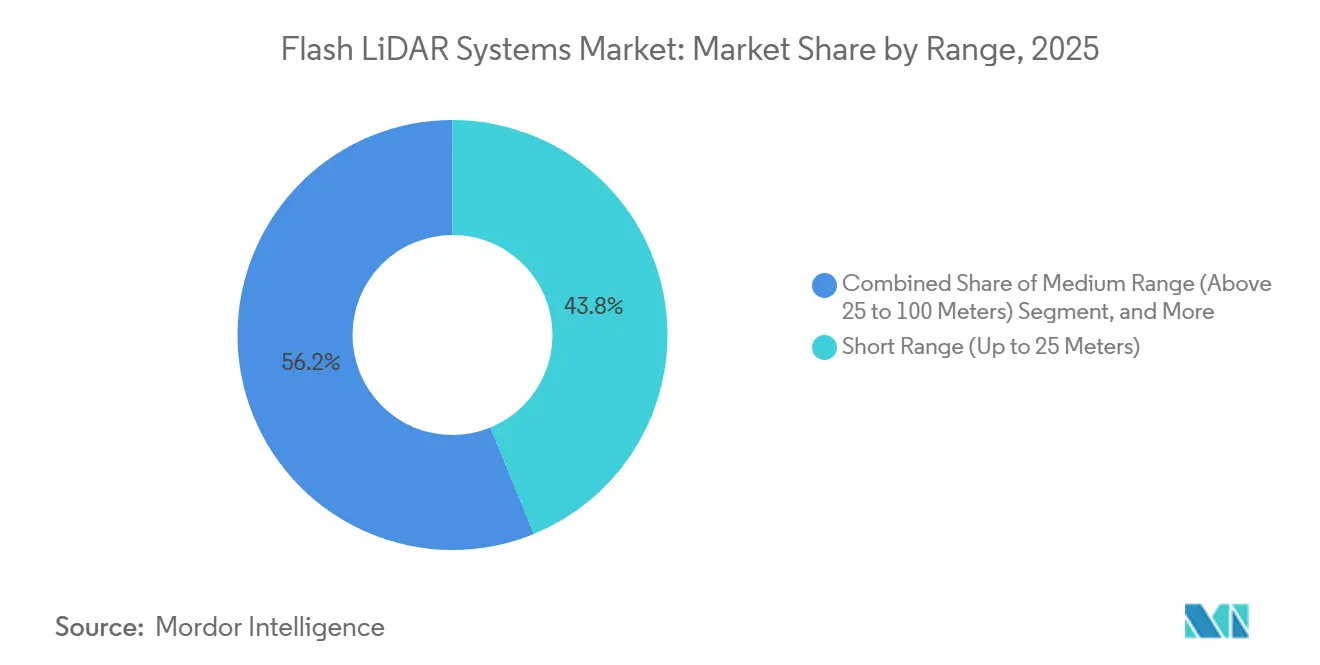
Short range, up to 25 meters, held 43.81% of the Flash LiDAR systems market share in 2025. Warehouse picking supports the Flash LiDAR systems market through autonomous guided vehicle proximity sensing, and robotic bin picking accounts for much of this demand. Full-scene illumination is well-suited to these compact operating areas. Signal quality and ambient-light rejection can be easier to optimize indoors, where lighting is consistent. The installed base in indoor logistics supports continued demand for short-range products. Buyers also use these sensors in applications that require low-latency close-range obstacle detection.
Long range, above 100 meters, is projected to expand at a 19.18% CAGR through 2031. Ports, airports, and heavy-industry perimeter monitoring are the main developing uses. These settings need reliable sensing across longer operating distances and extended duty cycles. The absence of mechanical wear can be relevant where equipment operates continuously. The medium range, 25 to 100 meters, serves cross-aisle warehouse monitoring and large-format sorting lines. Optica presented a flash LiDAR system that achieved 100-meter outdoor depth imaging with 2% accuracy in high ambient light.



By Product Form: Modules Lead While Integrated Systems Gain Momentum
Flash LiDAR modules accounted for 46.73% of the Flash LiDAR systems market in 2025. Their installed base in the Flash LiDAR systems market is supported by automotive Tier 1 suppliers and logistics automation integrators. Modules allow an integrator to pair sensing hardware with its own software stack. This flexibility remains important for established industrial automation buyers. Standalone flash LiDAR sensors continue to serve research, prototyping, and retrofit work. These buyers may not need a pre-integrated system for an individual project.
Integrated flash LiDAR perception systems are projected to expand at a 19.21% CAGR through 2031. These offerings combine sensing, edge processing, and perception software in a certified unit. They can reduce deployment work for users with limited integration resources. In June 2026, MicroVision delivered MOVIA sensors to an artificial intelligence company and a hyperscaler for the evaluation of robotics and spatial artificial intelligence. RoboSense introduced its E2 sensor with EOCENE SPAD-SoC architecture in July 2026. These product launches show the movement toward perception-ready products.
By Application: Detection Leads Adoption While Navigation Expands
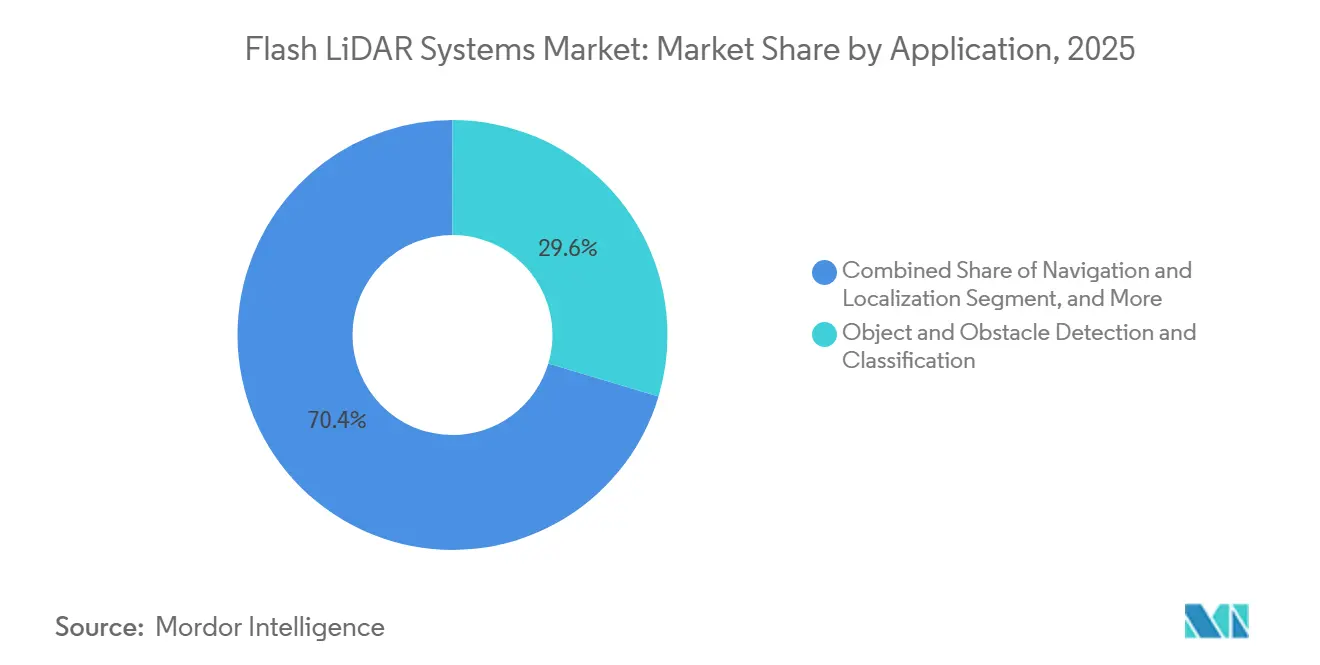
Object and obstacle detection and classification accounted for 29.61% of the Flash LiDAR systems market size in 2025. The application is central to the Flash LiDAR systems market across autonomous and semi-autonomous platforms. Forklift safety zones, robotic picking cells, and perimeter systems all rely on dependable object recognition. Safety-rated detection has established validation practices in many deployments. This makes procurement more routine in applications with clear safety requirements. Collision avoidance and safety remain a related use where full-scene geometry can support timely decisions.
Navigation and localization are projected to expand at a 19.98% CAGR through 2031. Autonomous mobile robot fleets depend on simultaneous localization and mapping to navigate changing environments. Consistent spatial data at high frame rates supports this task. Full-scene capture can limit scan-head position artifacts in maps from rotating-mirror systems. Picking, sorting, gripping guidance, inspection, and quality control also use three-dimensional geometry to support machine tasks. Perimeter and access monitoring is emerging in pharmaceuticals, food processing, and data centers, where certified detection can be required.
By End-User Industry: Automotive Holds Scale While Logistics Changes Demand
Automotive held 25.43% of the Flash LiDAR systems market share in 2025. Demand in the Flash LiDAR systems market includes driver-monitoring systems, near-field advanced driver-assistance systems, and automation inside vehicle plants. ISO 26262 creates a demanding procurement environment for road-vehicle systems. Validated vendors can benefit from multi-year supply agreements after design wins. Electronics and semiconductors, consumer goods, food and beverage, and pharmaceuticals and life sciences create a broad second group of users. Their needs differ in cleanroom conditions, contamination control, housing, and certification.
Third-party logistics and e-commerce are projected to expand at a 20.57% CAGR through 2031. Fulfillment centers are deploying more autonomous mobile robots for transport and picking tasks. This raises demand for sensing systems that support navigation and safe movement. Ports, airports, and transportation infrastructure are also assessing systems for autonomous vehicle guidance and perimeter monitoring. Agriculture and metals, mining, and heavy industry are earlier-stage users of rugged outdoor designs. The Flash LiDAR systems industry has a varied end-user base because duty conditions differ across these settings.
Geography Analysis
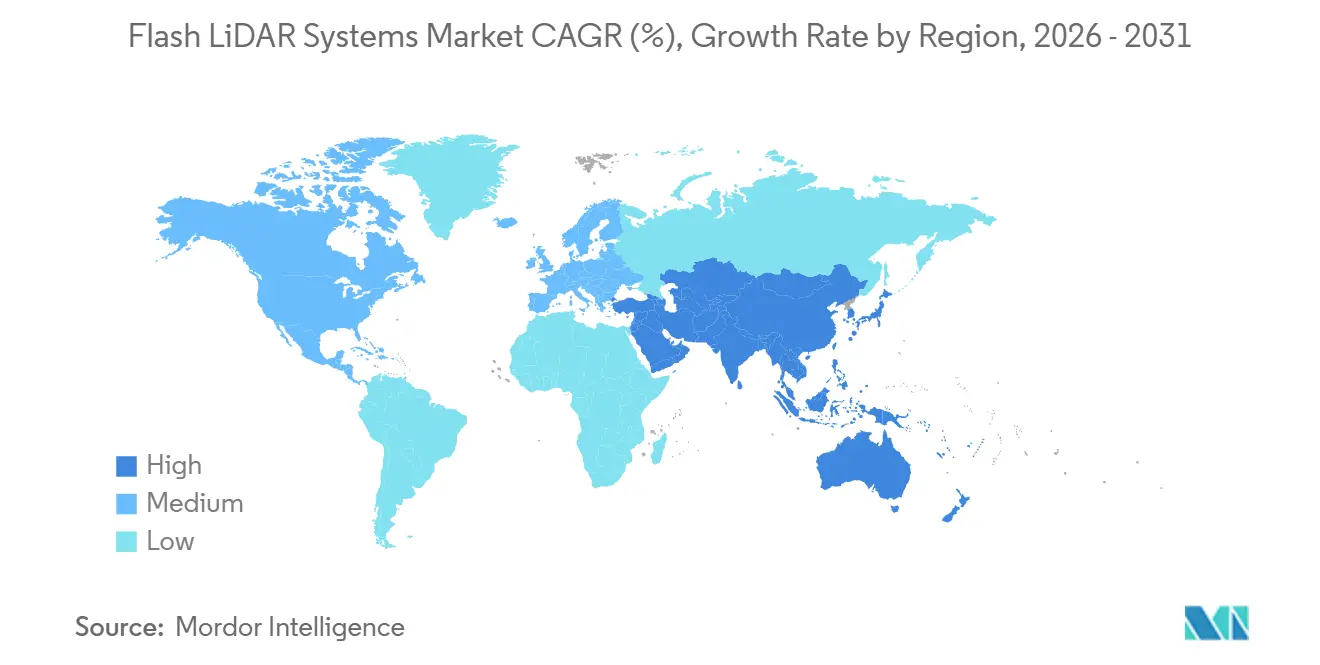
Asia-Pacific accounted for 39.71% of the Flash LiDAR systems market in 2025 and is projected to expand at a 19.54% CAGR through 2031. China accounts for the largest share of regional demand due to the deployment of L2+ and L3 advanced driver-assistance systems and the expansion of robotics use. Hesai reported a 44% share of China’s long-range ADAS LiDAR sector in the second quarter of 2026.[2]Hesai Group, “Second Quarter 2026 Financial Results Exhibit 99-1,” U.S. Securities and Exchange Commission EDGAR, sec.gov. It also ranked first in China’s humanoid and quadruped robot LiDAR category according to the company’s filing. Japan contributes through precision manufacturing automation, while South Korea supports robotics platforms and advanced driver-assistance integration.
North America held the second-largest global share in 2025. The Flash LiDAR systems market in the region has established logistics automation at major United States fulfillment centers. It also has automotive Tier 1 supplier activity and a mature robotics integration base. Safety requirements for industrial mobile robots support the procurement of qualified sensors. Canada provides applications in mining automation and precision agriculture. Mexico is adding demand through nearshoring-related investment in automotive supplier facilities.
Europe has a mature base for flash LiDAR integration in German automotive manufacturing and intralogistics. France, Italy, and Spain are adding uptake in food and beverage and pharmaceutical automation. The European Union Machinery Regulation 2023/1230 takes effect in 2027 and reinforces safety expectations for perception sensors in shared human-machine workplaces. The Middle East, Africa, and South America remain smaller markets with developing demand. Port modernization in the Middle East and food-processing automation in Brazil provide near-term use cases. These areas can benefit from integrated offerings, which reduce installation and validation requirements.

Competitive Landscape
The Flash LiDAR systems market has a moderately fragmented competitive structure. Volume-scale Asian producers compete strongly on unit costs and shipment scale. European and North American suppliers of Flash LiDAR systems differentiate themselves by integrating safety, offering perception software, and delivering system performance. This structure places price pressure on standalone sensing hardware. It also preserves room for suppliers that can provide certified, integrated products. The Flash LiDAR systems market, therefore, faces competition at both the component and system levels.
MicroVision demonstrated its Tri-Lidar Architecture in May 2026. The configuration combined the MOVIA S short-range flash sensor with the HALO long-range sensor into a unified real-time perception system.[3]MicroVision, Inc., “MicroVision Demonstrates Tri-Lidar Breakthrough, Advancing Integration and Scaled Perception,” MicroVision Investor Relations, ir.microvision.com. The move reflects a Flash LiDAR systems market strategy to offer coordinated coverage across near-field and long-range requirements. STMicroelectronics launched the VL53L9 in June 2026 with calibration-free operation and on-chip processing. RoboSense followed in July 2026 with the E2 and its SPAD-SoC architecture. These moves show suppliers seeking to combine sensor hardware with processing capability.
There is an opening among mid-market industrial buyers who need compliant detection but lack internal systems integration teams. Integrated products that include a sensor, safety controller, and validated software can address this need. Semiconductor integration is becoming a key driver in the Flash LiDAR systems market and an important source of differentiation, as it enables cost control and on-chip processing. The Flash LiDAR systems industry also includes suppliers that focus on specialized applications rather than high-volume vehicle programs. Supplier selection can therefore depend on certification, software, range, and deployment support.
Flash LiDAR Systems Industry Leaders
RoboSense Technology Co., Ltd.
Hesai Technology Co., Ltd.
Continental AG
Opsys Technologies Ltd.
LuminWave Technology Co., Ltd.
- *Disclaimer: Major Players sorted in no particular order

Recent Industry Developments
- August 2026: Hesai Group reported Q2 2026 net revenues of RMB 860.8 million (USD 126.9 million), with robotics LiDAR shipments surging 193.4% year-over-year to 142,371 units. The company raised its full-year Strategic Growth Initiatives revenue guidance to RMB 200-300 million, reflecting accelerating humanoid robot and embodied AI customer engagements across more than 50 global partners.
- July 2026: MicroVision launched MicroVision Semiconductor, Inc., formerly Black Forest Engineering, acquired from Luminar, a dedicated organization for custom ASIC development, mixed-signal ICs, and photonic sensing technologies. The unit supports in-house development of next-generation photonic integrated circuits for the company’s flash and FMCW LiDAR platforms and also pursues external customer programs, directly reducing MicroVision’s dependence on third-party silicon for its MOVIA flash sensor roadmap.
- July 2026: RoboSense unveiled the E2, its next-generation fully solid-state digital LiDAR built on the proprietary EOCENE SPAD-SoC architecture, alongside dual flagship chipsets Phoenix and Peacock, at the World Artificial Intelligence Conference in Shanghai. The Peacock chipset delivers ultra-wide-field-of-view image-grade three-dimensional perception optimized for robotics, while Phoenix targets high-precision long-range sensing for demanding ADAS applications, marking RoboSense’s first simultaneous mass-production chipset reveal.
- June 2026: STMicroelectronics launched the VL53L9, its first direct time-of-flight three-dimensional LiDAR all-in-one module, featuring 2,268 sensing zones in a 12.8 mm by 6.1 mm footprint with on-chip AI-ready processing, 100 frames per second, and calibration-free operation. Volume production commenced in early July 2026, directly targeting robotics, industrial automation, smart buildings, and AR/VR applications, and expanding the addressable market to MCU-class edge AI systems.


Global Flash LiDAR Systems Market Report Scope
The Flash LiDAR Systems Market refers to the market for solid-state, non-scanning LiDAR systems that capture depth information across a wide field of view in a single exposure, enabling rapid three-dimensional perception to detect, locate, and classify objects. Flash LiDAR systems combine light sources, optical components, sensors, and processing technologies to provide depth sensing for applications that require fast, reliable spatial awareness in automotive, industrial, logistics, infrastructure, and other environments.
The Flash LiDAR Systems Market Report is Segmented by Range (Short Range (Up to 25 Meters), Medium Range (Above 25 to 100 Meters), and Long Range (Above 100 Meters)), Product Form (Standalone Flash LiDAR Sensors, Flash LiDAR Modules, and Integrated Flash LiDAR Perception Systems), Application (Navigation and Localization, Collision Avoidance and Safety, Object and Obstacle Detection and Classification, Picking, Sorting, and Gripping Guidance, Inspection and Quality Control, Perimeter and Access Monitoring, and Other Applications), End-User Industry (Automotive, Electronics and Semiconductors, Consumer Goods, Food and Beverage, Pharmaceuticals and Life Sciences, Metals, Mining, and Heavy Industry, Third-Party Logistics and E-Commerce, Ports, Airports, and Transportation Infrastructure, Agriculture, and Other End-User Industries), and Geography (North America, South America, Europe, Asia-Pacific, and Middle East and Africa). The Market Forecasts are Provided in Terms of Value (USD).
| Short Range (Up to 25 Meters) |
| Medium Range (Above 25 to 100 Meters) |
| Long Range (Above 100 Meters) |
| Standalone Flash LiDAR Sensors |
| Flash LiDAR Modules |
| Integrated Flash LiDAR Perception Systems |
| Navigation and Localization |
| Collision Avoidance and Safety |
| Object and Obstacle Detection and Classification |
| Picking, Sorting, and Gripping Guidance |
| Inspection and Quality Control |
| Perimeter and Access Monitoring |
| Other Applications |
| Automotive |
| Electronics and Semiconductors |
| Consumer Goods |
| Food and Beverage |
| Pharmaceuticals and Life Sciences |
| Metals, Mining, and Heavy Industry |
| Third-Party Logistics and E-Commerce |
| Ports, Airports, and Transportation Infrastructure |
| Agriculture |
| Other End-User Industries |
| North America | United States | |
| Canada | ||
| Mexico | ||
| South America | Brazil | |
| Argentina | ||
| Rest of South America | ||
| Europe | Germany | |
| United Kingdom | ||
| France | ||
| Italy | ||
| Spain | ||
| Rest of Europe | ||
| Asia-Pacific | China | |
| Japan | ||
| India | ||
| South Korea | ||
| ASEAN | ||
| Rest of Asia-Pacific | ||
| Middle East and Africa | Middle East | Saudi Arabia |
| United Arab Emirates | ||
| Turkey | ||
| Rest of the Middle East | ||
| Africa | South Africa | |
| Nigeria | ||
| Rest of Africa | ||
| By Range | Short Range (Up to 25 Meters) | ||
| Medium Range (Above 25 to 100 Meters) | |||
| Long Range (Above 100 Meters) | |||
| By Product Form | Standalone Flash LiDAR Sensors | ||
| Flash LiDAR Modules | |||
| Integrated Flash LiDAR Perception Systems | |||
| By Application | Navigation and Localization | ||
| Collision Avoidance and Safety | |||
| Object and Obstacle Detection and Classification | |||
| Picking, Sorting, and Gripping Guidance | |||
| Inspection and Quality Control | |||
| Perimeter and Access Monitoring | |||
| Other Applications | |||
| By End-User Industry | Automotive | ||
| Electronics and Semiconductors | |||
| Consumer Goods | |||
| Food and Beverage | |||
| Pharmaceuticals and Life Sciences | |||
| Metals, Mining, and Heavy Industry | |||
| Third-Party Logistics and E-Commerce | |||
| Ports, Airports, and Transportation Infrastructure | |||
| Agriculture | |||
| Other End-User Industries | |||
| By Geography | North America | United States | |
| Canada | |||
| Mexico | |||
| South America | Brazil | ||
| Argentina | |||
| Rest of South America | |||
| Europe | Germany | ||
| United Kingdom | |||
| France | |||
| Italy | |||
| Spain | |||
| Rest of Europe | |||
| Asia-Pacific | China | ||
| Japan | |||
| India | |||
| South Korea | |||
| ASEAN | |||
| Rest of Asia-Pacific | |||
| Middle East and Africa | Middle East | Saudi Arabia | |
| United Arab Emirates | |||
| Turkey | |||
| Rest of the Middle East | |||
| Africa | South Africa | ||
| Nigeria | |||
| Rest of Africa | |||


Key Questions Answered in the Report
What is the flash LiDAR systems market size?
The flash LiDAR systems market size was estimated at USD 1.22 billion in 2026 and is forecast to reach USD 2.86 billion by 2031, at an 18.58% CAGR.
Which range category leads flash LiDAR systems adoption?
Short-range systems, up to 25 meters, led with a 43.81% share in 2025 because warehouse and proximity-sensing uses are widespread.
Which product form is expanding most quickly?
Integrated flash LiDAR perception systems are projected to expand at a 19.21% CAGR through 2031.
What application has the largest use of flash LiDAR systems?
Object and obstacle detection and classification held the largest application share at 29.61% in 2025.
Which end-user sector has the highest projected expansion?
Third-party logistics and e-commerce is projected to expand at a 20.57% CAGR through 2031, supported by autonomous mobile robot deployments.
Which region leads flash LiDAR systems demand?
Asia-Pacific led with a 39.71% share in 2025 and is projected to expand at a 19.54% CAGR through 2031.
Page last updated on:





