
Fixed Tilt Solar Photovoltaic (PV) Market Size and Share
Market Overview
| Study Period | 2022 - 2032 |
|---|---|
| Market Size (2027) | USD 1.61 Billion |
| Market Size (2032) | USD 2.61 Billion |
| Growth Rate (2027 - 2032) | 10.14 % |
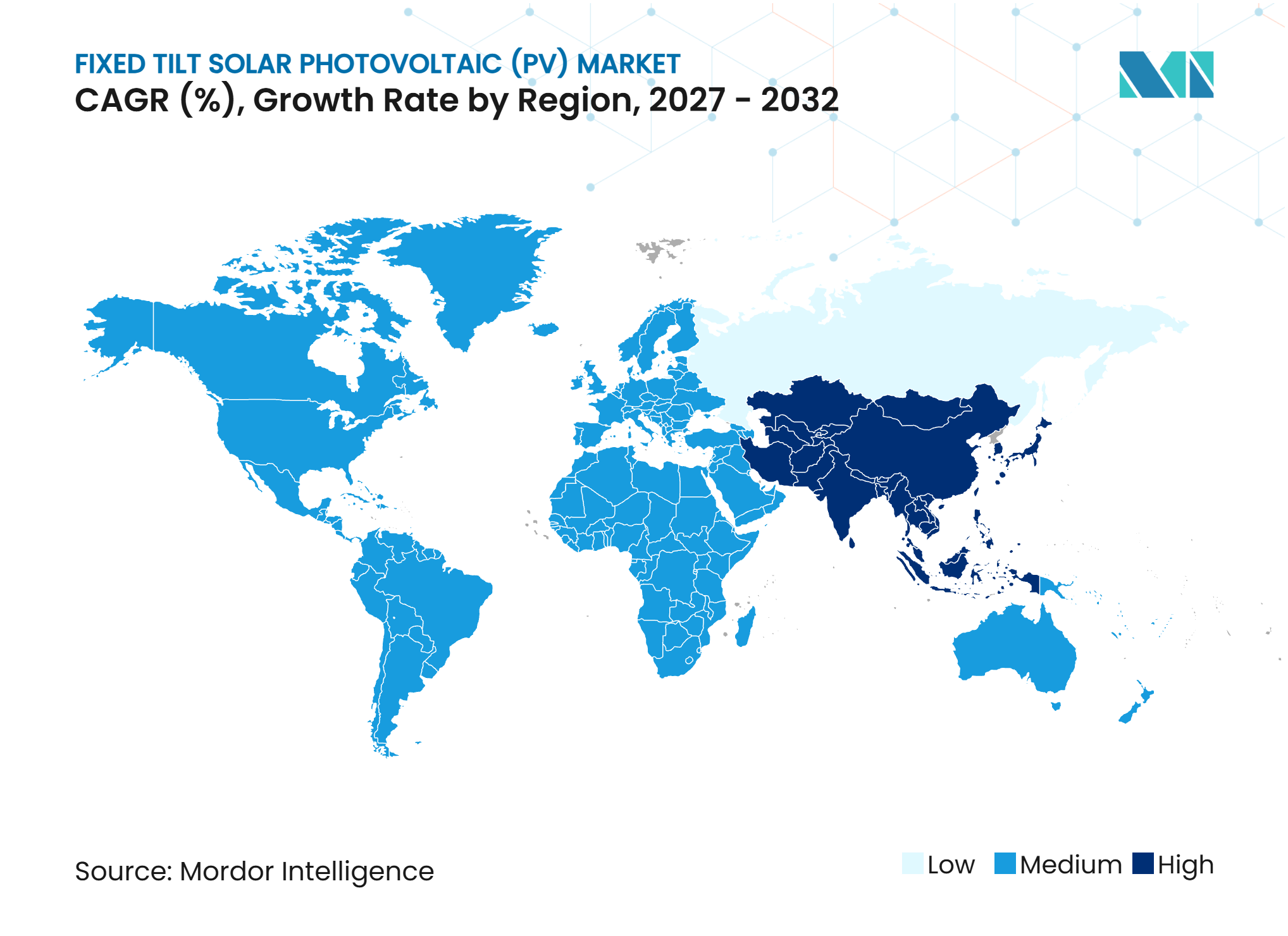
| Fastest Growing Market | Asia-Pacific |
| Largest Market | Asia-Pacific |
| Market Concentration | Low |
Major Players *Disclaimer: Major Players sorted in no particular order Image © Mordor Intelligence. Reuse requires attribution under CC BY 4.0. | |
Fixed Tilt Solar Photovoltaic (PV) Market Analysis by Mordor Intelligence
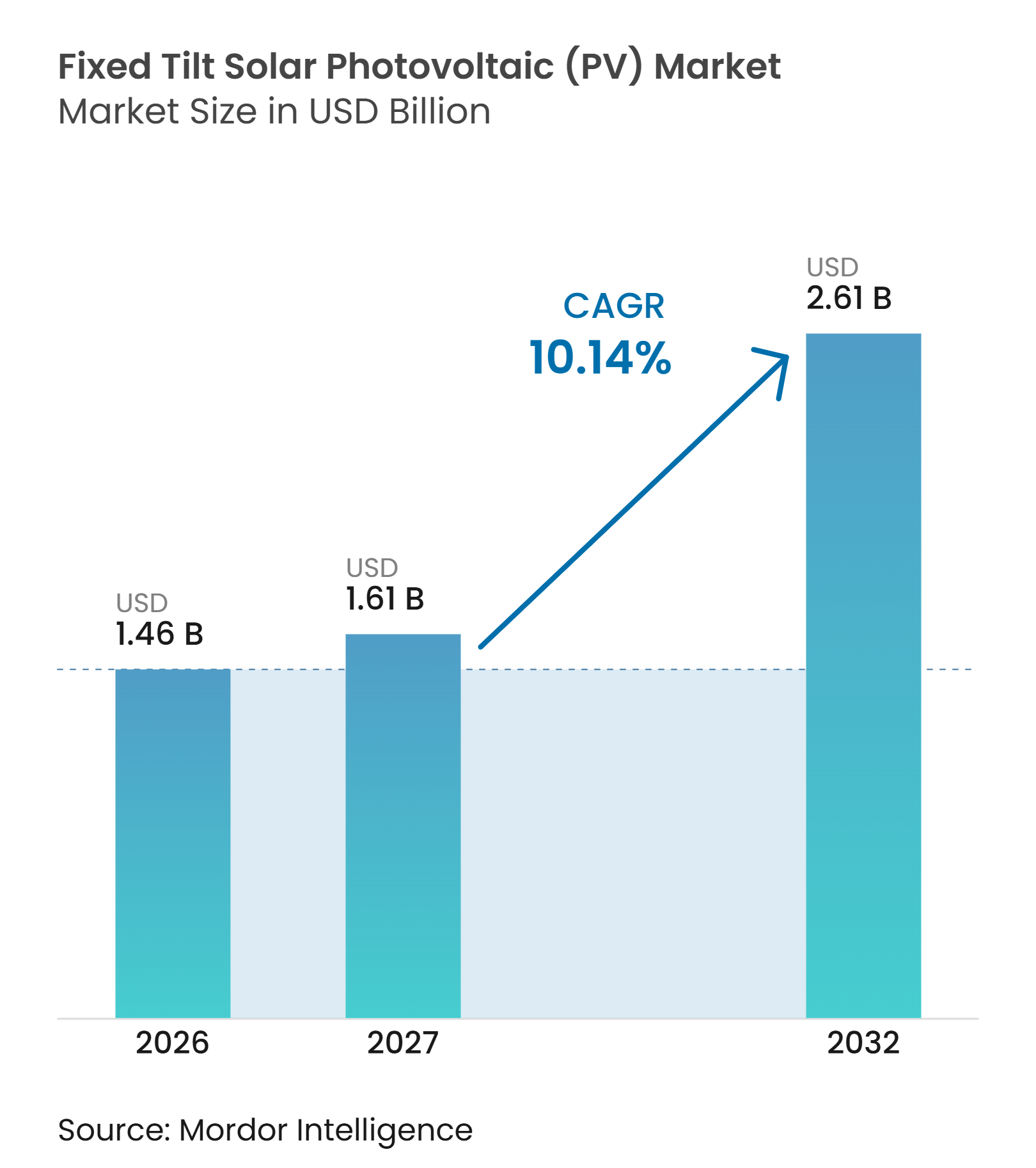
The global fixed tilt solar photovoltaic market size is projected to be USD 1.46 billion in 2026, USD 1.61 billion in 2027, and reach USD 2.61 billion by 2032, growing at a CAGR of 10.14% from 2027 to 2032. Global solar additions reached 510.3 GW in 2025, which supports a wider project base for fixed mounting systems.[1] The fixed tilt solar PV market benefits where lower equipment complexity, irregular terrain, wind exposure, or lower direct-normal irradiance reduce the value of tracking equipment. This position gives the fixed tilt solar PV market a practical role in varied site conditions. Distributed installations and commercial rooftops favor fixed structures because they generally require simple designs and predictable maintenance, while domestic-content rules favor manufacturers that can supply compliant local structures. The fixed tilt solar PV market can still face slower equipment procurement when grid delays and curtailment persist despite strong solar pipelines.
Key Report Takeaways
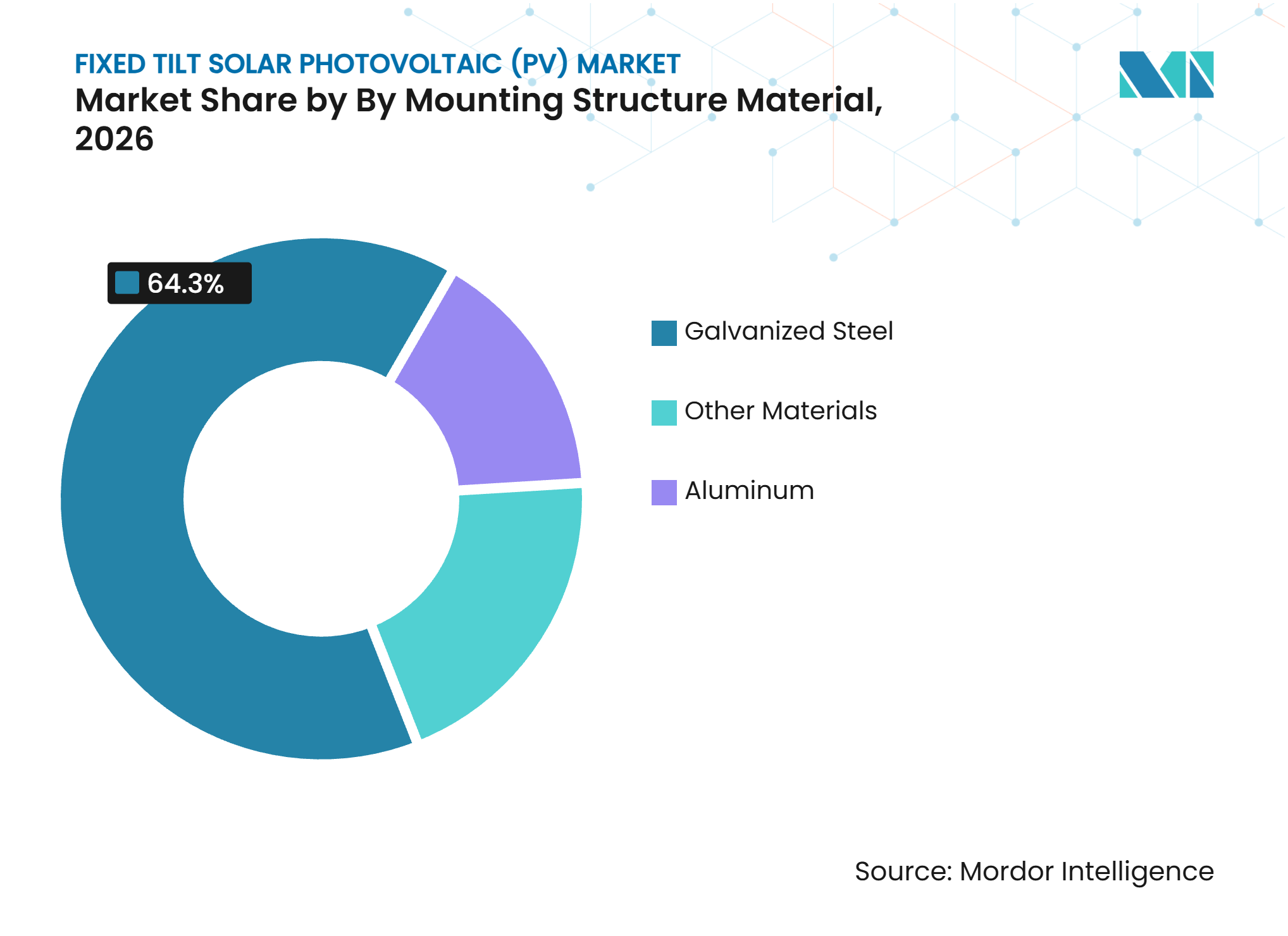
- By mounting structure material, galvanized steel held 64.3% of the fixed tilt solar PV market share in 2026, while aluminum is projected to grow at a 10.4% CAGR through 2032.
- By installation type, ground-mounted systems accounted for 66.5% of the fixed tilt solar PV market size in 2026, while floating systems are forecast to grow at an 11.2% CAGR through 2032.
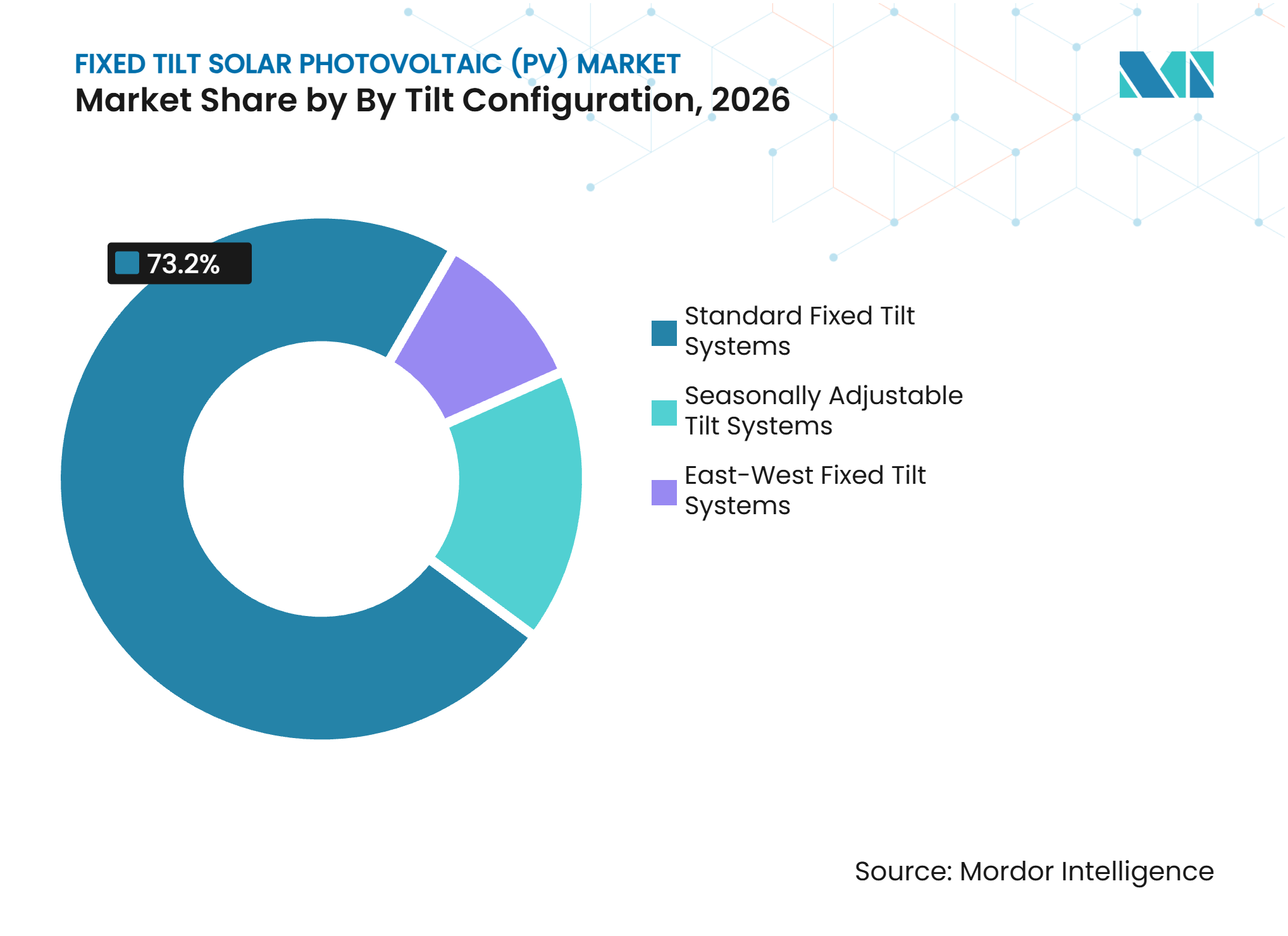
- By tilt configuration, standard fixed tilt held 73.2% share in 2026, while east-west fixed tilt is forecast to expand at a 10.7% CAGR through 2032.
- By end user, utility-scale power generation held 59.7% share in 2026, while commercial and industrial users are forecast to grow at a 10.9% CAGR through 2032.
- By geography, Asia-Pacific held 46.3% share in 2026 and is forecast to grow at a 10.6% CAGR through 2032.
Note: Market numbers in this report are based on Mordor Intelligence's proprietary estimation framework, which combines nine months of actuals with Q4 projections for base year 2026.
Market Trends and Insights
Drivers Impact Analysis of Fixed Tilt Solar Photovoltaic (PV) Market*
| Driver | (~) % Impact on CAGR Forecast | Geographic Relevance | Impact Timeline |
|---|---|---|---|
| Renewable-Energy Capacity Additions and Decarbonization Targets | +3.0% | Global, concentrated in Asia, EU, and MENA | Long term (≥ 4 years) |
| Lower Balance-of-System Cost and Simpler Operations Than Tracking Systems | +2.0% | Global, highest relevance in Asia-Pacific and South America | Medium term (2-4 years) |
| Expansion of Utility-Scale and Distributed Solar Deployment | +1.7% | Global, Asia-Pacific core, with spillover to Middle East, Africa, and South America | Long term (≥ 4 years) |
| Domestic-Content Incentives and Regional Manufacturing Build-Out | +1.4% | North America and Europe primarily | Short term (≤ 2 years) |
| Foundation-Light Designs for Uneven Terrain and Challenging Soils | +0.7% | South America, Southeast Asia, and Sub-Saharan Africa | Medium term (2-4 years) |
| Higher-Efficiency and Bifacial Module Compatibility | +0.8% | Global, led by Asia-Pacific and Europe | Long term (≥ 4 years) |
| Source: Mordor Intelligence | |||
Renewable-Energy Capacity Additions and Decarbonization Targets
Solar deployment remains the clearest demand driver for the fixed tilt solar PV market. Global solar capacity additions reached 647 GW in 2025, up 11% from the prior year, and cumulative installed solar capacity approached 2,900 GW[2]. The IEA projects 4,600 GW of renewable additions through 2030, with solar accounting for 80% of the expected total[3]. Distributed PV is expected to represent 42% of PV expansion through 2030, and these installations commonly use fixed structures IEA.ORG. Asia accounted for 74.2% of renewable capacity added in 2025, which enlarges demand in markets with varied terrain and cost-sensitive projects. This deployment pattern supports fixed mounting demand beyond the utility projects that receive most public attention. It also broadens the project base available to the fixed tilt solar PV market.
Lower Balance-of-System Cost and Simpler Operations Than Tracking Systems
Cost and operating simplicity keep fixed structures relevant in the fixed tilt solar PV market. SolarPower Europe reported that fixed tilt systems are used in 50% of European utility-scale projects and in virtually all rooftop installations.[4] Fixed systems can use smaller and less specialized installation crews, which matters when labor requirements raise project costs. They also avoid moving components that require monitoring and maintenance over a project’s operating life. GameChange Solar introduced its MaxSpan fixed tilt system in February 2025 and stated that the design can reduce post count by up to 70% per MW. Product changes of this type allow suppliers to improve construction economics without relying on tracking technology.
Expansion of Utility-Scale and Distributed Solar Deployment
The split between large utility projects and distributed projects creates several routes to demand for the fixed tilt solar PV market. The IEA expects distributed PV to contribute 42% of PV expansion through 2030, where fixed structures are the normal installation choice. Commercial and industrial systems increasingly focus on self-consumption rather than export revenue. That setting supports rooftop and east-west layouts that broaden generation across the day. In China, solar curtailment rose to 6.6% in the first half of 2025 from 3.9% in the first half of 2024, reducing the practical value of additional midday output in affected grid corridors. Agrivoltaic canopy systems are also gaining certification in Southern Europe and Southeast Asia, adding another application for fixed structures
Domestic-Content Incentives and Regional Manufacturing Build-Out
Domestic-content incentives are changing supplier decisions in the fixed tilt solar PV market. IRS guidance updated in January 2025 sets domestic-content requirements for racking rails and structural fasteners that support eligibility for a 10-percentage-point investment tax credit bonus. OMCO Solar opened a USD 10 million manufacturing plant in Alabama in March 2025 to serve this demand. The company then launched a 100% domestic portfolio in August 2025 across 5 facilities with 13 GW of annual capacity. SolarPower Europe has also called for mounting structures to receive coverage under the Net-Zero Industry Act. Manufacturers with compliant local supply can therefore compete on both availability and tax-credit eligibility.
Restraints Impact Analysis of Fixed Tilt Solar Photovoltaic (PV) Market*
| Restraint | (~) % Impact on CAGR Forecast | Geographic Relevance | Impact Timeline |
|---|---|---|---|
| Yield Disadvantage Versus Single-Axis Tracking in High-Irradiance Utility Sites | -1.6% | North America, Middle East, North Africa, and Australia | Long term (≥ 4 years) |
| Grid Interconnection Delays and Curtailment Risk | -1.3% | North America, China, India, and Brazil | Medium term (2-4 years) |
| Tariff, Trade-Remedy, and Steel-Input Volatility | -1.1% | North America primarily, with spillover to Europe and Asia-Pacific | Short term (≤ 2 years) |
| Site-Specific Geotechnical and Extreme-Weather Engineering Requirements | -0.7% | South America, Middle East, Africa, South Asia, and Southeast Asia | Medium term (2-4 years) |
| Source: Mordor Intelligence | |||
Yield Disadvantage Versus Single-Axis Tracking in High-Irradiance Utility Sites
Single-axis trackers can raise energy yield by 12% to 25% compared with fixed structures in high-direct-normal-irradiance locations. This difference can lower levelized cost of electricity at utility sites in the U.S. Southwest, Saudi Arabia, and inland Australia. It remains a clear limit on fixed-system adoption where land is available and power prices reward maximum annual output. East-west fixed layouts can still compete where midday grid supply is already saturated. aream Group reported that east-west configurations can deliver 15% to 25% higher self-consumption in settings where midday electricity has low or negative marginal value. This improves project economics even when annual generation is lower than a south-facing alternative.
Grid Interconnection Delays and Curtailment Risk
Grid access constraints limit how quickly solar projects reach construction and purchase mounting equipment. China’s solar curtailment rate was 6.6% in the first half of 2025, compared with 3.9% in the first half of 2024. Brazil reported solar curtailment of 20% in August 2025, compared with 12% in August 2024, as capacity outpaced transmission development. The IEA has identified grid congestion as a challenge for energy security and electricity transitions. Delays reduce procurement below what headline project pipelines imply. They can also encourage lower-capex fixed structures when developers face uncertain timing and constrained revenue.
*Our forecasts treat driver/restraint impacts as directional, not additive. The impact forecasts reflect baseline growth, mix effects, and variable interactions.
Fixed Tilt Solar Photovoltaic (PV) Market Segment Analysis
By Mounting Structure Material:
Aluminum Gains Ground Within a Steel-Led Supply BaseGalvanized steel held 64.3% share of mounting material demand in 2026. Its strength-to-cost balance supports utility-scale ground-mounted projects with longer structural spans and established supply chains. Aluminum is forecast to grow at a 10.4% CAGR through 2032, supported by rooftop and commercial applications that need lower-weight designs. Ernst Schweizer used an aluminum east-west system at a 35 MWp industrial rooftop project in Denmark that entered service in June 2025. The project demonstrates that aluminum systems can serve large commercial installations.
Aluminum also has relevance where lifecycle emissions affect procurement decisions. A 2025 scientific study found that aluminum made through low-carbon smelting can reduce carbon dioxide emissions by 75% compared with standard production. Steel tariffs in the United States increased the importance of domestic sourcing during 2025. OMCO Solar and GameChange Solar invested in U.S. supply arrangements that support domestic-content compliance. Composite, fiberglass, and glass-reinforced nylon materials remain limited in scale but can suit selected commercial rooftop locations because of their corrosion resistance. These material choices show how the fixed tilt solar PV industry serves both high-volume utility projects and site-specific rooftop needs.



By Installation Type:
Floating Systems Add Growth in Land-Constrained MarketsGround-mounted systems accounted for 66.5% of the fixed tilt solar PV market size by installation type in 2026. Large procurement programs in China, India, and the Middle East underpin this position. Rooftop systems rank second, while building-integrated photovoltaics remain smaller because installation is more complex and costs are higher. Floating fixed tilt systems are forecast to grow at an 11.2% CAGR through 2032. Nearly 90% of global floating PV capacity is located in Asia, and China accounts for 50% of the total.
Floating projects respond to land constraints but also require designs that manage water conditions and wind exposure. Q Energy commissioned Europe’s largest floating PV plant in the Netherlands in June 2025. The project used shallow tilt angles between 5° and 12° to balance energy density, wind resistance, and float stability. IEC work on floating PV floats and mooring systems could reduce engineering uncertainty after formal standards are completed. Lower engineering risk could improve access to project finance as floating systems turn constrained water bodies into usable sites.
By Tilt Configuration:
East-West Layouts Fit Commercial Rooftop DemandStandard fixed tilt held 73.2% of the tilt-configuration segment in 2026. Its position rests on established engineering practice, while seasonally adjustable systems retain a small share in high-latitude locations where manual changes can improve seasonal output. East-west fixed tilt is projected to grow at a 10.7% CAGR through 2032. The layout supports rooftop users who prioritize on-site electricity use across morning and afternoon periods. A 2025 Korean study of 9 factory rooftops found that east-west bifacial systems achieved strong performance ratios and spread generation through the day.
East-west racking can increase installed capacity on the same flat roof by reducing inter-row spacing. Its output profile can also reduce exposure to midday oversupply. A 2025 scientific study found that bifacial gains can partly offset the 3% to 5% annual yield discount associated with east-west orientations. Domestic aluminum structures can also meet U.S. domestic-content rules for eligible projects. These features make the configuration important to commercial users, where the fixed tilt solar PV industry is shaped by load timing and roof geometry as much as annual energy production.

By End User:
Commercial and Industrial Demand Broadens the Customer BaseUtility-scale power generation held 59.7% of the fixed tilt solar PV market share by end user in 2026. China, India, Saudi Arabia, and the United States support this demand through large procurement programs. Fixed structures are selected where tracking gains do not justify added capital cost. Commercial and industrial users are projected to grow at a 10.9% CAGR through 2032 as rising electricity prices, net-metering reforms, and high self-consumption encourage on-site installations. GameChange Solar launched a distributed-generation division in January 2026 to serve commercial, industrial, and community solar customers.
Utility projects generate volume but place strong pressure on racking prices. They also expose suppliers to steel cost changes and budget constraints. Residential systems remain smaller within this product area because they rely on simpler roof-mount structures. Agricultural applications support combined crop and energy production, while carports, bus shelters, and government facilities are emerging in Sub-Saharan Africa and Southeast Asia. The fixed tilt solar PV market therefore draws demand from centralized projects as well as many smaller on-site uses. This range of customers supports the fixed tilt solar PV market across multiple installation settings.
Geography Analysis
Asia-Pacific held 46.3% of the fixed tilt solar PV market size in 2026 and is forecast to grow at a 10.6% CAGR through 2032. China accounted for 62% of global solar capacity additions in 2025 and added 314 GW. The country’s curtailment rate increased to 6.6% in the first half of 2025 from 3.9% a year earlier, which can favor lower-capex fixed systems in oversupplied grid areas. India’s evacuation constraints and Japan’s floating PV activity add to the regional opportunity. Indonesia, Malaysia, Thailand, and the Philippines are also developing as the next layer of demand through industrial electrification goals.
Europe is the second-largest regional setting for the fixed tilt solar PV market. Germany, Spain, and Italy lead utility-scale and commercial deployment, where fixed tilt systems are used in 50% of utility-scale projects and in virtually all rooftop installations. Spain and Germany host 60% of the European Union’s mounting providers. The Netherlands experienced a fivefold increase in solar capacity from 2018 to 2023, favoring east-west layouts that reduce peak grid injection by spreading output through the day.
North America is a key area for the fixed tilt solar PV market and is most affected by U.S. trade policy and domestic-content requirements. The United States installed 18 GW of solar in the first half of 2025, and solar represented 56% of new generating capacity. Fixed structures retain demand in commercial, community solar, and distributed commercial and industrial uses, while Brazil’s expanding pipeline is offset by curtailment and procurement delays. GameChange Solar established a factory in Bahia and a São Paulo office in October 2025, showing continued supplier interest in Brazil. IRENA reported renewable capacity growth of 28.9% in the Middle East and 15.9% in Africa during 2025, where commercial and off-grid projects favor structures with simple maintenance requirements
Competitive Landscape
Market Concentration
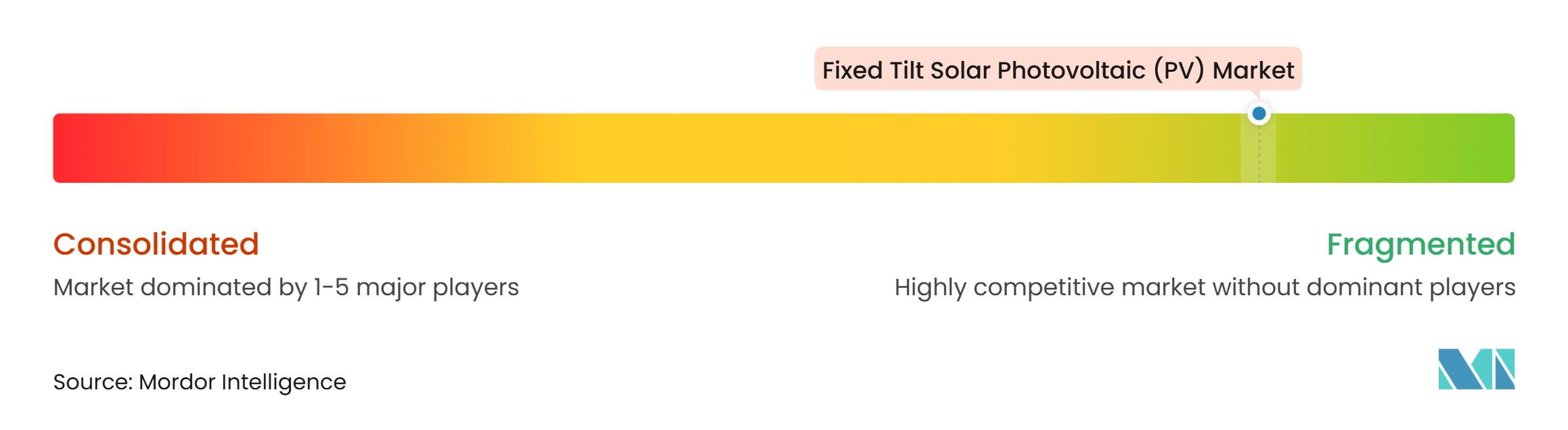
The fixed tilt solar PV market is fragmented. Dedicated mounting specialists compete with tracker manufacturers and residential racking companies, including GameChange Solar, OMCO Solar, PV Hardware, Schletter Group, K2 Systems, Solar FlexRack, Unirac, and Clenergy. Competition centers on product engineering, local manufacturing, project design support, and procurement compliance. Large suppliers seek customer relationships and manufacturing capacity through consolidation while preserving several specialized competitors.
Unirac acquired Terrasmart’s solar-racking business from Gibraltar Industries in July 2026, extending from residential and flat-roof products into commercial and industrial ground-mount and canopy applications. Pegasus Solar acquired Aerocompact’s North American division in January 2026, while Enstall acquired Schletter Group in January 2025, broadening capabilities across commercial flat-roof, ground-mount, fixed tilt, and tracker lines. These moves give buyers more options from manufacturers that can support several project formats. They also bring established design, manufacturing, and customer-support capabilities into broader portfolios. This can shorten the time needed to enter adjacent fixed-structure categories.
Supply-chain compliance is a central competitive factor in the fixed tilt solar PV market, and OMCO Solar’s domestic portfolio is positioned for projects that seek domestic-content eligibility. GameChange Solar’s MaxSpan system focuses on reducing foundations and installation work on difficult sites. Clenergy formed a distribution partnership with Krannich Solar Spain in August 2025, expanding access to Spanish and Portuguese customers. Opportunities remain in agrivoltaic structures, floating installations in Sub-Saharan Africa, and east-west systems for logistics and industrial roofs in Asia, where no supplier is identified as dominant.
Fixed Tilt Solar Photovoltaic (PV) Industry Leaders
-
Schletter Group
-
K2 Systems GmbH
-
UNIRAC, Inc.
-
GameChange Solar
-
OMCO Solar
- *Disclaimer: Major Players sorted in no particular order
Fixed Tilt Solar Photovoltaic (PV) Market Companies Covered in this Report
- Arctech Solar Holding Co., Ltd.
- Canadian Solar Inc.
- First Solar, Inc.
- GameChange Solar
- Hanwha Solutions Corporation (Qcells)
- JA Solar Technology Co., Ltd.
- JinkoSolar Holding Co., Ltd.
- K2 Systems GmbH
- Larsen & Toubro Limited
- LONGi Green Energy Technology Co., Ltd.
- OMCO Solar
- Power Construction Corporation of China, Ltd.
- PV Hardware (PVH)
- Risen Energy Co., Ltd.
- Schletter Group
- Solar FlexRack
- Sterling and Wilson Renewable Energy Limited
- Trina Solar Co., Ltd.
- UNIRAC, Inc.
- Waaree Energies Limited
Recent Industry Developments in Fixed Tilt Solar Photovoltaic (PV) Market
- July 2026: Unirac acquires Terrasmart's solar racking business from Gibraltar Industries. The transaction extends Unirac's residential and flat-roof platform into C&I ground-mount and canopy segments, creating a comprehensive full-suite fixed tilt offering across US market verticals.
- January 2026: GameChange Solar launches a dedicated Distributed Generation Solar Division to advance commercial, industrial, and community solar solutions, signaling a strategic pivot to address fast-growing C&I and community solar end-user segments with fixed tilt racking.
- January 2026: Pegasus Solar acquires the North American division of Aerocompact, gaining exclusive license to manufacture and sell Aerocompact's commercial flat-roof and ground-mount product line in North America, accelerating entry into the C&I fixed tilt market following its FX flat-roof racking launch at RE+ 2025.
- August 2025: OMCO Solar launches 100% domestic fixed tilt and tracker solution portfolio across 5 US manufacturing facilities with 13 GW annual capacity, enabling full IRA domestic content safe-harbor qualification and eliminating tariff exposure.
Global Fixed Tilt Solar Photovoltaic (PV) Market Report Scope
The Global Fixed Tilt Solar Photovoltaic (PV) Market comprises the market for solar photovoltaic mounting structures and installation systems designed to hold solar panels at a predetermined inclination and orientation to capture solar radiation and convert it into electricity. Fixed tilt PV systems use stationary mounting arrangements without continuous or automated tracking of the sun, providing a comparatively simple and cost-effective solution for solar power generation across ground-mounted, rooftop, building-integrated, and floating installations. These systems incorporate mounting structures manufactured from materials such as galvanized steel, aluminum, and other materials, along with configurations designed to accommodate different site conditions, installation requirements, and solar generation objectives. The market includes standard fixed tilt systems, seasonally adjustable tilt systems, and east-west fixed tilt configurations deployed across utility-scale power generation, commercial and industrial facilities, residential buildings, agricultural applications, and public infrastructure. Fixed tilt solar PV systems support renewable electricity generation, reduce dependence on conventional energy sources, and enable solar installations across diverse geographical and climatic conditions.
The Global Fixed Tilt Solar Photovoltaic (PV) Market is segmented by Mounting Structure Material (Galvanized Steel, Aluminum, and Other Materials); By Installation Type (Ground-Mounted Fixed Tilt Systems, Rooftop Fixed Tilt Systems, Building-Integrated Photovoltaic (BIPV) Systems, and Floating Fixed Tilt Solar PV Systems); By Tilt Configuration (Standard Fixed Tilt Systems, Seasonally Adjustable Tilt Systems, and East-West Fixed Tilt Systems); and By End User (Utility-Scale Power Generation, Commercial and Industrial, Residential, Agricultural, and Public Infrastructure, and Other Applications). The market is also segmented geographically across 26 countries across key regions. For each segment, market sizing and forecasts are provided on the basis of value (USD).
Segmentation Overview
| Galvanized Steel |
| Aluminum |
| Other Materials |
| Ground-Mounted Fixed Tilt Systems |
| Rooftop Fixed Tilt Systems |
| Building-Integrated Photovoltaic (BIPV) Systems |
| Floating Fixed Tilt Solar PV Systems |
| Standard Fixed Tilt Systems |
| Seasonally Adjustable Tilt Systems |
| East-West Fixed Tilt Systems |
| Utility-Scale Power Generation |
| Commercial and Industrial |
| Residential |
| Agricultural |
| Public Infrastructure and Other Applications |
| North America | United States |
| Canada | |
| Mexico | |
| Europe | Germany |
| France | |
| Italy | |
| Spain | |
| United Kingdom | |
| Poland | |
| Netherlands | |
| Russia | |
| Rest of Europe | |
| Asia-Pacific | China |
| India | |
| Japan | |
| South Korea | |
| Australia | |
| Indonesia | |
| Malaysia | |
| Thailand | |
| Philippines | |
| Rest of Asia-Pacific | |
| South America | Brazil |
| Argentina | |
| Colombia | |
| Rest of South America | |
| Middle East and Africa | Saudi Arabia |
| United Arab Emirates | |
| South Africa | |
| Kenya | |
| Egypt | |
| Nigeria | |
| Rest of Middle East and Africa |
| By Mounting Structure Material | Galvanized Steel | |
| Aluminum | ||
| Other Materials | ||
| By Installation Type | Ground-Mounted Fixed Tilt Systems | |
| Rooftop Fixed Tilt Systems | ||
| Building-Integrated Photovoltaic (BIPV) Systems | ||
| Floating Fixed Tilt Solar PV Systems | ||
| By Tilt Configuration | Standard Fixed Tilt Systems | |
| Seasonally Adjustable Tilt Systems | ||
| East-West Fixed Tilt Systems | ||
| By End User | Utility-Scale Power Generation | |
| Commercial and Industrial | ||
| Residential | ||
| Agricultural | ||
| Public Infrastructure and Other Applications | ||
| By Geography | North America | United States |
| Canada | ||
| Mexico | ||
| Europe | Germany | |
| France | ||
| Italy | ||
| Spain | ||
| United Kingdom | ||
| Poland | ||
| Netherlands | ||
| Russia | ||
| Rest of Europe | ||
| Asia-Pacific | China | |
| India | ||
| Japan | ||
| South Korea | ||
| Australia | ||
| Indonesia | ||
| Malaysia | ||
| Thailand | ||
| Philippines | ||
| Rest of Asia-Pacific | ||
| South America | Brazil | |
| Argentina | ||
| Colombia | ||
| Rest of South America | ||
| Middle East and Africa | Saudi Arabia | |
| United Arab Emirates | ||
| South Africa | ||
| Kenya | ||
| Egypt | ||
| Nigeria | ||
| Rest of Middle East and Africa | ||
Key Questions Answered in the Report
What is the value outlook for fixed tilt solar PV?
The Fixed Tilt Solar Photovoltaic Market size is projected to be USD 1.46 billion in 2026, USD 1.61 billion in 2027, and reach USD 2.61 billion by 2032, growing at a CAGR of 10.14% from 2027 to 2032.
Why do developers choose fixed tilt solar PV systems?
Developers use them for simpler operations, lower equipment complexity, and their suitability for rooftops, uneven terrain, and projects where tracking output gains are limited.
Which mounting material leads demand?
Galvanized steel leads the mounting structure material segment with a 64.3% share in 2026, while aluminum is the fastest-growing material at a 10.4% CAGR through 2032.
Which type of installation is growing fastest?
Floating systems are projected to grow at an 11.2% CAGR through 2032, supported by land constraints and Asia’s leadership in floating PV capacity.
What region leads fixed tilt solar PV demand?
Asia-Pacific leads with a 46.3% share in 2026 and is forecast to grow at a 10.6% CAGR through 2032.
How do domestic-content rules affect suppliers?
U.S. domestic-content requirements can improve tax-credit eligibility, which favors manufacturers that can supply compliant racking rails and structural fasteners locally.