
Fireproof Insulation Market Size and Share
Market Overview
| Study Period | 2022 - 2032 |
|---|---|
| Market Size (2027) | USD 30.34 Billion |
| Market Size (2032) | USD 37.08 Billion |
| Growth Rate (2027 - 2032) | 4.09 % |
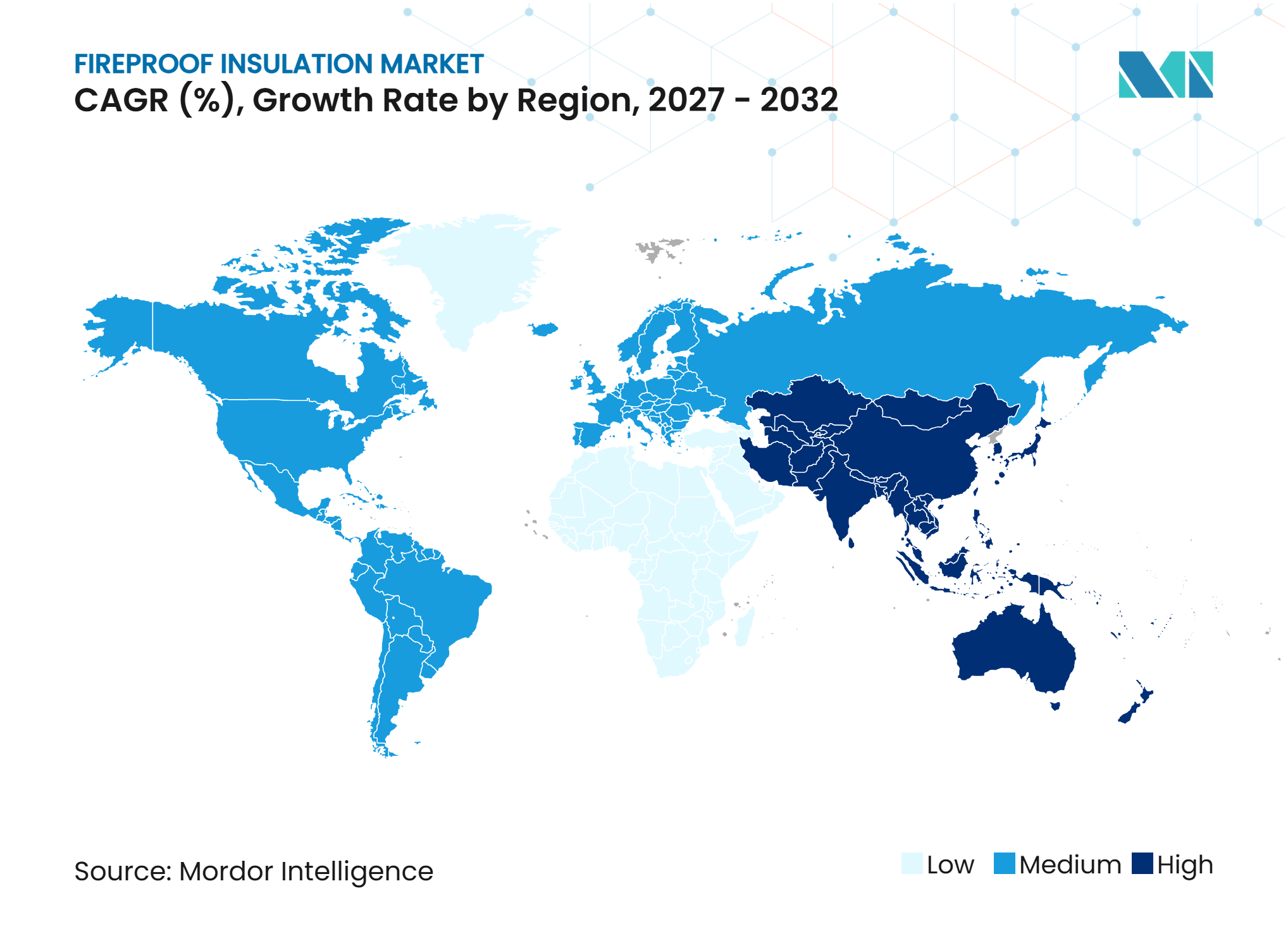
| Fastest Growing Market | Asia-Pacific |
| Largest Market | Asia-Pacific |
| Market Concentration | Medium |
Major Players *Disclaimer: Major Players sorted in no particular order Image © Mordor Intelligence. Reuse requires attribution under CC BY 4.0. | |
Fireproof Insulation Market Analysis by Mordor Intelligence
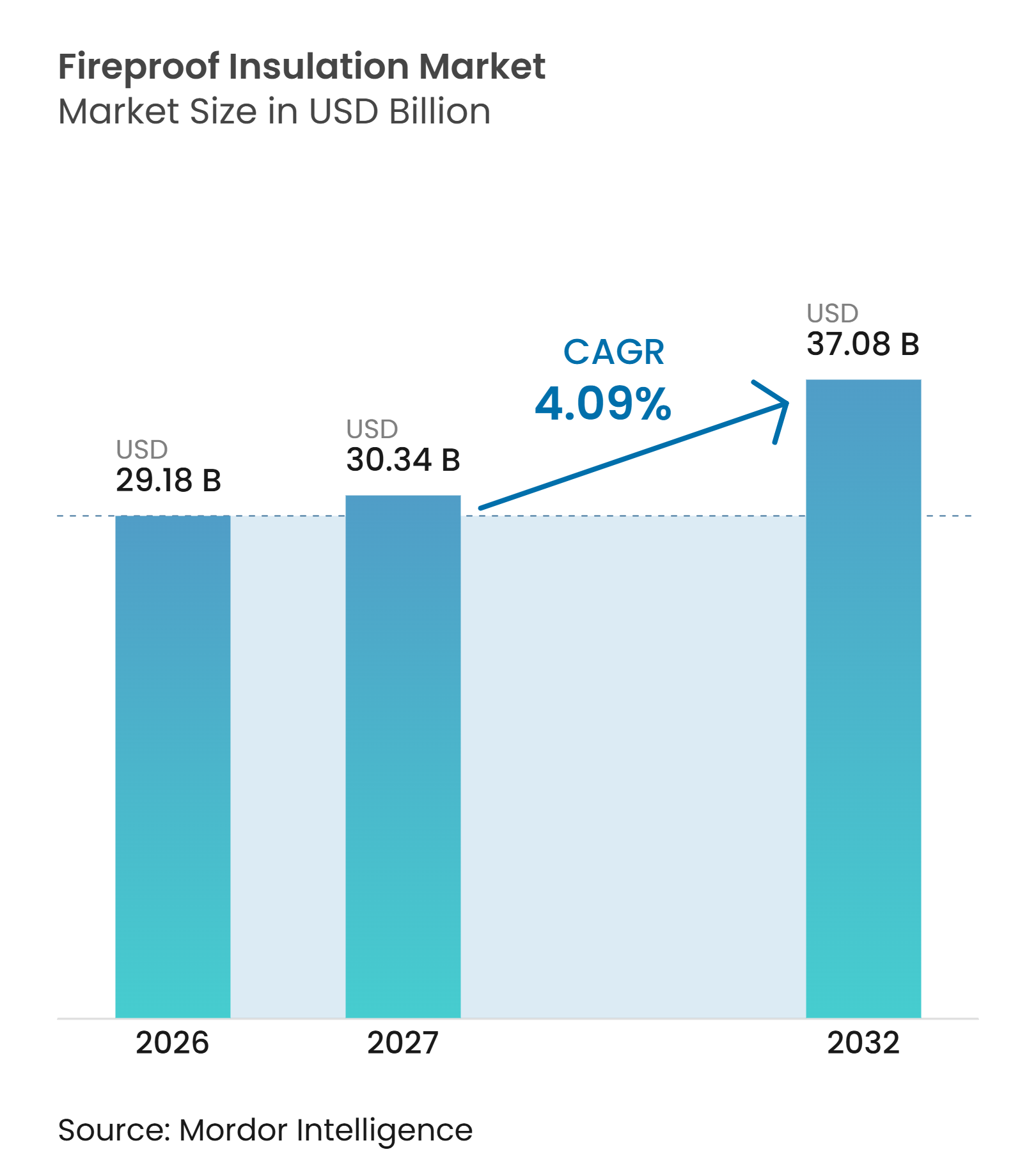
The Fireproof Insulation Market size was valued at USD 29.18 billion in 2026 and is estimated to grow from USD 30.34 billion in 2027 to USD 37.08 billion by 2032, at a CAGR of 4.09% during the forecast period (2027-2032). The fireproof insulation market is supported by stricter passive fire protection regulations in major construction markets. Regulation EU 2024/3110 entered into force in January 2025, while China published GB46520-2025 in October 2025, with enforcement starting in August 2026. These changes increase the importance of tested, noncombustible insulation and documented product performance. The market also benefits from energy renovation requirements, high-rise construction activity, data center development, and LNG infrastructure expansion. Cost volatility and a shortage of qualified installers can slow the conversion of regulatory requirements into installed capacity.
Key Report Takeaways
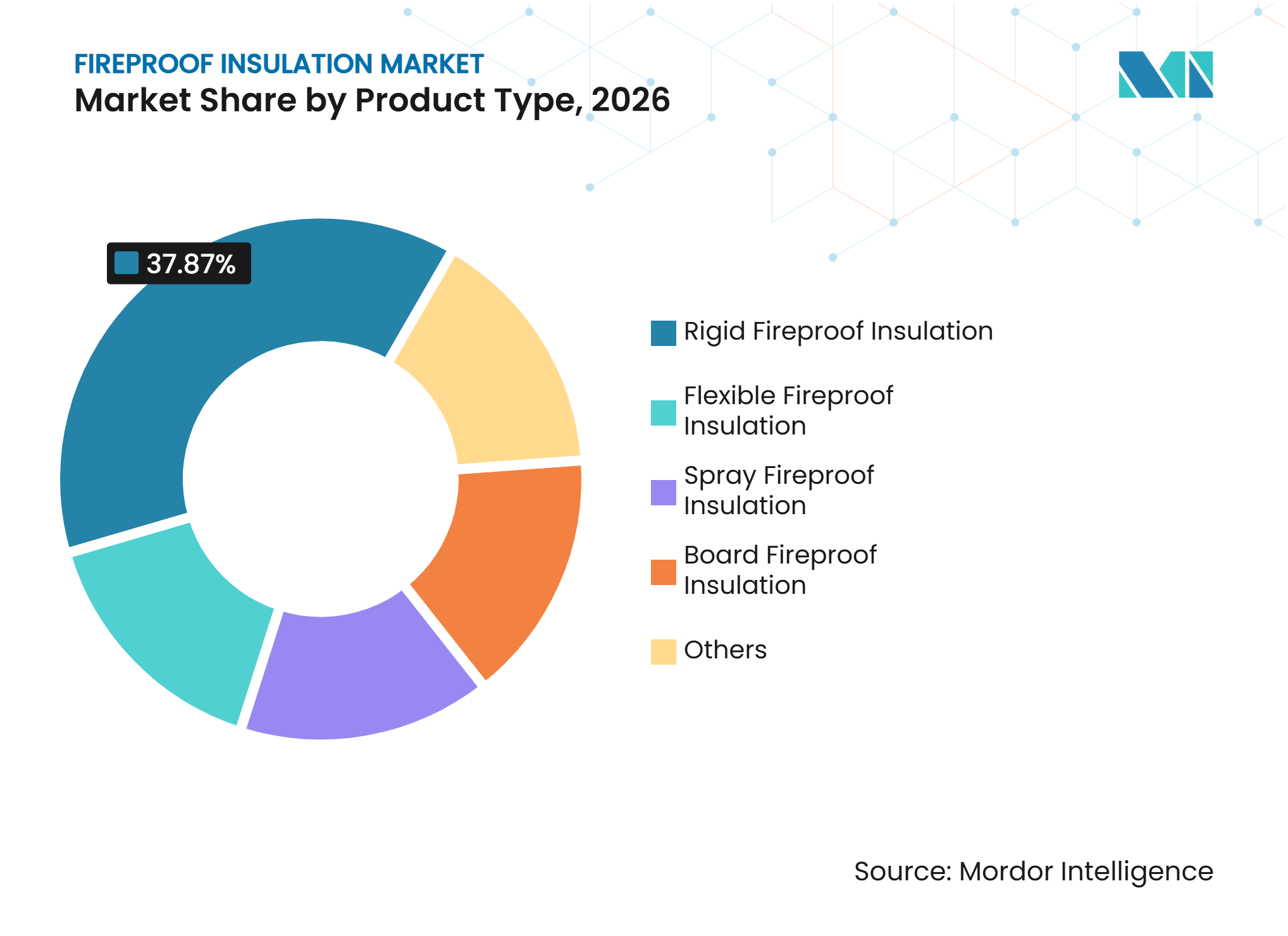
- By product type, rigid fireproof insulation held 37.87% of the Fireproof Insulation Market share in 2026 and is forecast to expand at a 5.45% CAGR through 2032.
- By material, mineral wool held 32.45% of the Fireproof Insulation Market share in 2026, while polyurethane foam is forecast to expand at a CAGR of 5.67% through 2032.
- By application, walls and facades accounted for 31.78% of the Fireproof Insulation Market size in 2026, while pipes, ducts, and vessels are forecast to expand at a 5.89% CAGR through 2032.
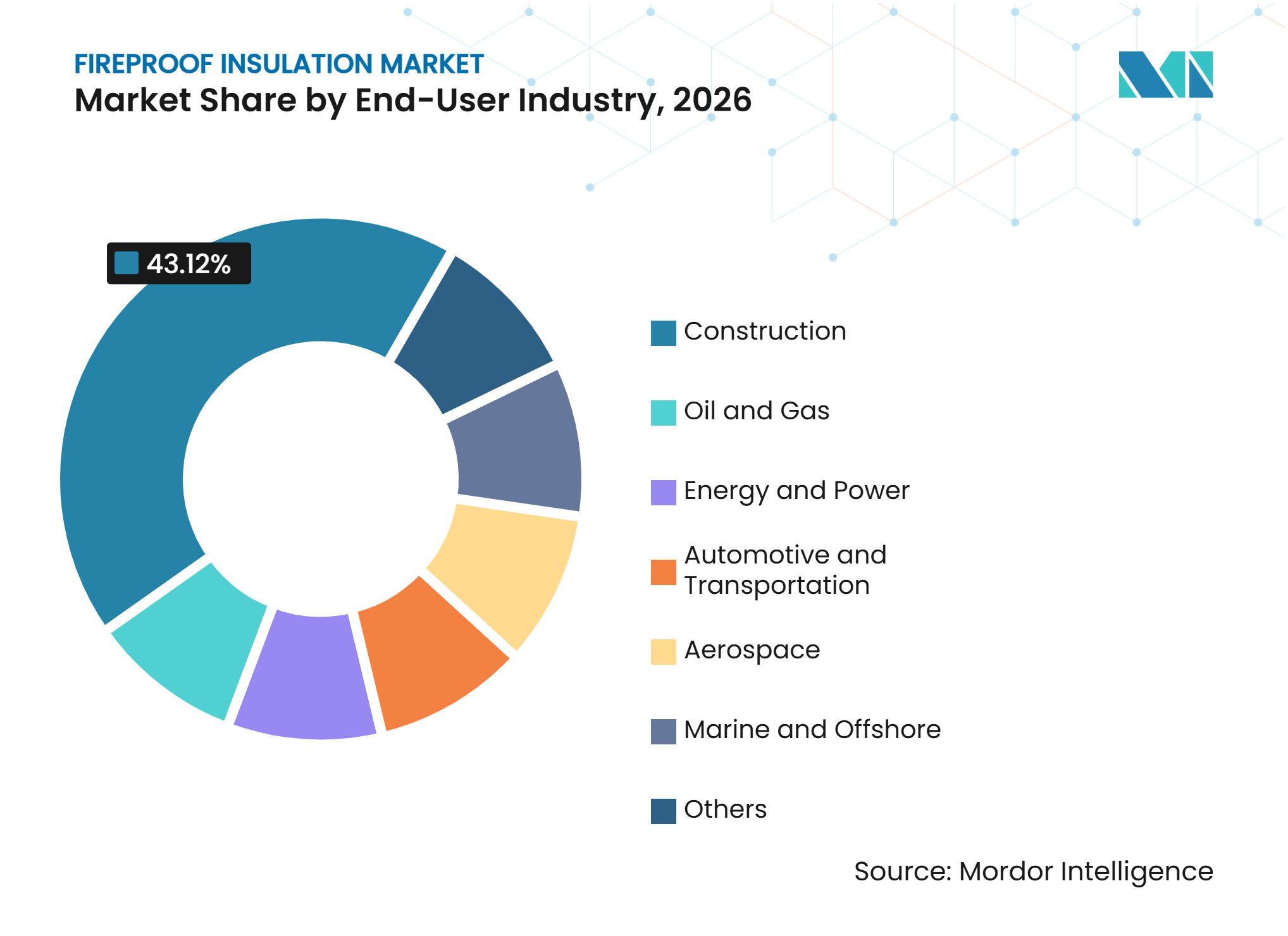
- By end-user industry, construction held 43.12% of the Fireproof Insulation Market share in 2026, while oil and gas is forecast to expand at a CAGR of 6.93% through 2032.
- By geography, Asia-Pacific held 38.54% of the Fireproof Insulation Market share in 2026 and is forecast to expand at a 6.38% CAGR through 2032.
Note: Market numbers in this report are based on Mordor Intelligence's proprietary estimation framework, which combines nine months of actuals with Q4 projections for base year 2026.
Market Trends and Insights
Drivers Impact Analysis of Fireproof Insulation Market*
| Drivers | (~) % Impact on CAGR Forecast | Geographic Relevance | Impact Timeline |
|---|---|---|---|
| Stricter Fire-Safety Codes and Enforcement | +1.2% | Global, with near-term emphasis in China, the European Union, and North America | Short term (≤ 2 years) |
| Energy-Efficiency and Green-Building Compliance | +0.9% | European Union-led, with spillover to North America and core Asia-Pacific markets | Medium term (2-4 years) |
| High-Rise, Dense-Urban, and Infrastructure Construction | +0.7% | Asia-Pacific, with spillover to Saudi Arabia and the United Arab Emirates | Medium term (2-4 years) |
| Industrial, Data-Center, and Electrification Asset Protection | +0.8% | Global, concentrated in North America, Asia-Pacific, and the Middle East | Short term (≤ 2 years) |
| Assembly-Level Certification and Digital Compliance Libraries | +0.3% | European Union, United Kingdom, and North America | Long term (≥ 4 years) |
| Source: Mordor Intelligence | |||
Stricter Fire-Safety Codes and Enforcement
China, the European Union, and North America are tightening fire safety requirements, creating stronger near-term demand for compliant products in the fireproof insulation market. China published GB46520-2025 on October 5, 2025, with the standard taking effect on August 1, 2026. The standard sets combustion performance requirements for organic, inorganic, and composite insulation materials and requires product marking with the combustion performance class and producer identity. The recast Construction Products Regulation entered into force on January 7, 2025, linking fire class declarations with a broader product information framework. This framework increases the value of products that already have tested system documentation. The fireproof insulation market therefore favors established suppliers that can update technical files and certificates as requirements change.
Energy-Efficiency and Green-Building Compliance
Energy renovation rules are increasing demand for insulation systems that satisfy both thermal and fire requirements. The European Commission issued its Energy Performance of Buildings Directive (EPBD) implementation package on June 30, 2025, outlining the path for Member States to bring the directive into national law by May 2026. The directive requires Member States to renovate the worst-performing 16% of non-residential buildings by 2030 and 26% by 2033. Renovation may require replacing existing combustible assemblies with compliant materials during thermal upgrades. In the United States, the July 2025 adoption of the 2021 IECC for HUD- and USDA-financed new housing broadens the base for energy-efficient insulation specifications. These policies support the fireproof insulation market by requiring higher thermal standards without weakening fire performance.
High-Rise, Dense-Urban, and Infrastructure Construction
Dense urban construction is placing greater attention on façade fire performance and compartmentation. In February 2025, China began a nationwide, whole-chain fire hazard remediation campaign for building insulation in densely occupied premises. The program directs authorities to identify and address unsafe insulation materials in existing buildings. Under its January 2025 notice, Jilin Province required A-grade noncombustible materials in hospitals, schools, and high-occupancy residential buildings above 100 meters. This enforcement approach is creating replacement demand for mineral wool and calcium silicate products in the fireproof insulation market.
Industrial, Data-Center, and Electrification Asset Protection
Industrial projects require insulation that protects pipework, ducts, vessels, and structural components under demanding conditions. LNG terminals, offshore platforms, and data center chilled-water systems all require tested fire-rated mechanical insulation. ROCKWOOL identifies fire safety and thermal management as central requirements for LNG insulation applications[1]. Kingspan identifies data centers and EV battery factories as high-value uses for the fire-rated mineral fiber panels produced at its Mattoon facility. NORSOK and SOLAS requirements also shape product specifications for offshore and marine facilities. These end uses give the fireproof insulation market demand sources beyond conventional building construction.
Restraints Impact Analysis of Fireproof Insulation Market*
| Restraints | (~) % Impact on CAGR Forecast | Geographic Relevance | Impact Timeline |
|---|---|---|---|
| High Material, Testing, and Installation Cost | -0.9% | Global, with the strongest effect in emerging markets and residential construction | Medium term (2-4 years) |
| Volatile Mineral, Chemical, and Energy Inputs | -0.6% | Global, with elevated exposure among European and Asian producers | Short term (≤ 2 years) |
| Scarcity of Certified Applicators and Fire-Test Engineers | -0.4% | Emerging Asia-Pacific markets, the Middle East and Africa, and Latin America | Long term (≥ 4 years) |
| Source: Mordor Intelligence | |||
High Material, Testing, and Installation Cost
Full-system fire testing and certified installation add to the overall cost of fireproof assemblies. This cost burden is significant in price-sensitive building markets, where buyers often prioritize initial material price. European regulations require reliable declarations for products making fire-performance claims, which creates a clear advantage for documented systems but can delay adoption where enforcement is weak. The fireproof insulation market is especially affected in parts of India, Southeast Asia, and sub-Saharan Africa, where verified A-class materials can cost more than unverified alternatives. While insurance requirements can encourage broader adoption of passive fire protection documentation, smaller property owners tend to adopt these requirements more slowly.
Volatile Mineral, Chemical, and Energy Inputs
Mineral wool and glass fiber production relies on energy-intensive processes, exposing producers to energy price fluctuations. ROCKWOOL reported a EUR 473 million investment program for 2025, which includes efforts to electrify production lines. The company also reported that a production incident at Flums, Switzerland, and a factory closure in China contributed to a 2.10% compression in the Earnings Before Interest, Taxes, Depreciation, and Amortization (EBITDA) margin in 2025. Polyurethane foam producers face similar exposure, as blowing-agent costs can move with oil prices. These cost pressures can reduce margins even when demand remains strong. As a result, the fireproof insulation market benefits from suppliers with broader manufacturing networks and effective input-cost management.
*Our forecasts treat driver/restraint impacts as directional, not additive. The impact forecasts reflect baseline growth, mix effects, and variable interactions.
Fireproof Insulation Market Segment Analysis
By Product Type:
Rigid Formats Lead Across Commercial ApplicationsRigid fireproof insulation held 37.87% of the fireproof insulation market share by product type in 2026 and is forecast to expand at a 5.45% CAGR through 2032. The format is widely used in wall cavities, roofs, and industrial equipment enclosures due to its dimensional stability and compressive strength. Its structure allows a single layer to meet both thermal and fire-rating requirements, which is useful in façades and industrial sites where available space is limited. Rigid systems also benefit from the growing preference for assemblies tested as complete units. The market continues to favor products with published data for the exact installation configuration.
Flexible fireproof insulation is suited to pipes, ducts, and complex equipment shapes that boards cannot cover easily. It is increasingly used in mechanical retrofits and industrial projects. Spray fireproof insulation remains relevant for structural steel in data centers and warehouses because it conforms to irregular surfaces. Isolatek introduced FireSolve SB in January 2025, a solvent-based intumescent product with ultra-low volatile organic compound (VOC) content and up to four-hour ASTM E119 ratings. Board products serve partitions and compartmentation, where pre-tested board-and-stud assemblies simplify specification. Digital compliance records under the European framework further favor rigid and board formats that include complete test documentation.



By Material:
Mineral Wool Dominates While Polyurethane Foam Leads GrowthMineral wool held 32.45% of the fireproof insulation market share in 2026. It combines noncombustible performance with thermal efficiency, which aligns with A1 Euroclass expectations and energy renovation requirements. This makes it particularly relevant for European projects that must improve energy performance without reducing fire protection. Knauf opened a EUR 140 million glass mineral wool plant in Romania in January 2025 with an annual capacity of 75,000 tons. It also announced a EUR 200 million rock mineral wool plant in North Wales in May 2025, with a capacity of over 100,000 tons per year. The company opened a 30,000-ton mineral wool plant in Tashkent in July 2025.
Fiberglass maintains demand in residential and light commercial construction due to its cost-performance balance. Calcium silicate is used in high-temperature petrochemical and power equipment where organic foams are unsuitable. Polyurethane foam is the fastest-growing material, with the market projected to expand at a 5.67% CAGR through 2032. Fire-rated polyisocyanurate (PIR) formulations support thinner assemblies in roofing, cold storage, data centers, and retrofit applications. BASF introduced its Autofroth system in February 2026, reporting 30% lower smoke toxicity than brominated baselines and up to 20% lower embodied carbon. Product development is focused on fire behavior, thermal performance, and lower environmental impact simultaneously.
By Application:
Wall Systems Lead While Pipe and Duct Demand AcceleratesWalls and façades accounted for 31.78% of the fireproof insulation market size in 2026. High-rise residential and commercial construction support this position, as do regulations that restrict combustible exterior cladding. The segment also reflects the increasing complexity of interfaces between façade systems and structural elements. Etex, Remagin, Promat, and Siniat launched a third-party tested solution for connecting steel infill walls to fire-protected steelwork in May 2025. Such systems reduce uncertainty at the steel-to-cladding interface. The market has an opportunity to grow where suppliers can offer complete, documented wall solutions.
Roofs and ceilings benefit from energy renovation programs and stricter roof fire classifications. Floors and raised floors are important in data centers, pharmaceutical facilities, and chemical sites where compartmentation is required. Pipes, ducts, and vessels are the fastest-growing application, recording a 5.89% CAGR through 2032. LNG terminals, offshore assets, and chilled-water networks in hyperscale data centers generate the strongest demand for this application. Knauf introduced Performance+ Pipe and Pipe & Tank insulation in April 2025, describing it as formaldehyde-free and certified Asthma and Allergy Friendly. This reflects how product specifications are expanding beyond fire and thermal performance to include indoor air quality considerations.
By End-User Industry:
Construction Leads Anchor Demand While Oil and Gas Records Fastest GrowthConstruction accounted for 43.12% of the fireproof insulation market share in 2026. Urbanization in Asia-Pacific, renovation requirements in Europe, and infrastructure programs in the Middle East support its large demand base. Demand is shifting toward non-residential commercial and mixed-use buildings as requirements for public buildings become more stringent. Data center construction also increases the need for protected mechanical and electrical systems. Public and private projects increasingly require documented systems rather than unverified standalone materials.
Energy and power applications include power plant equipment, transmission infrastructure, and battery storage. Luyang supplied ceramic fiber paper in small batches for lithium battery fire protection during 2025. Automotive, transportation, aerospace, and marine applications also require high-temperature insulation and passive fire protection. Oil and gas is the fastest-growing end-user category at a 6.93% CAGR through 2032. Armacell launched ArmaGel XGH and XGC in April 2025 for cryogenic and dual-temperature insulation applications. Its Pune facility, opened in June 2025, doubled global aerogel capacity and supports temperatures from -196°C to +650°C for LNG and offshore projects.

Geography Analysis
Asia-Pacific
Asia-Pacific held 38.54% of the fireproof insulation market share in 2026 and is forecast to grow at a 6.38% CAGR through 2032. China's remediation campaign and GB46520-2025 create a sizable replacement opportunity in buildings with noncompliant insulation. India is a key regional growth market, where ROCKWOOL is investing in local production, and Saint-Gobain is planning its fifth and largest mineral wool plant. South Korea's KCC expanded glass wool capacity to 220,000 metric tons per year in 2025 to meet demand for noncombustible insulation. These investments reflect rising regional emphasis on proven fire performance in buildings. The combination of compliance upgrades and new construction continues to support the fireproof insulation market in the region.
North America
North America is supported by the adoption of National Fire Protection Association (NFPA) codes, non-residential building activity, and data center development. The market has a relatively high baseline for specification, as American Society of Heating, Refrigerating and Air-Conditioning Engineers (ASHRAE) and NFPA standards shape material and system choices. Owens Corning reported USD 3,700 million in insulation segment revenue in 2025 and is investing in an Extruded Polystyrene (XPS) plant in Arkansas. Johns Manville announced plans for a blown-wool production line in Winder, Georgia, in February 2025. Construction began in early 2026, with operations targeted for mid-2027. This manufacturing investment supports the fireproof insulation market through domestic supply and a code-driven demand base.
Europe, the Middle East, and South America
Europe is supported by the Energy Performance of Buildings Directive (EPBD) renovation obligations and the Construction Products Regulation fire-performance framework. ROCKWOOL's Hams Hall center and Knauf's planned North Wales plant demonstrate long-term supplier commitment to the region. Saudi Arabia and the United Arab Emirates are increasing demand through infrastructure, data center, and industrial projects. Morgan Advanced Materials reported share gains in the region through its FireMaster duct system during 2025. South America remains an emerging region, with investment in construction materials helping to build passive fire protection capability. The fireproof insulation market in the Middle East and Africa also benefits from LNG and industrial investment by Aramco and ADNOC.
Competitive Landscape
Market Concentration

The fireproof insulation market is moderately fragmented. ROCKWOOL, Knauf Insulation, Owens Corning, Kingspan, and Saint-Gobain hold significant positions, while Recticel, Armacell, Etex, Morgan Advanced Materials, and Asian manufacturers are relevant in specialist applications. No single supplier leads across every product category. Mineral wool suppliers compete differently from polyurethane foam specialists, which focus on cold-chain, mechanical insulation, and data center applications. As a result, competition is highly dependent on application and certification requirements. Technical support, testing capability, supply availability, and service are as important as material performance in this market.
Suppliers expanded capacity in locations where local production supports demand for new construction and renovation. Knauf opened its Tashkent facility in July 2025 and advanced mineral wool investments in Romania and North Wales[2]. ROCKWOOL invested in fire testing capabilities at Hams Hall and launched the FirePro range in October 2025. Etex acquired Drumarkon to strengthen its industrial solutions portfolio, including expertise in marine fire panels. These developments indicate that companies invested in systems, documentation, and application-specific capabilities, not just production capacity.
Digital product records constitute an additional competitive requirement, as public tenders and major projects may require detailed evidence of compliance. European regulation establishes a framework for more accessible product information and sustainability data, which may be difficult for smaller producers to meet given the testing and data systems involved. Aerogel suppliers are also addressing constrained-space applications on offshore platforms and in data center mechanical rooms; Armacell expanded its aerogel manufacturing capacity in India in June 2025. The market remains open to specialists, but large suppliers retain an advantage in areas requiring global testing, manufacturing, and documentation capabilities.
Fireproof Insulation Industry Leaders
-
ROCKWOOL A/S
-
Saint-Gobain
-
Owens Corning
-
Knauf Insulation
-
Kingspan Group
- *Disclaimer: Major Players sorted in no particular order
Fireproof Insulation Market Companies Covered in this Report
- 3M
- Armacell
- BASF
- Etex Group
- Johns Manville
- Kingspan Group
- Knauf Insulation
- L'ISOLANTE K-FLEX S.p.A.
- Luyang Energy-Saving Materials Co., Ltd.
- Morgan Advanced Materials
- Owens Corning
- Recticel NV
- ROCKWOOL A/S
- Saint-Gobain
- Sika AG
Recent Industry Developments in Fireproof Insulation Market
- October 2025: ROCKWOOL A/S launched its FirePro fire-stopping product range from its global center of excellence at Hams Hall, Birmingham. The launch followed a multi-million-pound investment, 53 fire tests, and the development of nine new products, including coated batt, sealants, collars, and wraps. This marked ROCKWOOL's entry into the active fire-stopping segment of the fireproof insulation market, expanding beyond its traditional bulk insulation position.
- July 2025: Knauf Insulation opened its rock mineral wool plant in Tashkent, Uzbekistan. The facility, the first launched by an international insulation manufacturer in the country, has an annual capacity of 30,000 tons/year and serves Central Asian building markets. In the same month, Knauf Insulation expanded its Illange, France, site with a EUR 100 million investment, adding production of ceiling solutions alongside the existing rock wool capacity.
Global Fireproof Insulation Market Report Scope
Fireproof insulation refers to materials used to prevent or slow the spread of fire and withstand high temperatures, protecting buildings, equipment, and structures from heat and flames. These materials are engineered to resist ignition, limit heat transfer, and maintain structural integrity under extreme thermal conditions.
The fireproof insulation market is segmented by product type, material, application, end-user industry, and geography. By product type, the market is segmented into rigid fireproof insulation, flexible fireproof insulation, spray fireproof insulation, board fireproof insulation, and others. By material, the market is segmented into fiberglass, mineral wool, calcium silicate, polyurethane foam, and others. By application, the market is segmented into walls and facades, roofs and ceilings, floors and raised floors, pipes, ducts, and vessels, and others. By end-user industry, the market is segmented into construction, oil and gas, energy and power, automotive and transportation, aerospace, marine and offshore, and others. The report also covers market sizes and forecasts for fireproof insulation across 15 countries in major regions. The market sizes and forecasts are provided in terms of value (USD).
Segmentation Overview
| Rigid Fireproof Insulation |
| Flexible Fireproof Insulation |
| Spray Fireproof Insulation |
| Board Fireproof Insulation |
| Others |
| Fiberglass |
| Mineral Wool |
| Calcium Silicate |
| Polyurethane Foam |
| Others |
| Walls and Facades |
| Roofs and Ceilings |
| Floors and Raised Floors |
| Pipes, Ducts, and Vessels |
| Others |
| Construction |
| Oil and Gas |
| Energy and Power |
| Automotive and Transportation |
| Aerospace |
| Marine and Offshore |
| Others |
| Asia-Pacific | China |
| India | |
| Japan | |
| South Korea | |
| ASEAN Countries | |
| Rest of Asia-Pacific | |
| North America | United States |
| Canada | |
| Mexico | |
| Europe | Germany |
| United Kingdom | |
| France | |
| Italy | |
| NORDIC Countries | |
| Rest of Europe | |
| South America | Brazil |
| Argentina | |
| Rest of South America | |
| Middle East and Africa | Saudi Arabia |
| South Africa | |
| Rest of Middle East and Africa |
| By Product Type | Rigid Fireproof Insulation | |
| Flexible Fireproof Insulation | ||
| Spray Fireproof Insulation | ||
| Board Fireproof Insulation | ||
| Others | ||
| By Material | Fiberglass | |
| Mineral Wool | ||
| Calcium Silicate | ||
| Polyurethane Foam | ||
| Others | ||
| By Application | Walls and Facades | |
| Roofs and Ceilings | ||
| Floors and Raised Floors | ||
| Pipes, Ducts, and Vessels | ||
| Others | ||
| By End-User Industry | Construction | |
| Oil and Gas | ||
| Energy and Power | ||
| Automotive and Transportation | ||
| Aerospace | ||
| Marine and Offshore | ||
| Others | ||
| By Geography | Asia-Pacific | China |
| India | ||
| Japan | ||
| South Korea | ||
| ASEAN Countries | ||
| Rest of Asia-Pacific | ||
| North America | United States | |
| Canada | ||
| Mexico | ||
| Europe | Germany | |
| United Kingdom | ||
| France | ||
| Italy | ||
| NORDIC Countries | ||
| Rest of Europe | ||
| South America | Brazil | |
| Argentina | ||
| Rest of South America | ||
| Middle East and Africa | Saudi Arabia | |
| South Africa | ||
| Rest of Middle East and Africa | ||
Key Questions Answered in the Report
What is current market size of Fireproof Insulation Market?
The Fireproof Insulation Market size was valued at USD 29.18 billion in 2026 and is estimated to grow from USD 30.34 billion in 2027 to USD 37.08 billion by 2032, at a CAGR of 4.09% during the forecast period (2027-2032).
Which application is growing fastest through 2032?
Pipes, ducts, and vessels are the fastest-growing application, with a projected 5.89% CAGR through 2032, supported by LNG, offshore, and data center projects.
Which end-user category is expected to grow fastest?
Oil and gas is projected to grow at a 6.93% CAGR through 2032, driven by LNG and offshore projects that require cryogenic and passive fire protection systems.
Which region leads fireproof insulation demand and growth?
Asia-Pacific leads with a 38.54% share in 2026 and is expected to grow at a 6.38% CAGR through 2032.