
Fire Stopping Materials Market Size and Share
Market Overview
| Study Period | 2021 - 2031 |
|---|---|
| Market Size (2026) | USD 1.9 Billion |
| Market Size (2031) | USD 2.61 Billion |
| Growth Rate (2026 - 2031) | 6.62 % |
| Fastest Growing Market | Asia-Pacific |
| Largest Market | Asia-Pacific |
| Market Concentration | Medium |
Major Players *Disclaimer: Major Players sorted in no particular order Image © Mordor Intelligence. Reuse requires attribution under CC BY 4.0. | |
Fire Stopping Materials Market Analysis by Mordor Intelligence
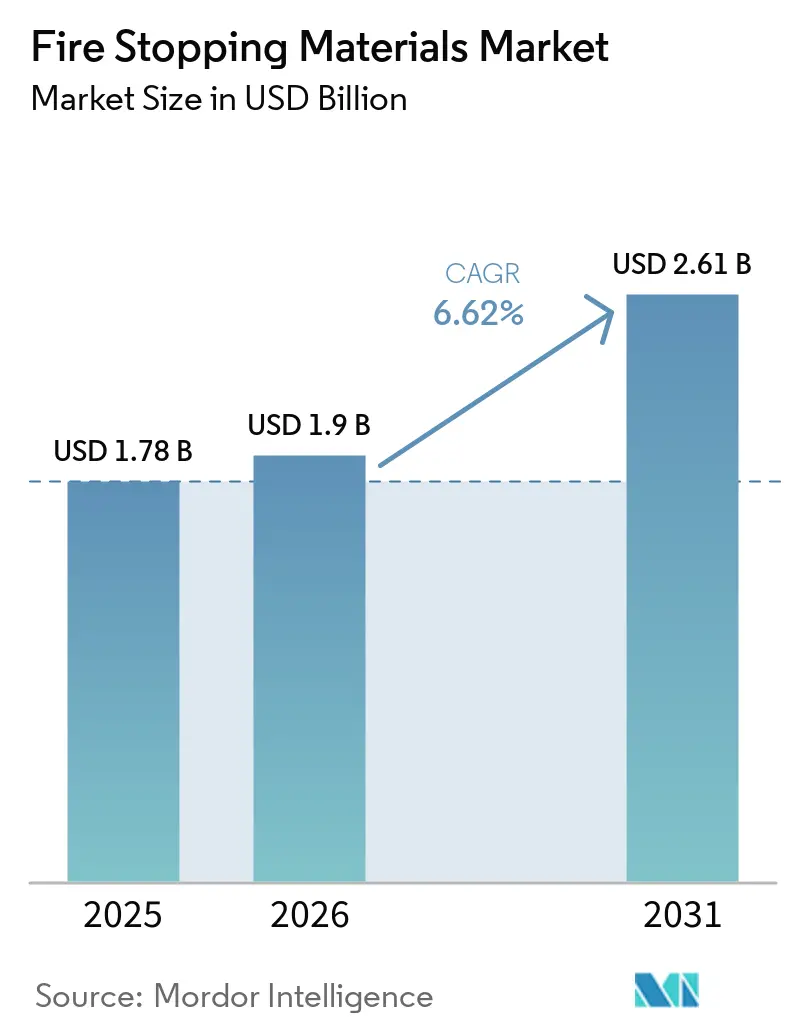
The Fire Stopping Materials Market size was valued at USD 1.78 billion in 2025 and is estimated to grow from USD 1.90 billion in 2026 to reach USD 2.61 billion by 2031, at a CAGR of 6.62% during the forecast period (2026-2031). Demand for certified penetration-sealing systems remains tied to building-code requirements rather than discretionary construction spending. Cable-intensive facilities, including data centers, semiconductor fabrication plants, and medical facilities, require more protected openings within each fire-rated wall and floor assembly. Once a tested system is included in a project specification, product substitution becomes more difficult because installers must follow the listed configuration. Re-enterable boards, putty pads, and collars are becoming more valuable where cables are changed frequently after installation. Manufacturers are responding with broader certification libraries, design tools, and products suited to off-site mechanical, electrical, and plumbing assembly work.
Key Report Takeaways
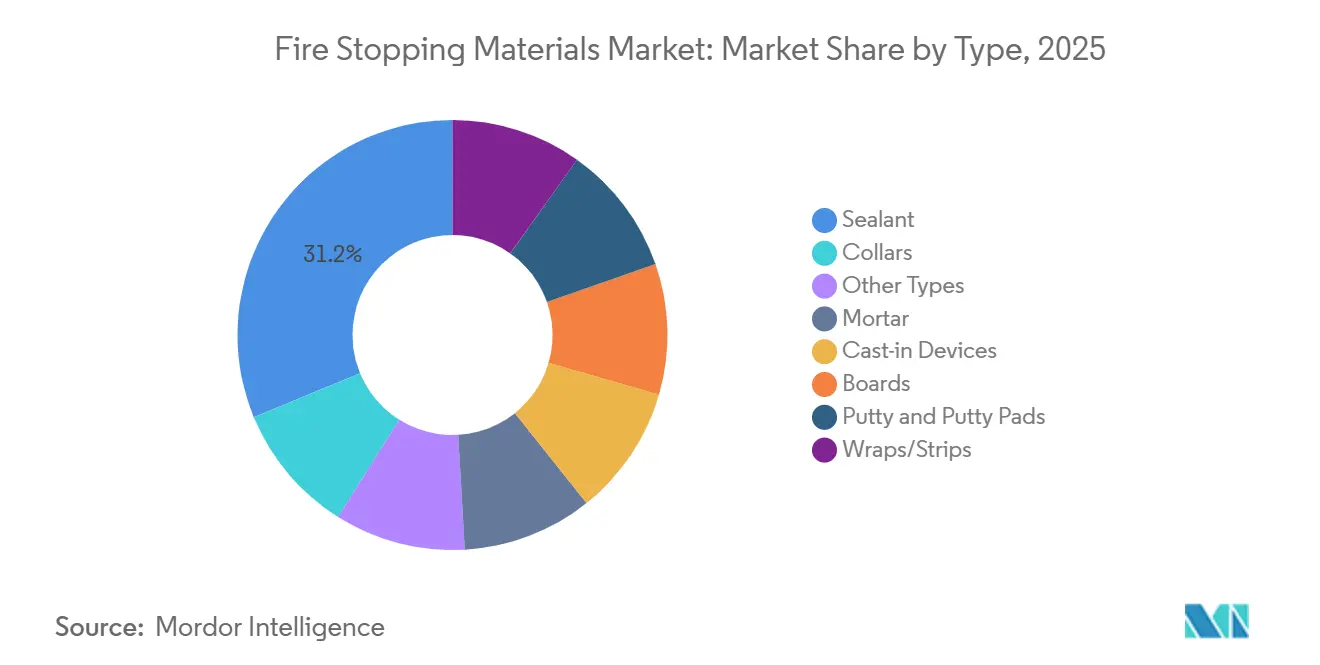
- By type, sealants held 31.24% of the fire stopping materials market share in 2025, while boards are projected to advance at a 7.07% CAGR through 2031.
- By application, electrical held 45.67% of the fire stopping materials market share in 2025 and is projected to advance at a 7.25% CAGR through 2031.
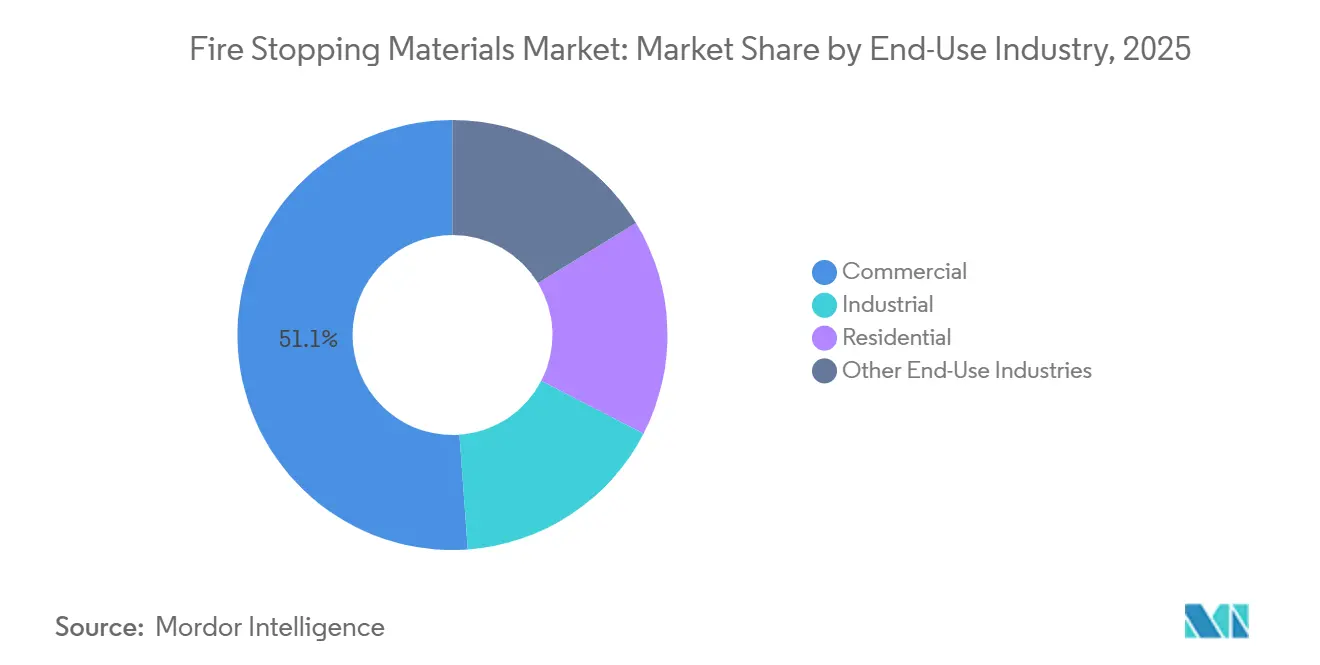
- By end-use industry, commercial held 51.13% of the fire stopping materials market share in 2025, while industrial is projected to advance at a 7.63% CAGR through 2031.
- By geography, Asia-Pacific held 44.58% of the fire stopping materials market share in 2025 and is projected to advance at a 7.16% CAGR through 2031.
Note: Market size and forecast figures in this report are generated using Mordor Intelligence’s proprietary estimation framework, updated with the latest available data and insights as of January 2026.
Global Fire Stopping Materials Market Trends and Insights
Drivers Impact Analysis*
| Driver | (~) % Impact on CAGR Forecast | Geographic Relevance | Impact Timeline |
|---|---|---|---|
| Tightening Fire-Safety Codes and Enforcement | +1.8% | Global | Short term (≤ 2 years) |
| High-Rise and Infrastructure Construction | +1.5% | APAC core, spillover to MEA and South America | Medium term (2–4 years) |
| Data-Center, Modular-Construction, and Prefabricated-MEP Expansion | +1.3% | North America & EU, APAC growing | Short term (≤ 2 years) |
| Increasing MEP Penetration Density | +0.9% | Global | Medium term (2–4 years) |
| Aging-Building Retrofit and Firestop Remediation | +0.7% | North America & EU | Long term (≥ 4 years) |
| Source: Mordor Intelligence | |||
Tightening Fire-Safety Codes and Enforcement
Underwriters Laboratories (UL) 1479 Edition 4 was released in April 2025 and raised the performance benchmarks for through-penetration firestop systems. Manufacturers had to requalify affected system listings, which increased the importance of current test evidence in commercial specifications. International Building Code requirements also call for firestop systems to be installed and inspected under specified conditions in relevant projects[1]International Firestop Council, “Understanding ASTM and UL Standards for Firestopping,” International Firestop Council, firestop.org. These requirements reduce the scope for using untested fillers when a project is subject to documented inspection. India’s SP 7:2026 introduced a dedicated data-center occupancy class and updated fire-safety provisions, extending the relevance of compartmentation planning in new buildings. The use of ASTM, UL, and EN test approaches across major construction regions also makes broad certification coverage more important for suppliers. This supports the fire stopping materials market where code enforcement and project documentation are becoming more formal.
High-Rise and Infrastructure Construction
High-rise buildings contain multiple service risers, staircase enclosures, and electrical distribution routes that pass-through fire-rated walls and floors. Each opening requires a tested firestop configuration that matches the substrate, penetrant, and rating of the assembly. Metro systems, airports, and tunnels also contain dense heating, ventilation, air conditioning, signaling, and power networks. These projects therefore require more firestop work per square foot than less complex structures. India’s SP 7:2026 adjusted fire-safety thresholds for several occupancy types, broadening the relevance of fire protection planning in institutional construction. Taller structures often require 2-hour or 4-hour rated systems rather than standard 1-hour assemblies. This shifts demand toward products that meet higher performance requirements and carry higher installation value.
Increasing MEP Penetration Density
The fire stopping materials market benefits when the number of cables and pipes within each opening increases. Building management systems, distributed antenna systems, power networks, and fiber backbones make individual penetrations more complex. A mixed-service opening often needs an engineered listed system rather than a general sealant application. Building Information Modeling (BIM) enables designers to coordinate penetrations earlier and to include approved firestop configurations in project documents. This process favors manufacturers that provide extensive listed-system libraries and digital product information. Prefabricated mechanical, electrical, and plumbing assemblies can also centralize procurement with fabricators. Suppliers without compatible design information face a weaker position when specifications are set before site installation begins.
Data-Center, Modular-Construction, and Prefabricated-MEP Expansion
Data centers require large volumes of power and data cabling, which create high-fill tray penetrations across rated assemblies. Specified Technologies Inc. launched EZ Path ULTRA in July 2026 for high-density cable tray applications in data centers and telecommunications infrastructure. The product supports cable trays in several widths and is intended for projects that need future cable changes. This demand profile favors pathways, boards, and putty-based solutions that can be reopened without rebuilding the entire seal. Modular construction also allows firestop materials to be installed during factory assembly, reducing jobsite labor and application variation. The fire stopping materials market therefore has an opening for products designed around prefabricated mechanical, electrical, and plumbing workflows.
Restraints Impact Analysis*
| Restraint | (~) % Impact on CAGR Forecast | Geographic Relevance | Impact Timeline |
|---|---|---|---|
| Certified System and Installation Cost Burden | -0.7% | Global, most acute in emerging markets | Medium term (2–4 years) |
| Skilled-Applicator Shortages and Installation Complexity | -0.5% | North America & EU | Short term (≤ 2 years) |
| Re-Penetration, Movement, and Assembly-Compatibility Risk | -0.3% | Global | Long term (≥ 4 years) |
| Source: Mordor Intelligence | |||
Certified System and Installation Cost Burden
Certified systems cost more than general construction fillers because they require listed materials, trained installation, and, on some projects, third-party inspection. The installation must follow the tested configuration for the opening and penetrant combination. Inconsistently enforced codes can leave room for lower-cost, non-rated foam or mastic products. This creates a risk that certified-product demand does not fully match the total number of penetrations in new construction. The 2025 revision of UL 1479 also required system requalification, which added laboratory testing and documentation costs. Large suppliers can spread these costs across wider portfolios, while smaller companies may face a higher burden. The constraint is most visible in price-sensitive residential and small commercial projects in emerging construction regions.
Skilled-Applicator Shortages and Installation Complexity
Firestop installation requires knowledge of substrate type, annular space, penetrant combinations, and the required depth of fill. Listed firestop systems must be installed in accordance with their tested configurations, leaving little scope for unplanned changes at the jobsite. Training and accreditation requirements can delay the growth of the qualified installer base. This is a practical constraint in North America and Europe, where construction activity and documentation requirements are both high. Factory-prefabricated assemblies can draw certified labor away from conventional site work while reducing labor needs inside the factory process. Re-penetration after tenant upgrades or information technology changes can also disturb existing seals. Where penetration records are incomplete, property managers may not restore compliant protection after later work.
*Our forecasts treat driver/restraint impacts as directional, not additive. The impact forecasts reflect baseline growth, mix effects, and variable interactions.
Segment Analysis
By Type: Sealants Anchor Market Share While Boards Lead Growth
Sealants held 31.24% of the fire stopping materials market share in 2025 because they can be used across cable bundles, pipes, ducts, and construction joints. Their flexibility across different substrates supports broad use in commercial, industrial, and residential installations. Intumescent sealants expand under heat and help close openings created when combustible pipes or cable materials soften. The 2025 update to UL 1479 increased the importance of tested formulations in listed through-penetration systems. Low-volatile-organic-compound and halogen-free products have relevance in healthcare, education, and public buildings. These buyers often align environmental purchasing requirements with fire-safety specifications. Mortar remains relevant in high-load mechanical and plumbing penetrations where compressive strength and dimensional stability are important.
Boards are projected to advance at a 7.07% CAGR through 2031. Data centers and large commercial facilities use boards where cable routes are likely to change after the initial installation. Re-enterable formats allow changes without removing and rebuilding an entire permanent seal. Cast-in devices are also gaining use in new commercial and data-center projects because they can be placed before concrete is poured. Collars have a strong role in Asia-Pacific residential towers where plastic drainage pipes are replacing metal pipework. Wraps, strips, putty, and putty pads serve specialized cable-tray and armored-cable applications.



By Application: Electrical Penetrations Drive Both Revenue and Growth Rate
Electrical applications held 45.67% of the fire stopping materials market share in 2025. Power and data cables pass-through rated assemblies in commercial towers, industrial facilities, hospitals, airports, and data centers. Their wide use across building types gives the category a large installed base. Higher power density and additional information technology capacity increase the number of cable tray penetrations in data centers. These openings require listed systems that can accommodate the actual cable arrangement and the rating of the wall or floor. Specified Technologies Inc. introduced EZ Path ULTRA in 2026 for high-density cable applications, showing the demand for products made for changing cable infrastructure. The electrical category benefits from the combined needs of data infrastructure, grid electrification, and electric-vehicle charging installation.
Electrical applications are projected to advance at a 7.25% CAGR through 2031. This growth is supported by rising cable density rather than a single building category. Mechanical uses remain a stable contributor through heating, ventilation, air conditioning, and large-diameter pipe penetrations. Plumbing work supports the use of collars, wraps, and putty systems, especially where plastic pipes are used in multi-family housing. Other applications include structural joints, perimeter barriers, and curtain wall assemblies. India’s IS 18190:2023 created a national test reference for curtain wall perimeter fire barriers, adding relevance for qualified facade firestop systems. Healthcare and educational facilities also operate under life-safety requirements that can expand the number of locations where documented penetration protection is necessary.
By End-Use Industry: Commercial Leads While Industrial Outpaces the Market
Commercial held 51.13% of the fire stopping materials market share in 2025. Office towers, hospitals, shopping malls, hotels, airports, and data centers contain dense mechanical, electrical, and plumbing systems. Their design creates numerous service crossings through rated walls and floors. Code-driven purchasing makes firestop work a necessary part of the building package in these facilities. Hospitals have extensive compartmentation needs and often require protection across highly serviced clinical areas. Data centers add cable-heavy pathways and frequent future modification needs. Residential projects provide steady demand because service crossings between units must maintain fire separation.
Industrial is projected to advance at a 7.63% CAGR through 2031. Oil and gas sites, chemical plants, pharmaceutical facilities, semiconductor plants, and electronics facilities require high levels of fire protection. A fire event in these settings can cause serious operational disruption in addition to safety risks. National investment programs have supported semiconductor and electronics facilities in the United States, Japan, South Korea, and India. These projects require high-temperature mortars, halogen-free sealants, and multi-hour-rated cast-in devices in many applications. Industrial expansion and construction joints also require products that can accommodate movement and demanding service conditions. Transit, infrastructure, and institutional facilities add further demand where large buildings contain complex service networks.
Geography Analysis
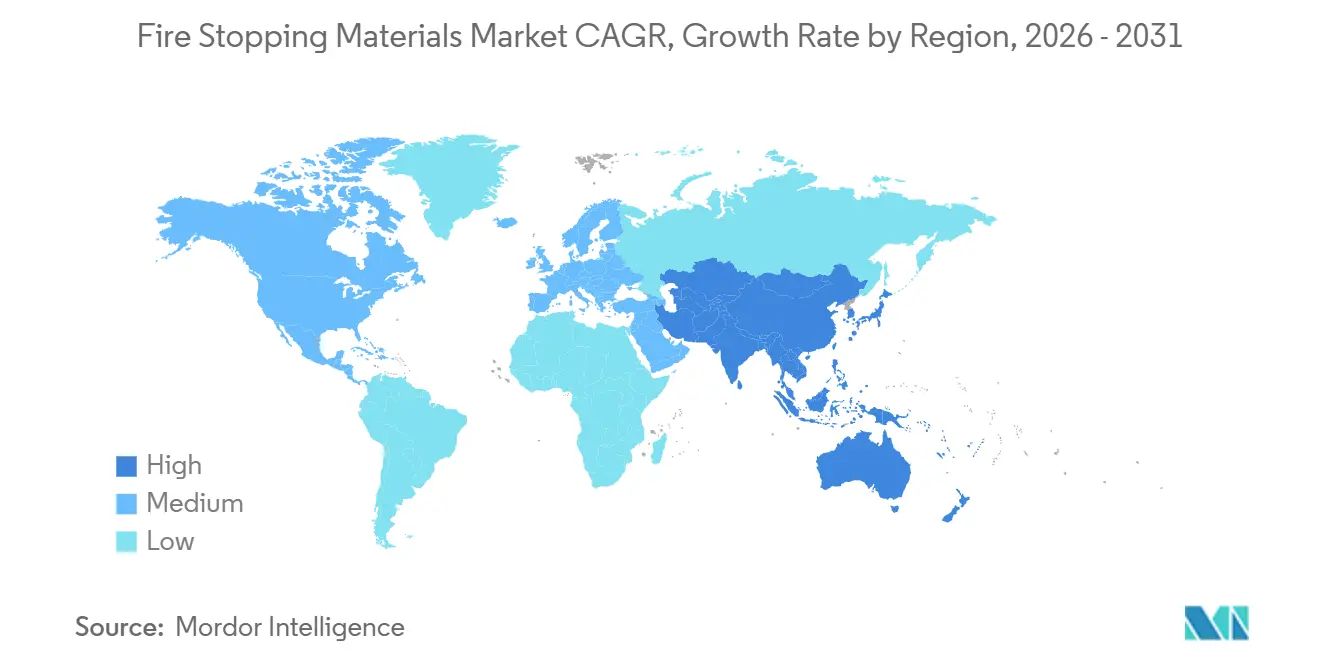
Asia-Pacific held 44.58% of the fire stopping materials market share in 2025 and is projected to advance at a 7.16% CAGR through 2031. China, India, South Korea, Japan, and Association of Southeast Asian Nations countries support demand through urban construction and changing building requirements. India’s SP 7:2026 introduced a dedicated data-center occupancy class and additional compartmentation provisions. High-rise residential and commercial construction in China continues to support collar and sealant use, particularly where plastic drainage pipes are used. Vietnam, Indonesia, and the Philippines are tightening building-fire provisions after incidents in high-occupancy structures. Japan and South Korea support premium specification demand through combined seismic and fire-safety requirements. These conditions support demand for higher-rated penetration systems in commercial and institutional projects.
North America is a mature area for the fire stopping materials market, with strong use of code-based specifications and documented installation workflows. Building Information Modeling is widely used to coordinate service openings earlier in the project process. International Building Code inspection requirements for relevant high-rise and risk-category projects strengthen the need for documented listed systems. Data-center construction supports electrical penetration demand because facilities require extensive power and data routing. Canada aligns closely with United States requirements through CAN/ULC-S115, supporting similar product expectations across the region. Mexico offers added commercial construction demand in growing cities, although enforcement is not uniform. The mix of data centers and institutional facilities supports demand for premium firestop applications.
Europe is shaped by Construction Products Regulation requirements and the EN 1366 test series for penetration and joint systems. The United Kingdom is moving from national BS 476 classifications toward EN 13501-series classifications under Approved Document B, which is expected to prompt review of existing product choices. Germany, France, and Nordic countries have strong compliance practices and demand for low-volatile-organic-compound formulations in public procurement. South America remains smaller but is expanding through commercial construction in Brazil and Argentina. Sika AG opened manufacturing facilities in Argentina and Colombia in February 2026, improving its regional production footprint. The Middle East and Africa are supported by Saudi Arabia’s Vision 2030 projects, including data centers, hospitals, and mixed-use towers. Suppliers that combine regional certification coverage with technical support have an opportunity in these developing distribution markets.

Competitive Landscape
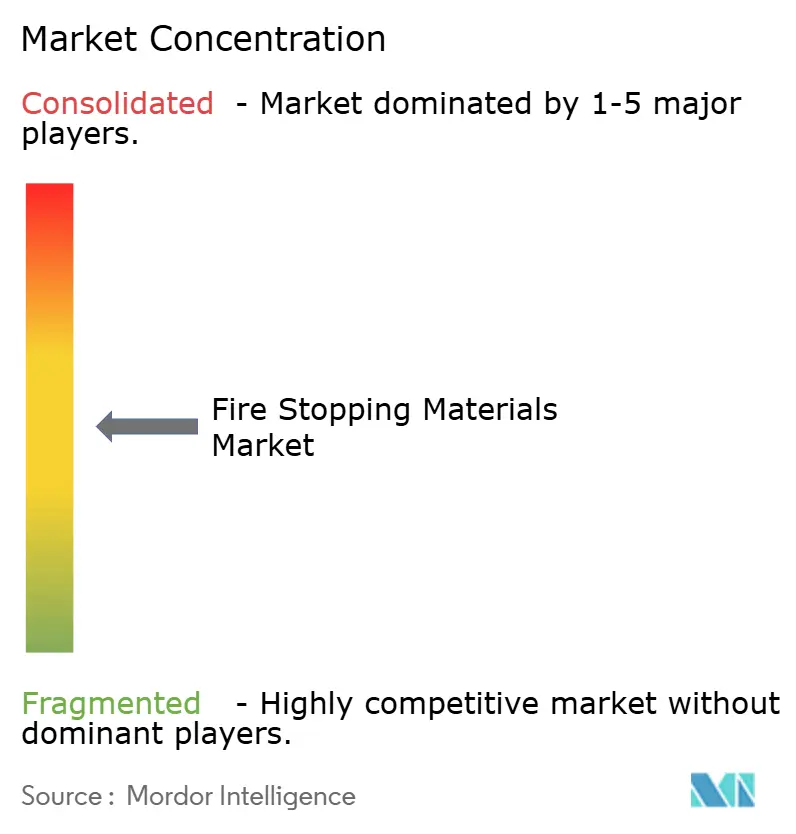
The fire stopping materials market is moderately concentrated, with the top five players including Hilti Corporation, 3M, Sika AG, Etex Group, and RPM International Inc. Hilti Corporation, 3M, Sika AG, and RPM International Inc. have broad portfolios and contractor-facing distribution capabilities. ROCKWOOL A/S, Knauf Insulation, and Etex Group have positions in mineral wool and fire-rated board applications. Product performance remains important but listed-system coverage can be more decisive once a design team selects a configuration. Hilti Corporation serves contractors through products, installation tools, and PROFIS Engineering design software. This combination can make product changes less attractive after a contractor standardizes its workflow. 3M supports multinational construction relationships through its intumescent compound and sealant portfolio.
In March 2026, 3M announced an agreement involving Madison Fire & Rescue and Scott Safety that broadened its presence across the fire-safety value chain[2]3M, “3M to Create a Leading Fire and Safety Business, Acquires Madison Fire & Rescue and Combines with Scott Safety,” 3M News, news.3m.com. In February 2026, Sika AG agreed to acquire Akkim to extend distribution across Eastern Europe, Central Asia, the Middle East, and North Africa. Sika AG also opened 5 manufacturing facilities in February 2026, including facilities in the United States, Argentina, Colombia, Bangladesh, and Tanzania. These actions strengthen supply proximity and regional distribution capacity. In August 2026, Hilti North America launched HIT-FP 700 R, a fire-resistant injectable cementitious mortar for structural concrete connections. The product was designed to work with PROFIS Engineering for fire-load design workflows.
Opportunities in the fire stopping materials market include BIM-compatible digital libraries, factory-integrated formats, and re-enterable solutions for frequently modified cable routes. Specified Technologies Inc. targeted the last area with its July 2026 EZ Path ULTRA launch for high-density cable trays. Quelfire, TENMAT Ltd., and RectorSeal compete through specialized certifications and installer-training programs. These companies can address locations and applications that may be too narrow for global suppliers to manage through direct sales channels. Manufacturers are also integrating intumescent protection into mechanical, electrical, and plumbing components during product design. This approach can reduce field labor and lower the risk that later work disturbs an existing assembly. The International Firestop Council identifies tested and listed systems as central to maintaining compliant firestop performance across changing construction conditions.
Fire Stopping Materials Industry Leaders
Hilti Corporation
3M
Sika AG
Etex Group
RPM International Inc.
- *Disclaimer: Major Players sorted in no particular order

Recent Industry Developments
- August 2026: Hilti Corporation launched HIT-FP 700 R, a fire-resistant injectable cementitious mortar rated to withstand temperatures up to 1,108°F for post-installed rebar extensions and splices. The product expanded fire-resistant mortar solutions for structural concrete applications, supporting demand for fire-stopping materials in construction.
- August 2026: CitroTech and Global Fireproof Solutions (GFS) announced a strategic partnership to integrate CitroTech’s non-toxic fire inhibitor across GFS’s fire-protection businesses. The collaboration expanded the availability of environmentally responsible fire-retardant solutions across geographies and applications, supporting innovation in fire-stopping and fire-protection materials.


Global Fire Stopping Materials Market Report Scope
Fire stopping materials are specialized products used to seal openings, joints, penetrations, and gaps in building assemblies to restrict the spread of fire, smoke, and hot gases. They help maintain the fire-resistance performance of walls, floors, and other fire-rated assemblies while supporting compartmentation and building safety.
The Fire Stopping Materials Market is segmented by type, application, end-use industry, and geography. By type, the market is segmented into sealant, mortar, cast-in devices, boards, putty and putty pads, collars, wraps/strips, and other types. By application, the market is segmented into electrical, mechanical, plumbing, and other applications. By end-use industry, the market is segmented into commercial, industrial, residential, and other end-use industries. The report also covers the market size and forecasts for fire stopping materials in 15 countries across major regions. For each segment, the market sizing and forecasts have been done on the basis of value (USD).
| Sealant |
| Mortar |
| Cast-in Devices |
| Boards |
| Putty and Putty Pads |
| Collars |
| Wraps/Strips |
| Other Types |
| Electrical |
| Mechanical |
| Plumbing |
| Other Applications |
| Commercial |
| Industrial |
| Residential |
| Other End-Use Industries |
| Asia-Pacific | China |
| India | |
| Japan | |
| South Korea | |
| ASEAN Countries | |
| Rest of Asia-Pacific | |
| North America | United States |
| Canada | |
| Mexico | |
| Europe | Germany |
| United Kingdom | |
| France | |
| Italy | |
| NORDIC Countries | |
| Rest of Europe | |
| South America | Brazil |
| Argentina | |
| Rest of South America | |
| Middle East and Africa | Saudi Arabia |
| South Africa | |
| Rest of Middle East and Africa |
| By Type | Sealant | |
| Mortar | ||
| Cast-in Devices | ||
| Boards | ||
| Putty and Putty Pads | ||
| Collars | ||
| Wraps/Strips | ||
| Other Types | ||
| By Application | Electrical | |
| Mechanical | ||
| Plumbing | ||
| Other Applications | ||
| By End-Use Industry | Commercial | |
| Industrial | ||
| Residential | ||
| Other End-Use Industries | ||
| By Geography | Asia-Pacific | China |
| India | ||
| Japan | ||
| South Korea | ||
| ASEAN Countries | ||
| Rest of Asia-Pacific | ||
| North America | United States | |
| Canada | ||
| Mexico | ||
| Europe | Germany | |
| United Kingdom | ||
| France | ||
| Italy | ||
| NORDIC Countries | ||
| Rest of Europe | ||
| South America | Brazil | |
| Argentina | ||
| Rest of South America | ||
| Middle East and Africa | Saudi Arabia | |
| South Africa | ||
| Rest of Middle East and Africa | ||


Key Questions Answered in the Report
What is the size of the fire stopping materials market?
The fire stopping materials market stands at USD 1.90 billion in 2026 and is projected to reach USD 2.61 billion by 2031.
What is driving demand for fire stopping materials?
Code requirements, high-rise construction, data centers, rising cable density, and prefabricated building systems support demand.
Which type led the market demand in 2025?
Sealants held a 31.24% share in 2025 because they are used across cable, pipe, duct, and joint applications.
Which application is expected to grow fastest through 2031?
Electrical is projected to advance at a 7.25% CAGR through 2031, supported by data, power, and charging infrastructure.
Page last updated on:





