
Fire Resistant Tapes Market Size and Share
Market Overview
| Study Period | 2022 - 2032 |
|---|---|
| Market Size (2027) | USD 0.97 Billion |
| Market Size (2032) | USD 1.31 Billion |
| Growth Rate (2027 - 2032) | 6.16 % |
| Fastest Growing Market | Asia-Pacific |
| Largest Market | Asia-Pacific |
| Market Concentration | Low |
Major Players *Disclaimer: Major Players sorted in no particular order Image © Mordor Intelligence. Reuse requires attribution under CC BY 4.0. | |
Fire Resistant Tapes Market Analysis by Mordor Intelligence
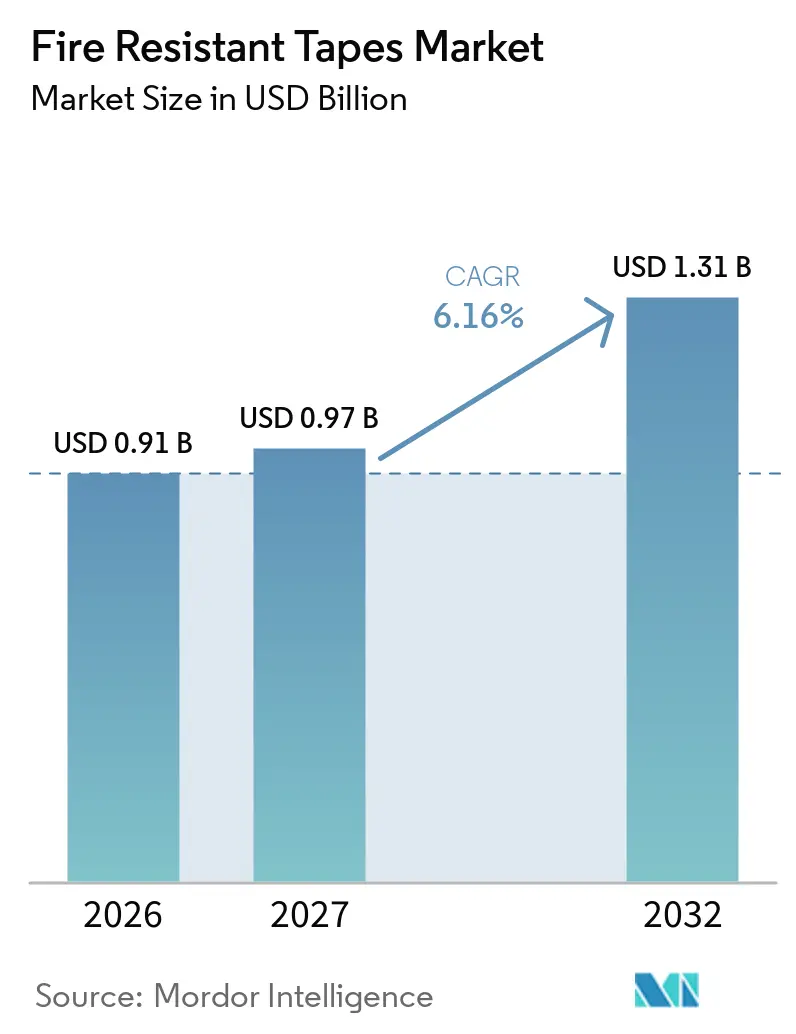
The Fire Resistant Tapes Market size was valued at USD 0.91 billion in 2026 and is estimated to grow from USD 0.97 billion in 2027 to USD 1.31 billion by 2032, at a CAGR of 6.16% during the forecast period (2027-2032). Demand for fire resistant tapes spans electrification, construction safety retrofits, and electronics assembly, providing market support across multiple end uses. Procurement is shifting from passive hazard containment toward engineered fire performance, changing how buyers define product requirements. Electric vehicle (EV) battery safety, electronics capacity additions in Asia, and stricter passive fire protection codes in construction are shaping current demand. Suppliers are responding by offering products designed to specific performance standards, rather than relying on standard flame-retardant grades. Trade-policy-related costs of flame-retardant additives and specialty polymer substrates could pressure producers without integrated supply chains.
Key Report Takeaways
- By coating type, single coated tapes held 68.12% of the fire resistant tapes market share in 2026, while double coated tapes are forecast to expand at a 6.73% CAGR through 2032.
- By tape type, acetate held 29.56% of the fire resistant tapes market share in 2026, while Nomex is forecast to grow at a 6.81% CAGR through 2032.
- By end-user industry, electrical and electronics accounted for 32.38% global share in 2026, while automotive is forecast to record a 7.25% CAGR through 2032.
- By geography, Asia-Pacific accounted for 43.07% global share in 2026 and is forecast to advance at a 7.06% CAGR through 2032.
Note: Market numbers in this report are based on Mordor Intelligence's proprietary estimation framework, which combines nine months of actuals with Q4 projections for base year 2026.
Market Trends and Insights
Drivers Impact Analysis of Fire Resistant Tapes Market*
| Drivers | (~) % Impact on CAGR Forecast | Geographic Relevance | Impact Timeline |
|---|---|---|---|
| Fire-Safe Electrification of EV Battery Packs | +2.1% | Global, with an Asia-Pacific core in China, South Korea, and Japan, plus North America and Europe | Medium term (2-4 years) |
| Stricter Fire-Safety Codes and Certification Requirements | +1.3% | North America and Europe, with spillover to the Asia-Pacific | Short term (≤ 2 years) |
| Expansion of Electrical and Electronics Manufacturing | +1.2% | Asia-Pacific, especially China, South Korea, India, and Japan, with spillover to Southeast Asia | Short term (≤ 2 years) |
| Growth of Building, Infrastructure, and Retrofit Activity | +0.8% | Global, with new builds in Asia-Pacific, the Middle East, and Africa, plus retrofits in North America and Europe | Long term (≥ 4 years) |
| Low-Smoke, Halogen-Free Tape Adoption in Enclosed Transport | +0.5% | Europe, Asia-Pacific rail expansion, and North America | Medium term (2-4 years) |
| Source: Mordor Intelligence | |||
Fire-Safe Electrification of EV Battery Packs
Thermal runaway in lithium-ion battery packs has made fire protection a central engineering concern for EV manufacturers. Fire-resistant tapes are becoming structural elements in pack design rather than secondary accessories. In March 2025, Avery Dennison Performance Tapes introduced an EV Battery Venting Materials Portfolio featuring single and double-coated anisotropic filmic tapes and proprietary fire-barrier coatings. The adhesive side can withstand more than 15 seconds of flame exposure, while the outer film burns through in under 4 seconds, supporting controlled venting and limiting flame spread to adjacent cells. Structural battery designs leave less room for conventional thermal management materials. Thin pressure-sensitive tapes that combine fire-barrier, bonding, and dielectric functions, therefore fit the evolving battery design requirements.
This combination of functions shifts demand from commodity substrates toward engineered materials and positions tape suppliers closer to cell and module design decisions. Fire-resistant products can serve at the cell, module, and pack levels, rather than only supporting final pack assembly. Suppliers with material engineering capabilities can therefore participate in engineering programs with battery system designers, shifting purchasing from a maintenance-oriented activity to a product-development relationship. The fire-resistant tapes market benefits when a single component can address controlled venting, bonding, electrical insulation, and flame management within a compact design.
Stricter Fire-Safety Codes and Certification Requirements
Compliance frameworks are raising performance requirements across the fire-resistant tapes market. The 2025 National Fire Codes and International Fire Code updates reinforce passive fire protection requirements for penetrations, joints, and surface-mounted materials in commercial and institutional construction. These updates broaden the range of construction applications in which fire-resistant tapes can be specified and separate products by performance level and documentation. UL 510-certified tapes, American Society for Testing and Materials (ASTM) E119-listed products, and UL 94 V-0 grades address different compliance requirements.
Manufacturers must obtain certification for each relevant standard, which favors suppliers that already have testing and documentation resources. Smaller converters may struggle to fund multiple certification programs simultaneously, limiting their access to premium institutional and original equipment manufacturer (OEM) channels. UL Solutions identifies ANSI/CAN/UL 510 and related standards as part of its insulating tape testing and certification offering for electrical applications[1]. The program also supports component qualification needs in electronics. As a result, certification shapes both product acceptance and the type of customer a supplier can serve.
Expansion of Electrical and Electronics Manufacturing
Global electronics and information technology production increased 11% year on year in 2025 to USD 4,118.4 billion and increased a further 10% in 2026 to USD 4,510.3 billion, supported by AI infrastructure investment and digital transformation in manufacturing. This production base supports demand for fire-resistant tape products used in component, board, and system assembly. Cleanrooms, surface-mount assembly lines, and battery cell formation areas use polyimide masking tape, acetate cloth tape, and flame-retardant double-coated tape, providing a large base for suppliers.
Demand is concentrated in applications where both electrical reliability and fire performance are required. Semiconductor fabrication, printed circuit board (PCB) assembly, and power electronics each require insulating materials that function within controlled manufacturing processes. China's electronics expansion is focused on areas such as power electronics, EV inverters, and charging modules, which require demanding fire-resistant tape specifications. Asia-Pacific can therefore retain a strong position in the fire-resistant tapes market beyond short-term electronics cycles by combining electronics assembly, battery manufacturing, and industrial infrastructure within a shared demand base.
Growth of Building, Infrastructure, and Retrofit Activity
Construction retrofits in North America and Europe are supporting passive fire protection work in occupied buildings, driven by updated building codes and insurer-led compliance upgrades. Fire-resistant tapes are used at construction joints, through-penetration firestops, and cable tray interfaces. Their format allows installation without the curing time or overspray associated with liquid sealants, making them suitable for projects where building operations continue during the work. The fire-resistant tapes market also benefits from new infrastructure activity in Asia-Pacific, the Middle East, and Africa.
3M offers Fire and Water Barrier Tape and Smoke and Sound Tape tested and listed in accordance with ASTM E2307, E1966, and E814. These products carry UL and Intertek approvals and meet International Building Code requirements. They demonstrate how tape formats can replace traditional spray-applied firestop materials in retrofit work, shortening installation time and reducing labor requirements. This gives contractors a practical reason to select tape products where the required fire performance is available and connects product demand to compliance work that is less dependent on new building starts.
Restraints Impact Analysis of Fire Resistant Tapes Market*
| Restraints | (~) % Impact on CAGR Forecast | Geographic Relevance | Impact Timeline |
|---|---|---|---|
| Specialized Material and Processing Costs | -0.7% | Global, with the strongest effect in South America, the Middle East, and Africa | Short term (≤ 2 years) |
| Inconsistent Test Methods and Certification Requirements | -0.5% | Global, particularly cross-border trade from the Asia-Pacific to North America and Europe | Medium term (2-4 years) |
| Adhesive Compatibility with Low-Surface-Energy and Composite Substrates | -0.3% | Asia-Pacific automotive, European aerospace, and North America | Long term (≥ 4 years) |
| Source: Mordor Intelligence | |||
Specialized Material and Processing Costs
Aramid fibers, ceramic-coated glass cloth, halogen-free acrylic adhesives, and calcined mica are core materials for high-performance fire-resistant tapes. These materials have limited supplier bases and higher input costs than commodity tape materials. Precision coating and slitting add further costs in safety-critical applications. Dimensional tolerances can affect a product's certification and end use. Mid-tier manufacturers face a difficult margin position when lower-cost alternatives remain available in price-sensitive construction applications. Material and processing costs can therefore limit smaller firms' ability to compete in premium product segments.
These costs favor producers with vertically integrated supply chains or long-term raw material agreements, as such companies can better protect supply and manage input cost volatility. Smaller converters may remain in segments where products are more interchangeable, which typically face greater price competition and margin pressure. The restraint is strongest where customers have limited ability to pay for specialized fire performance, and in regions where distribution costs and smaller order quantities increase the delivered price of engineered materials. The fire-resistant tapes market must therefore balance performance requirements against the cost of certified substrates and adhesives.
Inconsistent Test Methods and Certification Requirements
The fire-resistant tapes market operates under a fragmented set of test standards, including UL 94, IEC 60454, ASTM E119, Federal Motor Vehicle Safety Standard (FMVSS) 302, DIN 53438, and EN 45545-2, which are applied across different jurisdictions. A tape that meets UL 94 V-0 requirements in North America may still require separate qualification for European rail or Japanese electronics applications. Required tests can differ by substrate, adhesive, and smoke-emission criteria. Separate testing increases development time and certification costs, and can slow a product's entry into new regions.
The Firestop Contractors International Association continues to work with ASTM International and UL on frameworks for firestop system testing, although convergence remains incomplete. ANSI/UL 62275, Fourth Edition, was adopted in May 2025 to align with IEC 62275, Edition 4, for cable management system specifications[2]. However, its scope remains narrow, and manufacturers must still manage multiple separate testing paths. This particularly affects smaller suppliers with fewer resources for cross-border approvals. The resulting compliance burden can delay the introduction of new materials even when their technical performance is adequate.
*Our forecasts treat driver/restraint impacts as directional, not additive. The impact forecasts reflect baseline growth, mix effects, and variable interactions.
Fire Resistant Tapes Market Segment Analysis
By Coating Type:
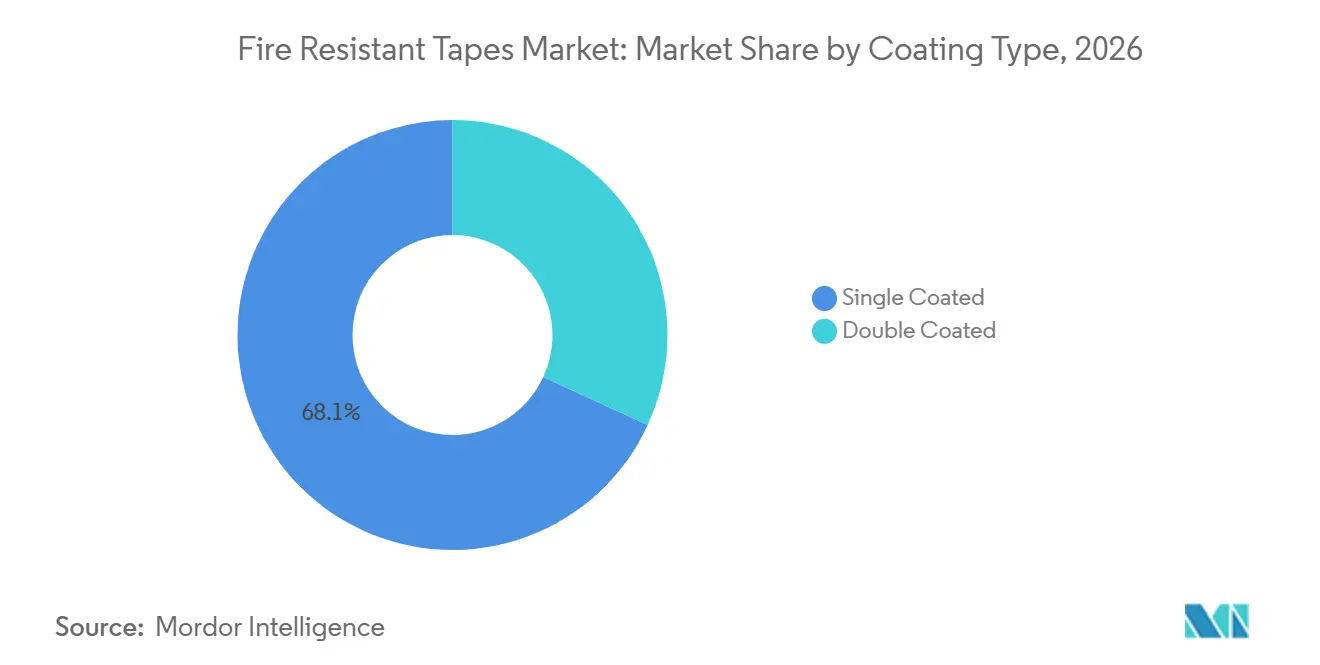
Single Coat Leads, Double Coat Gains Functional GroundSingle coated tapes held a 68.12% global share in 2026. Their position reflects cost efficiency, process compatibility in high-volume electronics assembly, and a large installed base in wire bundling, transformer insulation, and PCB masking. These products meet core thermal-resistance and dielectric-strength requirements for many electrical and electronic applications, supporting continued demand where a single functional adhesive surface is sufficient. Single coated tapes also fit established assembly processes and procurement specifications, giving the segment a stable base.
Double coated tapes are forecast to expand at a 6.73% CAGR through 2032. The fire resistant tapes market for double coated products benefits from thin EV battery module designs that require bonding and fire management within limited space. These tapes bond mica sheets, aerogel blankets, and ceramic fibers to cell surfaces in a single operation, thereby reducing assembly steps, improving dimensional consistency, and eliminating the need for mechanical fasteners. Avery Dennison's 2025 EV Battery Venting Materials Portfolio uses double coated architectures for this bonding function, with fire-barrier coatings serving different roles on each side. The category is moving beyond adhesive configuration toward composite structures with fire-barrier layers, anisotropic burn-through profiles, and pressure-sensitive adhesive systems. This raises the importance of adhesive chemistry and fire-barrier materials expertise in supplier selection.

By Tape Type:
Acetate Retains Scale, Nomex Advances on Thermal CredentialsAcetate accounted for 29.56% of the global share in 2026, making it the largest tape type. It is well established in motor coil wrapping, transformer phase separation, and switchgear insulation. Its mechanical conformability, dielectric strength, and flame self-extinguishing behavior under UL 94 criteria support its use in those applications. Glass cloth tape is used for high-temperature masking in electronics reflow processes and oven applications. Polyvinyl chloride (PVC) tape serves general electrical insulation needs, although its halogen content can limit its suitability in low-smoke, zero-halogen specifications. Polyimide tape is used in precision electronics for flexible circuit lamination and solder-mask protection due to its chemical resistance and high-temperature performance.
Nomex is forecast to grow at a 6.81% CAGR through 2032. Its thermal class H performance at 180°C and self-extinguishing characteristics support its use in electric motor insulation. The material is relevant to automotive drivetrains and industrial machinery that require durable electrical insulation. Nomex tape also supports aircraft interior components and electrical system insulation where weight, safety, and thermal performance are important. Renewable energy, EV, and rail transportation applications add to this demand base. Specialty polytetrafluoroethylene (PTFE) and polyphenylene sulfide (PPS)-based tapes serve narrower applications in high-temperature chemical processing and specialty electronics, where conventional flame retardants cannot meet the required material performance.
By End-User Industry:
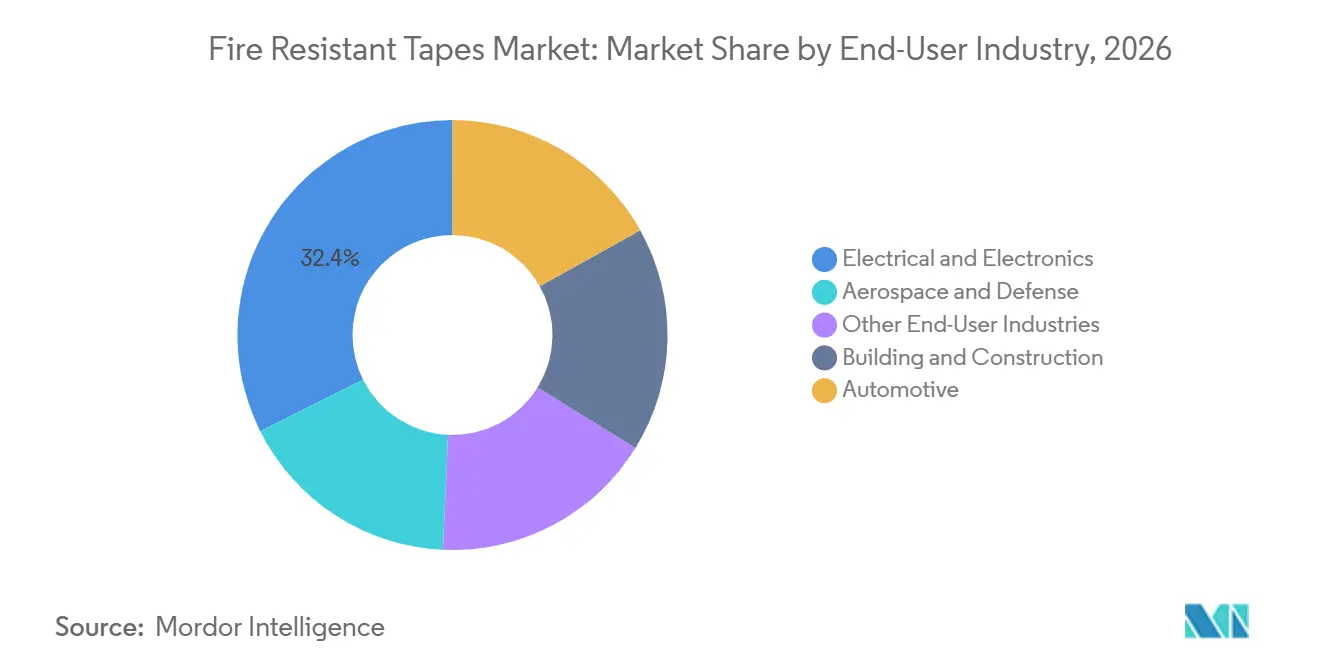
Electronics Anchors Demand, Automotive Drives MarginElectrical and electronics accounted for 32.38% of the global share in 2026. Semiconductor fabrication, printed circuit board (PCB) assembly, data-center power distribution, and consumer-device manufacturing support this demand. Global semiconductor sales increased 26.2% in 2025 to USD 795.6 billion, reflecting AI infrastructure investment and a broader recovery in electronics demand. This output requires tape at the component, board, and system levels. Building and construction is the second-largest end-user category, supported by firestop and joint-sealing needs in new commercial projects and retrofit work. Aerospace and defense remain high-value end uses for Nomex and glass cloth tapes, which are used in cabin materials, wire harnesses, and composite assemblies.
Automotive is forecast to grow at a 7.25% CAGR through 2032. EV architecture drives demand for high-voltage battery packs, power-electronics housings, and wire-harness routing near thermal surfaces, needs that were absent or much smaller in internal-combustion vehicle designs. In August 2025, tesa launched tesa 67003, a fire protection tape for EV wire harnesses capable of withstanding 1,000°C for 10 minutes. The product is designed to follow cable geometry in ways that rigid sleeves cannot, and original equipment manufacturers (OEMs) and Tier-1 suppliers are evaluating it for future vehicle platforms. Growing automotive demand is increasing interest in double coated, Nomex, and ceramic-integrated tapes, which can shift product mix toward higher-performance materials.
Geography Analysis
APAC Fire Resistant Tapes Market
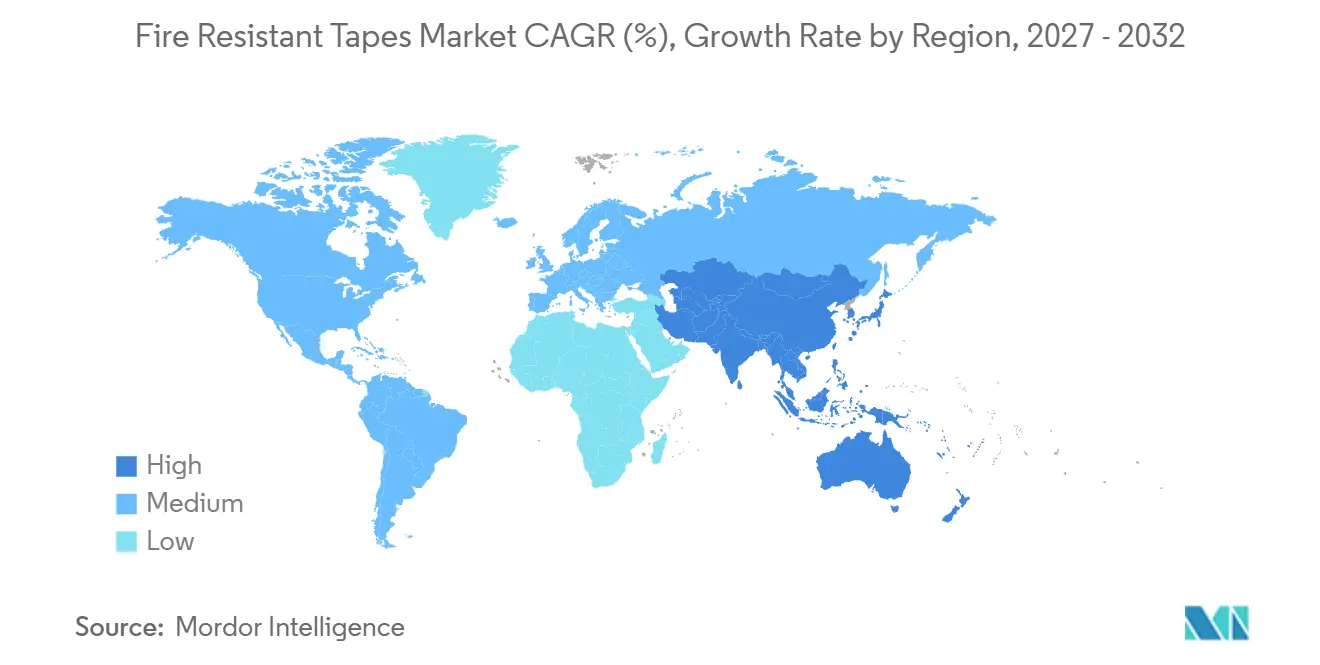
Asia-Pacific accounted for 43.07% of the global share in 2026 and is forecast to grow at a 7.06% CAGR through 2032. China is the primary demand center, with battery manufacturing clusters in Shenzhen, Guangzhou, and Shanghai that use tapes for cell assembly, module bonding, and pack-level thermal management. Production output from CATL and BYD provides a large demand base for fire-safe adhesive materials. Japan supports demand in semiconductor packaging, transformer insulation, and aerospace components. South Korea adds demand from semiconductor producers and EV battery manufacturers. India is expanding its construction and electrical end-use base through data center investment, power distribution upgrades, and metro rail development.
APAC and North America Fire Resistant Tapes Market
India's Production Linked Incentive schemes are attracting electronics manufacturing investment, which is expected to create additional demand for tape through 2032. China's industrial tape localization rate has exceeded 41%, and domestic producers are increasingly able to meet Underwriters Laboratories (UL) 94 VTM-0 requirements for EV battery applications. This trend may narrow the price premium of global brands in high-volume applications. North America holds a substantial position driven by aerospace and defense, EV assembly, and mature passive fire protection requirements. The United States construction sector supports retrofit demand under International Building Code and International Fire Code requirements. Mexico's growing automotive manufacturing corridor adds demand as EV battery assembly expands within the North American supply chain.
EMEA and South America Fire Resistant Tapes Market
South America holds a smaller position, with Brazil and Argentina as the primary markets for infrastructure investment and industrial safety upgrades. Europe is supported by automotive electrification, rail investment, and construction product compliance, with Germany, France, and the United Kingdom as key national markets. EN 45545-2 remains central to rail tape specifications, covering flammability, smoke emission, and toxicity requirements across hazard levels HL1 through HL3. UNIFE published the Rail Industry Substance List Version 2025-03 in April 2025, updating material requirements for tape substrates and adhesives in Europe's rail sector. The Middle East and Africa remain the most nascent regions, although Gulf construction and urban development projects are driving demand for building applications. South Africa supports regional demand through electrical and mining activities, while limited alignment of standards and technical distribution continues to constrain the depth of the regional market.
Competitive Landscape
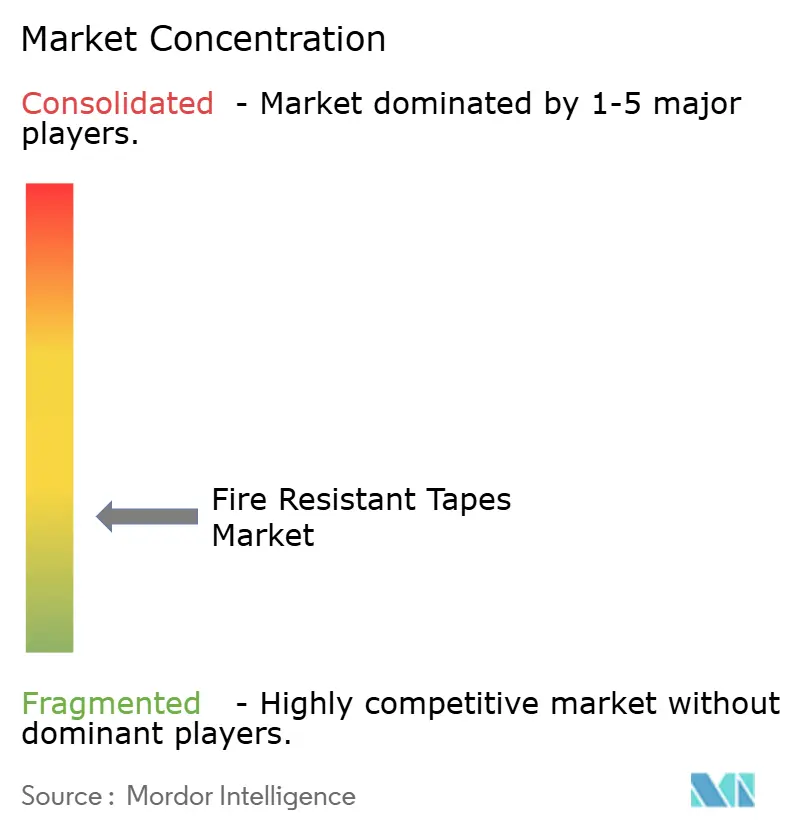
The fire resistant tapes market is fragmented at the premium tier. 3M, Nitto Denko Corporation, tesa, Avery Dennison, and Saint-Gobain hold positions through adhesive chemistry, certification portfolios, and OEM relationships. Below this group, regional converters and specialty manufacturers serve industry niches and local markets. Leading suppliers are focusing on application-specific products rather than price competition in the acetate and PVC categories. These products include anisotropic venting tapes, ceramic-infused composites, and halogen-free EV wire-harness solutions. This approach reduces price sensitivity when a product is specified in an OEM design.
Sustainability remains an open product area regarding fire resistance and adhesive performance. Bio-based and PFAS-free flame-retardant adhesive options remain limited. Regulatory pressure on halogenated compounds under REACH and RoHS is driving demand for alternatives that meet performance requirements. tesa's flameXtinct assortment is certified to UL 94 and FMVSS 302 and is fully halogen-free. The company launched a 3-product wire-harness tape suite for EV applications in August 2025. Avery Dennison's 2025 EV Battery Venting Materials Portfolio represents another move toward tailored fire-barrier and venting materials.
Chinese specialty tape manufacturers are emerging in thin EV battery tapes and have achieved UL 94 VTM-0 certification for some products. Digital adhesive formulation simulation is reducing development cycles for fire-barrier tapes from 24 months to under 12 months. Roll-to-roll precision coating with real-time quality monitoring is also being used to support multilayer functional tapes. Patents are becoming more important in anisotropic tape architecture, fire-barrier adhesive chemistry, and ceramizable silicone coatings. Smaller suppliers require timely product development and certification to compete for EV OEM programs.
Fire Resistant Tapes Industry Leaders
-
3M
-
Avery Dennison Corporation
-
Nitto Denko Corporation
-
tesa SE
-
Saint-Gobain
- *Disclaimer: Major Players sorted in no particular order
Fire Resistant Tapes Market Companies Covered in this Report
- 3M
- Americover, Inc.
- Avery Dennison Corporation
- Boyd
- CHUKOH CHEMICAL INDUSTRIES, LTD.
- LINTEC Corporation
- NICHIBAN Co., Ltd.
- Nitto Denko Corporation
- Rogers Corporation
- Saint-Gobain
- Scapa
- Shurtape Technologies, LLC
- Tape-Pak, Inc.
- Teraoka Seisakusho co., Ltd.
- tesa SE
Recent Industry Developments in Fire Resistant Tapes Market
- February 2026: Riwega (Italy) introduced Tape Fire B75, an acrylic adhesive tape achieving fire reaction class B-s1,d0, and class A2-s1,d0 when installed in combination with the Panther Universal A2 membrane. The fire-resistant tape expanded options in the European building construction market by offering enhanced UV resistance, addressing combined fire and weatherability specifications that existing products did not meet simultaneously.
- August 2025: Tesa SE announced a 3-product wire harness tape suite covering fire protection, accident protection, and abrasion resistance for EV applications. Tesa 67003, the fire-resistant tape variant, withstands temperatures up to 1000°C for 10 minutes and was engineered to conform to cable geometry more effectively than rigid protective sleeves. Major OEMs and Tier-1 suppliers evaluated the solution for next-generation vehicle platforms.
Global Fire Resistant Tapes Market Report Scope
Fire-resistant tapes (often grouped with or distinguished from flame-retardant tapes) are specialized adhesive or non-adhesive tapes engineered to withstand high temperatures, resist ignition, limit thermal transfer, and self-extinguish when exposed to fire or extreme heat.
The fire resistant tapes market is segmented by coating type, tape type, end-user industry, and geography. By coating type, the market is segmented into single coated and double coated. By tape type, the market is segmented into acetate, glass cloth, nomex, polyimide, polyvinyl chloride (PVC), and other tape types. By end-user industry, the market is segmented into electrical and electronics, building and construction, automotive, aerospace and defense, and other end-user industries. The report also covers market sizes and forecasts for the global fire resistant tapes across 15 countries in major regions. The market sizes and forecasts are provided in terms of value (USD).
Segmentation Overview
| Single Coated |
| Double Coated |
| Acetate |
| Glass Cloth |
| Nomex |
| Polyimide |
| Polyvinyl Chloride (PVC) |
| Other Tape Types |
| Electrical and Electronics |
| Building and Construction |
| Automotive |
| Aerospace and Defense |
| Other End-User Industries |
| Asia-Pacific | China |
| India | |
| Japan | |
| South Korea | |
| ASEAN Countries | |
| Rest of Asia-Pacific | |
| North America | United States |
| Canada | |
| Mexico | |
| Europe | Germany |
| United Kingdom | |
| France | |
| Italy | |
| NORDIC Countries | |
| Rest of Europe | |
| South America | Brazil |
| Argentina | |
| Rest of South America | |
| Middle East and Africa | Saudi Arabia |
| South Africa | |
| Rest of Middle East and Africa |
| By Coating Type | Single Coated | |
| Double Coated | ||
| By Tape Type | Acetate | |
| Glass Cloth | ||
| Nomex | ||
| Polyimide | ||
| Polyvinyl Chloride (PVC) | ||
| Other Tape Types | ||
| By End-User Industry | Electrical and Electronics | |
| Building and Construction | ||
| Automotive | ||
| Aerospace and Defense | ||
| Other End-User Industries | ||
| By Geography | Asia-Pacific | China |
| India | ||
| Japan | ||
| South Korea | ||
| ASEAN Countries | ||
| Rest of Asia-Pacific | ||
| North America | United States | |
| Canada | ||
| Mexico | ||
| Europe | Germany | |
| United Kingdom | ||
| France | ||
| Italy | ||
| NORDIC Countries | ||
| Rest of Europe | ||
| South America | Brazil | |
| Argentina | ||
| Rest of South America | ||
| Middle East and Africa | Saudi Arabia | |
| South Africa | ||
| Rest of Middle East and Africa | ||
Key Questions Answered in the Report
What is current market size of Fire Resistant Tapes Market?
The Fire Resistant Tapes Market size was valued at USD 0.91 billion in 2026 and is estimated to grow from USD 0.97 billion in 2027 to USD 1.31 billion by 2032, at a CAGR of 6.16% during the forecast period (2027-2032).
Which tape material is growing fastest?
Nomex is forecast to grow at a 6.81% CAGR through 2032, supported by motor insulation, EV, aerospace, rail, and renewable energy applications. Its self-extinguishing behavior and H-class thermal performance are important where electrical insulation must withstand sustained heat.
Why are EVs important for fire-resistant tape suppliers?
EV battery packs require materials for controlled venting, bonding, insulation, and flame management. The fire resistant tapes market is supported by automotive demand, which is forecast to expand at a 7.25% CAGR through 2032 because battery packs, power-electronics housings, and wire harnesses introduce safety needs not found at the same scale in legacy vehicle designs.
Which region leads demand?
Asia-Pacific held a 43.07% share in 2026 and is forecast to grow at a 7.06% CAGR through 2032, supported by battery production, electronics, and infrastructure.