
Fiberglass Mold Market Size and Share
Market Overview
| Study Period | 2021 - 2031 |
|---|---|
| Market Size (2026) | USD 509.65 Million |
| Market Size (2031) | USD 682.99 Million |
| Growth Rate (2026 - 2031) | 6.03 % |
| Fastest Growing Market | Asia-Pacific |
| Largest Market | Asia-Pacific |
| Market Concentration | Medium |
Major Players *Disclaimer: Major Players sorted in no particular order Image © Mordor Intelligence. Reuse requires attribution under CC BY 4.0. | |
Fiberglass Mold Market Analysis by Mordor Intelligence
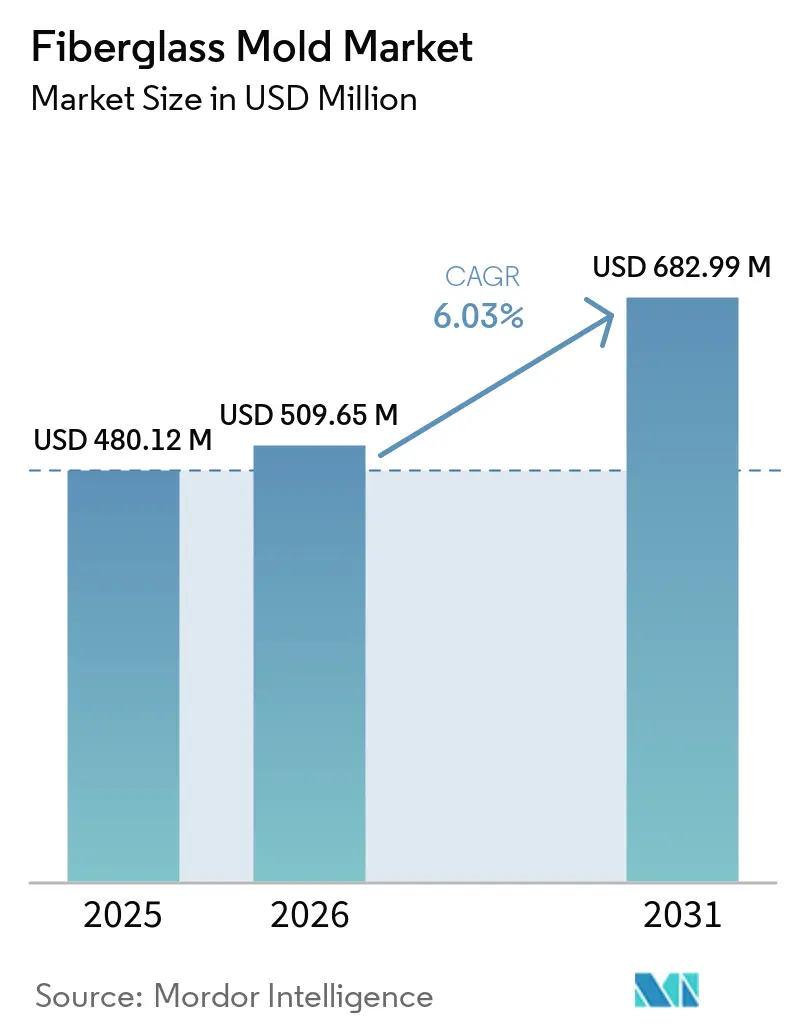
The Fiberglass Mold Market size was valued at USD 480.12 million in 2025 and is estimated to grow from USD 509.65 million in 2026 to USD 682.99 million by 2031, at a CAGR of 6.03% during the forecast period (2026-2031). The Fiberglass Mold Market is supported by investments in composite tooling for wind energy, aerospace, marine, and automotive applications. Mold buyers require dimensional accuracy because it affects the quality and consistency of composite parts produced with the tool. Demand aligns with aircraft production plans, wind turbine size, and composite manufacturing programs rather than broader economic conditions. Suppliers expand their digital design and automated manufacturing capabilities, while regional specialists compete by offering engineering support and faster design modifications. Frequent blade redesigns generate replacement demand before molds reach the end of their operational life.
Key Report Takeaways
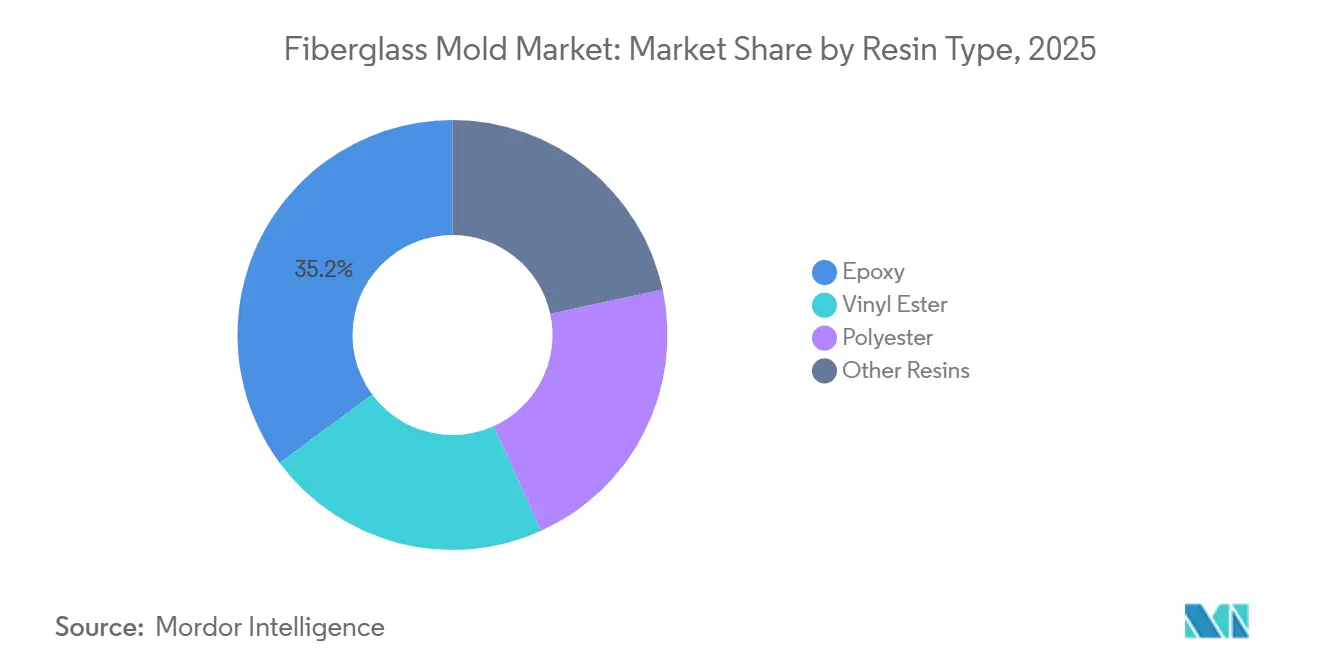
- By resin type, epoxy held 35.16% of the Fiberglass Mold Market share in 2025 and is forecast to expand at a CAGR of 6.78% through 2031.
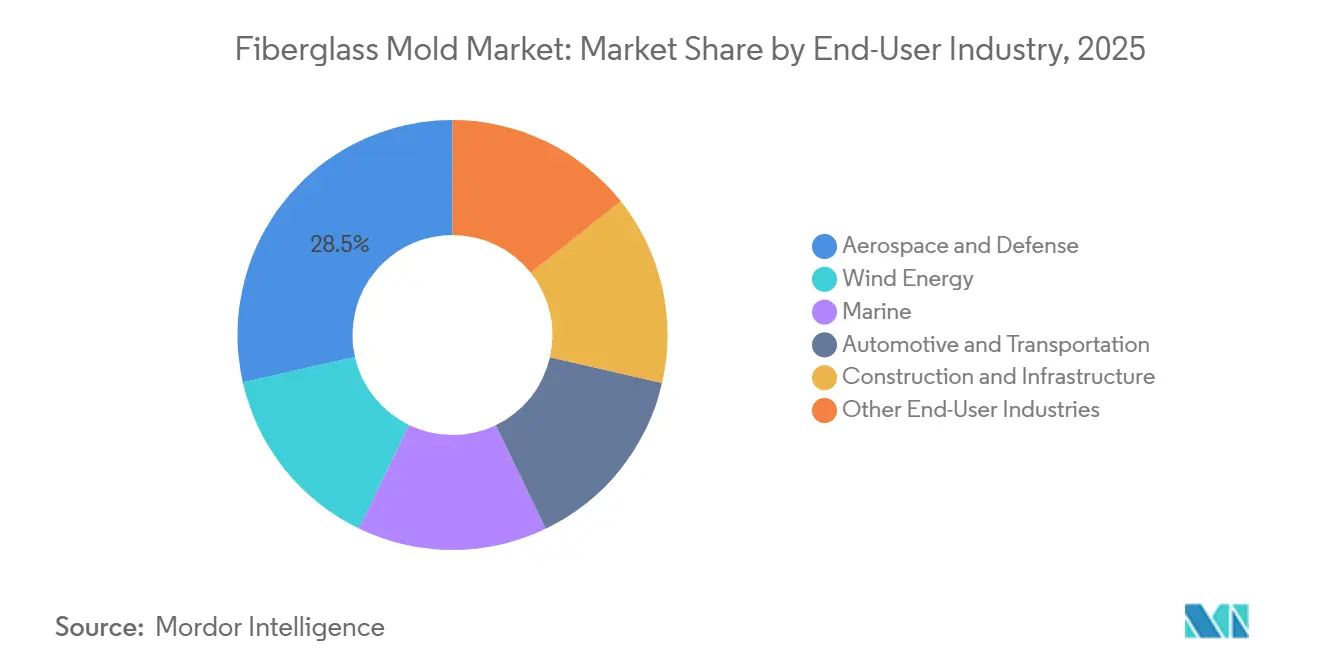
- By end-user industry, aerospace and defense accounted for 28.53% of the Fiberglass Mold Market share in 2025, while wind energy is forecast to grow at a 7.23% CAGR through 2031.
- By geography, Asia-Pacific accounted for 40.78% of the Fiberglass Mold Market share in 2025 and is forecast to expand at a 6.85% CAGR through 2031.
Note: Market size and forecast figures in this report are generated using Mordor Intelligence’s proprietary estimation framework, updated with the latest available data and insights as of January 2026.
Global Fiberglass Mold Market Trends and Insights
Drivers Impact Analysis*
| Drivers | (~) % Impact on CAGR Forecast | Geographic Relevance | Impact Timeline |
|---|---|---|---|
| Wind-Turbine Blade Manufacturing Expansion | +2.0% | Global, concentrated in APAC and North America | Medium term (2-4 years) |
| Lightweight Composite Adoption in Automotive and Transportation | +1.1% | North America, Europe, APAC | Medium term (2-4 years) |
| Aerospace, Defense, and Marine Composite Production | +0.9% | North America, Europe | Long term (≥ 4 years) |
| Automated, Digitally Machined and Additively Enabled Tooling | +0.8% | Global | Medium term (2-4 years) |
| Model-Renewal Cycles Requiring Replacement Tooling | +0.6% | Global | Short term (≤ 2 years) |
| Source: Mordor Intelligence | |||
Wind Turbine Blade Manufacturing Expansion Supports Long-Term Tooling Demand
The Fiberglass Mold Market benefits from offshore wind development through 2031, particularly as manufacturers invest in larger offshore turbine platforms and associated production lines. Larger turbines require dedicated tooling for blade shells, root assemblies, trailing-edge sections, and other blade components that must fit together consistently during production. As turbine ratings exceed 15 MW, each blade platform requires larger and more precise mold sets, increasing the need for surface quality and dimensional control.
Xinjiang Goldwind Science & Technology Co., Ltd. (Goldwind) delivered 16.2 MW turbines in Yangjiang, Guangdong, in 2026, indicating that large turbine formats have entered commercial delivery beyond early-stage development programs. New blade generations require purpose-built tooling, even when existing production capacity remains operational, because changes in aerodynamic profiles or root designs can render older molds unsuitable. Consequently, the Fiberglass Mold Market has a sustained source of procurement demand linked to turbine design modifications, component-line investments, and production plans rather than solely to annual installation levels. Replacement orders also arise when blade manufacturers introduce revised profiles before existing tools reach the end of their usable physical life.
Lightweight Composite Adoption in Automotive and Transportation Drives Mid-Market Tooling Entry
Automotive manufacturers use glass fiber-reinforced polymer components to reduce vehicle weight and offset the mass of battery packs in electric vehicles. These applications include body panels, floor modules, and structural inserts. This trend supports demand for fiberglass molds that deliver consistent surface finishes, controlled dimensions, and repeatable production cycles for higher-output component programs.
High-pressure resin transfer molding and vacuum infusion are relevant for vehicle platforms that require controlled fiber content, reliable part quality, and near-net-shape composite components. A 10% reduction in vehicle weight can improve fuel economy by 6% to 8%, supporting the use of lightweight composite components. Mold demand can also arise when manufacturers replace established metal components with composite designs, including instances where part consolidation changes the component design and production approach. Therefore, the Fiberglass Mold Market is exposed to redesign activity, production-quality requirements, and lightweighting programs that do not depend solely on total vehicle production. A shift from metal to composite parts can require new production tools even within an established vehicle platform.
Aerospace, Defense, and Marine Composite Production Establishes High-Value Tooling Demand
Aerospace manufacturers are expanding the use of out-of-autoclave composite processing, enabling fiberglass tooling applications that were previously less suitable for qualified aircraft programs. In September 2025, Syensqo and Teijin Carbon received FAA-sponsored National Center for Advanced Materials Performance (NCAMP) qualification for the PRISM EP2400 epoxy resin infusion system with Tenax IMS65 E23 24K reinforcement. The system was the first resin-infusion system in the NCAMP database and carried material data recognized under FAA and EASA frameworks.
Qualified material histories can help tool producers serve aircraft programs with material, process, traceability, and documentation requirements that new suppliers may require time to establish. In June 2026, Continuous Composites announced a multiyear U.S. Army contract to advance Continuous Fiber 3D (CF3D) manufacturing for precision-strike missile components[1]Continuous Composites, “Continuous Composites Engages in US Army ManTech Effort to Advance Manufacturing Approaches for Next-Generation Missile Components,” Continuous Composites, continuouscomposites.com.. Marine applications also support the Fiberglass Mold Market through hull, deck, and structural-panel fabrication, including superyacht construction and composite vessel retrofit programs, where tooling must maintain the required surface finish across repeated fabrication cycles.
Automated, Digitally Machined, and Additively Enabled Tooling Reshapes Cost and Speed Economics
Digital design, robotic deposition, and five-axis CNC finishing are changing how mold manufacturers produce complex tooling, particularly for customers requiring large tools within shorter delivery periods. These methods can reduce the time required to manufacture replacement tools and enable faster responses to revised blade designs without relying solely on traditional multi-part mold construction.
Belotti and Moi Composites introduced a hybrid thermoset composite manufacturing platform at JEC World 2026 that combines robotic short-fiber deposition with in-line CNC milling. The platform extends hybrid manufacturing beyond limited prototype applications into commercial composite production, where surface accuracy and repeatability remain important. Faster mold production can enable customers in the Fiberglass Mold Market to replace tools as product designs evolve, rather than waiting through conventional lead times. This capability reduces a constraint that previously delayed the transition of updated blade designs into production.
Restraints Impact Analysis*
| Restraints | (~) % Impact on CAGR Forecast | Geographic Relevance | Impact Timeline |
|---|---|---|---|
| High Initial Investment in Facilities and Specialized Equipment | -1.2% | Global, most acute in South America and Middle East and Africa (MEA) | Long term (≥ 4 years) |
| Skilled-Labor, Quality-Control, and Environmental-Compliance Burden | -0.9% | Europe, North America | Medium term (2-4 years) |
| Long Tool Life Delaying Replacement Demand | -0.8% | Global | Short term (≤ 2 years) |
| Source: Mordor Intelligence | |||
High Initial Investment in Facilities and Specialized Equipment Constrains New Entrant Activity
Producing a mold for a utility-scale wind blade requires temperature-controlled facilities, a precision master plug, and curing equipment capable of accommodating large surface areas and the heat generated during processing. The master plug must maintain tight dimensional accuracy across a large working surface, resulting in facility and machining requirements that differ from those for smaller composite tools. Large-blade mold sets can require capital investments of several million dollars before a supplier can serve a wind program. Offshore heated molds further increase investment requirements through embedded heating systems, steel frames, and turning equipment.
These requirements concentrate high-value tooling capacity in facilities in Europe and China, where manufacturers have production expertise and supporting equipment. South America, the Middle East, and Africa also have limited access to specialized gel coats, five-axis machining equipment, and certified composite technicians. As a result, supply capacity in the Fiberglass Mold Market shifts slowly toward emerging demand centers, supporting the position of facilities with large-format production capabilities.
Skilled-Labor, Quality-Control, and Environmental-Compliance Burden Creates Ongoing Operational Drag
Fiberglass mold production requires experienced personnel in composite lay-up, surface finishing, inspection, and resin handling, as each discipline affects tool consistency and quality. Developing these skills takes time, and manufacturers cannot rapidly expand qualified labor capacity through hiring alone, particularly for programs that require certified processes and repeatable quality standards.
Environmental regulations governing volatile organic compound emissions also impose recurring costs on manufacturers using polyester and vinyl ester resin systems. In 2025, AOC, INEOS Composites, Polynt, Scott Bader, and SIR Industriale completed a life-cycle assessment study of unsaturated polyester and vinyl ester resins[2]Scott Bader Company Limited, “New Life Cycle Assessment Data Available for UPRs and Vinyl Esters,” Scott Bader, scottbader.com.. The study added updated results to the Ecoinvent 3.11 database and reflected increasing customer and regulatory requirements for environmental documentation. Smaller producers in the Fiberglass Mold Market may face higher unit costs because they cannot distribute the costs of quality systems, compliance infrastructure, and environmental documentation across multiple high-volume programs. Consequently, these manufacturers may focus on lower-precision applications with less stringent process and reporting requirements.
*Our forecasts treat driver/restraint impacts as directional, not additive. The impact forecasts reflect baseline growth, mix effects, and variable interactions.
Segment Analysis
By Resin Type: Epoxy Leads Precision Tooling Demand
Epoxy accounted for 35.16% of the Fiberglass Mold Market in 2025 and is forecast to expand at a CAGR of 6.78% through 2031. This makes epoxy the largest and fastest-growing resin category in the market. Its curing characteristics result in lower shrinkage than polyester alternatives, which is important when mold accuracy determines the shape of large finished composite parts. Minor dimensional variations can affect aerodynamic surfaces and component fit across large assemblies. Epoxy also supports vacuum infusion processes used in wind energy, aerospace, and marine tooling applications, where manufacturers require stable and reproducible results.
The National Center for Advanced Materials Performance (NCAMP) qualified PRISM EP2400 for epoxy resin infusion in aerospace applications in September 2025. This qualification provides recognized material data for out-of-autoclave composite fabrication in accordance with NMS 241 and NPS 82401. Vinyl ester remains relevant for marine molds because it provides hydrolytic stability and resistance to osmotic blistering, which polyester systems lack in saltwater hull applications. Polyester retains a cost advantage over other materials for nonstructural and construction-related tooling, particularly in price-sensitive South Asian and Southeast Asian markets. Low-viscosity, fast-curing, and toughened epoxy grades are expanding the range of applications suitable for epoxy, supporting growth in the Fiberglass Mold Market for precision applications while narrowing the role of lower-cost resin systems.



By End-User Industry: Wind Energy Sets Growth Pace While Aerospace and Defense Lead Revenue
Aerospace and defense accounted for 28.53% of the Fiberglass Mold Market size in 2025. The segment relies on tolerance requirements and material qualification standards for commercial aircraft and defense programs. Wind energy is forecast to record the highest CAGR, at 7.23%, through 2031. Larger offshore turbines require matched molds for blade shells, root inserts, and trailing-edge assemblies that must function together within a defined production process. Each new turbine generation requires increased investment in associated mold sets as blade dimensions and structural requirements evolve.
In March 2026, Gurit signed a two-year supply contract with an Asia-Pacific wind turbine original equipment manufacturer for glass-pultruded blade-root reinforcements. The contract exceeds CHF 10 million (USD 11 million) over its term and supports next-generation blade structural requirements. Marine molds support the production of hulls, decks, and structural panels, while automotive and transportation tooling supports vehicle lightweighting and battery-electric vehicle range objectives. Construction and infrastructure tooling supports modular composite cladding and fiber-reinforced bridge deck programs. Other end uses, including sporting goods, marine leisure, and specialty equipment, provide a fragmented but steady demand base for regional suppliers in the Fiberglass Mold Market.
Geography Analysis
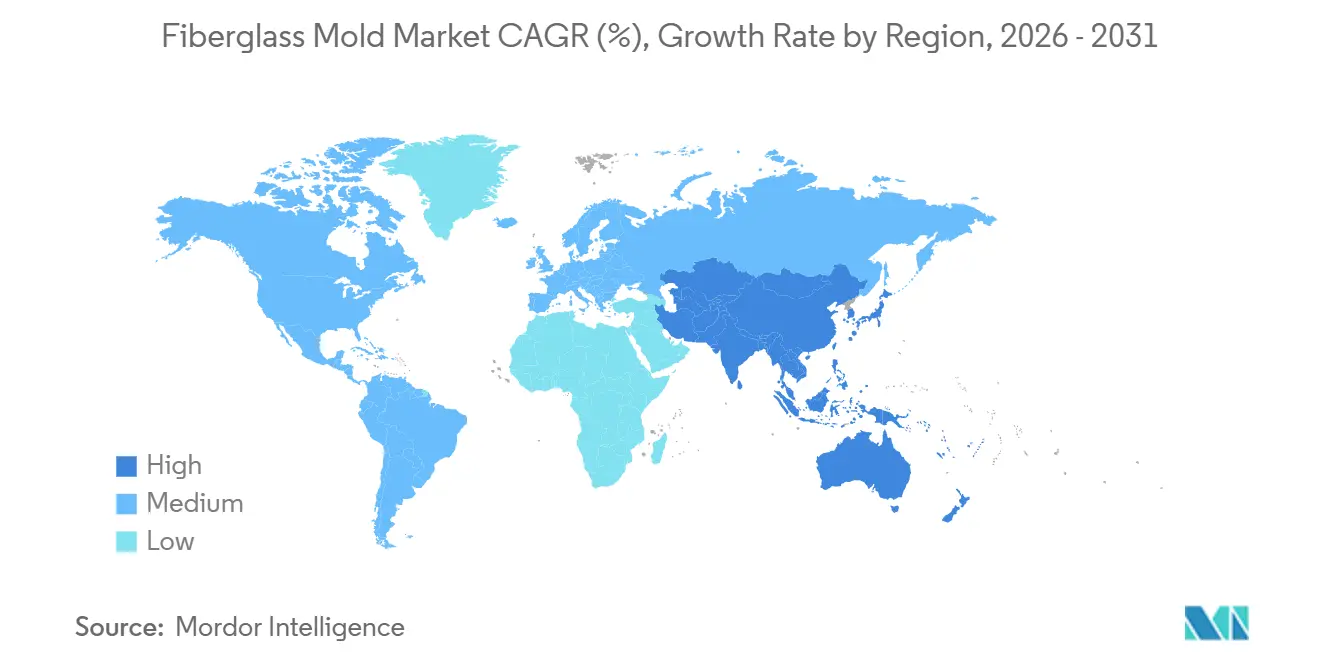
Asia-Pacific accounted for 40.78% of the Fiberglass Mold Market size in 2025 and is projected to expand at a CAGR of 6.85% through 2031. China’s offshore wind manufacturing base supports regional demand for large blade tooling, with molding activities located near coastal component production facilities. India’s renewable energy plans are driving investment in domestic turbine manufacturing and local composite tooling capacity. European mold providers are pursuing partnerships with Asia-Pacific manufacturers to develop local blade-tooling capabilities rather than supplying completed tools for export. Regional producers benefit from proximity to wind-component production lines and access to an established composite supply chain. These factors help manufacturers align mold deliveries with schedules for blades, components, materials, and production facilities. Local presence also reduces the logistical challenges of transporting large tools between locations and provides manufacturers with access to suppliers serving the regional wind sector.
North America is supported by demand for aerospace and defense composite tooling, with wind energy providing additional demand. In June 2026, Janicki Industries selected Great Falls, Montana, for a USD 800 million manufacturing campus spanning 2 million square feet over a decade. The expansion targets aerospace, defense, and space composite tooling requirements and is expected to create more than 1,000 jobs within its first five years. Europe is the second-largest region by revenue, supported by offshore wind activity in Denmark, Germany, and the United Kingdom. Producers must also comply with emissions requirements for resin systems. These requirements remain an operational consideration for mold fabricators using polyester and vinyl ester systems, while offshore wind and aerospace programs support demand for precision composite tools.
South America, the Middle East, and Africa remain smaller but developing regions in the Fiberglass Mold Market. Brazil’s onshore wind expansion supports baseline mold procurement; however, local production capacity for large-format molds remains limited, and European and Chinese suppliers receive a share of tooling expenditure. Saudi Arabia and the United Arab Emirates offer long-term potential as their energy and composites capabilities develop. Gaps in precision machining, certified labor, and transportation infrastructure for large molds continue to constrain near-term local production. Local suppliers must strengthen capabilities in machining, materials handling, composite fabrication, and logistics before they can compete consistently with established Asian and European manufacturers on large-format projects.

Competitive Landscape
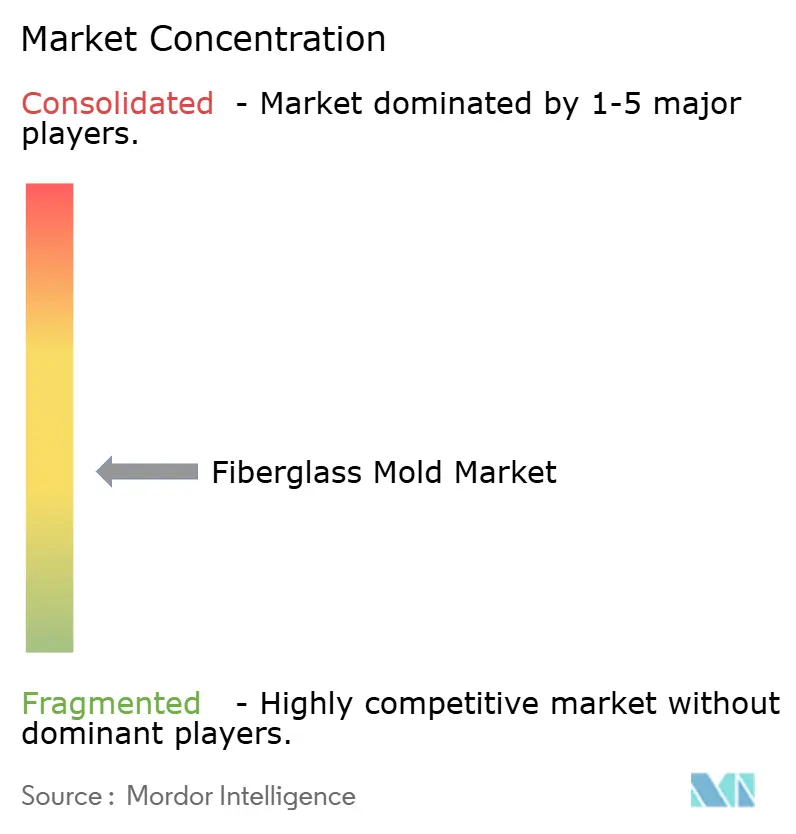
The Fiberglass Mold Market is moderately fragmented, with integrated materials and tooling suppliers, independent mold builders, and resin suppliers offering tooling services. Companies compete based on technical capabilities, manufacturing quality, and proximity to customer production lines. Gurit Holding AG combines materials expertise with industrial plugs and molds for wind blade production. Its OptiCore parametric design platform supports a five-year supply agreement with a wind turbine original equipment manufacturer (OEM). This approach positions the company through its design tools, material knowledge, and mold manufacturing capabilities. It also demonstrates how suppliers pursue longer-term customer relationships by supporting design, tooling, and material requirements rather than competing solely for individual mold orders.
Janicki Industries competes through precision manufacturing capabilities for aerospace, defense, and space applications. The June 2026 announcement for the Great Falls campus reflected an expansion strategy focused on long-term advanced manufacturing capacity. In April 2026, the company announced the addition of more than 270,000 square feet of production space across Washington and Utah. The Layton, Utah, facility received a 70,000-square-foot expansion to accommodate milling equipment for processing aerospace composite and metallic components. These investments address the need for specialized production capacity in the Fiberglass Mold Market and support programs with demanding tool size and quality requirements. The expansion reflects the importance of large production facilities, specialized milling equipment, and inspection capabilities for aerospace, defense, and space composite applications.
Smaller regional suppliers compete through lower costs, responsive engineering, and shorter iteration cycles for new blade profiles. Digital mold lifecycle management remains at an early stage among leading suppliers; however, the ability to monitor thermal gradients, surface wear, and infusion quality can serve as a differentiating factor. Resin suppliers are also placing greater emphasis on environmental credentials and formulation performance, supported by the 2025 life cycle assessment collaboration among major resin producers. Customer concentration in the wind energy industry remains a risk, as financial stress at a major blade producer can affect contracted tooling revenue. This risk increases when tool production, material commitments, and customer-specific engineering work depend on a limited number of blade programs.
Fiberglass Mold Industry Leaders
Gurit Holding AG
Janicki Industries, Inc.
TPI Composites, Inc.
Molded Fiber Glass Companies
Dencam Composite
- *Disclaimer: Major Players sorted in no particular order

Recent Industry Developments
- June 2026: Janicki Industries selected Great Falls, Montana, for an USD 800 million manufacturing campus expansion. The project will cover 2 million square feet over a decade on 180 acres at AgriTech Park and will address demand for composite tooling, including fiberglass molds, across the aerospace, defense, and space industries. Construction began in July 2026, and the first phase is expected to open by the end of 2027.
- March 2026: Gurit signed a two-year supply contract with an Asia-Pacific wind turbine OEM for glass-pultruded blade root reinforcements. The contract, valued at more than CHF 10 million (USD 11 million) over its term, supports structural requirements for next-generation wind turbine blades and demand for fiberglass mold-related composite applications.


Global Fiberglass Mold Market Report Scope
A fiberglass mold is a rigid, hollow manufacturing tool made from glass-fiber-reinforced resin. It provides a defined shape for producing consistent composite parts during fabrication.
The fiberglass mold market is segmented by resin type, end-user industry, and geography. By resin type, the market is segmented into epoxy, vinyl ester, polyester, and other resins. By end-user industry, the market is segmented into wind energy, marine, aerospace and defense, automotive and transportation, construction and infrastructure, and other end-user industries. The report also covers market size and forecasts for fiberglass mold across 15 countries in major regions. The market sizes and forecasts are provided in terms of value (USD).
| Epoxy |
| Vinyl Ester |
| Polyester |
| Other Resins |
| Wind Energy |
| Marine |
| Aerospace and Defense |
| Automotive and Transportation |
| Construction and Infrastructure |
| Other End-User Industries |
| Asia-Pacific | China |
| India | |
| Japan | |
| South Korea | |
| ASEAN Countries | |
| Rest of Asia-Pacific | |
| North America | United States |
| Canada | |
| Mexico | |
| Europe | Germany |
| United Kingdom | |
| France | |
| Italy | |
| NORDIC Countries | |
| Rest of Europe | |
| South America | Brazil |
| Argentina | |
| Rest of South America | |
| Middle East and Africa | Saudi Arabia |
| South Africa | |
| Rest of Middle East and Africa |
| By Resin Type | Epoxy | |
| Vinyl Ester | ||
| Polyester | ||
| Other Resins | ||
| By End-User Industry | Wind Energy | |
| Marine | ||
| Aerospace and Defense | ||
| Automotive and Transportation | ||
| Construction and Infrastructure | ||
| Other End-User Industries | ||
| By Geography | Asia-Pacific | China |
| India | ||
| Japan | ||
| South Korea | ||
| ASEAN Countries | ||
| Rest of Asia-Pacific | ||
| North America | United States | |
| Canada | ||
| Mexico | ||
| Europe | Germany | |
| United Kingdom | ||
| France | ||
| Italy | ||
| NORDIC Countries | ||
| Rest of Europe | ||
| South America | Brazil | |
| Argentina | ||
| Rest of South America | ||
| Middle East and Africa | Saudi Arabia | |
| South Africa | ||
| Rest of Middle East and Africa | ||


Key Questions Answered in the Report
What is current market size of Fiberglass Mold Market?
The Fiberglass Mold Market size was valued at USD 480.12 million in 2025 and is estimated to grow from USD 509.65 million in 2026 to USD 682.99 million by 2031, at a CAGR of 6.03% during the forecast period (2026-2031).
Which end-use application is growing fastest?
Wind energy is the fastest-growing end-user application, with a projected 7.23% CAGR through 2031. Larger turbines and revised blade designs require matched tooling sets for several blade components, raising the value and scale of supplier capabilities.
Why are wind turbine mold manufacturers important to customers?
Larger turbines and more frequent blade redesigns require dedicated mold sets for blade shells, root assemblies, and related components. Replacement demand can occur before molds have reached the end of their physical working life, particularly when a revised blade profile requires different tooling.
Which region leads fiberglass mold demand?
Asia-Pacific led with 40.78% in 2025 and is forecast to grow at a 6.85% CAGR through 2031. The region benefits from proximity to major wind-component manufacturing, established composite supply networks, and increasing domestic tooling capacity in key manufacturing locations.
Page last updated on:





