
Ferroalloys Market Size and Share
Market Overview
| Study Period | 2021 - 2031 |
|---|---|
| Market Size (2026) | USD 65.35 Billion |
| Market Size (2031) | USD 82.07 Billion |
| Growth Rate (2026 - 2031) | 4.66 % |
| Fastest Growing Market | Asia-Pacific |
| Largest Market | Asia-Pacific |
| Market Concentration | Low |
Major Players *Disclaimer: Major Players sorted in no particular order Image © Mordor Intelligence. Reuse requires attribution under CC BY 4.0. | |
Ferroalloys Market Analysis by Mordor Intelligence
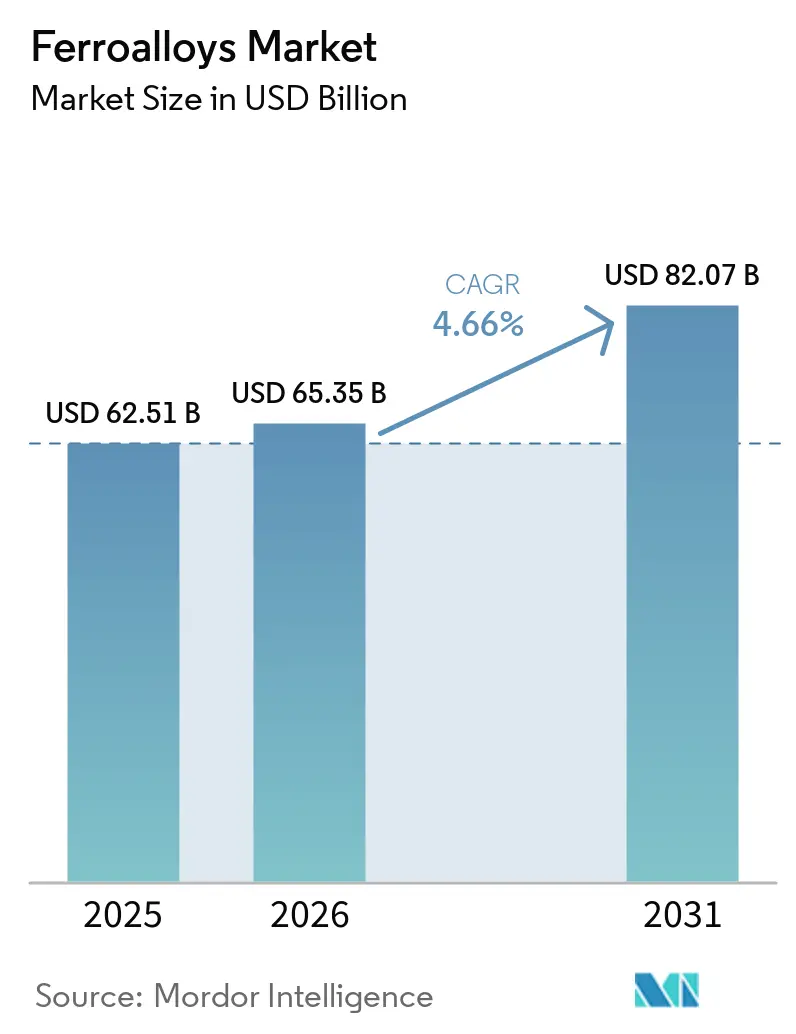
The ferroalloys market size was valued at USD 62.51 billion in 2025 and is estimated to grow from USD 65.35 billion in 2026 to reach USD 82.07 billion by 2031, at a CAGR of 4.66% during the forecast period (2026-2031). Ferroalloys are essential inputs in steelmaking, supporting alloying, deoxidation, desulfurization, and corrosion resistance in both blast furnace and electric arc furnace operations. Global crude steel production reached 1,849.4 Mt in 2025, while global steel demand is forecast at 1,724 Mt in 2026 and 1,762 Mt in 2027. The ferroalloys market is shaped by changes in steel production, as electric arc furnace capacity and demand for higher-grade steel increase the need for controlled alloy additions. India, Southeast Asia, and parts of Africa are contributing to demand growth, while China faces a weaker property cycle, shifting growth toward infrastructure, manufacturing, and specialty steel applications. Competitive strategies focus on secure ore access, reliable electricity, lower-carbon production routes, and the ability to supply specification-grade material for direct-reduced-iron and electric arc furnace steelmaking.
Key Report Takeaways
- By product type, ferrochromium held 28.78% of the ferroalloys market share in 2025, while ferrosilicon is forecast to expand at a 5.14% CAGR through 2031.
- By application, carbon and low-alloy steel accounted for 43.06% of the ferroalloys market in 2025, while cast iron is forecast to expand at a CAGR of 5.32% through 2031.
- By end-user industry, construction and infrastructure captured 38.47% of the ferroalloys market share in 2025, while automotive and transportation are forecast to grow at a 5.78% CAGR through 2031.
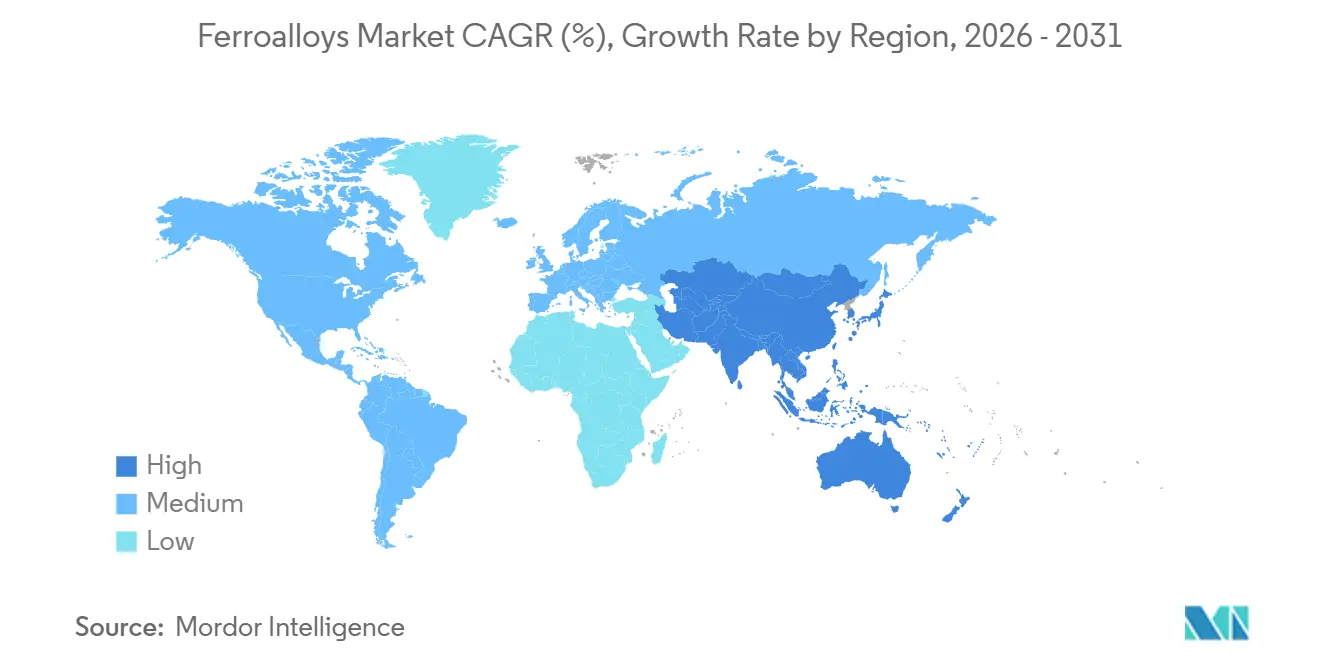
- By geography, Asia-Pacific accounted for 58.44% of regional revenue in 2025 and is forecast to grow at a 5.66% CAGR through 2031.
Note: Market size and forecast figures in this report are generated using Mordor Intelligence’s proprietary estimation framework, updated with the latest available data and insights as of January 2026.
Market Trends and Insights
Drivers Impact Analysis of Ferroalloys Market*
| Drivers | (~) % Impact on CAGR Forecast | Geographic Relevance | Impact Timeline |
|---|---|---|---|
| Structural Growth in Global Steel Production | +1.5% | Global, the highest pull from India, ASEAN, and Africa | Medium term (2-4 years) |
| Infrastructure, Housing, and Industrial Investment | +1.2% | Asia-Pacific, Middle East, Africa | Medium term (2-4 years) |
| Stainless-Steel, Automotive, and EV Material Demand | +0.9% | Global: highest in China, South Korea, Germany, India | Long term (≥ 4 years) |
| Low-Carbon Steelmaking and Higher-Purity Alloy Demand | +0.5% | EU, North America, Japan, South Korea, India | Long term (≥ 4 years) |
| Hydrogen-Ready Direct-Reduced-Iron Projects | +0.3% | EU, Middle East, India, Sweden | Long term (≥ 4 years) |
| Source: Mordor Intelligence | |||
Structural Growth in Global Steel Production
Global steel output remains the primary demand signal for the ferroalloys market. World steel demand is forecast at 1,724 Mt in 2026 and 1,762 Mt in 2027. This regional growth partly offsets a weaker outlook in China and broadens the customer base for manganese, chromium, and silicon alloys. Electric arc furnace steelmaking requires closely controlled alloy chemistry because scrap can introduce residual elements that are harder to manage in the melt. Global direct-reduced iron (DRI) production reached a record 151 Mt in 2025, increasing 7.2% year over year, with MIDREX plants accounting for 82.3 Mt of that total.
The growth of DRI production adds a quality dimension to demand for steel-related alloys. Melt shops using higher DRI shares require inputs with more consistent composition and lower residual content, which supports demand for specification-grade ferroalloys rather than bulk grades alone. The ferroalloys market, therefore, benefits from both steel production output and the higher quality requirements of newer steelmaking routes. Producers that can maintain consistent chemistry have a clearer path into electric arc furnace supply chains. These requirements also make production control, ore selection, and reliable power supply more important to supplier competitiveness.
Infrastructure, Housing, and Industrial Investment
Infrastructure investment supports demand for structural steel, reinforcing bars, engineering steel, and long products that use ferroalloys. Higher specifications for seismic zones and coastal applications may require tighter silicon and manganese tolerances than older structural grades. As a result, the ferroalloys market can benefit from changes in steel quality requirements, even where tonnage growth is modest. Demand is distributed across buildings, transportation systems, ports, rail corridors, and industrial facilities.
The geographic pattern of construction demand matters as much as aggregate steel output. The economies of India, Southeast Asia, and Africa are important because they combine infrastructure needs with expanding manufacturing bases. China remains the largest single consumer of ferroalloys, but its steel demand is forecast to contract 1.5% in 2026 as the property correction continues. Japan presents a more mixed picture, with civil construction and shipbuilding holding stable or improving modestly while automotive demand faces pressure. The Japan Iron and Steel Federation identifies competition from Chinese electric vehicles and US tariff policy as factors affecting the automotive outlook[1]. This end-use variation makes regional sales planning more important for ferroalloy suppliers.
Stainless Steel, Automotive, and Electric Vehicle (EV) Material Demand
Stainless steel is a major source of demand for ferrochromium because chromium is essential to its corrosion resistance. The International Chromium Development Association reported that strong stainless steel output continued to support demand for chrome ore and ferrochromium in the first half of 2026. This relationship gives ferrochromium a direct link to stainless steel production cycles. Automotive producers also use advanced high-strength steel in electric vehicle structures, battery enclosures, and safety systems. These grades require carefully controlled additions of manganese and silicon, and the shift toward stronger vehicle steels can raise alloy intensity per vehicle.
The automotive picture differs across major producing countries. Japan's specialty steel outlook is more constrained because automotive demand is under pressure, even though shipbuilding remains at high utilization. The ferroalloys market is therefore exposed to both the output of steel used in vehicles and the composition of the selected steel grades. Ferromanganese and ferrosilicon benefit when producers adopt grades that require greater strength, formability, or corrosion protection. Demand from stainless steel, automotive, and electric vehicle applications together favors producers that can supply consistent grades over long customer qualification cycles.
Low-Carbon Steelmaking and Higher-Purity Alloy Demand
The transition toward electric arc furnace production and increased use of DRI has created demand for higher-purity ferroalloys. India produced 58.8 Mt of DRI in 2025, an increase of 7.4% from the prior year, according to MIDREX. China has also set a target for electric-furnace steel to exceed 15% of national output, which would increase demand for inputs that meet the chemistry requirements of electric arc furnaces. Low-phosphorus ferromanganese and medium-carbon ferrochromium are well aligned with this production route. Lower residual content helps steelmakers manage the quality limits associated with scrap and DRI, creating a more favorable position for suppliers with controlled raw materials and stable process quality.
Hydrogen-ready DRI projects reinforce this need, as they are intended to feed low-emission electric arc furnace steelmaking. An International Council on Clean Transportation (ICCT) study estimated ferroalloy input costs at USD 1,214.19 per ton in US hydrogen-DRI-electric arc furnace green steel production, representing 38% of total resource costs. This indicates that ferroalloys remain important inputs in a lower-carbon steel pathway. The opportunity is not limited to greater material demand; it also depends on the ability to supply grades that meet strict chemistry specifications. The ferroalloys industry is therefore increasingly differentiated by purity, carbon content, and reliability rather than output alone. This shift can support suppliers of premium grades but raises the technical and capital requirements for smaller producers.
Restraints Impact Analysis of Ferroalloys Market*
| Restraints | (~) % Impact on CAGR Forecast | Geographic Relevance | Impact Timeline |
|---|---|---|---|
| Electricity and Reductant Cost Volatility | -0.9% | South Africa, Europe, and India, with wider effects on global smelting margins | Short term (≤ 2 years) |
| Concentrated Ore Supply and Logistics Disruptions | -0.8% | Global, with origin risk concentrated in South Africa and Kazakhstan | Medium term (2-4 years) |
| Carbon Compliance and Retrofit Burden | -0.5% | EU importers and high-emission exporters in South Africa, China, and India | Long term (≥ 4 years) |
| Source: Mordor Intelligence | |||
Electricity and Reductant Cost Volatility
Electricity costs are a major restraint on ferroalloy production because submerged arc furnaces are highly energy-intensive. Energy can account for 40%-60% of ferroalloy production costs, leaving smelter margins highly exposed to power prices. South Africa illustrates the scale of this issue, as electricity tariffs rose by more than 900% since 2008. By late 2025, only 8 of more than 80 ferroalloy furnaces were operating in the country. These conditions reduced the international competitiveness of local smelting despite the country's strong ore position and increased the importance of electricity contracts in capacity operation and investment decisions.
This constraint extends beyond South Africa. Transalloys issued retrenchment notices in December 2025 after high electricity costs made competing internationally difficult. High energy prices in Europe also created pressure on steel and ferroalloy capacity. Producers with captive hydroelectric power or lower-cost contracted electricity hold a material cost advantage. This favors production locations such as China and Norway over regions with high or volatile power prices. As a result, the ferroalloys market can see capacity shifts even when ore availability remains unchanged. For buyers, this concentration increases the value of geographically diversified supply arrangements.
Concentrated Ore Supply and Logistics Disruptions
Chromium supply is concentrated in a limited number of producing areas. Kazakhstan and Southern Africa hold 95% of the world's chromium ore resources[2]. South Africa accounted for 23 Mt of chromite ore output in 2025 and remains a central supply base for ferrochromium. This concentration means that policy changes, transport constraints, power shortages, or operational disruptions can quickly affect global availability. South Africa's support for possible chrome ore export controls in October 2025 added uncertainty about future raw material flows. Large integrated producers are better positioned to manage this risk, as they can combine ore, smelting, and logistics operations.
Manganese supply faces similar exposure to logistics disruptions. Eramet reported that its Gabon operations were disrupted following a plant fire in early 2026, while its capital program included spending to improve the logistics chain in Gabon. Smaller smelters that purchase ore and reductants on spot markets have less protection from such disruptions. Delays in ore movement can raise costs and affect delivery performance. The same risk applies when a major producing country changes its export policy. Secure supply is therefore a key competitive issue in the ferroalloys market and helps explain why downstream steelmakers may favor suppliers with integrated sourcing systems.
*Our forecasts treat driver/restraint impacts as directional, not additive. The impact forecasts reflect baseline growth, mix effects, and variable interactions.
Ferroalloys Market Segment Analysis
By Product Type:
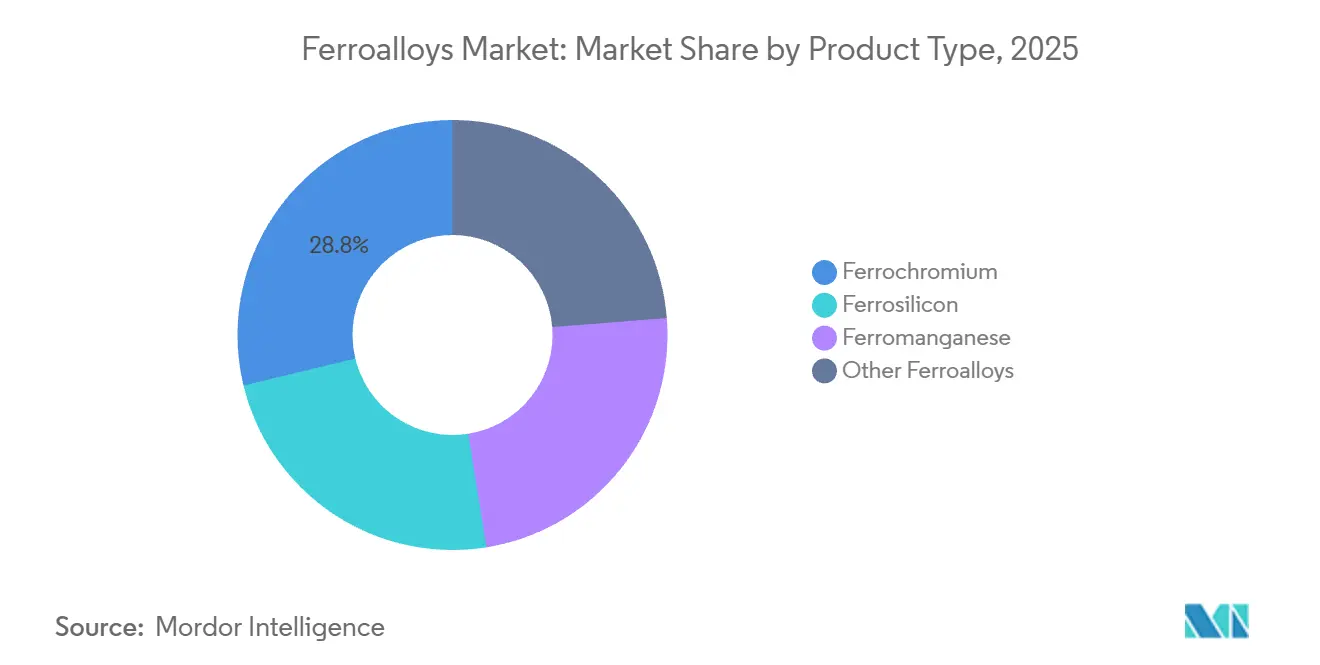
Silicon Leads Growth as Alloy Mix DiversifiesFerrochromium held 28.78% of product revenue in 2025, making it the largest product category in the ferroalloys market. Its position reflects the chromium requirements of stainless steel production and the scale at which stainless steel is manufactured. Ferrosilicon is projected to be the fastest-growing product type, at a 5.14% CAGR between 2026 and 2031. It is used as a deoxidizer in electric arc furnace steelmaking and also serves silicon-related applications. In August 2025, Ferroglobe converted two furnaces, one in the United States and one in Europe, from producing silicon metal to producing ferrosilicon. The conversion added 35,000-40,000 tons of annual ferrosilicon capacity in response to stronger product economics.
China added high-carbon ferrochromium capacity in the first half of 2026, which temporarily altered regional supply balances before a seasonal demand slowdown moderated price momentum. Ferromanganese remains important for sulfur control in carbon and alloy steels. Other ferroalloys, including ferronickel, ferrovanadium, and ferromolybdenum, serve more specialized requirements in aerospace, defense, and energy equipment. Electric arc furnace operations require lower-phosphorus ferromanganese and lower-carbon ferrochromium to manage residual elements. European safeguard measures introduced in November 2025 have also affected sourcing decisions. Elkem resumed production at its Rana and Salten plants and stated that supply tightening could support prices following the EU's reduction of tariff-free steel quotas from July 2026.

By Application:
Carbon Steel Dominates Output, Foundry Segment Records Faster GrowthCarbon and low-alloy steel accounted for 43.06% of the ferroalloys market in 2025, the largest share of any application. Carbon and low-alloy steel are widely used in structural construction, pipelines, automotive bodies, and general engineering, providing the core output base for the ferroalloys market. Alloy and special steel have higher ferroalloy content per ton due to the precise requirements of aerospace tools, power equipment, and nuclear-grade plate. Stainless steel is also widely used, as it contains chromium, which provides corrosion resistance. Jindal Stainless reported Q1 FY2027 net revenue of INR 11,279 crore (USD 1.35 billion), up 10.5% year over year, following the commissioning of its Indonesian melt shop in March 2026.
Cast iron is the fastest-growing application, with a forecast CAGR of 5.32% through 2031. Foundries use ferrosilicon to control graphite morphology and ferromanganese to improve tensile performance in cast iron grades. Electric vehicle motor components and precision-cast suspension parts support higher specification requirements, broadening the ferroalloys market beyond primary steel products. India's passenger vehicle sales are forecast at 6-6.5 million units in FY2026-27, which supports foundry activity and associated alloy demand. Other applications include welding electrodes, superalloys, and electronics-related specialty uses. While these uses add demand at smaller quantities and do not materially change the overall application mix, they support demand for selected premium grades.
By End-User Industry:
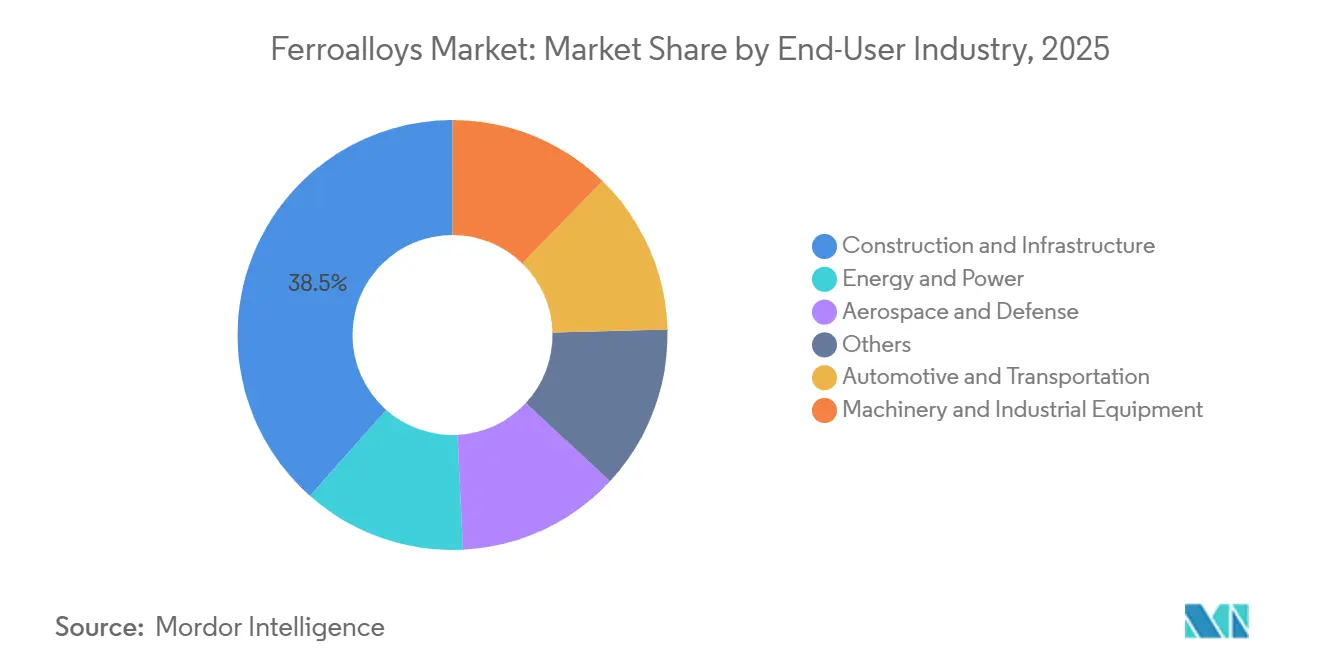
Construction Anchors Output, Automotive Records Fastest GrowthConstruction and infrastructure held 38.47% of end-user revenue in 2025. The segment uses alloyed steel in reinforcing bars, structural sections, bridges, buildings, and transport infrastructure. Infrastructure and manufacturing investment in India, Southeast Asia, and Africa supports this demand base, giving the ferroalloys market a broad base of recurring construction demand. China's infrastructure investment is also expected to provide incremental demand as local governments respond to weakness in the property sector.
Automotive and transportation are forecast to grow at a 5.78% CAGR through 2031, the fastest rate among end-user industries. Advanced high-strength steel used in electric vehicle structures, battery enclosures, and crash systems requires more controlled manganese additions than conventional vehicle steel, raising the role of ferroalloys in vehicle-grade steel and creating a higher-value demand stream within the ferroalloys market. Machinery and industrial equipment generate steady demand for engineering steels used in mining, construction, and industrial machinery. Energy and power applications require high-specification alloys for offshore wind, nuclear structures, and pipelines. Aerospace and defense remain small-quantity end users but require premium grades of ferronickel, ferrovanadium, and ferrotitanium.
Geography Analysis
APAC Ferroalloys Market
Asia-Pacific accounted for 58.44% of regional revenue in 2025 and is expected to record the fastest regional growth at a 5.66% CAGR through 2031. China is the region's largest production and consumption center, home to the world's largest steelmaking system. This scale makes Asia-Pacific the central demand area in the ferroalloys market. Electric arc furnace expansion continues to raise alloy intensity per ton of steel produced. India presents a contrasting growth outlook, with crude steel production reaching 164.9 Mt in 2025, up 10.4% year over year.
North America Ferroalloys Market
Japan has stable demand from shipbuilding and civil construction, although its automotive outlook is weaker. South Korea maintains demand from automotive, shipbuilding, and equipment supply chains. Mexico contributes to demand through its role in automotive assembly. Ferroglobe has cited Western industrial policy and domestic supply as relevant to its market positioning.
EMEA and South America Ferroalloys Market
Europe faces the combined effects of decarbonization requirements, high energy prices, and import competition. The EU Carbon Border Adjustment Mechanism entered its definitive phase on January 1, 2026, affecting iron, steel, and related carbon-intensive inputs. In South America, demand is centered on Brazil, where steel demand grew 7.8% in 2025 before the regional outlook moderated. In the Middle East and Africa, demand is supported by infrastructure programs. South Africa remains a critical source of ferrochromium due to its chromite ore base.
Competitive Landscape
The ferroalloys market is fragmented. Large integrated producers operate chrome assets in South Africa and Kazakhstan, and silicon and manganese operations in Norway and France. Chinese state-linked entities also hold significant capacity positions. Hundreds of smaller smelters operate in China, India, and Kazakhstan. This structure limits pricing power for many suppliers. Cost efficiency, access to electricity, and captive raw materials are, therefore, central competitive factors.
Ferroglobe highlights its Western operations as a differentiator under EU and US critical-material policy frameworks. The company is also evaluating the restart of operations in Venezuela near hydroelectric power facilities. EU safeguard measures approved in November 2025 provided European producers with greater protection against import pressure. The EU carbon mechanism further favors lower-emission supply into the region. These policies can influence purchasing decisions alongside underlying alloy prices. Producers with lower-emission output and regional supply can benefit from this market structure.
Eramet signed a memorandum of understanding with the Gabonese Republic in July 2026 for a 265,000-ton-per-year manganese alloys plant near coastal logistics infrastructure. Glencore-Merafe finalized a negotiated electricity pricing agreement at 62c/kWh with Eskom in June 2026, enabling the restart of the Boshoek and Wonderkop smelters. Smaller producers in Kazakhstan, India, and Indonesia are expanding output and developing direct relationships with Asian electric arc furnace operators. Competition is increasingly centered on quality, supply reliability, power costs, and delivery distance. Integrated producers hold a stronger position when logistics disruptions or power-price differences affect smaller independent smelters.
Ferroalloys Industry Leaders
-
Glencore
-
China Minmetals Corporation
-
Tata Steel
-
Ferroglobe
-
Samancor Chrome
- *Disclaimer: Major Players sorted in no particular order

Ferroalloys Market Companies Covered in this Report
- Assmang Ltd
- China Minmetals Corporation
- Elkem ASA
- Eramet
- Erdos Group
- Eurasian Resources Group
- Ferro Alloys Corporation Ltd.(FACOR)
- Ferroglobe
- Finnfjord AS
- Glencore
- Jindal Stainless Limited
- OM Holdings Ltd.
- SAIL
- Samancor Chrome
- Tata Steel
Recent Industry Developments in Ferroalloys Market
- March 2026: Jindal Stainless commissioned its 1.2 MTPA stainless steel melt shop in Indonesia through its joint venture, ahead of schedule, raising total global melting capacity in the ferroalloys industry to 4.2 MTPA. The company also committed an additional INR 900 crore (approximately USD 108 million) to increase downstream cold rolling capacity from 2.05 MTPA to 2.67 MTPA by FY28.
- February 2026: The Glencore-Merafe Chrome Venture recommissioned 50% of the Lion Smelter's operating capacity at Steelpoort, Limpopo Province, recording its first ferrochrome production tap on February 16, 2026. The restart followed the National Energy Regulator of South Africa's approval of a 12-month interim electricity tariff of 87.74c/kWh, supporting ferrochrome output in the ferroalloys market.
Global Ferroalloys Market Report Scope
Ferroalloy is a mixture of iron combined with a high proportion of one or more other elements, such as manganese, silicon, or chromium. It is primarily used as a raw material in steelmaking and metal production, where it introduces alloying elements into molten steel or iron.
The ferroalloys market is segmented by product type, application, end-user industry, and geography. By product type, the market is segmented into ferrosilicon, ferromanganese, ferrochromium, and other ferroalloys. By application, the market is segmented into carbon and low alloy steel, stainless steel, alloy and special steel, cast iron, and others. By end-user industry, the market is segmented into construction and infrastructure, automotive and transportation, machinery and industrial equipment, energy and power, aerospace and defense, and others. The report also covers market size and forecasts for ferroalloys across 15 countries in major regions. The market sizes and forecasts are provided in terms of value (USD).
Segmentation Overview
| Ferrosilicon |
| Ferromanganese |
| Ferrochromium |
| Other Ferroalloys |
| Carbon and Low Alloy Steel |
| Stainless Steel |
| Alloy and Special Steel |
| Cast Iron |
| Others |
| Construction and Infrastructure |
| Automotive and Transportation |
| Machinery and Industrial Equipment |
| Energy and Power |
| Aerospace and Defense |
| Others |
| Asia-Pacific | China |
| India | |
| Japan | |
| South Korea | |
| ASEAN Countries | |
| Rest of Asia-Pacific | |
| North America | United States |
| Canada | |
| Mexico | |
| Europe | Germany |
| United Kingdom | |
| France | |
| Italy | |
| NORDIC Countries | |
| Rest of Europe | |
| South America | Brazil |
| Argentina | |
| Rest of South America | |
| Middle East and Africa | Saudi Arabia |
| South Africa | |
| Rest of Middle East and Africa |
| By Product Type | Ferrosilicon | |
| Ferromanganese | ||
| Ferrochromium | ||
| Other Ferroalloys | ||
| By Application | Carbon and Low Alloy Steel | |
| Stainless Steel | ||
| Alloy and Special Steel | ||
| Cast Iron | ||
| Others | ||
| By End-User Industry | Construction and Infrastructure | |
| Automotive and Transportation | ||
| Machinery and Industrial Equipment | ||
| Energy and Power | ||
| Aerospace and Defense | ||
| Others | ||
| By Geography | Asia-Pacific | China |
| India | ||
| Japan | ||
| South Korea | ||
| ASEAN Countries | ||
| Rest of Asia-Pacific | ||
| North America | United States | |
| Canada | ||
| Mexico | ||
| Europe | Germany | |
| United Kingdom | ||
| France | ||
| Italy | ||
| NORDIC Countries | ||
| Rest of Europe | ||
| South America | Brazil | |
| Argentina | ||
| Rest of South America | ||
| Middle East and Africa | Saudi Arabia | |
| South Africa | ||
| Rest of Middle East and Africa | ||
Key Questions Answered in the Report
What is current market size of Ferroalloys Market?
The ferroalloys market size was valued at USD 62.51 billion in 2025 and is estimated to grow from USD 65.35 billion in 2026 to reach USD 82.07 billion by 2031, at a CAGR of 4.66% during the forecast period (2026-2031).
Which product category leads ferroalloy demand?
Ferrochromium led product revenue with 28.78% in 2025. Its position is closely tied to stainless steel production, where chromium is essential for corrosion resistance. Stainless output and the availability of chrome ore, therefore, have a direct effect on demand for this category.
Why are electric furnaces important to ferroalloy suppliers?
Electric arc furnaces require controlled alloy chemistry because scrap can contain residual elements. This raises demand for lower-residual, specification-grade ferroalloys, especially where Direct Reduced Iron (DRI) is used in the steelmaking charge. The ferroalloys market benefits when customers prioritize repeatable chemistry and reliable quality over bulk material alone.
Which end-user sector has the highest ferroalloy growth outlook?
Automotive and transportation are the fastest-growing end-user segment, with a projected 5.78% CAGR through 2031. Advanced high-strength steels in electric vehicle structures and battery enclosures require carefully controlled manganese additions. Machinery, energy, aerospace, and defense also require selected alloy grades, but at lower volumes.