
Feed Non-Protein Nitrogen Market Size and Share
Market Overview
| Study Period | 2021 - 2031 |
|---|---|
| Market Size (2026) | USD 1.28 Billion |
| Market Size (2031) | USD 1.62 Billion |
| Growth Rate (2026 - 2031) | 4.82 % |
| Fastest Growing Market | Asia-Pacific |
| Largest Market | Asia-Pacific |
| Market Concentration | Medium |
Major Players *Disclaimer: Major Players sorted in no particular order Image © Mordor Intelligence. Reuse requires attribution under CC BY 4.0. | |
Feed Non-Protein Nitrogen Market Analysis by Mordor Intelligence
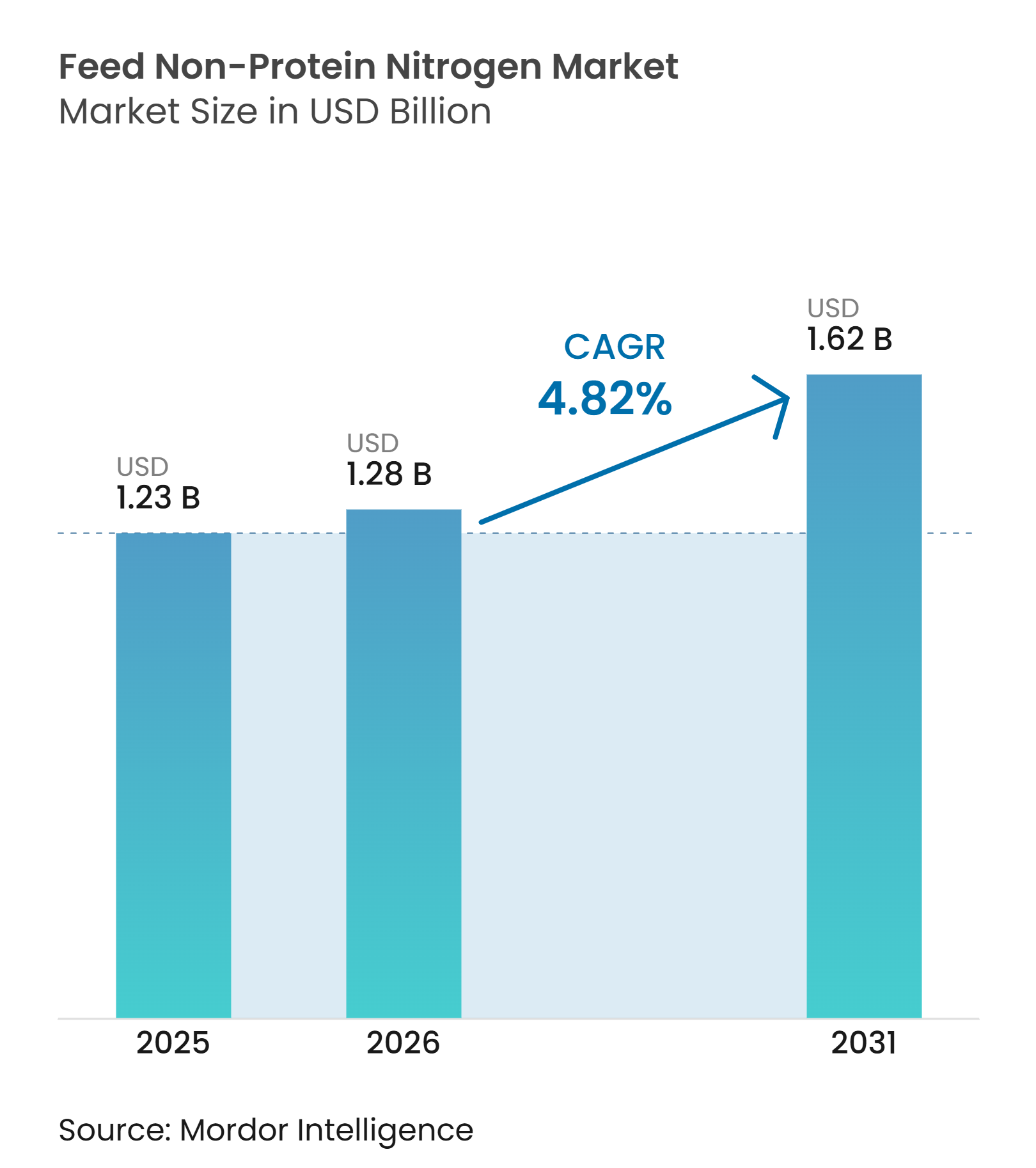
The feed non-protein nitrogen market size was valued at USD 1.23 billion in 2025 and is projected to grow from USD 1.28 billion in 2026 to USD 1.62 billion by 2031, registering a CAGR of 4.82% from 2026 to 2031. Feed non-protein nitrogen (NPN) provides ruminants with protein-equivalent nitrogen at a lower cost than many conventional protein meals. Its use depends on the difference between protein-meal prices and urea input costs, making ingredient pricing central to purchasing decisions. Larger dairy and beef herds sustain steady demand, as ruminant diets require reliable nitrogen supplies. Slow-release products are gaining attention for their ability to manage ammonia release more gradually and support safer formulation practices. Suppliers are therefore balancing broad commodity distribution with more specialized products for operators that require tighter feeding control.
Key Report Takeaways
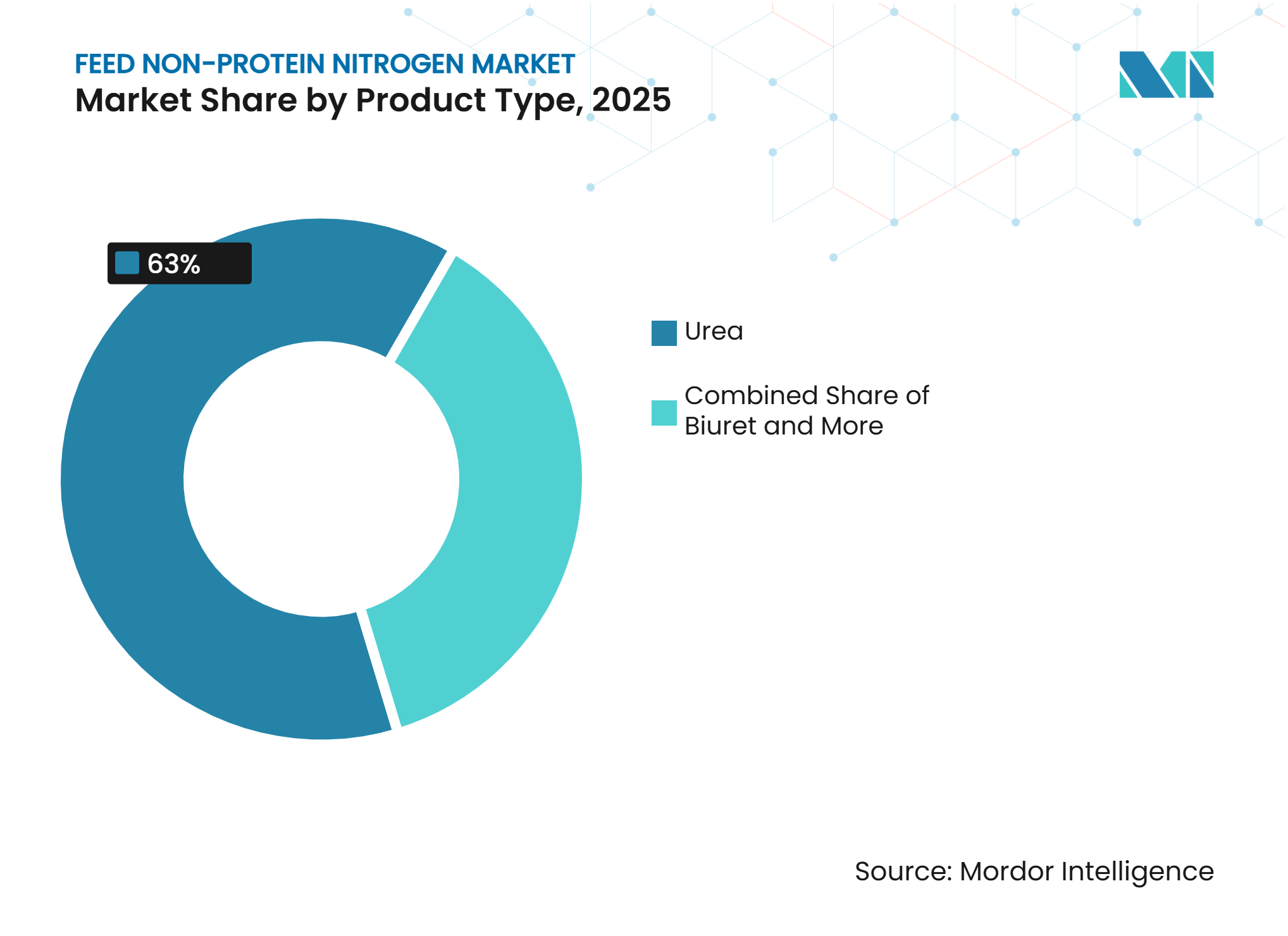
- By product type, urea accounted for the largest 63.0% of the feed non-protein nitrogen market share in 2025, while biuret is projected to grow at the fastest CAGR of 6.5% from 2026 to 2031.
- By form, dry accounted for the largest share at 75.0% in 2025, while the feed non-protein nitrogen market size for liquid is projected to grow at the fastest CAGR of 5.8% from 2026 to 2031.
- By animal type, dairy cattle accounted for the largest share at 60.0% in 2025, while sheep and goats are projected to grow at the fastest CAGR of 5.2% from 2026 to 2031.
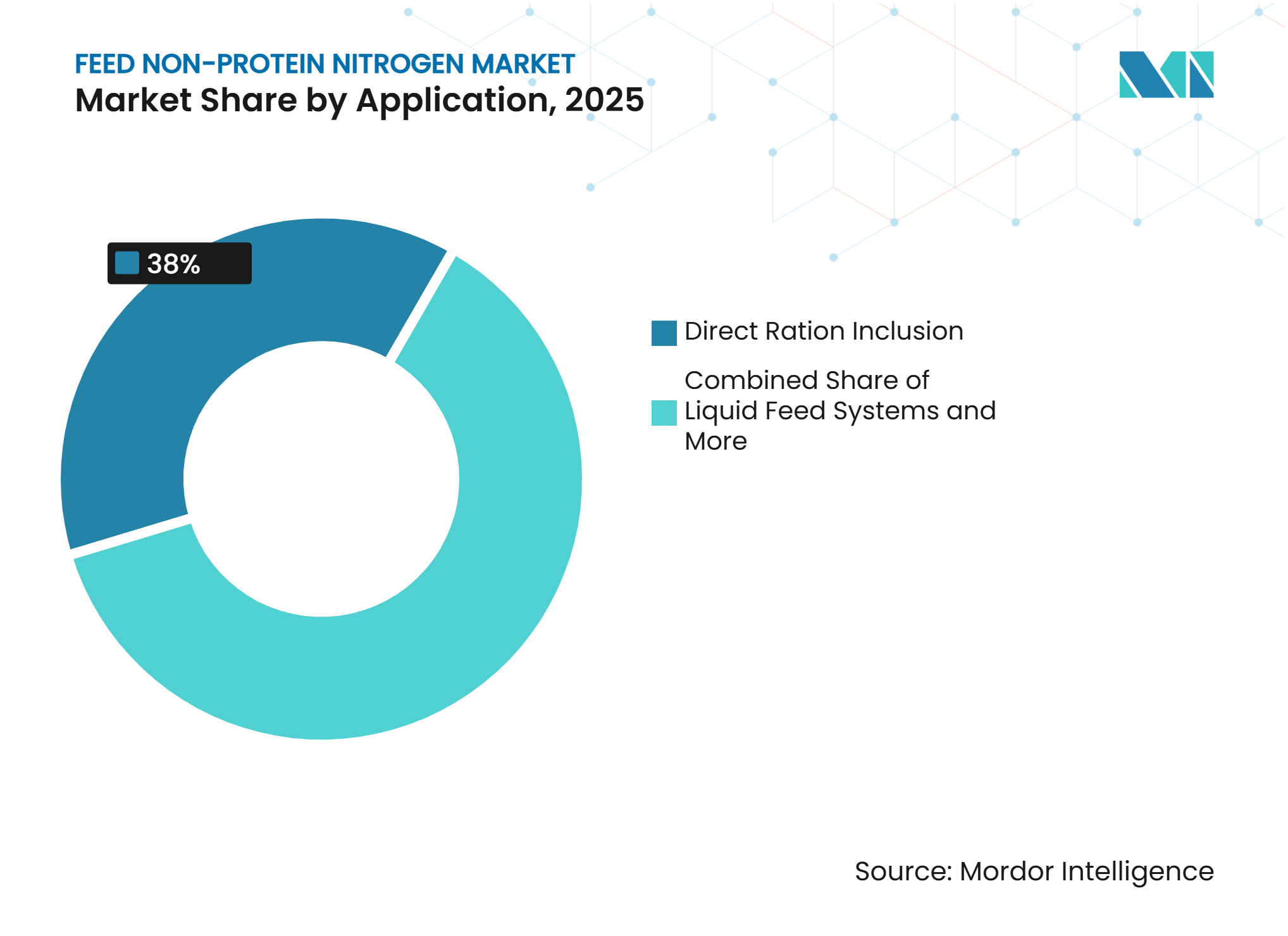
- By application, direct ration inclusion accounted for the largest share at 38.0% in 2025, while non-protein nitrogen-fortified complete feed is projected to grow at the fastest CAGR of 5.5% from 2026 to 2031.
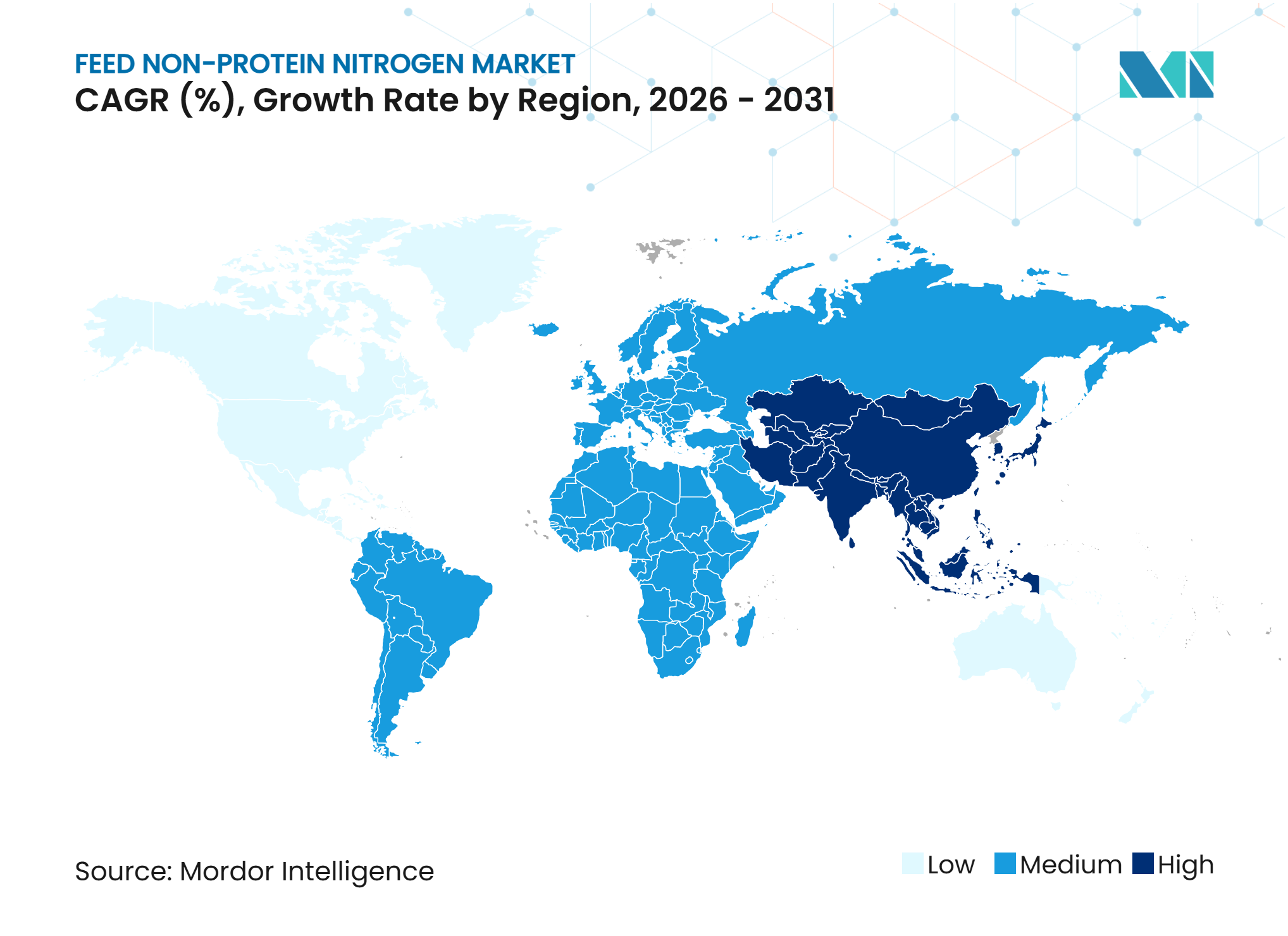
- By geography, Asia-Pacific accounted for the largest share at 38.0% in 2025 and is projected to grow at the fastest CAGR of 5.4% from 2026 to 2031.
Note: Market size and forecast figures in this report are generated using Mordor Intelligence’s proprietary estimation framework, updated with the latest available data and insights as of January 2026.
Market Trends and Insights
Drivers Impact Analysis of Feed Non-Protein Nitrogen Market*
| Driver | (~) % Impact on CAGR Forecast | Geographic Relevance | Impact Timeline |
|---|---|---|---|
| Cost advantage versus conventional protein meals | +1.2% | Global, strongest in Asia-Pacific, South America, and Africa | Short term (≤ 2 years) |
| Expansion of commercial dairy and beef production | +1.0% | Asia-Pacific, South America, and the Middle East | Medium term (2-4 years) |
| Rising demand for milk and meat productivity | +0.8% | Global, especially India, Southeast Asia, and Sub-Saharan Africa | Long term (≥ 4 years) |
| Protein-price volatility and feed-cost optimization | +0.6% | Global, especially North America and Europe | Short term (≤ 2 years) |
| Slow-release and encapsulated non-protein nitrogen formulations | +0.5% | North America, Europe, and leading Asia-Pacific dairy markets | Medium term (2-4 years) |
| Precision feeding and nitrogen-use efficiency | +0.4% | North America, Europe, and Australasia | Long term (≥ 4 years) |
| Source: Mordor Intelligence | |||
Cost Advantage Versus Conventional Protein Meals
Ruminal conversion of non-protein nitrogen into microbial protein allows feed formulators to meet part of a ration's protein requirement with a lower-cost nitrogen source. This substitution becomes more valuable as the cost of purchased oilseed meal rises. The United States Department of Agriculture (USDA) projected the 2026/27 season-average soybean meal price at USD 310.00 per short ton in its August 2026 World Agricultural Supply and Demand Estimates[1]. At this cost, least-cost formulation models remain weighted toward non-protein nitrogen, and dairy and beef operators translate this into recurring purchase volume.
Expansion of Commercial Dairy and Beef Production
Commercial dairy and beef systems are expanding herd sizes and daily output per operation, placing more animals on continuously formulated rations. The Organization for Economic Co-operation and Development (OECD)-Food and Agriculture Organization (FAO) Agricultural Outlook 2026 projects world milk production to grow at 2.0% per annum, reaching 1,223 million metric tons by 2035[2]. Each additional lactating animal carries a standing nitrogen requirement, so herd growth translates into recurring non-protein nitrogen offtake. Feed mills scaling alongside these herds lift demand for the ration and compound feed channels.
Rising Demand for Milk and Meat Productivity
Producers are measured on output per animal, which places a premium on ration inputs that convert nitrogen into a measurable production response. Research published in 2025 in Agriculture, an MDPI journal, recorded a 13.3% increase in average daily weight gain in Holstein fattening bulls fed slow-release urea combined with molasses. Gains of that magnitude give nutritionists a documented performance case for controlled-release formats, and each converted ration commits the operation to continuing non-protein nitrogen purchases across dairy and beef feeding programs.
Slow-Release and Encapsulated Non-Protein Nitrogen Formulations
Coating and encapsulation slow urea hydrolysis in the rumen, allowing ammonia to become available in step with the energy released during carbohydrate fermentation. A 2025 study published in the Journal of Agriculture and Food Research by Elsevier reported that energy-corrected milk output increased from 18.1 to 19.5 kilograms per day in Holstein cows supplemented with slow-release urea[3]. Gains of this magnitude allow suppliers to price controlled-release grades based on measured performance, and operations that adopt them tend to repeat purchases, increasing realized value per ton across the feed non-protein nitrogen market.
Restraints Impact Analysis of Feed Non-Protein Nitrogen Market*
| Restraint | (~) % Impact on CAGR Forecast | Geographic Relevance | Impact Timeline |
|---|---|---|---|
| Ammonia toxicity and formulation-safety risk | -0.5% | Global, with higher risk in smallholder systems in Asia and Sub-Saharan Africa | Short term (≤ 2 years) |
| Regulatory inclusion limits and documentation burden | -0.4% | Europe, North America, and Australasia | Medium term (2-4 years) |
| Natural-gas and urea-price volatility | -0.6% | Global, particularly Europe and South Asia | Short term (≤ 2 years) |
| Competition from alternative protein and rumen technologies | -0.3% | North America, Europe, and leading Asia-Pacific dairy markets | Long term (≥ 4 years) |
| Source: Mordor Intelligence | |||
Regulatory Inclusion Limits and Documentation Burden
Non-protein nitrogen inclusion is capped by feed regulations in major markets, and labeling rules require declared limits on equivalent crude protein from these sources. These ceilings fix the maximum inclusion rate per ton of ration, limiting the volume any supplier can sell into a given herd. Raising a limit or introducing a new formulation requires a safety and efficacy dossier that must clear a multi-stage authorization review before the product can be sold. Regulated ceilings and authorization timelines therefore hold market volume below what cost economics alone would support.
Natural-Gas and Urea-Price Volatility
Feed-grade urea is priced along the ammonia value chain, meaning natural gas costs and nitrogen trade disruptions directly affect what feed manufacturers pay. The World Bank Group reported that urea prices in April 2026 were up 80% since February. Swings of that magnitude eliminate the cost margin that justifies non-protein nitrogen in the least-cost formulation, prompting buyers to restrict orders to immediate requirements until prices stabilize. This deferred purchasing suppresses contracted volume across the feed non-protein nitrogen market during periods of elevated nitrogen pricing.
*Our forecasts treat driver/restraint impacts as directional, not additive. The impact forecasts reflect baseline growth, mix effects, and variable interactions.
Feed Non-Protein Nitrogen Market Segment Analysis
By Product Type:
Urea Leads Volume and Biuret Support GrowthUrea accounted for the largest 63.0% of the feed non-protein nitrogen market share in 2025. Its broad availability, established handling practices, and compatibility with ruminant feeding systems support its dominant position. Urea provides a concentrated nitrogen source that rumen microorganisms can convert into microbial protein when sufficient fermentable energy is available. Feed manufacturers and livestock producers can therefore incorporate it into balanced rations while managing protein costs. Its established use across dairy and beef production also supports consistent demand. These factors reinforce urea as the leading product type across commercial and farm-level feeding applications.
Biuret is projected to grow at the fastest CAGR of 6.5% from 2026 to 2031. Its controlled nitrogen-release characteristics offer an alternative for producers seeking more gradual ruminal nitrogen availability compared to conventional urea. Specialty compounds can also support formulations requiring greater control over nitrogen utilization, particularly when feed composition and feeding frequency vary. Ammonium phosphate and ammonium sulfate provide additional nitrogen alongside mineral nutrients, broadening their utility in specialized feeding applications. This product diversification allows manufacturers to address different ration requirements while supporting demand for controlled nitrogen delivery and reducing reliance on conventional urea-based supplementation.



By Form:
Dry Products Remain Predominant and Liquid Products Gain in Controlled SystemsThe dry segment accounted for the largest share at 75.0% in 2025. Prills, granules, and pellets move through batch-mix and continuous-mix feed mill equipment without additional handling infrastructure, and their storage stability holds up across long inland supply routes and humid climates. Prills are widely specified because their regular shape and consistent density support accurate weighing in automated batching systems. Compound feed manufacturers and larger farms with existing material-handling assets can adopt dry formats without additional capital outlay, keeping this form central to routine ration production in both compound plants and on-farm mixing operations.
The liquid segment of the feed non-protein nitrogen market is projected to grow at the fastest CAGR of 5.8% from 2026 to 2031. Liquid supplements delivered through total mixed ration systems coordinate nitrogen release with sugar availability, supporting microbial protein synthesis in the rumen. Molasses-based carriers allow suppliers to blend nitrogen with energy and minerals in a single delivery, and metered dosing equipment gives operators tighter control over inclusion rates. Range and pasture programs across North America, South America, and Australia rely on liquid formulations when distributing dry material is difficult over extensive grazing units.
By Animal Type:
Dairy Cattle Hold the Largest Position and Sheep and Goats Grow FasterDairy cattle accounted for the largest share at 60.0% in 2025. Lactating cows have high daily nitrogen requirements, and dairy rations are already formulated around rumen-degradable protein targets, making non-protein nitrogen straightforward to incorporate within existing specifications. Herd managers with mixing controls and a consistent supply of fermentable energy can maintain inclusion at safe levels. Beef cattle rank second, with feedlot finishing programs in North America, Brazil, and Australia pairing urea with rapidly fermentable starch in grain-based diets, supporting steady offtake throughout the finishing cycle.
Sheep and goats are projected to grow at the fastest CAGR of 5.2% from 2026 to 2031. Commercial flock expansion across the Middle East, North Africa, and South Asia is driving producers toward affordable supplement formats, with nitrogen blocks and lick supplements suited to extensive systems with limited feeding infrastructure. Rising demand for mutton and goat milk provides smallholders with returns that justify the cost of supplements. Buffalo herds in South Asia and Southeast Asia contribute further volume, while non-ruminant applications proceed within the inclusion conditions set by national feed regulations in each market.
By Application:
Direct Ration Inclusion Leads and Non-Protein Nitrogen-Fortified Complete Feed Grows FasterDirect ration inclusion accounted for the largest share at 38.0% in 2025. Commercial dairy farms and feedlots add urea or ammonium salts directly into controlled total mixed ration formulations, keeping the ingredient within the farm's own ration design process and existing quality checks. Nutritionists can adjust inclusion quickly as forage analysis changes. Compound feed manufacturing ranks second, combining non-protein nitrogen with energy ingredients, minerals, and vitamins before delivery, which suits farms that prefer a finished product and fewer on-site handling steps at the point of feeding.
Non-protein nitrogen-fortified complete feed is projected to grow at the fastest CAGR of 5.5% from 2026 to 2031. Integrated manufacturers across Asia and South America are building complete rations that deliver nitrogen as part of a broader nutrition package, removing formulation work from the farm and standardizing feeding outcomes across the herds they supply. Silage enrichment provides another route by applying ammonium compounds during ensiling to increase crude protein and improve aerobic stability. Range and pasture supplementation extends reach into extensive beef systems where dry-season forage carries a nitrogen deficit for extended grazing periods.

Geography Analysis
Asia-Pacific accounted for the largest share at 38.0% in 2025 and is projected to grow at the fastest CAGR of 5.4% from 2026 to 2031. India anchors regional consumption as the world's largest milk producer, with cooperative dairies and compound feed manufacturers continually managing ration costs. China's feedlot beef sector adds concentrated demand through grain-based finishing diets. Dairy and beef operations across Indonesia, Vietnam, and Thailand are formalizing, shifting from farm-mixed rations toward purchased compound feed, which brings nitrogen supplement decisions into commercial procurement channels served by regional feed groups.
North America and South America hold established demand rooted in long operating experience. Commercial dairies and feedlots across the United States and Canada have used feed-grade urea and molasses-based liquid supplements for decades, supported by dense inland distribution and mills that process nitrogen through automated batching. Brazil represents the largest South American market, where feedlot finishing and pasture supplementation both draw on urea. Argentina's feedlot sector adds volume, though currency movements can disrupt buying cycles and push purchasing toward shorter contract terms and smaller order sizes throughout the season.
Europe, the Middle East, and Africa present distinct operating conditions. Spain, France, and Poland lead European cattle feed manufacturing, where purity specifications and low-biuret grades govern purchasing decisions. The European Feed Manufacturers' Federation (FEFAC) forecast European Union cattle feed production at 45.358 million metric tons for 2026, indicating a large installed base of industrially formulated ruminant rations for nitrogen suppliers. In the Middle East, demand is driven by commercial dairy and sheep operations in Saudi Arabia and Turkey. Herd growth in Sub-Saharan Africa supports the use of range blocks and lick supplements in extensive grazing systems.
Competitive Landscape
Market Concentration
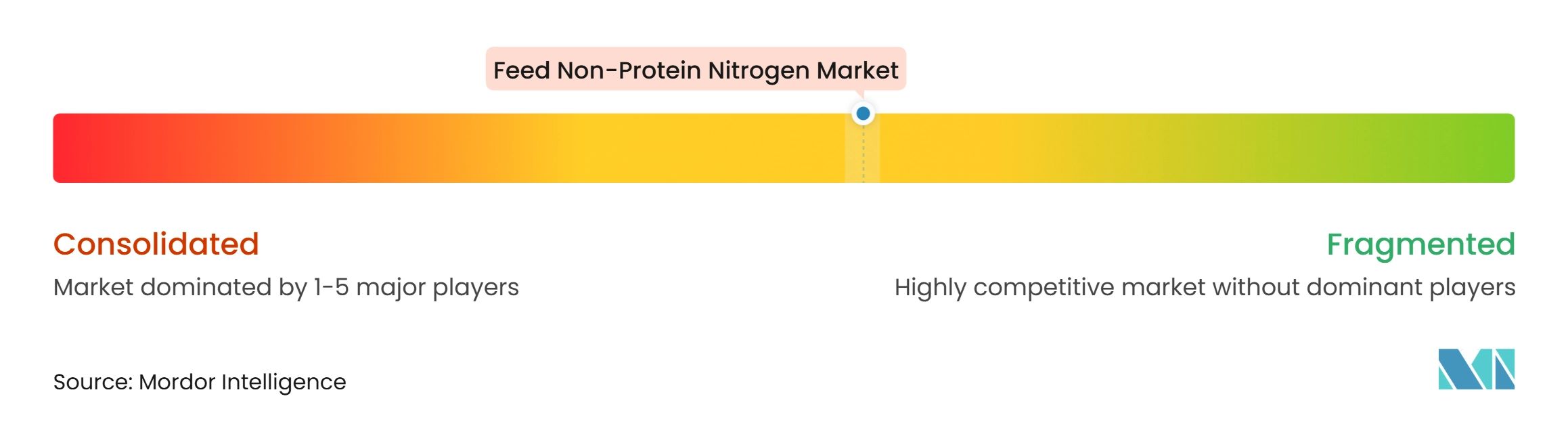
The feed non-protein nitrogen market is moderately fragmented in 2025, with key players including Yara International ASA, Nutrien Ltd., Saudi Basic Industries Corporation (Saudi Arabian Oil Group), OCI N.V., and Archer-Daniels-Midland Company. Competition spans upstream nitrogen producers and downstream animal nutrition suppliers, with companies differentiating through feed-grade urea availability, nitrogen product portfolios, formulation capabilities, distribution networks, and technical support. Yara directly markets feed-grade urea for cattle and other ruminants, while Saudi Basic Industries Corporation maintains a broad agri-nutrients portfolio including urea and ammonia. This creates competition across commodity supply, specialty products, and feed-oriented solutions.
Competition is also influenced by the integration of nitrogen production with established agricultural distribution networks. Large producers can leverage existing infrastructure, while specialty suppliers can build value through application-specific formulations and technical services. Companies serving liquid-feed systems can further differentiate by combining nitrogen sources with energy ingredients and other nutritional components. This approach shifts competition beyond basic ingredient pricing to formulation quality, delivery consistency, feed management support, and operational convenience. As livestock producers increasingly seek efficient ration solutions, suppliers with established distribution and technical capabilities can strengthen relationships with feed manufacturers, dairy farms, beef operations, and other commercial livestock users.
Competitive positioning is increasingly influenced by production scale and by nitrogen producers' ability to secure long-term supply capacity for urea-based applications. In March 2026, SABIC Agri-Nutrients received approval to develop its seventh plant in Jubail, adding 2.6 million metric tons of annual urea capacity and increasing its total agri-nutrient production capacity from approximately 4.8 million to 7.4 million metric tons per year. This expansion improves supply availability and reinforces the company's scale advantage, supporting its ability to compete for nitrogen-based applications, including livestock feed supplementation.
Feed Non-Protein Nitrogen Industry Leaders
-
Yara International ASA
-
Nutrien Ltd.
-
Saudi Basic Industries Corporation (Saudi Arabian Oil Group)
-
OCI N.V.
-
Archer-Daniels-Midland Company
- *Disclaimer: Major Players sorted in no particular order
Feed Non-Protein Nitrogen Market Companies Covered in this Report
- Yara International ASA
- Archer-Daniels-Midland Company
- Alltech, Inc.
- Fertiberia, S.A.
- Nutrien Ltd.
- SKW Stickstoffwerke Piesteritz GmbH (AGROFERT, a.s.)
- EW Nutrition GmbH (EW GROUP GmbH)
- Kemin Industries, Inc.
- Balchem Corporation
- Saudi Basic Industries Corporation (Saudi Arabian Oil Group)
- OCI N.V.
- Petróleo Brasileiro S.A.
- Westway Feed Products LLC (Hartree Partners, LP)
- Quality Liquid Feeds, Inc.
Recent Industry Developments in Feed Non-Protein Nitrogen Market
- June 2026: OCI N.V. sold a 50% stake in OCI Nitrogen to AGROFERT, a.s. for EUR 110 million (USD 119 million), transferring operational control of the European nitrogen production business. This transaction directly affects the competitive supply landscape for nitrogen products, including urea used in livestock feed supplementation.
- March 2026: Saudi Basic Industries Corporation (Saudi Arabian Oil Group) received approval for a feedstock allocation for a seventh Jubail production complex, which could expand annual urea capacity from 4.8 million to 7.4 million metric tons, strengthening its nitrogen supply position.
- September 2025: Archer-Daniels-Midland Company and Alltech, Inc. signed an agreement to establish a North American animal feed joint venture combining 43 feed mills. The expanded manufacturing network strengthens access to formulated livestock feeds, creating broader channels for the incorporation and distribution of non-protein nitrogen ingredients.
Global Feed Non-Protein Nitrogen Market Report Scope
Feed non-protein nitrogen (NPN) refers to nitrogen-containing feed ingredients, such as urea and biuret, that rumen microbes convert into microbial protein. It is used primarily in ruminant diets to supplement dietary nitrogen, support microbial growth, improve fiber digestion, and reduce feed costs.
The feed non-protein nitrogen market report is segmented by product type (urea, biuret, ammonia, ammonium phosphate, ammonium sulfate, and other product types), by form (dry and liquid), by animal type (dairy cattle, beef cattle, sheep and goats, buffalo, and non-ruminants), by application (direct ration inclusion, compound feed manufacturing, silage enrichment, range and pasture supplementation, liquid feed systems, and non-protein nitrogen-fortified complete feed), and by geography (North America, South America, Europe, Asia-Pacific, Middle East, and Africa). The market forecasts are provided in terms of value (USD).
Segmentation Overview
| Urea |
| Biuret |
| Ammonia |
| Ammonium Phosphate |
| Ammonium Sulfate |
| Other Product Types |
| Dry | Prills |
| Granules | |
| Pellets | |
| Liquid |
| Dairy Cattle |
| Beef Cattle |
| Sheep and Goats |
| Buffalo |
| Non-Ruminants |
| Direct Ration Inclusion |
| Compound Feed Manufacturing |
| Silage Enrichment |
| Range and Pasture Supplementation |
| Liquid Feed Systems |
| Non-Protein Nitrogen-Fortified Complete Feed |
| North America | United States |
| Canada | |
| Mexico | |
| Rest of North America | |
| South America | Brazil |
| Argentina | |
| Chile | |
| Rest of South America | |
| Europe | Germany |
| France | |
| United Kingdom | |
| Italy | |
| Spain | |
| Poland | |
| Russia | |
| Rest of Europe | |
| Asia-Pacific | China |
| India | |
| Japan | |
| Australia | |
| Indonesia | |
| Rest of Asia-Pacific | |
| Middle East | Saudi Arabia |
| Turkey | |
| United Arab Emirates | |
| Qatar | |
| Rest of Middle East | |
| Africa | South Africa |
| Egypt | |
| Morocco | |
| Kenya | |
| Rest of Africa |
| By Product Type | Urea | |
| Biuret | ||
| Ammonia | ||
| Ammonium Phosphate | ||
| Ammonium Sulfate | ||
| Other Product Types | ||
| By Form | Dry | Prills |
| Granules | ||
| Pellets | ||
| Liquid | ||
| By Animal Type | Dairy Cattle | |
| Beef Cattle | ||
| Sheep and Goats | ||
| Buffalo | ||
| Non-Ruminants | ||
| By Application | Direct Ration Inclusion | |
| Compound Feed Manufacturing | ||
| Silage Enrichment | ||
| Range and Pasture Supplementation | ||
| Liquid Feed Systems | ||
| Non-Protein Nitrogen-Fortified Complete Feed | ||
| By Geography | North America | United States |
| Canada | ||
| Mexico | ||
| Rest of North America | ||
| South America | Brazil | |
| Argentina | ||
| Chile | ||
| Rest of South America | ||
| Europe | Germany | |
| France | ||
| United Kingdom | ||
| Italy | ||
| Spain | ||
| Poland | ||
| Russia | ||
| Rest of Europe | ||
| Asia-Pacific | China | |
| India | ||
| Japan | ||
| Australia | ||
| Indonesia | ||
| Rest of Asia-Pacific | ||
| Middle East | Saudi Arabia | |
| Turkey | ||
| United Arab Emirates | ||
| Qatar | ||
| Rest of Middle East | ||
| Africa | South Africa | |
| Egypt | ||
| Morocco | ||
| Kenya | ||
| Rest of Africa | ||
Key Questions Answered in the Report
What is the projected feed non-protein nitrogen market size through 2031?
The feed non-protein nitrogen market size is projected to increase from USD 1.28 billion in 2026 to USD 1.62 billion by 2031.
Which animal category uses the most non-protein nitrogen?
Dairy cattle held the largest 60.0% share in 2025 because lactating cows require high daily nitrogen throughput and are commonly fed controlled rations.
Which region is growing the fastest for these feed inputs?
Asia-Pacific held the largest 38.0% share in 2025 and is forecast to grow at the fastest 5.4% CAGR from 2026 to 2031, supported by dairy and beef expansion.
What limits wider use of non-protein nitrogen in animal feed?
Ammonia toxicity risk, inclusion limits, documentation requirements, and volatile urea costs can reduce adoption when formulation controls are limited.