
Federated Identity Management Market Size and Share
Market Overview
| Study Period | 2021 - 2032 |
|---|---|
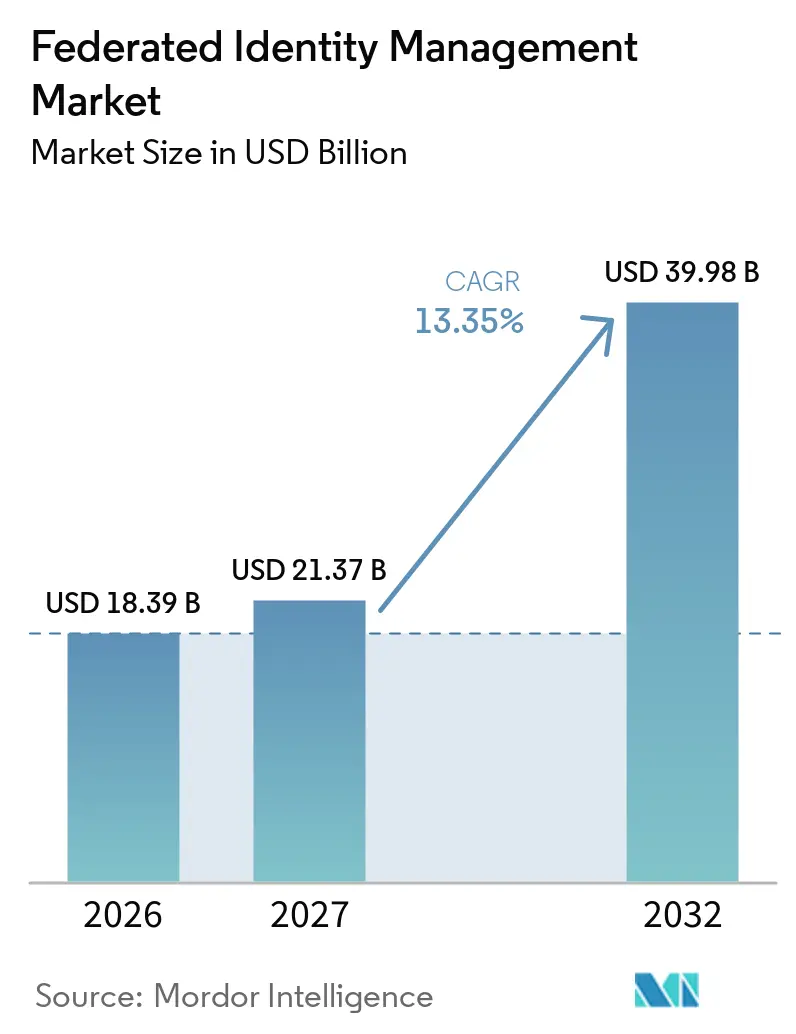
| Market Size (2027) | USD 21.37 Billion |
| Market Size (2032) | USD 39.98 Billion |
| Growth Rate (2027 - 2032) | 13.35 % |
| Fastest Growing Market | Asia-Pacific |
| Largest Market | North America |
| Market Concentration | Medium |
Major Players *Disclaimer: Major Players sorted in no particular order Image © Mordor Intelligence. Reuse requires attribution under CC BY 4.0. | |
Federated Identity Management Market Analysis by Mordor Intelligence
The federated identity management market size is projected to be USD 18.39 billion in 2026, USD 21.37 billion in 2027, and reach USD 39.98 billion by 2032, growing at a CAGR of 13.35% from 2027 to 2032. Identity is becoming the main control point for access across software-as-a-service applications, multi-cloud systems, partner networks, and AI workloads. Credential theft, distributed application environments, and stronger regulatory requirements are driving identity controls to a higher priority in security budgets. Digital identity programs in Asia-Pacific, the Middle East, and Europe are also bringing government and citizen identity needs into federation programs. Vendors are responding by combining access management, identity governance, privileged access, and endpoint capabilities within broader security platforms. The opportunity is increasingly shaped by machine, workload, and AI-agent identities, although a single provider can also create a major point of failure, and data-residency rules can complicate global designs across complex enterprises.
Key Report Takeaways
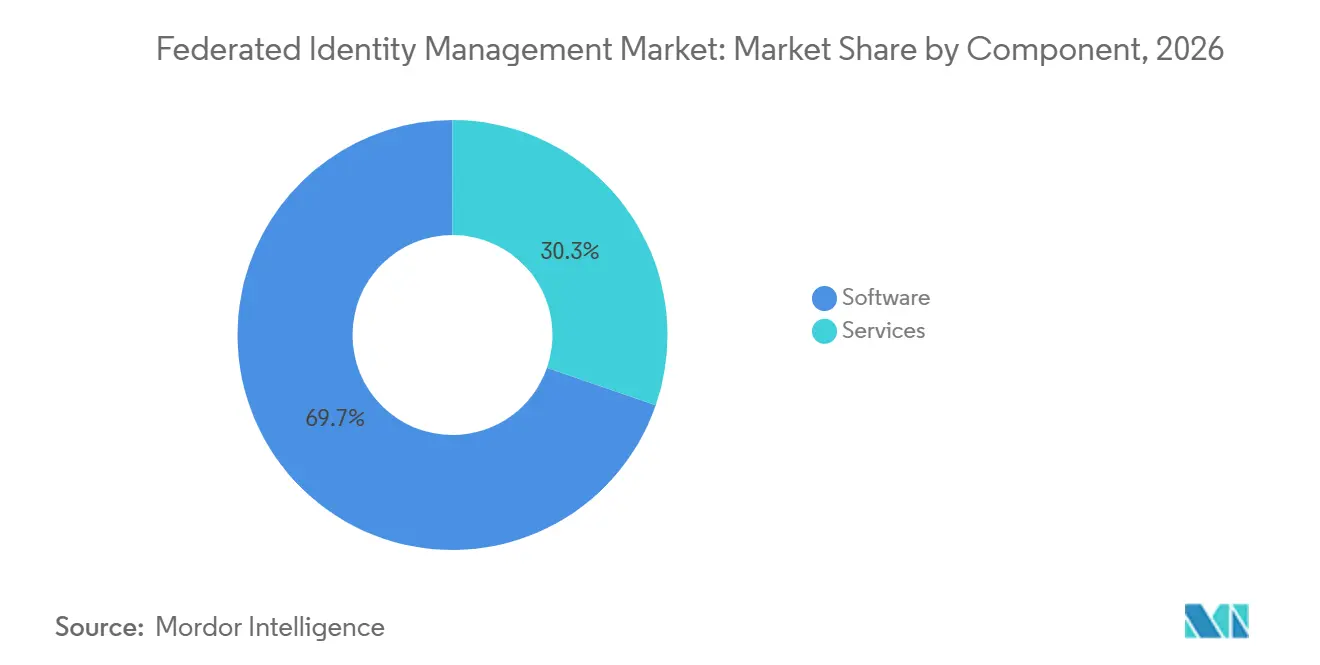
- By component, software held 69.71% of the federated identity management market share in 2026, while services are projected to expand at a 15.84% CAGR through 2032.
- By deployment mode, cloud held 68.51% of the market in 2026 and is projected to expand at a 16.62% CAGR through 2032.
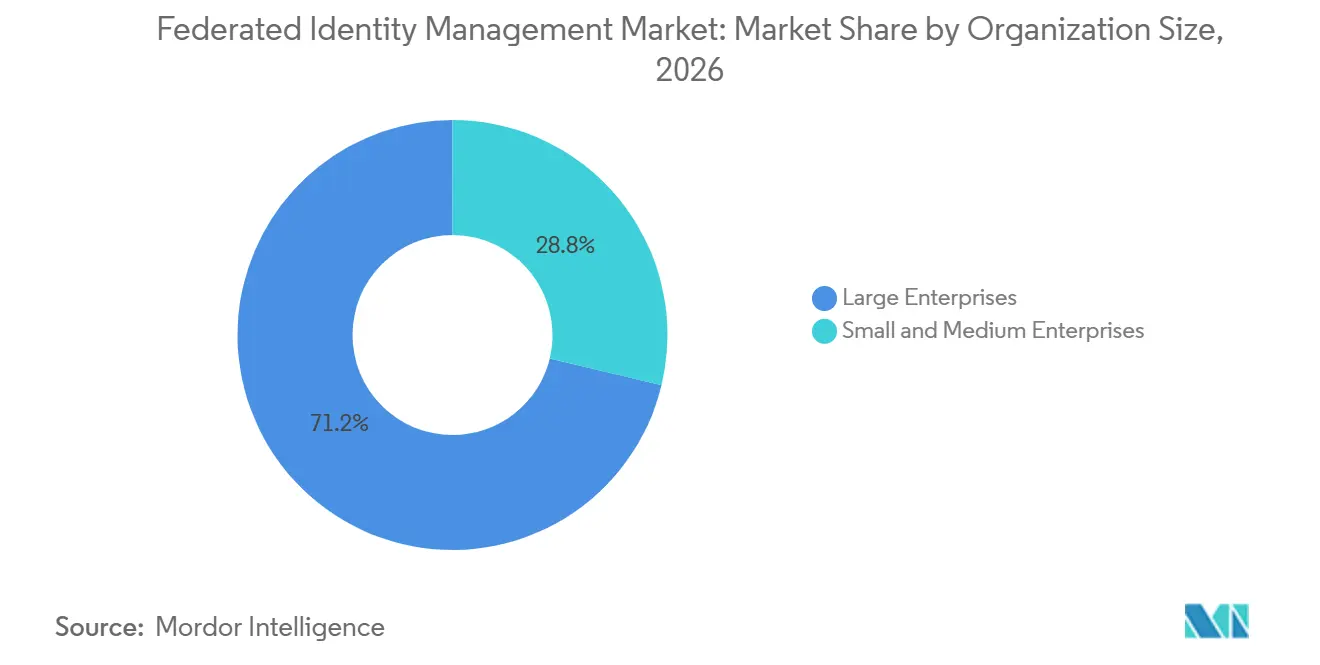
- By organization size, large enterprises held 71.24% of the federated identity management market in 2026, while small and medium-sized enterprises is projected to expand at a 14.89% CAGR through 2032.
- By identity domain, workforce identity held 34.72% of the market in 2026, while machine, workload, and AI-agent identity are projected to expand at a 16.11% CAGR through 2032.
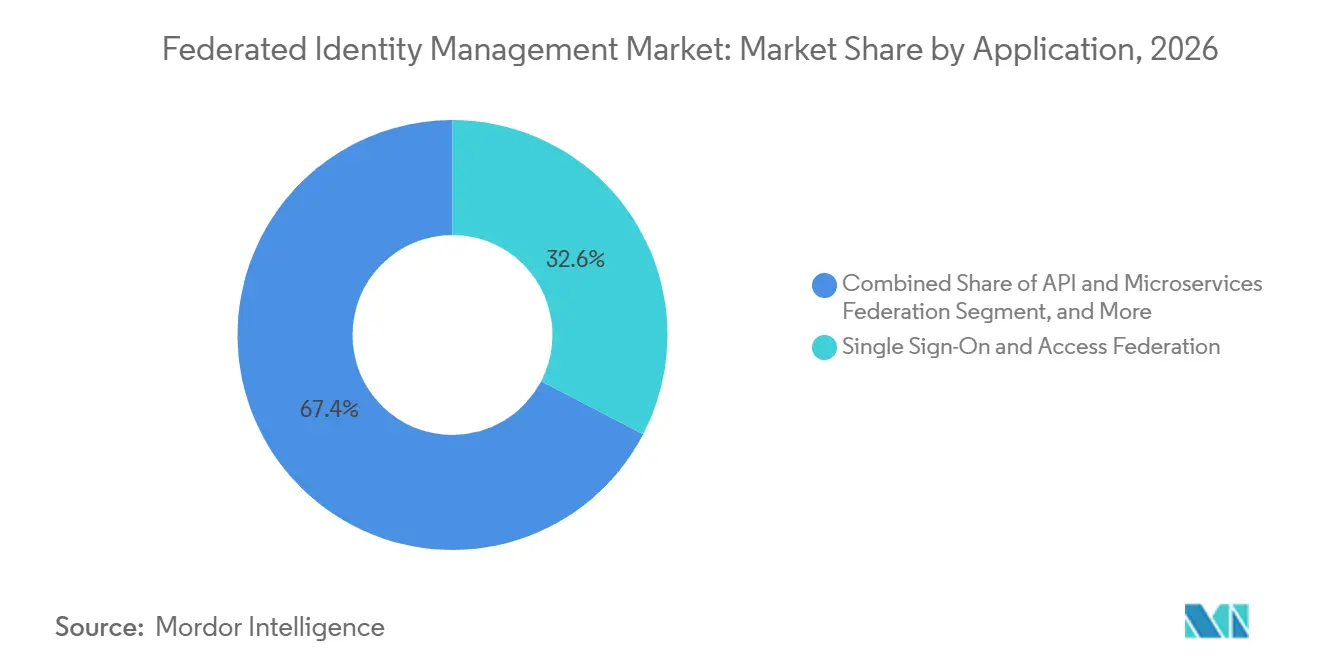
- By application, single sign-on and access federation accounted for 32.64% of the federated identity management market in 2026, while API and microservices federation is projected to expand at a 17.43% CAGR through 2032.
- By industry vertical, banking, financial services, and insurance held 26.69% of the market in 2026, while government and public administration are projected to expand at a 16.71% CAGR through 2032.
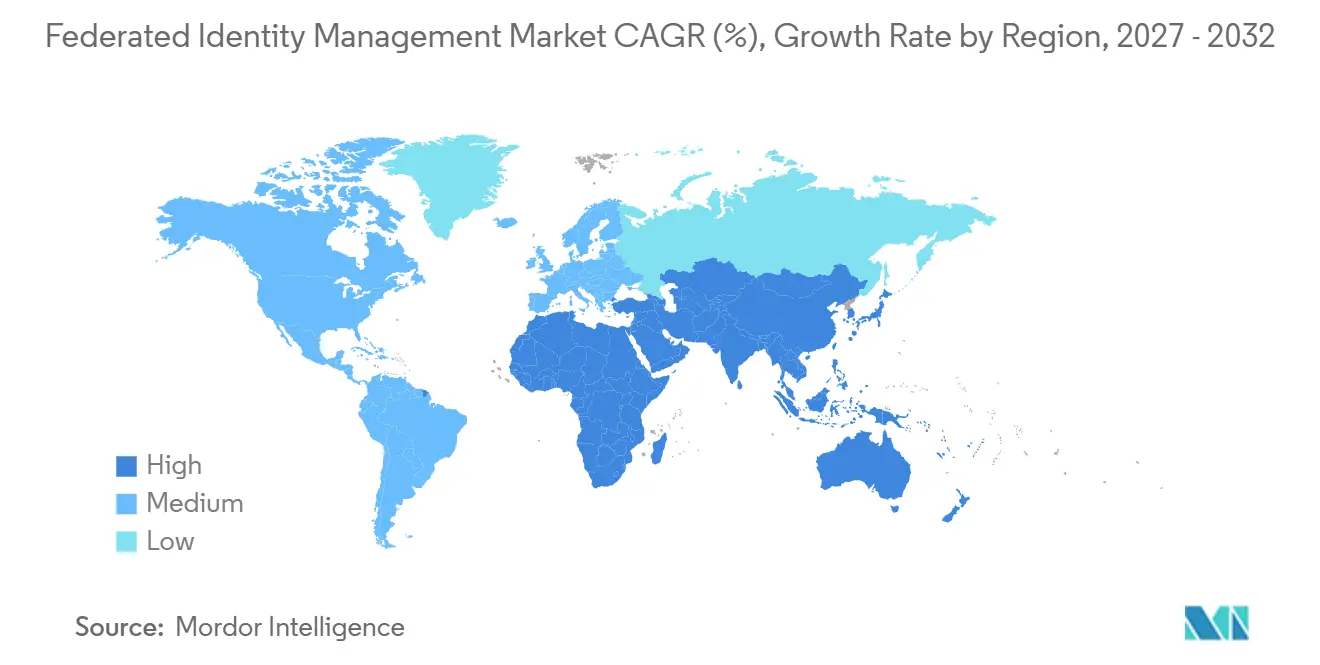
- By geography, North America held 41.64% of the federated identity management market in 2026, while Asia-Pacific is projected to expand at a 17.19% CAGR through 2032.
Note: Market numbers in this report are based on Mordor Intelligence's proprietary estimation framework, which combines nine months of actuals with Q4 projections for base year 2026.
Market Trends and Insights
Drivers Impact Analysis of Federated Identity Management Market*
| DRIVER | (~) % IMPACT ON CAGR FORECAST | GEOGRAPHIC RELEVANCE | IMPACT TIMELINE |
|---|---|---|---|
| Escalating Identity-Based Cyberattacks and Credential Abuse | +4.5% | Global, concentrated in North America, Europe, and Asia-Pacific financial hubs | Short term (≤ 2 years) |
| Zero Trust and Identity-Centric Security Adoption | +4.0% | Global, strongest institutional mandates in North America and the EU | Medium term (2-4 years) |
| Expansion of SaaS and Multi-Cloud Application Estates | +3.5% | Global, with North America and Europe leading spending and Asia-Pacific accelerating | Medium term (2-4 years) |
| Tightening Privacy, Resilience, and Digital Identity Regulation | +2.8% | EU, United States, and Asia-Pacific national frameworks | Medium term (2-4 years) |
| Federation of Machine, Workload, and AI-Agent Identities | +1.5% | Global, concentrated in cloud-native and AI-forward enterprise environments | Long term (≥ 4 years) |
| Federated Identity for Cross-Organization Collaboration | +1.0% | North America, Europe, and global large-enterprise supply chains | Long term (≥ 4 years) |
| Source: Mordor Intelligence | |||
Zero Trust and Identity-Centric Security Adoption
Zero-trust architecture has moved beyond a design principle and is becoming an operational requirement for many organizations. This shift brings federated identity decisions into security modernization programs because access must be verified across users, devices, and applications. The National Security Agency released updated user-identity-pillar guidance in April 2026, setting out phase-based maturity expectations for organizations following zero trust programs. NIST published Special Publication 1800-35 in June 2025 with 19 validated zero trust architecture builds developed with 24 collaborators.[1] These reference architectures give organizations practical approaches for evaluating identity controls and reducing uncertainty during vendor selection. The Federated identity management market benefits as network security and cloud engineering teams join decisions that were previously handled mainly by identity and security operations teams.
Expansion of SaaS and Multi-Cloud Application Estates
Application portfolios have become more distributed, making identity federation necessary for consistent access across systems. Enterprises use federation to connect users and applications when separate software tenants and cloud platforms would otherwise create isolated authentication processes. The resulting identity work expands with each application connection, rather than only with the number of employees using the system. This can create a growing backlog of provisioning, authentication, and lifecycle tasks when programs are delayed. Organizations with large cloud estates also need federation bridges between trust domains as workloads move across providers. The Federated identity management market, therefore, addresses both new cloud deployments and the operational burden created by existing application sprawl, particularly where separate teams manage applications, infrastructure, and security policies without a common identity layer.
Escalating Identity-Based Cyberattacks and Credential Abuse
Identity attacks remain a major route into enterprise systems, making access controls central to breach prevention. IBM reported that credential theft was involved in nearly 1 in 3 incidents observed in 2024.[2] IBM also reported an 84% year-over-year increase in emails that delivered infostealers, with a 180% rise in early 2025 compared with 2023. Microsoft recorded a 32% increase in identity-based attacks during the first half of 2025 and stated that more than 97% involved password attacks. These conditions position federation as a security control that can reduce the use of unmanaged credentials and improve visibility into authentication activity. The Federated identity management market is consequently tied more closely to security budgets than to standalone access-management spending.
Tightening Privacy, Resilience, and Digital Identity Regulation
Regulatory requirements are turning identity management into a required control for many regulated organizations. The Digital Operational Resilience Act applied to European Union financial entities from January 17, 2025, requiring stronger oversight of digital operational resilience. NIST finalized Special Publication 800-63-4 on July 31, 2025, providing digital identity guidance for federal agencies and regulated institutions in the United States. The European Commission stated that its January 2026 NIS2 amendments extended risk-management obligations to 28,700 companies, including 6,200 micro and small enterprises previously outside the scope. eIDAS 2.0 and the expected European Digital Identity Wallet add another requirement for businesses that must accept and validate government-issued credentials. These policies make auditable identity controls a practical purchasing requirement across the Federated identity management market.
Restraints Impact Analysis of Federated Identity Management Market*
| RESTRAINT | (~) % IMPACT ON CAGR FORECAST | GEOGRAPHIC RELEVANCE | IMPACT TIMELINE |
|---|---|---|---|
| Legacy Protocol and Directory Integration Complexity | -2.1% | Global, most acute in banking, financial services, insurance, government, and defense | Short term (≤ 2 years) |
| Specialist Skills Shortage and High Implementation Services Cost | -1.5% | Global, particularly acute in North America, Western Europe, and emerging Asia-Pacific markets | Medium term (2-4 years) |
| Data Sovereignty and Cross-Border Trust Fragmentation | -0.8% | EU, China, India, and cross-border enterprise federation programs | Long term (≥ 4 years) |
| Centralized Federation Failure and Concentration Risk | -0.5% | Global, concentrated in large single-provider deployments | Medium term (2-4 years) |
| Source: Mordor Intelligence | |||
Legacy Protocol and Directory Integration Complexity
Many deployments must connect current federation protocols with older directories and authentication systems. Modern approaches such as SAML 2.0, OAuth 2.0, and OpenID Connect do not always align easily with LDAP directories, Kerberos domains, or proprietary application controls. This increases the testing, migration, and audit work required before a new platform can be fully deployed. Older systems can also lack the application programming interfaces needed to document and monitor identity controls. That limitation is important where DORA and NIS2 require traceable risk management and access records. The Federated identity management market faces longer sales and implementation cycles when buyers must resolve legacy dependencies before realizing value from new software.
Specialist Skills Shortage and High Implementation Services Cost
Federated identity projects need staff with knowledge of federation protocols, zero trust architecture, and increasingly AI-related identity controls. ISC2 reported in April 2026 that 95% of organizations had at least 1 cybersecurity skill need, and 59% described their deficiency as critical or significant. SANS Institute and GIAC reported that skills gaps accounted for 60% of workforce concerns, compared with 40% for headcount shortages. The same research found that 27% of organizations reported breaches linked directly to workforce capability gaps. These shortages increase reliance on implementation services and can be difficult for mid-sized organizations and public agencies with fixed technology budgets. The cost of specialist support can therefore delay adoption even when a buyer recognizes the security or compliance need, leaving the Federated identity management market dependent on service capacity as well as software demand.
*Our forecasts treat driver/restraint impacts as directional, not additive. The impact forecasts reflect baseline growth, mix effects, and variable interactions.
Federated Identity Management Market Segment Analysis
By Component:
Services Expand as Deployments Become More ComplexSoftware held 69.71% of the Federated identity management market share in 2026, supported by platform licensing and recurring subscription revenue. Organizations usually purchase a federation platform before adding managed services or integration support. This sequence reflects the role of software as the core layer for authentication, policy management, and access connections. Platform purchases also give buyers a foundation for later identity governance and privileged access work. Software vendors benefit when customers standardize their identity controls on a single platform. The segment remains central because federation programs need a reliable system of record for policies, credentials, and trust relationships.
Services are projected to expand at a 15.84% CAGR from 2027 to 2032, the highest rate among components. Integration work often becomes more difficult when an organization moves from separate on-premises directories to a unified cloud identity design. Project scopes can increase as teams identify application dependencies, entitlement rules, and data-residency requirements. AI-agent identity governance adds further design work because permissions must be limited and workflows must be tailored to individual use cases. Outcome-based service models are gaining attention alongside traditional project engagements. This supports a larger role for consulting, integration, and managed services as the Federated identity management market becomes more complex.
By Deployment Mode:
Cloud Leads in Scale and AdoptionCloud commanded 68.51% of the Federated identity management market size in 2026 and is projected to expand at a 16.62% CAGR through 2032. The segment is both the largest deployment mode and the fastest-growing option. Cloud-first organizations can begin with a hosted identity platform and extend its use as their application portfolios grow. This avoids some of the migration work that slows other technology transitions. Subscription delivery also supports faster updates to authentication features and policy tools. These characteristics make cloud federation suitable for organizations building new digital services as well as enterprises modernizing older identity systems.
On-premises deployment remains relevant for defense, intelligence, and critical infrastructure organizations that restrict cloud routing of authentication tokens. These buyers often prioritize control over sensitive data and use local systems to meet sovereignty or security requirements. Hybrid and multi-cloud models are also important, where applications operate across multiple cloud providers. Federation bridges connect trust domains so that identities and access policies can work across those environments. This need grows as enterprises distribute workloads among different providers and internal systems. The Federated identity management market therefore includes cloud platforms, local deployments, and architectures that connect both approaches, rather than replacing every established environment with a single operating model.
By Organization Size:
Small and Medium-Sized Enterprises Narrow the GapLarge enterprises held 71.24% of the market in 2026, reflecting long-standing investment in directories, identity governance, and privileged access management. Their current spending increasingly extends existing systems instead of creating entirely new identity programs. Many large organizations are migrating their established infrastructure to cloud-native designs while preserving key access controls. Their scale also creates complex requirements for employee, partner, contractor, and application identities. Governance obligations and larger user populations increase the need for consistent policies across business units. These factors preserve the leading position of large enterprises in the Federated identity management market.
Small and medium-sized enterprises are projected to expand at a 14.89% CAGR from 2027 to 2032. Cloud-native businesses can adopt federation from the outset rather than retrofitting it into several older systems. This can reduce the operational disruption associated with a later migration. The European Commission's 2026 NIS2 amendments brought 6,200 micro and small enterprises into the directive's expanded scope.[3] That regulatory development can turn compliance needs into first-time identity procurement for smaller organizations. The segment is therefore gaining relevance even though large enterprises retain the larger installed base.
By Identity Domain:
Non-Human Identities Change the Security PerimeterWorkforce identity held 34.72% of the market in 2026 because employee access remains the basic enterprise federation use case. Organizations need consistent authentication for staff using internal applications, cloud services, and remote work tools. Customer identity and access management supports consumer-facing services, while business-to-business partner identity supports external collaboration. Government and citizen identity applies federation to public services and national digital identity programs. These domains show how the market extends beyond employee login functions. Workforce identity remains the largest starting point for adoption because it connects security controls with daily employee access.
Machine, workload, and AI-agent identity is projected to expand at a 16.11% CAGR from 2027 to 2032. Non-human principals are increasingly used across cloud environments, but many legacy systems were created mainly for human-initiated authentication. The Internet Engineering Task Force WIMSE working group published the AI Identity Management System draft to address AI-agent authentication using OAuth 2.0 and SPIFFE-related approaches.[4] The standards work provides a basis for product development by vendors including Microsoft, SailPoint, and Ping Identity. Machine identities require controlled issuance, rotation, and revocation of credentials because they can access systems without direct human action. This makes non-human identity a major expansion area for the Federated identity management market.
By Application:
API Federation Supports Microservices and AI WorkloadsSingle sign-on and access federation held 32.64% of the market in 2026, making it the largest application area. It provides the first federation capability adopted by many enterprises because it allows users to access multiple systems through connected authentication processes. Identity lifecycle and automated provisioning add control over user changes and account administration. Adaptive authentication and step-up access help organizations apply stronger checks where risk is higher. Cloud infrastructure and workload access extend federation beyond employee-facing applications. These application layers show how basic single sign-on can evolve into a broader identity program.
API and microservices federation is projected to expand at a 17.43% CAGR from 2027 to 2032. Service-mesh designs and OAuth 2.0 authorization require authentication methods that work between services rather than through browser redirects. This is particularly important for AI agents that call enterprise APIs using limited OAuth tokens. Token issuance, rotation, and revocation become critical at scale when many services and agents operate across a cloud environment. The IETF OAuth Working Group adopted a SPIFFE client authentication draft in June 2026. This standards activity supports road maps for workload API federation and reinforces the shift toward non-human access controls.

By Industry Vertical:
Regulation Supports Financial Services and Digitization Supports GovernmentBanking, financial services, and insurance accounted for 26.69% of the market in 2026, the largest vertical share. Financial institutions face stringent requirements for access controls, third-party identity tracking, and operational resilience. DORA has applied to European Union financial entities since January 17, 2025. PCI DSS v4.0.1 required multifactor authentication from March 31, 2025, which adds to the sector's need for stronger access management. Open banking also requires trusted identity relationships between financial institutions and third-party providers. These obligations keep the vertical central to the Federated identity management market.
The government and public administration industry is projected to expand at a 16.71% CAGR from 2027 to 2032. National digital identity programs are creating new requirements for public agencies and enterprises that connect to government-issued credentials. India's Unique Identification Authority of India introduced the Aadhaar Face Authentication software development kit at Global Fintech Fest 2026. The technology supports the use of federated biometric credentials across banking, healthcare, and government portals. Healthcare and life sciences also need federation for electronic health record access controls. Ping Identity's verification and fraud protection solution was listed in the Epic App Orchard in July 2026, showing how identity tools are being connected with clinical systems. Retail and e-commerce, telecommunications and media, and travel and hospitality provide additional use cases for customer and partner access.
Geography Analysis
North America Federated Identity Management Market
North America held 41.64% of the market in 2026. The region benefits from a large concentration of global technology companies and a mature security procurement environment. United States policy is also translating security requirements into clearer technology milestones. The National Security Agency issued its user identity pillar guidance in April 2026. NIST finalized Special Publication 800-63-4 in July 2025, providing a digital identity reference for federal agencies and regulated institutions. Canada supports cross-provincial digital identity through the Pan-Canadian Trust Framework, which aligns with NIST and OpenID Connect approaches.
Europe and South America Federated Identity Management Market
The region is extending the federation toward AI-agent identity. Microsoft introduced Entra Agent ID at Ignite 2025, extending zero-trust principles to AI workloads through OAuth-based, short-lived credentials and a developer SDK. Okta made Agent SSO generally available in August 2026, enabling organizations to provision and govern AI agent credentials through their established identity infrastructure. Europe is the second-largest regional market because DORA, NIS2, and eIDAS 2.0 are driving structured, compliance-focused investment in federation. The European Commission stated that the 2026 NIS2 amendments extended obligations to 28,700 companies. Germany's IT-Grundschutz framework treats identity and access management as a foundational control area. South America is an emerging region where Brazil's LGPD supports customer identity and access management adoption, particularly in financial services.
APAC and MEA Federated Identity Management Market
Asia-Pacific is projected to expand at a 17.19% CAGR from 2027 to 2032, the fastest regional rate. Government digital identity programs, open banking rules, and mobile-first services are creating greenfield federation opportunities in the region. India's Aadhaar ecosystem has processed more than 500 crore authentication transactions across nearly 200 entities, creating an identity layer that enterprises increasingly need to connect with. Japan's Digital Agency is extending the My Number corporate identity framework, while China's MLPS 2.0 requires identity authentication controls for critical infrastructure under data-sovereignty limits. The Asian Development Bank reported that 56% of Asia-Pacific jurisdictions have enacted open banking regulations. The Middle East is advancing through Saudi Vision 2030 and UAE digital economy programs, while Africa remains at an earlier stage with activity led by South Africa and Nigeria in financial services and telecommunications.
Competitive Landscape
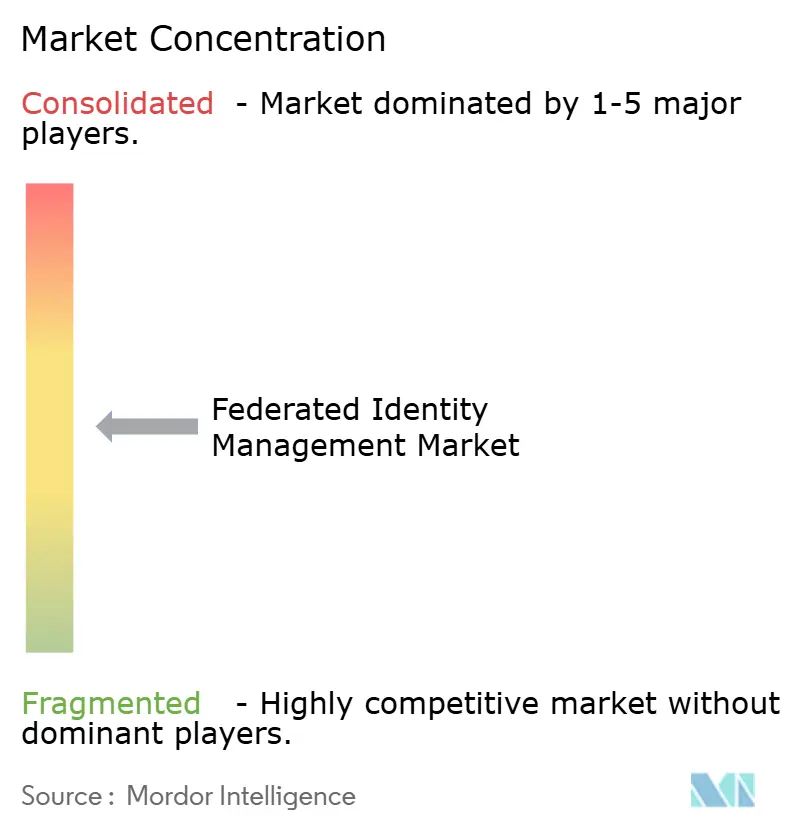
The federated identity management market is moderately fragmented at the platform level. Microsoft Entra ID and Okta hold established positions through ecosystem integration and recent AI-agent identity releases. Larger vendors are combining identity, privileged access management, identity governance, endpoint controls, and cloud security capabilities. This broadens their product portfolios and increases the competitive pressure on standalone federation suppliers. Competition is shifting toward policy management, behavioral analysis, and governance across organizations as core workload federation becomes more standardized. The Federated identity management market also includes open-source platforms such as Keycloak, which provide lower-cost options for buyers in emerging markets and apply pricing pressure to commercial vendors, particularly when buyers can accept a more self-managed deployment model and place cost control ahead of an integrated supplier relationship. In the Federated identity management market, this gives price-sensitive buyers a different route to core federation functions without changing the need for sound identity governance.
Palo Alto Networks completed its acquisition of CyberArk for approximately USD 25 billion in February 2026. The transaction brought privileged access management and CyberArk Identity's federated single sign-on capabilities into a wider network and cloud security platform. Ping Identity expanded its Runtime Identity coverage for AI agents to Google Cloud Marketplace in September 2026, adding to its work across AWS and Cloudflare. The release helps enterprises manage AI-agent authentication in cloud-native settings. Okta made Agent SSO generally available in August 2026 with dynamic client registration and short-lived scoped tokens instead of static application programming interface keys. These releases demonstrate that leading vendors are treating agent identity as a core product area rather than a limited extension of employee access.
SailPoint introduced adaptive identity updates in March 2026, including a next-generation access certification engine and a rebuilt separation-of-duties capability. The product work targets governance for human and non-human identities across its AI-powered platform. Ping Identity's listing in the Epic App Orchard and its partnership with OLOID for passwordless clinical authentication show a focus on vertical integration in healthcare. Opportunities remain in small and medium-sized enterprise adoption, cross-border government and citizen identity connections, and non-human identity governance for multi-agent AI systems. No vendor has established dominant adoption across all of these areas. The Federated identity management market continues to offer room for specialized suppliers where platforms have not yet achieved broad adoption, since buyers may need capabilities that fit a particular sector, deployment environment, identity type, or cross-organization trust arrangement. The Federated identity management market may therefore reward suppliers that solve difficult connection and governance problems for clearly defined buyer groups.
Federated Identity Management Industry Leaders
-
Microsoft Corporation
-
Okta, Inc.
-
Ping Identity Corporation
-
International Business Machines Corporation
-
ForgeRock, Inc.
- *Disclaimer: Major Players sorted in no particular order
Federated Identity Management Market Companies Covered in this Report
- Microsoft Corporation
- Okta, Inc.
- Ping Identity Corporation
- International Business Machines Corporation
- ForgeRock, Inc.
- Oracle Corporation
- Google LLC
- Amazon Web Services, Inc.
- SailPoint Technologies Holdings, Inc.
- CyberArk Software Ltd.
- One Identity LLC
- Broadcom Inc.
- Entrust Corporation
- Thales S.A.
- Saviynt, Inc.
- SecureAuth Corporation
- JumpCloud Inc.
- RSA Security LLC
- OpenText Corporation
- NEC Corporation
- Accenture plc
- Yubico AB
Recent Industry Developments in Federated Identity Management Market
- September 2026: Ping Identity launched Identity Agents on Google Cloud Marketplace on September 29, 2026, extending Runtime Identity coverage for AI agents to a third major cloud provider alongside AWS and Cloudflare, and enabling enterprises to manage agent authentication within Google Cloud-native environments.
- August 2026: Okta made Agent SSO generally available on August 24, 2026, allowing enterprises to provision and govern AI agent credentials through established Okta identity infrastructure using dynamic client registration and short-lived scoped tokens in place of static API keys.
- May 2026: JumpCloud closed a Series F funding round at a USD 3.2 billion post-money valuation on May 26, 2026, directing proceeds toward expanding its small and medium-sized enterprise-focused cloud directory and federated identity platform and accelerating agentic identity and access management product development.
- February 2026: Palo Alto Networks closed the acquisition of CyberArk at approximately USD 25 billion on February 11, 2026, consolidating privileged access management and identity security, including CyberArk Identity's federated single sign-on capabilities, within a unified network and cloud security platform.
Global Federated Identity Management Market Report Scope
The federated identity management market covers software and services that enable trusted identity sharing and access federation across organizations, applications, clouds, and identity domains. It includes single sign-on, identity providers, directory synchronization, B2B partner identity, government digital identity, and machine or AI-agent identity federation.
The Federated Identity Management Market Report is Segmented by Component (Software, and Services), Deployment Mode (Cloud-Based, On-Premises, and Hybrid and Multi-Cloud), Organization Size (Large Enterprises, and Small and Medium Enterprises), Identity Domain (Workforce Identity, Customer Identity and Access Management, Business-to-Business Partner Identity, Government and Citizen Identity, and Machine, Workload, and AI-Agent Identity), Application (Single Sign-On and Access Federation, Identity Lifecycle and Automated Provisioning, Adaptive Authentication and Step-Up Access, API and Microservices Federation, Cloud Infrastructure and Workload Access, and Other Applications), Industry Vertical (Banking, Financial Services, and Insurance (BFSI), Government and Public Administration, Healthcare and Life Sciences, Retail and E-Commerce, Telecommunications and Media, Travel and Hospitality, and Other Industry Verticals), and Geography (North America, South America, Europe, Asia-Pacific, Middle East, and Africa). The Market Forecasts are Provided in Terms of Value (USD).
Segmentation Overview
| Software |
| Services |
| Cloud-Based |
| On-Premises |
| Hybrid and Multi-Cloud |
| Large Enterprises |
| Small and Medium Enterprises |
| Workforce Identity |
| Customer Identity and Access Management |
| Business-to-Business Partner Identity |
| Government and Citizen Identity |
| Machine, Workload, and AI-Agent Identity |
| Single Sign-On and Access Federation |
| Identity Lifecycle and Automated Provisioning |
| Adaptive Authentication and Step-Up Access |
| API and Microservices Federation |
| Cloud Infrastructure and Workload Access |
| Other Applications |
| Banking, Financial Services, and Insurance (BFSI) |
| Government and Public Administration |
| Healthcare and Life Sciences |
| Retail and E-Commerce |
| Telecommunications and Media |
| Travel and Hospitality |
| Other Industry Verticals |
| North America | United States |
| Canada | |
| Mexico | |
| South America | Brazil |
| Argentina | |
| Rest of South America | |
| Europe | United Kingdom |
| Germany | |
| France | |
| Italy | |
| Rest of Europe | |
| Asia-Pacific | China |
| Japan | |
| India | |
| South Korea | |
| Rest of Asia-Pacific | |
| Middle East | United Arab Emirates |
| Saudi Arabia | |
| Rest of Middle East | |
| Africa | South Africa |
| Nigeria | |
| Rest of Africa |
| By Component | Software | |
| Services | ||
| By Deployment Mode | Cloud-Based | |
| On-Premises | ||
| Hybrid and Multi-Cloud | ||
| By Organization Size | Large Enterprises | |
| Small and Medium Enterprises | ||
| By Identity Domain | Workforce Identity | |
| Customer Identity and Access Management | ||
| Business-to-Business Partner Identity | ||
| Government and Citizen Identity | ||
| Machine, Workload, and AI-Agent Identity | ||
| By Application | Single Sign-On and Access Federation | |
| Identity Lifecycle and Automated Provisioning | ||
| Adaptive Authentication and Step-Up Access | ||
| API and Microservices Federation | ||
| Cloud Infrastructure and Workload Access | ||
| Other Applications | ||
| By Industry Vertical | Banking, Financial Services, and Insurance (BFSI) | |
| Government and Public Administration | ||
| Healthcare and Life Sciences | ||
| Retail and E-Commerce | ||
| Telecommunications and Media | ||
| Travel and Hospitality | ||
| Other Industry Verticals | ||
| By Geography | North America | United States |
| Canada | ||
| Mexico | ||
| South America | Brazil | |
| Argentina | ||
| Rest of South America | ||
| Europe | United Kingdom | |
| Germany | ||
| France | ||
| Italy | ||
| Rest of Europe | ||
| Asia-Pacific | China | |
| Japan | ||
| India | ||
| South Korea | ||
| Rest of Asia-Pacific | ||
| Middle East | United Arab Emirates | |
| Saudi Arabia | ||
| Rest of Middle East | ||
| Africa | South Africa | |
| Nigeria | ||
| Rest of Africa | ||
Key Questions Answered in the Report
What is the size of the federated identity management market?
The federated identity management market size is projected to be USD 18.39 billion in 2026, USD 21.37 billion in 2027, and reach USD 39.98 billion by 2032, growing at a CAGR of 13.35% from 2027 to 2032.
What is driving adoption of federated identity management?
Credential-based attacks, zero trust programs, multi-cloud application environments, and identity regulations are increasing demand for federation capabilities.
Which deployment model leads federated identity management adoption?
Cloud leads with a 68.51% share in 2026 and is projected to expand at a 16.62% CAGR through 2032.
Which federated identity application is expanding fastest?
API and microservices federation is projected to expand at a 17.43% CAGR through 2032 as cloud services and AI agents require controlled API authentication.
Which region has the fastest projected adoption?
Asia-Pacific is projected to expand at a 17.19% CAGR through 2032, supported by digital identity programs, open banking rules, and mobile-first services.
Why are AI agents important for identity programs?
Machine, workload, and AI-agent identity is projected to expand at a 16.11% CAGR because non-human accounts need controlled credentials, permissions, and token management.