
Eye Allergy Therapeutics Market Size and Share
Market Overview
| Study Period | 2020 - 2031 |
|---|---|
| Market Size (2026) | USD 4.74 Billion |
| Market Size (2031) | USD 5.5 Billion |
| Growth Rate (2026 - 2031) | 5.50 % |
| Fastest Growing Market | Asia-Pacific |
| Largest Market | North America |
| Market Concentration | Medium |
Major Players
*Disclaimer: Major Players sorted in no particular order Image © Mordor Intelligence. Reuse requires attribution under CC BY 4.0. |
|
Eye Allergy Therapeutics Market Analysis by Mordor Intelligence
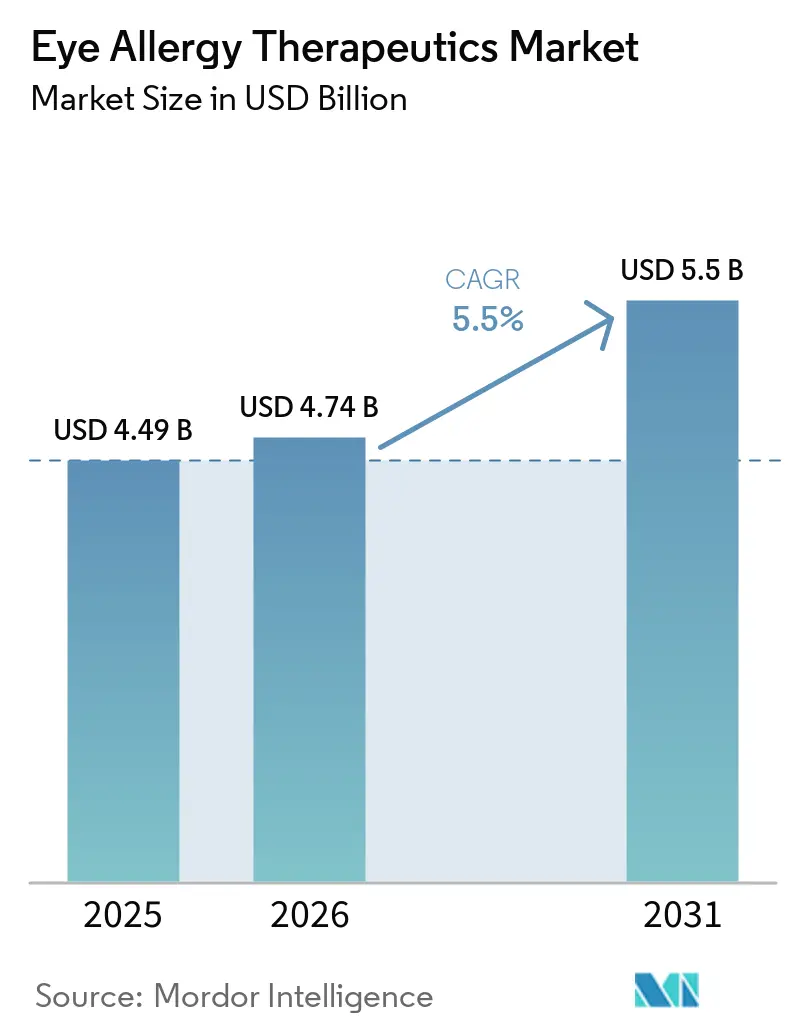
The Eye Allergy Therapeutics Market size is projected to expand from USD 4.49 billion in 2025 and USD 4.74 billion in 2026 to USD 5.5 billion by 2031, registering a CAGR of 5.5% between 2026 to 2031.
The eye allergy therapeutics market is supported by a large population with allergic conjunctivitis and a low rate of formal treatment seeking, which leaves room for prescription, OTC, and telehealth access to reach more patients. Longer pollen seasons are expected to extend the treatment period for seasonal products and increase interest in sustained-use options. Branded suppliers are focusing on preservative-free products, once-daily formats, and new delivery methods to protect value as generic topical products become more common. Disease-modifying allergen antibody programs could also change the eye allergy therapeutics market if they receive regulatory approval, although they remain in clinical development. North America remains the largest regional contributor, while Asia-Pacific has the strongest forecast growth rate.
Key Report Takeaways
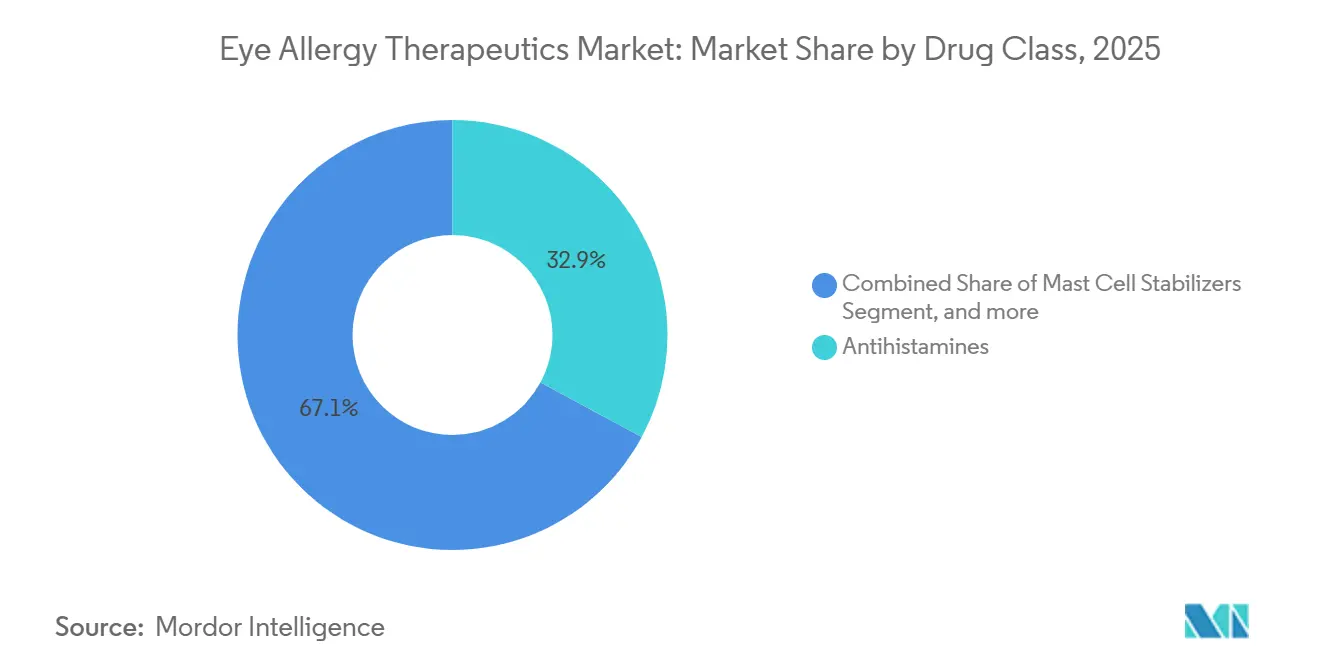
- By drug class, antihistamines led with 32.87% of the eye allergy therapeutics market share in 2025, while immunotherapy is forecast to expand at a 7.54% CAGR through 2031.
- By allergy type, seasonal allergic conjunctivitis held 43.98% of the eye allergy therapeutics market share in 2025, while perennial allergic conjunctivitis is projected to grow at a CAGR of 7.05% by 2031.
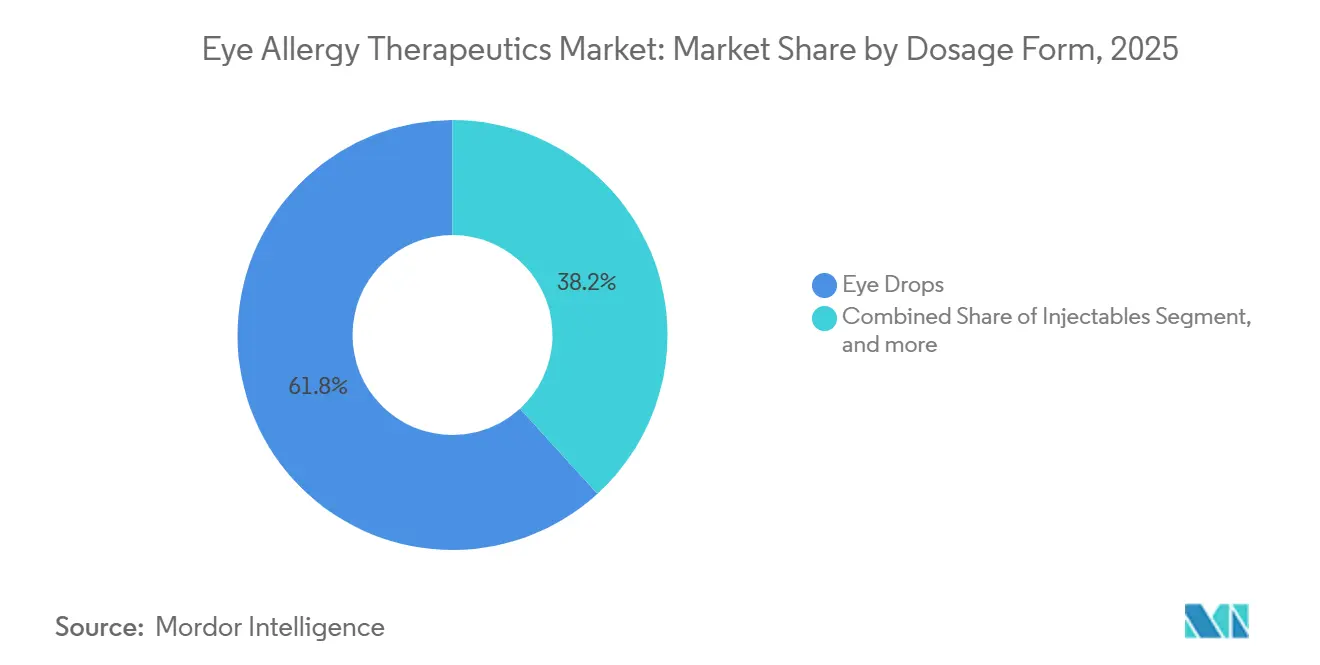
- By dosage form, eye drops accounted for 61.78% of the segment in 2025, while oral tablets and capsules are advancing at a 7.15% CAGR through 2031.
- By route of administration, topical ocular administration captured 55.32% of the segment in 2025, while oral administration is forecast to grow at a 7.34% CAGR through 2031.
- By distribution channel, hospital pharmacies held 58.64% of the segment in 2025, while online pharmacies and e-commerce are forecast to expand at a 7.65% CAGR through 2031.
- By end user, hospitals held 69.43% of the segment in 2025, while homecare settings are forecast to grow at a 7.98% CAGR through 2031.
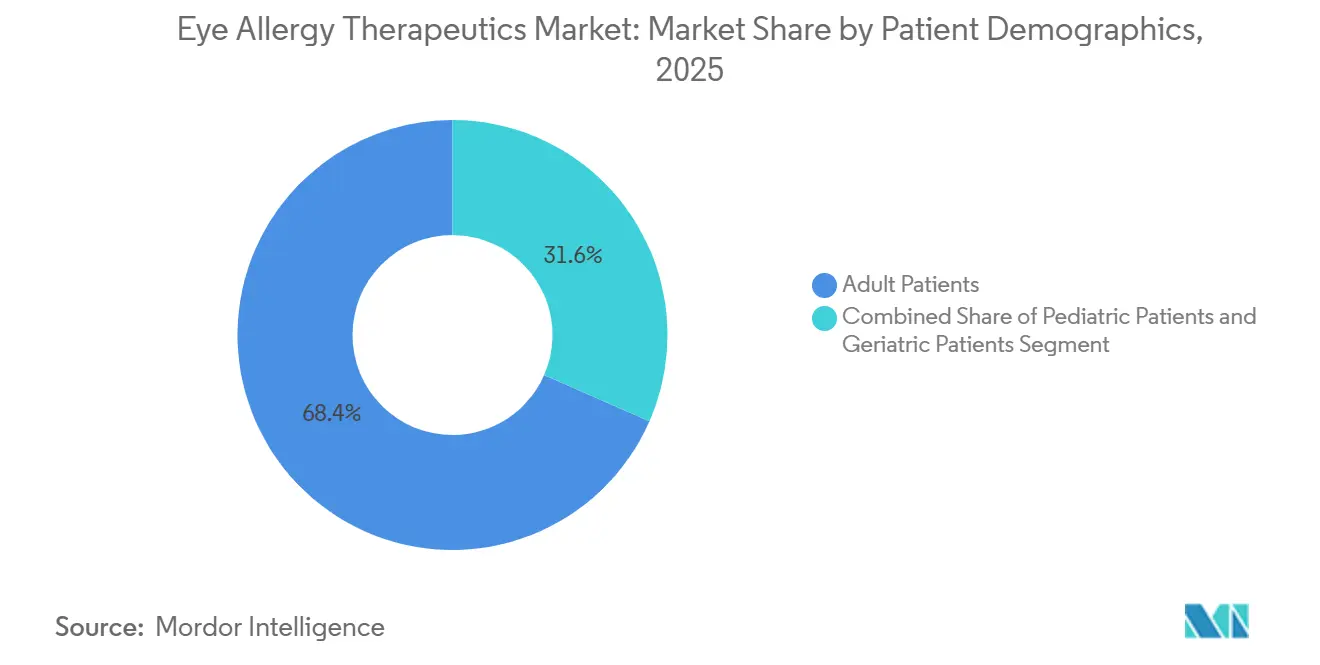
- By patient demographics, adults accounted for 68.43% of the segment in 2025, while pediatric patients are projected to expand at an 8.88% CAGR through 2031.
- By prescription status, prescription products held 60.43% of the segment in 2025, while over-the-counter products are forecast to grow at an 8.65% CAGR through 2031.
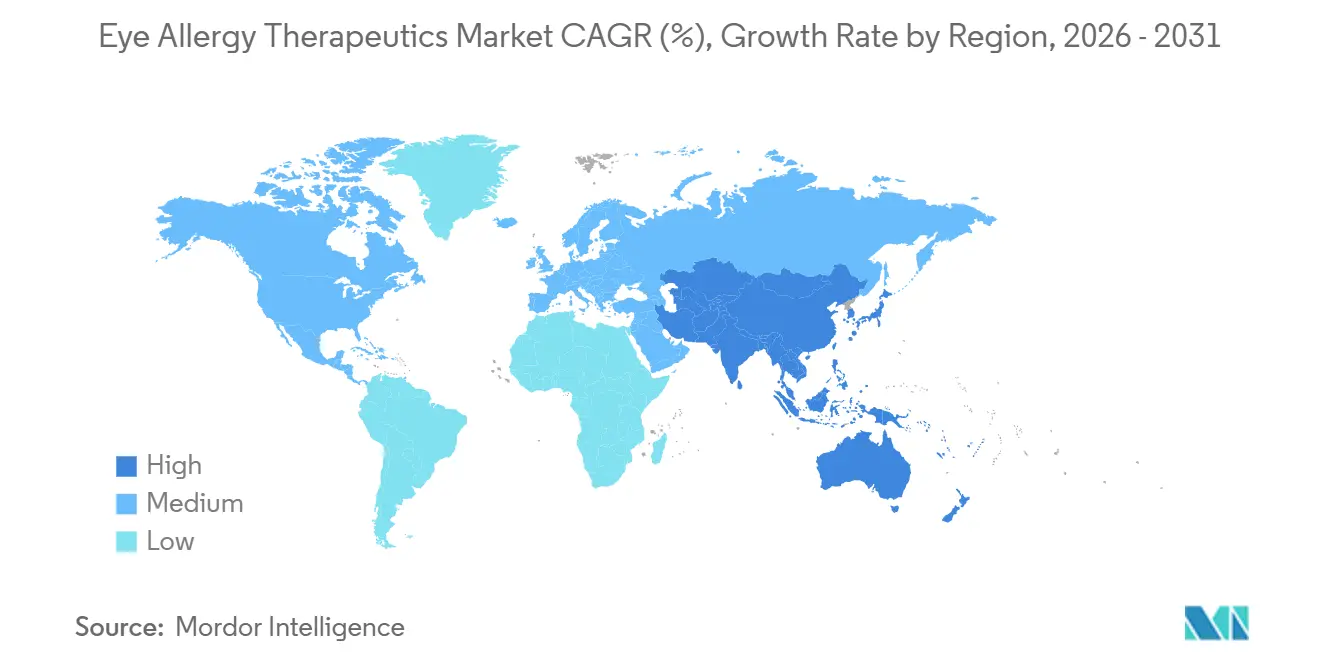
- By geography, North America held 42.43% of the segment in 2025, while Asia-Pacific is forecast to grow at an 6.76% CAGR through 2031.
Note: Market size and forecast figures in this report are generated using Mordor Intelligence’s proprietary estimation framework, updated with the latest available data and insights as of January 2026.
Market Trends and Insights
Drivers Impact Analysis of Eye Allergy Therapeutics Market*
| Driver | (~) % Impact on CAGR Forecast | Geographic Relevance | Impact Timeline |
|---|---|---|---|
| Rising Prevalence Of Allergic Conjunctivitis | +1.20% | Global | Short term (≤ 2 years) |
| Increasing Environmental Allergen And Pollution Exposure | +0.80% | APAC core, spill-over to MEA and North America | Medium term (2-4 years) |
| Expansion Of Over-The-Counter And Self-Care Access | +0.70% | North America and APAC | Short term (≤ 2 years) |
| Adoption Of Once-Daily And Dual-Action Formulations | +0.60% | Global | Medium term (2-4 years) |
| Longer And More Intense Pollen Seasons | +0.50% | North America, Europe and APAC | Long term (≥ 4 years) |
| Periocular Delivery To Improve Adherence And Reduce Administration Burden | +0.40% | Japan, EU, global pilot | Medium term (2-4 years) |
| Source: Mordor Intelligence | |||
Rising Prevalence of Allergic Conjunctivitis
Allergic conjunctivitis remains common, but many symptomatic people do not seek formal care. The research estimates that 14% to 45% of the general population is affected across regions, while only 10% of symptomatic patients seek medical care. The United States has reported a prevalence of up to 40%, and Japan has reported allergic conjunctival disease in 48.7% of people[1]American Academy of Allergy, Asthma and Immunology, “Impact of Climate Change on Aerobiology, Rhinitis, and Allergen Immunotherapy,” PubMed, pubmed.ncbi.nlm.nih.gov.. India recorded a 9.53% rate, which indicates that diagnosis and treatment access remain uneven. A 2025 study of pediatric and adolescent cases found ocular allergy in 49.3% of surveyed cases, keeping childhood sensitization important to future demand[2]BMC Public Health, “Ambient Sulfur Dioxide and Daily Outpatient Visits for Allergic Conjunctivitis,” BMC Public Health, link.springer.com.. The eye allergy therapeutics market, therefore, depends not only on prevalence but also on access that converts symptoms into appropriate treatment.
Increasing Environmental Allergen and Pollution Exposure
Environmental allergens and air pollution can increase ocular allergy symptoms through related exposure pathways. A study across 5 Chinese cities analyzed 109,985 allergic conjunctivitis outpatient visits and associated a 1-standard-deviation increase in ambient sulfur dioxide with a 4.5% increase in risk[3]Journal of Pediatric Health Care, "Diagnosis and Management of Pediatric Allergic Rhinoconjunctivitis in the US", jpedhc.org.. The association persisted after adjustment for particulate matter, carbon monoxide, nitrogen dioxide, and ozone. Pollution exposure can also affect the conjunctival epithelial barrier and complicate symptom management through the need for ocular-surface protection. Demand is therefore likely to be strongest in densely populated areas where urban exposure and healthcare awareness rise together. Environmental policy may reduce some local exposures over time, but treatment awareness and access can still increase during that transition.
Adoption of Once-Daily and Dual-Action Formulations
Once-daily products can support adherence for patients who find repeated eye-drop use difficult. A pooled analysis of 2 randomized trials found that preservative-free bilastine 0.6% reduced itch from 15 minutes through 16 hours and supported once-daily dosing. The study also found bilastine to be noninferior to ketotifen 0.025% at onset. A 2025 network meta-analysis ranked olopatadine 0.1% highest for efficacy in seasonal and perennial allergic conjunctivitis, with SUCRA values of 0.88 and 0.85. These clinical features explain why established molecules remain important even as generic competition grows. Preservative-free, once-daily, and dual-action options give branded suppliers ways to address adherence and ocular-surface concerns in the eye allergy therapeutics market.
Periocular Delivery to Improve Adherence and Reduce Administration Burden
Periocular delivery applies treatment to eyelid skin instead of requiring eye-drop instillation. Santen introduced Alesion Eyelid Cream 0.5% in Japan in May 2024 as a once-daily cream-type treatment for allergic conjunctivitis. A Phase 3 trial supported delivery of epinastine through the eyelid to the conjunctival surface. A 2025 case report also described its relevance for patients who struggle with conventional drops. Santen and KYORIN entered a joint marketing agreement in July 2026 to promote the product beyond ophthalmology practices in Japan. This approach may help the eye allergy therapeutics market reach patients whose care is managed by allergists, internists, or pediatricians.
Restraints Impact Analysis of Eye Allergy Therapeutics Market*
| Restraint | (~) % Impact on CAGR Forecast | Geographic Relevance | Impact Timeline |
|---|---|---|---|
| Adverse Effects And Preservative-Related Ocular-Surface Irritation | -0.50% | Global | Short term (≤ 2 years) |
| Limited Diagnosis And Treatment Access In Emerging Markets | -0.60% | MEA, South America and rural APAC | Medium term (2-4 years) |
| Generic Price Erosion After Loss Of Exclusivity | -0.70% | North America and Europe | Medium term (2-4 years) |
| Misclassification Of Allergy Symptoms With Dry Eye And Infectious Conjunctivitis | -0.30% | Global | Medium term (2-4 years) |
| Source: Mordor Intelligence | |||
Adverse Effects and Preservative-Related Ocular-Surface Irritation
Long-term topical treatment can create ocular-surface concerns when preservatives and excipients irritate the eye. A 2024 review of 20 clinical trials found that many antihistamine studies did not systematically assess tear-film break-up time or corneal damage. This leaves uncertainty about long-term population-level ocular-surface safety. The research states that benzalkonium chloride is present in 70% of ophthalmic formulations and can disrupt the tear film at repeated doses. Dry eye symptoms can overlap with allergy symptoms, which can make treatment selection harder. Preservative-free formats can offer differentiation, but intolerance may still lead some patients to stop treatment.
Generic Price Erosion After Loss of Exclusivity
Generic entry is putting pressure on prices in high-volume topical antihistamine products. FDA records show a marketing start for an olopatadine 0.7% generic in January 2026. As established molecules lose exclusivity, branded products can face lower pricing power and reduced margins. This pressure is most visible in products that have moved from prescription channels to OTC channels. The eye allergy therapeutics market may consequently place greater value on formulations with clear clinical or delivery differences. New molecular entities and allergen-specific biologics could provide longer development lead times than conventional topical generics, if their clinical programs and approvals progress.
*Our forecasts treat driver/restraint impacts as directional, not additive. The impact forecasts reflect baseline growth, mix effects, and variable interactions.
Eye Allergy Therapeutics Market Segment Analysis
By Drug Class:
Antihistamines Lead While Immunotherapy AdvancesAntihistamines held 32.87% of the drug-class segment in 2025, giving them the largest position in the eye allergy therapeutics market. Olopatadine 0.1% ranked highest in a 2025 network meta-analysis for seasonal and perennial allergic conjunctivitis. Mast-cell stabilizers support preventive care, while dual-action agents, corticosteroids, and decongestants serve longer-term or adjunctive needs in routine clinical management. Calcineurin inhibitors address narrower conditions such as vernal keratoconjunctivitis, where the eye allergy therapeutics market requires options beyond standard antihistamine drops.
Immunotherapy is forecast to grow at a 7.54% CAGR through 2031, the fastest rate among drug classes. The eye allergy therapeutics market size for this class could benefit from sublingual immunotherapy use and investigational allergen-blocking antibodies. Regeneron reported Phase 3 data in 2025 showing more than 50% reductions in ocular itch versus placebo in cat- and birch-allergy challenge studies. The programs target allergens affecting more than 20 million cat-allergy and 10 million birch-allergy patients in the United States, but remain unapproved, so their future role in the eye allergy therapeutics market depends on clinical and regulatory outcomes.



By Allergy Type:
Seasonal Cases Lead While Perennial Cases Grow FasterSeasonal allergic conjunctivitis accounted for 43.98% of the allergy-type segment in 2025. Predictable pollen seasons, established OTC brands, and retail merchandising support this leading position. Rapid onset and identifiable triggers also make seasonal cases suitable for self-treatment and product development. Vernal, atopic, giant papillary, and contact allergic conjunctivitis remain smaller categories that can require specialized treatment.
Perennial allergic conjunctivitis is projected to grow at a 7.05% CAGR through 2031. Year-round exposure to house dust mites and animal dander supports ongoing treatment needs and differs from the concentrated seasonal buying cycle. In April 2024, the FDA reviewed an expanded Odactra indication for children aged 5 to 17 with house dust mite-induced allergic rhinitis with or without conjunctivitis. Contact allergic conjunctivitis also receives attention as sensitization to cosmetic ingredients affects younger users, which widens the range of conditions addressed in the eye allergy therapeutics market.
By Dosage Form:
Eye Drops Retain Scale While Oral Products Gain UseEye drops held 61.78% of the dosage-form segment in 2025. Their leading position reflects quick onset, local delivery, low systemic exposure, established patient familiarity, and broad coverage across prescription and OTC settings. Injectable products remain smaller, but the DEXTENZA intracanalicular insert delivers a 30-day tapered preservative-free corticosteroid course without self-administration. Gels and ointments remain more relevant in severe or chronic cases, leaving eye drops central to day-to-day treatment in the eye allergy therapeutics market.
Oral tablets and capsules are forecast to expand at a 7.15% CAGR through 2031. This format is relevant when allergic rhinitis and ocular symptoms occur together. The ARIA-EAACI guidance recognizes second-generation oral antihistamines as an option when rhinitis coexists, while noting ocular-surface considerations. Sublingual immunotherapy tablets add an immunomodulatory component, and pediatric Odactra use may support this pathway.
By Route Of Administration:
Topical Delivery Leads While Oral Delivery GrowsTopical ocular administration captured 55.32% of the route-of-administration segment in 2025. It provides high local drug concentrations at the conjunctival surface with limited systemic absorption. Clinical guidance has long supported topical products for ocular symptoms. Oral, nasal, and injectable routes address combined symptoms or reduce the daily self-administration burden.
Oral administration is forecast to grow at a 7.34% CAGR through 2031. Its growth mirrors use among patients with both ocular and nasal symptoms and provides a systemic option alongside local treatment. Periocular delivery remains smaller but introduces an alternative to drops, and the Alesion trial demonstrated drug transit through the eyelid to the conjunctival surface. Distribution outside ophthalmology could broaden awareness of this route in Japan and create a differentiated access path within the eye allergy therapeutics market.
By Distribution Channel:
Hospital Pharmacies Lead While Online Channels AccelerateHospital pharmacies accounted for 58.64% of the distribution-channel segment in 2025. Prescription corticosteroids, immunomodulators, and specialized products continue to move through institutional pathways. Retail pharmacies supply a large volume of OTC antihistamine drops, while ophthalmology clinics concentrate specialist-recommended treatments. This mix gives hospital pharmacies a leading role in complex care.
Online pharmacies and e-commerce are forecast to grow at a 7.65% CAGR through 2031. OTC availability, repeat purchasing, and reduced travel barriers support this channel, particularly for patients managing recurring seasonal symptoms. OCuSOFT expanded Retaine Allergy olopatadine 0.2% distribution to CVS locations nationwide in June 2025. Wider prescription-to-OTC switching may reduce the relative role of hospital pharmacy dispensing over time and make channel planning more important in the eye allergy therapeutics market.
By End User:
Hospitals Lead While Homecare ExpandsHospitals held 69.43% of the end-user segment in 2025. This position includes inpatient and outpatient institutional volume, including ophthalmology clinic dispensing within hospital systems. Severe cases such as vernal and atopic keratoconjunctivitis often require specialist supervision. Allergy centers influence immunotherapy use, while research institutions support evidence generation.
Homecare settings are projected to grow at a 7.98% CAGR through 2031. OTC products and telemedicine-enabled diagnosis allow more patients to manage seasonal symptoms at home. Higher-concentration OTC olopatadine and generic alternatives can reduce the need for a clinical visit for uncomplicated cases. Limited clinical oversight can be a concern when symptoms represent vernal or atopic keratoconjunctivitis rather than routine allergy.
By Patient Demographics:
Adults Lead While Pediatric Use ExpandsAdults accounted for 68.43% of the patient-demographics segment in 2025. Higher treatment seeking among adults and a history of adult-focused approvals support that share. Older adults can generate substantial institutional volume because ocular-surface problems and comorbidities may complicate care. Pediatric patients have historically had fewer approved treatment choices.
Pediatric patients are forecast to grow at an 8.88% CAGR through 2031. The 2025 DEXTENZA label expanded the allergic conjunctivitis indication to children aged 2 years and older. The FDA review of Odactra supported use in children aged 5 to 17, and Rohto introduced an OTC epinastine product in Japan for use from age 1 in 2026. ARIA-EAACI guidance also includes a treatment approach for pediatric allergic rhinoconjunctivitis.
By Prescription Status:
Prescription Products Lead While OTC Products Grow FastestPrescription products held 60.43% of the prescription-status segment in 2025. Their share is supported by premium pricing, institutional reimbursement, and use in complex cases. The tier includes corticosteroids, intracanalicular inserts, calcineurin inhibitors, and potential biologics. Hospital and ophthalmology channels provide some protection from retail generic price pressure.
OTC products are forecast to grow at an 8.65% CAGR through 2031. Rohto launched Alguard Epinastine Eye Drops in Japan in March 2026 as the first OTC epinastine hydrochloride product. The research states that the Alguard brand held 70% of Japan's allergy eye-drop category, making the launch important for consumer access. These switches can expand self-care while limiting pricing leverage for products that lose exclusivity.
Geography Analysis
North America Eye Allergy Therapeutics Market
North America held 42.43% of the regional segment in 2025, making it the largest contributor to the eye allergy therapeutics market. The United States is the core revenue source because disease recognition, OTC availability, and branded pricing infrastructure are well established. Up to 40% of the United States population has been affected by allergic conjunctivitis. Multiple Pataday generations and their generic successors broadened access while placing pressure on branded margins. FDA prescription-to-OTC processes continue to influence pricing and consumer availability.
Europe Eye Allergy Therapeutics Market
Europe remains a significant secondary region with varied national reimbursement systems. Germany, the United Kingdom, France, Italy, and Spain have different formulary conditions and conversion patterns for prescription and OTC products. Preservative-free formulations can have stronger positioning where prescribers place greater emphasis on ocular-surface safety, which can shape product selection in the eye allergy therapeutics market. The 2024 to 2025 ARIA-EAACI update provides a clinical framework for topical and systemic care.
APAC, MEA and South America Eye Allergy Therapeutics Market
Asia-Pacific is forecast to expand at a 6.76% CAGR through 2031, the fastest regional rate in the eye allergy therapeutics market. Urban pollution, health awareness, and government attention to eye health support the region's outlook. Japan reported allergic conjunctival disease prevalence of 48.7% and has a mature OTC eye-drop culture. Rohto's 2026 OTC epinastine launch added a new nonprescription option in Japan. Santen launched Verkazia in China in December 2025, while the Middle East and Africa and South America remain smaller contributors because access is more limited.

Competitive Landscape
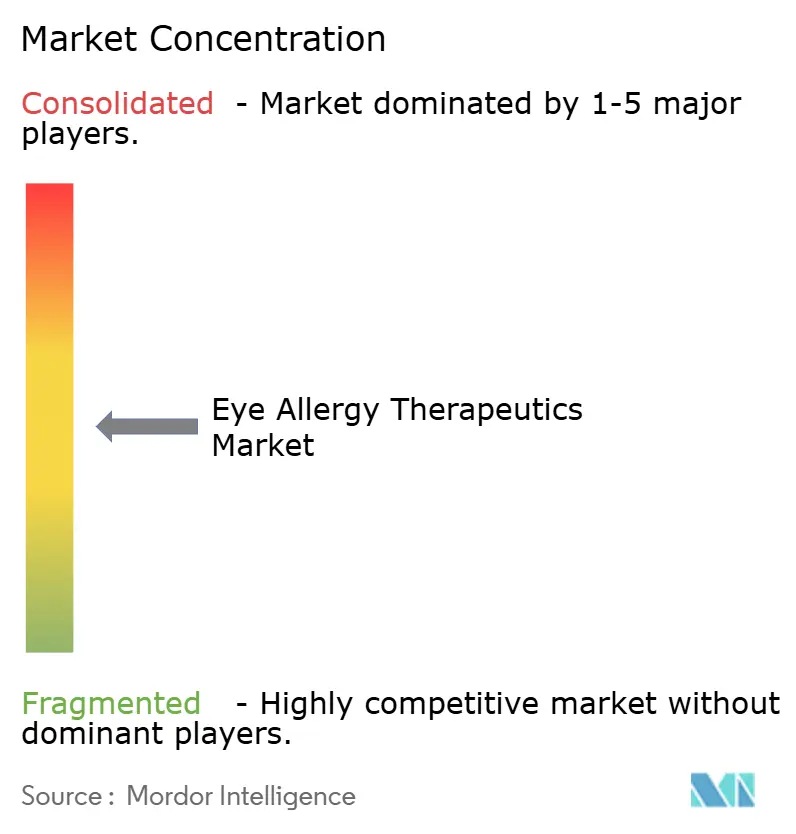
The eye allergy therapeutics market has moderate branded concentration and a more fragmented generic topical tier. Alcon, Bausch + Lomb, AbbVie, and Santen have strong commercial positions through OTC antihistamines, prescription drops, and specialty ophthalmic products. Generic suppliers are increasingly active in off-patent ophthalmic molecules, which adds price pressure after exclusivity ends and makes scale in manufacturing and distribution more relevant. The research indicates that generic products can enter at 30% to 50% discounts. This structure supports investment in product features that are harder to copy quickly.
Formulation differentiation is a central competitive response in the eye allergy therapeutics market. Preservative-free formats, once-daily dosing, intracanalicular inserts, and periocular creams can improve convenience or ocular-surface tolerability. Santen launched Alesion Eyelid Cream 0.5% in Japan in May 2024. In July 2026, Santen and KYORIN agreed to jointly promote the product beyond ophthalmology practices. Ocular Therapeutix expanded the DEXTENZA label in 2025 for pediatric allergic conjunctivitis in patients aged 2 years and older.
Allergen-specific biologics represent an important development path for the eye allergy therapeutics market. Regeneron's cat- and birch-allergen antibody programs reported positive Phase 3 challenge results in 2025. In June 2026, the company registered a Phase 3 cat-allergy study, while a birch-allergy study has a primary completion estimate of February 2027. Telios Pharma is also studying TL-925 ophthalmic emulsion in a Phase 2 seasonal allergic conjunctivitis trial.
Eye Allergy Therapeutics Industry Leaders
-
Alcon Inc.
-
Bausch + Lomb Corporation
-
AbbVie Inc.
-
Santen Pharmaceutical Co., Ltd.
-
Sun Pharmaceutical Industries Limited
- *Disclaimer: Major Players sorted in no particular order
Eye Allergy Therapeutics Market Companies Covered in this Report
- Alembic Pharmaceuticals
- Alcon
- Abbvie
- Bausch + Lomb Corporation
- Cipla
- Eton Pharmaceuticals, Inc.
- Glenmark Pharmaceuticals
- Harrow, Inc.
- Hikma Pharmaceuticals
- Lupin
- Mitsubishi Tanabe Pharma
- Novartis
- Ocular Therapeutix, Inc.
- Pfizer
- Regeneron Pharmaceuticals
- Sanofi
- Santen Pharmaceuticals
- Sun Pharmaceuticals Industries
- Teva Pharmaceutical Industries

Recent Industry Developments in Eye Allergy Therapeutics Market
- August 2026: KYORIN Pharmaceutical commenced co-promotion of Santen's Alesion Eyelid Cream 0.5% in Japan for medical institutions outside the ophthalmology specialty. The agreement, signed on July 13, 2026, is designed to extend the world's first periocular cream for allergic conjunctivitis to allergists, internists, and paediatricians, capturing the large proportion of AC prescribing that occurs outside ophthalmology, a structural channel gap that has historically limited market penetration of specialist-developed products.
- March 2026: ROHTO Pharmaceutical launched Rohto Alguard Epinastine Eye Drops in Japan, the first OTC approval of epinastine hydrochloride, an active ingredient previously available only by prescription, enabling pharmacy access without a physician visit. The Alguard brand holds a 70% share of Japan's allergy eye drop market, and this Rx-to-OTC switch is expected to materially expand the consumer self-treatment pool.
- February 2026: Regeneron presented first Phase 3 data from its cat- and birch-allergen antibody programmes at the AAAAI Annual Meeting in Philadelphia. These presentations marked the first public disclosure of conjunctival allergen challenge results from Phase 3 trials for both allergen-blocking programmes, informing the design of registration-enabling confirmatory studies planned for 2026.
- December 2025: Santen launched Verkazia, ciclosporin eye drops, in China for severe vernal keratoconjunctivitis in children and young adults aged 4 years and older, providing the first preservative-free topical ciclosporin treatment for this debilitating pediatric chronic ocular allergy in the Chinese market.


Global Eye Allergy Therapeutics Market Report Scope
According to the report’s scope, eye allergy therapeutics are medications used to treat and manage allergic reactions affecting the eyes, such as itching, redness, and swelling. They include antihistamines, mast cell stabilizers, and anti-inflammatory agents to relieve symptoms.
The eye allergy therapeutics market is segmented into drug class, allergy type, dosage form, route of administration, distribution channel, end user, patient demographics, prescription status, and geography. By drug class, the market is segmented into antihistamines, mast cell stabilizers, dual-action agents, corticosteroids, decongestants, immunotherapy, and other drug classes. By allergy type, the market is segmented into Seasonal allergic conjunctivitis, perennial allergic conjunctivitis, vernal keratoconjunctivitis, atopic keratoconjunctivitis, giant papillary conjunctivitis, and contact allergic conjunctivitis. By dosage form, the market is segmented into eye drops, injectables, oral tablets/capsules, gels and ointments. By route of administration, the market is segmented into topical ocular administration, periocular administration, oral administration, nasal administration, and injectable administration. By distribution channel, the market is segmented into hospital pharmacies, retail pharmacies and drug stores, online pharmacies and e-commerce, and other distribution channels. By end user, the market is segmented into hospitals, ophthalmology clinics, allergy centers, homecare settings, and other end users. By patient demographics, the market is segmented into pediatric patients and adult patients. By prescription status, the market is segmented into prescription products and over-the-counter products. By geography, the market is segmented into North America, Europe, Asia-Pacific, the Middle East and Africa, and South America. The report also covers the estimated market sizes and trends for 17 countries across major regions globally. The report offers values (USD) for all the above segments.
| Antihistamines |
| Mast Cell Stabilizers |
| Dual-action Agents |
| Corticosteroids |
| Decongestants |
| Immunotherapy |
| Other Drug Classes |
| Seasonal Allergic Conjunctivitis |
| Perennial Allergic Conjunctivitis |
| Vernal Keratoconjunctivitis |
| Atopic Keratoconjunctivitis |
| Giant Papillary Conjunctivitis |
| Contact Allergic Conjunctivitis |
| Eye Drops |
| Injectables |
| Oral Tablets/Capsules |
| Gels and Ointments |
| Topical Ocular Administration |
| Periocular Administration |
| Oral Administration |
| Nasal Administration |
| Injectable Administration |
| Hospital Pharmacies |
| Retail Pharmacies and Drug Stores |
| Online Pharmacies and E-Commerce |
| Other Distribution Channels |
| Hospitals |
| Ophthalmology Clinics |
| Allergy Centers |
| Homecare Settings |
| Other End Users |
| Pediatric Patients |
| Adult Patients |
| Prescription Products |
| Over-the-Counter Products |
| North America | United States |
| Canada | |
| Mexico | |
| Europe | Germany |
| United Kingdom | |
| France | |
| Italy | |
| Spain | |
| Rest of Europe | |
| Asia-Pacific | China |
| Japan | |
| India | |
| Australia | |
| South Korea | |
| Rest of Asia-Pacific | |
| Middle East and Africa | GCC |
| South Africa | |
| Rest of Middle East and Africa | |
| South America | Brazil |
| Argentina | |
| Rest of South America |
| By Drug Class | Antihistamines | |
| Mast Cell Stabilizers | ||
| Dual-action Agents | ||
| Corticosteroids | ||
| Decongestants | ||
| Immunotherapy | ||
| Other Drug Classes | ||
| By Allergy Type | Seasonal Allergic Conjunctivitis | |
| Perennial Allergic Conjunctivitis | ||
| Vernal Keratoconjunctivitis | ||
| Atopic Keratoconjunctivitis | ||
| Giant Papillary Conjunctivitis | ||
| Contact Allergic Conjunctivitis | ||
| By Dosage Form | Eye Drops | |
| Injectables | ||
| Oral Tablets/Capsules | ||
| Gels and Ointments | ||
| By Route of Administration | Topical Ocular Administration | |
| Periocular Administration | ||
| Oral Administration | ||
| Nasal Administration | ||
| Injectable Administration | ||
| By Distribution Channel | Hospital Pharmacies | |
| Retail Pharmacies and Drug Stores | ||
| Online Pharmacies and E-Commerce | ||
| Other Distribution Channels | ||
| By End User | Hospitals | |
| Ophthalmology Clinics | ||
| Allergy Centers | ||
| Homecare Settings | ||
| Other End Users | ||
| By Patient Demographics | Pediatric Patients | |
| Adult Patients | ||
| By Prescription Status | Prescription Products | |
| Over-the-Counter Products | ||
| Geography | North America | United States |
| Canada | ||
| Mexico | ||
| Europe | Germany | |
| United Kingdom | ||
| France | ||
| Italy | ||
| Spain | ||
| Rest of Europe | ||
| Asia-Pacific | China | |
| Japan | ||
| India | ||
| Australia | ||
| South Korea | ||
| Rest of Asia-Pacific | ||
| Middle East and Africa | GCC | |
| South Africa | ||
| Rest of Middle East and Africa | ||
| South America | Brazil | |
| Argentina | ||
| Rest of South America | ||


Key Questions Answered in the Report
What is projected value for eye allergy therapeutics market by 2031?
Eye allergy therapeutics market is projected to reach USD 6.19 billion by 2031.
Which drug class leads eye allergy treatment?
Antihistamines led the drug-class segment with 32.87% in 2025. Immunotherapy is the fastest-growing class at a 7.54% CAGR through 2031, supported by interest in therapies that may alter allergic disease pathways.
Why are preservative-free eye allergy products important?
Preservatives can affect the ocular surface with repeated use and may complicate symptom management for people with dry eye. Preservative-free products may address tolerability concerns and support product differentiation.
Which region is growing fastest for eye allergy care?
Asia-Pacific is forecast to grow at a 6.76% CAGR through 2031, supported by urban exposure, health awareness, and wider access to treatment. Japan and China illustrate the region's combination of mature consumer access and expanding specialty treatment availability.
How are OTC switches changing eye allergy treatment?
OTC switches can make common treatments easier to access, especially through pharmacies and online channels. They can increase generic competition, lower pricing power, and shift more routine care toward consumer self-management.
What new therapies are being developed for allergic conjunctivitis?
Allergen-specific antibody programs from Regeneron are in Phase 3 studies. These investigational products aim to block particular allergens and remain subject to clinical, safety, and regulatory review before routine commercial availability.
Page last updated on:





