
Event-Based Industrial Vision Systems Market Size and Share
Market Overview
| Study Period | 2020 - 2031 |
|---|---|
| Market Size (2026) | USD 0.34 Billion |
| Market Size (2031) | USD 1.14 Billion |
| Growth Rate (2026 - 2031) | 27.38 % |
| Fastest Growing Market | Asia-Pacific |
| Largest Market | North America |
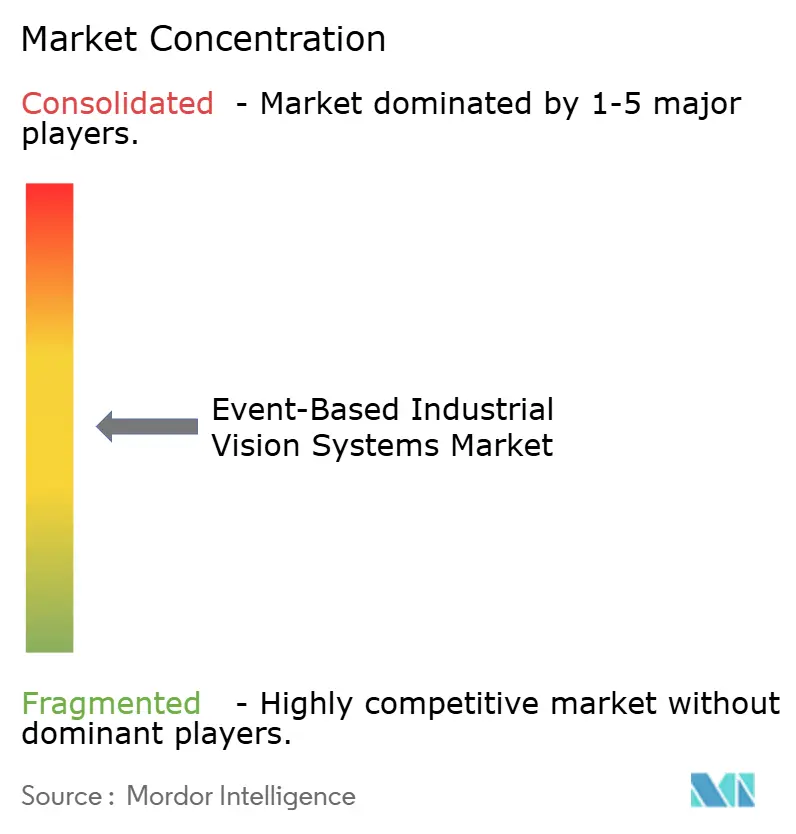
| Market Concentration | Medium |
Major Players *Disclaimer: Major Players sorted in no particular order Image © Mordor Intelligence. Reuse requires attribution under CC BY 4.0. | |
Event-Based Industrial Vision Systems Market Analysis by Mordor Intelligence
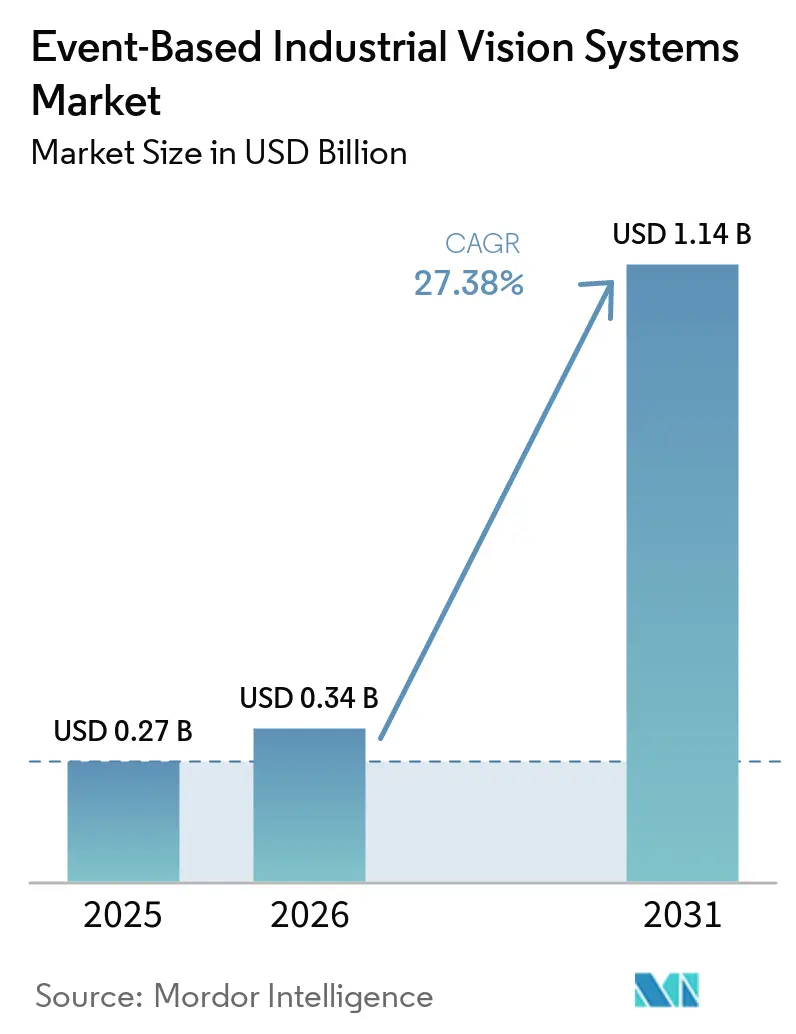
The Event-Based Industrial Vision Systems Market size was valued at USD 0.27 billion in 2025 and estimated to expand from USD 0.34 billion in 2026 to reach USD 1.14 billion by 2031, at a CAGR of 27.38% during the forecast period (2026-2031). The Event-Based Industrial Vision Systems Market addresses production environments in which motion blur, fixed exposure latency, and redundant image data limit the use of frame-based machine vision. Its adoption is tied to applications in which missed defects, production interruptions, or control delays result in material operating costs. Manufacturers are pairing event sensors with edge processing so that systems can respond at the point of inspection rather than send full video streams for centralized analysis. Competitive strategies increasingly combine sensor hardware, processing capability, and software tools that support deployment within existing industrial workflows. The opportunity is concentrated in high-speed inspection, automation, and monitoring settings where conventional systems have performance limits. It is not equally distributed across all factory tasks, because static scenes and lower-speed lines can continue to use established cameras with lower acquisition and integration costs. Adoption will depend on whether suppliers can offer systems that reduce the technical burden of handling event streams, integrate with plant control tools, and demonstrate reliable results under actual production lighting conditions. These conditions make system design, application support, and compatibility as important as basic sensor performance when customers select a solution, particularly in sites with established quality procedures, existing industrial networks, limited specialist engineering capacity, and strict uptime expectations during daily production schedules across connected manufacturing cells.
Key Report Takeaways
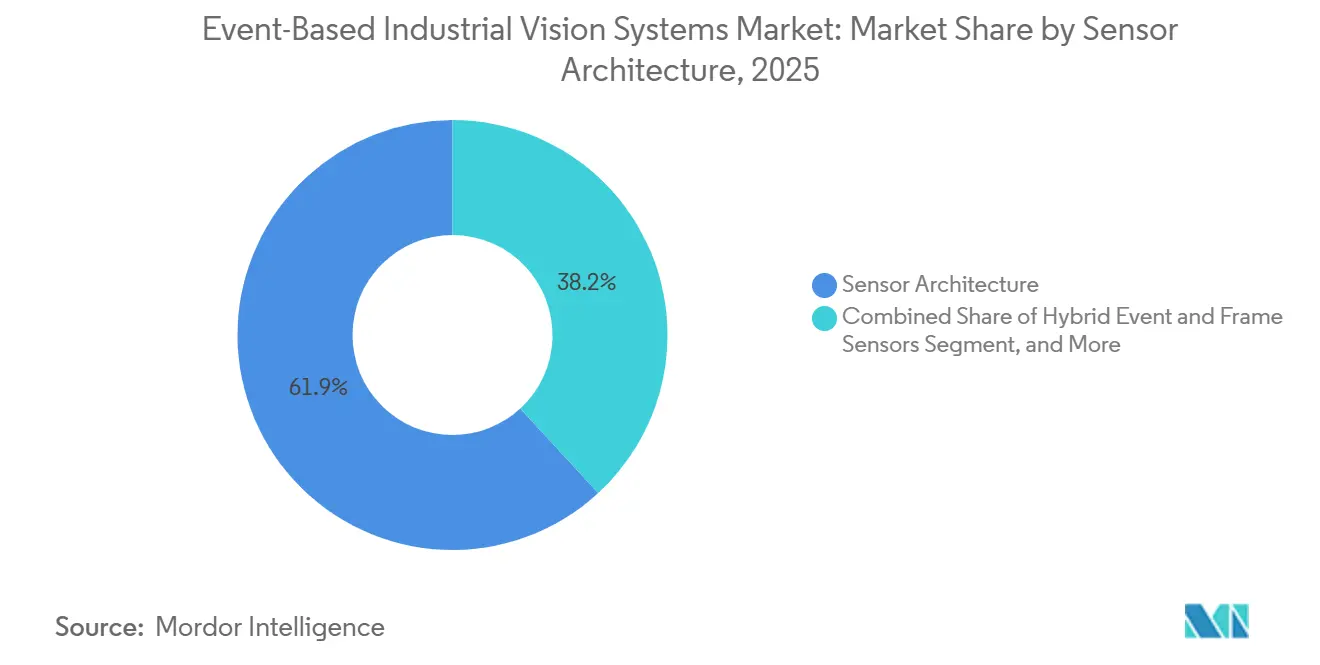
- By sensor architecture, pure event-based sensors accounted for 61.85% of the Event-Based Industrial Vision Systems Market share in 2025, while hybrid event- and frame-based sensors are projected to expand at a 29.65% CAGR through 2031.
- By system component, industrial event cameras accounted for 32.46% of the Event-Based Industrial Vision Systems Market share in 2025, while processing hardware and software are projected to expand at a 28.35% CAGR through 2031.
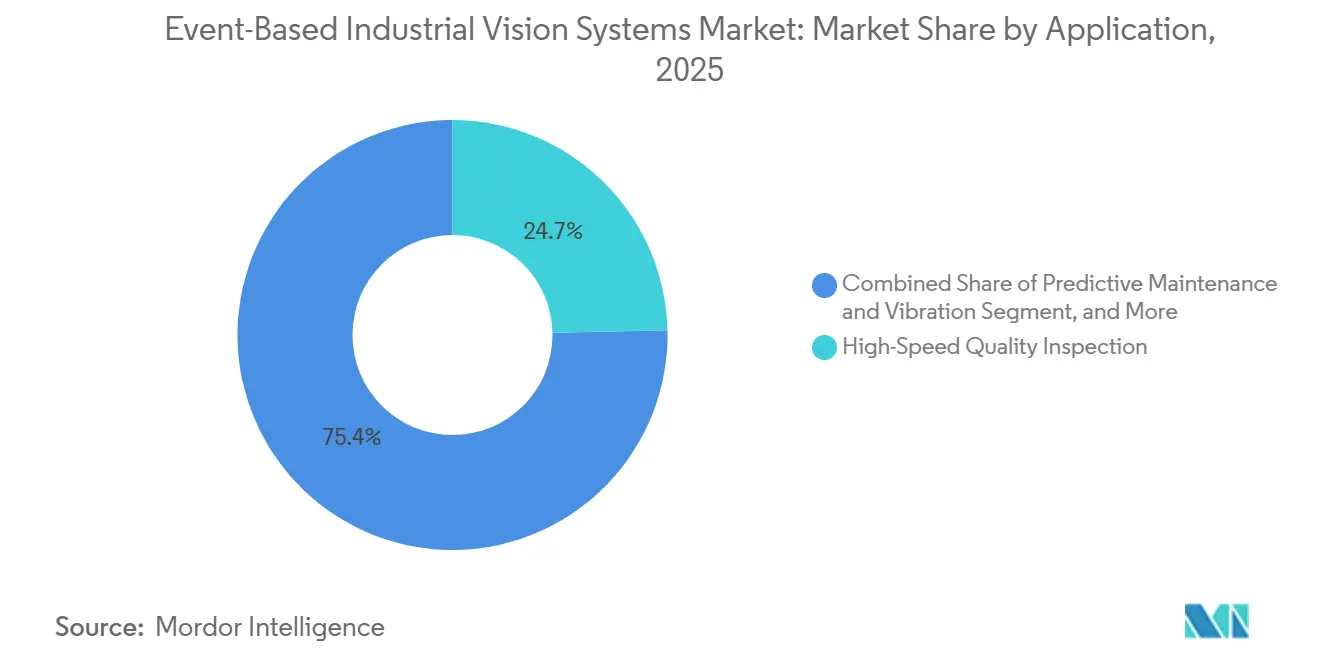
- By application, high-speed quality inspection held 24.65% share in 2025, while predictive maintenance and vibration monitoring are expected to expand at a 29.46% CAGR through 2031.
- By end-user industry, automotive accounted for a 25.84% share in 2025, while electronics and semiconductors are projected to expand at a 28.75% CAGR through 2031.
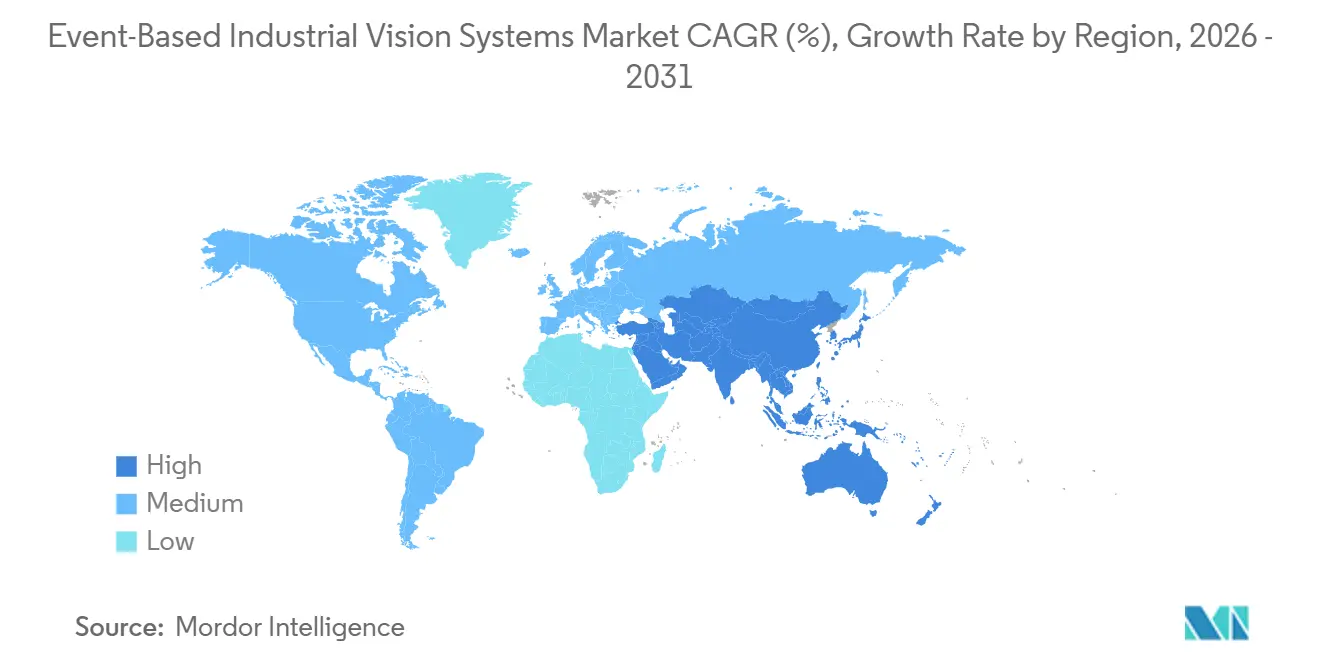
- By geography, North America held 34.78% share in 2025, while Asia-Pacific is projected to expand at a 29.20% CAGR through 2031.
Note: Market size and forecast figures in this report are generated using Mordor Intelligence’s proprietary estimation framework, updated with the latest available data and insights as of January 2026.
Global Event-Based Industrial Vision Systems Market Trends and Insights
Demand for High-Speed Industrial Inspection and Automation
Manufacturers operating under zero-defect requirements face constraints when frame-based cameras inspect products moving at speeds above 2 meters per second. Motion blur and frame latency can make sub-millimeter defect classification unreliable at those speeds. Event-based sensors generate output when individual pixels register brightness changes, rather than capture a complete image at fixed intervals. Sony reported pixel latency below 100 microseconds at 1,000 lux for its IMX636 sensor. Sony also states that event sensors can detect relative luminance changes associated with scratches, stains, and surface anomalies on moving products. This approach reduces the amount of information passed to downstream computing systems and makes the Event-Based Industrial Vision Systems Market more relevant to paint inspection, weld monitoring, and other rapid industrial processes.[1]
Growth of Industrial Robotics and Smart Manufacturing
The global operational stock of industrial robots reached 5 million units in 2025, following an 11.2% increase in annual installations to 603,307 units. The International Federation of Robotics expects global installations to reach 655,000 units in 2026 and 806,000 units by 2029.[2] Electronics and automotive both recorded 10% growth in robot deployments during 2025. Event cameras can support robotic pick-and-place tasks because their motion data can be processed on very short time scales. This capability can reduce gripper errors on fast conveyors and improve response time in closed-loop control. Collaborative robot installations reached 66,000 units in 2025, representing 11% of all installations, thereby broadening the role of event sensing in worker proximity and machine safety monitoring.
Integration of Event Sensors With Edge AI and Neuromorphic Processors
The Event-Based Industrial Vision Systems Market is gaining traction, driven by processors designed to interpret sparse sensor data near production assets. BrainChip began commercial availability and production shipments of its AKD1500 neuromorphic processor in June 2026. The company states that the processor operates at under 300 mW in PCIe mode and can process sensor inputs at acquisition without cloud dependence. SynSense’s Speck system-on-chip combines event-based image sensing with 320,000 on-chip neurons, supporting low-power processing in compact systems. This hardware can help industrial users deploy inference within thermally constrained enclosures. Prophesee’s Hearth platform adds GDPR-compatible data handling, AI governance, and over-the-air update capabilities, supporting deployments that must meet European compliance requirements.[3]
Increasing Demand for Low-Power, Always-On Machine Vision
Continuous monitoring of conveyors, rotating machinery, and safety zones can require significant computing and storage when conventional cameras record at 60 to 120 frames per second. Event cameras only generate data when a change occurs in the scene. Sony lists a standby power of 5 mW for its EVS technology, enabling continuous sensing in constrained installations. Low-illuminance settings can increase pixel latency and introduce edge artifacts, which limit the benefit in dim industrial areas such as metalworking shops. Prophesee launched its GenX320 Starter Kit for Raspberry Pi 5 in August 2025, giving developers a lower-cost route to build applications for drones, robotics, automation, and surveillance. These tools can widen access beyond specialist integrators and support the low-power monitoring use cases within the Event-Based Industrial Vision Systems Market.[4]
Restraints Impact Analysis*
| Restraint | (~) % Impact on CAGR Forecast | Geographic Relevance | Impact Timeline |
|---|---|---|---|
| High Sensor and System Costs at Limited Production Scale | -3.8% | Global, most acute in cost-sensitive locations | Short term (≤ 2 years) |
| Shortage of Event-Based Data-Processing Expertise | -2.6% | Global | Medium term (2-4 years) |
| Limited Interoperability With Legacy Machine-Vision Architectures | -1.8% | Europe and North America, where legacy installations are extensive | Medium term (2-4 years) |
| Sparse-Event Blind Spots in Static and Low-Contrast Inspection Scenes | -1.0% | Global | Long term (≥ 4 years) |
| Source: Mordor Intelligence | |||
High Sensor and System Costs at Limited Production Scale
Event-based sensors cost thousands of USD per unit at current production volumes. The cost reflects limited-volume CMOS fabrication and does not only arise from the underlying silicon. A complete deployment also needs optics, processing hardware, and event-stream software, which raises the initial engineering cost for each installation. Prophesee raised EUR 20 million (USD 22.3 million) in June 2026 to support commercial scale-up, embedded sensor intelligence, and its Hearth software platform. Greater production volume could lower the cost base, but automotive-tier pricing is not yet available. This cost structure may slow near-term adoption in the Event-Based Industrial Vision Systems Market, especially among smaller manufacturers with established frame-based equipment.
Shortage of Event-Based Data-Processing Expertise
Conventional machine vision has mature libraries, tools, and a broad pool of trained users. Event-based processing requires knowledge of asynchronous and spatiotemporal data structures. Development teams must handle irregular event streams rather than regular pixel grids, which can require changes to model design, training workflows, and programmable logic controller integration. A 2026 systematic review identified limited real-world validation datasets, unstandardized simulation platforms, and limited labeled event data as continuing challenges for event-based vision applications. Innovation had deployed its technology at more than 700 organizations in 40 countries before its acquisition by SynSense, indicating that practitioner experience remains concentrated within a limited specialist community. Software providers can respond by supplying preconfigured processing pipelines that deliver inspection results through interfaces familiar to plant engineers.
*Our forecasts treat driver/restraint impacts as directional, not additive. The impact forecasts reflect baseline growth, mix effects, and variable interactions.
Segment Analysis
By Sensor Architecture: Pure Event-Based Sensors Lead, While Hybrid Designs Expand
Pure event-based sensors held 61.85% of the Event-Based Industrial Vision Systems Market share in 2025. Their position reflects the availability of Sony IMX636 and IMX637 sensors, which were co-developed with Prophesee for event-based applications. Sony reports sub-100-microsecond pixel latency and a dynamic range exceeding 120 dB for the IMX636 product family. These specifications support inspection where rapid movement and changing light conditions challenge frame-based systems. Color event-based sensors and other advanced sensing approaches had smaller positions because chrominance information adds reconstruction requirements. Their use is more relevant in scientific and specialized inspection cases where color information is required. These designs remain relevant where an inspection decision depends on color separation as well as on changes in motion or brightness, but the added processing requirement makes their current role narrower than that of pure event sensing in fast factory inspection.
Hybrid event and frame sensors are projected to expand at a 29.65% CAGR through 2031. They allow users to operate legacy frame-based algorithms alongside event streams from a single sensor platform. This can reduce the retraining and requalification burden associated with a move to pure event-based sensing. CenturyArks launched the SilkyEvCam HD Module in October 2025 as a commercially available event-based camera module with a MIPI interface. The module uses the Sony-Prophesee IMX636 HD sensor and gives engineers a standard embedded camera interface. Hybrid architectures can therefore find wider use in food and beverage and pharmaceutical lines that need to preserve existing inspection software while introducing new sensing capability. Their role is particularly practical when operations need a staged transition, because teams can validate event data against familiar frame-based results before changing qualification procedures or replacing established inspection rules.

By System Component: Industrial Cameras Hold the Largest Position, While Processing Expands
Industrial event cameras held 32.46% of the Event-Based Industrial Vision Systems Market share in 2025. This reflects demand for complete camera units rather than for raw sensor silicon, which requires a custom design. IDS launched the uEye EVS camera series in March 2025 with the Sony-Prophesee IMX636HD sensor and Prophesee’s Metavision processing technology. IDS and Prophesee reported a dynamic range above 120 dB and 10x to 1,000x data reduction compared with frame-based alternatives. Event-based image sensors and camera modules remain important for integrators building customized assemblies. Integration and support services hold the smallest share because deployment remains concentrated among original equipment manufacturers and specialized integrators. This pattern reflects an early commercial stage in which many customers still need tailored camera positioning, optical selection, processing configuration, and connection to plant control systems before a solution can operate consistently on a production line.
Processing hardware and software are projected to expand at a 28.35% CAGR through 2031. The component is supported by processors capable of running event-driven inference in industrial systems. BrainChip made the AKD1500 available in an M.2 form factor in July 2026 for industrial and commercial designs. The format can support plug-in integration for fanless industrial PCs and retrofits of legacy systems. BrainChip’s June 2026 production announcement also positioned the processor for industrial IoT use cases. SynSense’s Speck system-on-chip adds a compact option that combines sensing and processing. As hardware becomes more accessible, software platforms with ready-to-use models for common industrial tasks can become a key differentiator in the Event-Based Industrial Vision Systems Market. Suppliers that make event data easier to interpret can reduce the skills burden on manufacturing teams and can help customers move from a technical evaluation to a system used in daily inspection operations.
By Application: High-Speed Quality Inspection Leads, While Predictive Maintenance Advances
High-speed quality inspection accounted for 24.65% of the Event-Based Industrial Vision Systems Market in 2025. Automotive manufacturers require full inline inspection of stamped, cast, and painted parts at speeds that can exceed the useful range of standard frame-based cameras. Sony states that its event-based sensors detect relative luminance differences associated with surface defects while sending differential data rather than full frames. This supports inspection of paint defects, scratches, stains, and other anomalies on moving products. Object counting and gauging also benefit from low latency on high-throughput lines. Robotic guidance and pick-and-place applications similarly use rapid motion information to improve timing and positioning. In each case, the benefit comes from focusing processing on movement and surface change, instead of requiring the system to examine every part of a full image where no useful change has occurred.
Predictive maintenance and vibration monitoring are projected to expand at a 29.46% CAGR through 2031. Event sensors can capture vibration-induced changes in luminance on equipment housings at microsecond resolution. The resulting data can be processed at the edge for real-time fault classification. Worker and machine safety monitoring is an emerging use case as robotic workcells become denser. Optical character recognition and identification can use blur-free sensing to monitor high-speed label printing at rates above 10,000 parts per hour. Process monitoring and control can use event sensing in welding, cutting, and forming, where spark detection and tool-wear indicators require fine temporal resolution. A prevented failure on a continuous line can make the monitoring investment more practical for users assessing this part of the Event-Based Industrial Vision Systems Market. This economic case is strongest where an unexpected stop affects an interconnected process, since maintenance staff can use early signals to inspect equipment before a developing fault disrupts output.
By End-User Industry: Automotive Leads, While Electronics and Semiconductor Expands Fastest
Automotive held 25.84% of the Event-Based Industrial Vision Systems Market share in 2025. The segment combines fast inspection requirements, high surface-quality standards, and an established machine vision base within the Event-Based Industrial Vision Systems Market. Prophesee identifies automotive use cases, including paint defect inspection, scratch detection, and planarity testing. Event sensors can detect paint anomalies and micro-cracks that occur too quickly for conventional cameras to consistently capture at line speed. Industrial machinery and robotics represent another area of demand because operators need predictive maintenance for heavy assets. Metals, mining, and materials processing use the technology for spark monitoring and surface anomaly detection on rolling mills. These settings share the same demand for rapid detection under difficult lighting and high movement, which makes them relevant beyond automotive facilities, which currently represent the largest end-user group.
Electronics and semiconductor is projected to expand at a 28.75% CAGR through 2031. The use case is driven by sub-micron defect detection on advanced-node wafers, pushing beyond the frame-rate limits of conventional systems. Sony’s industrial EVS range is designed for rapid luminance changes and high-speed imaging conditions. Food and beverage producers can use event sensing for contamination checks and packaging-line inspection. Pharmaceutical and medical-device manufacturers can apply it to capsule and blister-pack inspection. Logistics and warehousing use blur-free imaging for parcel sorting on conveyor belts moving above 3 meters per second. Research and scientific institutions also contribute to algorithm development that later moves into industrial deployments, often with a 2-4-year lag. Their contribution can support the development of event-processing methods before industrial users adopt them for inspection, maintenance, safety, or control tasks that require validated operational results.
Geography Analysis
North America held 34.78% of the Event-Based Industrial Vision Systems Market share in 2025. The United States has advanced semiconductor fabrication locations in Arizona and Texas, automotive stamping and assembly operations across Michigan and the Southeast, and a dense network of machine vision integrators. These conditions support trials and early deployment of event-based systems. The region also benefits from proximity to neuromorphic processor developers. BrainChip began commercial production shipments of the AKD1500 in June 2026 for industrial IoT and other applications. Canada and Mexico extend demand through their automotive supply chains and contract manufacturing activity. This broader regional production base supports demand beyond projects that originate in the United States. It also gives suppliers access to connected automotive and manufacturing operations that can apply similar camera and processing approaches across facilities, while local integrators adapt systems to each plant’s machinery and inspection workflow.
Europe has a strong base in Germany, France, and the United Kingdom, where system integrators and academic centers are active in developing event-based algorithms. IDS Imaging Development Systems and Prophesee signed a letter of intent in March 2026 to co-develop next-generation industrial vision systems. The cooperation supports multi-sensor design and the integration of industrial manufacturing. The EU Machinery Regulation, EU 2023/1230, will be fully applicable from January 2027 and will update safety requirements for automated machinery. This can create upgrade cycles where older vision systems do not meet new conformity requirements. Italy, France, and Spain add application demand through precision manufacturing, aerospace, and food processing. Europe’s expansion is more measured because many facilities must migrate from an extensive base of legacy machine vision hardware. That migration can favor solutions that work alongside existing cameras and software, since manufacturers can introduce event sensing without stopping an entire production process or immediately replacing every inspection asset.
Asia-Pacific is projected to expand at a 29.20% CAGR through 2031, the fastest rate among the regional groups. China installed 354,000 industrial robots in 2025, representing 59% of global installations. This installed base provides a large base of robot-integrated production lines where camera upgrades can be introduced. Japan remains important to event-sensor innovation through Sony’s IMX636, IMX637, IMX646, and IMX647 EVS products. South Korea’s electronics and semiconductor base supports demand for advanced inspection. India recorded a 15% increase in industrial robot installations in 2025, which establishes automation infrastructure for medium-term adoption. The Middle East and Africa remain early-stage markets, with initial adoption linked to greenfield smart-factory projects in Saudi Arabia and the UAE. Greenfield facilities can specify Event-Based Industrial Vision Systems Market solutions during design, which avoids the compatibility challenge faced by sites that must connect newer sensors to an established legacy inspection environment.
Competitive Landscape
The Event-Based Industrial Vision Systems Market is moderately fragmented across sensor silicon, systems integration, and software and processing middleware. Prophesee, Sony Semiconductor Solutions, CelePixel, and AlpsenTek operate in the sensor silicon space. SynSense and iniVation, IDS Imaging Development Systems, and Lucid Vision Labs participate in end-to-end systems integration. MVTec Software, Imago Technologies, and SynSense provide software or processing capabilities. SynSense acquired 100% of iniVation in November 2025. The transaction combined event-based camera hardware with neuromorphic processing silicon and retained Innovation’s Zurich operation for existing customers. It gives the combined business control across sensing and processing, while competitors in the Event-Based Industrial Vision Systems Market that specialize in one layer must show how their products can work effectively with partner hardware or third-party software.
Prophesee follows a full-stack approach through its Hearth platform, which includes GDPR compatibility, AI governance, and over-the-air updates. The company raised EUR 20 million (USD 22.3 million) in June 2026 to finance commercial scaling, embedded intelligence, and the platform launch. IDS and Prophesee expanded their relationship in March 2026 through a letter of intent for next-generation industrial vision systems. BrainChip and EdgeAI provide hardware-agnostic neuromorphic processing platforms rather than event cameras. Their approach could place greater value on sensor intellectual property and algorithm rights if processing hardware becomes more standardized. The Event-Based Industrial Vision Systems Industry, therefore, has competition across both components and software layers. The different positions mean that a supplier can compete through sensor performance, an integrated camera design, lower-power inference, or software that makes event information usable in routine industrial workflows.
A production-certified system that combines event cameras with time-of-flight LiDAR or structured-light sensors within a single calibrated enclosure is not available from any of the listed vendors. This creates an opportunity in multi-sensor fusion for suppliers capable of validating a complete industrial design. IEC TC65 has not published a specific conformity framework for event-based machine vision. The absence of a dedicated standard leaves compliance pathways less defined for new entrants. Established suppliers in the Event-Based Industrial Vision Systems Market with experience in industrial compliance can have an advantage during procurement and deployment. Patent activity around hybrid event-frame architectures indicates that intellectual property positions are still being formed in a fast-expanding sensor category. Early technical positions can influence the design choices available to integrators, particularly when hybrid systems are used to connect event sensing with conventional inspection methods that remain common across industrial plants. The competitive structure remains dispersed across sensor, systems, and software layers, and no combined top-player market share was supplied to quantify concentration more precisely.
Event-Based Industrial Vision Systems Industry Leaders
-
Sony Corporation
-
Samsung Electronics Co., Ltd.
-
Prophesee SA
-
iniVation AG
-
OmniVision Technologies, Inc.
- *Disclaimer: Major Players sorted in no particular order
Recent Industry Developments
- September 2026: The International Federation of Robotics published its World Robotics 2026 report, confirming that global industrial robot installations reached a record 603,307 units in 2025 (+11.2%), with the global operational stock surpassing 5 million units. Installations are forecast to reach 655,000 units in 2026 and 806,000 by 2029, a trajectory that directly expands the total addressable base for event-based machine vision co-deployed with robotic systems.
- August 2026: BrainChip Holdings announced a partnership with Orama.AOI, an AI-powered automated optical inspection provider, to deploy Akida neuromorphic AI models retrained on Orama.AOI's industrial inspection datasets for tire production and semiconductor packaging. The collaboration demonstrates production-ready defect detection on BrainChip's AKD1500 M.2 neuromorphic platform for fanless industrial PCs, extending event-based AI inference into cost-sensitive factory floor environments without GPU-class power consumption.
- July 2026: BrainChip made its AKD1500 neuromorphic chip available in M.2 form factor, enabling drop-in plug-and-play edge AI for industrial and commercial designs. The module targets fanless industrial PCs and legacy system retrofits, lowering integration barriers for manufacturers seeking on-device event-based inference without power supply or cooling redesign.
- July 2026: The Beijing Industrial Intelligence Association issued T/BIIA 081-2026, a specification formalizing deep learning-based defect detection requirements across semiconductor, automotive, textile, food processing, and metal processing applications in China. The standard accelerates procurement mandates for high-speed vision systems, including event-based cameras, across China's advanced manufacturing sector.
Global Event-Based Industrial Vision Systems Market Report Scope
Event-Based Industrial Vision Systems are bio-inspired imaging solutions that use neuromorphic sensors to asynchronously capture pixel-level brightness changes, offering ultra-low latency, high temporal resolution, and reduced data bandwidth for real-time monitoring of high-speed motion and dynamic events in industrial automation.
The Event-Based Industrial Vision Systems Market Report is Segmented by Sensor Architecture (Pure Event-Based Sensors (DVS/EVS), Hybrid Event and Frame Sensors, Color Event-Based Sensors, and Other Advanced Event-Sensing Architectures), System Component (Event-Based Image Sensors, Camera Modules, Industrial Event Cameras, Processing Hardware and Software, and Integration and Support Services), Application (High-Speed Quality Inspection, Object Counting and Gauging, Robotic Guidance and Pick-and-Place, Motion and Optical-Flow Analysis, Predictive Maintenance and Vibration Monitoring, Process Monitoring and Control, Worker and Machine-Safety Monitoring, and Optical Character Recognition and Identification), End-User Industry (Automotive, Electronics and Semiconductor, Industrial Machinery and Robotics, Food and Beverage, Pharmaceutical and Medical-Device, Metals, Mining, and Materials Processing, Logistics and Warehousing, Research and Scientific Institutions, and Other End-User Industries), and Geography (North America, South America, Europe, Asia-Pacific, Middle East and Africa). The Market Forecasts are Provided in Terms of Value (USD).
| Pure Event-Based Sensors (DVS/EVS) |
| Hybrid Event and Frame Sensors |
| Color Event-Based Sensors |
| Other Advanced Event-Sensing Architectures |
| Event-Based Image Sensors |
| Camera Modules |
| Industrial Event Cameras |
| Processing Hardware and Software |
| Integration and Support Services |
| High-Speed Quality Inspection |
| Object Counting and Gauging |
| Robotic Guidance and Pick-and-Place |
| Motion and Optical-Flow Analysis |
| Predictive Maintenance and Vibration Monitoring |
| Process Monitoring and Control |
| Worker and Machine-Safety Monitoring |
| Optical Character Recognition and Identification |
| Automotive |
| Electronics and Semiconductor |
| Industrial Machinery and Robotics |
| Food and Beverage |
| Pharmaceutical and Medical-Device |
| Metals, Mining, and Materials Processing |
| Logistics and Warehousing |
| Research and Scientific Institutions |
| Other End-User Industries |
| North America | United States | |
| Canada | ||
| Mexico | ||
| South America | Brazil | |
| Argentina | ||
| Rest of South America | ||
| Europe | Germany | |
| United Kingdom | ||
| France | ||
| Italy | ||
| Spain | ||
| Rest of Europe | ||
| Asia-Pacific | China | |
| Japan | ||
| India | ||
| South Korea | ||
| Rest of Asia-Pacific | ||
| Middle East and Africa | Middle East | Saudi Arabia |
| United Arab Emirates | ||
| Turkey | ||
| Rest of the Middle East | ||
| Africa | South Africa | |
| Nigeria | ||
| Rest of Africa | ||
| By Sensor Architecture | Pure Event-Based Sensors (DVS/EVS) | ||
| Hybrid Event and Frame Sensors | |||
| Color Event-Based Sensors | |||
| Other Advanced Event-Sensing Architectures | |||
| By System Component | Event-Based Image Sensors | ||
| Camera Modules | |||
| Industrial Event Cameras | |||
| Processing Hardware and Software | |||
| Integration and Support Services | |||
| By Application | High-Speed Quality Inspection | ||
| Object Counting and Gauging | |||
| Robotic Guidance and Pick-and-Place | |||
| Motion and Optical-Flow Analysis | |||
| Predictive Maintenance and Vibration Monitoring | |||
| Process Monitoring and Control | |||
| Worker and Machine-Safety Monitoring | |||
| Optical Character Recognition and Identification | |||
| By End-User Industry | Automotive | ||
| Electronics and Semiconductor | |||
| Industrial Machinery and Robotics | |||
| Food and Beverage | |||
| Pharmaceutical and Medical-Device | |||
| Metals, Mining, and Materials Processing | |||
| Logistics and Warehousing | |||
| Research and Scientific Institutions | |||
| Other End-User Industries | |||
| By Geography | North America | United States | |
| Canada | |||
| Mexico | |||
| South America | Brazil | ||
| Argentina | |||
| Rest of South America | |||
| Europe | Germany | ||
| United Kingdom | |||
| France | |||
| Italy | |||
| Spain | |||
| Rest of Europe | |||
| Asia-Pacific | China | ||
| Japan | |||
| India | |||
| South Korea | |||
| Rest of Asia-Pacific | |||
| Middle East and Africa | Middle East | Saudi Arabia | |
| United Arab Emirates | |||
| Turkey | |||
| Rest of the Middle East | |||
| Africa | South Africa | ||
| Nigeria | |||
| Rest of Africa | |||
Key Questions Answered in the Report
What is the size of the Event-Based Industrial Vision Systems Market?
The Event-Based Industrial Vision Systems Market was valued at USD 0.27 billion in 2025, is estimated at USD 0.34 billion in 2026, and is projected to reach USD 1.14 billion by 2031 at a 27.38% CAGR.
What is driving adoption of event-based industrial vision systems?
High-speed inspection, industrial robotics, low-power continuous monitoring, and local AI processing are supporting adoption where frame-based systems experience motion blur or latency limits.
Which sensor architecture held the largest share in 2025?
Pure event-based sensors held 61.85% share in 2025. Hybrid event and frame sensors are projected to expand at a 29.65% CAGR through 2031.
Which application is projected to expand fastest through 2031?
Predictive maintenance and vibration monitoring is expected to expand at a 29.46% CAGR through 2031, supported by non-contact vibration sensing and edge-based fault classification.
Which region is projected to expand fastest?
Asia-Pacific is projected to expand at a 29.20% CAGR through 2031, supported by Chinas large industrial robot base and strong electronics and semiconductor activity.
What is the main barrier to wider deployment?
High system costs and limited event-stream processing expertise remain the most material barriers, particularly where manufacturers rely on established frame-based equipment.