
Industrial Vision Maintenance Services Market Size and Share
Market Overview
| Study Period | 2020 - 2031 |
|---|---|
| Market Size (2026) | USD 1.14 Billion |
| Market Size (2031) | USD 1.82 Billion |
| Growth Rate (2026 - 2031) | 9.81 % |
| Fastest Growing Market | Asia-Pacific |
| Largest Market | Asia-Pacific |
| Market Concentration | Medium |
Major Players *Disclaimer: Major Players sorted in no particular order Image © Mordor Intelligence. Reuse requires attribution under CC BY 4.0. | |
Industrial Vision Maintenance Services Market Analysis by Mordor Intelligence
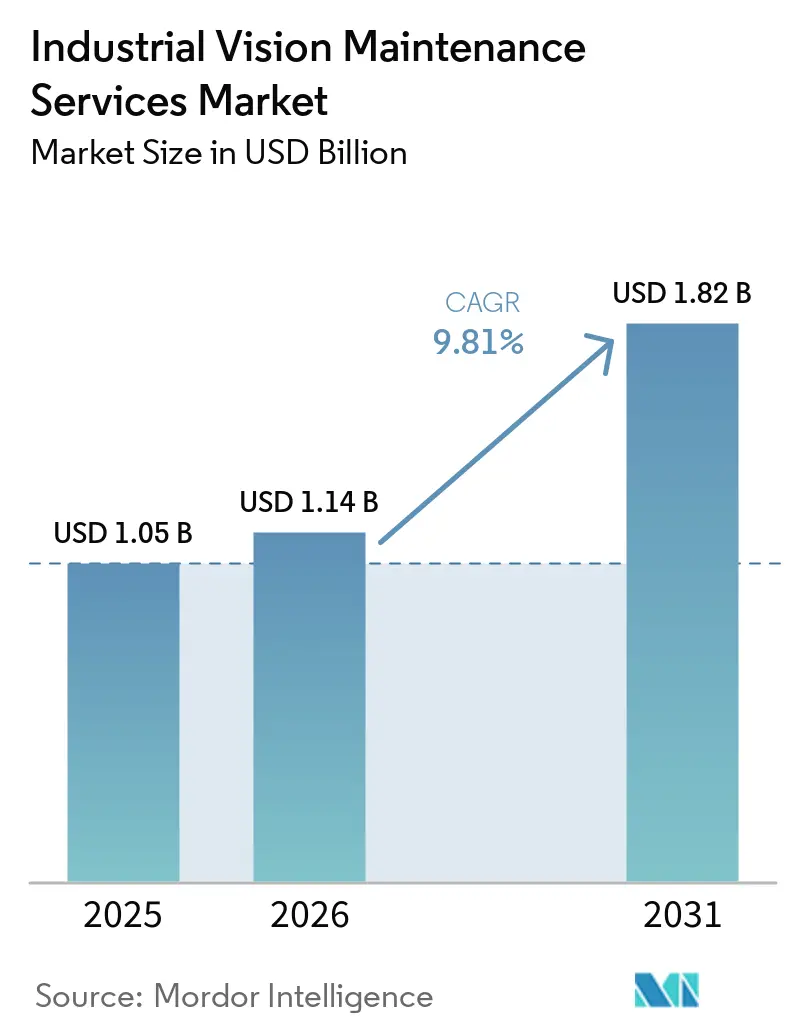
The industrial vision maintenance services market size was USD 1.14 billion in 2026 and is projected to reach USD 1.82 billion by 2031, growing at a CAGR of 9.81% from 2026 to 2031. The installed base of machine vision equipment is increasing, which is shifting spending from initial hardware purchases toward service over the equipment life cycle. AI-based inspection systems require calibration, software updates, and model performance checks more often than older rule-based systems. This creates recurring work for providers that can maintain equipment, software, and operating records across multiple plants. OEMs can use installed-base telemetry and calibration data to support premium contracts, while independent integrators can compete through lower-cost cross-brand support. Retrofit costs and the limited supply of qualified specialists may delay service adoption at older facilities, even where demand for reliable inspection is strong.
Key Report Takeaways
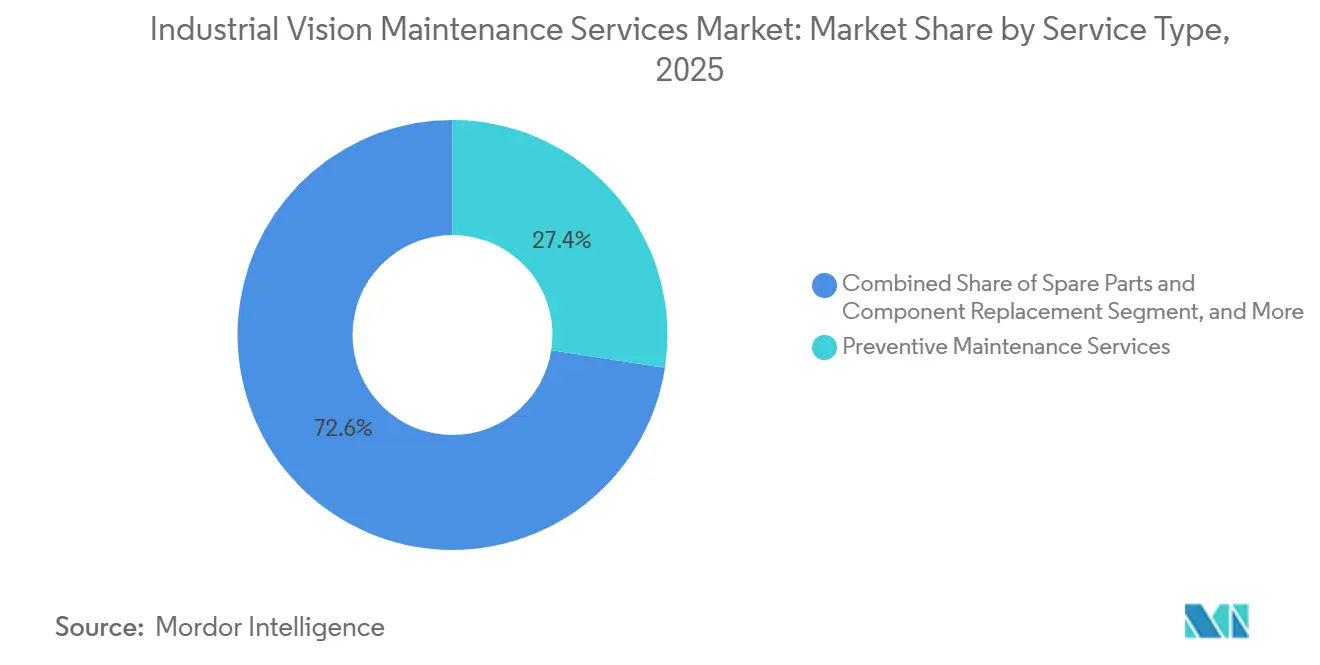
- By service type, Preventive Maintenance Services held 27.43% of the industrial vision maintenance services market size in 2025, while Remote Monitoring and Diagnostics is projected to expand at a CAGR of 11.34% through 2031.
- By service delivery, On-Site Services held 53.78% of the industrial vision maintenance services market share in 2025, while Remote Services is projected to expand at a CAGR of 10.87% through 2031.
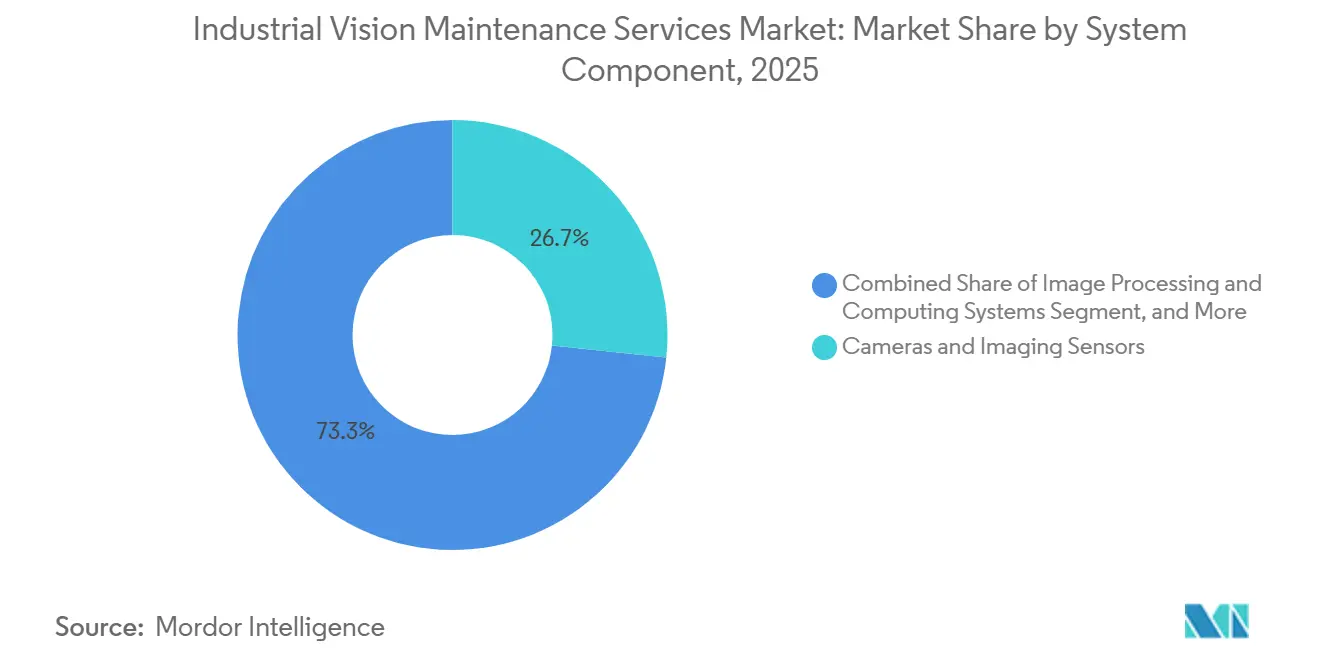
- By system component, Cameras and Imaging Sensors held 26.67% revenue share in 2025, while Vision Software and Controllers is projected to expand at a CAGR of 11.82% through 2031.
- By contract type, Time-and-Material Services held 38.67% revenue share in 2025, while Performance-Based and SLA Contracts is projected to expand at a CAGR of 11.56% through 2031.
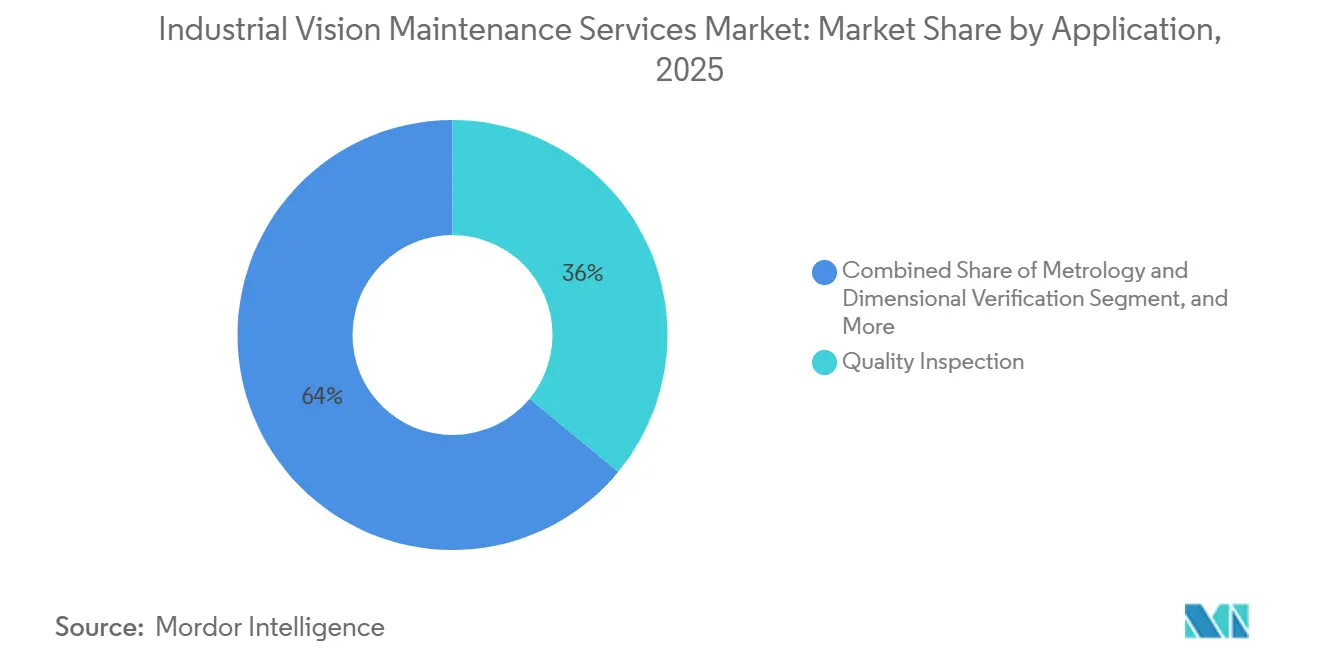
- By application, Quality Inspection held 35.98% revenue share in 2025, while Robotic Guidance and Bin Picking is projected to expand at a CAGR of 11.78% through 2031.
- By industry vertical, Automotive and Mobility held 23.17% revenue share in 2025, while Electronics and Semiconductors is projected to expand at a CAGR of 11.88% through 2031.
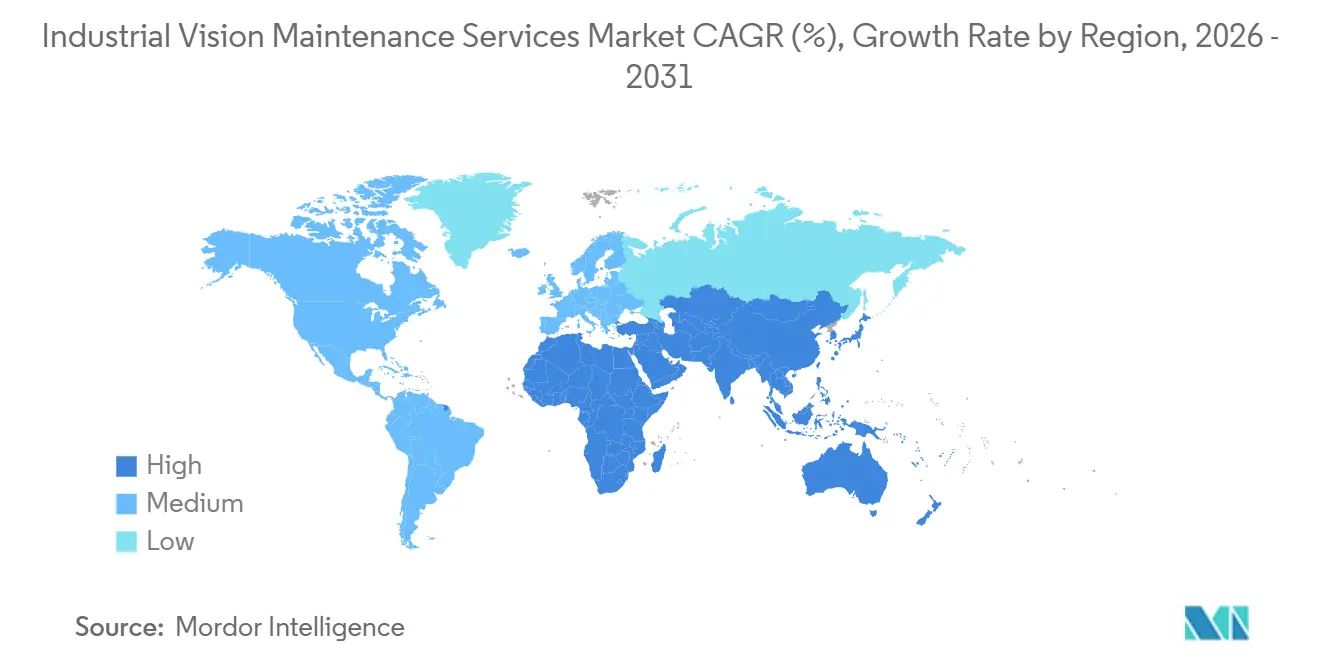
- By geography, Asia-Pacific held 34.76% revenue share in 2025 and is projected to expand at a CAGR of 11.47% through 2031.
Note: Market size and forecast figures in this report are generated using Mordor Intelligence’s proprietary estimation framework, updated with the latest available data and insights as of January 2026.
Global Industrial Vision Maintenance Services Market Trends and Insights
Drivers Impact Analysis*
| Driver | (~) % Impact on CAGR Forecast | Geographic Relevance | Impact Timeline |
|---|---|---|---|
| Expansion of Zero-Defect Manufacturing | +2.1% | Global, with concentrated demand in China, Germany, South Korea, and Japan | Long term (≥ 4 years) |
| Rising Cost of Unplanned Vision-System Downtime | +1.9% | Global, with highest financial exposure in North America and Western Europe | Short term (≤ 2 years) |
| Shift Toward Predictive and Outcome-Based Maintenance Contracts | +1.6% | North America and Europe, with spillover to core Asia-Pacific markets | Medium term (2-4 years) |
| Growth of Edge AI and Remote Diagnostics | +1.4% | Global, with acceleration in Asia-Pacific and North America | Medium term (2-4 years) |
| Optical and Camera Drift in Harsh Production Environments | +1.0% | Global, with highest relevance in heavy industry corridors of India, China, and Eastern Europe | Medium term (2-4 years) |
| Vision-Model Drift From Frequent SKU and Recipe Changes | +0.8% | Core Asia-Pacific markets, with spillover to North America and Europe | Long term (≥ 4 years) |
| Source: Mordor Intelligence | |||
Expansion of Zero-Defect Manufacturing Raises Inspection System Uptime Standards
Zero-defect requirements are increasing the need for dependable vision system maintenance across automotive, pharmaceutical, and electronics supply chains. Customer quality requirements can make calibration records, model version histories, and response times part of the service agreement. These records help manufacturers demonstrate that inspection systems are managed consistently. ISO 9001 and IATF 16949 documentation requirements also increase the importance of maintaining traceable service records. As factories add more robotic cells and cameras, interdependent calibration tasks can make the service requirement more complex than that of a single-camera installation. The industrial vision maintenance services market, therefore, benefits when inspection uptime becomes linked to supplier quality obligations.
Rising Cost of Unplanned Vision-System Downtime Creates Urgent Demand for Preventive Programs
Unplanned vision system downtime can disrupt production and expose manufacturers to defects that go undetected. A production line stoppage in automotive assembly can cost USD 2 million per hour, which makes planned service easier to justify for critical lines. Partial system degradation can be particularly difficult to detect because a weakened camera in a multi-sensor setup may reduce inspection accuracy without triggering a clear alarm. Research on AI-assisted camera maintenance describes how condition monitoring can help identify performance deterioration before it affects output quality. Providers with real-time health monitoring can use that capability to support higher-value service agreements. Reactive repair can cost 5 to 10 times the planned maintenance rate, which continues to support preventive enrollment across the industrial vision maintenance services market.
Shift Toward Predictive and Outcome-Based Maintenance Contracts Restructures Market Revenue
Outcome-based contracts link provider compensation to uptime and inspection performance rather than engineering hours alone. This model requires providers to understand equipment behavior well enough to take on performance risk. Research on machine manufacturer contracts identified 20 decision criteria that shape life-cycle profits and risk management under outcome-based arrangements. OEMs can have an advantage because their installed-base data can help them price service commitments and identify recurring failure patterns. Cognex made OneVision commercially available in May 2026, providing centralized AI model life-cycle management across device fleets and reducing multi-site scaling costs by up to 50% for early adopters. As providers build comparable data capabilities, performance-based contracts may become more common in the industrial vision maintenance services market.
Growth of Edge AI and Remote Diagnostics Expands Service Reach
Edge AI allows inspection models to run locally, reducing dependence on continuous cloud connectivity. This can address latency and data handling concerns in regulated or time-sensitive production settings. Remote tools can also detect changes in model performance when product recipes, materials, or operating conditions shift. That capability reduces the need to wait for a defect escape before reviewing the inspection model. In March 2026, Matsuo Institute and OMRON Field Engineering reported full-scale deployment of an AI maintenance inspection system that achieved 89% accuracy across 8,332 operational judgment cases.[1]Matsuo Institute, “AI Judgment Model for Maintenance Operations, Full-Scale Introduction,” Matsuo Institute, matsuo-institute.com The system demonstrates how digital inspection support can reduce the workload of equipment checks and broaden the reach of remote service models.
Restraints Impact Analysis*
| Restraint | (~) % Impact on CAGR Forecast | Geographic Relevance | Impact Timeline |
|---|---|---|---|
| High Retrofit and Integration Costs | -0.7% | Global, most severe in brownfield facilities in South America, Southeast Asia, and Eastern Europe | Short term (≤ 2 years) |
| Shortage of Vision-Service Specialists | -0.5% | Global, most acute in North America, Western Europe, and South Korea | Medium term (2-4 years) |
| Proprietary Calibration Data and Vendor Lock-In | -0.4% | Global, concentrated in multi-vendor production environments | Medium term (2-4 years) |
| Cybersecurity and Data-Residency Exposure in Connected Service Models | -0.3% | Global, with highest compliance pressure in Europe and regulated industries | Long term (≥ 4 years) |
| Source: Mordor Intelligence | |||
High Retrofit and Integration Costs Limit Service Adoption in Brownfield Environments
Older production lines were often not designed for connected diagnostics, which can raise the cost of adding service infrastructure. Legacy protocols such as Modbus and Profibus may require additional integration work because they lack standard application interfaces. Real-time performance needs and safety isolation requirements can add further engineering work. Facilities may also need custom camera mounts, conduit changes, and network installations while keeping production operating. These conditions can delay the start of formal service agreements after a vision system is installed. The barrier is especially relevant in South America, Southeast Asia, and Eastern Europe, where established facilities represent a meaningful part of the potential industrial vision maintenance services market.
Shortage of Vision-Service Specialists Constrains Service Delivery Capacity
Service providers need technicians who understand industrial maintenance, AI model retraining, multi-sensor calibration, and edge deployment. This combined skill requirement is harder to meet than the need for general maintenance labor. The US Bureau of Labor Statistics projects 54,200 annual openings for industrial machinery maintenance workers through 2034, while specialists with AI vision skills represent a smaller group within that workforce. China formalized Industrial Vision System Operator as National Occupation Standard 6-31-07-02 in 2023, and a 2025 standard addressed vocational skills training for automotive industrial vision operators. In the United States, specialists who manage advanced vision maintenance programs earn annual salaries of USD 136,000 to USD 228,000. These labor costs can constrain the speed at which providers add capacity, even as demand for the industrial vision maintenance services market rises.
*Our forecasts treat driver/restraint impacts as directional, not additive. The impact forecasts reflect baseline growth, mix effects, and variable interactions.
Segment Analysis
By Service Type: Remote Diagnostics Reshapes the Preventive Maintenance Value Chain
Preventive Maintenance Services held 27.43% of revenue in 2025. The segment covers scheduled camera cleaning, lens recalibration, lighting checks, and firmware updates. These tasks help maintain inspection accuracy across the installed base of vision equipment. Their role is most visible on high-throughput automotive and electronics lines where small accuracy losses can lead to costly quality issues. Scheduled work also gives manufacturers a documented maintenance history for systems linked to production quality requirements. Preventive programs remain the core service approach for buyers who have not yet adopted continuous condition monitoring. The work covers both physical assets and operating settings that can affect image quality. It also creates a regular provider relationship that can support later adoption of more advanced service models.
Remote Monitoring and Diagnostics is projected to expand at a CAGR of 11.34% through 2031. Edge AI makes continuous collection and review of vision system telemetry more practical without a dedicated technician on site. The line between preventive maintenance and remote diagnostics is becoming less clear as software handles more condition-assessment work. Cognex made OneVision commercially available in May 2026 to centralize AI model life-cycle management across device fleets.[2]Cognex Corporation, “Cognex OneVision™ Adoption Ramps as Manufacturers Scale AI Vision Globally,” Cognex Corporation, newswire.ca The company reported that early adopters reduced multi-site scaling costs by up to 50%. Corrective Maintenance and Repair Services, Software and Firmware Maintenance, Performance Optimization Services, and Spare Parts and Component Replacement cover other stages of the equipment life cycle. Spare parts are important in locations with particulate contamination or thermal cycling because cameras and sensors can wear more quickly. These service categories make the industrial vision maintenance services market relevant across hardware, software, and system performance needs.



By Service Delivery: On-Site Delivery Remains Essential as Remote Support Expands
On-Site Services accounted for 53.78% of service delivery revenue in 2025. Physical work remains necessary for camera position checks, lens cleaning, lighting replacement, and spatial calibration. Semiconductor wafer inspection and automotive metrology can require direct optical alignment that remote access cannot provide. This requirement supports continuing demand for local field technicians and partner networks. On-site visits also allow technicians to inspect the production setting around the vision equipment. Dust, vibration, heat, and mechanical changes can all affect camera performance. The large share shows that digital tools have not eliminated the need for hands-on maintenance. Instead, they have changed how providers determine when a visit is required.
Remote Services is projected to expand at a CAGR of 10.87% through 2031. Edge-deployed AI models and secure remote access allow technicians to identify software issues, install firmware updates, and track model performance without travel. A remote specialist can support more systems than a field technician who must travel between sites. Hybrid Services combine scheduled physical visits with continuous remote review of software and performance metrics. This structure can help providers set visit frequency based on measured system condition rather than a fixed calendar. Fuji Film Business Innovation developed an AI-integrated unified maintenance support platform in 2026 and began deployments across Japan, Asia-Pacific, and Europe in July 2026. The platform reflects investment by established equipment suppliers in operating models that combine field work with digital maintenance support. The industrial vision maintenance services market can use this approach to preserve physical maintenance quality while reducing unnecessary dispatches.
By System Component: Software and Controllers Gain Importance Alongside Cameras
Cameras and Imaging Sensors accounted for 26.67% of revenue in 2025. They are frequent maintenance items because sensor degradation, lens fouling, and housing seal failures can lead to unscheduled service calls. Image capture quality is the starting point for every machine vision decision. A small decline in optical performance can affect the reliability of downstream inspection results. This makes physical condition monitoring important even in systems that use advanced AI models. Regular cleaning, recalibration, and replacement work can help preserve image quality in difficult production environments. Cameras and sensors, therefore, remain a central source of recurring demand for field service. Their position also reflects the broad installed base of conventional and AI-enabled vision hardware.
Vision Software and Controllers are projected to expand at a CAGR of 11.82% through 2031. AI-based inspection systems require model retraining, performance monitoring, and version control, in addition to hardware maintenance. A lens can be cleaned quickly, but a model affected by a material change can require data collection and retraining before performance is restored. Research on AI-assisted camera maintenance found that well-maintained systems can sustain detection accuracy above 95% in environments with dust and vibration. Lighting Systems, Lenses and Optics, Image Processing and Computing Systems, and Cabling, Interfaces and Connectivity each need distinct service activities. Lighting performance can decline before a human operator notices a visible failure, reducing image contrast and inspection quality. Software-linked service demand benefits as systems require ongoing validation and updates
By Contract Type: Performance-Based Agreements Gain Ground Over Break-Fix Billing
Time-and-Material Services held 38.67% revenue share in 2025. The segment is supported by legacy installations that operate without structured service agreements. Many brownfield facilities still use reactive repair billing when a fault becomes visible. This approach may appear flexible to the buyer, but it does not establish a predictable maintenance schedule. Annual Maintenance Contracts provide a middle option for manufacturers that want planned service costs. They can support routine preventive work without requiring the provider to accept broad performance risk. The large time-and-material position shows that many customers are still moving from break-fix practices toward more formal service coverage. The pace of this transition shapes the commercial mix of the industrial vision maintenance services market.
Performance-Based and SLA Contracts are projected to expand at a CAGR of 11.56% through 2031. Providers use historical system data to set service terms related to uptime and inspection performance. Research on outcome-based contracts for machine manufacturers documents 20 decision criteria that affect life-cycle profit and risk management. Managed Vision Services represent the most developed contract form because the provider takes responsibility for hardware refresh, model updates, and operating support. These offerings are gaining relevance among large accounts with complex vision portfolios. Both parties must invest in connected monitoring infrastructure before such guarantees can be used effectively. That investment can slow early adoption, but it can also create a durable data advantage for providers that establish system-health records early.
By Application: Quality Inspection Provides the Broad Base for Service Demand
Quality Inspection held 35.98% revenue share in 2025. This application is present in many production settings that use machine vision, including pharmaceutical serialization and automotive stamping. Its wide use makes it the largest part of the maintainable installed base. Inspection systems are closely tied to product compliance, so manufacturers often prioritize their maintenance programs. Process Monitoring and Control, Metrology and Dimensional Verification, and Identification, Traceability, and Code Reading serve separate production needs. Metrology systems require periodic recertification traceable to recognized measurement management requirements. Each application requires different maintenance routines, but all depend on stable image capture and accurate system settings. This broad base of applications supports recurring service demand across the industrial vision maintenance services market.
Robotic Guidance and Bin Picking are projected to expand at a CAGR of 11.78% through 2031. Adoption of 3D vision-guided robotics is increasing in automotive assembly, logistics, and electronics manufacturing. Vention launched Rapid Operator AI at NVIDIA GTC 2026 in March 2026 and reported first-pick success rates of up to 99% for autonomous bin picking. These systems combine 3D cameras, lighting calibration, robot kinematic models, and AI grasp-planning models. A change in one component can affect the full system and may reduce pick success. This interdependence requires providers to review the equipment as an integrated system rather than as separate parts. It can also support multi-year service relationships because recertification involves the overall operating setup. The industrial vision maintenance services market gains from applications where reliable performance depends on continued coordination of hardware, software, and robotics.
By Industry Vertical: Electronics and Semiconductors Drive the Fastest Growth
Automotive and Mobility accounted for 23.17% of revenue in 2025. Vehicle body assembly, powertrain inspection, and EV battery manufacturing use dense networks of machine vision equipment. General Motors developed BVSeal, an automated inspection system that uses gas imaging cameras, cobots, edge computing, and AI to detect leaks in EV battery trays and packs. Such installations require coordinated maintenance across hardware, software, and robotic elements. Industrial Machinery and Equipment, Aerospace and Defense, and Pharmaceuticals and Life Sciences also drive stable demand due to their quality and traceability requirements. In Food and Beverage, camera fouling and lighting degradation can be important service triggers on high-speed packaging lines. Automotive remains a large customer group because the cost of poor inspection performance can be material. Its installed system density supports a substantial share of the industrial vision maintenance services market.
Electronics and Semiconductors are projected to expand at a CAGR of 11.88% through 2031. At semiconductor nodes of 5 nanometers or smaller, an undetected defect can render a wafer lot unusable. Vision uptime and accuracy therefore affect yield management directly. The financial exposure can support higher service contract values where inspection failures interrupt advanced production. Growth is also linked to advanced packaging methods such as chip-on-wafer and 3D stacking. These methods use inspection configurations that are more complex to maintain than conventional 2D automated optical inspection systems. Multi-modality inspection adds maintenance demands across cameras, computing systems, software models, and calibration routines. This need for sustained accuracy makes semiconductor operations a major growth area for the industrial vision maintenance services market.
Geography Analysis
Asia-Pacific accounted for 34.76% of regional revenue in 2025 and is projected to grow at a CAGR of 11.47% through 2031. China provides the largest absolute volume in the region through electronics assembly clusters in Guangdong, Jiangsu, and Zhejiang. These clusters have dense vision-system installations that increasingly require formal maintenance programs. South Korea and Japan support demand for high-precision services through semiconductor and automotive inspection applications. India is adding electronics and automotive capacity that is expected to enter the maintenance cycle through 2026 and later years. SICK AG announced an investment of RM1 billion (USD 227 million) in a high-tech manufacturing and sensor hub in Johor, Malaysia. Phase 1 involved RM280 million (USD 63.7 million) and was scheduled to begin by 2026. These investments reinforce Asia-Pacific's role in the industrial vision maintenance services market.
North America held the second-largest geographic share in 2025. The United States accounted for the largest share of regional revenue. Automotive operations in the Midwest and semiconductor fabrication centers in Arizona, Texas, and New York have dense deployments of vision systems. High downtime costs in these environments support demand for premium maintenance agreements. The US Bureau of Labor Statistics recorded 462,000 open manufacturing positions in March 2026.[3]U.S. Bureau of Labor Statistics, “Job Openings and Labor Turnover Survey,” U.S. Department of Labor, bls.gov. Limited labor availability can increase interest in managed and remote support models that reduce the need for on-site specialists. Canada and Mexico add demand through integrated automotive supply chains and supplier quality requirements. These conditions sustain the industrial vision maintenance services market in North America.
Europe represented the third-largest geographic segment in 2025. Germany, the United Kingdom, and France formed the core of regional demand, supported by industrial machinery, automotive, and precision manufacturing. Germany has an established systems integration base and major OEM activity from SICK AG, Basler AG, IDS Imaging Development Systems GmbH, and Baumer Holding AG. The EU NIS2 Directive increased cybersecurity requirements for connected service platforms in 2024, adding compliance considerations for remote monitoring contracts. SICK Korea signed an MOU with Hyundai Motor in June 2026 to cooperate on advanced safety technology for future smart manufacturing applications. The Middle East remains an early-stage opportunity as industrial diversification programs increase non-oil manufacturing investment. Africa remains at an earlier stage, with South Africa and Egypt providing the most immediate entry points as manufacturing complexity grows. These conditions support the industrial vision maintenance services market across Europe and adjacent regions.

Competitive Landscape
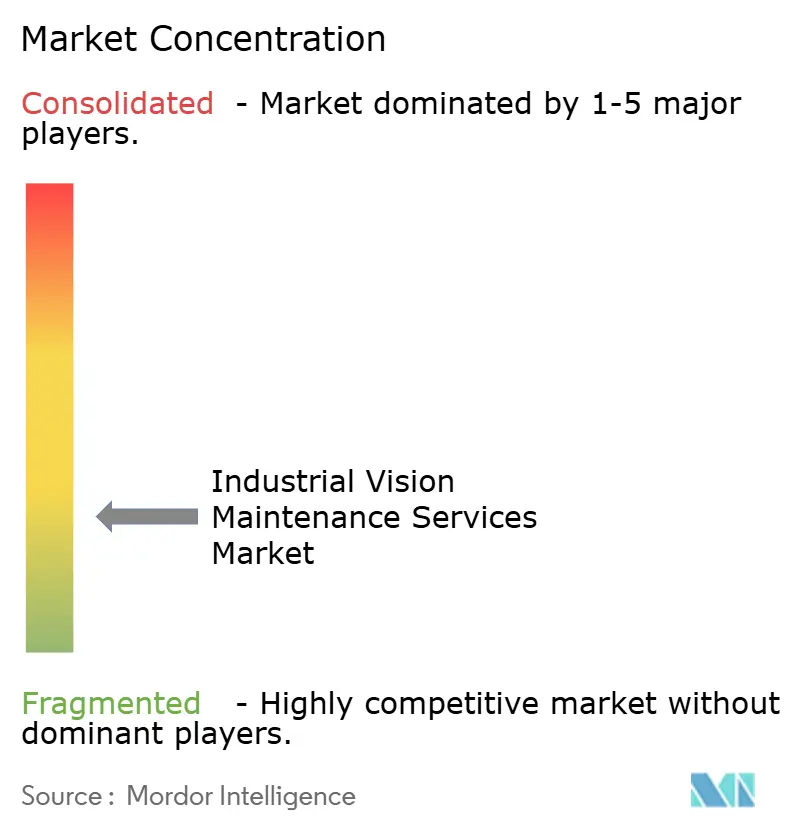
The industrial vision maintenance services market is moderately fragmented. Cognex Corporation, Keyence Corporation, and OMRON Corporation have access to the telemetry, calibration constants, and AI model histories connected with their installed equipment. This information can help OEMs identify system issues and offer premium service agreements. Independent providers can replace components and maintain lenses, but they may not have access to proprietary specifications that restore full inspection performance after a major system event. Competition is therefore divided between OEM-led connected service contracts and cross-brand service offered at lower price points. SICK AG expanded its Nova platform in August 2026 with AI-powered 3D inspection capabilities that combine deep learning with height data analysis. This type of product development can create demand for software migration and model retraining as older systems become less suitable for new applications.
Manufacturers operating 20 to 200 vision system nodes represent an important customer group for independent managed service providers. These companies may lack the scale to procure OEM-managed services, yet still face increasing complexity as AI models require retraining and recalibration. Independent providers can address this need with cross-brand diagnostic tools and model management platforms. The approach is intended to support multiple equipment brands without dependence on proprietary hardware. Basler AG partnered with Advantech in April 2026 to deploy GMSL-based vision and robotics computing platforms.[4]Basler AG, “Basler AG Acquires Majority Stake in Its Distribution Partner in India,” Basler AG, webdisclosure.com. The partnership combined Basler ace 2 GMSL industrial cameras with Advantech AI computing systems for robotics and intelligent logistics uses. Basler also acquired a 76% stake in its Indian distribution partner in October 2025, which strengthened its direct local access and service presence. These actions extend supplier capabilities across the industrial vision maintenance services market.
Continuous AI model health monitoring is becoming an important factor in service contract renewals and account retention. Providers that can identify changes in model behavior can address performance issues before they become quality failures. This capability is different from a one-time calibration visit because it requires ongoing data review and software support. OEMs have an advantage where equipment telemetry and calibration data remain proprietary. Independent integrators retain an opening, whereas manufacturers use equipment from several suppliers and need a single provider across the production environment. Cognex launched OneVision in May 2026 to support collaborative AI vision development and centralized model life-cycle management. Early adopters reported lower multi-site scaling costs and faster application development using the platform. The industrial vision maintenance services market is likely to remain divided between proprietary OEM ecosystems and independent cross-brand support models.
Industrial Vision Maintenance Services Industry Leaders
Cognex Corporation
Keyence Corporation
Basler AG
Teledyne Technologies Incorporated
OMRON Corporation
- *Disclaimer: Major Players sorted in no particular order

Recent Industry Developments
- August 2026: Cognex Corporation reported record Q2 2026 revenue of USD 291 million, representing a 17% year-over-year increase, with operating income doubling to USD 86 million and operating margin expanding to 29.4%. The company cited broad-based demand across major end markets combined with continued growth in AI-enabled vision applications, and announced full commercial availability of its OneVision platform.
- August 2026: SICK AG expanded its Nova machine vision platform with configurable AI-powered 3D inspection capabilities, integrating deep learning with precise height-data analysis to detect defects beyond the capability of classical 3D imaging. The update made Nova the first SICK platform to bring neural network AI capabilities into its high-precision 3D vision product line.
- June 2026: SICK Korea signed an MOU with Hyundai Motor Company at Hyundai Motor's Ulsan plant for advanced safety technology cooperation in future smart-manufacturing environments, covering industrial safety applications including an explosion-proof safety light curtain certified by the Korea Occupational Safety and Health Agency, the first and only product of its kind certified in South Korea.
- May 2026: Cognex Corporation announced the general availability of OneVision, a collaborative AI vision development environment that reduced multi-site scaling costs by up to 50% for early adopters. Schneider Electric achieved a doubled yield across globally deployed inspection lines through the platform, while Essity reduced application build time from over 1 year to under 1 day.


Global Industrial Vision Maintenance Services Market Report Scope
The Industrial Vision Maintenance Services Market covers services that support the maintenance, repair, calibration, inspection, and optimization of industrial vision systems. These systems include cameras, sensors, lenses, lighting equipment, image-processing software, and related hardware used for quality inspection, process monitoring, measurement, sorting, and automation across industries.
The Industrial Vision Maintenance Services Market Report is Segmented by Service Type (Preventive Maintenance Services, Corrective Maintenance and Repair Services, Remote Monitoring and Diagnostics, Software and Firmware Maintenance, Performance Optimization Services, and Spare Parts and Component Replacement), Service Delivery (On-Site Services, Remote Services, and Hybrid Services), System Component (Cameras and Imaging Sensors, Lenses and Optics, Lighting Systems, Image Processing and Computing Systems, Vision Software and Controllers, and Cabling, Interfaces and Connectivity), Contract Type (Time-and-Material Services, Annual Maintenance Contracts, Performance-Based / SLA Contracts, and Managed Vision Services), Application (Quality Inspection, Process Monitoring and Control, Robotic Guidance and Bin Picking, Metrology and Dimensional Verification, and Identification, Traceability, and Code Reading), Industry Vertical (Automotive and Mobility, Electronics and Semiconductors, Industrial Machinery and Equipment, Aerospace and Defense, Pharmaceuticals and Life Sciences, Food and Beverage, and Other Industry Verticals), and Geography (North America, South America, Europe, Asia-Pacific, Middle East, and Africa). The Market Forecasts are Provided in Terms of Value (USD).
| Preventive Maintenance Services |
| Corrective Maintenance and Repair Services |
| Remote Monitoring and Diagnostics |
| Software and Firmware Maintenance |
| Performance Optimization Services |
| Spare Parts and Component Replacement |
| On-Site Services |
| Remote Services |
| Hybrid Services |
| Cameras and Imaging Sensors |
| Lenses and Optics |
| Lighting Systems |
| Image Processing and Computing Systems |
| Vision Software and Controllers |
| Cabling, Interfaces and Connectivity |
| Time-and-Material Services |
| Annual Maintenance Contracts |
| Performance-Based / SLA Contracts |
| Managed Vision Services |
| Quality Inspection |
| Process Monitoring and Control |
| Robotic Guidance and Bin Picking |
| Metrology and Dimensional Verification |
| Identification, Traceability, and Code Reading |
| Automotive and Mobility |
| Electronics and Semiconductors |
| Industrial Machinery and Equipment |
| Aerospace and Defense |
| Pharmaceuticals and Life Sciences |
| Food and Beverage |
| Other Industry Verticals |
| North America | United States |
| Canada | |
| Mexico | |
| South America | Brazil |
| Argentina | |
| Chile | |
| Rest of South America | |
| Europe | Germany |
| United Kingdom | |
| France | |
| Italy | |
| Spain | |
| Rest of Europe | |
| Asia-Pacific | China |
| Japan | |
| India | |
| South Korea | |
| Rest of Asia-Pacific | |
| Middle East | United Arab Emirates |
| Saudi Arabia | |
| Qatar | |
| Rest of Middle East | |
| Africa | South Africa |
| Egypt | |
| Nigeria | |
| Rest of Africa |
| By Service Type | Preventive Maintenance Services | |
| Corrective Maintenance and Repair Services | ||
| Remote Monitoring and Diagnostics | ||
| Software and Firmware Maintenance | ||
| Performance Optimization Services | ||
| Spare Parts and Component Replacement | ||
| By Service Delivery | On-Site Services | |
| Remote Services | ||
| Hybrid Services | ||
| By System Component | Cameras and Imaging Sensors | |
| Lenses and Optics | ||
| Lighting Systems | ||
| Image Processing and Computing Systems | ||
| Vision Software and Controllers | ||
| Cabling, Interfaces and Connectivity | ||
| By Contract Type | Time-and-Material Services | |
| Annual Maintenance Contracts | ||
| Performance-Based / SLA Contracts | ||
| Managed Vision Services | ||
| By Application | Quality Inspection | |
| Process Monitoring and Control | ||
| Robotic Guidance and Bin Picking | ||
| Metrology and Dimensional Verification | ||
| Identification, Traceability, and Code Reading | ||
| By Industry Vertical | Automotive and Mobility | |
| Electronics and Semiconductors | ||
| Industrial Machinery and Equipment | ||
| Aerospace and Defense | ||
| Pharmaceuticals and Life Sciences | ||
| Food and Beverage | ||
| Other Industry Verticals | ||
| By Geography | North America | United States |
| Canada | ||
| Mexico | ||
| South America | Brazil | |
| Argentina | ||
| Chile | ||
| Rest of South America | ||
| Europe | Germany | |
| United Kingdom | ||
| France | ||
| Italy | ||
| Spain | ||
| Rest of Europe | ||
| Asia-Pacific | China | |
| Japan | ||
| India | ||
| South Korea | ||
| Rest of Asia-Pacific | ||
| Middle East | United Arab Emirates | |
| Saudi Arabia | ||
| Qatar | ||
| Rest of Middle East | ||
| Africa | South Africa | |
| Egypt | ||
| Nigeria | ||
| Rest of Africa | ||


Key Questions Answered in the Report
What is the current size of industrial vision maintenance services?
The sector was valued at USD 1.14 billion in 2026 and is projected to reach USD 1.82 billion by 2031, at a CAGR of 9.81%.
What is driving demand for industrial vision maintenance services?
Zero-defect production requirements, high downtime costs, remote diagnostics, and the need to maintain AI inspection models are increasing service demand.
Which service type leads industrial vision maintenance services?
Preventive Maintenance Services led with 27.43% share in 2025, while Remote Monitoring and Diagnostics is projected to grow at a CAGR of 11.34% through 2031.
Why are remote maintenance services gaining adoption?
Remote tools allow providers to monitor software, firmware, and model performance without travel, while physical tasks can remain part of a hybrid service plan.
Which end-use vertical is growing fastest?
Electronics and Semiconductors is projected to expand at a CAGR of 11.88% through 2031 because inspection uptime and accuracy affect production yield.
Page last updated on:





