
EV Composites Market Size and Share
Market Overview
| Study Period | 2022 - 2032 |
|---|---|
| Market Size (2027) | USD 3.88 Billion |
| Market Size (2032) | USD 8.23 Billion |
| Growth Rate (2027 - 2032) | 16.23 % |
| Fastest Growing Market | Asia-Pacific |
| Largest Market | Asia-Pacific |
| Market Concentration | Low |
Major Players *Disclaimer: Major Players sorted in no particular order Image © Mordor Intelligence. Reuse requires attribution under CC BY 4.0. | |
EV Composites Market Analysis by Mordor Intelligence
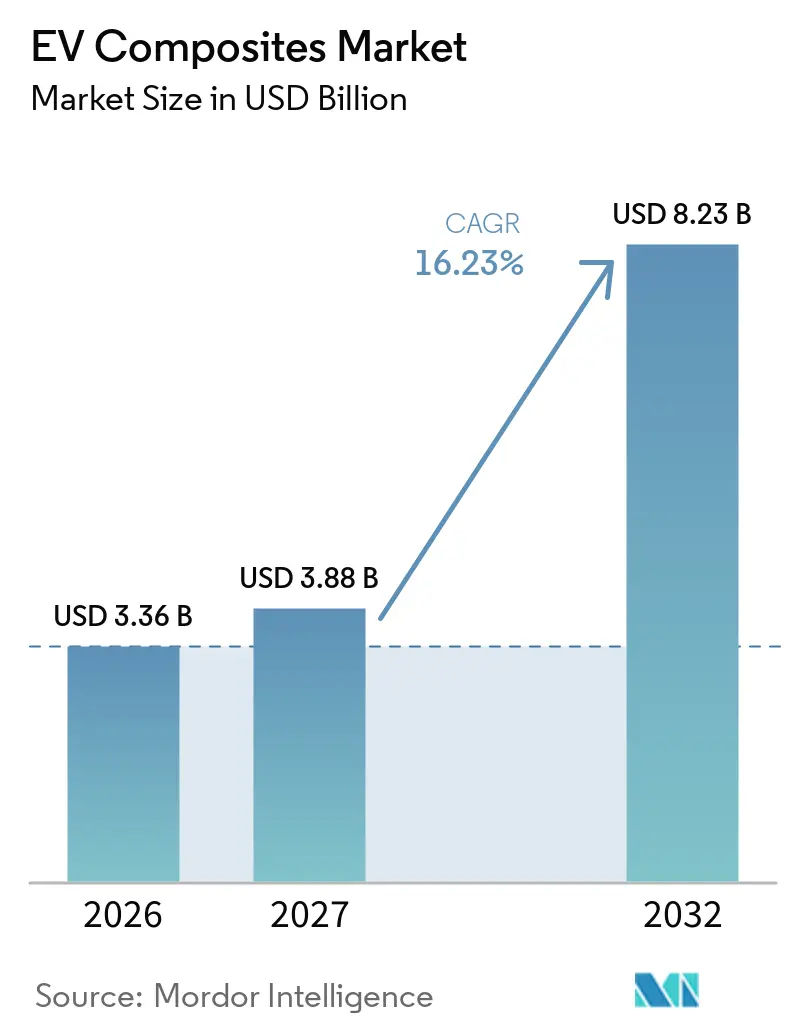
The EV Composites Market size was valued at USD 3.36 billion in 2026 and is estimated to grow from USD 3.88 billion in 2027 to reach USD 8.23 billion by 2032, at a CAGR of 16.23% during the forecast period (2027-2032). Demand is tied to the need to manage the weight added by large battery packs while preserving driving range and payload capacity. Battery enclosures are becoming a central area of material selection because they must combine structural protection, fire performance, and thermal-runaway containment. Suppliers are placing more emphasis on thermoplastic systems that can support faster cycle times, recyclability, and integration of several functions within one component. Competition is shaped by carbon fiber producers, compound suppliers, and system integrators that seek to control more of the enclosure value chain. The Electric Vehicle (EV) composites market also faces cost pressure, uneven regional electric-vehicle demand, and unresolved end-of-life requirements for some composite systems.
Key Report Takeaways
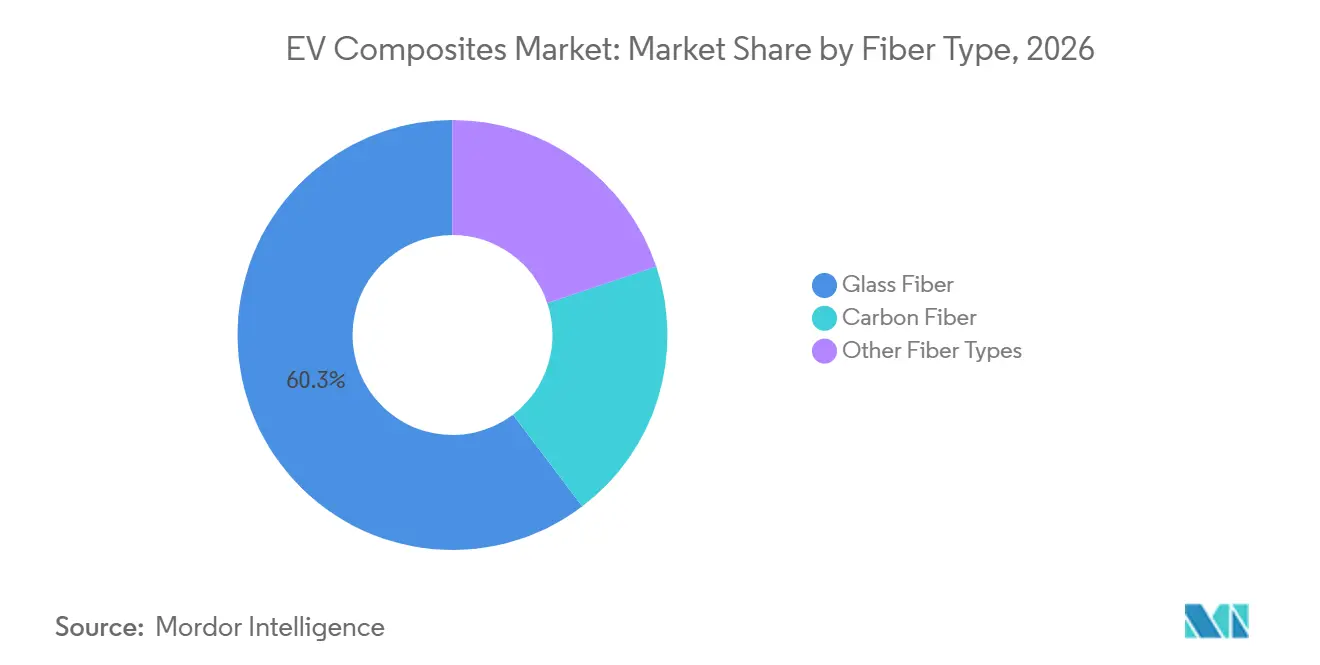
- By fiber type, glass fiber held 60.32% of the EV composites market share in 2026, while carbon fiber is forecast to advance at a 16.89% CAGR through 2032.
- By resin type, thermoplastic held 55.04% of the EV composites market share in 2026 and is forecast to advance at a 17.06% CAGR through 2032.
- By manufacturing process, injection molding held 35.78% of the EV composites market share in 2026, while compression molding is forecast to advance at a 17.52% CAGR through 2032.
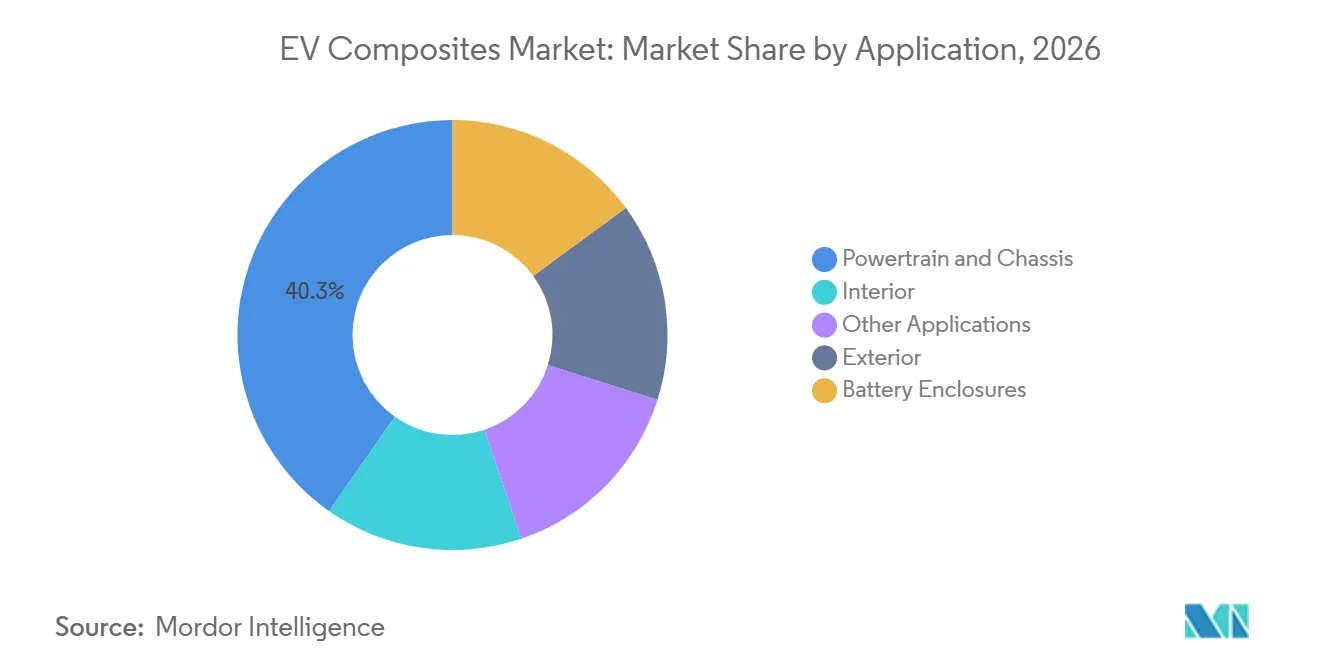
- By application, powertrain and chassis held 40.26% of the EV composites market share in 2026, while battery enclosures are forecast to advance at a 17.94% CAGR through 2032.
- By geography, Asia-Pacific held 42.41% of the EV composites market share in 2026 and is forecast to advance at a 17.41% CAGR through 2032.
Note: Market numbers in this report are based on Mordor Intelligence's proprietary estimation framework, which combines nine months of actuals with Q4 projections for base year 2026.
Market Trends and Insights
Drivers Impact Analysis of EV Composites Market*
| Driver | (~) % Impact on CAGR Forecast | Geographic Relevance | Impact Timeline |
|---|---|---|---|
| EV Production Scale Expanding Composite Addressable Volume | +4.5% | Global, led by China, Europe, North America | Short term (≤ 2 years) |
| Vehicle Lightweighting Extending Range and Payload | +3.8% | Global, highest intensity in Asia-Pacific | Medium term (2–4 years) |
| Battery Enclosure Integration Improving System-Level Economics | +3.2% | Asia-Pacific core, spillover to Europe and North America | Medium term (2–4 years) |
| Thermoplastic Processing Enabling High-Volume Serial Production | +2.4% | Germany, Japan, South Korea, China | Long term (≥ 4 years) |
| Tightening Emissions and Battery Safety Requirements | +1.6% | EU, China (GB38031-2025), North America | Short term (≤ 2 years) |
| Source: Mordor Intelligence | |||
EV Production Scale Expanding Composite Addressable Volume
Electric-vehicle production gives composite suppliers a larger base of potential component programs. The International Energy Agency expects electric cars to account for close to 30% of global car sales in 2026, supporting demand for vehicle materials that reduce mass and protect battery systems[1]. Composite parts can offset part of the 200–450-kilogram battery weight penalty and therefore support vehicle efficiency. China remains important because its manufacturers supply a large share of global electric-vehicle sales, and its domestic supply chain includes glass fiber mats, Glass Mat Thermoplastic (GMT) boards, sheet molding compounds, and thermoplastic compounds. This concentration links demand growth and supply capacity closely to Chinese vehicle output. Suppliers with concentrated exposure to China, therefore, need broader customer and regional supply strategies.
Vehicle Lightweighting Extending Range and Payload
Vehicle mass reduction continues to support adoption in the EV composites market because battery packs place pressure on range and payload. The World Economic Forum reported that a 10% reduction in vehicle mass can improve energy efficiency by 6%-8% and can increase electric-vehicle range by 70%. Composite battery enclosures can be lighter than aluminum alternatives, which makes enclosure design a material priority. A 2025 PLOS One study found that an optimized carbon fiber reinforced polymer battery-box layup improved assembly quality by 40.63% and first-order modal frequency by 33.34%. Manufacturers can also combine stiffeners, thermal channels, and electromagnetic interference shielding in a molded component. That integration can reduce part count and may improve the overall economics of a vehicle program.
Battery Enclosure Integration Improving System-Level Economics
Battery enclosures are projected to advance at a 17.94% CAGR through 2032, reflecting their structural and safety role in the EV composites market. A September 2025 Society for the Advancement of Material and Process Engineering (SAMPE) paper described a one-shot thermoplastic composite hybrid over-molding process for a 1.3-meter by 1.8-meter battery cover with a cycle time below 90 seconds and a potential component-cost reduction of up to 28% compared with multi-piece metal systems. Large enclosure programs increasingly assess materials on system cost rather than on raw material cost alone. China’s GB 38031-2025 took effect in July 2026 and requires original equipment manufacturers and Tier 1 suppliers to reassess enclosure-material specifications. The requirement raises the importance of thermal-runaway control, bonfire performance, and crash protection in the same component. These conditions create opportunities for suppliers that can validate composite systems against structural, fire, and thermal requirements.
Thermoplastic Processing Enabling High-Volume Serial Production
Thermoplastic processing supports higher-volume use of composites by reducing manufacturing steps. Direct long fiber thermoplastic molding combines compounding and molding, avoiding autoclave curing for relevant enclosure applications. A 2025 Polymers study reported a compression-molded carbon fiber reinforced polymer battery enclosure with cross-shaped stiffeners, a 10-15 minute cure cycle, and a 4.78-kilogram mass. Thermoplastic systems can also support welding and recycling pathways that are less practical for thermoset systems. Kautex built a high-capacity compression molding line in China for Pentatonic Model Year (MY) 2027 programs, bringing this process capability in-house. The EV composites market can benefit from the fact that large-format parts require automotive production rates and integrated functions.
Restraints Impact Analysis of EV Composites Market*
| Restraint | (~) % Impact on CAGR Forecast | Geographic Relevance | Impact Timeline |
|---|---|---|---|
| Composite Material and Tooling Cost Premiums | -2.8% | Global, most acute in North America and Europe | Short term (≤ 2 years) |
| Recycling and End-of-Life Qualification Gaps | -2.1% | EU (End-of-Life Vehicles Regulation), Global | Medium term (2–4 years) |
| Inconsistent Cross-Material Testing and Repair Standards | -1.3% | North America, Europe | Long term (≥ 4 years) |
| Source: Mordor Intelligence | |||
Composite Material and Tooling Cost Premiums
Cost remains a constraint for composite use in mass-volume electric vehicles. Higher material and tooling costs can limit adoption where a program targets lower vehicle prices and high output. SGL Carbon reported intensifying price pressure from Chinese competition in automotive composites during 2025. This pressure challenges the price premium traditionally available to European carbon fiber suppliers. The National Renewable Energy Laboratory published a 2025 method that recovered both fiber and resin components from carbon fiber composites. Lower-cost recycled feedstock could improve material economics over time. Until those pathways reach a broader commercial scale, adoption depends on whether part-count and system-level savings justify the initial premium.
Recycling and End-of-Life Qualification Gaps
End-of-life treatment remains difficult for structural composites at the automotive scale. The European Commission has proposed circularity measures for critical raw materials and e-drive motors in vehicles, which increase attention to material recovery pathways[2]. Thermoset composites cannot be remelted, while pyrolysis and solvolysis can involve energy use or affect fiber properties. A 2025 Sustainability study found that raw-material extraction and use phases offered the greatest potential to reduce cumulative energy demand and carbon dioxide emissions for a prototype composite battery enclosure. Repair practices also remain less mature for automotive polymer matrix composites than for aerospace applications. A 2025 Applied Composite Materials review noted that automotive composite damage and design limits have not yet been established as standards. These gaps can lengthen qualification cycles and increase lifecycle-cost uncertainty.
*Our forecasts treat driver/restraint impacts as directional, not additive. The impact forecasts reflect baseline growth, mix effects, and variable interactions.
EV Composites Market Segment Analysis
By Fiber Type:
Glass Fiber Scale Anchors the Market, Carbon Fiber Leads GrowthGlass fiber held 60.32% of the EV composites market share in 2026, reflecting its cost position and broad use across interior panels and enclosure lids. The material meets tensile and stiffness requirements for many high-volume applications without the cost burden of carbon fiber. Its scale also rests on established processing for glass mat thermoplastic boards, sheet molding compounds, and glass fiber reinforced polypropylene. Chinese suppliers supported this position through automated production of interior composite components for domestic electric-vehicle programs. Natural and basalt fibers are used in selected interior and underbody applications where bio-content is relevant. These materials remain smaller in the EV composites market but support a wider mix of use cases.
Carbon fiber is projected to advance at a 16.89% CAGR through 2032, with demand centered on battery trays and structural chassis components. Its higher stiffness-to-weight performance supports applications where mass reduction can justify a cost premium. In October 2025, TORAY INDUSTRIES, INC. and Hyundai Motor Group signed a Strategic Joint Development Agreement for high-performance carbon fiber reinforced polymer materials for future mobility platforms. The agreement covers development, production, and commercialization across Toray Advanced Materials Korea, Toray Advanced Composites Netherlands, and Euro Advanced Carbon Fiber Composites Germany. Carbon fiber adoption is also supported by interest in thermoplastic carbon fiber reinforced polymer systems, which offer shorter cycles and potential recycling benefits. Supply availability and precursor costs remain important limits on wider use in mainstream vehicle programs.

By Resin Type:
Thermoplastics Redefine Production EconomicsThermoplastic resins held 55.04% of the EV composites market share in 2026 and are projected to advance at a 17.06% CAGR through 2032. This position shows that the leading resin family is still expanding rapidly rather than nearing maturity. Thermoplastics support weld bonding, recycling options, and fast processing for large-format enclosure parts. These properties fit vehicle programs that need structural performance within standard press infrastructure. Suppliers are using continuous-fiber laminates and flame-retardant thermoplastic cores to make hybrid battery-cover systems. The EV composites market, therefore, gives thermoplastic materials an advantage where cycle time and part integration are important.
Thermoset resins continue to serve parts that require dimensional stability and chemical resistance at elevated temperatures. Relevant uses include resin-transfer-molded frames, selected underbody panels, and battery enclosure trays for high-performance vehicles. ISO 13094:2025 established a combined stress test for adhesive-bonded carbon fiber reinforced polymer-to-metal assemblies. The standard reduces uncertainty in qualifying mixed-material structural joints. Thermosets face a structural disadvantage where recyclability and short cycle times are decisive. They nevertheless retain a role in performance-focused programs where post-cure behavior and temperature resistance matter most.
By Manufacturing Process:
Injection Molding Leads, Compression Molding Captures High-GrowthInjection molding held 35.78% of the EV composites market share in 2026 because it uses established infrastructure and produces complex small-to-medium components. Common parts include seat frames, brackets, connector housings, and interior structural inserts. The process supports repeatable production across many vehicle programs. Resin transfer molding addresses applications that need controlled fiber orientation and low void content. It is relevant to premium monocoques and subframes. Other processes, including pultrusion, filament winding, and automated tape laying, address specialized profiles, pressure vessels, and tubular structures.
Compression molding is projected to advance at a 17.52% CAGR through 2032 as large enclosure programs adopt direct long fiber thermoplastic and thermoplastic composite routes. The process can form large parts while incorporating functional features. The 2025 Polymers study on a carbon fiber reinforced polymer battery enclosure demonstrated the value of compression molding for lower-mass structures. Kautex’s China capacity reflects a supplier effort to control the process and enclosure economics within its own operations. Compression molding is especially relevant where a part needs high structural performance and automotive-scale production. Its growth depends on further reductions in tooling cost, cycle time, and material cost.
By Application:
Powertrain and Chassis Holds Revenue, Battery Enclosures Command MomentumPowertrain and chassis held 40.26% of the EV composites market share in 2026. This segment benefits from composite content that originated in earlier lightweighting programs. Exterior components use glass fiber sheet molding compound and glass fiber reinforced polypropylene in a range of panel applications. Interior applications include seat structures, instrument-panel carriers, load floors, and headliners. Glass mat thermoplastic boards are active in Chinese electric-vehicle interiors. These uses provide a broad demand base for the EV composites industry.
Battery enclosures are projected to advance at a 17.94% CAGR through 2032 because they combine structural, thermal, and fire-safety requirements. GB 38031-2025 requires closer review of enclosure materials for programs entering production from mid-2026. The standard makes bonfire performance and thermal-runaway containment more important in material selection. Röchling announced a unidirectional glass-fiber thermoplastic composite sandwich intrusion protection plate for a European original equipment manufacturer’s multi-model electric-vehicle platform, with production targeted for 2027. The part is designed to help prevent battery penetration in accidents and reduce thermal runaway propagation. This direction supports more integrated enclosure designs that combine safety and structural functions.
Geography Analysis
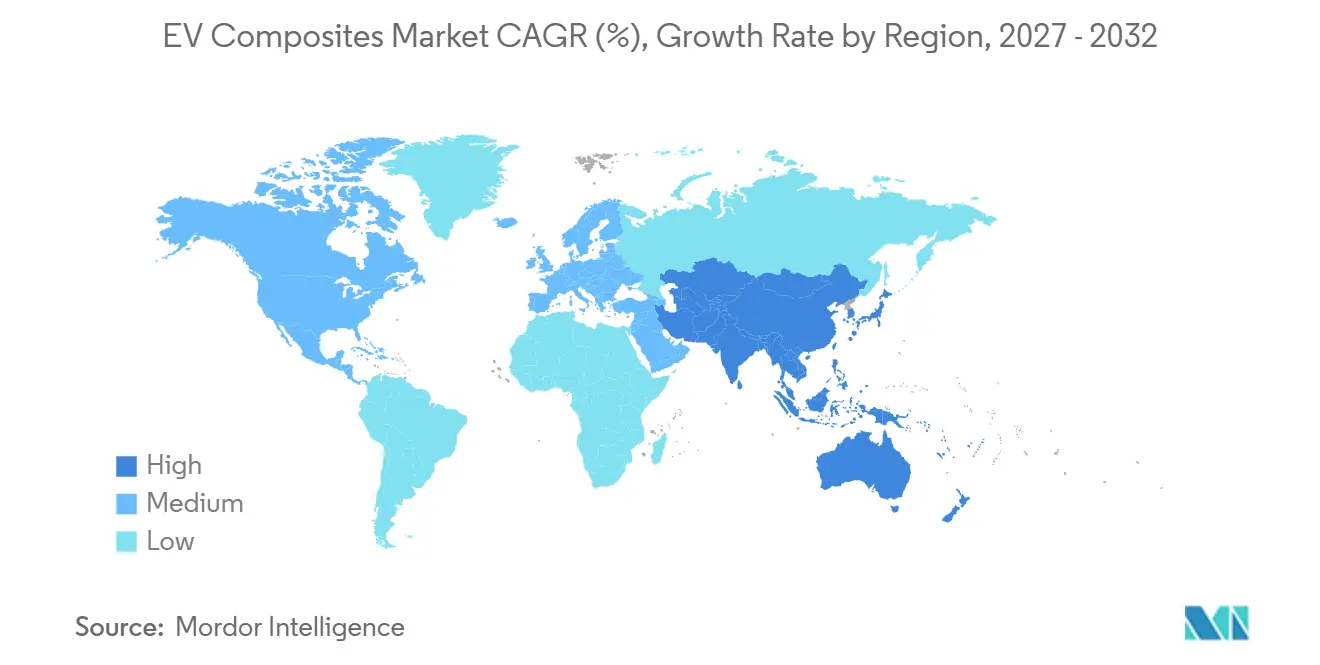
APAC EV Composites Market
Asia-Pacific held 42.41% of the EV composites market share in 2026 and is projected to advance at a 17.41% CAGR through 2032. China anchors regional demand through its large electric-vehicle manufacturing base and integrated supply chain for glass fiber and thermoplastic composite materials. This structure can reduce per-part material costs for domestic original equipment manufacturers. India recorded 35,000 electric-vehicle sales in the first quarter of 2025, a 45% year-over-year increase, while policy programs supported localization. Japan and South Korea contribute to high-value carbon fiber development, while Vietnam’s expanding assembly base adds demand for glass fiber composites.
Europe EV Composites Market
Europe is a significant region for the EV composites market, with regulatory requirements that emphasize product carbon-footprint disclosure and end-of-life recovery. Suppliers are increasingly expected to provide product carbon footprint data during quotation processes. This requirement supports interest in recyclable thermoplastic composite systems despite their potential cost premium. Germany remains central to European manufacturing because of its premium original equipment manufacturer base. The United Kingdom, France, Italy, and Nordic countries add demand through supplier ecosystems and new electric-vehicle programs.
The Americas and MEA EV Composites Market
North America has a less even demand outlook than Asia-Pacific because electric-vehicle registrations weakened through late 2025 after the expiration of tax credits. Ford Motor Company and Oak Ridge National Laboratory are developing recyclable composite materials that combine sensing, structural, and enclosure functions. South America and Middle East and Africa remain smaller demand areas within the EV composites market, although Brazil recorded more than 30,000 electric-vehicle sales in the first quarter of 2025. Saudi Arabia’s Vision 2030 program has attracted interest in localized glass fiber compounding investment, which could support demand as vehicle assembly and charging infrastructure develop.
Competitive Landscape
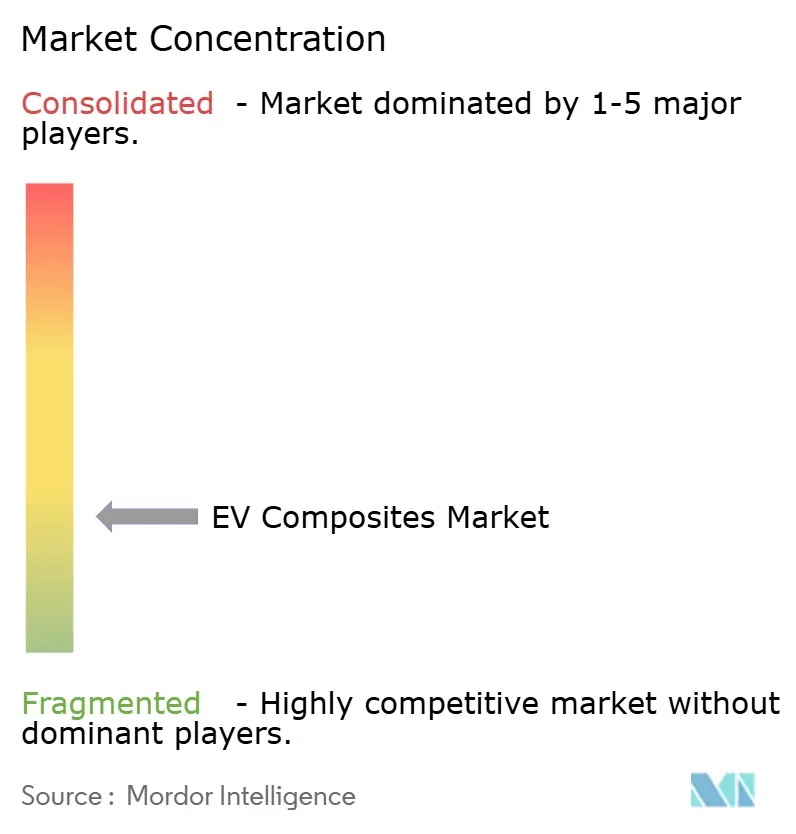
The EV composites market is highly fragmented, with the top five players including Teijin Limited, SGL Carbon, Kautex, Syensqo, and TORAY INDUSTRIES, INC. Avient Corporation, Covestro AG, Envalior, SABIC, Syensqo, and Teijin Limited compete through material platforms and application expertise. Kautex, Plastic Omnium, Owens Corning, SGL Carbon, Hexcel Corporation, FORVIA, Röchling, and Mitsubishi Chemical Group Corporation broaden competition across fibers, prepregs, systems, and vehicle applications.
Material suppliers differentiate through processing routes for high-volume large parts. SABIC, Envalior, Syensqo, and Covestro AG offer distinct material and manufacturing approaches for cost-efficient composite production. Battery thermal-runaway management remains a development area because suppliers must combine structure, fire performance, and thermal containment. Recycling-focused suppliers may gain ground as recovered-fiber methods develop. National Renewable Energy Laboratory (NREL)’s method for recovering both carbon fiber and resin components could support lower-cost secondary feedstock over time.
Kautex won an order in July 2025 for a full battery-electric vehicle thermoplastic composite lower battery housing for a multi-brand platform. In October 2025, TORAY INDUSTRIES, INC. and Hyundai Motor Group agreed to jointly develop high-performance carbon fiber reinforced polymer materials for future mobility. ISO 8203-4:2025 establishes laser shearography requirements for nondestructive testing of fiber-reinforced plastic composites. Better automated quality assurance could help address testing gaps in repair-sensitive applications.
EV Composites Industry Leaders
-
Teijin Limited
-
SGL Carbon
-
Kautex
-
Syensqo
-
TORAY INDUSTRIES, INC.
- *Disclaimer: Major Players sorted in no particular order
EV Composites Market Companies Covered in this Report
- Avient Corporation
- Covestro AG
- Envalior
- Forvia
- Hexcel Corporation
- Kautex
- Mitsubishi Chemical Group Corporation
- Owens Corning
- Plastic Omnium
- Röchling
- SABIC
- SGL Carbon
- Syensqo
- Teijin Limited
- TORAY INDUSTRIES, INC.
Recent Industry Developments in EV Composites Market
- May 2026: Trinseo developed a battery top cover using flame-retardant thermoplastic polycarbonate unidirectional (PC UD) tape, available in 1.0 mm and 1.5 mm wall thicknesses. The development supports the EV composites market by advancing lightweight, fire-resistant composite components for electric vehicle battery systems.
- July 2025: Kautex received an order from an automotive original equipment manufacturer for a thermoplastic composite lower battery housing for a fully battery-electric vehicle platform. The housing is designed to reduce weight, improve corrosion resistance, and integrate multiple functions, supporting the EV composites market through greater adoption of thermoplastic composites in battery protection systems.
Global EV Composites Market Report Scope
EV composites are engineered materials that combine reinforcing fibers with polymer resins to deliver strength, stiffness, and reduced weight in electric vehicles. They support vehicle efficiency and structural performance while helping address requirements for battery protection and component durability.
The EV Composites Market is segmented by fiber type, resin type, manufacturing process, application, and geography. By fiber type, the market is segmented into glass fiber, carbon fiber, and other fiber types. By resin type, the market is segmented into thermoset and thermoplastic. By manufacturing process, the market is segmented into compression molding, injection molding, resin transfer molding, and other manufacturing processes. By application, the market is segmented into powertrain and chassis, exterior, interior, battery enclosures, and other applications. The report also covers the market size and forecasts for EV composites across 15 countries. For each segment, the market sizing and forecasts have been done on the basis of value (USD).
Segmentation Overview
| Glass Fiber |
| Carbon Fiber |
| Other Fiber Types |
| Thermoset |
| Thermoplastic |
| Compression Molding |
| Injection Molding |
| Resin Transfer Molding |
| Other Manufacturing Processes |
| Powertrain and Chassis |
| Exterior |
| Interior |
| Battery Enclosures |
| Other Applications |
| Asia-Pacific | China |
| India | |
| Japan | |
| South Korea | |
| ASEAN Countries | |
| Rest of Asia-Pacific | |
| North America | United States |
| Canada | |
| Mexico | |
| Europe | Germany |
| United Kingdom | |
| France | |
| Italy | |
| NORDIC Countries | |
| Rest of Europe | |
| South America | Brazil |
| Argentina | |
| Rest of South America | |
| Middle East and Africa | Saudi Arabia |
| South Africa | |
| Rest of Middle East and Africa |
| By Fiber Type | Glass Fiber | |
| Carbon Fiber | ||
| Other Fiber Types | ||
| By Resin Type | Thermoset | |
| Thermoplastic | ||
| By Manufacturing Process | Compression Molding | |
| Injection Molding | ||
| Resin Transfer Molding | ||
| Other Manufacturing Processes | ||
| By Application | Powertrain and Chassis | |
| Exterior | ||
| Interior | ||
| Battery Enclosures | ||
| Other Applications | ||
| By Geography | Asia-Pacific | China |
| India | ||
| Japan | ||
| South Korea | ||
| ASEAN Countries | ||
| Rest of Asia-Pacific | ||
| North America | United States | |
| Canada | ||
| Mexico | ||
| Europe | Germany | |
| United Kingdom | ||
| France | ||
| Italy | ||
| NORDIC Countries | ||
| Rest of Europe | ||
| South America | Brazil | |
| Argentina | ||
| Rest of South America | ||
| Middle East and Africa | Saudi Arabia | |
| South Africa | ||
| Rest of Middle East and Africa | ||
Key Questions Answered in the Report
What is the size of the EV composites market?
The EV composites market size was valued at USD 3.36 billion in 2026 and is estimated to grow from USD 3.88 billion in 2027 to reach USD 8.23 billion by 2032, at a CAGR of 16.23% during the forecast period (2027-2032).
What is driving demand for EV composites?
Battery weight, range requirements, enclosure safety, and the need for parts with integrated structural and thermal functions are supporting demand.
Which fiber type held the largest share in 2026?
Glass fiber held 60.32% of the EV composites market share in 2026.
Why are thermoplastic composites important for electric vehicles?
Thermoplastic resins held 55.04% of the EV composites market share in 2026 and support faster processing, weld bonding, and recycling options.