
Europe Warehouse Real Estate Market Size and Share
Market Overview
| Study Period | 2021 - 2032 |
|---|---|
| Forecast Data Period | 2027 - 2032 |
| Base Year Market Size (2026) | USD 58.88 Billion |
| Market Size (2027) | USD 61.94 Billion |
| Market Size (2032) | USD 79.81 Billion |
| Growth Rate (2027 - 2032) | 5.20 % |
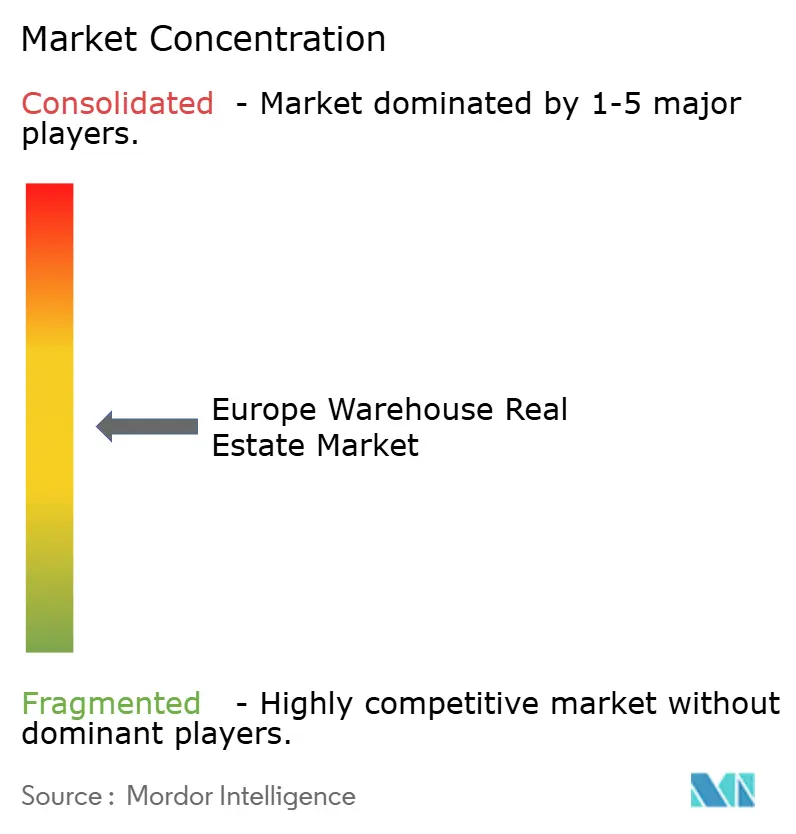
| Market Concentration | Medium |
Major Players *Disclaimer: Major Players sorted in no particular order Image © Mordor Intelligence. Reuse requires attribution under CC BY 4.0. | |
Europe Warehouse Real Estate Market Analysis by Mordor Intelligence
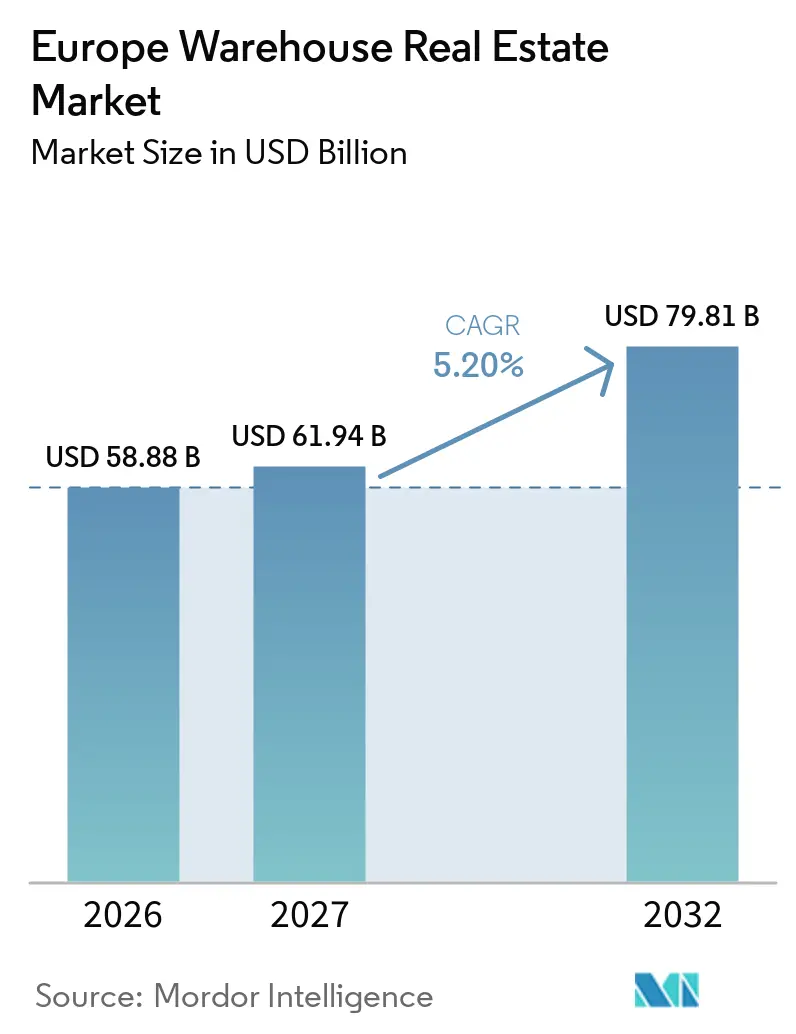
The Europe Warehouse Real Estate Market size is expected to increase from USD 58.88 billion in 2026 to USD 61.94 billion in 2027 and reach USD 79.81 billion by 2032, growing at a CAGR of 5.20% over 2027-2032.
The Europe warehouse real estate market is supported by limited modern supply in major logistics corridors, continued online retail activity, and manufacturers seeking shorter and more resilient supply chains. Prime buildings near cities, ports, rail terminals, and highways continue to draw occupier interest because they reduce delivery times and support network flexibility. Older warehouses face a different outlook because their energy performance, floor loading, and power capacity can fall short of current tenant requirements. Developers are placing greater emphasis on brownfield sites, energy-ready designs, and built-to-suit projects because financing and construction costs make speculative development harder to justify. The Europe warehouse real estate market therefore favors well-located Class A assets, while grid access and development viability remain central constraints.
Key Report Takeaways
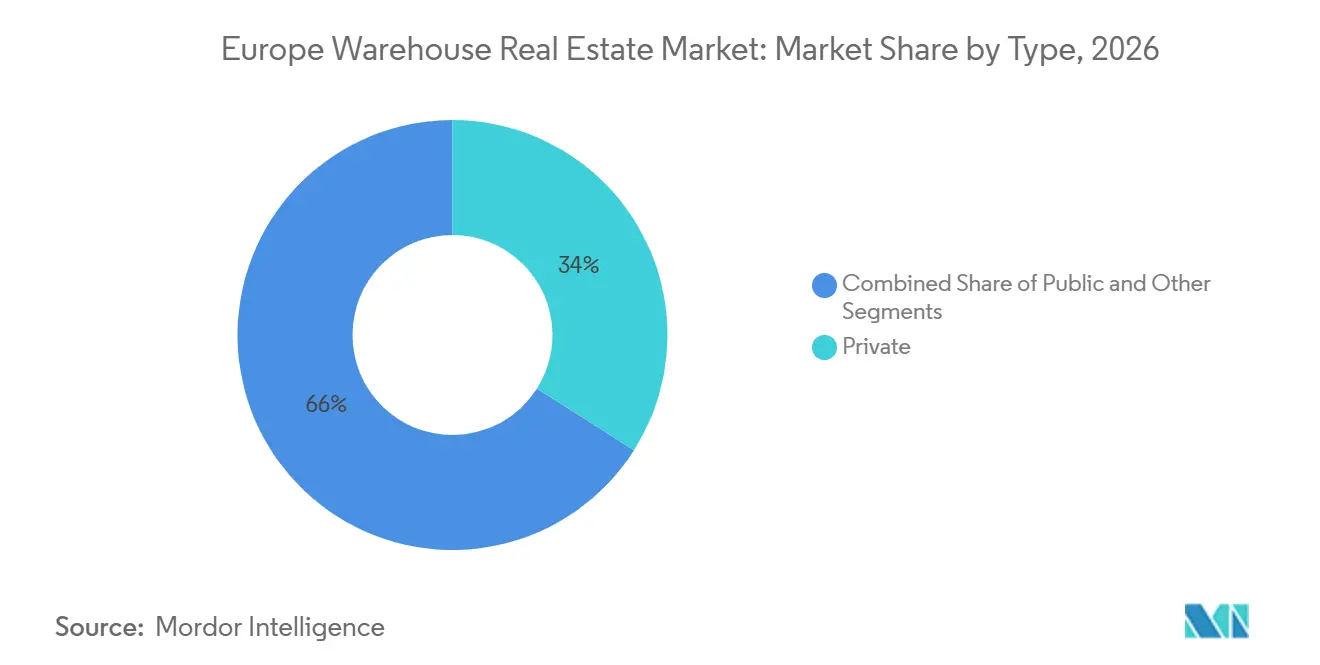
- By type, private warehouses held 34.00% in 2026, while others recorded the highest projected CAGR at 7.20% through 2032.
- By temperature control, general warehouses accounted for 74.00% of the Europe warehouse real estate market share in 2026, while refrigerated warehouses are forecast to grow at a 6.00% CAGR through 2032.
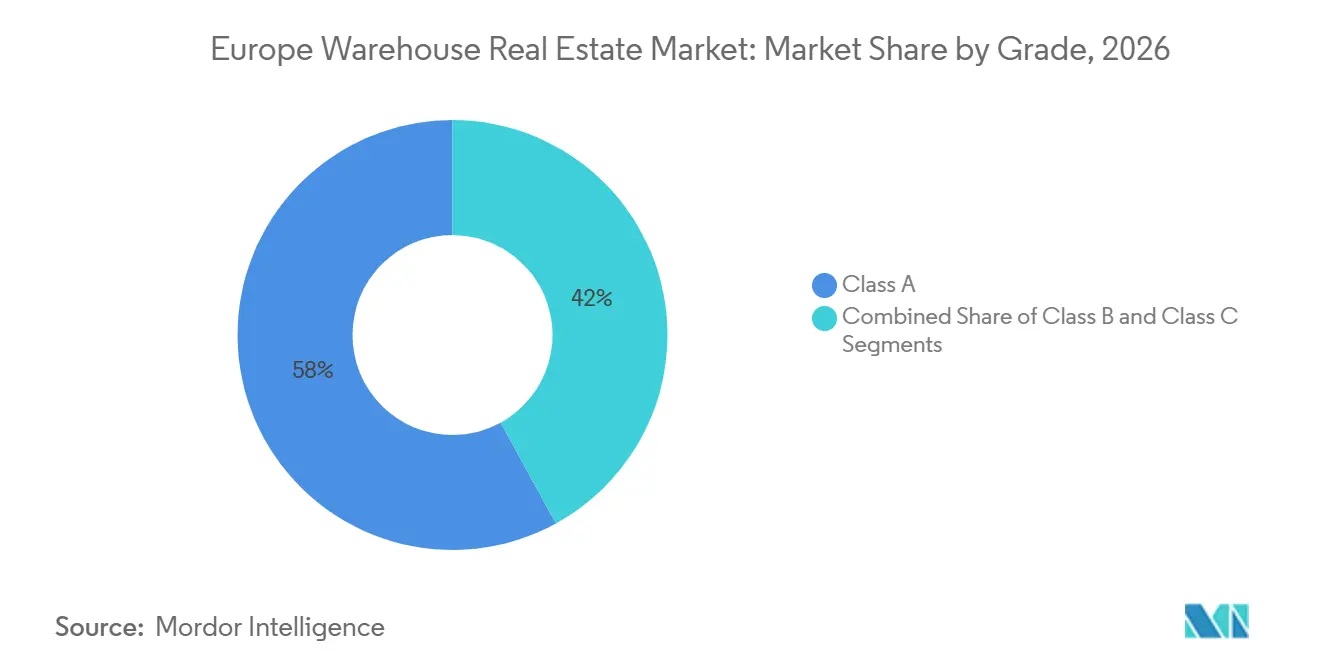
- By grade, Class A accounted for 58.00% in 2026 and is advancing at a 7.50% CAGR through 2032.
- By warehouse size, large-scale warehouses held 40.00% in 2026, while small-scale warehouses are forecast to expand at a 7.10% CAGR through 2032.
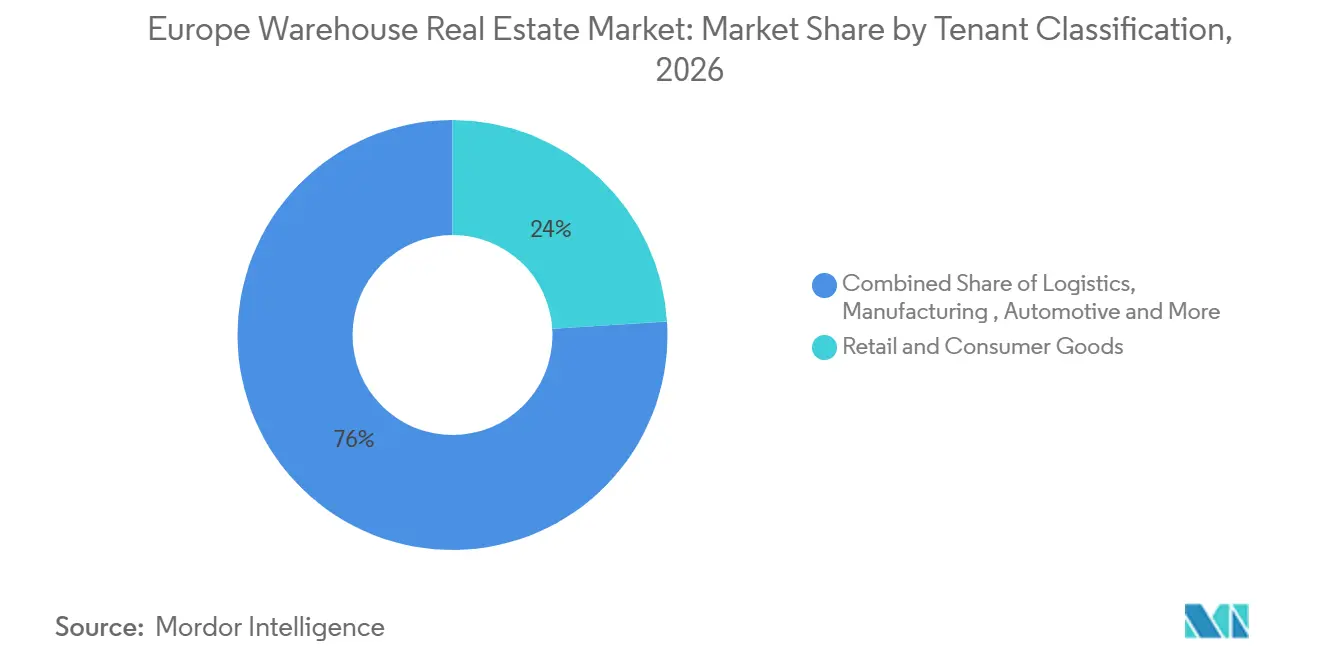
- By tenant classification, retail and consumer goods held 24.00% in 2026, while pharmaceuticals and healthcare are forecast to expand at a 7.40% CAGR through 2032.
- By geography, Germany held 24.00% in 2026, while Rest of Europe is projected to grow at a 7.00% CAGR through 2032.
Note: Market numbers in this report are based on Mordor Intelligence's proprietary estimation framework, which combines nine months of actuals with Q4 projections for base year 2026.
Market Trends and Insights
Drivers Impact Analysis of Europe Warehouse Real Estate Market*
| Drivers | (~) % Impact on CAGR Forecast | Geographic Relevance | Impact Timeline |
|---|---|---|---|
| Cross-Border E-Commerce and Parcel Networks | +1.4% | Western and Central and Eastern Europe, including the United Kingdom, Germany, the Netherlands, and Poland | Short term (≤ 2 years) |
| European Nearshoring, Defense, and Industrial Reinvestment | +1.2% | Central and Eastern Europe, with spillover to Germany, the United Kingdom, and the Nordics | Medium term (2-4 years) |
| Urban Logistics and Multi-Story Warehouse Demand | +0.9% | Urban corridors in Paris, London, Amsterdam, and Berlin | Medium term (2-4 years) |
| Energy-Efficient Class A Assets and Green-Lease Requirements | +0.7% | Europe, with strong relevance in the Netherlands, Germany, and the United Kingdom | Long term (≥ 4 years) |
| Cold-Chain, Food Safety, and Pharmaceutical Distribution | +0.6% | Central and Eastern Europe, Iberia, and France | Long term (≥ 4 years) |
| Port, Rail, and Inland-Intermodal Connectivity | +0.5% | Rotterdam, Antwerp-Bruges, Hamburg, Gdańsk, and Genoa corridors | Medium term (2-4 years) |
| Source: Mordor Intelligence | |||
Cross-Border E-Commerce and Parcel Networks
Cross-border online retail is raising demand for facilities that can receive, store, and distribute goods within the European Union. JD.com launched its Joybuy platform across the United Kingdom, Germany, France, the Netherlands, Belgium, and Luxembourg in March 2026, supported by a European network of 60 warehouses and depots. The rollout shows how marketplace operators are committing to regional fulfillment networks rather than relying only on cross-border parcel flows—the Europe warehouse real estate market benefits when inventory moves closer to consumers and customs entry points. Larger dock-served buildings are particularly relevant because operators increasingly combine parcel processing with pallet-based inventory handling. This shift can place smaller ramp-only facilities at a disadvantage where tenants need faster and higher-volume throughput.
European Nearshoring, Defense, and Industrial Reinvestment
Industrial reinvestment is broadening warehouse demand beyond consumer-led distribution. Manufacturers that move production or sourcing closer to European customers need storage for components, finished goods, and secure supply-chain inventory. Defense-related production can also require controlled yards, higher floor loading, reliable power, and facilities designed for long operating periods. Romania’s modern industrial and logistics stock reached 7.5 million sqm in recent years, and production activities accounted for 1/3 of industrial space demand in the cited analysis. The Europe warehouse real estate market gains from built-to-suit projects where these requirements are difficult to meet in generic stock. Long lease terms can make such developments more attractive to asset owners seeking stable income.
Urban Logistics and Multi-Story Warehouse Demand
Urban logistics demand is increasing the commercial case for multi-story warehouses in land-constrained cities. AEW agreed to fund the UP! development in Vénissieux, Lyon, in April 2025, a 21,000 sqm urban industrial and distribution project designed for 2 levels and targeted for 2026 delivery[1]. CTP also signed a 15-year lease with Crisp at CTPark Amsterdam City in January 2026, covering 13,000 sqm of warehouse space and 3,000 sqm of mezzanine space[2]. These developments show that operators can use vertical layouts when proximity to dense population centers outweighs higher construction costs. The Europe warehouse real estate market has a limited supply of sites that can provide rapid delivery coverage, truck access, and adequate power. Multi-level projects can serve that need, but they require careful design around ramps, loading, traffic circulation, and tenant operations.
Energy-Efficient Class A Assets and Green-Lease Requirements
Energy performance is becoming a practical leasing and investment consideration for modern logistics facilities. P3 Logistic Parks reported that its P3 Abrera facility in Catalonia achieved a BREEAM Outstanding rating of 97.76% in February 2026, with 100% operational carbon dioxide savings and a 62.76% reduction in water consumption[3]. VGP reported that Building B at VGP Park Arad in Romania achieved a BREEAM International New Construction score of 96.3%. These projects show why new facilities increasingly include better insulation, solar generation, water controls, and data systems for energy monitoring. The Europe warehouse real estate market rewards assets that can meet tenant reporting needs and help reduce operating costs. Older buildings without a credible refurbishment path may see weaker leasing demand and more capital expenditure needs.
Restraints Impact Analysis of Europe Warehouse Real Estate Market*
| Restraints | (~) % Impact on CAGR Forecast | Geographic Relevance | Impact Timeline |
|---|---|---|---|
| Development-Finance Constraints and Higher Yield Requirements | -1.1% | Europe, with particular pressure in Germany, the Netherlands, and United Kingdom secondary markets | Short term (≤ 2 years) |
| High Electricity Costs and Grid Reliability Risk | -0.8% | The Netherlands, Germany, Belgium, and the Nordics | Medium term (2-4 years) |
| Planning, Biodiversity-Net-Gain, and Environmental Review Delays | -0.6% | The United Kingdom, France, and Germany, especially near urban nodes | Long term (≥ 4 years) |
| Oversupply in Selected Peripheral and Secondary Markets | -0.5% | Central and Eastern European secondary markets, parts of Iberia, and southern Germany | Short term (≤ 2 years) |
| Source: Mordor Intelligence | |||
Development-Finance Constraints and Higher Yield Requirements
New warehouse projects must generate rents that cover land, construction, financing, and tenant-improvement costs. The development pipeline can slow when achievable rents do not support those costs at an acceptable return. Lenders are focusing more closely on pre-leasing, energy assumptions, and exit values before committing capital. This favors established locations and schemes with committed tenants over speculative projects in unproven submarkets. The Europe warehouse real estate market may face limited new supply in high-cost areas even where occupier demand remains sound. This situation supports rents for the best existing assets but can delay the capacity needed by expanding businesses.
High Electricity Costs and Grid Reliability Risk
Electricity access has become a major location factor for logistics facilities that use automation, refrigeration, rooftop solar, and electric vehicle charging. Prologis introduced its OnDemand Power microgrid at Almere in the Netherlands to combine rooftop solar, battery storage, and backup generation. The company stated that the system provides more than 400 kilowatts of on-site capacity where utility supply could provide 55 kilowatts until 2035. Such measures can protect operations, but they require capital and technical capability that not all owners can deploy. The Europe warehouse real estate market is therefore likely to place a premium on sites with secure grid connections or workable local energy solutions. Power constraints can also limit the future electrification of delivery fleets at warehouse sites.
*Our forecasts treat driver/restraint impacts as directional, not additive. The impact forecasts reflect baseline growth, mix effects, and variable interactions.
Europe Warehouse Real Estate Market Segment Analysis
By Type:
Private Warehouses Lead While Specialized Formats ExpandPrivate warehouses held 34.00% of the Europe warehouse real estate market size in 2026. Large manufacturers, retailers, and third-party logistics providers use these facilities when their operations require dedicated layouts, security arrangements, or equipment. A built-to-suit building can support a tenant’s preferred flows, storage systems, and loading design. This model also suits activities where operating continuity and long-term control are important. Private facilities can attract institutional capital because leases are often longer and specifications are linked closely to the tenant’s needs.
Others is the fastest-growing type, with a projected 7.20% CAGR through 2032. This category includes formats that do not fit neatly within traditional public or private labels, such as secure defense stores, logistics nodes near data centers, and last-mile fulfillment sites. Some operators are also using flexible agreements that permit shared use of a facility without changing its basic design. The Europe warehouse real estate market is seeing greater demand for these hybrid formats as users seek space that can serve several operational roles. Their growth indicates that property design is becoming more tailored to specific supply-chain requirements.

By Temperature Control:
General Warehouses Remain the Core FormatGeneral warehouses commanded 74.00% of the Europe warehouse real estate market share in 2026. Their scale reflects broad demand from retail, manufacturing, online fulfillment, and logistics service providers. Modern general warehouses can include efficient lighting, building controls, heat pumps, and rooftop solar systems. These features improve operational performance while keeping the building suitable for a wide range of users. The large installed base of ambient storage means this category remains the main source of warehouse capacity across the region.
Refrigerated warehouses are forecast to grow at a 6.00% CAGR through 2032. Food distribution and pharmaceutical handling are increasing the need for sites with controlled temperature systems and reliable backup arrangements. Aenova’s new cold-chain warehouse in Latina includes automation, compliance-focused design, and dual independent refrigeration. Some general warehouses are also adding partial chilled areas, which can make the boundary between the 2 formats less distinct. The Europe warehouse real estate market is likely to need more buildings that combine ambient and temperature-controlled operations on the same site.
By Grade:
Class A Strengthens Its PositionClass A held 58.00% in 2026. Its leading position reflects tenant demand for buildings with modern loading areas, clear internal heights, reliable power, and strong energy performance. These facilities are more likely to support automation and detailed reporting on operating conditions. They also meet the requirements of tenants that need secure and high-throughput operations. The Europe warehouse real estate industry is directing more capital toward this grade because it offers a clearer path to durable rental demand.
Class A is also the fastest-growing grade, at a projected 7.50% CAGR through 2032. The same features that support its current share are increasing its value to occupiers that are relocating from older stock. Class B space remains useful for cost-sensitive users and shorter-term needs, while Class C buildings may require refurbishment or redevelopment. P3 Abrera’s 97.76% BREEAM score shows how high the sustainability benchmark has become for new and refurbished facilities. This division between grades will remain important as energy and operational requirements become more demanding.
By Warehouse Size:
Large-Scale Facilities Anchor NetworksLarge-scale warehouses above 250,000 sq ft accounted for 40.00% in 2026. These facilities support regional distribution, major online fulfillment operations, and third-party logistics networks. Their large yards and storage volumes are also relevant to defense logistics and high-volume manufacturing supply chains. A single large building can consolidate inventory and reduce the number of handling points across a network. This makes the category important for occupiers that need wide market coverage from a limited number of locations.
Small-scale warehouses under 50,000 sq ft are forecast to grow at a 7.10% CAGR through 2032. Their appeal comes from proximity to customers and the ability to support local delivery, returns, and specialized distribution. Small units can also help tenants test new locations without committing to a large facility. CTPark Amsterdam City demonstrates a larger campus approach that includes multi-level space suited to dense urban operations. The Europe warehouse real estate market is thus supporting both network-scale distribution centers and more local formats.
By Tenant Classification:
Retail and Consumer Goods Stay LargestRetail and consumer goods held 24.00% in 2026. These users depend on distributed facilities to support store replenishment, online orders, returns, and product availability. Their requirements vary from large regional distribution centers to smaller sites near cities. Retailers also need flexible space because demand patterns can shift across channels and seasons. This makes the category an important base of leasing activity across mature European logistics markets.
Pharmaceuticals and healthcare are forecast to expand at a 7.40% CAGR through 2032. These tenants need reliable temperature control, traceability, secure access, and operating standards that can support sensitive products. Aenova’s investment in Latina shows the level of automation and refrigeration resilience required by this user group. Manufacturing, food and beverage, and logistics operators also remain material users of warehouse space, each with different design needs. The Europe warehouse real estate market is becoming more specialized as tenant requirements move beyond standard storage.
Geography Analysis
Germany held 24.00% of the Europe warehouse real estate market share in 2026. Its position reflects its manufacturing base, extensive road and rail connections, and central role in European distribution networks. The country continues to attract demand for large logistics buildings and secure industrial storage. Grid availability is increasingly important in key logistics areas because tenants need power for automation, refrigeration, and fleet charging. This makes power-ready sites a distinct part of the German warehouse proposition.
Rest of Europe is the fastest-growing country in the Europe warehouse real estate market, with a projected 7.00% CAGR through 2032. Modern warehouse stock in Poland reached 36.58 million sqm at year-end 2025, and the country has continued to benefit from nearshoring, online retail, and its location within Central and Eastern Europe. Demand is strongest in established corridors around Warsaw, Łódź, and Poznań. The country offers a combination of land availability, improving transport links, and access to regional customers. These strengths support both pre-let development and selected speculative projects in core submarkets.
The United Kingdom remains an important logistics location because it supports a large consumer base and established national distribution networks. France and Spain have different supply and demand conditions, but both retain active urban and gateway corridors. The Netherlands offers strong connectivity, although land scarcity and power constraints can limit development. Italy remains relevant for gateway logistics linked to Milan and Genoa. At the same time, Romania, the Czech Republic, Hungary, and Slovakia provide further capacity for nearshoring and regional fulfillment, requiring occupiers and investors to weigh transport access, labor, power, land, and tenant demand together.
Competitive Landscape
The Europe warehouse real estate market is moderately concentrated at the prime end, where a limited group of developers, real estate investment trusts, and large platforms control key sites and institutional-grade portfolios. Prologis announced a recommended acquisition of SEGRO in August 2026, valued at USD 18.8 billion and subject to the stated regulatory and shareholder approvals. The company said the combined European operating portfolio would total 368 million sq ft, while its European footprint would increase by 47% and its land bank by 126%. If completed, the transaction would strengthen the combined platform in prime urban and gateway locations. The proposed deal illustrates the value placed on scale, land control, and access to established tenants.
Panattoni, Goodman, GLP, P3 Logistic Parks, CTP, WDP, and VGP are pursuing growth through redevelopment, modern new construction, and expansion in supply-constrained locations. VGP and AREIM agreed to a third closing of their SAGA joint venture in November 2025, comprising 17 logistics buildings across 13 parks in 8 countries and 424,000 sqm in total. WDP announced in May 2026 that it had acquired 2 landbank positions in France for future logistics development. Panattoni launched a 37,000 sqm logistics platform in France in January 2026 on a brownfield site. These actions show that leading players are using land acquisition, joint ventures, and brownfield conversion to add modern supply.
Competition is moving toward energy resilience, sustainability credentials, and facilities that are ready for automation, as shown by Prologis’ Almere microgrid investment where the public connection is limited. P3 and VGP have used high BREEAM scores to demonstrate building performance to tenants and investors. Smaller operators can compete in specialist urban, cold-chain, and shared-use formats, but large capital commitments create a meaningful barrier in prime locations. The Europe warehouse real estate market therefore combines large-platform competition with narrower opportunities for specialized developers.
Europe Warehouse Real Estate Industry Leaders
-
SEGRO plc
-
Prologis, Inc.
-
GLP Pte. Ltd.
-
Panattoni Development Company, Inc.
-
Goodman Group
- *Disclaimer: Major Players sorted in no particular order
Europe Warehouse Real Estate Market Companies Covered in this Report
- SEGRO plc
- Prologis, Inc.
- GLP Pte. Ltd.
- Panattoni Development Company, Inc.
- Goodman Group
- Blackstone Real Estate
- Logicor
- P3 Logistic Parks
- Cushman & Wakefield plc
- CBRE Group, Inc.
- Colliers International Group Inc.
- Hines
- VGP NV
- DWS Group
- Catena AB
- Mileway
- Tritax Big Box REIT plc
- WDP NV
- CTP N.V.
- Exeter Property Group
Recent Industry Developments in Europe Warehouse Real Estate Market
- June 2026: Prologis, Inc. announced a recommended acquisition of SEGRO plc, valuing SEGRO at USD 18.8 billion. The combination would create a European operating portfolio of 368 million sq ft, expand Prologis’ European footprint by 47%, increase its European land bank by 126%, and establish a combined development pipeline of 13 million sq ft. Completion is expected in H1 2027, subject to regulatory and shareholder approvals. The proposed combination brings together 2 established logistics platforms with major positions in European urban and gateway locations.
- May 2026: WDP committed to acquire 2 strategic landbank positions in France. The sites are at Le Mesnil-Amelot near Paris Charles de Gaulle Airport and north of Toulouse, with planned logistics capacity of 70,000 sqm and 62,000 sqm, respectively. The first location sits beside a major air cargo gateway, while the Toulouse site is planned as a mixed-use logistics campus.
- January 2026: Panattoni France acquired an 11.6-hectare brownfield site in the Seine-Eure metropolitan area and began construction of a 37,000 sqm speculative logistics platform. The company said the project targets pharmaceutical and cosmetics occupiers, includes a BREEAM Excellent target, and is expected to be delivered in Q1 2027. The project combines a brownfield location with a specification aimed at users that need reliable, high-quality logistics space.
Europe Warehouse Real Estate Market Report Scope
Segmentation Overview
| Public |
| Private |
| Others |
| General Warehouse |
| Refrigerated Warehouse |
| Class A |
| Class B |
| Class C |
| Small-Scale Warehouses, Under 50,000 sq ft |
| Medium-Scale Warehouses, 50,000-250,000 sq ft |
| Large-Scale Warehouses, Above 250,000 sq ft |
| Manufacturing |
| Retail and Consumer Goods |
| Food and Beverage |
| Pharmaceuticals and Healthcare |
| Logistics |
| Other End Users |
| United Kingdom |
| Germany |
| France |
| Italy |
| Spain |
| Netherlands |
| Russia |
| Rest of Europe |
| By Type | Public |
| Private | |
| Others | |
| By Temperature Control | General Warehouse |
| Refrigerated Warehouse | |
| By Grade | Class A |
| Class B | |
| Class C | |
| By Warehouse Size | Small-Scale Warehouses, Under 50,000 sq ft |
| Medium-Scale Warehouses, 50,000-250,000 sq ft | |
| Large-Scale Warehouses, Above 250,000 sq ft | |
| By Tenant Classification | Manufacturing |
| Retail and Consumer Goods | |
| Food and Beverage | |
| Pharmaceuticals and Healthcare | |
| Logistics | |
| Other End Users | |
| By Countries | United Kingdom |
| Germany | |
| France | |
| Italy | |
| Spain | |
| Netherlands | |
| Russia | |
| Rest of Europe |
Key Questions Answered in the Report
What is the projected value of Europe warehouse real estate by 2032?
The Europe warehouse real estate market is projected to reach USD 79.81 billion by 2032, from USD 61.94 billion in 2027. This outlook reflects continued demand for modern logistics capacity in established and emerging European corridors, particularly where new supply remains limited.
What is the forecast growth rate for Europe warehouse real estate?
The forecast CAGR is 5.20% for 2027 to 2032. Growth is linked to online retail fulfillment, nearshoring, specialized storage, and a limited supply of quality assets in preferred locations, especially in urban and gateway submarkets.
Which warehouse type holds the largest share in Europe?
Private warehouses lead by type with a 34.00% share in 2026. Dedicated facilities remain useful to large users that need customized layouts, secure operations, and long-term control over warehouse processes, including equipment and site layout decisions.
Why are Class A warehouses gaining demand?
Class A assets held a 58.00% share in 2026 and offer the power, loading, energy performance, and automation readiness sought by many tenants. The grade is also forecast to grow at 7.50% through 2032, showing continued preference for newer and more efficient facilities.
Which country is growing fastest in European warehouse real estate?
Rest of Europe is forecast to record the highest country CAGR, at 7.00% through 2032. Its appeal rests on its regional location, transport links, nearshoring activity, and demand around major logistics centers, where both regional and local distribution activity can be supported.
Which tenant group is growing fastest?
Pharmaceuticals and healthcare are projected to expand at a 7.40% CAGR through 2032, supported by specialized handling and temperature-control needs. This tenant group favors validated, secure, and resilient facilities that can manage specialized products with reliable operating controls.