
Europe Transportation Technical Textiles Market Size and Share
Market Overview
| Study Period | 2026 - 2032 |
|---|---|
| Forecast Data Period | 2027 - 2032 |
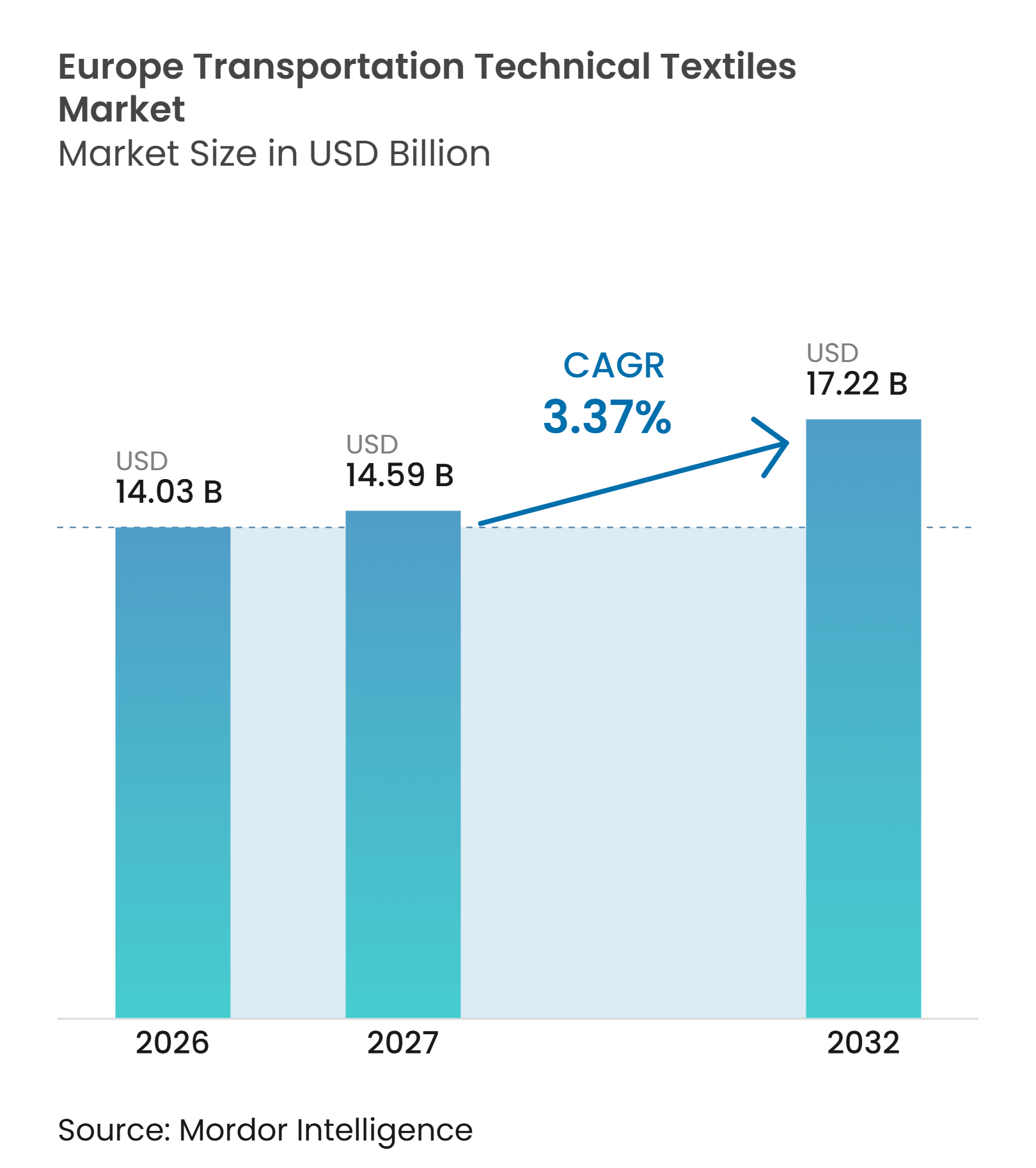
| Base Year Market Size (2026) | USD 14.03 Billion |
| Market Size (2027) | USD 14.59 Billion |
| Market Size (2032) | USD 17.22 Billion |
| Growth Rate (2027 - 2032) | 3.37 % |
| Market Concentration | Medium |
Major Players *Disclaimer: Major Players sorted in no particular order Image © Mordor Intelligence. Reuse requires attribution under CC BY 4.0. | |
Europe Transportation Technical Textiles Market Analysis by Mordor Intelligence
The Europe Transportation Technical Textiles Market size is projected to be USD 14.03 billion in 2026, USD 14.59 billion in 2027, and reach USD 17.22 billion by 2032, growing at a CAGR of 3.37% from 2027 to 2032.
Electric vehicle programs are increasing requirements for acoustic insulation, thermal management layers, and battery fire barriers. Lightweight composite structures are also gaining importance as vehicle manufacturers respond to emissions rules and seek lower component mass. Rail investment is widening demand beyond road vehicles, especially for fire-compliant interiors and lightweight panels. Suppliers are responding by combining recycled content, improved fire performance, and more efficient processing into product development. Qualification periods and uncertainty around PFAS replacement remain constraints, but they also favor suppliers that can meet verified performance requirements.
Key Report Takeaways
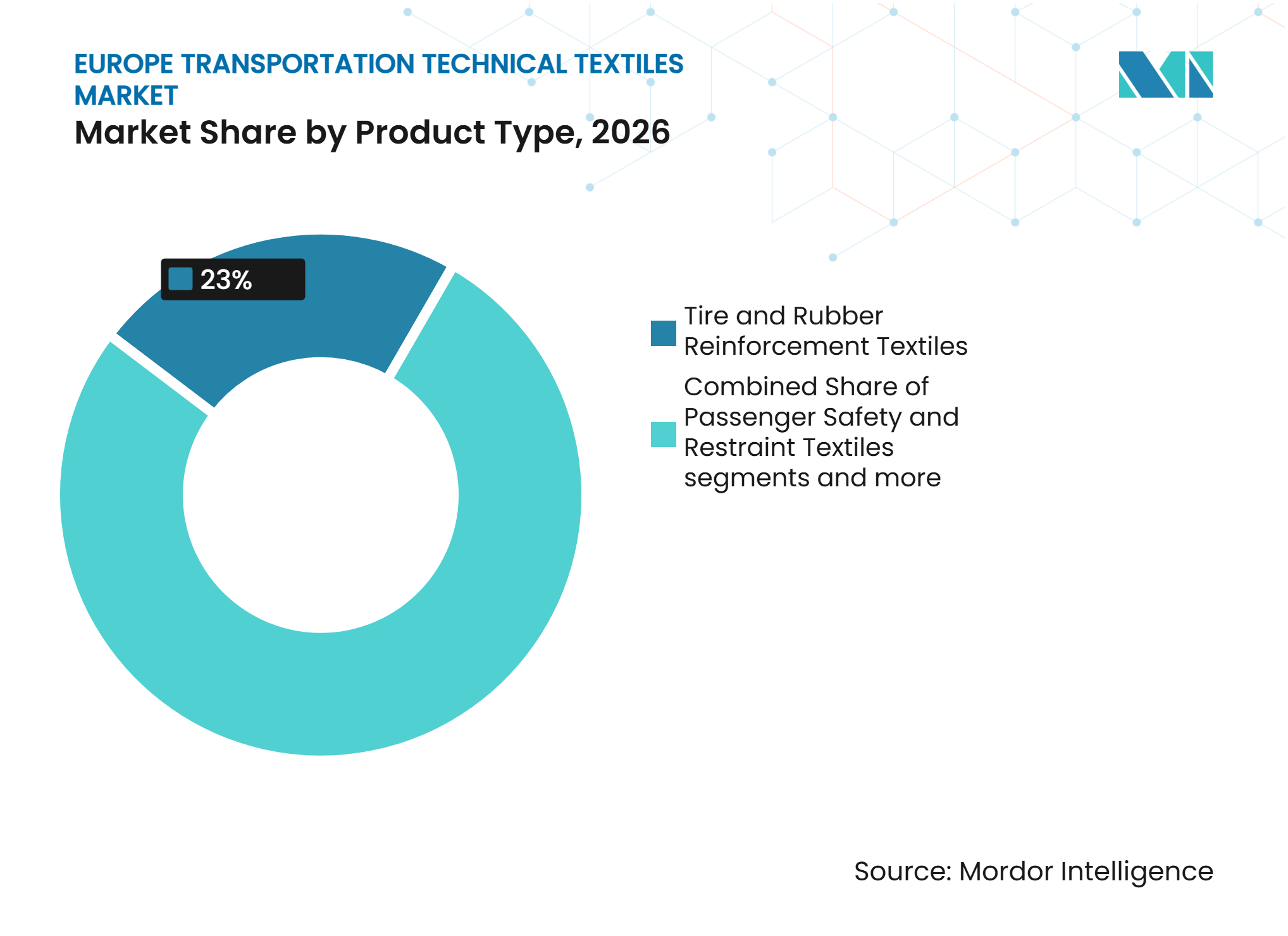
- By product type, tire and rubber reinforcement textiles held 23% of the Europe transportation technical textiles market share in 2026, while structural and composite reinforcement textiles are forecast to grow at a 5.8% CAGR through 2032.
- By material type, polyester held 35% of the Europe transportation technical textiles market share in 2026, while carbon fibers are forecast to grow at a 6.5% CAGR through 2032.
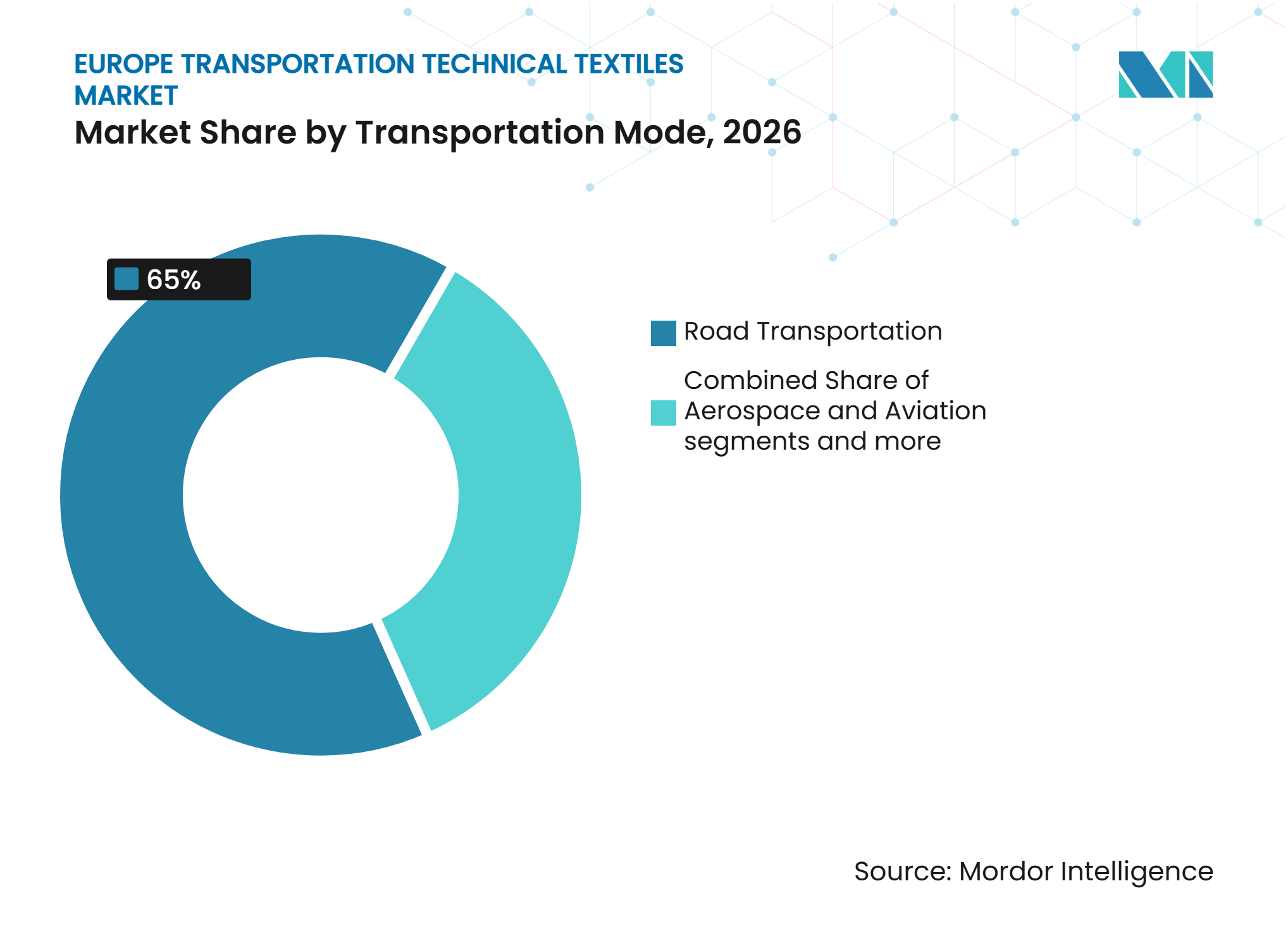
- By transportation mode, road transportation accounted for 65% of the Europe transportation technical textiles market size in 2026, while aerospace and aviation are forecast to grow at a 5.2% CAGR through 2032.
- By geography, Germany held 22% of the regional market share in 2026, while the Rest of Europe is forecast to grow at a 4.8% CAGR through 2032.
Note: Market numbers in this report are based on Mordor Intelligence's proprietary estimation framework, which combines nine months of actuals with Q4 projections for base year 2026.
Market Trends and Insights
Drivers Impact Analysis of Europe Transportation Technical Textiles Market*
| Driver | (~) % Impact on CAGR Forecast | Geographic Relevance | Impact Timeline |
|---|---|---|---|
| Electrification-Driven Demand for Thermal, Acoustic and Fire-Protection Textiles | +1.1% | Germany, France, BENELUX, and Nordics | Medium term (2-4 years) |
| Lightweighting Requirements for European Vehicle Platforms | +0.8% | Europe, especially Germany, United Kingdom, and France | Long term (≥ 4 years) |
| Rail Infrastructure Modernization and Cross-Border Network Investment | +0.6% | Central and Eastern Europe, Germany, and France | Medium term (2-4 years) |
| Premium Interior Upgrades and Passenger-Comfort Requirements | +0.4% | Germany, United Kingdom, France, Italy, and BENELUX | Short term (≤ 2 years) |
| Battery-Safe Mono-Material and Recycled-Content Solutions | +0.3% | Europe, especially Germany and BENELUX | Medium term (2-4 years) |
| European Technical Textile Clusters and Advanced Composite Innovation | +0.2% | Germany, France, Italy, and United Kingdom | Long term (≥ 4 years) |
| Source: Mordor Intelligence | |||
Electrification-Driven Demand for Thermal, Acoustic, and Fire-Protection Textiles
Electric vehicle programs are changing the role of acoustic, thermal, and protective textiles in European vehicle platforms. With less powertrain noise, road, tire, and motor sounds become more noticeable inside the vehicle, increasing demand for carefully designed insulation layers. Battery packs also require fire barriers that can perform during thermal runaway events. Autoneum introduced E-Fiber flame shields in March 2025, stating that the mica-free composite material can withstand temperatures up to 1,400°C and has entered pre-development testing with European vehicle manufacturers. Battery electric vehicles use 18 to 25 kg of nonwoven material, compared with 14 to 18 kg in similar internal-combustion vehicles. This combination of acoustic refinement and battery protection increases textile content at the platform level and supports demand for higher-value technical materials.
Lightweighting Requirements for European Vehicle Platforms
Vehicle manufacturers continue to look for lower-mass components as European fleet emissions rules shape long-term product planning. Textile-based composite reinforcement can replace selected metal parts in vehicle, aerospace, and rail applications. The carbon fiber reinforced polymer composites and glass fiber preforms can reduce component mass by 30% to 50% in suitable applications. The European policy discussion around end-of-life vehicles has reduced uncertainty for carbon fiber applications after the material was removed from the draft list of substances of concern. This clarification matters because vehicle programs require investment decisions years before series production. It also gives suppliers a clearer basis to develop structural fabrics for road and aerospace customers.
Rail Infrastructure Modernization and Cross-Border Network Investment
Rail investment is creating a separate demand base for transportation textiles in passenger cabins, composite panels, flooring, and fire-rated systems. The European Commission awarded EUR 2.8 billion (USD 3.3 billion) in Connecting Europe Facility funding for 94 transport projects in July 2025, with 77% directed to rail projects.[1] These projects include Rail Baltica construction, European Rail Traffic Management System deployment, and high-speed connections in Czechia and Poland. The revised TEN-T framework requires electrification and higher design standards across the network, creating a stronger need for modern rolling stock.[2] Fire, smoke, and toxicity requirements under EN 45545 make verified rail materials important for suppliers seeking this demand.
Premium Interiors, Recycled Content, and Composite Innovation
Vehicle interior programs increasingly combine appearance, acoustic comfort, recycled content, and weight performance within the same specification. This is widening demand for multilayer upholstery, acoustic headliners, carpet composites, and molded polyester parts. Trützschler reported that its TRUECYCLED yarn, made from 50% post-consumer textile waste and 50% recycled polyester, was used in Lotus Eletre and Emeya seat backs during 2025. Autoneum also states that its recycled polyester product platforms support lightweight acoustic and interior applications. The Europe Transportation Technical Textiles market therefore rewards suppliers that can meet quality, circularity, and processing needs without increasing complexity for vehicle manufacturers. Material clusters in Germany, France, Italy, and the United Kingdom support this work through composite manufacturing knowledge and product testing capabilities.
Restraints Impact Analysis of Europe Transportation Technical Textiles Market*
| Restraint | (~) % Impact on CAGR Forecast | Geographic Relevance | Impact Timeline |
|---|---|---|---|
| Energy-Intensive Coating, Finishing, and Composite Processing | -0.5% | Germany, France, and Italy | Long term (≥ 4 years) |
| Long OEM Qualification Cycles and Validation Costs | -0.4% | Europe, with stronger effects in France and Nordic markets | Medium term (2-4 years) |
| PFAS Substitution and Functional-Performance Trade-Offs | -0.3% | Europe, especially France and Nordic markets | Medium term (2-4 years) |
| Limited Availability of Consistent Recycled Technical Fibers | -0.2% | Europe, especially composite and acoustic applications | Short term (≤ 2 years) |
| Source: Mordor Intelligence | |||
Energy-Intensive Coating, Finishing, and Composite Processing
Coating, laminating, and composite curing require substantial energy and expose European plants to higher industrial cost pressure. The stenter finishing consumes 0.3 to 0.5 kWh per kilogram of finished fabric and can lose a significant share of energy through humid exhaust air. SGL Carbon stated in 2026 that high manufacturing costs and regulatory requirements are weighing on European chemical and advanced-material operations. Heat recovery and more efficient machinery can improve economics, but plant upgrades require capital and production planning. This issue is strongest in coating and composite processing sites in Germany, France, and Italy. It can delay investment in next-generation lines even where customer demand is present.
Long OEM Qualification Cycles and Validation Costs
New recycled-content nonwovens, bio-based composites, and functional coated fabrics often require 18 to 36 months of OEM testing before receiving series-production approval. Battery applications require additional validation for flame resistance, material purity, thickness consistency, and thermal runaway protection. Autoneum’s E-Fiber battery flame shields entered pre-development testing with European OEMs after battery validation, illustrating the demanding process for new protective textile solutions. Acoustic materials can require longer review periods when their performance must be assessed within the full vehicle system. The supplied draft indicates that validation and OEM approval can add 5% to 15% to Tier 1 component pricing. These requirements favor established suppliers with approved materials and can slow the adoption of newer recycled-content and bio-based alternatives.
*Our forecasts treat driver/restraint impacts as directional, not additive. The impact forecasts reflect baseline growth, mix effects, and variable interactions.
Europe Transportation Technical Textiles Market Segment Analysis
By Product Type:
Structural Composites Gain Ground on the Leading Tire SegmentTire and rubber reinforcement textiles held 23% of the regional market share in 2026, supported by tire production across Germany, France, Spain, and Eastern Europe. These materials use high-tenacity polyester and nylon cord fabrics in tire carcasses and sidewalls. Structural and Composite Reinforcement Textiles are expected to grow at a 5.8% CAGR through 2032 as manufacturers adopt carbon and glass fiber preforms in aerospace structures, rail bodies, and electric vehicle enclosures. Hexcel and Arkema presented PEKK-carbon thermoplastic composite work at the Paris Air Show in 2025, reporting production-cycle improvements for targeted aerospace components. Faster production is important because it can help composite parts move beyond specialist, low-volume applications. The German work on 3D woven textiles aims to improve fatigue resistance and reduce delamination in load-bearing uses. These developments support a shift toward structural textile applications where qualification, repeatability, and cycle time are as important as material strength.
Passenger safety and restraint textiles remain tied to vehicle production through airbag fabrics and seat belt webbing. Interior and Upholstery Textiles benefit from higher expectations for comfort and visual quality across vehicle categories. Acoustic, Thermal, and Protective Insulation Textiles gain content on battery electric platforms where noise control and battery safety need additional materials. Filtration and Air Management Textiles are linked to improving cabin air management requirements. Autoneum states that Flexi-Light PET contains up to 90% recycled PET and can be molded into three-dimensional acoustic decoupler forms. This approach brings interior and insulation functions closer together on a shared polyester material platform. Suppliers that serve both categories can simplify component design and provide broader solutions to vehicle manufacturers. The regional market size for structural applications is thus supported by both higher-performance composite demand and integration across existing textile functions.



By Material Type:
Carbon Fiber Advances While Polyester Retains ScalePolyester held 35% of the regional market share in 2026 because it works across nonwoven, woven, and knitted constructions. Its broad use also reflects relatively favorable processing economics and growing use of recycled polyester in automotive applications. Carbon Fibers are forecast to grow at a 6.5% CAGR through 2032, led by aerospace weight reduction and premium electric vehicle composite applications. Toray Carbon Fibers Europe completed an expansion at Abidos, France, in March 2026, lifting its European output to more than 6,000 tons per year. The capacity addition indicates a commitment to regional supply for aerospace and automotive composite programs. The Carbon Fiber Europe alliance, launched in 2025, brings together Hexcel, Mitsubishi Chemical Europe, Teijin, and Toray around advocacy, sustainability, standards, and health and safety. The group’s work shows that material growth also depends on regulatory engagement and shared technical standards.
Polyamide remains important for airbags and seat belts because it offers energy absorption and low air permeability under deployment loads. Glass fibers support volume composite reinforcement in rail panels and commercial vehicle structures. Polypropylene is used in interior liners and filtration, while aramid is used for high-temperature and protective applications. Natural and regenerated fibers are entering interior panels where visible surfaces, tactile quality, and lower material impact are part of the requirement. Bcomp states that its ampliTex flax-fiber reinforcements have been applied in automotive design applications. In 2026, EcoTechnilin supplied natural-fiber composite materials for the Alpine A390's dashboard structure and door map pockets, supporting the adoption of lightweight and sustainable materials in automotive interiors. This material mix limits dependence on a single fiber family and allows suppliers to match properties to each transportation application. The Europe Transportation Technical Textiles market benefits when recycled and natural-fiber options can meet dimensional, processing, and safety requirements alongside established synthetic materials.
By Transportation Mode:
Road Maintains Volume While Aerospace Grows FasterRoad transportation accounted for 65% of the Europe Transportation Technical Textiles market size in 2026 because the region has a large passenger car and commercial vehicle manufacturing base. Each vehicle uses textiles across airbags, seating, carpets, acoustic insulation, tire reinforcement, and filtration. Autoneum reported that purely electric vehicles accounted for 60% of its new orders in 2024, compared with 35% in 2023. Internal-combustion and hybrid passenger vehicles remain a large near-term demand base. Commercial vehicles continue to require durable upholstery, acoustic liners, and air filtration media. Two- and three-wheelers form a smaller opportunity, especially in Southern Europe. Road mode will remain the central volume market, but the mix of textile functions within each vehicle is changing.
Aerospace and aviation is forecast to grow at a 5.2% CAGR through 2032, the fastest rate among transportation modes. Next-generation aircraft programs use high levels of composite material and need certified interior and structural textile systems. The European Space Agency reported in July 2025 that the Phoebus project was developing carbon-fiber-reinforced tank-cover technology in Augsburg, Germany. Rail Transportation also has a meaningful role because rolling-stock procurement must satisfy EN 45545 fire, smoke, and toxicity requirements. Marine Transportation supports demand for lightweight composites and fire-rated interior materials, particularly for specialist vessels. Other specialized platforms add demand for reinforcement and protective textiles where performance requirements are high. The combination of aerospace, rail, and marine reduces the Europe Transportation Technical Textiles market’s dependence on automotive cycles. It also increases the importance of testing, certification, and application-specific engineering for suppliers.

Geography Analysis
Germany
Germany accounted for 22% of the regional market share in 2026, making it the region’s largest national position. Its role reflects the concentration of automotive manufacturers, Tier 1 suppliers, nonwoven machinery makers, composite institutes, and advanced material companies. Battery electric vehicle programs are increasing demand for acoustic insulation, thermal management nonwovens, and mono-material polyester interiors. Autoneum states that it processes more than 30,000 tons of recycled PET each year for transportation applications. Germany’s EUR 100 billion (USD 117.6 billion) five-year rail investment also supports demand for lightweight panels, fire-resistant seating, and gangway systems. The country’s composite ecosystem connects application development with specialist testing and machinery expertise. Allianz Textiler Leichtbau displayed hybrid carbon-polymer fleece materials with electromagnetic-shielding capability at JEC World 2025. This work indicates that German suppliers are developing textiles that provide several functions in one component. Regulatory requirements for safety, recyclability, and vehicle emissions keep these higher-value solutions relevant to customer programs.
Rest of Europe
The Rest of Europe is forecast to grow at a 4.8% CAGR through 2032, the fastest-growing region. The group includes Central, Eastern, and Southern European production centers where vehicle assembly and Tier 1 operations are expanding. Manufacturing cost competitiveness and supply-chain diversification are supporting this shift. Connecting Europe Facility funding is also directing rail investment into cohesion countries, including Poland, Czechia, Romania, Hungary, and Slovakia. These projects create demand for fire-compliant interiors, acoustic panels, composite flooring, and related rail components. Rail Baltica and Poland’s planned airport and rail hub further widen regional opportunities for rail and aviation-related materials. Scott Bader introduced Crestafire LEO composite systems for rail in 2025, with applications including carriage roofs, side panels, flooring, and nose sections. The region’s importance is increasing because suppliers can link local manufacturing with new infrastructure demand. European rail fire requirements remain a key compliance factor for materials selected in these projects.
Western and Northern Europe
The United Kingdom, France, Italy, Spain, BENELUX, and the Nordics contribute through different transportation end uses and material capabilities. The United Kingdom has aerospace composites activity and specialized woven-textile capacity, supporting high-rate preforming for aircraft programs. France combines aerospace composites with a stronger domestic focus on PFAS substitution after Law No. 2025-188 set restrictions for PFAS-containing textiles from January 2026. Italy supports demand through automotive design, motorcycles, aerospace maintenance, and marine composites. Spain’s vehicle assembly base and BENELUX logistics and chemical infrastructure provide steady demand for transport-related components. Nordic markets contribute to marine applications, including fire-rated and anti-corrosion exterior materials for commercial and offshore fleets. These markets do not follow a single demand pattern, but together they broaden the Europe Transportation Technical Textiles market’s customer base. Suppliers that can adapt material formats and compliance documentation to each application are better positioned across these varied markets.
Competitive Landscape
Market Concentration
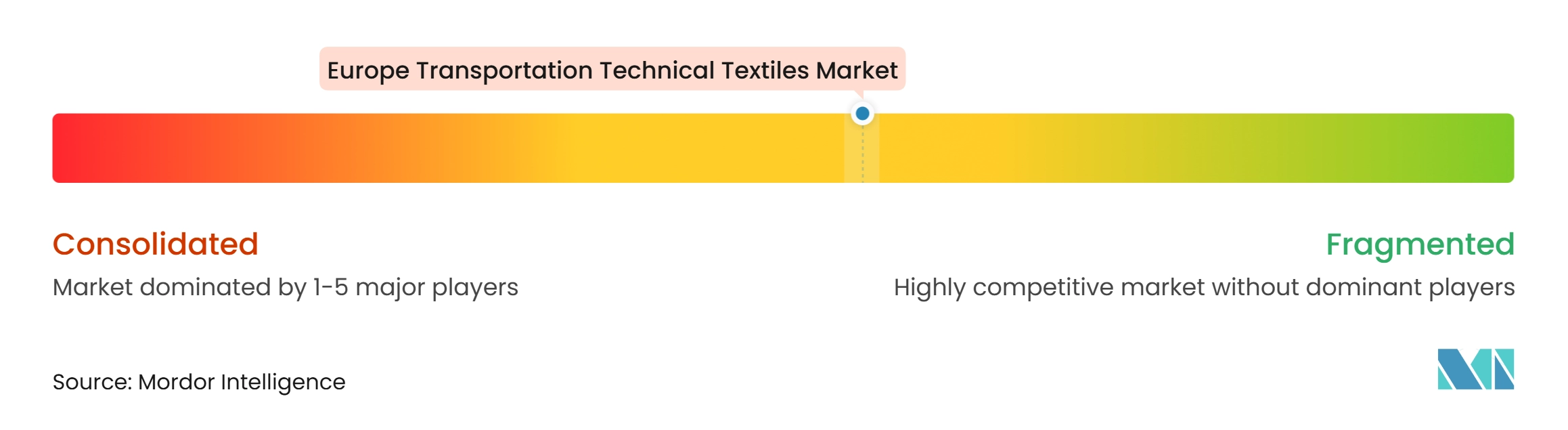
The Europe transportation technical textiles market exhibits a medium level of market concentration. Toray, Teijin, Hexcel, Solvay, and SGL Carbon have material capabilities in fibers, prepregs, and advanced composites. Autoneum, Freudenberg Performance Materials, Porcher Industries, SAERTEX, and Bcomp compete through application knowledge, OEM approval history, and specialized processing. Competitive advantage depends on verified recycled content, fire safety performance, application engineering, and efficient manufacturing. Railway EN 45545 and aerospace EASA CS 25.853 requirements raise the importance of test evidence and certification. Companies that already have approved materials can benefit from long customer qualification cycles. This structure supports durable positions for established suppliers while leaving openings in specialized applications.
Freudenberg acquired the remaining 25% stake in Japan Vilene Company in December 2025, strengthening its nonwoven capabilities across automotive, medical, and filtration applications. Autoneum launched its E-Fiber mica-free flame shields in March 2025 for electric vehicle battery protection. Hexcel and Arkema used the Paris Air Show in 2025 to present thermoplastic composite developments intended to reduce production-cycle time. These actions show that scale, material performance, and manufacturing efficiency are being pursued at the same time. Strategic investment is focused on applications where safety, weight, and circularity are measurable customer requirements. Suppliers are also using industry associations and policy engagement to seek clarity on carbon fiber and end-of-life vehicle regulation.
Smaller companies can compete where a specialized material provides a direct solution to a customer problem. Bcomp’s natural fiber reinforcement platform is one example of an alternative to conventional synthetic reinforcements for selected interior and panel applications. Mica-free battery fire barriers, circular mono-material polyester interiors, and PFAS-free coatings also represent areas where technical differentiation can matter. Digital process control, automated fiber placement, and thermoplastic processing can reduce production time and energy use. These capabilities can raise entry barriers because they require equipment, process knowledge, and customer validation. Lower-cost regional production alone may not be sufficient where safety requirements are strict. The competitive environment is therefore shaped by a balance between scale in upstream materials and narrow expertise in application-specific components. Suppliers that connect material science with approved vehicle, rail, or aerospace programs are likely to retain stronger positions.
Europe Transportation Technical Textiles Industry Leaders
-
Autoneum Holding AG
-
Freudenberg Performance Materials SE & Co. KG
-
Lear Corporation
-
Porcher Industries
-
SAERTEX GmbH & Co. KG
- *Disclaimer: Major Players sorted in no particular order
Europe Transportation Technical Textiles Market Companies Covered in this Report
- Autoneum Holding AG
- Freudenberg Performance Materials SE & Co. KG
- Lear Corporation
- Porcher Industries
- SAERTEX GmbH & Co. KG
- Trelleborg AB
- HÜBNER Group
- SGL Carbon SE
- Toray Industries, Inc.
- Teijin Limited
- Solvay SA
- Hexcel Corporation
- DuPont de Nemours, Inc.
- Ahlstrom Oyj
- Fibertex Personal Care A/S
- Fibertex Nonwovens A/S
- Sandler AG
- TWE Group GmbH
- DIATEX SAS
- Heathcoat Fabrics Limited
- HUESKER Synthetic GmbH
- Sioen Industries NV
- Bcomp Ltd.
- Microtex Composites S.r.l.
Recent Industry Developments in Europe Transportation Technical Textiles Market
- March 2026: Toray Carbon Fibers Europe completes capacity expansion at Abidos, France. A new carbon fiber production unit was commissioned, lifting European output to more than 6,000 tons per year. The expansion reinforces the European supply base for aerospace and automotive composite programs amid OEM demand for supply chain resilience.
- September 2025: Autoneum secures OEM orders for Ultra-Silent Frunk from three major vehicle manufacturers. Series production for two battery-electric vehicle models started in China and Germany in 2025. The all-polyester frunk system incorporates up to 70% recycled content and delivers significant weight reduction versus plastic alternatives.
- July 2025: European Commission allocates EUR 2.8 billion (USD 3.3 billion) in CEF grants for 94 transport projects, with 77% directed to rail. Funded projects include Rail Baltica construction, ERTMS rollout in 11 member states, and high-speed corridor development in Czechia and Poland. The grant cycle materially advances near-term rail rolling stock procurement volumes across Europe.
Europe Transportation Technical Textiles Market Report Scope
The Europe Transportation Technical Textile Market Report is Segmented by Product Type (Passenger Safety and Restraint Textiles, Transportation Interior and Upholstery Textiles, and More), by Material Type (Polyester (PET), Polyamide (Nylon), and More), by Transportation Mode (Road Transportation, Aerospace and Aviation, and More), and by Geography (Germany, and More). The Market Forecasts are Provided in Terms of Value (USD).
Segmentation Overview
| Passenger Safety and Restraint Textiles | Automotive Airbag Fabrics and Textile Cushions |
| Seat Belt Webbing | |
| Other Transportation Safety and Restraint Textiles | |
| Transportation Interior and Upholstery Textiles | Seat Upholstery and Seating Fabrics |
| Automotive and Transportation Carpets | |
| Other Transportation Interior Textiles (Headliner, Window-Shading, etc.) | |
| Tyre and Rubber Reinforcement Textiles | |
| Acoustic, Thermal and Protective Insulation Textiles | |
| Transportation Filtration and Air Management Textiles | |
| Structural and Composite Reinforcement Textiles (carbon fiber, glass fiber reinforcement fabric, etc.) | |
| Transportation Exterior and Protective Textiles | |
| Other Transportation Technical Textiles |
| Polyester (PET) |
| Polyamide (Nylon) |
| Polypropylene (PP) |
| Polyethylene (PE) |
| Glass Fibers |
| Carbon Fibers |
| Aramid and Other High-Performance Synthetic Fibers |
| Natural and Regenerated Fibers |
| Other Specialty Fibers and Materials |
| Road Transportation | Passenger Cars | Internal Combustion Engine and Hybrid Passenger Cars |
| Battery Electric Passenger Cars | ||
| Commercial Vehicles | ||
| Two-Wheelers, Three-Wheelers and Other Road Vehicles | ||
| Aerospace and Aviation | Commercial and Business Aircraft | |
| Military Aircraft and Helicopters | ||
| Spacecraft and Other Aerospace Platforms | ||
| Rail Transportation | ||
| Marine Transportation | Commercial and Cargo Vessels | |
| Passenger, Cruise Vessels, Recreational and Other Marine Vessels | ||
| Other Specialized Transportation Platforms |
| United Kingdom |
| Germany |
| France |
| Italy |
| Spain |
| BENELUX (Belgium, Netherlands, and Luxembourg) |
| NORDICS (Denmark, Finland, Iceland, Norway, and Sweden) |
| Rest of Europe |
| By Product Type | Passenger Safety and Restraint Textiles | Automotive Airbag Fabrics and Textile Cushions | |
| Seat Belt Webbing | |||
| Other Transportation Safety and Restraint Textiles | |||
| Transportation Interior and Upholstery Textiles | Seat Upholstery and Seating Fabrics | ||
| Automotive and Transportation Carpets | |||
| Other Transportation Interior Textiles (Headliner, Window-Shading, etc.) | |||
| Tyre and Rubber Reinforcement Textiles | |||
| Acoustic, Thermal and Protective Insulation Textiles | |||
| Transportation Filtration and Air Management Textiles | |||
| Structural and Composite Reinforcement Textiles (carbon fiber, glass fiber reinforcement fabric, etc.) | |||
| Transportation Exterior and Protective Textiles | |||
| Other Transportation Technical Textiles | |||
| By Material Type | Polyester (PET) | ||
| Polyamide (Nylon) | |||
| Polypropylene (PP) | |||
| Polyethylene (PE) | |||
| Glass Fibers | |||
| Carbon Fibers | |||
| Aramid and Other High-Performance Synthetic Fibers | |||
| Natural and Regenerated Fibers | |||
| Other Specialty Fibers and Materials | |||
| By Transportation Mode | Road Transportation | Passenger Cars | Internal Combustion Engine and Hybrid Passenger Cars |
| Battery Electric Passenger Cars | |||
| Commercial Vehicles | |||
| Two-Wheelers, Three-Wheelers and Other Road Vehicles | |||
| Aerospace and Aviation | Commercial and Business Aircraft | ||
| Military Aircraft and Helicopters | |||
| Spacecraft and Other Aerospace Platforms | |||
| Rail Transportation | |||
| Marine Transportation | Commercial and Cargo Vessels | ||
| Passenger, Cruise Vessels, Recreational and Other Marine Vessels | |||
| Other Specialized Transportation Platforms | |||
| By Geography | United Kingdom | ||
| Germany | |||
| France | |||
| Italy | |||
| Spain | |||
| BENELUX (Belgium, Netherlands, and Luxembourg) | |||
| NORDICS (Denmark, Finland, Iceland, Norway, and Sweden) | |||
| Rest of Europe | |||
Key Questions Answered in the Report
What is the regional market size?
The Europe transportation technical textiles market is projected to expand from USD 14.03 billion in 2026 to USD 17.22 billion by 2032, at a 3.37% CAGR from 2027 to 2032.
Which product category leads transportation technical textiles in Europe?
Tire and rubber reinforcement textiles led with a 23% share in 2026, supported by Europe’s established tire manufacturing base.
Which material is growing fastest in European transportation textiles?
Carbon fibers are forecast to grow at a 6.5% CAGR through 2032, supported by aerospace and premium electric vehicle composite applications.
Why are electric vehicles increasing textile demand?
Electric vehicles need more acoustic insulation, thermal management materials, and battery fire-protection layers than comparable internal-combustion vehicles.
Which transportation mode has the highest growth outlook?
Aerospace and Aviation is forecast to grow at a 5.2% CAGR through 2032 because of composite-intensive aircraft programs and certified interior requirements.
Which European geography is growing fastest for transportation technical textiles?
The Rest of Europe is forecast to grow at a 4.8% CAGR through 2032, supported by expanding assembly activity and rail investment in Central and Eastern Europe.