
Europe Technical Textile Manufacturing Market Size and Share
Market Overview
| Study Period | 2021 - 2032 |
|---|---|
| Forecast Data Period | 2027 - 2032 |
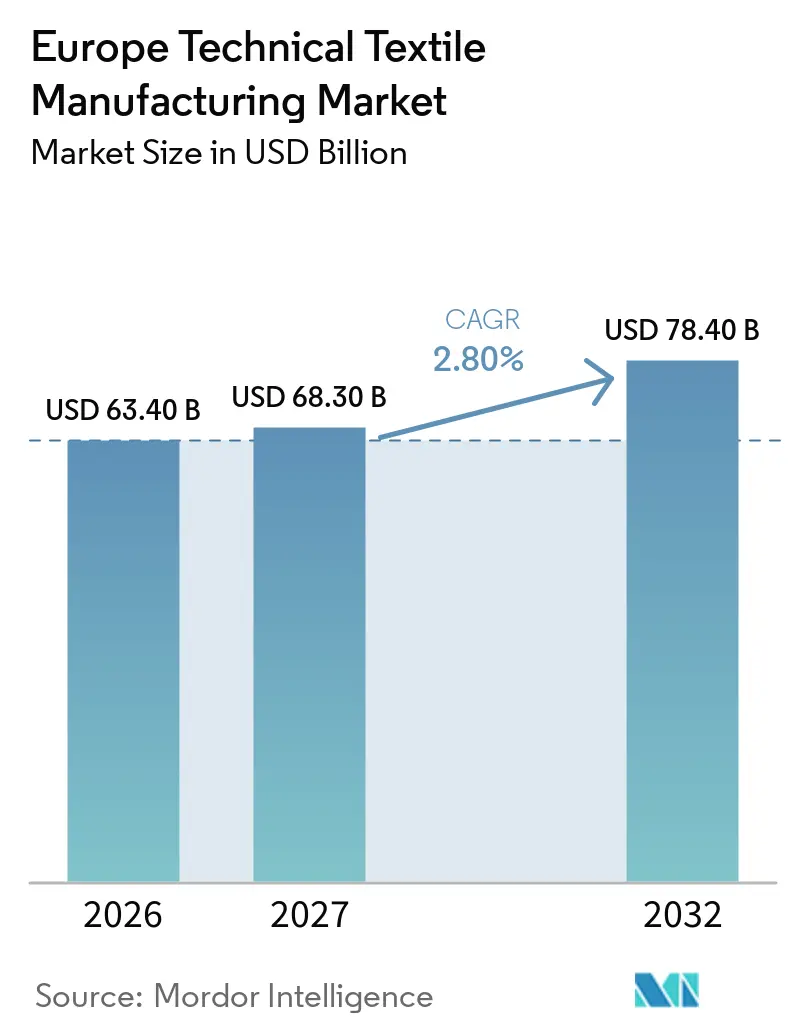
| Base Year Market Size (2026) | USD 63.40 Billion |
| Market Size (2027) | USD 68.30 Billion |
| Market Size (2032) | USD 78.40 Billion |
| Growth Rate (2027 - 2032) | 2.80 % |
| Market Concentration | Medium |
Major Players *Disclaimer: Major Players sorted in no particular order Image © Mordor Intelligence. Reuse requires attribution under CC BY 4.0. | |
Europe Technical Textile Manufacturing Market Analysis by Mordor Intelligence
The Europe Technical Textile Manufacturing Market size is projected to be USD 63.40 billion in 2026, USD 68.30 billion in 2027, and reach USD 78.40 billion by 2032, growing at a CAGR of 2.80% from 2027 to 2032.
The Europe technical textile manufacturing market is moving away from commodity output toward engineered materials that serve mobility, healthcare, infrastructure, and industrial uses. This shift gives producers more room to compete through certified performance, materials expertise, and specialized converting capabilities rather than price alone. Demand is also being shaped by the need for lightweight, durable, and high-performance materials that improve vehicle efficiency, strengthen construction applications, and meet stringent hygiene and filtration requirements. Automotive manufacturers are increasingly focused on textiles used in acoustic insulation, interior components, reinforcement, and composite structures. At the same time, healthcare providers require reliable materials for protective apparel, surgical products, and wound-care applications. Investment in transport networks, healthcare procurement, and circular material systems is expected to sustain demand across several end uses. In addition, European sustainability requirements are encouraging manufacturers to explore recycled fibers, bio-based inputs, lower-impact production processes, and designs that improve material recovery at the end of a product's life. Collaboration between textile manufacturers, research institutions, and end users is becoming important for developing application-specific materials and accelerating the commercialization of advanced textile technologies.
Key Report Takeaways
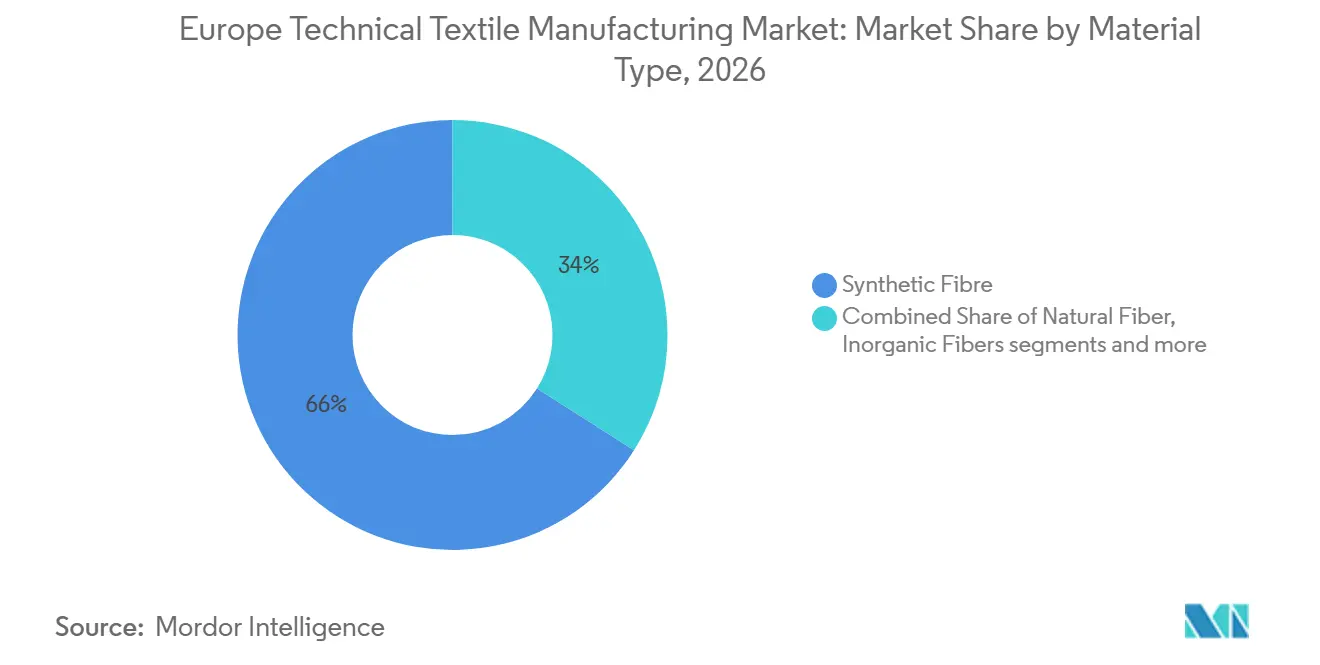
- By material type, synthetic fibers held a 66% of the Europe technical textile manufacturing market share in 2026, while others are forecast to grow at a 5% CAGR through 2032.
- By form and structure, nonwoven fabrics accounted for 36% of the Europe technical textile manufacturing market size in 2026, while other engineered textile structures are forecast to grow at a 3.5% CAGR through 2032.
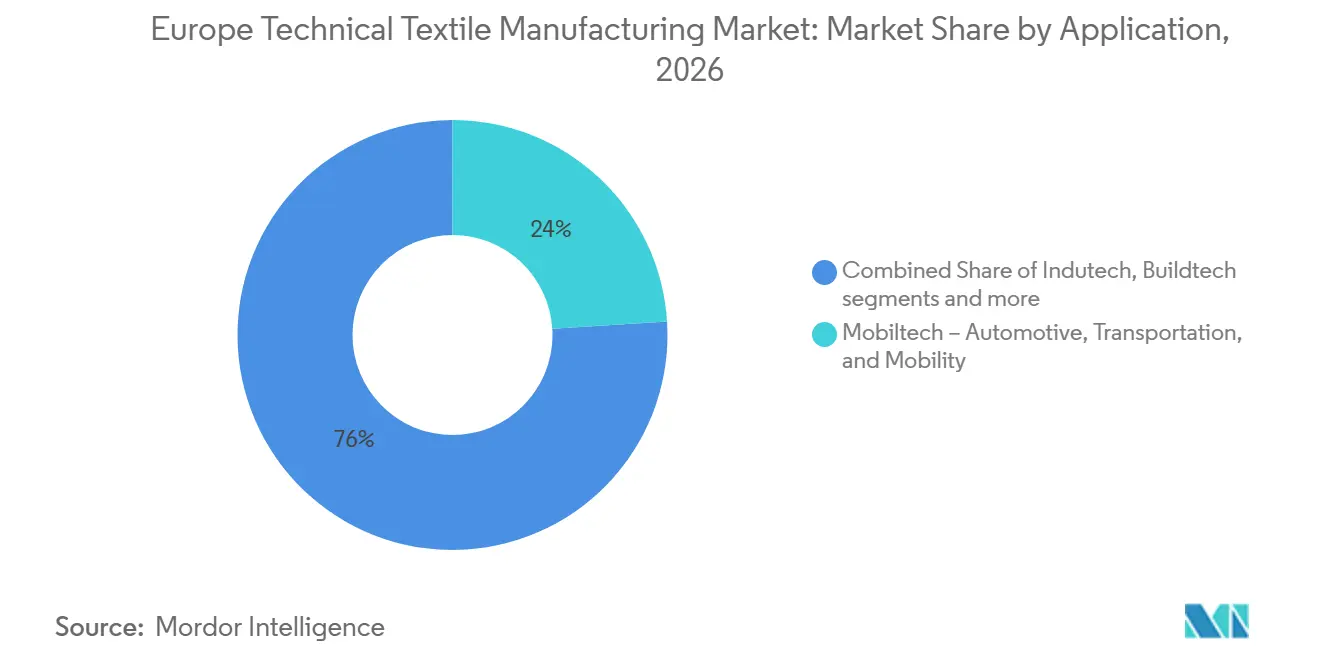
- By application, mobiltech held a 24% revenue share in 2026, while medtech is forecast to grow at a 4.5% CAGR through 2032.
- By geography, Italy held a 26% revenue share in 2026, while the Rest of Europe is forecast to grow at a 4.8% CAGR through 2032.
Note: Market numbers in this report are based on Mordor Intelligence's proprietary estimation framework, which combines nine months of actuals with Q4 projections for base year 2026.
Market Trends and Insights
Drivers Impact Analysis of Europe Technical Textile Manufacturing Market*
| Driver | (~) % Impact on CAGR Forecast | Geographic Relevance | Impact Timeline |
|---|---|---|---|
| Automotive Lightweighting and Electric Vehicle Interior Demand | +0.8% | Germany, France, Italy, BENELUX | Short term (≤ 2 years) |
| EU Circularity Rules and Mandatory Textile Waste Collection | +0.6% | EU-27, led by Germany, the Netherlands, and France | Medium term (2-4 years) |
| Geotextiles for Rail, Road, and Green Infrastructure Investment | +0.5% | Pan-European, CEE, NORDICS, Iberian Peninsula | Medium term (2-4 years) |
| Medical Barrier Fabrics and Structured Healthcare Procurement | +0.4% | Germany, United Kingdom, France, NORDICS, Spain | Short term (≤ 2 years) |
| Digital Product Passports and Traceable Material Flows | +0.3% | EU-27, early movers in Germany, the Netherlands | Long term (≥ 4 years) |
| European Technical Textile Clusters and Advanced Fiber Innovation | +0.2% | Germany, France, Italy, Belgium, the Czech Republic | Long term (≥ 4 years) |
| Source: Mordor Intelligence | |||
Automotive Lightweighting and Electric Vehicle Interior Demand
The Europe technical textile manufacturing market benefits from vehicle programs that require thermal management, acoustic control, and lightweight structural materials. Battery safety requirements raise demand for nonwovens with certified fire resistance, which conventional trim textiles cannot meet. This requirement shifts procurement toward fabrics with tested performance and documented material properties. In October 2025, the European Investment Bank provided Freudenberg with a EUR 100 million (USD 117.6 million) loan supporting a EUR 214 million (USD 251.7 million) research and development program for mobility materials and advanced nonwovens.[1] The financing supports development work in a category where automotive customers are tightening technical specifications. This positioning strengthens the Europe technical textile manufacturing market in higher-value vehicle applications.
EU Circularity Rules and Mandatory Textile Waste Collection
Separate collection of textile waste became mandatory on January 1, 2025, changing textile recovery from a voluntary activity into a formal supply-chain requirement.[2] Directive (EU) 2025/1892 entered into force on October 16, 2025, and requires member states to establish extended producer responsibility schemes by April 2028. The directive sets collection targets of 50% by 2030 and 70% by 2035. A more formal collection system can improve the availability and traceability of recovered feedstock for the Europe technical textile manufacturing market. An environmental study published by the Commission in June 2025 found that higher textile-to-textile recycling rates can reduce greenhouse gas emissions. However, coordinated policy support remains necessary for commercial scale. Producers that secure suitable recycled inputs can reduce exposure to volatile virgin-fiber costs over time.
Geotextiles for Rail, Road, and Green Infrastructure Investment
Transport investment is creating a clear demand base for geotextiles used in stabilization, erosion control, drainage, and railway construction. The Connecting Europe Facility Transport program committed EUR 2.8 billion (USD 3.3 billion) to 94 projects in July 2025. Rail projects received 77% of that allocation, which supports applications that require needle-punched nonwoven products. Regulation (EU) 2024/1679 sets 2030 for completion of the core TEN-T network and 2040 for the extended core network. These dates provide longer planning visibility than a single public works cycle. The Europe technical textile manufacturing market can therefore draw demand from infrastructure programs that continue beyond the current forecast period.
Medical Barrier Fabrics and Structured Healthcare Procurement
Hospital procurement is supporting demand for medical barrier fabrics that meet strict performance and traceability requirements. Spain issued EUR 12.2 million (USD 14.4 million) in surgical textile tenders during 2025, while Sweden established a framework covering 26 product groups for reusable and single-use barrier fabrics. EN 13795 governs surgical drapes, gowns, and clean-air suits, while ISO 16604 addresses viral-barrier performance. These requirements limit the role of suppliers who cannot demonstrate consistent barrier protection. Reusable surgical textiles must maintain barrier integrity through 75 to 100 autoclave cycles. The Europe technical textile manufacturing market can benefit as healthcare buyers evaluate lifecycle cost and place greater value on durable, certified reusable materials.
Restraints Impact Analysis of Europe Technical Textile Manufacturing Market*
| Restraint | (~) % Impact on CAGR Forecast | Geographic Relevance | Impact Timeline |
|---|---|---|---|
| Energy Intensive Dyeing, Coating, and Finishing Costs | -0.5% | Italy, Spain, Poland, and the Czech Republic | Short term (≤ 2 years) |
| Advanced Recycling and Sorting Capital Requirements | -0.4% | EU-27, Southern and Eastern Europe | Medium term (2-4 years) |
| Shortage of Skilled Technical Textile Labor | -0.3% | France, Germany, Italy, Spain | Short term (≤ 2 years) |
| PFAS Substitution and Functional Performance Trade Offs | -0.2% | Germany, Netherlands, France, NORDICS | Long term (≥ 4 years) |
| Source: Mordor Intelligence | |||
Energy Intensive Dyeing, Coating, and Finishing Costs
Dyeing, coating, and finishing operations remain exposed to high energy use and rising compliance costs. The European Environment Agency identifies textiles as the fifth-largest source of greenhouse gas emissions within EU manufacturing.[3] Facilities in Italy, Spain, Poland, and the Czech Republic are particularly exposed, where finishing activity forms a large part of local production. Obligations under the EU Energy Efficiency Directive add costs that process optimization alone may not offset. Smaller converters may lack sufficient capital for electrified or heat-pump-based equipment. This can widen the competitive gap within the Europe technical textile manufacturing market between specialized firms with investment capacity and firms that rely on older finishing assets.
Advanced Recycling and Sorting Capital Requirements
Textile fiber-to-fiber recycling in Europe remains below 1%, indicating that collection and sorting systems have not yet reached industrial scale. Sorting and chemical recycling facilities require capital that can be difficult for small and medium-sized producers to finance. Extended producer responsibility schemes are not required to be in place until April 2028, so early investors carry costs before related fee income becomes available. In October 2025, the EU Just Transition Fund awarded EUR 15 million (USD 17.6 million) to the Dutch SORTED consortium for AI-enabled textile sorting. The funding confirms public support, but access is uneven across regions. The Europe technical textile manufacturing market may therefore see circularity investments concentrate in areas with early public and private partnerships.
*Our forecasts treat driver/restraint impacts as directional, not additive. The impact forecasts reflect baseline growth, mix effects, and variable interactions.
Europe Technical Textile Manufacturing Market Segment Analysis
By Material Type:
Specialty and Conductive Fibers Gaining GroundSynthetic fibers held 66% of the Europe technical textile manufacturing market share in 2026, supported by their consistent mechanical properties and chemical resistance. Their compatibility with high-speed manufacturing also keeps them relevant across a broad range of technical end uses. The other category, which includes metallic, conductive, and specialty fibers, is forecast to grow at a 5% CAGR through 2032. Demand comes from smart textiles used in automotive sensing, defense, and wearable medical diagnostics. These applications require material functions that standard synthetic and natural fibers do not always provide. The Europe technical textile manufacturing market is therefore gaining value from applications that combine fabric structure with electrical, sensing, or protective properties. Natural fibers, especially flax and hemp, are finding interest in electric-vehicle interior biocomposites. Their use can support lower weight and verified bio-based content claims for vehicle makers.
Regenerated fibers such as lyocell and viscose are gaining relevance in hygiene and medical nonwovens. In September 2025, Lenzing refined its strategy and emphasized nonwoven applications as part of its response to a challenging operating environment. Inorganic fibers, mainly glass and basalt, remain important for composite reinforcement and building insulation. Their position is linked to construction applications that require thermal performance and structural durability. In November 2025, Lenzing announced a EUR 15 million (USD 17.6 million) expansion of VEOCEL Viscostar capacity for hygiene applications. The investment shows continued supplier interest in certified materials for hygiene and healthcare converters. High-performance fibers with recycled or bio-based content can address sustainability requirements while preserving technical performance. This creates room for premium materials across the Europe technical textile manufacturing market.

By Form and Structure:
Nonwovens Lead, Composite Structures DiversifyNonwoven fabrics held 36% of the Europe technical textile manufacturing market share in 2026, making them the largest form and structure category. Their converting efficiency supports use in hygiene, filtration, medical barriers, and geotextiles. Woven technical fabrics retain an important role where sustained tension and dimensional stability are required. Architectural membranes, industrial filtration, and sailcloth continue to rely on woven constructions for these reasons. Knitted fabrics serve specialized compression and sports-performance uses. Braided structures support offshore mooring, ropes, and composite preforms where controlled fiber orientation is important. In April 2025, Freudenberg Performance Materials introduced fine-filament spunbond nonwovens for filtration and medical applications. The launch shows ongoing product development in the largest structure category.
Other engineered textile structures are forecast to grow at a 3.5% CAGR through 2032. Their use is concentrated in wind-turbine blades, overhead conductors, maritime structures, and other composite applications. These applications justify higher material costs when strength and weight performance are decisive. In June 2025, Ahlstrom completed a Turin production unit for advanced molecular filtration media used in air and liquid filtration. The other category includes multi-axial structures, 3D woven preforms, and hybrid designs for aerospace and sporting goods. These products serve specifications that standard commercial fabric structures cannot meet. Higher-value specialty structures can help the Europe technical textile manufacturing market maintain revenue growth when commodity volumes are under pressure. The mix broadens the range of materials available to converters and end users across the Europe technical textile manufacturing market.
By Application:
Medtech Rising as Mobiltech ConsolidatesMobiltech held a 24% revenue share in 2026, making it the largest application category. The category covers automotive, rail, aerospace, and marine applications. Its size reflects established transport-textile supply chains in Germany, France, Italy, and BENELUX. The need for safety, lightweighting, acoustic control, and durable interior materials shapes demand. Vehicle production volumes remain relevant, but performance requirements increasingly determine material value. The Europe technical textile manufacturing market size for Mobiltech is supported by applications that require engineering validation and long qualification periods. This can limit direct substitution by lower-cost general textile products. The category remains central to the Europe technical textile manufacturing market despite moderating vehicle-output growth.
Medtech is forecast to grow at a 4.5% CAGR through 2032, the highest rate among application categories. Aging populations, structured public procurement, and greater use of reusable surgical textiles support this outlook. Multi-year healthcare contracts can reduce demand volatility for suppliers that meet certification and traceability requirements. Buildtech and Geotech benefit from transport infrastructure and construction programs that support geotextiles and architectural membranes. Indutech continues to support industrial filtration, conveyor systems, and process textiles. Protech is linked to personal protective equipment and high-visibility workwear that must meet protection requirements. Agrotech serves water-stressed farming areas through mulches and irrigation fabrics. Other applications include sport, home, and bio-packaging materials, which extend the Europe technical textile manufacturing market into smaller, specialized uses.
Geography Analysis
Europe Technical Textile Manufacturing Market
Italy held a 26% revenue share in 2026, supported by integrated clusters in Lombardy and Veneto. These clusters link specialty weaving, precision coating, and technical finishing within concentrated supply networks. Germany remains an important center for research, development, nonwovens, and performance materials. Freudenberg reported EUR 11.7 billion (USD 13.8 billion) in group revenue for 2025 and announced EUR 200 million (USD 235.3 million) in AI-enabled research and development commitments through 2028. France is a major production location with demand linked to transport applications, including automotive and aerospace. The country is also building circular-material capacity. Circ announced a EUR 450 million (USD 529.3 million) recycling facility in Saint-Avold that is expected to process 70,000 tonnes of cotton-polyester blended waste annually from 2028. These markets combine established conversion skills with growing interest in circular supply chains across the Europe technical textile manufacturing market.
United Kingdom, Spain, BENELUX and Nordics Technical Textile Manufacturing Market
The United Kingdom retains a focused base of technical yarn and technical textile producers. Supply-chain changes have directed part of this base toward defense procurement and exports outside the European Union. Spain has a strong nonwoven base and a growing medical-textile capability. Its EUR 12.2 million (USD 14.4 million) surgical-textile tenders in 2025 show the role of public healthcare purchasing. BENELUX has strategic importance in circular textile logistics and material recovery. The Dutch SORTED project received EUR 15 million (USD 17.6 million) in October 2025 to improve the quality of sorted post-consumer textile feedstock. The NORDICS provide a high-value outlet for certified medical and protective materials. These procurement patterns shape the Europe technical textile manufacturing market, as shown by Sweden's 2025 healthcare framework for 26 product groups.
Central and Eastern Europe Technical Textile Manufacturing Market
The rest of Europe is forecast to grow at a 4.8% CAGR through 2032, the highest rate among geographic segments. Central and Eastern European producers are expanding capacity for domestic infrastructure projects and Western European customers. Poland, the Czech Republic, and Hungary can benefit from rail and road construction under the Connecting Europe Facility. The program's project funding offers a demand base for regional geotextile producers. Portugal and Spain are using industrial incentives and Just Transition Fund access to improve finishing capacity. This supports movement into medical and technical-apparel applications. Western European principals also use regional sites to keep cost-sensitive production inside European supply chains. These conditions support the faster growth outlook for the Europe technical textile manufacturing market across the rest of Europe.
Competitive Landscape
The Europe technical textile manufacturing market exhibits a medium level of market concentration. Large integrated groups compete across fiber production, nonwoven converting, coated fabrics, and performance materials. Smaller manufacturers remain important because many technical applications require local service, custom development, and specialized finishing. Competition is increasingly based on traceability, recycled content, material performance, and certification. Price remains relevant, particularly for standard nonwovens and energy-intensive products. However, technically specified applications give suppliers more opportunity to differentiate through product capability. The market structure, therefore, remains defined by a limited group of large participants alongside several hundred specialized small and medium-sized enterprises.
Indorama Ventures and Jiaren Chemical Recycling formed a joint venture in November 2025 to develop a global fiber-to-fiber chemical recycling platform. The move strengthens access to recycled PET feedstock before extended producer responsibility schemes become operational. Freudenberg Performance Materials launched PLA and wood-pulp wetlaid nonwovens without chemical binders in December 2025. The launch positions the company in biodegradable materials for hygiene, agricultural, and technical packaging uses. ANDRITZ also entered a collaboration with Tandem Repeat in October 2025 to develop and scale Procell cellulosic fiber technology for nonwoven applications. These actions are reshaping the Europe technical textile manufacturing market through circular inputs and bio-based materials alongside conventional performance fibers. Product traceability is also becoming more important as environmental product rules become more demanding.
The European technical textile manufacturing industry has open opportunities in bio-based inputs and advanced nonwoven converting. No company is reported to hold a firmly established scale position across those areas. This leaves room for new partnerships, targeted capacity investments, and specialized material development. In April 2025, Beaulieu International Group divested Beaulieu Technical Textiles to RCP. The transaction reflects continuing investor interest in technical textile assets. Energy costs and recycling-capital needs may encourage further consolidation among mid-sized converters. Firms with strong financing and proprietary technology can respond more easily to compliance and modernization demands. Firms without these advantages may remain dependent on narrower niches or customer-specific programs. The Europe technical textile manufacturing market will continue to reward companies that can combine performance, traceability, and dependable European supply.
Europe Technical Textile Manufacturing Industry Leaders
-
Freudenberg Performance Materials
-
Ahlstrom Oyj
-
Berry Global, Inc.
-
TWE Group GmbH
-
Beaulieu Technical Textiles
- *Disclaimer: Major Players sorted in no particular order
Europe Technical Textile Manufacturing Market Companies Covered in this Report
- Freudenberg Performance Materials
- Ahlstrom Oyj
- Berry Global, Inc.
- TWE Group GmbH
- Beaulieu Technical Textiles
- Low & Bonar
- Don & Low Ltd
- HUESKER Synthetic GmbH
- Thrace Group
- TenCate Protective Fabrics
- Lenzing AG
- Toray Industries, Inc.
- Teijin Aramid B.V.
- Asahi Kasei Corporation
- Mitsui Chemicals, Inc.
- DuPont de Nemours, Inc.
- 3M Company
- Kimberly-Clark Corporation
- Indorama Ventures Public Company Limited
- Polyvlies Franz Beyer GmbH
- Minet S.A.
- JUTA a.s.
- Tirotex Textile Company
- Fothergill Group
- Arville Textiles Ltd.
- James Dewhurst Limited
- Statex Produktions & Vertriebs GmbH
- Borgstena Group
- Edilfloor S.p.A.
- PFNonwovens a.s.
Recent Industry Developments in Europe Technical Textile Manufacturing Market
- November 2025: Indorama Ventures Fibers and Jiaren Chemical Recycling formed a double-digit-million-USD joint venture to establish a global fiber-to-fiber chemical-recycling platform, targeting closed-loop PET textile circularity at scale. The JV positions Indorama as a vertically integrated circular-inputs supplier well ahead of the EU's mandatory EPR compliance activation in April 2028.
- November 2025: Lenzing invested EUR 15 million (USD 17.6 million) to expand VEOCEL Viscostar lyocell capacity at its European sites, targeting the hygiene and medical-nonwoven market with certified-sustainable fiber. This follows Lenzing's September 2025 strategy refinement, explicitly shifting production emphasis from apparel-grade fiber toward nonwoven-grade applications.
- October 2025: The European Investment Bank extended a EUR 100 million (USD 117.6 million) loan to Freudenberg in support of a EUR 214 million (USD 251.7 million) research and development program covering EV-mobility materials and advanced nonwovens. This represents the largest announced public-private research and development co-financing event in European technical textiles during 2025.
Europe Technical Textile Manufacturing Market Report Scope
The Europe Technical Textile Manufacturing Market Report is Segmented by Material Type (Natural Fiber, Synthetic Fiber, Regenerated Fiber, Inorganic Fiber, Others), Form and Structure (Woven, Nonwoven, Knitted, Braided, Yarns, Others), Application (Mobiltech, Indutech, Buildtech, Medtech, Protech, Agrotech, Geotech, Packtech, Oekotech, Hometech, Clothtech, Sporttech), and Geography (United Kingdom, Germany, France, and More). The Market Forecasts are Provided in Terms of Value (USD).
Segmentation Overview
| Natural Fiber | Cotton |
| Jute | |
| Others - (Flex, Wool, Hemp, Coir, etc.) | |
| Synthetic Fiber | Polyester |
| Polyamide / Nylon | |
| Polypropylene | |
| Polyethylene / UHMWPE | |
| Aramid and Other Specialty Synthetic Fibers | |
| Regenerated Fiber - Viscose, Lyocell, and Modal | |
| Inorganic Fibers (Glass, Carbon, Basalt, etc.) | |
| Others (Metallic, Conductive, and Other Specialty Fibers) |
| Woven Technical Textiles |
| Nonwoven Technical Textiles |
| Knitted Technical Textiles |
| Braided Technical Textiles |
| Other Engineered Textile Structures (Technical Yarns, Cords, Rovings, etc.) |
| Mobiltech - Automotive, Transportation, and Mobility |
| Indutech - Industrial and Manufacturing Applications |
| Buildtech - Building and Construction |
| Medtech - Medical and Hygiene |
| Protech - Personal and Property Protection |
| Agrotech - Agriculture, Horticulture, Forestry, and Fishing |
| Geotech - Geotextiles and Civil Engineering |
| Packtech - Packaging and Containment |
| Oekotech - Environmental Protection |
| Hometech - Furniture, Floor Coverings, and Domestic Technical Applications |
| Clothtech - Functional Components for Clothing and Footwear |
| Sporttech - Sports and Leisure Applications |
| United Kingdom |
| Germany |
| France |
| Italy |
| Spain |
| BENELUX (Belgium, Netherlands, and Luxembourg) |
| NORDICS (Denmark, Finland, Iceland, Norway, and Sweden) |
| Rest of Europe |
| By Material Type | Natural Fiber | Cotton |
| Jute | ||
| Others - (Flex, Wool, Hemp, Coir, etc.) | ||
| Synthetic Fiber | Polyester | |
| Polyamide / Nylon | ||
| Polypropylene | ||
| Polyethylene / UHMWPE | ||
| Aramid and Other Specialty Synthetic Fibers | ||
| Regenerated Fiber - Viscose, Lyocell, and Modal | ||
| Inorganic Fibers (Glass, Carbon, Basalt, etc.) | ||
| Others (Metallic, Conductive, and Other Specialty Fibers) | ||
| By Form and Structure | Woven Technical Textiles | |
| Nonwoven Technical Textiles | ||
| Knitted Technical Textiles | ||
| Braided Technical Textiles | ||
| Other Engineered Textile Structures (Technical Yarns, Cords, Rovings, etc.) | ||
| By Application | Mobiltech - Automotive, Transportation, and Mobility | |
| Indutech - Industrial and Manufacturing Applications | ||
| Buildtech - Building and Construction | ||
| Medtech - Medical and Hygiene | ||
| Protech - Personal and Property Protection | ||
| Agrotech - Agriculture, Horticulture, Forestry, and Fishing | ||
| Geotech - Geotextiles and Civil Engineering | ||
| Packtech - Packaging and Containment | ||
| Oekotech - Environmental Protection | ||
| Hometech - Furniture, Floor Coverings, and Domestic Technical Applications | ||
| Clothtech - Functional Components for Clothing and Footwear | ||
| Sporttech - Sports and Leisure Applications | ||
| By Geography | United Kingdom | |
| Germany | ||
| France | ||
| Italy | ||
| Spain | ||
| BENELUX (Belgium, Netherlands, and Luxembourg) | ||
| NORDICS (Denmark, Finland, Iceland, Norway, and Sweden) | ||
| Rest of Europe | ||
Key Questions Answered in the Report
What is the forecast for Europe's technical textile manufacturing?
The Europe technical textile manufacturing market is projected to rise from USD 63.4 billion in 2026 to USD 78.4 billion by 2032, at a 2.8% CAGR from 2027 to 2032.
Which material type leads European technical textile production?
Synthetic fibers lead with a 66% share in 2026, supported by their engineering consistency, chemical resistance, and manufacturing compatibility.
Which application is growing fastest in technical textiles across Europe?
Medtech is expected to record a 4.5% CAGR through 2032, supported by healthcare procurement and demand for certified reusable barrier fabrics.
Why are geotextiles important for European manufacturers?
Rail, road, and green-infrastructure programs require geotextiles for stabilization, drainage, and erosion control, creating demand visibility beyond the forecast period.
What are the largest constraints facing technical textile producers?
Energy-intensive finishing, the capital requirements for recycling and sorting, labor shortages, and functional tradeoffs from PFAS substitution constrain producers.
Which region is forecast to grow fastest through 2032?
The rest of Europe is forecast to grow at a 4.8% CAGR, supported by Central and Eastern European manufacturing capacity and infrastructure demand.