
Europe Soil Monitoring Market Size and Share
Market Overview
| Study Period | 2021 - 2031 |
|---|---|
| Forecast Data Period | 2026 - 2031 |
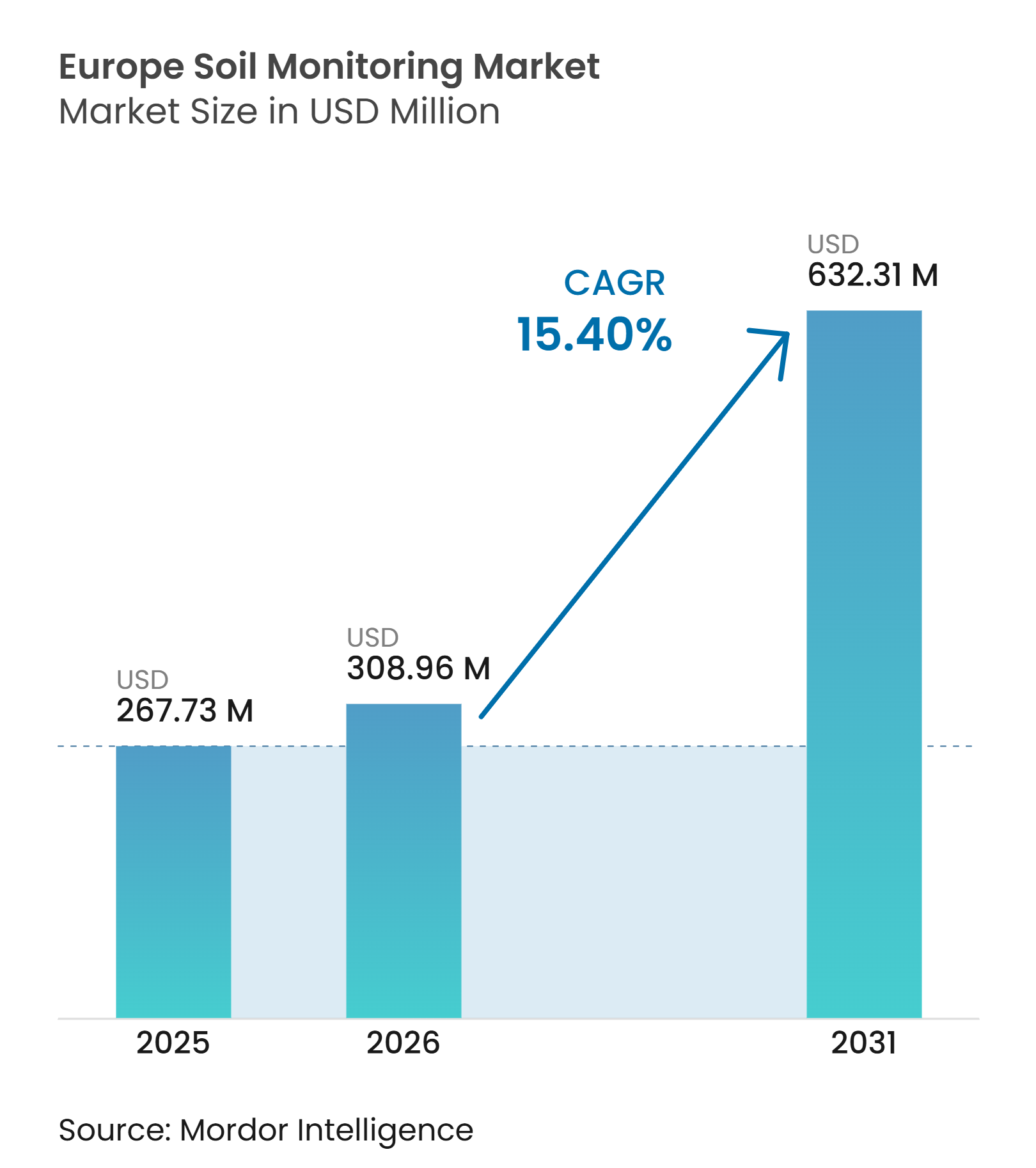
| Base Year Market Size (2025) | USD 267.73 Million |
| Market Size (2026) | USD 308.96 Million |
| Market Size (2031) | USD 632.31 Million |
| Growth Rate (2026 - 2031) | 15.40 % |
| Market Concentration | Medium |
Major Players *Disclaimer: Major Players sorted in no particular order Image © Mordor Intelligence. Reuse requires attribution under CC BY 4.0. | |
Europe Soil Monitoring Market Analysis by Mordor Intelligence
The Europe soil monitoring market was valued at USD 267.73 million in 2025 and is forecast to grow from USD 308.96 million in 2026 to USD 632.31 million by 2031, at a CAGR of 15.40% during the forecast period 2026-2031. The European Union (EU) Soil Monitoring Law, which entered into force in December 2025, establishes a common framework for systematic soil monitoring and assessment, with Member States required to transpose the Directive into national law by December 16, 2028, and submit their first implementation reports by December 16, 2031. This regulatory framework strengthens the role of systematic soil measurement and assessment for public agencies, laboratories, farms, and data providers. Common Agricultural Policy (CAP) eco-schemes covered 98.3 million hectares during the 2025 European Union budget year, increasing demand for verifiable records of soil management practices[1]. The market is shifting toward service contracts that combine measurement, calibration, data interpretation, and reporting. Smaller farms can avoid high upfront equipment costs when monitoring is delivered as a managed service, while suppliers can address data concerns through systems that keep farm information under local control.
Key Report Takeaways
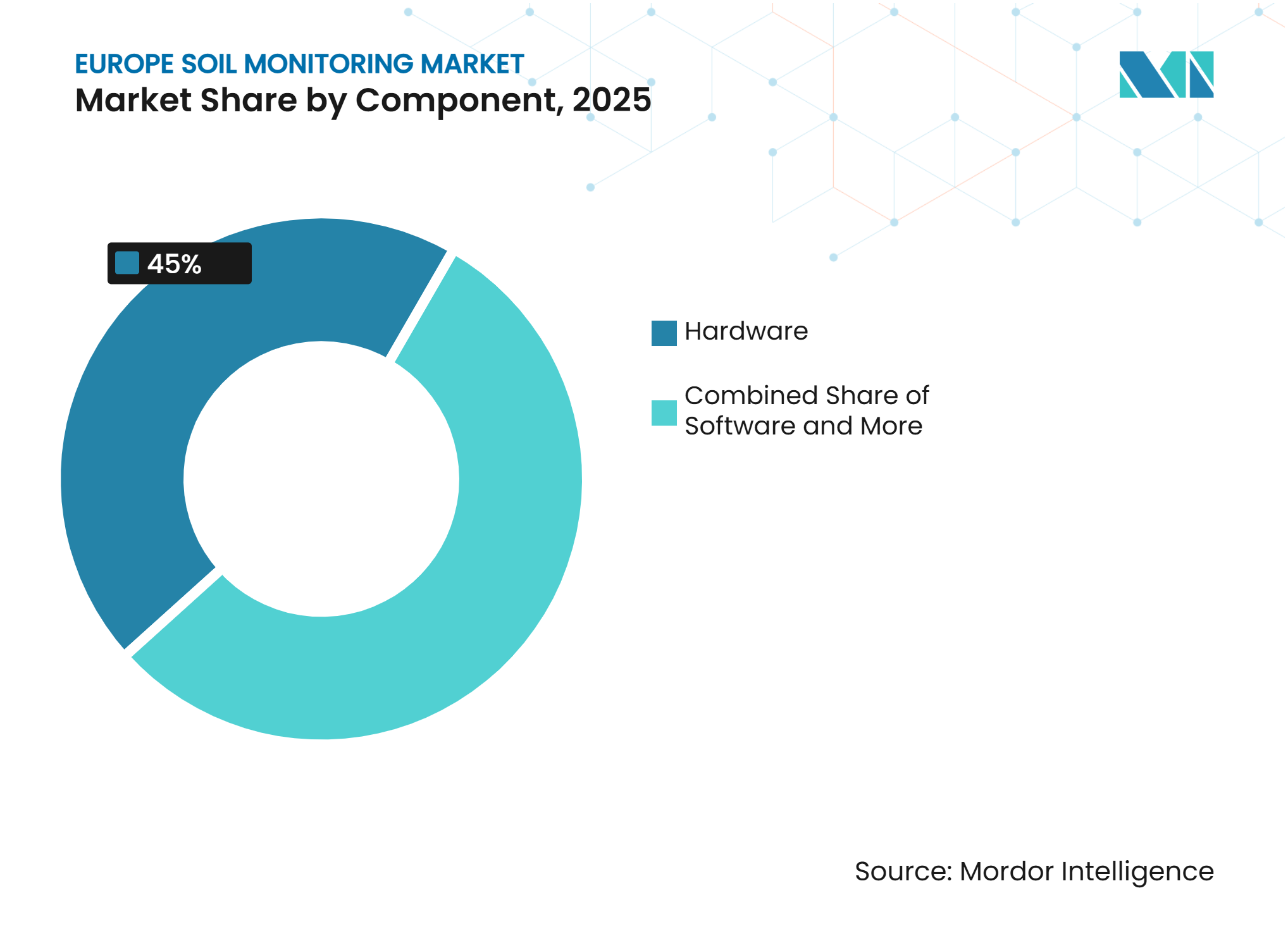
- By component, hardware was the largest segment and held 45.0% of the Europe soil monitoring market share in 2025, while services are the fastest-growing segment and are forecasted to expand at a 16.0% CAGR between 2026 and 2031.
- By product type, in-situ sensors were the largest segment and held 42.0% of the Europe soil monitoring market size in 2025, while remote-sensing platforms are the fastest-growing segment and are forecasted to expand at a 16.0% CAGR between 2026 and 2031.
- By connectivity technology, wireless was the largest segment and held 65.0% of the market share in 2025, while wireless is the fastest-growing segment and is forecasted to expand at a 15.0% CAGR between 2026 and 2031.
- By application, open field cultivation was the largest segment and held 47.0% of the market share in 2025, while protected cultivation is the fastest-growing segment and is forecasted to expand at a 15.0% CAGR between 2026 and 2031.
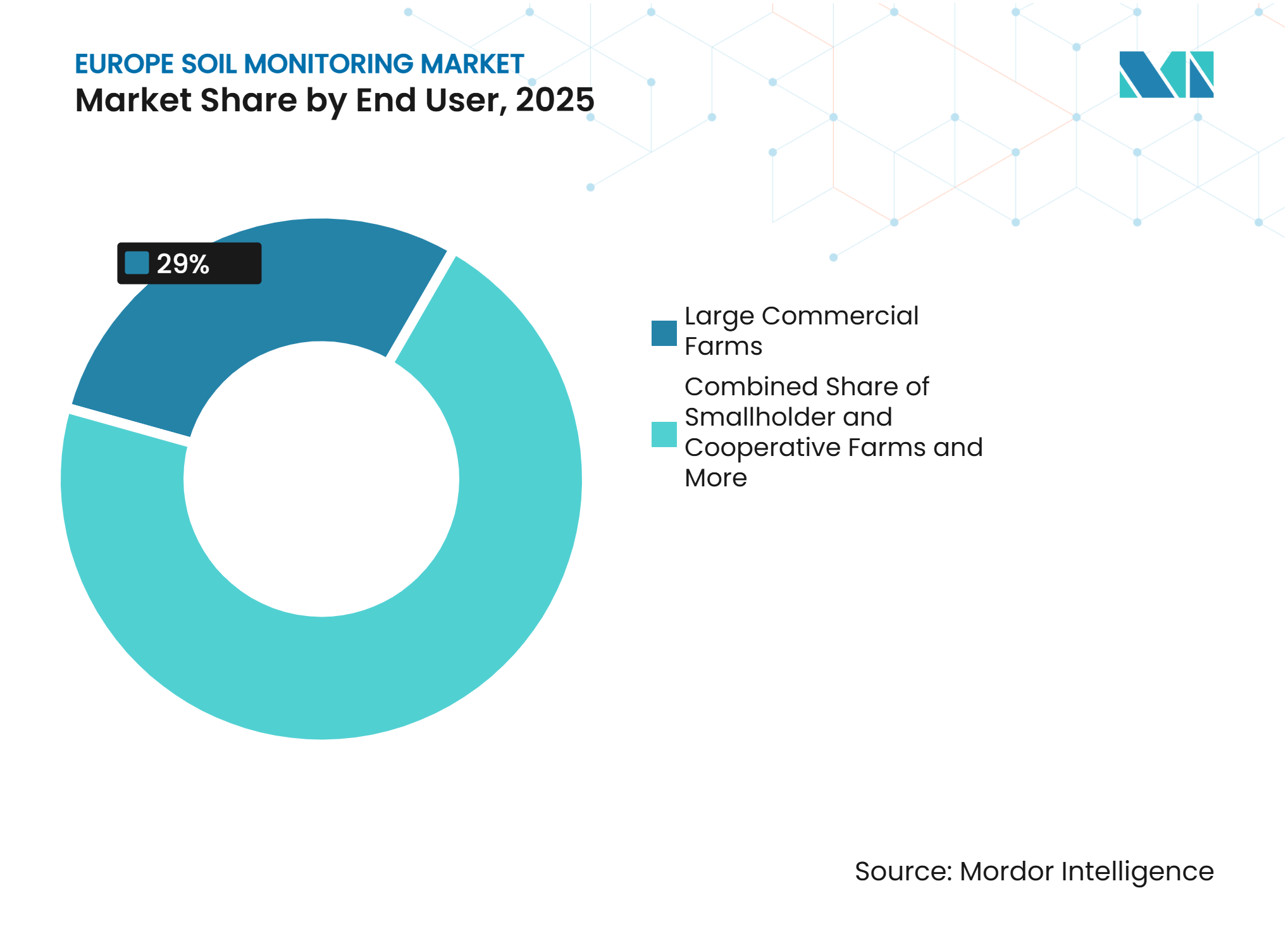
- By end user, large commercial farms were the largest segment and held 29.0% of the market share in 2025, while research institutes and universities are the fastest growing segment and are forecasted to expand at a 15.5% CAGR between 2026 and 2031.
Note: Market size and forecast figures in this report are generated using Mordor Intelligence’s proprietary estimation framework, updated with the latest available data and insights as of January 2026.
Market Trends and Insights
Drivers Impact Analysis of Europe Soil Monitoring Market*
| Driver | (~) % Impact on CAGR Forecast | Geographic Relevance | Impact Timeline |
|---|---|---|---|
| EU soil monitoring law creates recurring compliance demand | +3.5% | Germany, France, Italy, Spain, United Kingdom | Short term (≤ 2 years) |
| Precision agriculture adoption improves input efficiency | +2.8% | Germany, France, United Kingdom, Netherlands, Poland, Czech Republic | Medium term (2-4 years) |
| Cap eco-schemes encourage verifiable soil management | +2.2% | Germany, France, Italy, and Spain | Medium term (2-4 years) |
| Climate volatility increases demand for root-zone intelligence | +2.0% | Spain, Italy, France, Central Europe, and Eastern Europe | Short term (≤ 2 years) |
| Soil digital twins and remote sensing expand monitoring coverage | +1.8% | Europe, led by Germany, France, and Nordic countries | Long term (≥ 4 years) |
| Interoperable sensor networks enable cooperative-farm deployment | +1.6% | Germany, France, Netherlands, United Kingdom, Austria, and Denmark | Medium term (2-4 years) |
| Source: Mordor Intelligence | |||
EU Soil Monitoring Law Creates Recurring Compliance Demand
The European Union Soil Monitoring Law entered into force on 16 December 2025 and establishes a common framework for Member States to monitor and assess soil health across the European Union. Member States must transpose the Directive into national law by December 2028 and submit their first report on the implementation and assessment of soil health by December 2031. The framework addresses key soil threats and indicators, including erosion, loss of soil organic matter, salinization, contamination, compaction, sealing, and soil biodiversity. These requirements are anticipated to increase demand for soil sampling, laboratory analysis, monitoring technologies, and data-management systems as Member States establish monitoring and assessment programs. The Europe soil monitoring market can therefore benefit from recurring public-sector and institutional demand for tools and services that support standardized soil-health assessment, data collection, and reporting across different soil districts.
Precision Agriculture Adoption Improves Input Efficiency
The adoption of precision agriculture across Europe is increasing the need for accurate, field-level soil information to support more efficient farm management. The European Commission identifies precision agriculture, including sensor-based monitoring and targeted application of nutrients and other inputs, as a means of improving resource efficiency and reducing unnecessary input use. Soil monitoring provides information on parameters such as soil moisture, nutrient availability, organic matter, and other soil characteristics, enabling farmers to identify variations within and between fields and adjust fertilizer and irrigation applications accordingly. The growing integration of sensors, farm machinery, satellite data, and digital farm-management platforms is also increasing the value of interoperable soil datasets. As European agriculture moves toward more data-driven input management, demand for soil sensors, sampling technologies, analytical services, and digital platforms is anticipated to increase, supporting growth in the Europe soil monitoring market.
CAP Eco-Schemes Encourage Verifiable Soil Management
Common Agricultural Policy (CAP) eco-schemes and agri-environmental commitments are increasing the emphasis on sustainable soil-management practices across the European Union. A European Commission study published in November 2024 assessed 19 CAP Strategic Plans covering 18 Member States and estimated mitigation potential of up to 31 million metric tons of carbon dioxide equivalent per year. Eco-schemes accounted for 38% of this estimated mitigation potential, while voluntary soil-protection practices covered 47% of European Union farmland[2]. These measures increase the need for farmers and agricultural authorities to demonstrate and monitor environmental outcomes. Soil monitoring technologies can provide consistent measurements of parameters such as soil organic carbon, nutrient status, moisture, and other soil-health indicators, while digital platforms can maintain time- and location-specific records. As CAP support becomes increasingly linked to measurable environmental objectives, demand for soil monitoring, data collection, and reporting solutions is anticipated to increase, supporting growth in the Europe soil monitoring market.
Climate Volatility Increases Demand for Root-Zone Intelligence
Increasing climate variability and recurring drought conditions across parts of Southern Europe are raising the importance of accurate soil information for irrigation and crop-management decisions. Continuous monitoring of root-zone conditions can help farmers identify changes in soil moisture and other parameters and adjust irrigation according to actual field conditions rather than relying solely on fixed schedules. Advances in remote sensing are also improving the ability to derive soil information at larger spatial scales. A 2025 study published in Soil and Tillage Research found that combining multi-frequency synthetic aperture radar (SAR) data with optical data improved soil-property prediction compared with individual data sources. These developments support the integration of sensor measurements, remote sensing, and digital platforms to provide more comprehensive soil intelligence. As water availability becomes a more important constraint for agricultural production in drought-prone regions, the value of timely root-zone information is anticipated to increase, supporting demand for soil moisture sensors, remote-sensing solutions, and integrated soil monitoring platforms across the Europe soil monitoring market.
Restraints Impact Analysis of Europe Soil Monitoring Market*
| Restraint | (~) % Impact on CAGR Forecast | Geographic Relevance | Impact Timeline |
|---|---|---|---|
| Fragmented farm ownership lengthens payback periods | -1.8% | Italy, Spain, Eastern Europe, Greece, and Portugal | Long term (≥ 4 years) |
| Sensor calibration drift across diverse European soils | -1.2% | Germany, France, Italy, Spain, and the European Union | Medium term (2-4 years) |
| Incomplete interoperability across farm-data platforms | -1.0% | Germany, United Kingdom, France, and Netherlands | Medium term (2-4 years) |
| Data governance and liability concerns limit cross-platform sharing | -0.9% | Germany, United Kingdom, and France | Short term (≤ 2 years) |
| Source: Mordor Intelligence | |||
Fragmented Farm Ownership Lengthens Payback Periods
Small farms in Southern and Eastern Europe may not achieve a rapid return on investment from standalone sensor deployments. The European Union-funded SOILMONITOR project identified a long-term hardware target below EUR 500 per unit (USD 545), and stated that rapid returns at that price level were most achievable for high-value crops such as tomatoes and strawberries, according to the European Union Community Research and Development Information Service (EU CORDIS). Commodity grain farms can face payback periods of more than five years at current hardware prices. This limits individual purchases in Italy, Spain, and much of Eastern Europe. Cooperative procurement has begun to widen access in France and Germany, but participation varies across countries. Where farm size and local cooperative structures make direct ownership difficult, the European soil monitoring market is likely to rely more heavily on service-based pricing models.
Sensor Calibration Drift Across Diverse European Soils
Europe's diverse soil conditions create challenges for developing soil monitoring models and sensors that perform consistently across different environments. A 2024 study published in Geoderma and involving Wageningen University & Research developed a European soil organic carbon monitoring system using Sentinel-2 imagery and the Land Use and Coverage Area frame Survey (LUCAS) soil database. The study reported R² values of 0.41 for croplands and 0.28 for permanently vegetated areas at the continental scale, while accuracy reached 0.51 in Wallonia, Belgium, but was lower in Greece and the Czech Republic[3]. These differences demonstrate the challenges of applying soil-monitoring models across varying soil types, vegetation conditions, and field characteristics. In April 2025, the Leibniz Institute for Vegetable and Ornamental Crops (IGZ) began the BoDi project to develop high-resolution soil data from sensor measurements and support site-specific fertilizer-demand calculations, highlighting the need for localized soil information and calibration. Variations in sensor performance and model accuracy can increase calibration, validation, and maintenance requirements, raising the total cost of deploying soil monitoring systems. Consequently, the Europe soil monitoring market may continue to favor solutions that combine sensor technology with localized calibration, field validation, and data-management services.
*Our forecasts treat driver/restraint impacts as directional, not additive. The impact forecasts reflect baseline growth, mix effects, and variable interactions.
Europe Soil Monitoring Market Segment Analysis
By Component:
Services Expand Within a Hardware-Led Revenue MixHardware held 45.0% of the Europe soil monitoring market share in 2025, making it the largest component. Its leading position reflects spending on in-situ soil sensors, probes, data loggers, wireless gateways, and installation equipment required to establish monitoring infrastructure. The implementation of standardized soil monitoring across the European Union is anticipated to support demand for physical measurement equipment as Member States develop soil-health assessment systems. Hardware remains fundamental because it generates the field-level measurements required by software platforms, laboratories, farm-management systems, and reporting processes. Software represents another important component by converting sensor and sampling data into dashboards, analytical outputs, and decision-support tools for agricultural and institutional users. As soil monitoring programs become more structured, demand for integrated hardware and software solutions is anticipated to increase.
The Europe soil monitoring market for services is forecast to expand at a 16.0% CAGR between 2026 and 2031, representing the fastest growth among components. Services can include installation, calibration, maintenance, soil sampling, laboratory analysis, data interpretation, and reporting, allowing users to access monitoring capabilities without developing extensive in-house technical expertise. This model is particularly relevant where sensor performance requires site-specific calibration or where farms and public bodies need support in converting measurements into actionable soil-management information. In April 2026, CropX Technologies launched its Apex multi-depth soil sensor, which integrates with its digital agronomy platform and subscription-based services, illustrating the increasing integration of monitoring hardware with ongoing digital and agronomic support. As soil monitoring becomes more data-intensive and compliance-oriented, managed services and subscription-based models can generate recurring revenue while reducing the operational burden on users, supporting faster growth in the services segment.



By Product Type:
In-Situ Sensors Lead While Remote Sensing Gains UseIn-situ sensors accounted for 42.0% of the Europe soil monitoring market share by product type in 2025, making them the largest product category. Their leading position reflects the need for direct, localized measurements of soil conditions such as moisture, temperature, electrical conductivity, and other parameters at defined soil depths. Unlike satellite and aerial observations, in-situ systems provide continuous or repeated measurements at specific locations, making them important for irrigation management, soil-health assessment, research, and validation of broader monitoring models. Portable probes and field-testing equipment also allow agronomists, laboratories, and researchers to obtain site-specific measurements without installing permanent monitoring infrastructure. The continued requirement for both fixed and portable systems reflects differences in monitoring frequency, measurement depth, spatial coverage, and application requirements across European farms and institutional monitoring programs.
Remote-sensing platforms are forecast to expand at a 16.0% CAGR between 2026 and 2031, making them the fastest-growing product type. Satellite and aerial technologies can monitor large and geographically dispersed areas, helping identify spatial variations and locations requiring detailed field investigation without installing sensors throughout every monitored area. Their value increases when remote observations are combined with ground-based measurements that provide localized reference data and validation. In March 2025, the European Space Agency contracted the SaveCrops4EU project to develop a digital twin for European agricultural systems, incorporating field validation activities in Belgium, Germany, Hungary, and Spain. The project demonstrates the growing use of earth-observation and digital technologies to monitor agricultural conditions at scale. As European soil monitoring programs expand their geographic coverage, remote sensing is anticipated to complement rather than replace in-situ measurements, creating demand for integrated platforms that combine satellite observations, field sensors, and analytical tools.
By Connectivity Technology:
Wireless Connectivity Dominates and Drives Market GrowthWireless was the largest segment by connectivity technology, accounting for 65.0% of the Europe soil monitoring market share in 2025. Its leading position reflects the practicality of deploying wireless soil monitoring systems across agricultural fields, where wired communication infrastructure can be costly and difficult to install. Wireless technologies enable sensors distributed across multiple field locations to transmit soil data to centralized platforms, supporting continuous monitoring and reducing the need for manual data collection. Low-power wide-area network (LPWAN), cellular, and other wireless technologies are particularly suited to remote agricultural environments because they can support long-range communication and low-power sensor operation.
Wireless is also forecast to be the fastest-growing connectivity segment, expanding at a 15.0% CAGR between 2026 and 2031. The growth is supported by increasing deployment of connected soil sensors, IoT-enabled monitoring systems, and digital farm-management platforms that require reliable transmission of field-level data. Wireless connectivity also provides greater flexibility as monitoring networks expand across geographically dispersed fields and soil-monitoring locations. As European agriculture and institutional soil-monitoring programs increasingly integrate real-time data collection with cloud-based analytics and decision-support systems, demand for wireless connectivity solutions is anticipated to increase throughout the forecast period.
By Application:
Open Fields Lead and Protected Cultivation AdvancesOpen field cultivation accounted for 47.0% of the Europe soil monitoring market revenue by application in 2025, making it the largest segment. Its leading position is supported by the extensive area under cereal, oilseed, root crop, and other broad-acre production across Europe, where soil conditions can vary substantially across large fields. Soil monitoring enables farmers to track parameters such as moisture, nutrient status, temperature, and electrical conductivity to improve irrigation and fertilizer management and identify field-level variability. Open-field applications also require monitoring systems capable of operating across geographically dispersed locations and changing weather conditions. The implementation of the European Union Soil Monitoring Law is anticipated to further expand demand for standardized soil data and monitoring infrastructure, supporting the use of soil monitoring technologies across agricultural landscapes.
Protected cultivation is forecast to expand at a 15.0% CAGR between 2026 and 2031, making it the fastest-growing application segment. Greenhouses, polytunnels, and other controlled cultivation systems typically produce high-value crops under intensive management, increasing the economic value of accurate and frequent soil measurements. Monitoring soil moisture, nutrient availability, and other parameters can help growers optimize irrigation and fertilizer applications while maintaining crop productivity within controlled growing environments. The concentration of production and inputs within relatively small areas also makes sensor-based monitoring economically attractive. As European horticulture increasingly adopts digital and precision-management technologies, demand for high-frequency soil monitoring and data-driven crop-management solutions is anticipated to increase in protected cultivation.
By End User:
Commercial Farms Lead While Research Demand RisesLarge commercial farms accounted for 29.0% of the Europe soil monitoring market revenue in 2025, making them the largest end-user segment. Their larger cultivated areas allow monitoring costs to be distributed across more hectares, improving the economic case for investment in soil sensors, data platforms, and professional monitoring services. Commercial farms also tend to have greater access to precision agriculture equipment and digital farm-management systems, enabling soil data to be integrated into irrigation, fertilization, crop planning, and field-management decisions. The need to monitor soil conditions across large and spatially variable fields further supports the use of fixed sensors, connected monitoring systems, and data-driven advisory services. As European farms increasingly adopt precision-management practices and standardized soil-health monitoring, commercial farms are anticipated to remain a major source of demand for soil monitoring solutions.
Research institutes and universities are forecast to expand at a 15.5% CAGR between 2026 and 2031, making this the fastest-growing end-user segment. Research organizations require accurate and comparable soil measurements to evaluate soil properties, validate monitoring technologies, and develop models across different soil and climatic conditions. The increasing use of remote sensing, sensor networks, and digital soil models is creating additional demand for research-grade monitoring equipment and supporting analytical tools. Research projects can also contribute to the validation of technologies before wider commercial adoption by farms and agricultural service providers. As European soil-health initiatives and publicly funded research programs place greater emphasis on standardized soil data, research institutions are anticipated to generate increasing demand for specialized soil sensors, sampling equipment, analytical systems, and monitoring platforms.

Geography Analysis
Germany held the largest country share of the Europe soil monitoring market, accounting for 34.0% of market share in 2025. Its large agricultural base, established precision agriculture ecosystem, and advanced digital infrastructure support the adoption of soil monitoring technologies. Commercial farms can integrate soil measurements with farm machinery, farm-management software, and advisory systems to support irrigation, fertilization, and field-management decisions. The increasing integration of field data with digital agricultural platforms is also creating demand for connected monitoring solutions and interoperable data systems. In August 2026, Syngenta expanded its InterraScan soil-scanning service across Germany in collaboration with Agrolab and Smart Agro Solution, combining field scanning with laboratory analysis to provide detailed soil information. The United Kingdom also represents an established market for soil monitoring, supported by large arable farms, agricultural research institutions, and sustainability-oriented farm-management programs.
France is forecast to expand at a 15.0% CAGR between 2026 and 2031, making it the fastest-growing country among the European markets. The country's established digital agriculture ecosystem provides a foundation for connected soil monitoring technologies, while cooperative farming structures can facilitate access to shared equipment and data services among smaller farms. Increasing adoption of digital farm-management systems is anticipated to support the integration of soil measurements into irrigation, nutrient management, and crop-planning decisions. Italy and Spain also represent important markets, supported by intensive agricultural production and the need for efficient management of water and soil resources. In particular, irrigation requirements in parts of Southern Europe increase the relevance of soil moisture and root-zone monitoring technologies.
Other European markets provide additional growth opportunities as agricultural digitalization and soil-health initiatives expand. Poland and Romania have substantial arable land bases and can benefit from investments supported through the Common Agricultural Policy, while Scandinavian markets have demand for monitoring technologies linked to sustainable farm management and environmental measurement. Across Eastern Europe, increasing digitalization of agriculture and the development of national soil-monitoring frameworks are anticipated to support adoption over the forecast period.
Competitive Landscape
Market Concentration
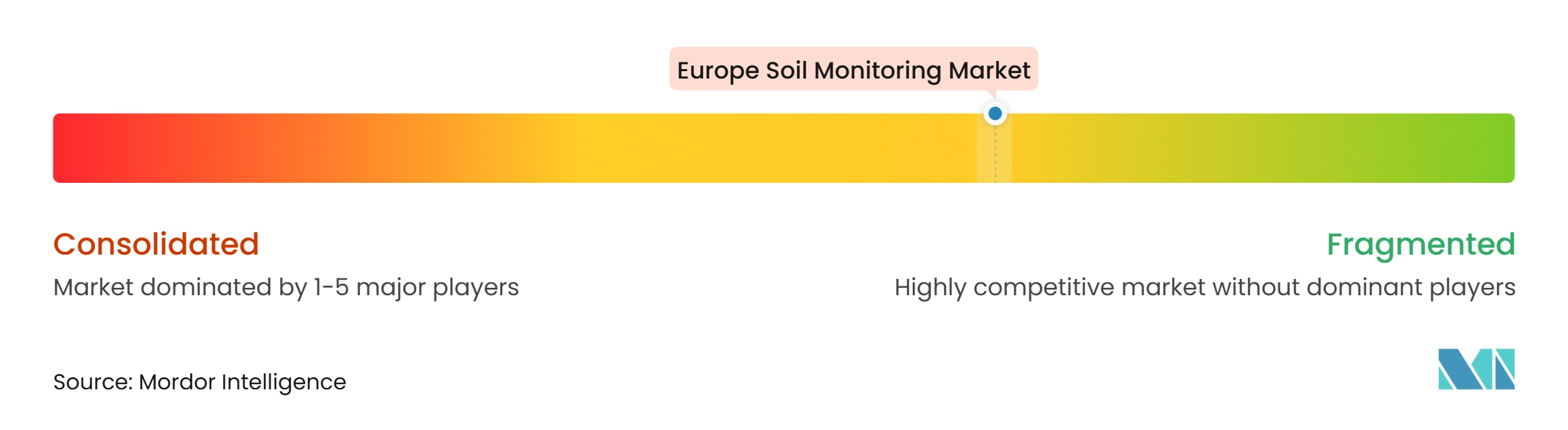
The Europe soil monitoring market is moderately fragmented, with the top five companies collectively holding a moderate share of the market in 2025. Major companies include METER Group, Inc., CropX Technologies, Inc., Sentek Technologies, Pessl Instruments GmbH, and SGS Société Générale de Surveillance SA. The remaining market is served by suppliers of sensing hardware, soil-testing equipment, data loggers, remote-sensing solutions, software platforms, laboratory analysis, and agronomic services, limiting the pricing power of any single supplier.
Players compete on sensing accuracy, monitoring depth, connectivity, data analytics, platform integration, and support services. In April 2026, CropX Technologies introduced its Apex multi-depth soil sensor, integrating high-resolution root-zone measurements with its digital agronomy platform and subscription-based services. The launch illustrates the shift toward combining monitoring hardware with recurring software and agronomic support. METER Group similarly competes through its portfolio of soil and environmental sensors and cloud-based data-management capabilities. In the Europe soil monitoring market, suppliers that combine reliable field measurements with analytics and practical farm-management workflows can differentiate beyond standalone sensor pricing.
In July 2026, Pessl Instruments expanded the connectivity capabilities of its METOS network through the 1NCE IoT platform, supporting cellular data transmission for connected monitoring equipment across multiple markets. In July 2026, Stenon raised EUR 18 million in Series B financing to scale its real-time soil measurement and data-management technology, highlighting investment in rapid, field-based soil analysis. The implementation of the EU Soil Monitoring Law is anticipated to further increase demand for standardized measurement, data management, and reporting capabilities. The Europe soil monitoring market remains open to players that combine accurate measurements with connected platforms, localized calibration, and compliance-oriented service delivery.
Europe Soil Monitoring Industry Leaders
-
METER Group, Inc.
-
CropX Technologies Ltd.
-
Sentek Technologies Pty Ltd
-
Pessl Instruments GmbH (Lindsay Corporation)
-
SGS Société Générale de Surveillance SA
- *Disclaimer: Major Players sorted in no particular order
Europe Soil Monitoring Market Companies Covered in this Report
- METER Group, Inc. (Campbell Group, Inc.)
- Sentek Technologies Pty Ltd
- CropX Technologies Ltd.
- SGS Société Générale de Surveillance SA
- Pessl Instruments GmbH (Lindsay Corporation)
- Soil Scout Oy
- Delta-T Devices Ltd
- Spectrum Technologies, Inc. (Transcat, Inc.)
- Campbell Scientific, Inc.
- Irrometer Company, Inc.
- Element Materials Technology Group Limited (Temasek Holdings)
- Acclima, Inc.
- Arable Labs, Inc.
- EOS Data Analytics, Inc. (Noosphere Ventures)
- AGCO Corporation
- Stevens Water Monitoring Systems, Inc.
Recent Industry Developments in Europe Soil Monitoring Market
- August 2026: Syngenta expanded its InterraScan soil-scanning service nationwide across Germany, in collaboration with Agrolab for laboratory analysis and Smart Agro Solution for field implementation. The service combines high-resolution sensor scanning, soil sampling, laboratory analysis, and digital mapping.
- August 2026: CropX Technologies acquired SCIO, a provider of portable near-infrared spectroscopy technology for agricultural and food applications. The acquisition expands CropX's sensing capabilities beyond soil and crop monitoring toward crop-quality and post-harvest measurements, supporting its strategy of integrating data across the agricultural production cycle.
- July 2026: Pessl Instruments and 1NCE announced the rollout of the METOS by Pessl Instruments weather-network solution powered by 1NCE. The deployment connects thousands of weather stations and field sensors across more than 80 countries through a common IoT platform, supporting real-time precipitation, soil-moisture, weather, and crop-disease-risk data transmission.
Europe Soil Monitoring Market Report Scope
The Soil Monitoring Market refers to the segment of the market that focuses on the use of technology to monitor soil conditions, which is crucial for agriculture and environmental management. It encompasses various components and is driven by the need for real-time data on soil parameters such as moisture, temperature, and nutrient content.
The Canada Soil Monitoring Market Report is Segmented by Component (Hardware, Software and Services), by Product Type (In-Situ Sensors, Remote-Sensing Platforms and Portable Probes and Test Kits), by Connectivity Technology (Wired and Wireless), by Application (Open Field, Protected Cultivation and Forestry), by End-User (Large Commercial Farms, Smallholder and Cooperative Farms, Research Institutes and Universities and Government and NGOs), and by Geography (Germany, Spain, France, Italy, and More). The Market Forecasts are Provided in Terms of Value (USD).
Segmentation Overview
| Hardware |
| Software |
| Services |
| In-Situ Sensors |
| Remote-Sensing Platforms |
| Portable Probes and Test Kits |
| Wired |
| Wireless (LPWAN, Cellular, Satellite) |
| Open Field |
| Protected Cultivation |
| Forestry |
| Large Commercial Farms |
| Smallholder and Cooperative Farms |
| Research Institutes and Universities |
| Government and NGOs |
| Germany |
| France |
| Spain |
| Italy |
| Russia |
| Rest of Europe |
| By Component | Hardware |
| Software | |
| Services | |
| By Product Type | In-Situ Sensors |
| Remote-Sensing Platforms | |
| Portable Probes and Test Kits | |
| By Connectivity Technology | Wired |
| Wireless (LPWAN, Cellular, Satellite) | |
| By Application | Open Field |
| Protected Cultivation | |
| Forestry | |
| By End User | Large Commercial Farms |
| Smallholder and Cooperative Farms | |
| Research Institutes and Universities | |
| Government and NGOs | |
| By Geography | Germany |
| France | |
| Spain | |
| Italy | |
| Russia | |
| Rest of Europe |
Key Questions Answered in the Report
What is the value of the Europe soil monitoring market in 2026?
The Europe soil monitoring market was valued at USD 308.96 million in 2026 and is forecasted to reach USD 632.31 million by 2031, at a 15.40% CAGR.
Which country leads European soil monitoring adoption?
Germany held the largest country share at 34.0% in 2025, supported by commercial farms and advanced agricultural technology use.
Why is protected cultivation adopting monitoring tools?
High-value greenhouse crops need detailed moisture and nutrient management, and a 5% yield improvement can offset installation costs within a single growing season.
What is driving demand for soil monitoring in Europe?
The Soil Monitoring Law, CAP eco-scheme reporting, precision agriculture adoption, and climate-related irrigation needs are supporting deployment.