
Market Overview
| Study Period | 2021 - 2032 |
|---|---|
| Forecast Data Period | 2027 - 2032 |
| Base Year Market Size (2026) | USD 303.10 Million |
| Market Size (2027) | USD 309.10 Million |
| Market Size (2032) | USD 415.60 Million |
| Growth Rate (2027 - 2032) | 6.10 % |
| Market Concentration | Medium |
Major Players *Disclaimer: Major Players sorted in no particular order Image © Mordor Intelligence. Reuse requires attribution under CC BY 4.0. | |
Europe Silage Additives Market Analysis by Mordor Intelligence
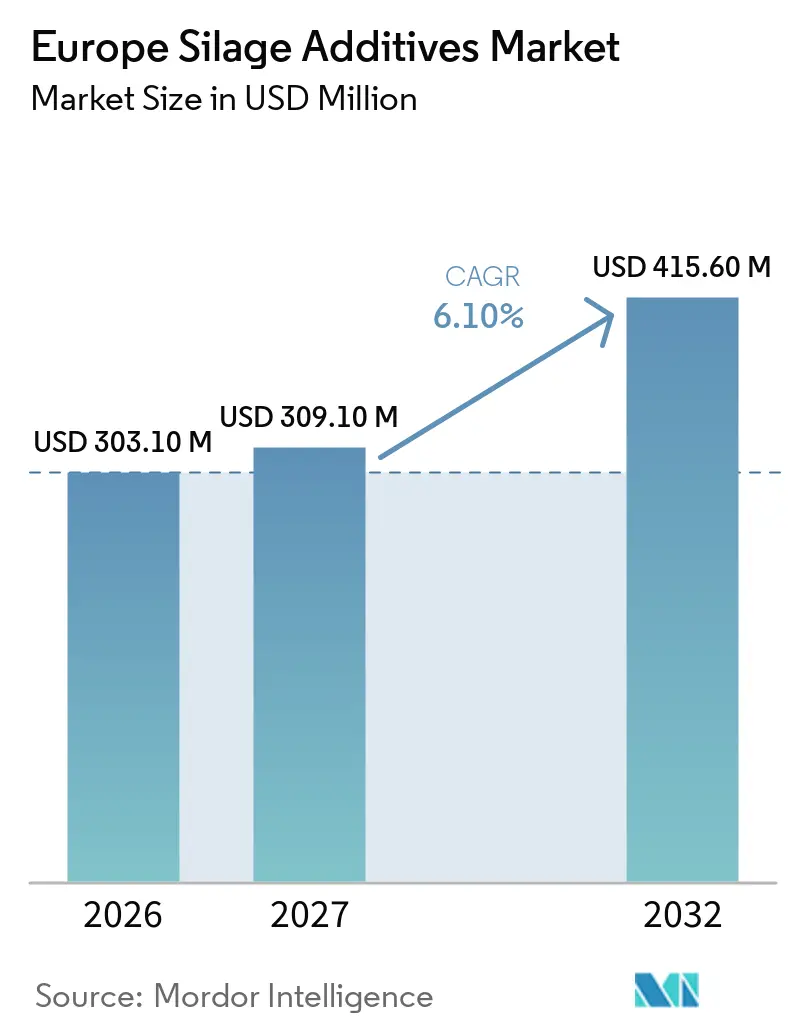
The Europe Silage Additives Market size was valued at USD 303.10 million in 2026 and is forecast to grow from USD 309.1 million in 2027 to USD 415.6 million, at a CAGR of 6.1% during the forecast period (2027-2032).
The European silage additives market is growing significantly due to the increasing need for high-quality silage to enhance livestock nutrition. Between 2020 and 2022, the European Commission recorded a slight rise in annual meat consumption within the EU, from 38.0 million metric tons to 38.1 million metric tons. This growing demand for meat and dairy products has led to an expansion in livestock farming, which, in turn, has increased the demand for efficient and high-quality animal feed. Silage, a key component of animal feed, plays a vital role in this context, with additives ensuring its quality and driving the market growth. The "Farm to Fork Strategy," central to the European Green Deal, aims to create fair, healthy, and environmentally friendly food systems. As part of this initiative, farmers are adopting sustainable farming practices, with silage additives helping to reduce waste by improving feed preservation and shelf-life. These additives also support sustainable farming operations, contributing to a lower environmental footprint.
Government policies and subsidies across Europe, aimed at enhancing livestock production and feed efficiency, are further supporting the silage additives market. These initiatives include regulations promoting additives that improve feed quality and livestock health. For example, in 2024, the UK government introduced the Endemics Disease Scheme, allocating over USD 89.5 million in funding, alongside an infrastructure grant for laying hens worth over USD 24.8 million under the Animal Health and Welfare Pathway. Additionally, silage additives help minimize feed waste and spoilage, reducing overall feed costs. This is particularly advantageous in Europe, where large-scale livestock farming is expanding, and feed demand is rising. According to the Office for National Statistics (UK), manufacturers' sales of farm animal feed reached USD 7.52 billion in 2022, up from USD 6.34 billion in 2021. Consequently, the combination of growing livestock farming, government investments in animal health, and the benefits of silage additives is driving market growth during the forecast period.
Note: Market numbers in this report are based on Mordor Intelligence's proprietary estimation framework, which combines nine months of actuals with Q4 projections for base year 2026.
Market Trends and Insights
Cereal Silage Leads market By Silage Type
Cereal crops, such as corn and sorghum, are characterized by higher fibre content and lower water-soluble carbohydrates (WSCs) compared to other forage crops. However, their dense structure and high moisture content make them prone to aerobic spoilage and nutrient losses during the ensiling process. To address this, additives like inoculants and acids are commonly used. These additives help prevent spoilage, reduce mould and yeast growth, and minimize dry matter loss. Additionally, cereal silage often has lower aerobic stability, making it more susceptible to spoilage when exposed to air after opening. Preservatives such as propionic acid are effective in improving aerobic stability, protecting the silage from post-storage deterioration. As a result, cereal crops generally require a substantial amount of additives to prevent spoilage.
Furthermore, additives enhance the fermentation process by encouraging the growth of beneficial lactic acid bacteria, which improves silage quality and reduces the risk of undesirable fermentation byproducts. In Europe, market players are introducing efficient silage additives for cereal crops, offering additional benefits that are driving market growth in the region. For example, Ecosyl provides Ecocool, a product designed for forages at risk of aerobic spoilage, such as high DM grass, whole crop cereals, and maize. According to Ecosyl, Ecocool contains two unique bacterial strains: Lactobacillus plantarum strain MTD/1 for rapid and efficient fermentation, and Lactobacillus buchneri strain PJB/1 to reduce heating and spoilage during feedout.
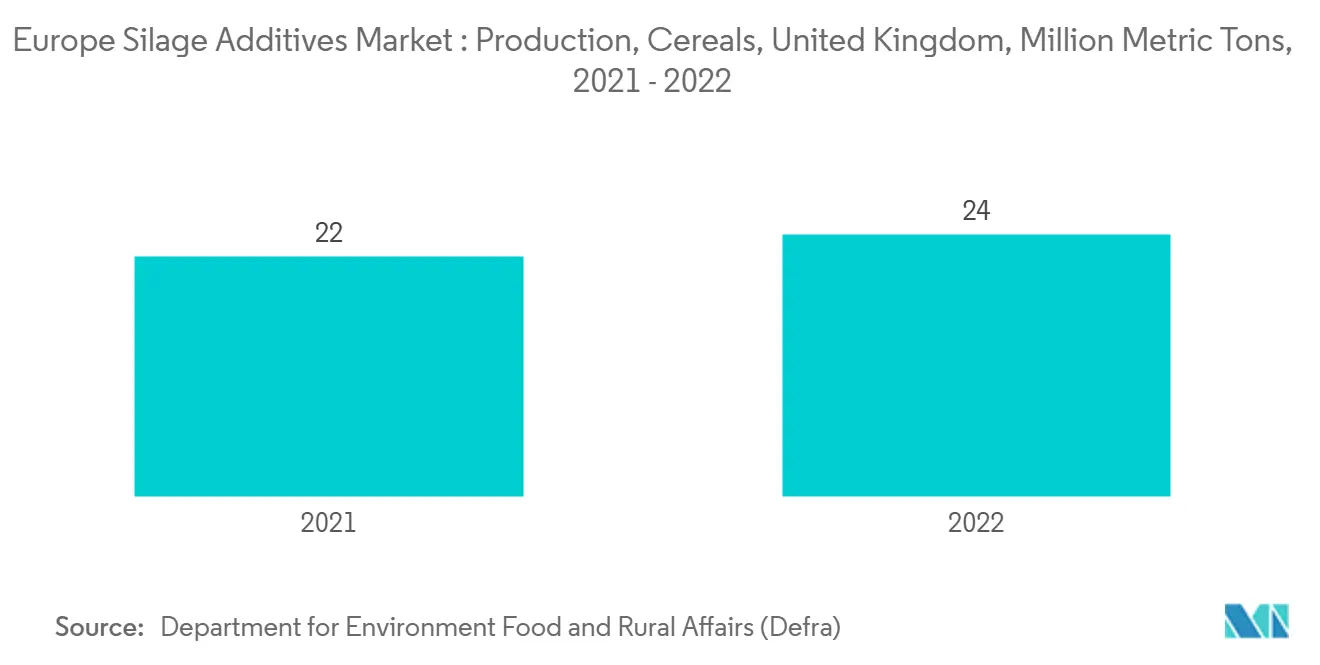
Additionally, the significant production volume of cereal crops in the region supports market growth by increasing the use of silage additives to prevent nutrient losses. For instance, the Department for Environment Food and Rural Affairs (Defra) reported that the value of United Kingdom cereal production in 2022 reached 24 million metric tons, up from 22 million metric tons in the previous year. These factors, combined with the improved fermentation process driven by lactic acid bacteria, are fueling the adoption of silage additives in cereal crops.

Russia Leads The Market With Respect To Geography
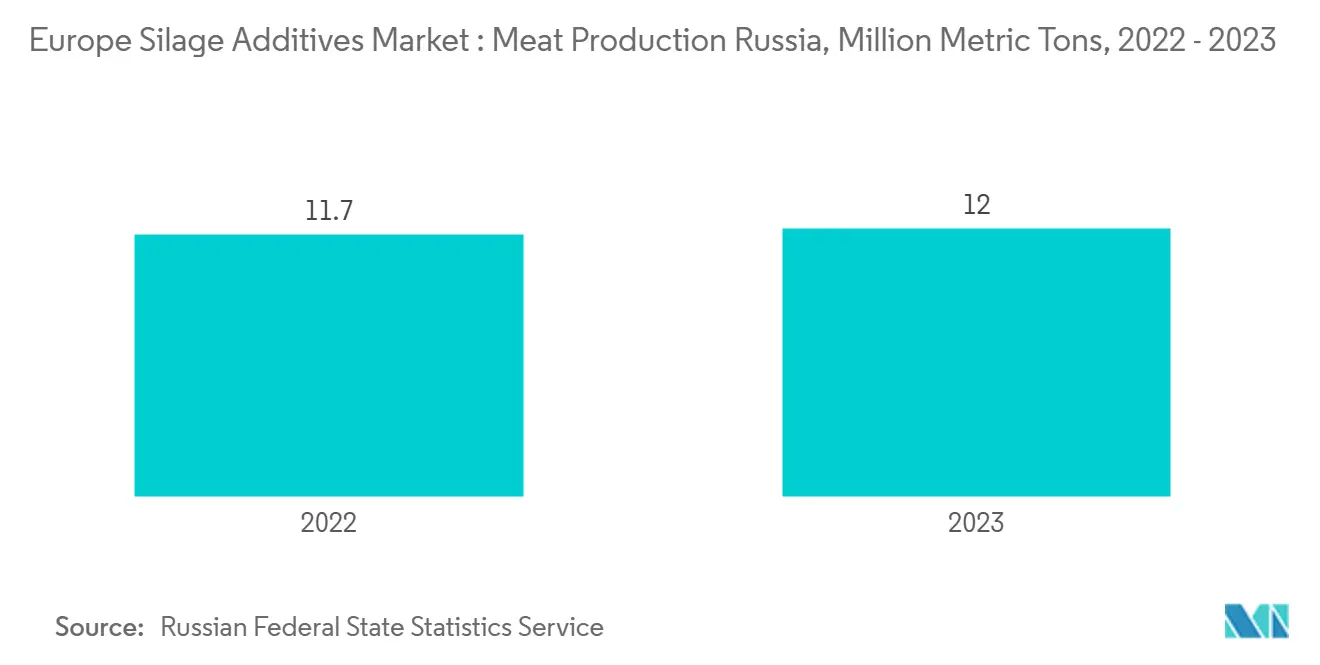
Russia is actively working to strengthen its domestic meat and dairy production to reduce reliance on imports. According to the Russian Federal State Statistics Service, the country’s meat production reached 12 million metric tons in 2023, up from 11.7 million metric tons in 2022. Poultry led the production categories, with over 5.3 million metric tons produced in 2023. Silage additives are essential in maintaining stable production efforts by improving the efficiency of livestock feed, which enhances productivity in the dairy and meat sectors. These additives help cut down on feed waste and spoilage, ultimately reducing overall feed costs. This benefits large-scale livestock farming in the country, and feed costs represent a significant share of production expenses.
Russia’s vast geography and varied climate pose challenges, such as short growing seasons for fresh forage in many regions. Silage additives help address these challenges by extending the shelf life of forage crops, ensuring farmers can provide adequate nutrition to livestock during off-seasons. These additives improve forage preservation, ensuring high-quality feed is available throughout the year. This is especially critical in regions with harsh climates where fresh forage is not accessible year-round. Additives like microbial inoculants enhance the fermentation process during silage production, reducing spoilage, minimizing nutrient losses, and producing more stable and digestible feed. This is vital for maintaining livestock health and growth.
Additionally, innovative products from major market players are driving the adoption of silage additives and supporting market growth. For example, Kemin Industries offers Kem LAC HD, a water-soluble silage inoculant containing three lactic acid-producing organisms. This product is designed to improve silage fermentation and is suitable for a wide range of forages chopped for ensiling, delivering a higher count of beneficial silage bacteria per gram. These innovations, combined with the increasing demand for high-quality meat and silage in Russia, are expected to drive market growth during the forecast period.
Competitive Landscape
Market Concentration
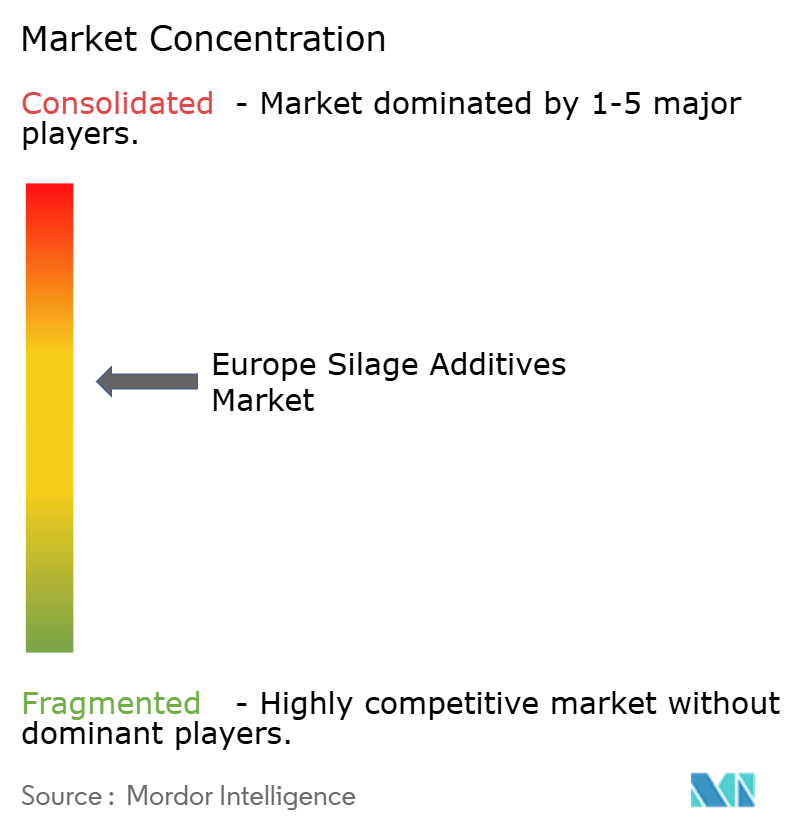
The Europe Silage Additive Market is characterized by moderate consolidation, with a few leading players holding substantial market shares due to the region's developed markets. These companies significantly increase their R&D expenditures to enhance product performance through innovation. The rising demand for highly efficient additives is anticipated to intensify competition and drive market dynamism during the forecast period. Key players in the Europe Silage Additives Market include BASF SE, Lallemand Inc., ForFarmers N.V., Novonesis A/S and Volac International Limited.
Europe Silage Additives Industry Leaders
-
BASF SE
-
Lallemand Inc.
-
ForFarmers N.V.
-
Novonesis A/S
-
Volac International Limited
- *Disclaimer: Major Players sorted in no particular order
Europe Silage Additives Market Companies Covered in this Report
- BASF SE
- Lallemand Inc.
- ForFarmers N.V.
- Novonesis
- Volac International Limited
- DSM-Firmenich AG
- Carrs Billington Agriculture (Sales) Limited
- Pearce Seeds LLP
- Mole Valley Farmers Limited
- Wynnstay Group P.L.C.
Recent Industry Developments in Europe Silage Additives Market
- May 2023: FM BioEnergy has unveiled a new silage additive, Silasil SG, aimed at maximizing biogas yields from British grass. This innovative additive is designed to safeguard the biogas potential of British grass during storage, enabling on-farm anaerobic digestion (AD) operators to boost methane production. Furthermore, Silasil SG is engineered to mitigate storage losses, curb reheating at the storage face during feed-out, and offer protection against yeast and moulds.
- March 2023: Volac, a company based in the UK, has introduced a new feed additives division. This division provides a comprehensive range of additives, including silage additives, designed to improve efficiency in the feed sector while contributing to Net Zero targets.
Europe Silage Additives Market Report Scope
Silage additives are substances added to forage crops during the silage-making process to improve fermentation, preservation, and nutritional value. The Europe Silage Additives Market Report is Segmented by Type (Inoculants, Organic Acids & Salts, Enzymes, Adsorbents, Preservatives, and Other Types), by Silage Type (Cereals, Legumes, and Other Silage Types), and by Geography (Germany, United Kingdom, France, Spain, Russia, Italy, and Rest of Europe). The report offers data in terms of Value (USD).
Segmentation Overview
Type
| Inoculants |
| Organic Acids & Salts |
| Enzymes |
| Adsorbents |
| Preservatives |
| Other Types |
Silage Type
| Cereals |
| Legumes |
| Other Silage Types |
Geography
| Germany |
| United Kingdom |
| France |
| Spain |
| Russia |
| Italy |
| Rest of Europe |
| Type | Inoculants |
| Organic Acids & Salts | |
| Enzymes | |
| Adsorbents | |
| Preservatives | |
| Other Types | |
| Silage Type | Cereals |
| Legumes | |
| Other Silage Types | |
| Geography | Germany |
| United Kingdom | |
| France | |
| Spain | |
| Russia | |
| Italy | |
| Rest of Europe |
Key Questions Answered in the Report
How big is the Europe Silage Additives Market?
The Europe Silage Additives Market size was valued USD 303.10 million in 2026 and it is anticipated to grow at a CAGR of 6.1% to reach USD 415.6 million by 2032.
What is the current Europe Silage Additives Market size?
In 2027, the Europe Silage Additives Market size is estimated to reach USD 309.10 million.
Who are the key players in Europe Silage Additives Market?
BASF SE, Lallemand Inc., ForFarmers N.V., Novonesis A/S and Volac International Limited. are the major companies operating in the Europe Silage Additives Market.
What was Russia's meat production in 2023?
According to the Russian Federal State Statistics Service, the country’s meat production reached 12 million metric tons in 2023, up from 11.7 million metric tons in 2022