
Europe Semiconductor Demand In Data Center Market Size and Share
Market Overview
| Study Period | 2021 - 2032 |
|---|---|
| Forecast Data Period | 2027 - 2032 |
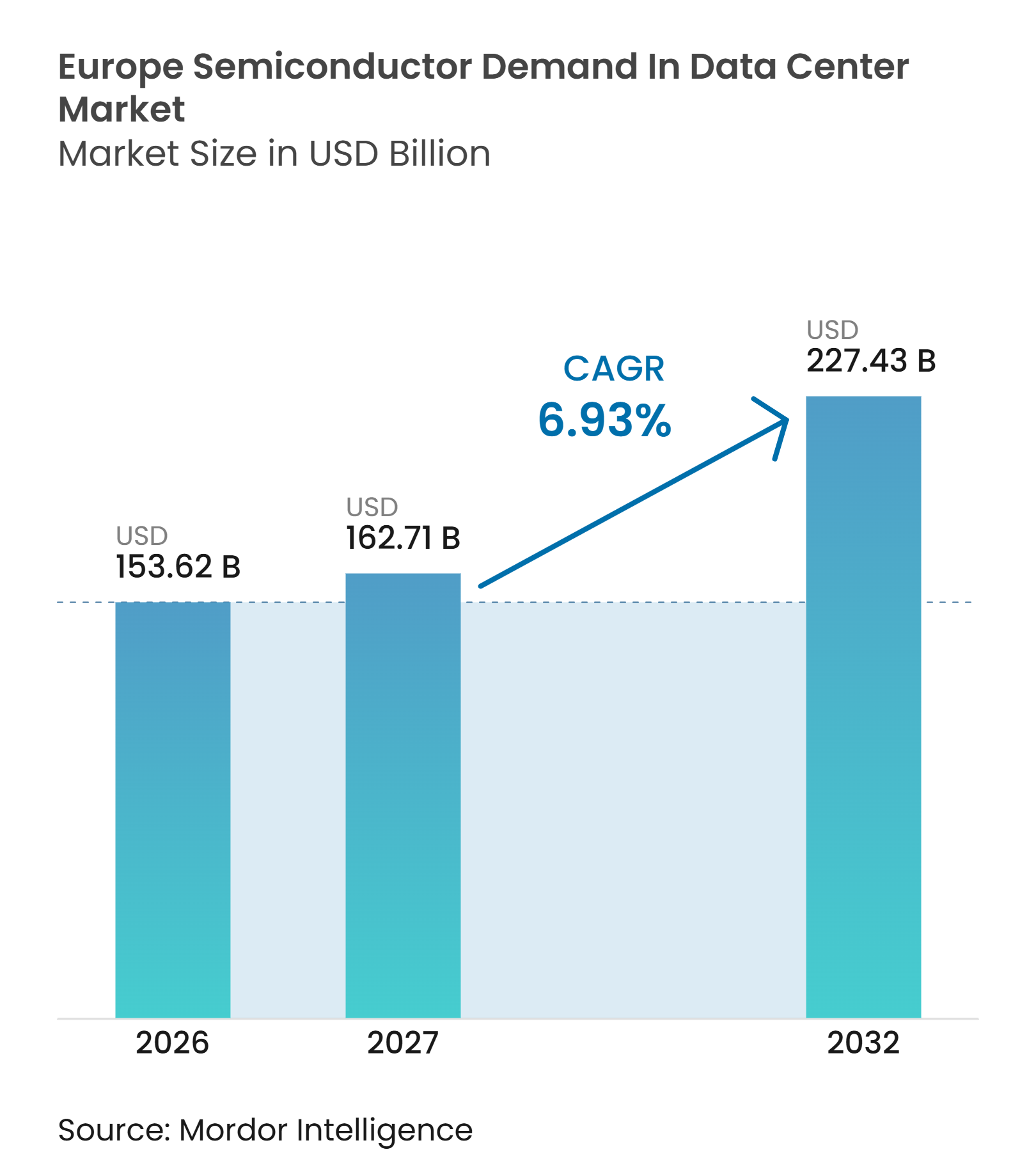
| Base Year Market Size (2026) | USD 153.62 Billion |
| Market Size (2027) | USD 162.71 Billion |
| Market Size (2032) | USD 227.43 Billion |
| Growth Rate (2027 - 2032) | 6.93 % |
| Market Concentration | High |
Major Players *Disclaimer: Major Players sorted in no particular order Image © Mordor Intelligence. Reuse requires attribution under CC BY 4.0. | |
Europe Semiconductor Demand In Data Center Market Analysis by Mordor Intelligence
The Europe semiconductor demand in data center market size is projected to be USD 153.62 billion in 2026, USD 162.71 billion in 2027, and reach USD 227.43 billion by 2032, growing at a CAGR of 6.93% from 2027 to 2032. Sovereign AI programs, hyperscale investment, and power upgrades are simultaneously driving up purchases of processors, memory, power devices, analog components, and sensors. This build-out is shorter and broader than earlier cloud-led expansion, which was more dependent on incremental migration from enterprise systems. AI clusters are also shifting spending toward power delivery, high-speed connectivity, and thermal control, because denser racks need more specialized supporting hardware. Colocation operators retain an important role because their existing grid connections and security controls can help enterprise and public-sector users avoid lengthy self-build processes. Supply concentration in advanced logic and high-bandwidth memory, together with grid connection and planning delays, may limit the pace at which planned capacity is brought into operation.
Key Report Takeaways
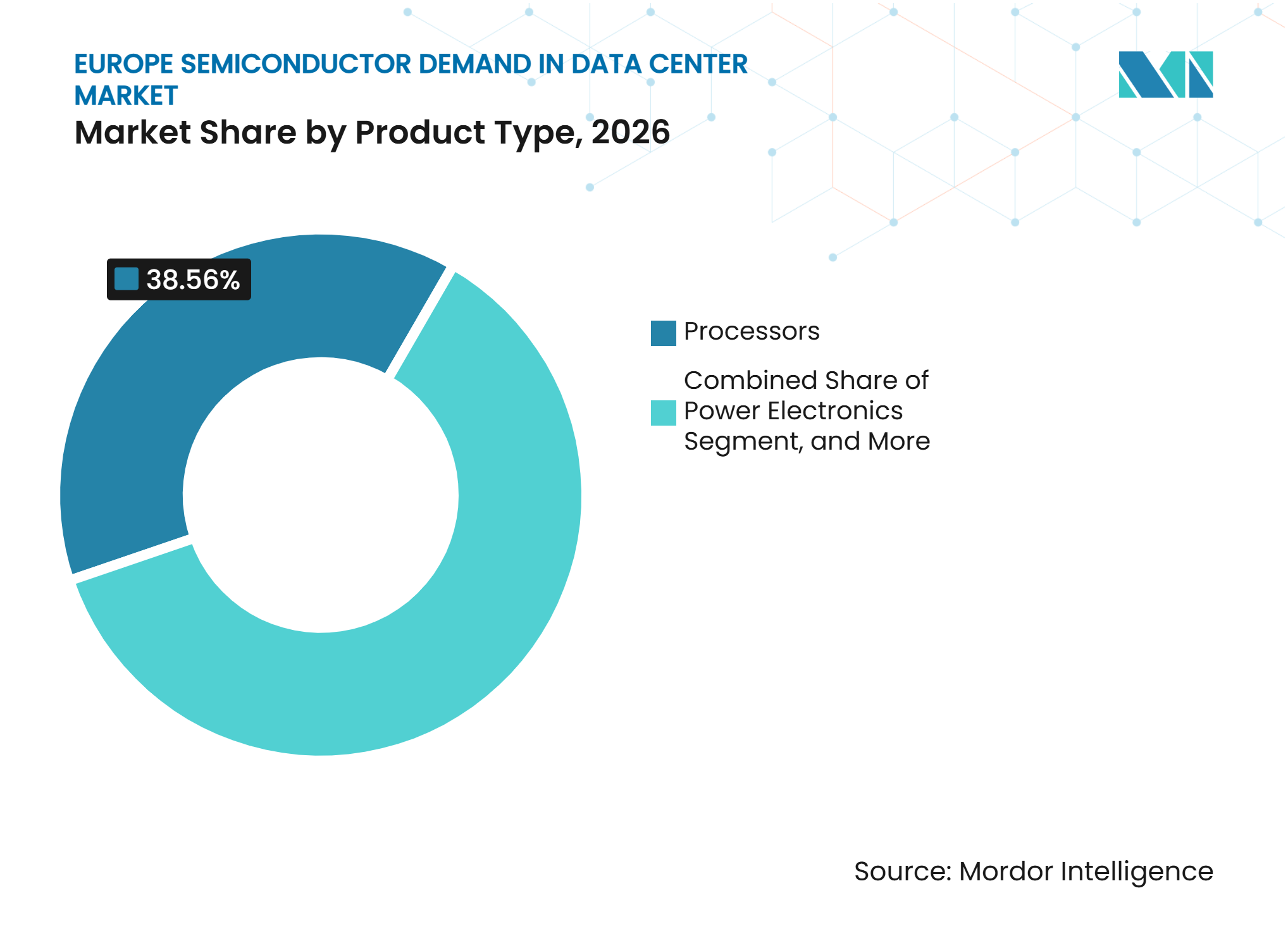
- By product type, processors held 38.56% of the Europe semiconductor demand in data center market share in 2026, while power electronics is projected to expand at a 7.82% CAGR through 2032.
- By application, IT equipment accounted for 68.73% of the Europe semiconductor demand in data center market size in 2026, while cooling and thermal management infrastructure is expected to grow at a 7.73% CAGR through 2032.
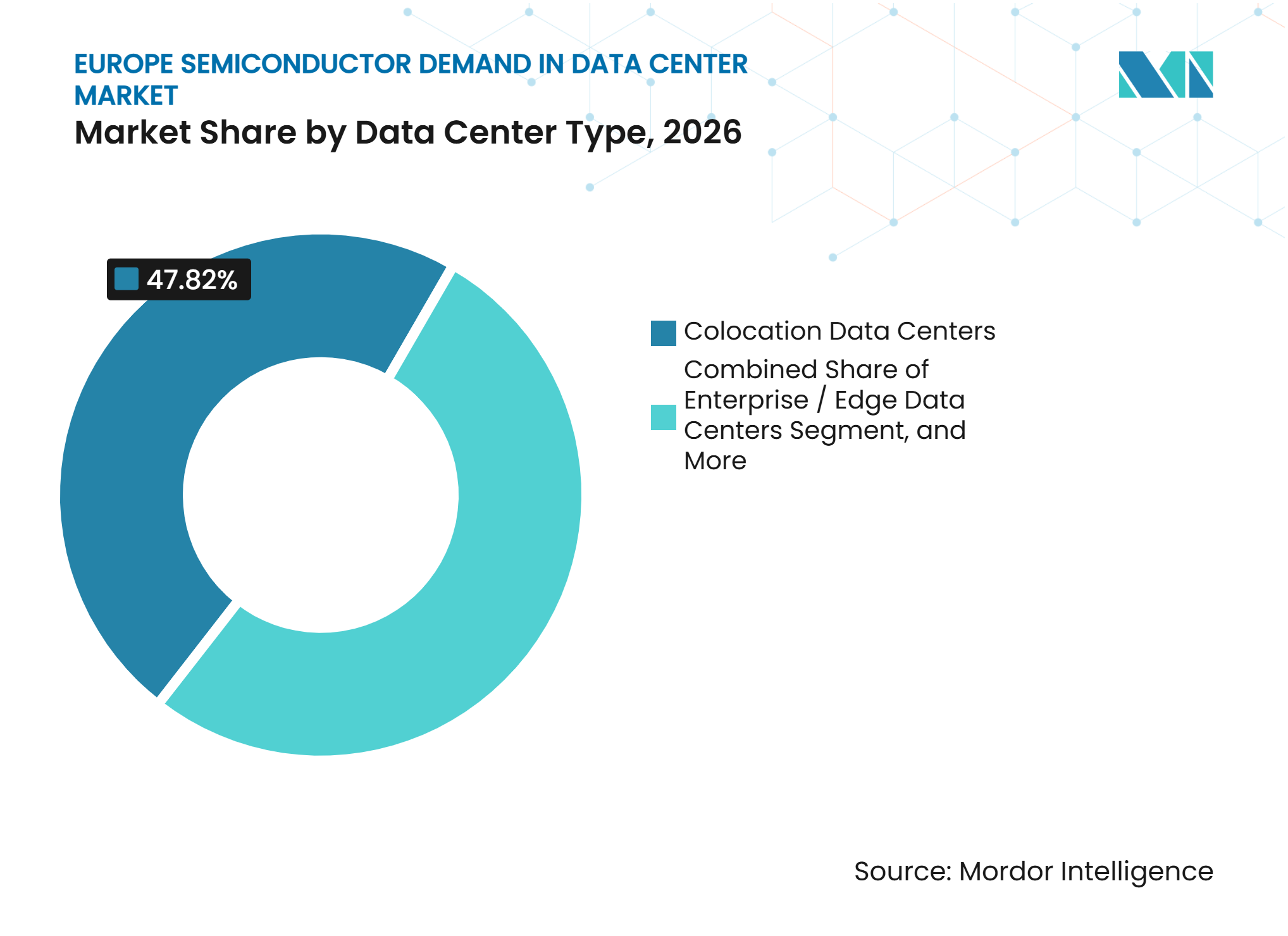
- By data center type, colocation data centers held 47.82% share in 2026, while hyperscale data centers are projected to record a 7.67% CAGR through 2032.
- By geography, Germany captured 23.48% share in 2026, while the United Kingdom is projected to expand at a 7.56% CAGR through 2032.
Note: Market numbers in this report are based on Mordor Intelligence's proprietary estimation framework, which combines nine months of actuals with Q4 projections for base year 2026.
Market Trends and Insights
Drivers Impact Analysis of Europe Semiconductor Demand In Data Center Market*
| Driver | (~) % Impact on CAGR Forecast | Geographic Relevance | Impact Timeline |
|---|---|---|---|
| AI Training and Inference Cluster Expansion | +2.1% | Global, with concentrated pull in Germany, United Kingdom, France, and Netherlands | Short term (≤ 2 years) |
| Cloud and Colocation Capacity Expansion | +1.5% | Global, with concentrated investment in United Kingdom, Nordics, and Germany | Short term (≤ 2 years) |
| Sovereign AI and Regulated-Workload Localization | +1.2% | EU-wide, with early gains in Germany, France, and Netherlands | Medium term (2-4 years) |
| Accelerated Computing and Heterogeneous Architecture Adoption | +0.8% | Global | Medium term (2-4 years) |
| High-Bandwidth Memory and Advanced Interconnect Intensity | +0.6% | Global | Medium term (2-4 years) |
| Performance-Per-Watt Procurement in Energy-Constrained Data Centers | +0.5% | EU-wide, particularly Germany and Netherlands | Long term (≥ 4 years) |
| Source: Mordor Intelligence | |||
AI Training and Inference Cluster Expansion
AI training and inference deployments are the largest immediate source of additional semiconductor demand across European data centers. NVIDIA has announced European infrastructure commitments totaling more than 3,000 exaflops of Blackwell compute capacity across Germany, France, the United Kingdom, Sweden, Italy, Spain, and Finland, through partnerships with Mistral AI, Nebius, and Nscale. The Europe semiconductor demand in data center market is therefore drawing on a wider set of devices than processor volumes alone. Inference systems remain active for longer periods than batch training jobs and require dependable power conversion, monitoring, and optical connections. That operating profile expands demand for power management, sensor, and connectivity components alongside GPUs and CPUs. Infineon and STMicroelectronics are positioned in these supporting layers, where the purchase cycle can be less concentrated than in the accelerator market.
Cloud and Colocation Capacity Expansion
Cloud and colocation expansion is increasing semiconductor demand, but it is also exposing limits in grid access and site approvals. Colocation data centers held 47.82% of the Europe semiconductor demand in data center market share in 2026, because established campuses can offer connected power and physical security controls without the lead time of a greenfield project. Operators can add processors, memory, networking, and power hardware sooner when they expand within an approved facility. This makes existing campuses a practical route for regulated enterprises and government users that need data residency and certified operations. The resulting procurement can be consolidated into large orders by a limited number of experienced site operators. It also gives operators with available power capacity an advantage when new locations face delayed grid connections.
Sovereign AI and Regulated-Workload Localization
The European Commission has committed EUR 10 billion (USD 11.5 billion) in public funding for 7 AI gigafactories and is targeting at least EUR 20 billion (USD 23 billion) in total investment.[1] NVIDIA, AMD, and Qualcomm signed letters of intent to supply processors to the proposed consortia, according to the announcement. These programs link compute procurement with requirements for local data handling and compliance with the EU AI Act. The GDPR and the EU AI Act can also increase demand for security, monitoring, and sensor devices that support controlled operations. The Europe semiconductor demand in data center market gains a more durable public-sector demand stream when national and regional projects move from planning to deployment. European component vendors may be considered more favorably where procurement evaluation also weighs supply-chain participation and data-residency requirements.
Accelerated Computing and Heterogeneous Architecture Adoption
Data center designs are moving from homogeneous CPU fleets toward mixed architectures that combine GPUs, CPUs, DPUs, FPGAs, SmartNICs, and custom ASICs. AMD expects its Helios rack-scale platform to combine EPYC CPUs, Instinct GPUs, Pensando networking, and ROCm software in a single AI infrastructure offering. Broadcom reported USD 16.7 billion in AI semiconductor revenue for Q3 FY2026, up 221% year over year, driven by custom accelerators and networking deployments. These configurations increase the number of semiconductor categories purchased for each rack. High-speed interconnect devices such as DPUs, IPUs, and PCIe retimers become more important when compute is distributed across specialized processors. Intel Foundry and ASML reported that High-NA EUV had processed more than 1 million wafers at Intel Foundry facilities, supporting continued competition in advanced CPU technology.
Restraints Impact Analysis of Europe Semiconductor Demand In Data Center Market*
| Restraint | (~) % Impact on CAGR Forecast | Geographic Relevance | Impact Timeline |
|---|---|---|---|
| Advanced-Node and HBM Supply Concentration | -1.4% | Global, with heightened exposure in Western Europe | Short term (≤ 2 years) |
| Grid-Connection and Data Center Permitting Delays | -0.9% | EU-wide, particularly Germany, United Kingdom, and Italy | Medium term (2-4 years) |
| Scarcity of Analog, Mixed-Signal, and Semiconductor Design Talent | -0.5% | EU-wide | Long term (≥ 4 years) |
| High Qualification Cost and Long Design-In Cycles | -0.4% | Global | Medium term (2-4 years) |
| Source: Mordor Intelligence | |||
Advanced-Node and HBM Supply Concentration
Advanced logic and high-bandwidth memory supply is concentrated among a small number of manufacturers, and their long-term commitments can limit availability for European buyers. ASML stated that European chipmakers purchased no EUV equipment in 2026, which highlights the region’s continued reliance on overseas leading-edge foundry capacity. European operators may face longer lead times and higher spot-market exposure when high-bandwidth memory capacity is committed under large accelerator programs. This constraint affects the timing of GPU, CPU, and memory procurement simultaneously. The ESMC venture, involving TSMC, Bosch, Infineon, and NXP, is investing more than EUR 10 billion (USD 11.5 billion) in a Dresden facility for 28/22 nm and 16/12 nm technologies. That investment strengthens regional supply over the longer term, but it does not remove near-term dependence on external advanced-node production.
Grid Connection and Data Center Permitting Delays
Power availability is a binding constraint for new data center construction in several European locations. Germany’s AI and high-performance computing data center capacity is expected to rise from 670 MW in 2026 to more than 2,100 MW by 2030, while grid connection and planning processes can take 3 to 5 years. Delays in grid reinforcement can postpone the full equipment purchase cycle for processors, memory, and power components. Deutsche Telekom is investing EUR 250 million (USD 287.5 million) to double the capacity of its Munich AI data center to 20 MW using NVIDIA technology. Expansion inside a connected and permitted site can be more attractive than developing a new location. This pattern favors larger certified campuses and can concentrate semiconductor orders among fewer buyers.
*Our forecasts treat driver/restraint impacts as directional, not additive. The impact forecasts reflect baseline growth, mix effects, and variable interactions.
Europe Semiconductor Demand In Data Center Market Segment Analysis
By Product Type:
Power Electronics Gain Importance at the Rack LevelProcessors held 38.56% of the Europe semiconductor demand in data center market share in 2026, supported by GPU purchases for AI workloads and high-core-count CPUs for cloud infrastructure. Power electronics is projected to be the fastest-growing product segment, at a 7.82% CAGR through 2032. Higher rack power requirements are changing the supporting semiconductor bill of materials. AI racks at very high power density require more capable conversion, distribution, protection, and monitoring devices. This shifts attention from older 54 V power architectures to 800 VDC systems, where gallium nitride and silicon carbide components enable more efficient conversion.
STMicroelectronics presented a 12 kW gallium nitride LLC converter designed for NVIDIA’s 800 VDC architecture, operating at 1 MHz and exceeding 98% efficiency.[2] The device also exceeded 2,600 W/in³ in power density, showing how compact power hardware can fit demanding AI rack designs. Memory devices, including DRAM, HBM, NAND, and NOR Flash, remain essential but face supply pressure from accelerator programs. Logic ICs such as FPGAs, DPUs, and SmartNICs are gaining importance as servers increasingly rely on specialized compute and networking functions. Analog ICs and sensors serve signal conditioning, environmental measurement, and power management.



By Application:
IT Equipment Maintains Volume While Thermal Systems ScaleIT equipment accounted for 68.73% of the Europe semiconductor demand in data center market size in 2026, because every AI cluster requires processors, memory, storage interfaces, and network hardware. Cooling and thermal management infrastructure is expected to record the highest application CAGR at 7.73% through 2032. Rack loads above 100 kW require direct-to-chip liquid cooling rather than the air-based systems used by many older facilities. Optical interconnects also depend on laser transmitters, photodetectors, and optical switching components that must operate reliably in high-density environments. Thermal management has therefore become a core design requirement rather than a peripheral facility function.
STMicroelectronics is advancing its PIC100 silicon photonics platform, developed with Amazon Web Services and manufactured on 300 mm wafers in Crolles, France. The platform is intended for 800 Gb/s and 1.6 Tb/s optical modules that support high-bandwidth cluster connections. Server and rack power systems, battery backup systems, and facility power infrastructure add semiconductor demand through UPS equipment, DC buses, and backup generation controls. Monitoring and automation systems add sensors, interface ICs, and control devices as campuses manage more nodes and higher loads. Safety and security systems also require supporting semiconductor content for access, surveillance, and environmental controls. These applications broaden the Europe semiconductor demand in data center market beyond the processors installed in servers.
By Data Center Type:
Colocation Holds Share While Hyperscale Changes Design StandardsColocation data centers held 47.82% of the Europe semiconductor demand in data center market share in 2026, as enterprise and public-sector operators use established campuses for secure and regulated workloads. Hyperscale data centers are projected to grow at a 7.67% CAGR through 2032. Cloud providers are building purpose-designed AI campuses that can exceed 300 MW and use dedicated grid connections and customized cooling. Those facilities purchase large equipment volumes and set technical reference points for bus voltage, memory interfaces, networking, and cooling. Their design choices can later influence enterprise and colocation deployments.
NVIDIA’s European partnerships include deployments with operators building sovereign and commercial AI capacity across several countries. Hyperscale facilities can secure multiyear component commitments because each campus has substantial compute demand. Colocation providers remain important where users need certified grid feeds, physical security, and EU AI Act data-residency controls. Enterprise and edge data centers create demand for microcontrollers, embedded processors, and sensors used in distributed inference operations. Their expansion is steadier because bandwidth cost and latency requirements shape where local capacity is viable. The balance between large campuses and distributed sites keeps the Europe semiconductor demand in data center industry exposed to both centralized and localized buying patterns.

Geography Analysis
Germany
Germany held 23.48% of the Europe semiconductor demand in data center market share in 2026. Bitkom projected a EUR 23.5 billion (USD 27 billion) data center investment pipeline for 2026, which was 57% higher than the previous year. Infineon opened its Smart Power Fab in Dresden in summer 2026 with an investment of EUR 5 billion (USD 5.75 billion). GlobalFoundries also committed EUR 1.1 billion (USD 1.265 billion) to expand capacity in Dresden, targeting output above 1 million wafers annually by the end of 2028.[3] Grid approvals remain a practical constraint, so operators with permitted sites can move faster than projects waiting for new connections.
United Kingdom
The United Kingdom is projected to grow at a 7.56% CAGR through 2032, the fastest rate among the regional segments in the Europe semiconductor demand in data center market. NVIDIA announced that Nscale, Nebius, and CoreWeave would support AI infrastructure deployment in the country, including a 14,000 Blackwell GPU commitment with Nscale and Nebius. Arm-based server CPU designs, together with Graphcore and Axelera AI inference offerings, add a domestic technology layer, although their deployment volumes remain below NVIDIA’s. The mix of large GPU clusters and specialized inference workloads supports purchases of processors, memory, power devices, and analog components, while grid reinforcement delays remain a delivery consideration for AI campus plans.
France, Italy, Spain, and the Nordics
France is strengthening its position in optical interconnect supply through STMicroelectronics’ Crolles fabrication site, where the PIC100 silicon photonics device is produced for high-bandwidth data center connections. Italy is expanding its silicon carbide base through STMicroelectronics’ EUR 5 billion (USD 5.75 billion) Catania investment, supported by EUR 2 billion (USD 2.17 billion) in state aid and planned to reach full capacity by 2032. Spain is gaining attention for edge computing and hyperscale colocation, while Finland, Sweden, and Norway offer renewable power and cooler climates that support large-scale AI infrastructure. ASML broke ground on an Eindhoven production campus in 2026 to expand EUV and High-NA EUV system capacity, reinforcing the Netherlands’ role in the wider semiconductor equipment supply chain. These markets have different supply and demand conditions, but their combined activity supports purchases of compute, memory, connectivity, and power devices.
Competitive Landscape
Market Concentration
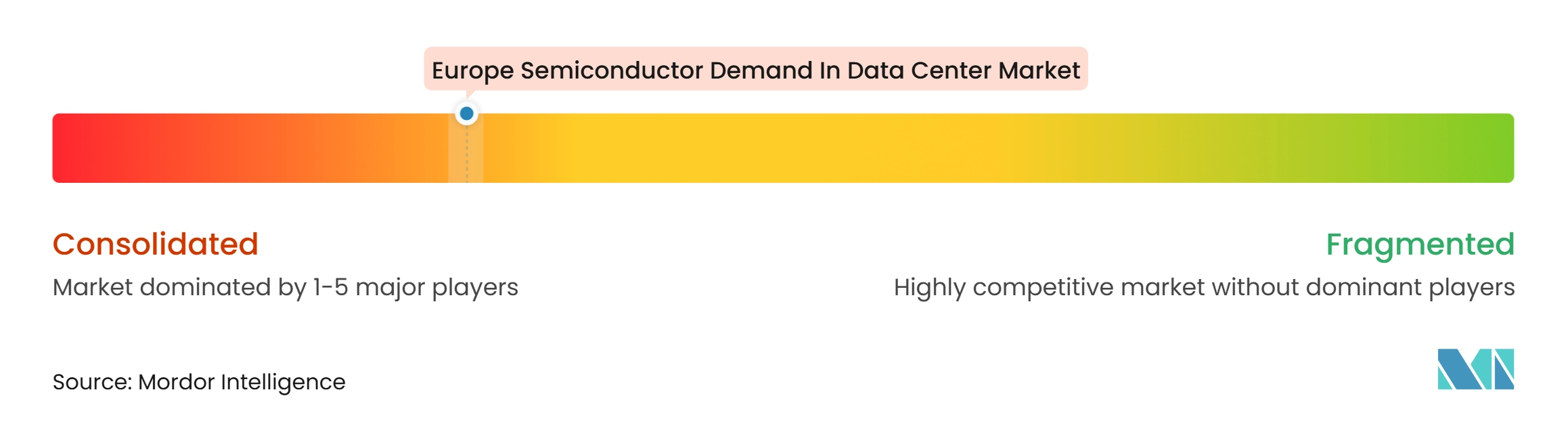
The Europe semiconductor demand in data center market has a concentrated core in AI accelerators and a more competitive structure in power electronics, analog ICs, and optical connectivity. NVIDIA remains the leading supplier of AI accelerators at scale, while AMD is building a credible alternative across GPUs and data center CPUs. AMD reported USD 6.7 billion in data center revenue in Q2 2026, up 107% year over year, and disclosed multiyear agreements with OpenAI and Meta for up to 6 GW of deployments each.[4] Broadcom reported USD 16.7 billion in AI semiconductor revenue in Q3 FY2026, up 221% year over year, with custom accelerator and networking programs supporting the result. These companies compete in different parts of the compute stack, including merchant accelerators, CPUs, custom XPUs, and high-speed networking.
European suppliers have a stronger position in the power conversion and specialized connectivity layers of AI infrastructure. Infineon expects data center revenue to reach EUR 2.5 billion (USD 2.875 billion) in FY2027, up from EUR 1.5 billion (USD 1.725 billion) in FY2026. Its Smart Power Fab in Dresden is a strategic move to increase the supply of power semiconductors for AI data centers. STMicroelectronics has advanced both its 800 VDC power solutions and PIC100 silicon photonics program, linking power efficiency and high-speed optical connectivity to new AI rack designs. The company’s work with Amazon Web Services on silicon photonics gives it a direct route into a rapidly expanding interconnect requirement. These investments give European vendors a growth path that differs from that of direct competitors in general-purpose AI accelerators.
Smaller European firms, including Axelera AI, Graphcore, Kalray, and SiPearl, are developing inference and high-performance computing designs for workloads where efficiency, compliance, and supply-chain origin matter. Their products address sovereign AI and specialized enterprise deployments rather than the largest global training clusters. NXP, Monolithic Power Systems, and Marvell serve important adjacent needs in mixed-signal devices, power ICs, and data processing units. Long qualification cycles and close engineering support can protect suppliers once their components are designed into an operator’s platform. The Europe semiconductor demand in data center market therefore combines a small group of global compute leaders with a wider supplier base in critical supporting technologies.
Europe Semiconductor Demand In Data Center Industry Leaders
-
NVIDIA Corporation
-
Intel Corporation
-
Advanced Micro Devices, Inc.
-
Broadcom Inc.
-
Micron Technology, Inc.
- *Disclaimer: Major Players sorted in no particular order
Europe Semiconductor Demand In Data Center Market Companies Covered in this Report
- NVIDIA Corporation
- Intel Corporation
- Advanced Micro Devices, Inc.
- Broadcom Inc.
- Micron Technology, Inc.
- Samsung Electronics Co., Ltd.
- SK hynix Inc.
- Taiwan Semiconductor Manufacturing Company Limited
- Microchip Technology Incorporated
- Renesas Electronics Corporation
- Qualcomm Incorporated
- Marvell Technology, Inc.
- Infineon Technologies AG
- STMicroelectronics N.V.
- NXP Semiconductors N.V.
- Texas Instruments Incorporated
- Analog Devices, Inc.
- Monolithic Power Systems, Inc.
- Astera Labs, Inc.
- Arm Holdings plc
- Imagination Technologies Limited
- Graphcore Limited
- Axelera AI B.V.
- Kalray S.A.
- SiPearl
- Cerebras Systems, Inc.
- GlobalFoundries Inc.
- X-FAB Silicon Foundries SE
- ASML Holding N.V.
Recent Industry Developments in Europe Semiconductor Demand In Data Center Market
- September 2026: Intel Foundry and ASML announced that High-NA EUV technology surpassed 1 million wafers processed at Intel Foundry's facilities, with Panther Lake, Intel 18A node, entering high-volume manufacturing on select layers. This was the first commercial high-volume deployment of High-NA EUV in production and signaled that the sub-2 nm logic node transition is commercially viable for AI data center CPU roadmaps.
- September 2026: AMD's market capitalization exceeded USD 1 trillion for the first time, driven by data center GPU and CPU growth. Q2 2026 data center revenue reached USD 6.7 billion, up 107% year over year, and the company disclosed multiyear supply agreements with OpenAI and Meta for up to 6 GW of AMD data center GPU deployments each.
- July 2026: The European Commission announced funding for 7 AI gigafactories across the EU with EUR 10 billion (USD 11.5 billion) in public money, targeting at least EUR 20 billion (USD 23 billion) in private investment. NVIDIA, AMD, and Qualcomm signed letters of intent to supply processors to gigafactory consortia, and operations were expected within 18 months of contract signing.
- February 2026: Infineon Technologies raised its FY2026 capital expenditure guidance to EUR 2.7 billion (USD 3.1 billion), up from EUR 2.2 billion (USD 2.4 billion), to accelerate manufacturing capacity for AI data-center power supplies. Q1 FY2026 revenue reached EUR 3.662 billion (USD 4.21 billion), with the Power and Sensor Systems division as the primary growth driver.
Europe Semiconductor Demand In Data Center Market Report Scope
The Europe data center semiconductor demand market refers to the demand for semiconductor components, including processors, memory chips, storage controllers, networking chips, and accelerators, used in data center infrastructure across Europe. These components support data processing, storage, connectivity, and high-performance computing requirements in cloud, enterprise, colocation, and edge data centers.
The Europe Semiconductor Demand in Data Center Market Report is Segmented by Product Type (Processors [Central Processing Units (CPUs), Graphics Processing Units (GPUs), Microcontrollers (MCUs), and Digital Signal Processors (DSPs)], Logic ICs [Field Programmable Gate Arrays (FPGAs), DPUs/IPUs/SmartNICs, Network Switches and Server Rack Connectivity, Controller ICs, and Other Logic ICs], Memory Type [DRAM, High-Bandwidth Memory (HBM), NAND Flash, NOR Flash, and Other Memory Types], Power Electronics [Discrete Components {Rectifiers, Bipolar Transistors, MOSFETs, IGBTs, and Other Discrete Components}, Power Modules {Thyristor Modules, IGBT Modules, MOSFET Modules, and Intelligent Power Modules (IPMs)}, and Power ICs {PMICs (Multichannel), Switching Regulators (AC/DC and DC/DC, Isolated/Non-Isolated), Linear Regulators, Battery Management ICs, Gate Driver ICs, and Other Power ICs}], Analog ICs [Interface and Signal-Conditioning ICs, Signal-Conversion ICs, Application-Specific Analog ICs], Optoelectronics [Laser Transmitters, Photodetectors and Photodiodes, Optocouplers and Optical Isolators, Optical Switches, and Infrared Emitters and Detectors], and Sensors [Temperature Sensors, Pressure Sensors, Magnetic-Field and Hall-Effect Sensors, Current Sensors, Humidity Sensors, and Gas and Smoke Sensors]), Application (IT Equipment, Server and Rack Power Systems, Battery Backup and Energy Storage Systems, Facility Power Infrastructure, Cooling and Thermal Management Infrastructure, Data Center Monitoring and Automation, and Safety and Security Infrastructure), Data Center Type (Hyperscale Data Centers, Colocation Data Centers, and Enterprise/Edge Data Centers), and Geography (Germany, United Kingdom, France, Italy, Spain, and Rest of Europe). The Market Forecasts are Provided in Terms of Value (USD).
Segmentation Overview
| Processors | Central Processing Units (CPUs) | |
| Graphics Processing Units (GPUs) | ||
| Microcontrollers (MCUs) | ||
| Digital Signal Processors (DSPs) | ||
| Logic ICs | Field Programmable Gate Arrays (FPGAs) | |
| DPUs / IPUs / SmartNICs | ||
| Network Switches and Server Rack Connectivity | ||
| Controller ICs | ||
| Other Logic ICs | ||
| Memory Type | DRAM | |
| High-Bandwidth Memory (HBM) | ||
| NAND Flash | ||
| NOR Flash | ||
| Other Memory Types | ||
| Power Electronics | Discrete Components | Rectifiers |
| Bipolar Transistors | ||
| MOSFETs | ||
| IGBTs | ||
| Other Discrete Components | ||
| Power Modules | Thyristor Modules | |
| IGBT Modules | ||
| MOSFET Modules | ||
| Intelligent Power Modules (IPMs) | ||
| Power ICs | PMICs (Multichannel) | |
| Switching Regulators (AC/DC, DC/DC, Isolated/Non-Isolated) | ||
| Linear Regulators | ||
| Battery Management ICs | ||
| Gate Driver ICs | ||
| Other Power ICs | ||
| Analog ICs | Interface and Signal-Conditioning ICs | |
| Signal-Conversion ICs | ||
| Application-Specific Analog ICs | ||
| Optoelectronics | Laser Transmitters | |
| Photodetectors and Photodiodes | ||
| Optocouplers and Optical Isolators | ||
| Optical Switches | ||
| Infrared Emitters and Detectors | ||
| Sensors | Temperature Sensors | |
| Pressure Sensors | ||
| Magnetic-Field and Hall-Effect Sensors | ||
| Current Sensors | ||
| Humidity Sensors | ||
| Gas and Smoke Sensors | ||
| IT Equipment |
| Server and Rack Power Systems |
| Battery Backup and Energy Storage Systems |
| Facility Power Infrastructure |
| Cooling and Thermal Management Infrastructure |
| Data Center Monitoring and Automation |
| Safety and Security Infrastructure |
| Hyperscale Data Centers |
| Colocation Data Centers |
| Enterprise / Edge Data Centers |
| Germany |
| United Kingdom |
| France |
| Italy |
| Spain |
| Rest of Europe |
| By Product Type | Processors | Central Processing Units (CPUs) | |
| Graphics Processing Units (GPUs) | |||
| Microcontrollers (MCUs) | |||
| Digital Signal Processors (DSPs) | |||
| Logic ICs | Field Programmable Gate Arrays (FPGAs) | ||
| DPUs / IPUs / SmartNICs | |||
| Network Switches and Server Rack Connectivity | |||
| Controller ICs | |||
| Other Logic ICs | |||
| Memory Type | DRAM | ||
| High-Bandwidth Memory (HBM) | |||
| NAND Flash | |||
| NOR Flash | |||
| Other Memory Types | |||
| Power Electronics | Discrete Components | Rectifiers | |
| Bipolar Transistors | |||
| MOSFETs | |||
| IGBTs | |||
| Other Discrete Components | |||
| Power Modules | Thyristor Modules | ||
| IGBT Modules | |||
| MOSFET Modules | |||
| Intelligent Power Modules (IPMs) | |||
| Power ICs | PMICs (Multichannel) | ||
| Switching Regulators (AC/DC, DC/DC, Isolated/Non-Isolated) | |||
| Linear Regulators | |||
| Battery Management ICs | |||
| Gate Driver ICs | |||
| Other Power ICs | |||
| Analog ICs | Interface and Signal-Conditioning ICs | ||
| Signal-Conversion ICs | |||
| Application-Specific Analog ICs | |||
| Optoelectronics | Laser Transmitters | ||
| Photodetectors and Photodiodes | |||
| Optocouplers and Optical Isolators | |||
| Optical Switches | |||
| Infrared Emitters and Detectors | |||
| Sensors | Temperature Sensors | ||
| Pressure Sensors | |||
| Magnetic-Field and Hall-Effect Sensors | |||
| Current Sensors | |||
| Humidity Sensors | |||
| Gas and Smoke Sensors | |||
| By Application | IT Equipment | ||
| Server and Rack Power Systems | |||
| Battery Backup and Energy Storage Systems | |||
| Facility Power Infrastructure | |||
| Cooling and Thermal Management Infrastructure | |||
| Data Center Monitoring and Automation | |||
| Safety and Security Infrastructure | |||
| By Data Center Type | Hyperscale Data Centers | ||
| Colocation Data Centers | |||
| Enterprise / Edge Data Centers | |||
| By Geography | Germany | ||
| United Kingdom | |||
| France | |||
| Italy | |||
| Spain | |||
| Rest of Europe | |||
Key Questions Answered in the Report
What is the Europe semiconductor demand in data center market size?
The Europe semiconductor demand in data center market is projected to reach USD 162.71 billion in 2027 and USD 227.43 billion by 2032, from USD 153.62 billion in 2026.
What is driving semiconductor purchases for European data centers?
AI training and inference clusters, cloud expansion, sovereign AI projects, and higher rack power density are increasing demand for compute, memory, power, and connectivity devices.
Which product category has the largest share of data center semiconductor spending in Europe?
Processors lead the product categories with 38.56% share in 2026, supported by GPU demand for AI workloads and CPU deployments for cloud infrastructure.
Which application is growing fastest in European data center semiconductor demand?
Cooling and thermal management infrastructure is expected to grow at a 7.73% CAGR through 2032 as high-density AI racks require liquid cooling and advanced optical connections.
Why are power semiconductors becoming more important in AI data centers?
Higher rack loads are accelerating the use of efficient 800 VDC power systems, which need gallium nitride and silicon carbide components for conversion and power management.