
Europe Seed Processing Machinery Market Size and Share
Market Overview
| Study Period | 2021 - 2031 |
|---|---|
| Forecast Data Period | 2026 - 2031 |
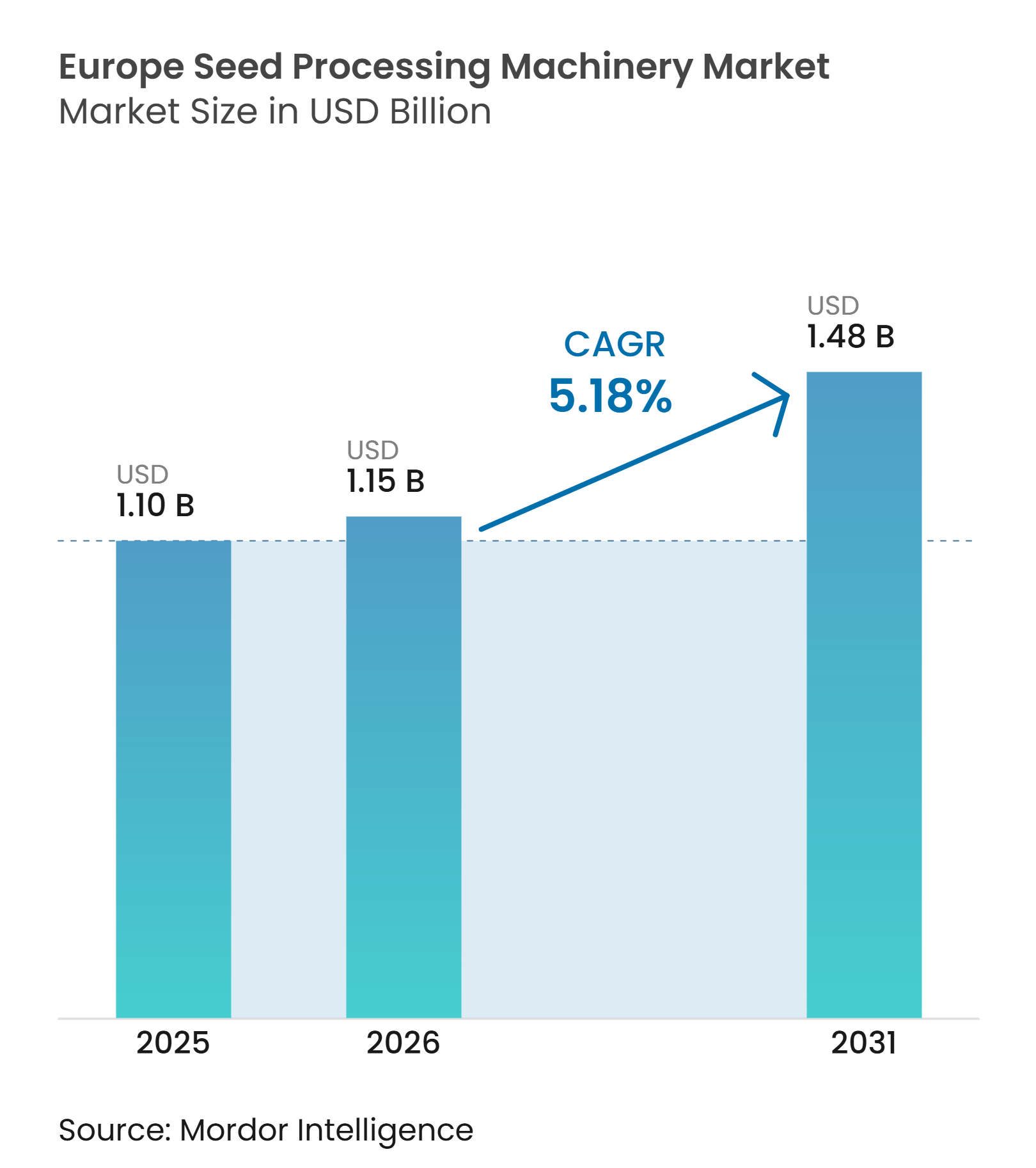
| Base Year Market Size (2025) | USD 1.10 Billion |
| Market Size (2026) | USD 1.15 Billion |
| Market Size (2031) | USD 1.48 Billion |
| Growth Rate (2026 - 2031) | 5.18 % |
| Market Concentration | Low |
Major Players *Disclaimer: Major Players sorted in no particular order Image © Mordor Intelligence. Reuse requires attribution under CC BY 4.0. | |
Europe Seed Processing Machinery Market Analysis by Mordor Intelligence
Europe’s seed processing machinery market was valued at USD 1.1 billion in 2025, is estimated at USD 1.2 billion in 2026, and is forecast to grow at a CAGR of 5.2% from 2026 to 2031, reaching USD 1.5 billion by 2031. Growth reflects a change in procurement priorities at European seed processors. Larger plants increasingly require multi-crop lines that preserve lot identity from intake through packing, while smaller operators prioritize modular equipment that improves one processing stage at a time. Certification rules make accuracy in cleaning, grading, labeling, and recordkeeping a commercial requirement, not simply an operational preference. Labor shortages reinforce the case for automated feeding, sorting, and process control because a shortage of trained operators directly reduces plant throughput and raises the risk of inconsistent lot handling. At the same time, changes in seed-treatment and coating requirements favor equipment that handles alternative formulations without disrupting established workflows.
Key Report Takeaways
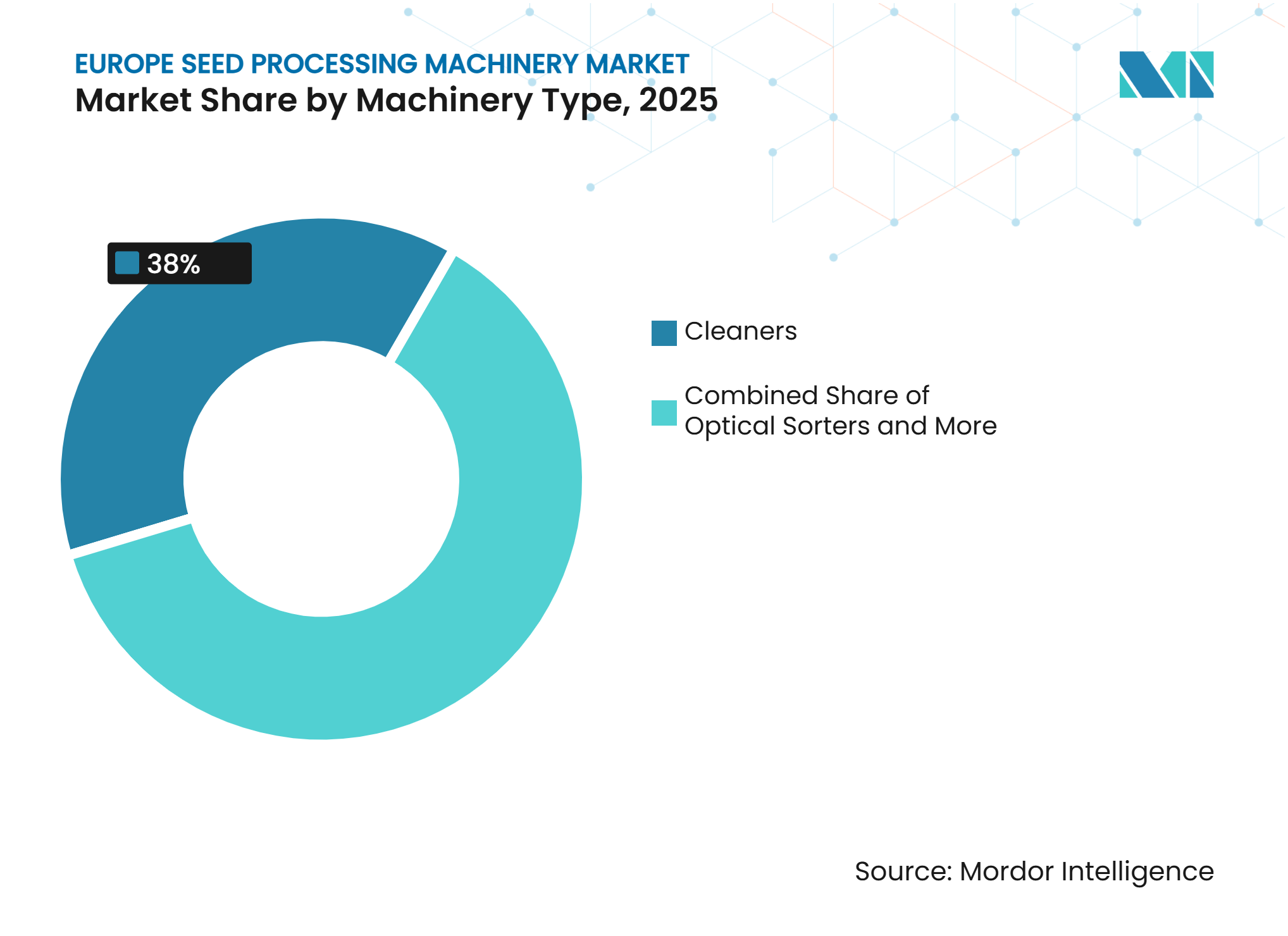
- By machinery type, cleaners accounted for 38% of the Europe seed processing machinery market size in 2025, while optical sorters are forecast to grow at the fastest CAGR of 7.5% from 2026 to 2031.
- By operation mode, automatic systems held 62% of the Europe seed processing machinery market share in 2026 and are forecast to grow at a CAGR of 6% from 2026 to 2031.
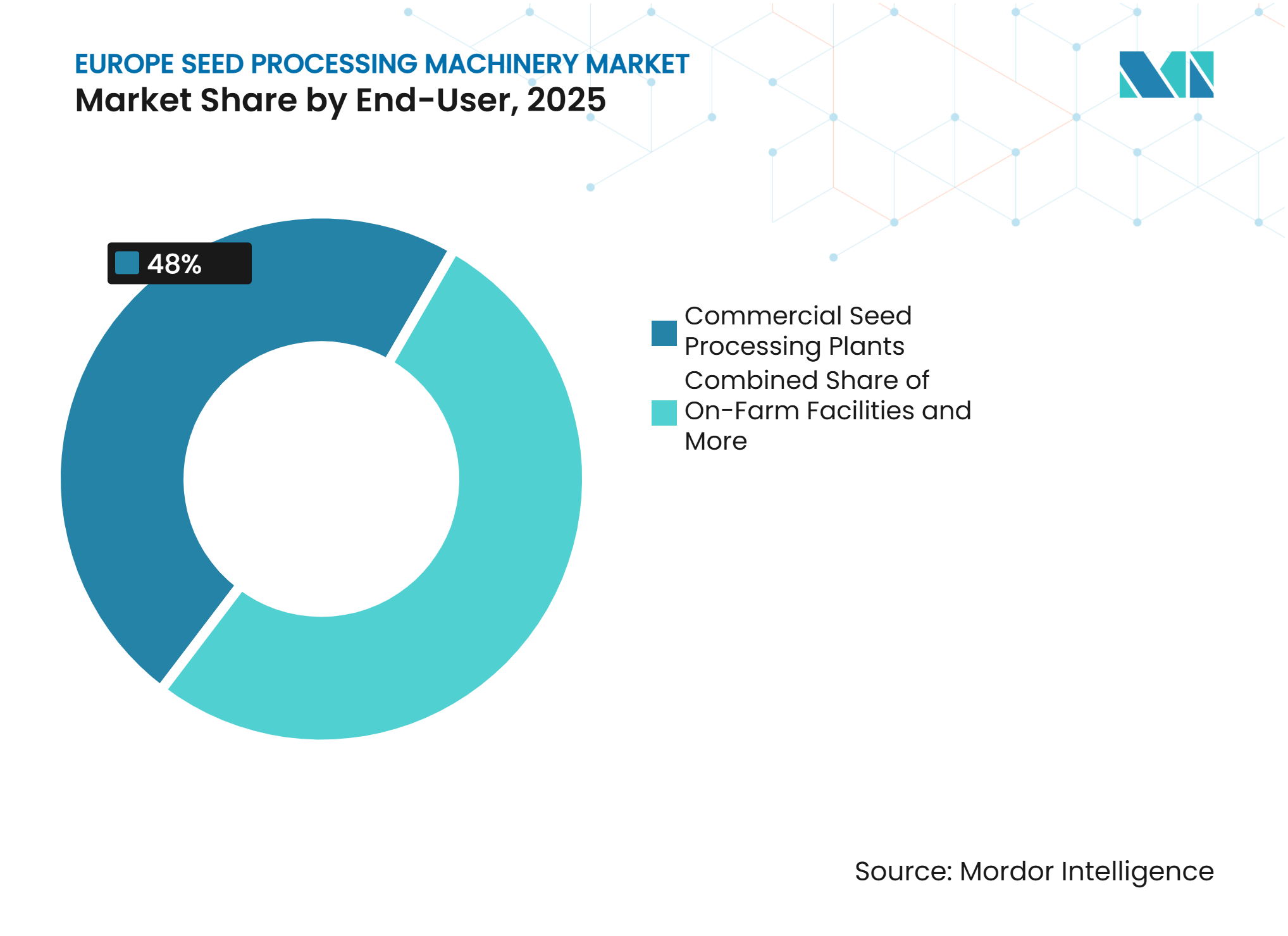
- By end user, commercial seed processing plants held the largest share at 48% in 2025, while on-farm facilities are forecast to grow at the fastest CAGR of 5.8% from 2026 to 2031.
- By geography, Germany held the largest country share at 24% in 2025, while Spain is forecast to grow at the fastest CAGR of 6.2% from 2026 to 2031.
Note: Market size and forecast figures in this report are generated using Mordor Intelligence’s proprietary estimation framework, updated with the latest available data and insights as of January 2026.
Market Trends and Insights
Drivers Impact Analysis of Europe Seed Processing Machinery Market*
| Driver | (~) % Impact on CAGR Forecast | Geographic Relevance | Impact Timeline |
|---|---|---|---|
| Certified Seed Quality and Traceability Requirements | +1.1% | France, Germany, Italy, Netherlands, Spain, and Rest of Europe apply European Union certification and lot-record rules. The United Kingdom requires separate domestic and export documentation. Ukraine and Russia face added traceability needs in cross-border trade. | Medium term (2-4 years) |
| CAP-Supported Farm and Processing Modernization | +0.9% | France, Germany, Italy, Netherlands, Spain, and Rest of Europe are affected because Common Agricultural Policy rural-development support can lower the cost of eligible processing upgrades, subject to national program rules. | Short term (≤ 2 years) |
| Automation to Offset Labor and Skills Shortages | +0.8% | France and the United Kingdom face documented agricultural hiring pressures. Germany, Netherlands, Italy, and Spain have higher-cost processing environments, while Ukraine and Russia face workforce disruption, increasing the value of automated line operation. | Medium term (2-4 years) |
| Climate-Related Variability in Seed Quality and Crop Establishment | +0.6% | France, Germany, Italy, and Spain face heat, drought, and uneven rainfall that alter incoming seed quality. Netherlands and the United Kingdom face weather variability, while conflict-related production disruption adds uncertainty in Ukraine and Russia. | Long term (≥ 4 years) |
| Expansion of Organic and Resilient Seed Supply Chains | +0.5% | Germany, France, and Netherlands have established organic seed supply activity. Italy and Spain have policy-backed organic production, while the United Kingdom and Ukraine require segregated, traceable handling for growing organic and resilient seed supply chains. | Medium term (2-4 years) |
| Demand for Flexible, Traceable, and Energy-Efficient Processing Lines | +0.7% | Germany, Netherlands, France, Italy, and Spain process diverse crop and seed portfolios. The United Kingdom requires distinct domestic and export records, while Ukraine, Russia, and Rest of Europe need modular upgrades that limit energy use and plant disruption. | Medium term (2-4 years) |
| Source: Mordor Intelligence | |||
Certified Seed Quality and Traceability Requirements
Complete automated lines require investment in cleaning, drying, sorting, treatment, packaging, controls, installation, and plant integration. Smaller cooperatives and on-farm facilities often lack the capital to replace every stage at once. The constraint is pronounced in Italy and Spain, where many operators are family-owned or regionally organized, and machinery budgets depend on seasonal cash flow. Ukraine faces a more severe limitation because war-related agricultural losses have shifted available capital toward continuity rather than modernization. Russia also faces restrictions on financing and access to imported precision equipment, as described in the source draft. These conditions lengthen replacement cycles and lead buyers toward phased upgrades, used equipment, or lower-specification systems. Suppliers that support staged modernization are therefore better aligned with the purchasing reality of capital-constrained operators.
CAP-Supported Farm and Processing Modernization
The Common Agricultural Policy provides a funding framework for modernizing agricultural processing assets. The European Parliament stated in 2024 that EUR 260.5 billion (USD 282.0 billion) was allocated to the Common Agricultural Policy for 2023 through 2027, with funding divided between direct support and rural development[1]. Where national programs identify processing equipment as eligible, rural development funding reduces the initial cost hurdle that often delays machinery replacement. Greece’s 2025 program documentation identified investments in processing, standardization, and packaging units for seeds and propagation material as eligible under its strategic plan. The structure favors staged investment because processors align a cleaner, grader, dryer, or packaging upgrade with available co-financing instead of funding an entire line at once. This supports machinery demand where operators meet the application, audit, and private co-investment conditions. It also explains why uptake varies by country and by each processor's administrative capacity.
Automation to Offset Labor and Skills Shortages
Automation addresses a constraint that affects both throughput and the consistency of certified seed lots. France Travail reported that 52% of planned agricultural hires were difficult to fill in 2024, according to material cited in the source draft. The United Kingdom’s agricultural workforce declined 1.9% to 279,000 in June 2025. Seed processing plants require trained personnel to set machinery, respond to incoming quality variation, and maintain cleaning accuracy. When these roles remain vacant, the constraint affects the entire line rather than a single manual task. Westrup ApS installed the Optica Mini by 3U Vision at Sejet Plant Breeding in Denmark in February 2026, replacing manual defect removal with automated optical cleaning. Such installations show why automation supports output stability and consistent purity management during staffing shortages.
Expansion of Organic and Resilient Seed Supply Chains
Organic seed supply requires strict separation, cleaning, and documentation to prevent mixing with conventional lots. Regulation (EU) 2018/848 requires the use of organic plant reproductive material in organic farming and establishes a route to end derogations for non-organic seed by 2036. A 2024 University of Giessen study found strong domestic organic seed supply coverage for key species in France and the Netherlands, while Germany exceeded 76%. Organic operations often process smaller batches and switch varieties more frequently than high-volume conventional facilities. They therefore require machinery that limits carryover between lots and handles seed gently throughout the line. Italy’s 2025 to 2028 plan for organic seed also signals policy support for additional capacity, as cited in the source draft. This demand favors flexible configurations over lines optimized solely for maximum throughput.
Restraints Impact Analysis of Europe Seed Processing Machinery Market*
| Restraint | (~) % Impact on CAGR Forecast | Geographic Relevance | Impact Timeline |
|---|---|---|---|
| High Capital Cost and Long Investment Payback | -0.70% | Italy and Spain contain many smaller or regionally organized operators with seasonal budgets. Ukraine and Russia face severe capital and equipment-access constraints, while Germany, France, Netherlands, United Kingdom, and Rest of Europe face high costs for complete automated lines and plant integration. | Long term (≥ 4 years) |
| Volatile Farm Economics and Uneven Access to Financing | -0.60% | Ukraine and Russia face conflict-related and trade-related financial pressure. Spain, Italy, France, and Germany are exposed to crop-price and seasonal income volatility, while Rest of Europe faces uneven access to co-financing and matching funds. | Short term (≤ 2 years) |
| Restrictions and Uncertainty Around Seed-Treatment Chemistry | -0.40% | European Union member states, including Germany and France, must follow changing European Union treatment rules. The United Kingdom uses separate emergency authorization processes, while Ukraine and Russia face uncertainty over approved formulations and access to treatment inputs. | Short term (≤ 2 years) |
| Retrofit Complexity and Compliance Costs for Existing Facilities | -0.50% | Germany, Netherlands, France, United Kingdom, Italy, and Spain have established facilities where legacy layouts, electrical systems, and documentation add retrofit cost. Ukraine and Russia face the same integration challenge alongside constrained replacement budgets. | Medium term (2-4 years) |
| Source: Mordor Intelligence | |||
Restrictions and Uncertainty Around Seed-Treatment Chemistry
Changes in seed-treatment chemistry complicate decisions on treating and coating equipment because processors must avoid investing in configurations that become unsuitable for approved formulations. Regulation (EC) No 1107/2009 governs plant protection products in the European Union[2]. The Court of Justice of the European Union ruled in January 2023 that member states could not authorize the use of seeds treated with plant protection products expressly prohibited at the European Union level. The United Kingdom has separate emergency authorization processes for sugar beet seed treatment, including advice for 2025 on Cruiser SB. Buyers must assess whether treating and coating equipment handles approved alternative formulations and the drying conditions they require. Regulatory uncertainty, therefore, delays some purchases and increases the importance of adaptable equipment designs.
Retrofit Complexity and Compliance Costs for Existing Facilities
Older plants often require more than a machine replacement when adding optical sorting, dust control, automated conveying, or traceability systems. Equipment footprints, building layout, electrical capacity, and safety measures add cost and extend project timelines. Regulation (EU) 2023/1230 applies from January 2027 and updates machinery requirements for products placed on the European Union market. Facilities with mixed-vintage lines must coordinate equipment upgrades with wider safety and documentation work. The issue is pronounced in Germany, the Netherlands, Italy, and Spain, where site layouts impose physical constraints. Retrofit complexity restrains investment in the short term, while favoring suppliers that integrate new machinery into operating plants with limited disruption.
*Our forecasts treat driver/restraint impacts as directional, not additive. The impact forecasts reflect baseline growth, mix effects, and variable interactions.
Europe Seed Processing Machinery Market Segment Analysis
By Machinery Type:
Cleaners Lead While Optical Sorters AdvanceCleaners held 38% of the Europe seed processing machinery market in 2025, making them the largest machinery type. Their leading position reflects their role as the first quality-control stage in most complete seed lines, where foreign material must be removed before grading, treatment, or packaging. Pre-cleaners, dryers, graders, separators, destoners, polishers, seed packagers, and other specialized equipment address later stages or crop-specific requirements. Coaters and treaters face changing requirements as processors adapt to alternative materials and regulatory deadlines. Optical sorters are forecast to grow at the fastest CAGR of 7.5% from 2026 to 2031. Their growth reflects demand for more precise identification of variable seed quality and defects, which helps processors retain more seed within acceptable quality thresholds.
PETKUS Technologie GmbH displayed several systems at Agritechnica 2025, including optical sorting, gravity separation, treatment, and smart-line equipment. The November 2025 presentation illustrates how suppliers are combining quality inspection with established mechanical processing stages. Sakata Vegetables Europe stated that it moved to a 100% biosourced and biodegradable film coating for its coated seed as of April 2025. The transition changes the materials that treating and drying equipment must handle. Machinery suppliers that accommodate these changes without disrupting coating quality are better positioned in the replacement cycle.



By Operation Mode:
Automatic Systems Set the Standard for Larger PlantsAutomatic systems held 62% of the market in 2026 and are forecast to grow at a CAGR of 6% from 2026 to 2031. The segment is the largest because large processors require consistent operation across multiple cleaning and quality-control stages. Automatic configurations reduce manual intervention, improving workflow consistency and limiting the impact of staffing shortages on throughput. They are particularly relevant in high-wage markets with limited availability of experienced operators. Semi-automatic equipment remains relevant where annual volumes are lower or projects must be funded in stages. The decision between the two modes, therefore, depends on a processor’s volume, labor availability, and access to investment capital.
PETKUS Technologie GmbH introduced a modular seed plant concept at EuroTier in December 2024. The prefabricated approach supports processors that intend to add automated capacity without waiting for a single full-line replacement decision. Regulation (EU) 2023/1230 will apply from January 2027, giving operators another reason to review the safety and control features of older installations. Semi-automatic systems continue to suit many on-farm and cooperative settings. Their limitations become more evident when processors require higher throughput, tighter lot control, or less dependence on specialized labor. This gives automatic systems a clearer advantage as plants scale beyond basic processing tasks.
By End-User:
Commercial Plants Provide the Broadest Equipment DemandCommercial seed processing plants held 48% of the market in 2025 and were the largest end-user group. These sites purchase a broad range of machinery because they manage complete processing sequences and operate under continuous certification review. Their equipment decisions cover capacity, lot separation, treatment, packing, and the documentation needed to support commercial seed movements. Seed producers invest in treatment, coating, and packaging where value-added seed sales require more controlled handling. Research institutions generally purchase lower volumes but need high-specification sorting or quality-analysis equipment for variety development work. Grain handling facilities form a separate demand group when seed-quality processing is required for certified downstream applications.
On-farm facilities are forecast to grow at the fastest CAGR of 5.8% from 2026 to 2031. Lower entry costs for compact automatic systems support a shift toward in-house seed quality management, particularly where growers seek closer control over cleaning and treatment. France, Italy, and Spain accounted for 42% of the European Union-approved seed production area in 2024, according to the source draft’s calculation based on European Seed Certification Agencies Association data. This concentration of seed production supports demand for equipment matched to local crops and service networks. Seed Processing Holland B.V. completed a factory acceptance test for Kemin Industries’ customized Seed Air Screen Machine CSM-4010 in April 2025. The project demonstrates continuing demand for purpose-built equipment among operators investing in dedicated capacity.

Geography Analysis
Germany held a 24% share in 2025, making it the largest country market. Its position reflects a dense base of certified processing activity and established machinery suppliers, which together support customization, installation, and access to service. France remains important because it had 338,940 ha of approved seed production area in 2024. The Netherlands has a concentration of vegetable and horticultural seed operations, where high-value seed and strict quality requirements support demand for more precise processing lines. Italy recorded 234,085 ha of approved seed production area in 2024, after a 13.6% increase. These markets combine a substantial seed-production base with operating conditions that favor reliable cleaning, grading, and traceability.
Spain is forecast to grow at the fastest CAGR of 6.2% from 2026 to 2031. Its approved seed production area reached 210,188 ha in 2024, up 9.3% from the prior year. The expansion supports demand for precision cleaning and optical inspection across cereal, vegetable, and specialty crops because processors must manage more certified lots with varied quality characteristics. The United Kingdom operates under a separate certification regime and requires processors to manage domestic documentation alongside export requirements[3]. Westrup ApS began directly serving the United Kingdom in March 2025 after ending its exclusive distribution agreement with Tornum Ltd. The direct-market approach reflects the commercial value of closer technical support in a country with separate certification processes.
Ukraine’s near-term demand remains centered on maintaining active capacity because the conflict has disrupted agricultural output and investment conditions. Russia continues to process grain and oilseed seed, but restrictions on imported technology and finance limit access to some advanced configurations. Rest of Europe includes markets where European Union co-financing supports upgrades of older cleaning, treating, and grading equipment. Greece and Croatia recorded seed production area gains of 27% and 29.7%, respectively, in 2024. Poland held 139,845 ha of approved seed production area in 2024, with growth of 0.6%. These markets favor practical mid-range equipment, while certification and trade requirements raise demand for higher processing accuracy.
Competitive Landscape
Market Concentration
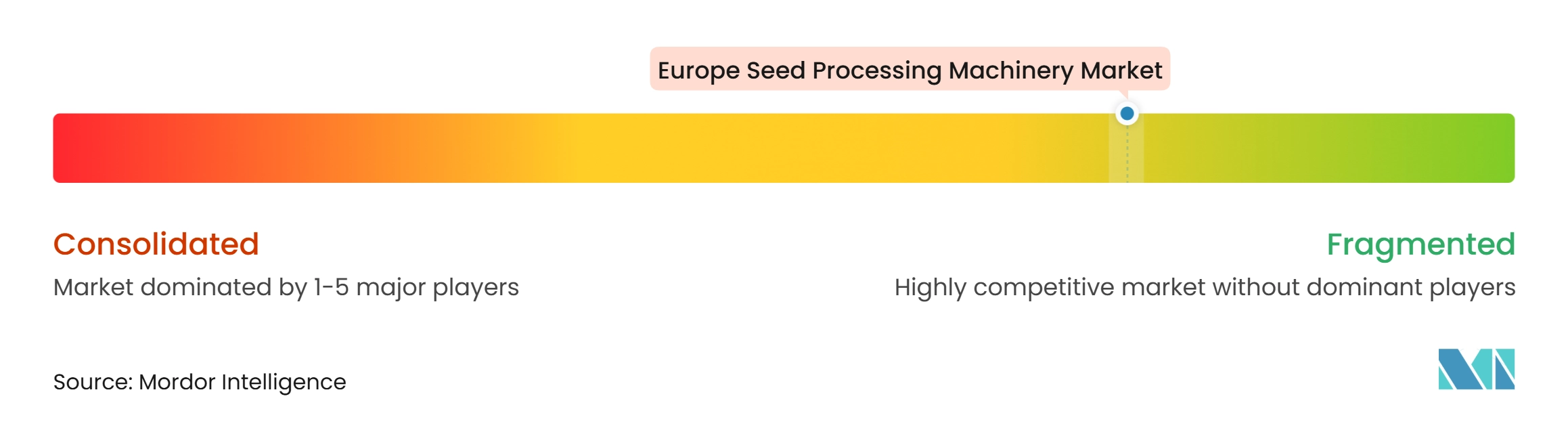
The Europe seed processing machinery market has a concentration score of 3 out of 10 because a limited group of internationally active suppliers competes with many regional specialists, and no combined top-player share is available. PETKUS Technologie GmbH, Westrup ApS, Bühler AG, and Seed Processing Holland B.V. operate across several European countries and compete on equipment breadth, technology, and access to services. Grain and Protein Technologies serves large-scale processing applications, extending the competitive field for commercial plants. SKIOLD GROUP, Alvan Blanch Development Company Ltd, JK MACHINERY, RIELA Polska Sp. z o. o., Reiter Seed Processing GmbH and Co. KG, Agralex Sp. z o. o., ISM SEPARATOR Sp. z o.o., Zuptor Sp. z o.o., Akyürek Group Technology, and Forumagroprom LLC represent the national and regional tier. Their positioning rests on crop specialization, project customization, local support, and price competitiveness. This structure gives buyers a choice between integrated full-line capability and locally tailored machinery.
PETKUS Technologie GmbH partnered with the International Seed Federation in July 2024 to advance educational and commercial activity around its IRIS optical sorting software. Westrup ApS entered a worldwide partnership with 3U Vision in 2025 to integrate color-sorting technology into its seed-cleaning portfolio. Seed Processing Holland B.V. used a 2025 equipment trial to demonstrate a one-step application process for coating and drying materials. These moves focus on the stages where quality control, labor use, and regulatory changes have the greatest effect on plant economics. Competitive advantage therefore depends on integrating machinery stages without adding operating complexity. Suppliers that connect sorting, treatment, drying, and records management within a workable plant layout hold a stronger position in modernization projects.
Bühler AG reported an 8% earnings before interest and taxes margin for 2025, compared with 7.6% in 2024, and stated that it launched 60 products and services during 2025. Westrup ApS reported in July 2025 that net profit had more than doubled in its 2024 to 2025 financial year, supported by completed projects, international expansion, and its 3U Vision partnership. These corporate results do not represent market shares, but they indicate that some international suppliers retain capacity to fund product development, service coverage, and project delivery. Smaller regional firms remain competitive where response time and familiarity with local crop conditions outweigh the value of a broad portfolio. The market therefore supports several competitive positions rather than one uniform supplier model. Demand for compliant, modular upgrades gives regional suppliers a clear route to compete with larger full-line providers.
Europe Seed Processing Machinery Industry Leaders
-
Grain & Protein Technologies
-
PETKUS Technologie GmbH
-
Westrup ApS
-
Bühler AG
-
Seed Processing Holland B.V.
- *Disclaimer: Major Players sorted in no particular order
Europe Seed Processing Machinery Market Companies Covered in this Report
- Grain & Protein Technologies
- PETKUS Technologie GmbH
- Westrup ApS
- Bühler AG
- Seed Processing Holland B.V.
- SKIOLD GROUP
- Alvan Blanch Development Company Ltd
- JK MACHINERY
- RIELA Polska Sp. z o. o.
- Reiter Seed Processing GmbH & Co. KG
- Agralex Sp. z o. o.
- ISM SEPARATOR Sp. z o.o.
- Zuptor Sp. z o.o.
- Akyürek Group Technology
- Forumagroprom LLC
Recent Industry Developments in Europe Seed Processing Machinery Market
- February 2026: Westrup ApS installed the Optica Mini by 3U Vision at Sejet Plant Breeding in Denmark, enabling a transition from manual defect removal to automated optical cleaning
- February 2026: Bühler AG published its 2025 results, reporting an 8% earnings before interest and taxes margin and confirming the launch of 60 products and services during 2025.
- November 2025: PETKUS Technologie GmbH exhibited the Optical Sorter OS G Iris, Batch Treater CM100, G2 Gravity Separator, OS f, and upgraded SL Smart Line at Agritechnica 2025 in Hanover.
Europe Seed Processing Machinery Market Report Scope
Europe Seed processing machinery encompasses equipment used in agriculture to clean, sort, grade, dry, treat, and package seeds, improving their quality and viability for planting. These machines play a critical role in removing impurities, ensuring uniformity, and safeguarding seeds from pests and diseases. The seed processing machinery market report is segmented by machinery type (pre-cleaners, cleaners, dryers, graders, coaters and treaters, separators and destoners, polishers, optical sorters, seed packagers, and other specialized equipment), by operation mode (automatic and semi-automatic), by end-user (commercial seed processing plants, seed producers, research institutions, on-farm facilities, and grain handling facilities), and by geography (France, Germany, Italy, Netherlands, Russia, Spain, Ukraine, United Kingdom, and Rest of Europe). The market forecasts are provided in terms of value (USD).
Segmentation Overview
| Pre-cleaners |
| Cleaners |
| Dryers |
| Graders |
| Coaters and Treaters |
| Separators and Destoners |
| Polishers |
| Optical Sorters |
| Seed Packagers |
| Other Specialized Equipment |
| Automatic |
| Semi-Automatic |
| Commercial Seed Processing Plants |
| Seed Producers |
| Research Institutions |
| On-Farm Facilities |
| Grain Handling Facilities |
| France |
| Germany |
| Italy |
| Netherlands |
| Russia |
| Spain |
| Ukraine |
| United Kingdom |
| Rest of Europe |
| By Machinery Type | Pre-cleaners |
| Cleaners | |
| Dryers | |
| Graders | |
| Coaters and Treaters | |
| Separators and Destoners | |
| Polishers | |
| Optical Sorters | |
| Seed Packagers | |
| Other Specialized Equipment | |
| By Operation Mode | Automatic |
| Semi-Automatic | |
| By End-User | Commercial Seed Processing Plants |
| Seed Producers | |
| Research Institutions | |
| On-Farm Facilities | |
| Grain Handling Facilities | |
| By Country | France |
| Germany | |
| Italy | |
| Netherlands | |
| Russia | |
| Spain | |
| Ukraine | |
| United Kingdom | |
| Rest of Europe |
Key Questions Answered in the Report
What is the value of Europe’s seed processing machinery sector in 2026?
The sector is estimated at USD 1.2 billion in 2026 and is forecast to reach USD 1.5 billion by 2031.
Which machinery type has the largest role in Europe?
Cleaners held the largest machinery-type share at 38% in 2025 because cleaning is needed before later processing stages.
Which equipment category is growing fastest through 2031?
Optical sorters are forecast to grow at the fastest CAGR of 7.5% from 2026 to 2031.
Which end users are the main buyers of seed processing equipment?
Commercial seed processing plants were the largest end-user group with 48% in 2025, while on-farm facilities are the fastest-growing group.