
Europe Roofing Market Size and Share
Market Overview
| Study Period | 2020 - 2031 |
|---|---|
| Forecast Data Period | 2026 - 2031 |
| Base Year Market Size (2025) | USD 48 Billion |
| Market Size (2026) | USD 50.16 Billion |
| Market Size (2031) | USD 63.41 Billion |
| Growth Rate (2026 - 2031) | 4.80 % |
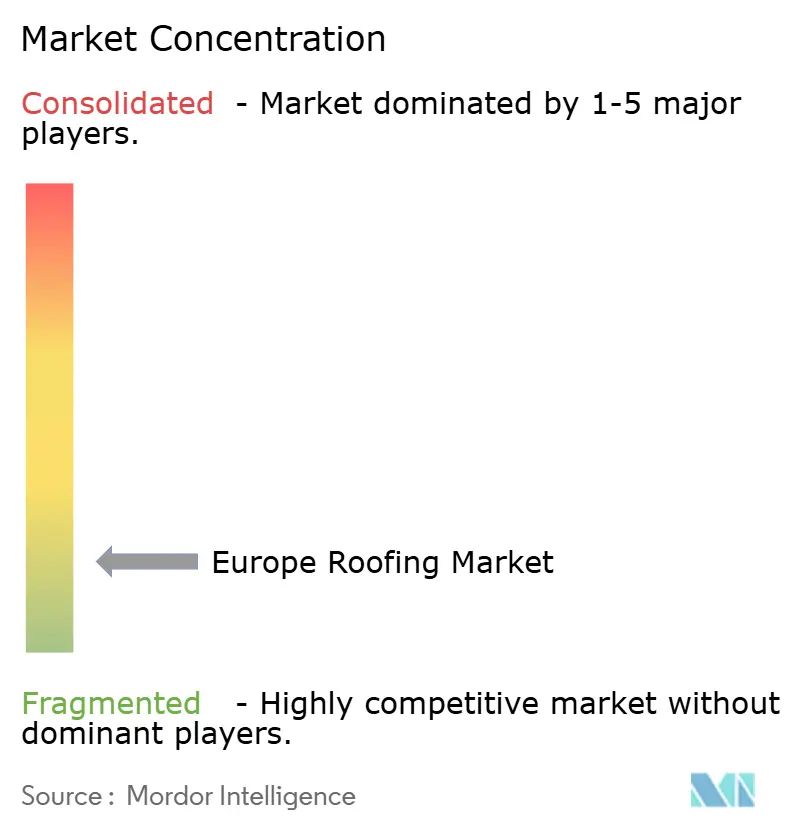
| Market Concentration | Medium |
Major Players *Disclaimer: Major Players sorted in no particular order Image © Mordor Intelligence. Reuse requires attribution under CC BY 4.0. | |
Europe Roofing Market Analysis by Mordor Intelligence
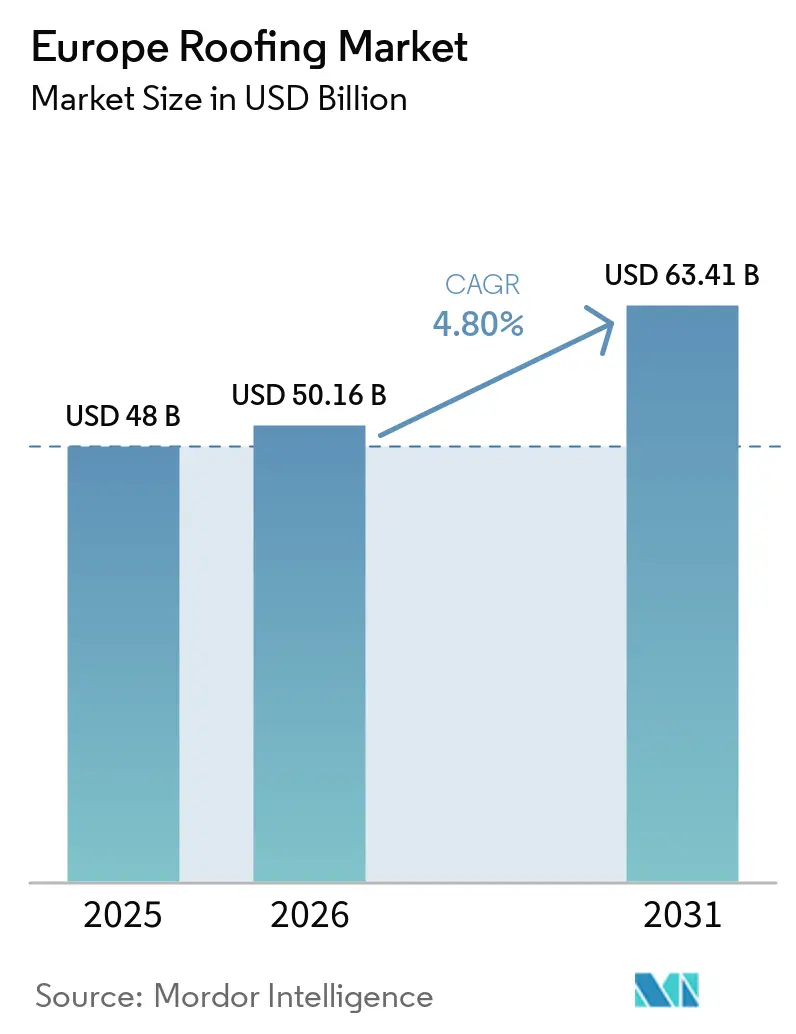
The Europe Roofing Market size is projected to expand from USD 48 billion in 2025 and USD 50.16 billion in 2026 to USD 63.41 billion by 2031, registering a CAGR of 4.80% between 2026 and 2031. The Europe roofing market is supported by an aging building base, as 85% of European Union buildings were built before 2000 and 75% had poor energy performance. The revised Energy Performance of Buildings Directive, or EPBD, requires national implementation by May 2026 and creates a long-term pipeline for renovation work. Integrated suppliers are expanding their roofing, insulation, and solar offerings because renovation projects increasingly combine these elements. Input-cost movements, a limited supply of skilled roofers, and product-compliance costs may delay projects or pressure supplier margins. The Europe roofing market therefore combines stable replacement demand with a shift toward systems that improve energy performance, support solar installations, and meet evolving material requirements.
Key Report Takeaways
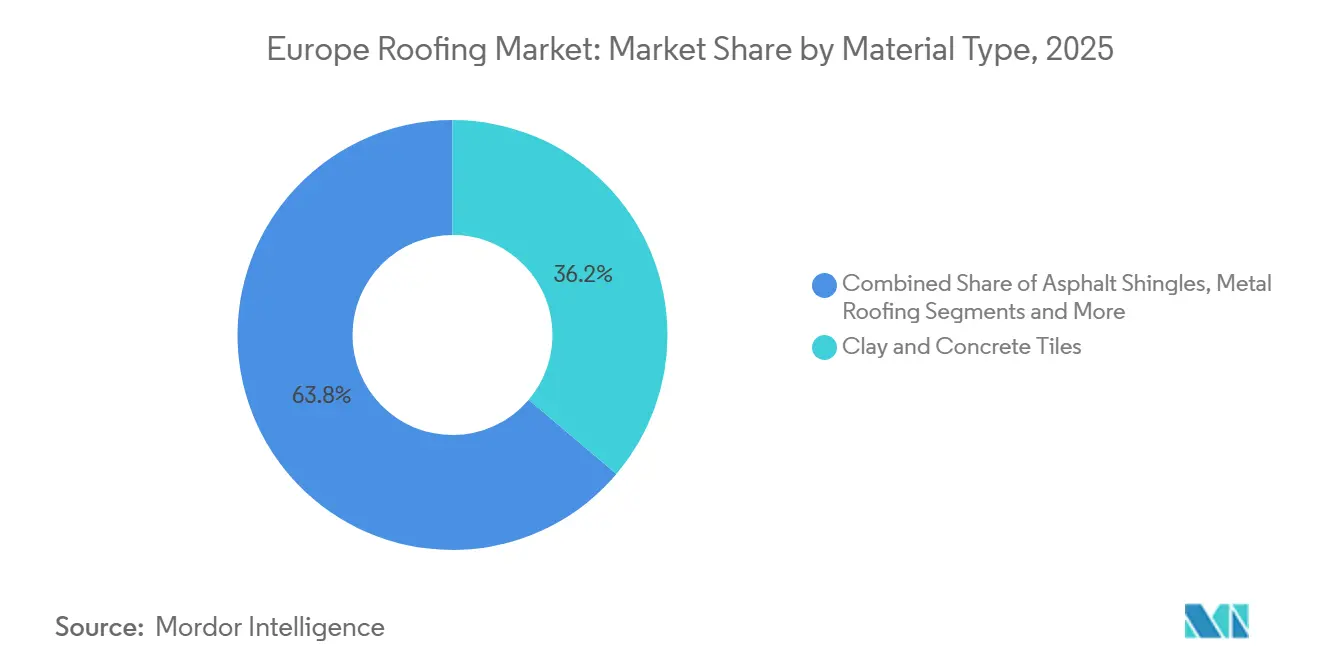
- By material type, clay and concrete tiles held 36.2% of Europe roofing market share in 2025, while metal roofing is forecast to grow at a 6.4% CAGR through 2031.
- By construction type, reroofing and replacement accounted for 57.4% of the Europe roofing market size in 2025, while new construction is forecast to expand at a 6.0% CAGR through 2031.
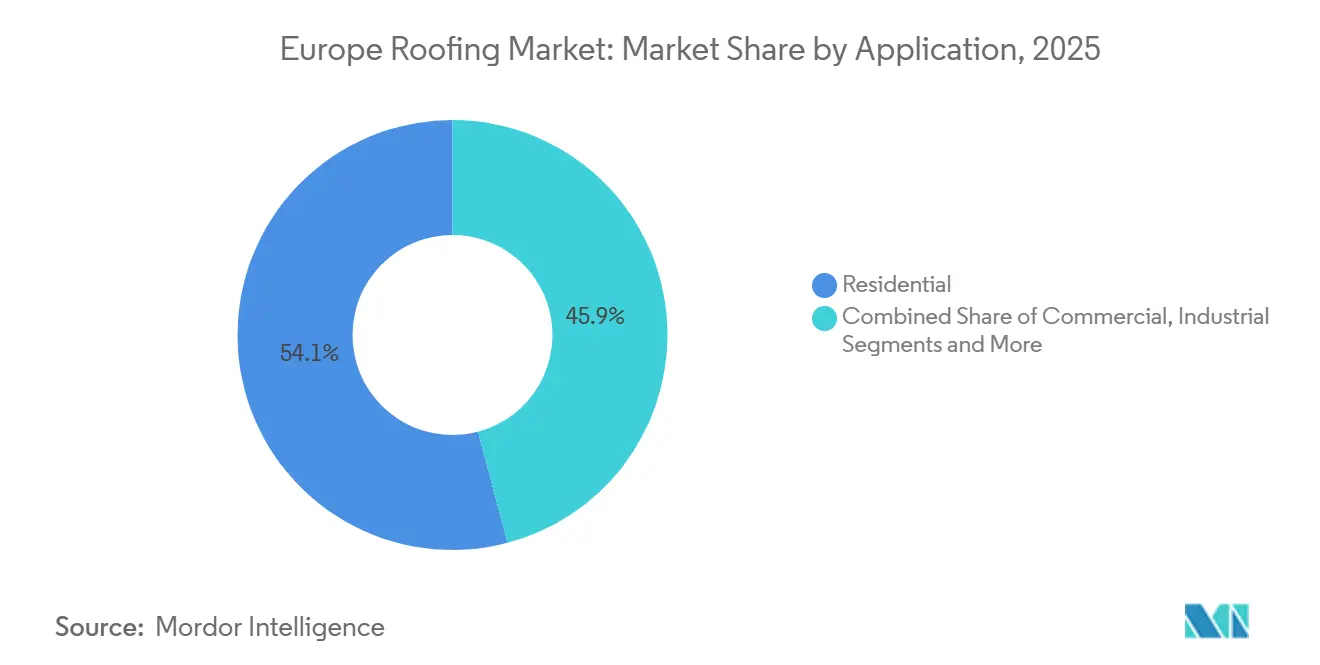
- By application, residential roofing held 54.1% of the Europe roofing market share in 2025, while industrial roofing is forecast to grow at a 6.1% CAGR through 2031.
- By country, Germany held 18.6% of the Europe roofing market size in 2025, while Romania is forecast to expand at a 6.3% CAGR through 2031.
Note: Market size and forecast figures in this report are generated using Mordor Intelligence’s proprietary estimation framework, updated with the latest available data and insights as of January 2026.
Europe Roofing Market Trends and Insights
Drivers Impact Analysis*
| Drivers | (~) % Impact on CAGR Forecast | Geographic Relevance | Impact Timeline |
|---|---|---|---|
| EU Renovation Wave and EPBD Retrofit Mandates | +1.4% | European Union, concentrated in Germany, France, Italy, and Central and Eastern Europe | Medium term (2-4 years) |
| Climate Targets Supporting Cool and Green Roofs | +0.7% | European Union, strongest in Germany, the Netherlands, and France | Long term (≥ 4 years) |
| Hailstorms and Wildfires Supporting Impact-Resistant Systems | +0.5% | Southern Europe and the Balkans | Short term (≤ 2 years) |
| Circular-Economy Rules Supporting Recyclable Materials | +0.4% | European Union, with advanced adoption in Northern Europe | Medium term (2-4 years) |
| Heritage Restoration Codes Supporting Clay And Slate Systems | +0.3% | Western and Southern Europe | Long term (≥ 4 years) |
| Contractor Consolidation Expanding Installation Capacity | +0.2% | Germany, the Netherlands, and the United Kingdom | Medium term (2-4 years) |
| Source: Mordor Intelligence | |||
EU Renovation Wave and EPBD Near-Zero-Energy Retrofit Mandates
The revised EPBD is a central demand driver for the Europe roofing market because it links building upgrades to national energy targets. It requires member states to renovate the 16% worst-performing nonresidential buildings by 2030 and reduce residential primary energy consumption by 16% by the same year[1]. Roof insulation and envelope work can help owners meet these targets because the roof is a major point of heat loss. Member states must introduce renovation-passport schemes by May 2026, giving building owners phased plans that can include later roof improvements. The Commission assessed 15 National Building Renovation Plans in July 2026, which set primary-energy reduction targets ranging from 24% to 73% by 2050. This makes demand less dependent on short-term housing starts and more connected to planned building upgrades.
National Climate-Neutrality Targets Accelerating Cool-Roof and Green-Roof Adoption
Climate targets are changing roof specifications across the Europe roofing market, especially for public and larger commercial buildings. The EPBD recognizes green roofs and cool roofs as measures that can reduce heating and cooling needs. Biosolar roofs combine vegetation with photovoltaic panels and can reduce panel-surface temperatures, supporting electricity output and system life. Germany has maintained green-roof support and requirements since 1998, while municipalities in the Netherlands, Austria, and Switzerland use comparable approaches. The directive also requires solar installations on new public nonresidential buildings from 2026 and on existing nonresidential buildings above 250 square meters from 2030. Wienerberger completed its acquisition of the remaining stake in GSE Intégration in July 2025, bringing in-roof photovoltaic technology into its European roofing offer.
Rising Hailstorm and Wildfire Frequency In Southern And Central Europe Driving Impact-Resistant Systems
Weather-related damage is increasing interest in higher-performance roofing systems in the Europe roofing market. Spain’s 2025 wildfire season caused close to USD 5.4 billion in damage, while low insurance coverage in parts of Southern Europe left a substantial share of losses uninsured. Swiss Re reported that wildfires, severe convective storms, and flooding made up 92% of USD 107 billion in global insured natural-catastrophe losses during 2025. Severe weather also damaged roofs in Croatia and other Balkan locations during 2025. These events can influence rebuilding specifications toward metal roofing and tiles with stronger wind-uplift performance. Saint-Gobain positions its reinforced ClimateFlex roofing technology for resilient roof applications. The resulting demand is concentrated in exposed areas, but it can add a resilience requirement to ordinary renovation projects.
Circular-Economy Regulation Pushing Recyclable and Bio-Based Roofing Materials
Circular-economy requirements are widening the performance criteria used in the Europe roofing market. The Construction Products Regulation, or CPR, EU 2024/3110, entered into force in January 2025 and applies progressively from January 2026. It introduces sustainability information and circular-economy requirements for construction products sold in the European Union. Metal systems can benefit because steel and aluminum roofs may contain recycled content and are recyclable at the end of their service life. The Waste Framework Directive target for recovery of at least 70% of nonhazardous construction waste places pressure on membrane suppliers to develop collection and recycled-material programs. Environmental Product Declarations, or EPDs, are becoming a common specification requirement, increasing the documentation expected from suppliers[3]. These requirements favor companies that can manage compliance across broad product portfolios, while raising the cost of participation for smaller producers.
Restraints Impact Analysis*
| Restraints | (~) % Impact on CAGR Forecast | Geographic Relevance | Impact Timeline |
|---|---|---|---|
| Energy-Price Volatility Raising Bitumen and PVC Input Costs | -0.9% | Europe, with the greatest margin exposure in Central and Northern Europe | Medium term (2-4 years) |
| CE Marking, REACH, and Fire-Classification Compliance Costs | -0.8% | European Union, especially smaller producers | Medium term (2-4 years) |
| Aging Skilled-Tradesperson Workforce | -0.5% | Western Europe, especially the United Kingdom, Sweden, and Germany | Long term (≥ 4 years) |
| Slow Permitting For Historic And Protected Buildings | -0.1% | Western and Southern Europe | Long term (≥ 4 years) |
| Source: Mordor Intelligence | |||
Energy-Price Volatility Raising Bitumen and PVC Input Costs
Feedstock volatility creates an immediate margin risk for producers in the Europe roofing market. Bitumen costs are tied to crude oil and refinery output, while thermoplastic polyolefin, or TPO, and polyvinyl chloride, or PVC, resin costs follow propylene and ethylene markets. Changes in supply conditions can complicate purchasing decisions for membrane producers that cannot lock in stable costs. Energy surcharges on membrane contracts can then reach contractors and make retrofit budgets less predictable. Bituminous and modified-bitumen membranes are especially exposed because manufacturing depends on both crude-oil prices and natural-gas costs. This exposure can delay discretionary retrofit decisions when project budgets must be revised.
Stringent CE Marking, REACH, And Fire-Classification Compliance Costs
Compliance requirements can slow product launches and add recurring costs in the Europe roofing market. The CPR and related fire-safety frameworks require producers to maintain product classifications, declarations of performance, and technical documentation. Producers using chemical plasticizers or polymer modifiers also have to manage chemical compliance responsibilities. The burden is greater for small companies with limited product ranges because testing and documentation cannot be spread across a large portfolio. Compliance can consequently encourage consolidation even when product demand remains sound.
*Our forecasts treat driver/restraint impacts as directional, not additive. The impact forecasts reflect baseline growth, mix effects, and variable interactions.
Segment Analysis
By Material Type: Tiles Lead While Metal Roofing Grows Fastest
Clay and concrete tiles accounted for 36.2% of the Europe roofing market in 2025, making them the largest material category. Their durability, thermal mass, and fit with heritage requirements support replacement demand across the large stock of pitched residential roofs in France, Italy, and Spain. Wienerberger completed the Terreal acquisition in March 2024, adding 28 production sites and the Creaton brand to its clay-tile and pitched-roof operations. Bituminous membranes remain important for flat commercial roofs, where waterproofing performance remains the first requirement.
Metal roofing is the fastest-growing material, with a forecast CAGR of 6.4% from 2026 to 2031. Lighter weight can make metal systems useful for older frames that cannot easily support heavier replacements. Standing-seam and concealed-fix profiles can also simplify photovoltaic mounting and speed installation when labor is limited. Single-ply systems, including TPO, ethylene propylene diene monomer, or EPDM, and PVC membranes, are gaining use on larger industrial roofs because they work with drainage layouts and solar installations. Asphalt shingles and wood continue to serve narrower residential renovation needs where design preference or heritage rules matter. The Europe roofing industry is moving toward materials that connect roof performance with energy and solar requirements.

By Construction Type: Reroofing Provides The Base While New Construction Expands
Reroofing and replacement represented 57.4% of the Europe roofing market in 2025, providing the largest construction-type base. The scale reflects the age of the regional building stock and standard roof lifecycles of 20 to 40 years. Replacement projects increasingly include insulation and photovoltaic work rather than a like-for-like roof change, raising project value and supporting suppliers that can provide compatible systems. Wienerberger reported in 2026 that renovation-driven roofing activity in France and Germany continued to gain importance.
New construction is forecast to grow at a 6.0% CAGR from 2026 to 2031, the fastest pace in this split. Central and Eastern Europe contributes to this demand through housing construction and industrial, logistics, and public developments. Poland, the Czech Republic, and Romania remain important locations for this activity. Western European residential starts were softer during 2025 because household credit conditions limited demand. Public and commercial building programs offer some offset as zero-emission standards are introduced for public buildings from 2028. The Europe roofing industry depends on replacement work for stability, while new buildings provide a faster-moving area of demand.
By Application: Residential Roofing Leads While Industrial Demand Advances
Residential applications held 54.1% of the Europe roofing market in 2025, the largest application share. The category is supported by the scale of European housing and the importance of single-family and low-rise renovation programs. Germany’s Federal Funding for Energy-Efficient Buildings program and France’s MaPrimeRénov' program support roof-related efficiency improvements, while commercial offices, retail properties, and hotels create a second major area of demand. Most residential activity comes from renovation and replacement rather than new construction.
Industrial roofing is forecast to grow at a 6.1% CAGR from 2026 to 2031, the fastest rate among applications. Warehouses, manufacturing sites, and energy-intensive facilities require extensive roof areas and often need insulation, drainage, and solar-ready specifications. The European Chips Act is expected to support industrial construction in Germany, France, and Ireland[2]. Institutional buildings such as schools and hospitals also benefit from the EPBD program for public nonresidential buildings. EPDM and TPO membranes are gaining attention for large flat roofs because they suit large-format installation and rooftop solar configurations. The Europe roofing market is exposed to both smaller residential projects and larger projects with complex technical requirements.
Geography Analysis
Germany held 18.6% of the Europe roofing market in 2025, making it the largest country market, and the Building Energy Act with the May 2026 EPBD implementation deadline supports roof improvements during major renovations. The 10.8% rise in first-year roofing apprentices in 2025 improves the future labor base, although demand has risen faster than workforce capacity. The United Kingdom remains a substantial market because of aging homes and social-housing needs. Its roofing workforce fell from close to 50,000 workers during the COVID-19 period to 39,000 to 40,000 workers, limiting project delivery. Sika acquired Cromar Building Products in March 2025, strengthening its supply of flat and pitched roofing systems in the United Kingdom.
France and Italy remain important for clay and concrete tiles because heritage architecture and local planning rules support traditional roof materials. France’s renovation incentives and the EPBD renovation-passport approach can support phased roof upgrades. Italy combines roof replacement with some seismic retrofit work, increasing the scope of certain projects. Spain’s wildfire damage in 2025 has increased attention to fire-resistant metal roofs and impact-resistant tiles in exposed regions. The Europe roofing market across these countries is shaped by renovation policy, local building rules, and climate resilience needs.
Romania’s 6.3% forecast CAGR through 2031 makes it the fastest-growing geography in the Europe roofing market. The country is aligning renovation policy with European Union standards and modernizing underinvested building stock, while Poland, the Czech Republic, the Baltics, and other Central European countries support demand for metal roofing and single-ply membranes. Sweden illustrates a capacity constraint, as the country needs 2,000 roofers over 3 years but trains 1,000. These markets offer higher construction activity, but installation capacity remains a practical limit on realized demand.
Competitive Landscape
The Europe roofing market has a consolidating group of integrated building-material suppliers and a fragmented base of regional manufacturers, contractors, and distributors. Wienerberger assembled a dedicated European roofing platform through the Terreal and GSE Intégration transactions, and reported USD 1.3 billion in 2025 revenue from that platform. Its strategy links clay tiles, renovation systems, and in-roof photovoltaic products. Sika uses its building-chemicals position and expanded distribution reach to address professional installers and building merchants.
Holcim sells roofing through Building Solutions brands, including Elevate and ZinCo, and can combine roofing with wider building-envelope requirements. Holcim reported an 18.3% recurring earnings before interest and taxes margin for 2025, although this figure relates to the wider group rather than roofing alone. The Europe roofing market has room for suppliers that combine roof membranes or tiles with photovoltaic mounting and biosolar compatibility. Wienerberger’s 2025 GSE Intégration acquisition is a clear example of this strategic direction. Saint-Gobain also positions reinforced roofing technology for applications that need stronger weather resilience.
Manufacturer concentration is increasing, while the contractor side remains dispersed across many local operators. This creates execution risk when national renovation programs require rapid installation capacity. Private-equity investors are pursuing platform-building strategies in roofing and facade contracting, including Bencis Capital Partners’ 2024 partnership with Wessels Bouwgroep in the Netherlands. TechnoNICOL’s 2024 divestiture of Italian and Lithuanian European operations, together with Sika’s Cromar deal and Wienerberger’s Terreal and GSE Intégration purchases, shows how acquisitions are extending product range, supply coverage, and solar capability. The available evidence supports a fragmented competitive structure rather than control by a small group of suppliers.
Europe Roofing Industry Leaders
-
Standard Industries
-
BMI Group
-
Owens Corning
-
Holcim
-
Saint-Gobain
- *Disclaimer: Major Players sorted in no particular order
Recent Industry Developments
- August 2026: Reuters reports France's unprecedented wildfire season prompts Europe-wide insurance reassessment. Approximately 220,000 residents were evacuated in France as wildfires burned across Spain and Greece, intensifying insurer and property-owner demand for fire-resistant roofing specifications and accelerating regulatory discussions on building resilience standards.
- May 2026: Saint-Gobain signed agreement to divest Tiles Distribution business in the Nordics. Portfolio rationalization of non-core distribution assets in Nordic markets reflects the group’s strategy of rotating toward higher-value construction chemicals and specification-led roofing and plasterboard businesses.
- January 2026: Bauder has officially opened its new production facility in Drusenheim, Alsace. Following a construction period of approximately two and a half years, Europe’s most modern production site for roofing systems is now fully operational. As a fourth-generation family-owned company, Bauder invested approximately EUR 100 million in its first plant in France, reinforcing its sustainable growth strategy and long-term commitment to Europe as a key business location.
Europe Roofing Market Report Scope
| Asphalt Shingles |
| Clay & Concrete Tiles |
| Metal Roofing |
| Bituminous / Modified Bitumen Membranes |
| Single-Ply Membranes (TPO, EPDM, and PVC) |
| Wood |
| Others |
| New Construction |
| Reroofing and Replacement |
| Residential |
| Commercial |
| Industrial |
| Institutional |
| Others |
| Germany |
| United Kingdom |
| France |
| Italy |
| Spain |
| Rest of Europe |
| By Material Type | Asphalt Shingles |
| Clay & Concrete Tiles | |
| Metal Roofing | |
| Bituminous / Modified Bitumen Membranes | |
| Single-Ply Membranes (TPO, EPDM, and PVC) | |
| Wood | |
| Others | |
| By Construction Type | New Construction |
| Reroofing and Replacement | |
| By Application | Residential |
| Commercial | |
| Industrial | |
| Institutional | |
| Others | |
| By Countries | Germany |
| United Kingdom | |
| France | |
| Italy | |
| Spain | |
| Rest of Europe |
Key Questions Answered in the Report
What is the forecast growth rate for Europe roofing through 2031?
The Europe roofing market is forecast to grow at a 4.8% CAGR from 2026 to 2031, reaching USD 63.41 billion.
Which roofing material is growing fastest in Europe?
Metal roofing is the fastest-growing material category, with a projected CAGR of 6.4% from 2026 to 2031.
What is driving roof replacement demand across Europe?
Aging buildings, energy-efficiency requirements under the EPBD, and the need to combine reroofing with insulation or solar work are key factors.
Which construction type has the largest share of demand?
Reroofing and replacement accounted for 57.4% of demand in 2025, supported by Europe’s older building stock.
Which application is expected to grow fastest?
Industrial roofing is forecast to grow at a 6.1% CAGR through 2031, supported by logistics, manufacturing, and larger energy-efficient buildings.
Which country is expected to grow fastest through 2031?
Romania is forecast to grow at a 6.3% CAGR, supported by building modernization and construction activity.