
Europe Property Insurance Market Size and Share
Market Overview
| Study Period | 2020 - 2031 |
|---|---|
| Forecast Data Period | 2026 - 2031 |
| Base Year Market Size (2025) | USD 177.80 Billion |
| Market Size (2026) | USD 184.5 Billion |
| Market Size (2031) | USD 225.20 Billion |
| Growth Rate (2026 - 2031) | 4.10 % |
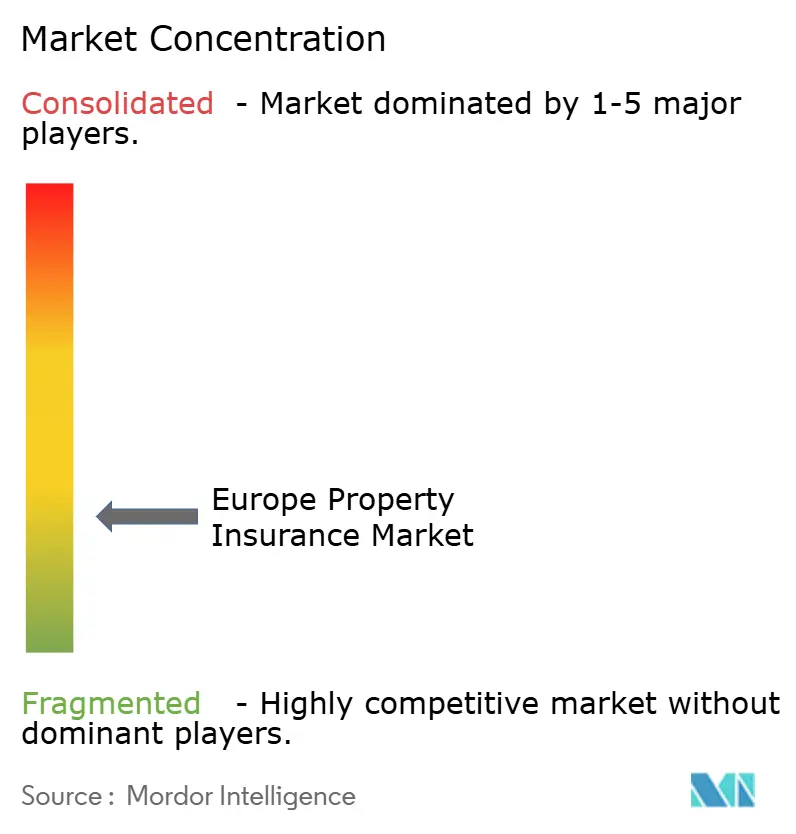
| Market Concentration | Low |
Major Players *Disclaimer: Major Players sorted in no particular order Image © Mordor Intelligence. Reuse requires attribution under CC BY 4.0. | |
Europe Property Insurance Market Analysis by Mordor Intelligence
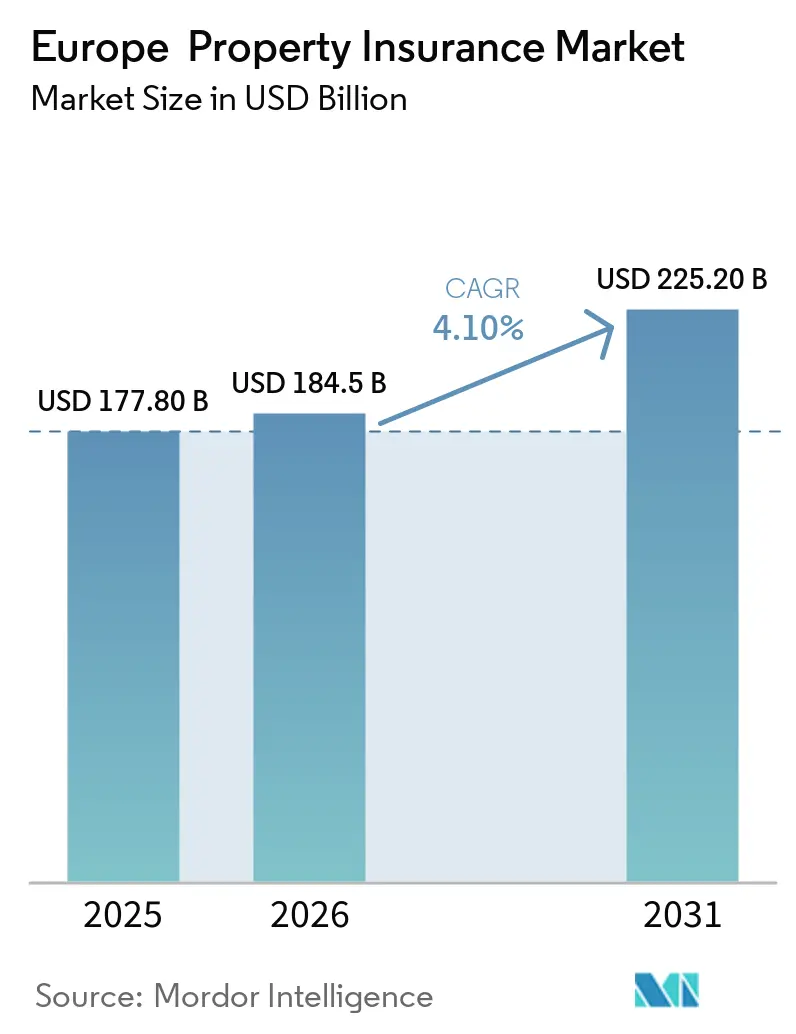
The Europe Property Insurance Market size is expected to grow from USD 177.80 billion in 2025 to USD 184.5 billion in 2026 and is forecast to reach USD 225.20 billion by 2031 at 4.10% CAGR over 2026-2031.
Natural catastrophe losses have increased the need for broader property protection across the region, while a significant share of losses remains uninsured. EIOPA reported that only 25% of European Union natural-catastrophe losses have been insured over recent decades, which leaves a large protection gap for insurers and public authorities to address. Property exposure in modeled European countries increased 7% each year from 2021 to 2025 as construction activity and asset values rose. Regulatory action, risk-sharing arrangements, and digital distribution are widening the scope for premium growth in the European property insurance market. Higher repair costs, affordability concerns, and uncertainty around future climate losses also limit how far insurers can extend coverage in high-risk areas.
Key Report Takeaways
- By insurance product, homeowners' insurance captured 43.5% of the European property insurance market share in 2025, while landlord insurance is projected to grow at 5.6% CAGR through 2031.
- By coverage type, building and structural coverage captured 60.3% of the European property insurance market share in 2025, while business interruption and loss-of-income coverage is projected to grow at 5.1% CAGR through 2031.
- By property type, residential properties captured 56.2% of the European property insurance market in 2025, while industrial and manufacturing properties are projected to grow at 5.8% CAGR through 2031.
- By policyholder, households captured 49.8% of the Europe property insurance market in 2025, while professional real-estate owners are projected to grow at 6% CAGR through 2031.
- By distribution channel, agents and brokers captured 67.4% of the European property insurance market in 2025, while embedded and affinity channels are projected to grow at 9.6% CAGR through 2031.
- By geography, Germany captured 18.4% of the Europe property insurance market in 2025, while Italy is projected to grow at 5.4% CAGR through 2031.
Note: Market size and forecast figures in this report are generated using Mordor Intelligence’s proprietary estimation framework, updated with the latest available data and insights as of January 2026.
Europe Property Insurance Market Trends and Insights
Drivers Impact Analysis*
| Driver | (~) % Impact on CAGR Forecast | Geographic Relevance | Impact Timeline |
|---|---|---|---|
| More Frequent and Severe Property Climate Hazards | +1.2% | Europe, especially Italy, Spain, France, Germany, and Central and Eastern Europe | Short term (≤ 2 years) |
| Rising Property Values and Exposure in High-Risk Areas | +0.8% | Northern and Western Europe, including the United Kingdom, Germany, the BENELUX, and France | Medium term (2-4 years) |
| Higher Construction, Repair, and Replacement Costs | +0.7% | Europe, with pressure in the United Kingdom and Germany | Short term (≤ 2 years) |
| Broader Nat-Cat Coverage and Public-Private Risk Sharing | +0.6% | Italy, Southern Europe, France, Spain, and Germany | Medium term (2-4 years) |
| Data-Driven and Parametric Property Risk Solutions | +0.4% | Germany, France, the United Kingdom, Italy, and wider Europe | Medium term (2-4 years) |
| Property Risk-Prevention Technology Adoption | +0.3% | Nordic countries, the United Kingdom, and Germany | Long term (≥ 4 years) |
| Source: Mordor Intelligence | |||
Accelerating Nat-Cat Frequency Is Repricing European Property Risk
Natural hazards are becoming a sustained underwriting issue for the European property insurance market rather than a short-lived claims event. EIOPA noted that the 4 years before 2026 were among Europe’s 5 costliest years for climate-related losses since 1980[1]. The growing frequency of floods, storms, wildfires, and other hazards raises the value of comprehensive property cover for households and businesses. It also increases the importance of accurate hazard mapping, policy wording, and reinsurance protection when insurers price new business. The European property insurance market can benefit from demand for cover, but higher expected losses can reduce underwriting margins if pricing and protection do not keep pace. Insurers are therefore placing greater emphasis on prevention and risk selection alongside post-loss claims payments.
Rising Property Values and Urban Exposure Amplify Insured Loss Potential
Rising building values and new construction have increased the insured values exposed to property losses across Europe. Verisk found that property exposure in its modeled European countries grew 7% annually between 2021 and 2025, supported by construction and higher asset values. In the United Kingdom, residential rebuild costs rose 4.9% in the year to January 2026, following a 3.8% increase in the preceding year[2]. Higher replacement values can expand written premiums in the European property insurance market, but they also increase the risk of underinsurance when policies are not updated. Commercial and industrial buildings need regular reassessment because their repair costs may move faster than standard annual indexation. This makes renewal valuation an important underwriting and loss-control practice for insurers and brokers.
Public-Private Nat-Cat Schemes Expand Coverage and Addressable Premiums
Public-private arrangements are becoming an important route to expand natural-catastrophe protection in the European property insurance market. Italy’s mandatory corporate natural-catastrophe insurance regime extended from large enterprises in March 2025 to small and medium-sized enterprises in January 2026, covering earthquake, flood, landslide, and inundation risks for corporate assets. Germany’s insurance association proposed Elementar Re in December 2025 to support protection for 400,000 high-risk buildings through sector-funded risk sharing[3]. EIOPA and the European Stability Mechanism modeled a European catastrophe excess-of-loss pool that could reduce the property protection gap from 50% to 10%. Such arrangements could allow private insurers to provide first-layer coverage while public mechanisms absorb more severe losses. The approach may improve availability in locations where fully private coverage is difficult to sustain.
Parametric and Data-Driven Solutions Are Reshaping the Innovation Frontier
Parametric and data-led products are widening the range of risks that can be addressed by the European property insurance market. AXA XL and AXA Climate use parametric structures for risks such as non-damage business interruption caused by heatwaves or droughts, with weather data supporting faster claims settlement. Generali expanded its use of Intermap’s Aquarius RMA platform to Poland, Hungary, and Slovenia in June 2026 to strengthen flood and natural-catastrophe underwriting[4]. These tools can support address-level pricing where historical data alone is less reliable. They can also reduce claims handling work when a measurable event triggers a predetermined payment. The European property insurance market is seeing digital tools used both for underwriting decisions and for risk prevention before a loss occurs.
Restraints Impact Analysis*
| Restraint | (~) % Impact on CAGR Forecast | Geographic Relevance | Impact Timeline |
|---|---|---|---|
| Affordability Constraints from Higher Property and Nat-Cat Premiums | -0.6% | Italy, Spain, Greece, and high-risk zones in Germany and the United Kingdom | Short term (≤ 2 years) |
| Climate Risk, Uncertainty, and Insurability Constraints | -0.5% | Mediterranean coasts, German flood corridors, and United Kingdom wildfire areas | Medium term (2-4 years) |
| Claims Cost Inflation and Repair-Capacity Constraints | -0.4% | Europe, with acute pressure in the United Kingdom and Germany | Short term (≤ 2 years) |
| Persistent Nat-Cat Underinsurance and Coverage Gaps | -0.3% | Eastern Europe, Southern Europe, and high-risk rural areas | Long term (≥ 4 years) |
| Source: Mordor Intelligence | |||
Premium Affordability Is Suppressing Take-Up Where It Matters Most
Affordability can restrict take-up in the European property insurance market even where the physical need for protection is increasing. EIOPA’s 2025 survey found that 17% of European respondents held property cover for natural-catastrophe damage. The survey identified income limits, unclear policy terms, and expectations of public support as barriers to demand. In Germany, 41% of residential buildings lacked elemental-damage cover in 2025, and high-risk properties faced annual premiums above EUR 2,000 (USD 2,200), compared with EUR 608 (USD 668.8) for a standard home policy with elemental cover. Rising repair costs can add further pressure by increasing premiums and creating constraints on contractor capacity after large events. If lower-risk customers leave voluntary insurance pools, the remaining pool may become more exposed and harder to price affordably.
Climate Uncertainty Is Constraining Insurability at the Margin
Climate uncertainty makes it harder for insurers to determine sustainable prices and coverage terms in exposed areas. EIOPA and the European Stability Mechanism estimated that 50% of European property risk remained uninsured under their catastrophe-modeling approach. The estimate was 75% under historical loss data because that approach covers a wider economic-loss base. Germany’s exposure is moving from a storm-led pattern toward one with more flood risk as heavy rainfall processes strengthen. Insurers need more detailed location data and prevention measures when past loss tables do not fully represent emerging hazard patterns. These conditions can narrow capacity in the European property insurance market, especially in Mediterranean coastal zones, flood corridors, and rural areas with persistent coverage gaps.
*Our forecasts treat driver/restraint impacts as directional, not additive. The impact forecasts reflect baseline growth, mix effects, and variable interactions.
Segment Analysis
By Insurance Product: Homeowners Anchor the Market as Landlord Coverage Accelerates
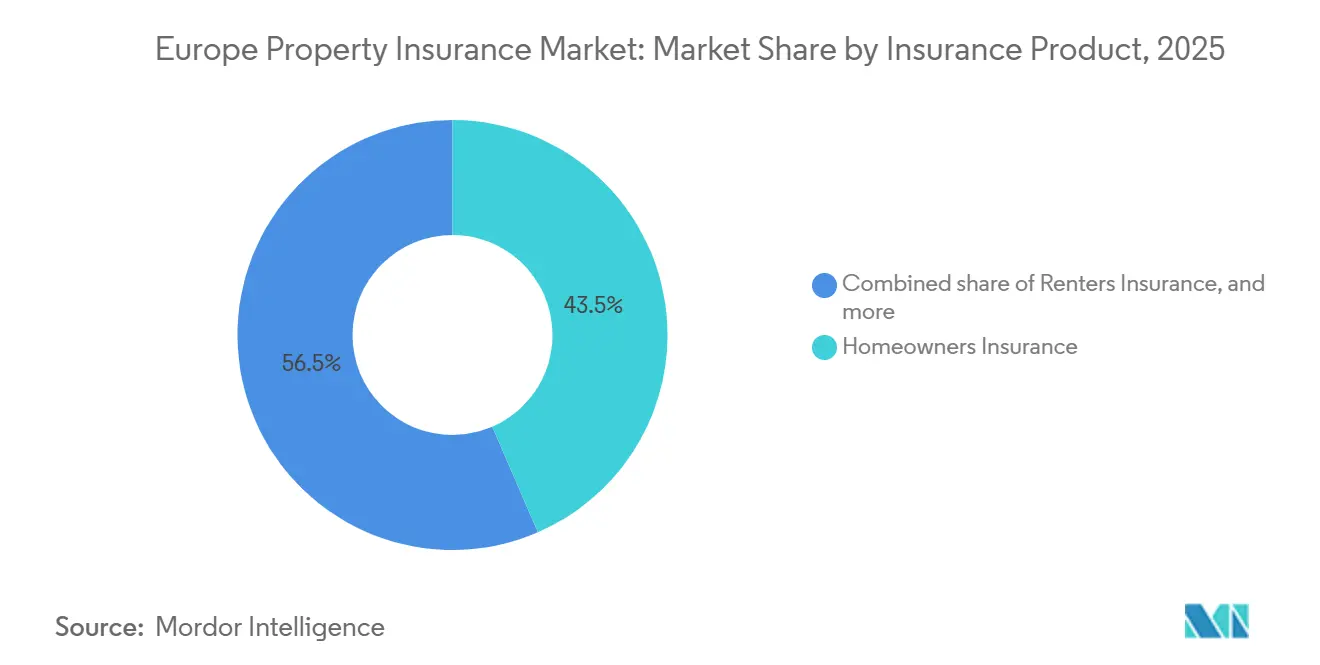
Homeowners insurance accounted for 43.5% of the European property insurance market in 2025 and remained the largest product category. Its scale reflects large owner-occupier populations across Western Europe and lender requirements linked to mortgages. Residential investment also supports demand for coverage that protects buildings and household assets. The Association of British Insurers reported GBP 307 million (USD 414.5 million) in subsidence payouts in the United Kingdom during 2025. The average settled subsidence claim reached GBP 17,820 (USD 24,057) in the first quarter of 2026, 9% higher than a year earlier. These claims illustrate why accurate rebuilding values remain important for homeowner policies. Escape-of-water and subsidence losses can affect earnings when insured values do not reflect current repair costs. The product category remains central to the European property insurance market because it combines a broad customer reach with substantial insured asset values. Its future performance will depend on insurer pricing, policy design, and preventive risk management.
Landlord insurance is projected to grow at a 5.6% CAGR through 2031, making it the fastest-growing insurance product. The category benefits from professional buy-to-let portfolios and the continued use of short-term rental platforms. These risks need specialist terms that go beyond standard homeowner policy wording. Commercial property insurance is smaller by volume share but benefits from higher insured values in logistics, data-center, and high-specification office assets. Renters insurance remains less developed in Southern and Eastern Europe because product design and distribution have historically focused on owner-occupiers. The European property insurance industry is also adapting its underwriting approach for landlords with multiple properties and varied tenant profiles. Policy conditions need to reflect building use, vacancy, liability, and property maintenance requirements. This creates a distinct opportunity for insurers that can combine property coverage with risk services. It also requires close attention to claims frequency across professionally managed and short-term rental properties. The European property insurance market, therefore, has different growth drivers within personal and commercial product lines.
By Coverage Type: Structural Coverage Dominates but Business Interruption Lines Gather Momentum
Building and structural coverage held 60.3% of the Europe property insurance market in 2025. It is the foundation of protection for both personal and commercial property policies. The category covers the physical structure, which makes it essential for mortgage-backed homes and business premises. Its large share reflects the high replacement cost of buildings after fire, flood, storm, and other covered damage. Contents and personal property coverage complements structural protection for household goods and business equipment. Smart-home devices and connected sensors can help insurers identify water leaks and fire hazards sooner. This can reduce loss severity where customers use prevention tools consistently. The European property insurance market continues to rely on structural coverage as its largest protection line. Building values and repair costs will remain important pricing inputs for this category. The scale of structural coverage also creates a strong need for updated sums insured at renewal.
Business interruption and loss-of-income coverage is projected to grow at a 5.1% CAGR through 2031. Commercial tenants and asset owners are seeking protection against income disruption as operations become more dependent on continuous access to buildings and equipment. Policy wording has also received greater attention following disputes over business interruption cover. AXA XL identified non-damage interruption from heatwaves and droughts as a priority area for parametric structures. Parametric policies can respond to a defined weather trigger without requiring physical damage to a building. They can provide faster settlement and lower claims handling needs than conventional indemnity policies. This supports the expansion of interruption cover into risks that traditional products have often excluded. The Europe property insurance industry can use these structures to serve businesses with exposure to weather-linked disruption. Insurers must still make policy triggers clear so customers understand when payment will occur. The broader use of business interruption cover adds a revenue source alongside conventional building protection.
By Property Type: Residential Assets Provide the Volume Base while Industrial Risk Leads Growth
Residential properties represented 56.2% of the Europe property insurance market in 2025. The segment is supported by the region’s large stock of owner-occupied and rented homes. Home protection remains closely linked to mortgage lending, rebuilding values, and household asset protection. Residential risks also generate recurring claims from escape of water, subsidence, fire, and weather events. The segment has broad policy volume and a large base of insured buildings. It is therefore important for insurers to maintain efficient distribution and claims processes. Rising rebuilding costs increase the need for policyholders to review declared values. Regional differences in flood, wildfire, and storm exposure also shape product pricing. Residential properties provide the volume base for the European property insurance market. Their risk profile makes prevention services and clear coverage terms increasingly relevant.
Industrial and manufacturing properties are projected to grow at a 5.8% CAGR through 2031. Data centers, battery-storage facilities, and distributed-energy assets support demand because they have high replacement values and specialized risk profiles. These facilities may need coverage terms that are not available through standard property policies. Commercial buildings also benefit from logistics investment, mixed-use development, and recovering hospitality activity. Public and institutional buildings can face underinsurance because public procurement rules may not reflect commercial reinstatement costs. Agricultural buildings remain a smaller but strategically relevant category within the European property insurance market. A parametric service introduced by CNH Capital, BNP Paribas Leasing Solutions, Shepherd Compello, and Swiss Re began its European rollout in Spain during 2026. The service covers machinery downtime during extreme weather and is linked to equipment financing agreements. This example shows how coverage can be incorporated into asset-intensive ownership arrangements. It also shows the role of specialized products in expanding protection for nontraditional property exposures.
By Policyholder: Households Dominate Volume but Professional RE Owners Lead Growth
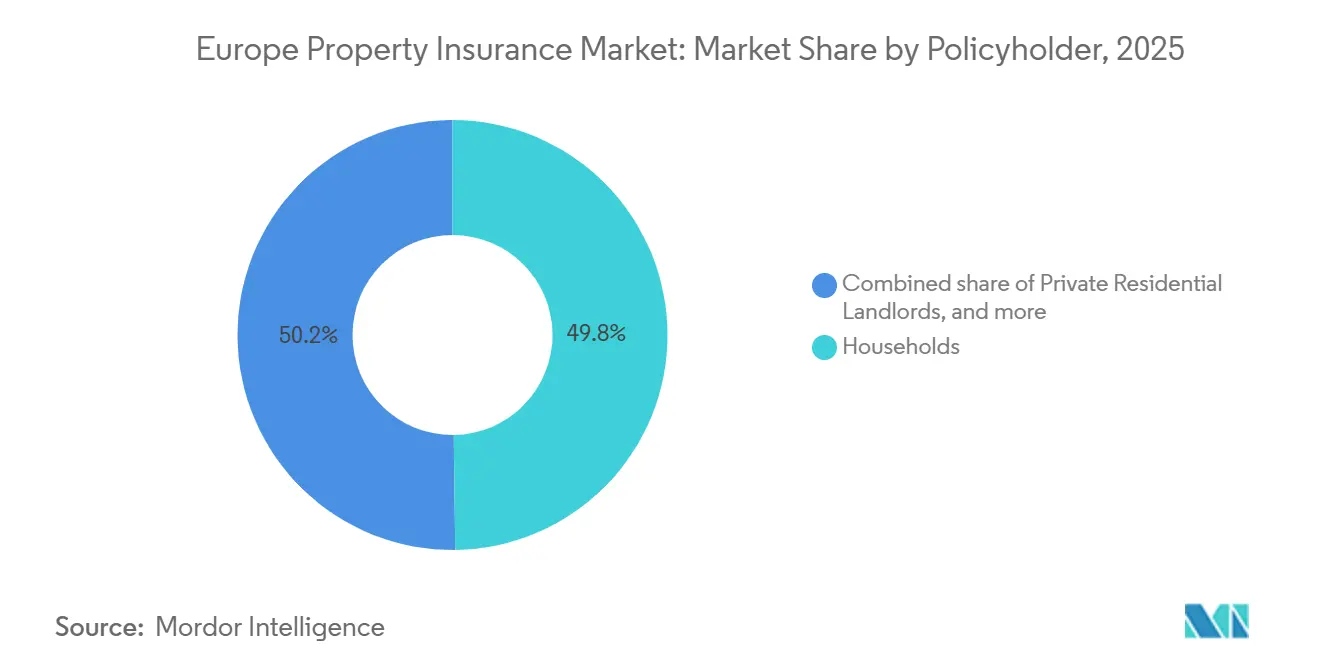
Households held 49.8% of the Europe property insurance market in 2025. This position reflects the wide base of owner-occupiers and tenants that use personal property coverage across Europe. Household policies usually combine building, contents, liability, and additional protection options. Coverage needs vary according to whether residents own, rent, or occupy properties in areas with elevated natural-catastrophe risk. Price sensitivity remains a major consideration for this group. Clear policy terms are important because some customers may assume that standard property policies include every climate-related peril. Insurers also need to balance affordability with adequate sums insured and risk-based pricing. Household demand provides a large and stable volume base for the European property insurance market. Digital claims services and prevention devices can improve the customer experience for this segment. The category remains closely affected by rebuilding inflation and local hazard exposure.
Professional real-estate owners are projected to grow at a 6% CAGR through 2031. Institutional ownership through REITs, real-estate private equity, and infrastructure funds is increasing the need for portfolio-level risk transfer programs. These buyers often require customized structures rather than standard policies. Small and medium-sized enterprise occupiers remain underserved in many countries because they may retain only fire and theft cover without flood or elemental protection. Italy is an exception because its natural-catastrophe requirement applied to small and medium-sized enterprises from January 2026. Large enterprises are increasingly using captives, parametric layers, prevention incentives, and traditional indemnity cover together. Public-sector and state-owned occupiers also present a distinct issue because public infrastructure is included in EIOPA’s estimate of uninsured losses. The European property insurance industry is responding with more tailored programs for asset owners with concentrated exposures. These programs need to account for property location, asset use, and the customer’s ability to retain risk. Professional owners create a faster-growing part of the European property insurance market because their coverage requirements are becoming more complex.
By Distribution Channel: Brokers Command Scale but Embedded Channels Redefine the Growth Agenda
Agents and brokers held 67.4% of the Europe property insurance market in 2025. Their position reflects established client relationships and the advisory needs of complex commercial property risks. Regulatory disclosure requirements also support the continued role of intermediated sales. Brokers can help customers assess replacement values, coverage exclusions, and risk-management needs. This is particularly relevant for businesses with several sites or exposures to flood and weather losses. The channel provides insurers with access to customers who need tailored coverage structures. It also supports policy servicing when claims and renewal requirements are complex. Agents and brokers remain a key distribution base for the European property insurance market. Their role is likely to stay important even as digital channels increase in scale. Complex underwriting needs continue to favor advice-led distribution.
Embedded and affinity channels are projected to grow at a 9.6% CAGR through 2031. ING and bolttech introduced embedded property insurance across the Netherlands, Italy, Poland, and Belgium in 2026. IKEA and Urban Jungle also launched home and contents cover in the United Kingdom at the point of furniture purchase in August 2026. These arrangements link insurance to moments when customers furnish a home, sign a lease, or finance equipment. Direct insurer channels are investing in digital quotation journeys and behavior-based pricing. Bancassurance remains important in France, Germany, and Italy because mortgage and savings relationships provide a natural sales channel. The European property insurance market can use embedded distribution to improve awareness when customers make property-related purchases. It may also reduce customer acquisition costs and improve risk selection at the point of sale. Insurers need to maintain clear disclosures when non-insurance brands originate policies. The growth of embedded channels is changing distribution without removing the need for conventional intermediaries.
Geography Analysis
Germany held 18.4% of the Europe property insurance market in 2025, which was the largest market position in the region. The country has a mature insurance base supported by Allianz, R+V Versicherung, and Talanx’s HDI unit. German natural-catastrophe exposure is shifting toward a greater role for flood risk and heavy rainfall. The German Insurance Association reported EUR 1.4 billion (USD 1.5 billion) in insured natural-hazard losses in the property segment during 2025, including EUR 400 million (USD 440 million) from flooding and flash floods. Germany’s coalition agreement supported mandatory elemental-damage coverage for new home policies. Gothaer Allgemeine also launched Yardstick Re, a flood-focused catastrophe bond that targeted EUR 100 million (USD 110 million) in 4-year reinsurance protection during 2026. The United Kingdom is Europe’s second-largest property insurance market. Aviva completed the integration of Direct Line in 2025 and secured a leadership position in the United Kingdom personal lines. United Kingdom subsidence payouts reached GBP 307 million (USD 414.5 million) in 2025, while construction costs rose 39.7% from 2020 to 2026. These conditions create persistent underinsurance pressure in both personal and commercial cover.
Italy is projected to grow at a 5.4% CAGR through 2031 and is the fastest-growing country within the Europe property insurance market. Its growth is tied to the phased mandatory corporate natural-catastrophe coverage requirement. Large enterprises came into scope in March 2025, medium-sized firms followed in October 2025, and small and medium-sized enterprises and micro-enterprises followed in January 2026. The Italian insurance supervisor can impose penalties and limit access to public tenders for firms that do not comply. France benefits from CatNat surcharge increases, climate-linked product redesign, prevention services, and building energy-efficiency retrofit activity. Spain is supported by the Consorcio de Compensación de Seguros, which provides a natural-catastrophe backstop for high-risk coastal and wildfire-exposed property. The October 2024 Valencia flooding increased demand for broader flood and elemental cover in Spain. Italy, France, and Spain demonstrate how regulation, public support, and recent weather events affect property insurance demand. Their experience also shows why country-specific policy structures remain important to the Europe property insurance market. The United States and Asia-Pacific are outside the scope of this Europe-focused analysis.
The BENELUX countries have high insurance penetration and are supported by insurers, including Achmea and Ageas, in the Netherlands and Belgium. ING’s 2026 embedded insurance rollout with Bolttech began in the Netherlands and shows the growing role of digital distribution in the region. Denmark, Finland, Norway, Sweden, and Iceland form the Nordic group, which has mature property insurance markets and high penetration. Competition in these countries is increasingly focused on connected-home monitoring and the prevention of water damage. Onics has deployed sensor-based monitoring through partnerships with major Nordic insurers to reduce escape-of-water losses. Central and Eastern Europe provides a longer-term opportunity because insurance penetration remains lower than in more mature European countries. EIOPA data showed that some Central and Eastern European countries historically insured less than 5% of natural-catastrophe losses. Generali extended its use of Intermap’s underwriting platform to Poland, Hungary, and Slovenia in June 2026.
Competitive Landscape
The European property insurance market is fragmented, with Allianz, AXA, Generali, Aviva, Zurich, and Talanx holding leading regional positions. Smaller mutual insurers and specialist carriers continue to serve national and niche markets. Allianz reported EUR 17.4 billion (USD 19.1 billion) in operating profit for 2025 and a Solvency II ratio of 218%. This financial position supports investment in technology, distribution, and acquisitions. AXA acquired Prima, an Italian direct insurer that reported EUR 1.2 billion (USD 1.3 billion) in premiums during 2024. The acquisition strengthened AXA’s direct digital distribution capability in European retail insurance. Larger groups use capital strength and established distribution to retain their positions in the European property insurance market. Their scale also supports access to reinsurance and investment in claims capabilities. National insurers remain relevant where local relationships and policy knowledge are important. The market’s structure leaves room for specialists who can serve distinct customer groups or hazard exposures.
Mergers, acquisitions, and bancassurance agreements remain important competitive tools. Zurich agreed in March 2026 to acquire Generali’s Irish property and casualty operations, known as RedClick, for EUR 337 million (USD 369 million) in cash. Allianz entered advanced discussions in June 2026 to acquire Portuguese insurer Caravela Seguros for EUR 150 million (USD 165 million). Allianz also confirmed an agreement with the National Bank of Greece that included a 30% interest in Allianz European Reliance and a 10-year bancassurance distribution arrangement. These transactions show how large insurers are building country positions and securing customer access through partners. Consolidation can strengthen distribution and capital resources, but it can also increase the need to differentiate products and service quality. The Europe property insurance market remains competitive because national players and specialist insurers hold meaningful local positions. Companies that acquire established books can gain immediate access to policyholders and local underwriting capability. The long-term value of these moves depends on integration, retention, and the ability to manage climate-related claims. Strategic partnerships are therefore as important as acquisitions for leading insurers.
Digital distribution and prevention services are creating a separate area of competition within the Europe property insurance market. ING and bolttech’s rollout across 4 European countries shows how banks can become an insurance origination point through digital banking platforms. IKEA and Urban Jungle’s United Kingdom launch shows that retailers can also offer home cover when customers buy property-related goods. Generali’s June 2026 platform rollout in Poland, Hungary, and Slovenia reflects the use of geospatial tools for flood and natural-catastrophe underwriting. Sampo, through If P&C, and Tryg use connected devices and claims-prevention data in Nordic markets. These services can help customers identify water leaks and other risks before a claim occurs. Digital challengers are most relevant in embedded distribution and risk-prevention services. Established insurers need to combine these tools with reliable underwriting, claims support, and regulatory compliance. The Europe property insurance industry is not defined only by premium pricing because service design and distribution also affect retention. Competition remains moderate rather than highly concentrated because national specialists and new technology-led models continue to shape customer access.
Europe Property Insurance Industry Leaders
-
Assicurazioni Generali S.p.A.
-
Sampo plc
-
Allianz SE
-
AXA SA
-
Zurich Insurance Group AG
- *Disclaimer: Major Players sorted in no particular order
Recent Industry Developments
- August 2026: Allianz Seguros partnered with climate-tech startup Satellites on Fire to deploy an AI and multi-satellite wildfire detection system monitoring more than 50 million hectares across Spain through summer 2026, representing a strategic shift from post-loss indemnity toward proactive asset-level risk prevention for insured homeowners and businesses.
- August 2026: IKEA and Urban Jungle launched an embedded home insurance product in the United Kingdom, offering flexible contents and buildings cover at the point of furniture purchase through Urban Jungle's digital platform; the FCA subsequently admitted Urban Jungle to its Scale-Up Unit, providing a dedicated regulatory support pathway.
- June 2026: Generali expanded its collaboration with Intermap Technologies to deploy the AI-enabled Aquarius Risk Management & Analytics (RMA) platform across Poland, Hungary, and Slovenia, enhancing flood and nat-cat underwriting accuracy across 3 Central and Eastern European markets.
- June 2026: Allianz entered advanced acquisition talks for Portuguese insurer Caravela Seguros in a deal valued at EUR 150 million (USD 165 million), extending its Southern European non-life footprint following earlier moves in Italy and Greece.
Europe Property Insurance Market Report Scope
| Homeowners Insurance |
| Renters Insurance |
| Landlord Insurance |
| Commercial Property Insurance |
| Building / Structural Property Coverage |
| Contents / Business Personal Property Coverage |
| Business Interruption / Loss of Income Coverage |
| Residential Properties |
| Commercial Properties |
| Industrial / Manufacturing |
| Public and Institutional |
| Agricultural Buildings |
| Households (Owner-Occupiers and Tenants) |
| Private Residential Landlords |
| Small and Medium-Sized Enterprise (SME) Occupiers |
| Large Enterprise Occupiers |
| Professional Real-Estate Owners |
| Public Sector / SOE |
| Agents & Brokers |
| Direct / Insurer-Owned Channels |
| Bancassurance & Other Financial Institutions Channels |
| Embedded / Affinity |
| United Kingdom |
| Germany |
| France |
| Spain |
| Italy |
| BENELUX (Belgium, the Netherlands, and Luxembourg) |
| NORDICS (Denmark, Finland, Iceland, Norway, and Sweden) |
| Rest of Europe |
| By Insurance Product | Homeowners Insurance |
| Renters Insurance | |
| Landlord Insurance | |
| Commercial Property Insurance | |
| By Coverage Type | Building / Structural Property Coverage |
| Contents / Business Personal Property Coverage | |
| Business Interruption / Loss of Income Coverage | |
| By Property Type | Residential Properties |
| Commercial Properties | |
| Industrial / Manufacturing | |
| Public and Institutional | |
| Agricultural Buildings | |
| By Policyholder | Households (Owner-Occupiers and Tenants) |
| Private Residential Landlords | |
| Small and Medium-Sized Enterprise (SME) Occupiers | |
| Large Enterprise Occupiers | |
| Professional Real-Estate Owners | |
| Public Sector / SOE | |
| By Distribution Channel | Agents & Brokers |
| Direct / Insurer-Owned Channels | |
| Bancassurance & Other Financial Institutions Channels | |
| Embedded / Affinity | |
| By Geography | United Kingdom |
| Germany | |
| France | |
| Spain | |
| Italy | |
| BENELUX (Belgium, the Netherlands, and Luxembourg) | |
| NORDICS (Denmark, Finland, Iceland, Norway, and Sweden) | |
| Rest of Europe |
Key Questions Answered in the Report
What is the projected value of the Europe property insurance market by 2031?
The Europe property insurance market is projected to reach USD 225.2 billion by 2031, growing at a 4.1% CAGR from 2026.
Which product category has the largest share in Europe property insurance?
Homeowners insurance led with a 43.5% share in 2025, supported by mortgage-linked requirements and broad owner-occupier demand.
Which distribution channel is expected to grow fastest in Europe?
Embedded and affinity channels are projected to grow at a 9.6% CAGR through 2031 as banks, retailers, and digital partners offer cover at purchase points.
Why is Italy growing faster than other European countries?
Italy is projected to grow at 5.4% CAGR through 2031 because mandatory corporate natural-catastrophe cover was extended to small and medium-sized enterprises in 2026.
How do climate risks affect European property coverage?
Floods, storms, wildfires, and other hazards increase demand for coverage, while higher losses and affordability constraints can reduce capacity in high-risk locations.
Which policyholder group is expected to expand fastest?
Professional real-estate owners are projected to grow at a 6% CAGR through 2031 as institutional property portfolios require more tailored risk-transfer programs.