
Europe Political Risk Insurance Market Size and Share
Market Overview
| Study Period | 2021 - 2032 |
|---|---|
| Forecast Data Period | 2027 - 2032 |
| Base Year Market Size (2026) | USD 7 Billion |
| Market Size (2027) | USD 7.30 Billion |
| Market Size (2032) | USD 9.40 Billion |
| Growth Rate (2027 - 2032) | 5.20 % |
| Market Concentration | Low |
Major Players *Disclaimer: Major Players sorted in no particular order Image © Mordor Intelligence. Reuse requires attribution under CC BY 4.0. | |
Europe Political Risk Insurance Market Analysis by Mordor Intelligence
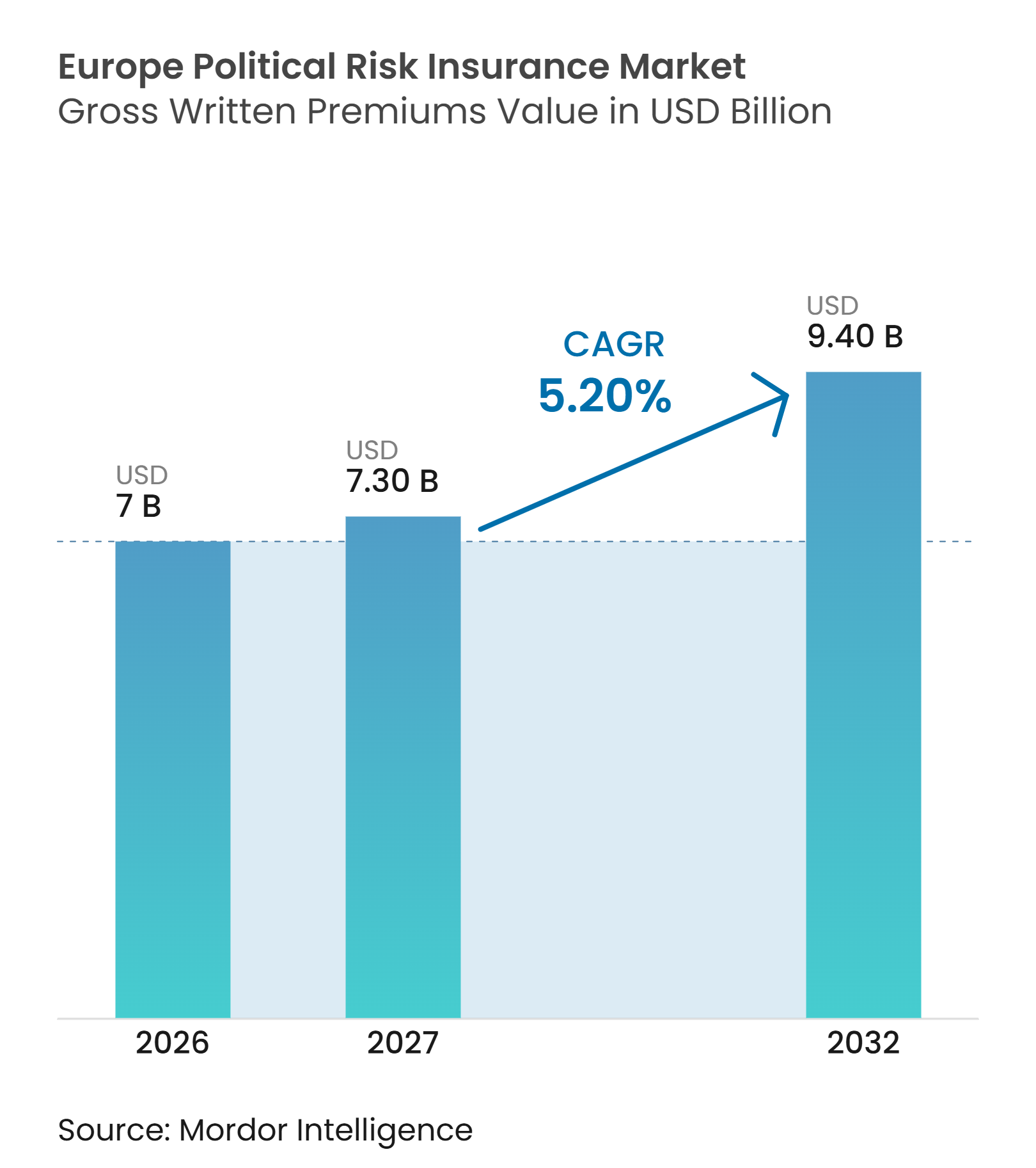
The Europe Political Risk Insurance Market size in terms of gross written premiums value is projected to be USD 7 billion in 2026, USD 7.30 billion in 2027, and reach USD 9.40 billion by 2032, growing at a CAGR of 5.20% from 2027 to 2032.
The Europe political risk insurance market is being shaped by persistent geopolitical disruption, trade restrictions, sanctions, and greater government involvement in strategic sectors. Coface reported that its social and political risk index reached 41.1% in 2025, above its pandemic-era high, which supports the view that political risk has become a lasting factor in international business decisions. Demand is also widening beyond traditional investment protection as buyers seek cover for disrupted contracts, currency restrictions, political violence, and interference with essential infrastructure. Supply is expanding through public guarantees, Lloyd's capacity, and specialist underwriting, although underwriters remain cautious in jurisdictions with concentrated geopolitical exposure. The planned Solvency II changes from January 2027 may release capital for productive investment, which could support capacity for infrastructure and energy-related risks in the Europe political risk insurance market
Key Report Takeaways
- By coverage type, political violence captured 34.3% of the Europe political risk insurance market share in 2026 and is projected to grow at a 7.4% CAGR through 2032.
- By end user, project developers and sponsors accounted for 29.9% of the Europe political risk insurance market share in 2026, while financial institutions are forecast to grow at 6.8% CAGR through 2032.
- By distribution channel, brokers and intermediaries held 52.8% of the Europe political risk insurance market share in 2026, while digital and online platforms are projected to grow at 8.6% CAGR through 2032.
- By provider type, export credit agencies captured 64.8% of the Europe political risk insurance market share in 2026, while multilateral institutions are projected to grow at an 8.1% CAGR through 2032.
- By sector, energy and power captured 29.2% of the Europe political risk insurance market share in 2026 and is projected to grow at 7.8% CAGR through 2032.
- By geography, the United Kingdom captured 24.4% of the Europe political risk insurance market share in 2026, while rest of Europe is projected to grow at 6.5% CAGR through 2032.
Note: Market numbers in this report are based on Mordor Intelligence's proprietary estimation framework, which combines nine months of actuals with Q4 projections for base year 2026.
Market Trends and Insights
Drivers Impact Analysis of Europe Political Risk Insurance Market*
| Driver | (~) % Impact on CAGR Forecast | Geographic Relevance | Impact Timeline |
|---|---|---|---|
| Geopolitical Fragmentation, Sanctions Escalation, and Government Intervention | +1.6% | Global, with European Union and United Kingdom concentration | Medium term (2-4 years) |
| European Outbound Investment in Emerging and Frontier Markets | +0.7% | European Union member states and Global Gateway partner regions | Long term (≥ 4 years) |
| Rising Demand for Expropriation, Currency Inconvertibility, and Transfer Restriction Coverage | +0.6% | Global, led by European investors in frontier and emerging markets | Short term (≤ 2 years) |
| Political Violence and War-Related Exposure in Cross-Border Investments | +0.8% | Eastern Europe and the Middle East, with European spillover | Short term (≤ 2 years) |
| Long-Term Infrastructure, Energy, and Strategic Project Financing | +0.5% | European Union and United Kingdom, sub-Saharan Africa, and Asia-Pacific through export credit | Long term (≥ 4 years) |
| Trade Policy Uncertainty and Political Risk Protection for International Supply Chains | +0.3% | Global | Short term (≤ 2 years) |
| Public-Private Investment Guarantees for High-Risk Markets and Strategic Projects | +0.2% | European Union-wide | Long term (≥ 4 years) |
| Source: Mordor Intelligence | |||
Geopolitical Fragmentation, Sanctions Escalation, and Government Intervention
Sanctions complexity is a leading demand driver and an underwriting constraint for the Europe political risk insurance market. The Russia-Ukraine war has added systemic risk to credit and political risk insurance portfolios, while the Unicredit AG v Celestial Aviation Services Court of Appeal judgment remains subject to United Kingdom Supreme Court review. WTW recorded USD 85.4 million in credit and political risk insurance claims during 2025, the highest level in 5 years, and more than 80% of the claims came from new loss notifications[1]. In WTW's 2026 survey, 65% of multinational respondents identified attacks on critical infrastructure as their leading gray-zone concern, while 61% cited economic coercion through tariffs or export embargoes. These conditions require underwriters to assess losses that can affect Europe and Asia-Pacific at the same time, reducing the protection normally provided by regional diversification. They also support demand for cover that responds to sanctions-related disruption, contract frustration, and state action.
European Outbound Investment in Emerging and Frontier Markets
European investment in emerging and frontier economies supports demand for political risk protection across energy, digital, manufacturing, agriculture, and transport projects. The Global Gateway initiative has EUR 39.8 billion (USD 46.4 billion) in European Fund for Sustainable Development Plus guarantee capacity. In April 2025, the European Union and the International Finance Corporation signed a EUR 291 million (USD 339.2 million) guarantee agreement that is expected to mobilize more than USD 1 billion in private investment for Global Gateway projects[2]. This adds a home-country regulatory consideration to the host-country risks already faced by investors. As a result, political risk cover must address a broader set of transaction and compliance concerns in the Europe political risk insurance market.
Rising Demand for Expropriation, Currency Inconvertibility, and Transfer Restriction Coverage
Currency conversion and fund repatriation constraints remain important sources of political risk losses for European multinational companies. Howden's 2025 survey found that 51% of senior risk and treasury executives experienced a political loss, while currency conversion issues and ownership-rights disputes each affected 40% of respondents. Foreign government interference produced average losses of USD 20 million per event, while currency exchange difficulties produced average losses of USD 16.2 million. In September 2025, MIGA and the International Bank for Reconstruction and Development combined a political risk guarantee with a policy-based guarantee to support a EUR 433.3 million (USD 505 million) sustainability-linked loan to Côte d'Ivoire[3]. The transaction shows how multilateral and private participants can structure protection for complex sovereign-linked financing. This approach increases the value of underwriting and structuring expertise for the Europe political risk insurance market.
Political Violence and War-Related Exposure in Cross-Border Investments
Political violence coverage has evolved as buyers have expanded their focus from conventional conflict to sabotage, civil unrest, and hybrid threats. Lockton reported GBP 350 million (USD 444.5 million) in new political violence capacity from Lloyd's syndicates and specialist underwriting agencies in February 2026[4]. Howden reported a 33% rise in demand for political risk insurance in 2025, while its research also showed broader adoption of political risk management tools by multinational companies. WTW found that 75% of its respondents had experienced a political risk or geopolitically related credit loss, the second-highest result in the survey's 9-year history. These losses place pressure on underwriting models that were historically built around emerging-market exposure. The Europe political risk insurance market therefore needs coverage design and pricing that can reflect developed-market as well as frontier-market events.
Restraints Impact Analysis of Europe Political Risk Insurance Market*
| Restraint | (~) % Impact on CAGR Forecast | Geographic Relevance | Impact Timeline |
|---|---|---|---|
| High Premiums, Deductibles, and Coverage Costs for High-Risk Jurisdictions | -0.5% | Global, concentrated in the Middle East, Eastern Europe, and West Africa | Short term (≤ 2 years) |
| Restricted Underwriting Capacity for Geopolitical Hotspots and Concentrated Exposures | -0.4% | China, Taiwan, Sudan, Israel, and parts of West Africa | Medium term (2-4 years) |
| Complex Policy Wordings, Exclusions, and Claims-Trigger Disputes | -0.3% | Global | Medium term (2-4 years) |
| Limited Availability of Reliable Country-Level and Sovereign Risk Data | -0.2% | Frontier and emerging markets | Long term (≥ 4 years) |
| Source: Mordor Intelligence | |||
High Premiums, Deductibles, and Coverage Costs for High-Risk Jurisdictions
Premium affordability limits adoption among small and medium-sized enterprises and first-time buyers operating in high-risk jurisdictions. WTW reported that political risk insurance rates for Gulf exposures ranged from 20% to 30%, compared with 0% to 5% for traditional programs in diversified markets. Such pricing can make cover uneconomic for projects below a defined transaction size. Howden found that 73% of potential buyers cited limited understanding of coverage as the main barrier to adoption. European small and medium-sized enterprises with frontier-market supply-chain exposure can therefore have a clear need for protection without converting that need into a policy purchase. Lower-cost, modular products and clearer explanations of coverage would address an important gap in the Europe political risk insurance market.
Restricted Underwriting Capacity for Geopolitical Hotspots and Concentrated Exposures
Limited capacity in sensitive jurisdictions affects how European underwriters build portfolios and allocate line sizes. China, Taiwan, Sudan, Israel, Mali, Burkina Faso, and Niger face constrained appetite because insurers must control aggregate exposure even when overall market capacity grows. WTW found that 2 large insurers had reduced their maximum line sizes while increasing typical deployed lines, indicating a focus on limiting peak-risk concentration rather than a broad withdrawal from the class. This can reduce available capacity for individual transactions in markets that are already difficult to insure. Complex policy wording, exclusions, and claim-trigger disputes can further slow placement and settlement in cross-border transactions. Gaps in reliable country-level and sovereign risk information also make long-term underwriting harder in frontier economies.
*Our forecasts treat driver/restraint impacts as directional, not additive. The impact forecasts reflect baseline growth, mix effects, and variable interactions.
Europe Political Risk Insurance Market Segment Analysis
By Coverage Type:
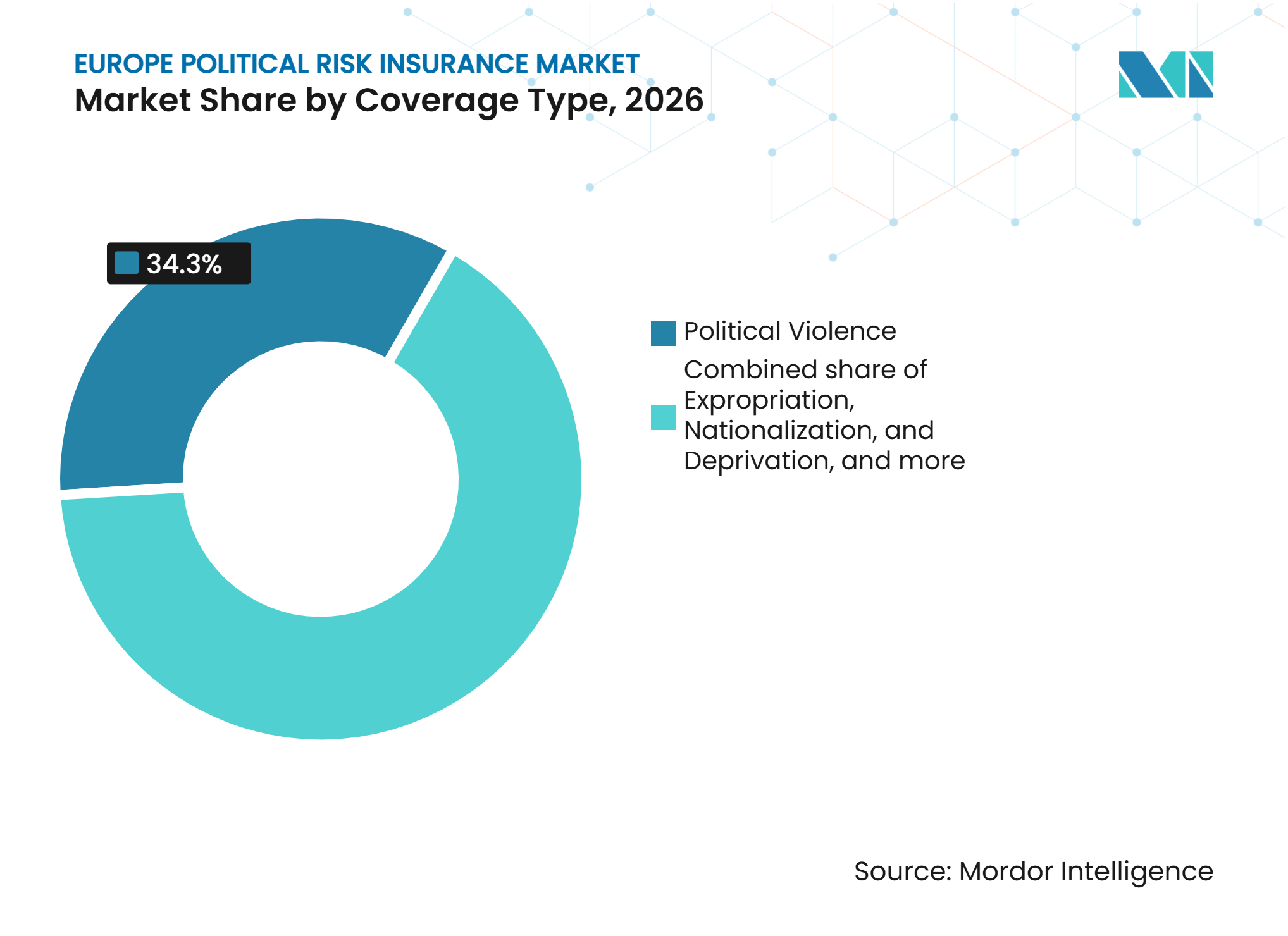
Political Violence Leads in Both Share and GrowthPolitical violence accounted for 34.3% of the Europe political risk insurance market in 2026 and is forecast to grow at a CAGR of 7.4% through 2032. This dual position reflects the greater importance of war-related perils, sabotage, and infrastructure attacks in cross-border investment decisions. Buyers increasingly view political violence, hybrid conflict, and economic coercion as connected causes of financial loss. This has broadened demand for terms that can address damage, interruption, and disruption arising from politically motivated events. The Europe political risk insurance market size for political violence is therefore supported by both broader coverage needs and higher buyer awareness.
Expropriation, nationalization, and deprivation remain the second-largest coverage type because European businesses retain equity and operating exposure in resource-rich frontier markets. Howden reported an average loss of USD 20 million for foreign government interference events, underscoring the financial consequence of state intervention. Currency inconvertibility and non-transfer restriction cover is becoming more relevant as capital controls affect the movement of funds in markets once considered stable. Breach of contract and non-honoring of sovereign obligations is the smallest coverage category, but it is expanding as project developers seek protection when state counterparties do not meet concession or power purchase terms. Policy disclosures, contractual clarity, and local regulatory requirements influence how these coverages are presented, compared, and understood in European cross-border transactions.


By End User:
Project Developers Lead, Financial Institutions Grow FastestProject developers and sponsors held a 29.9% share of the Europe political risk insurance market in 2026. They are key buyers because lenders often require political risk protection for large infrastructure and energy financings. Their needs are particularly strong where projects have long payback periods and rely on public authorities, concessions, or state-owned counterparties. Coverage can protect project cash flows and preserve lender confidence when political conditions change. Their leading position reflects their central role in arranging capital-intensive transactions.
Financial institutions are forecast to grow at a CAGR of 6.8% from 2027 to 2032. Banks use qualifying credit and political risk insurance to support credit risk mitigation under evolving capital frameworks. Multinational corporations remain the second-largest end-user group and are extending their use of cover beyond extractive and manufacturing activities. WTW found that 39% of corporate respondents viewed their own home-government policies, including export controls and outbound investment restrictions, as a source of greater political risk. Exporters, importers, public-sector bodies, and development institutions also use public and multilateral guarantees to support trade and investment in difficult markets.
By Distribution Channel:
Brokers Retain Leadership as Digital Access ExpandsBrokers and intermediaries held 52.8% of the Europe political risk insurance market in 2026. Their position reflects the tailored nature of policies covering sovereign risk, structured credit, and cross-border project finance. Large placements often require coordination among lenders, insurers, reinsurers, legal advisers, and public guarantee providers. Brokers also help buyers compare exclusions, claims triggers, limits, and pricing across complex policies. This advisory role remains important when transactions involve difficult jurisdictions or several insurance markets.
Digital and online platforms are forecast to grow at a CAGR of 8.6% from 2027 to 2032. These channels can support smaller and more standardized risks that may not justify a conventional broker-led process. Digital submission and triage tools can shorten application steps and widen access for mid-market buyers. Direct sales remain limited and are mainly used for standardized trade credit products with political risk extensions. Bancassurance and strategic partnerships have greater relevance in France, Germany, and the Benelux countries, where relationship banking and insurance bundling are more established than in the United Kingdom wholesale market.
By Provider Type:
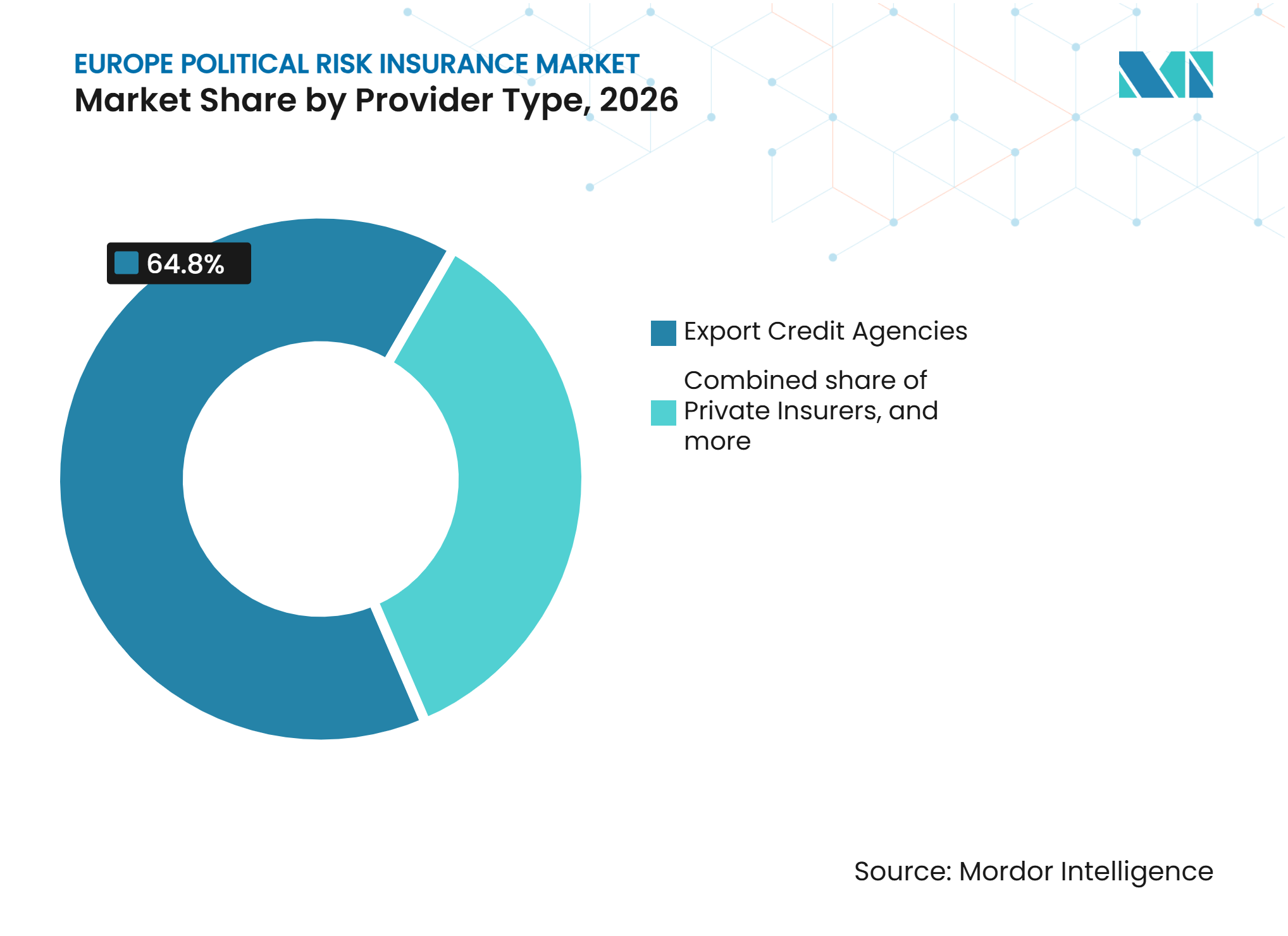
Export Credit Agencies Anchor Capacity, Multilaterals Scale UpExport Credit Agencies held a 64.8% share in 2026. They support transactions that private insurers may struggle to price or retain over long tenors. United Kingdom Export Finance, Euler Hermes, SACE, SERV, and Bpifrance provide an institutional base for export-linked political risk protection. The April 2026 G7 Export Credit Agency communiqué confirmed work on OECD Arrangement Modernization II and discussions on financing flexibility for energy security, competitiveness, and defense. This public role defines the competitive boundary between state-backed and private capacity.
Multilateral Institutions are projected to grow at a CAGR of 8.1% from 2027 to 2032. MIGA issued USD 9.5 billion in new guarantees across 44 projects during fiscal 2025, while the World Bank Group Guarantee Platform is targeting USD 20 billion in annual issuance by 2030. In February 2026, MIGA increased its coverage for Credit Bank Ukraine from EUR 41 million (USD 47.8 million) to EUR 80 million (USD 93.2 million). Private insurers remain the smallest provider group, but they compete through faster structuring, flexible wording, and an ability to serve non-standard or mid-market transactions. Their role is most visible where public institutions do not prioritize a risk or cannot provide the required product design.

By Sector:
Energy and Power Holds the Largest Position and Fastest GrowthEnergy and Power captured 29.2% of the Europe political risk insurance market in 2026 and is projected to grow at a CAGR of 7.8% through 2032. European-led energy transition projects often require long-dated cover in emerging-market jurisdictions. The sector is exposed to changes in tariffs, permits, offtake agreements, currency access, and government policy. Underwriters are also shifting their attention toward renewable projects and the associated construction, transmission, and storage infrastructure. These factors make Energy and Power the principal source of both current demand and forward growth.
Infrastructure and Transportation is the second-largest sector, supported by European investment in transport, energy, and digital corridors. The Global Gateway Investment Hub was launched in October 2025 to connect European companies with financing, export credit agencies, and public partners for projects in sub-Saharan Africa, Asia-Pacific, and Latin America. Mining, Oil and Gas, and Natural Resources face more difficult underwriting conditions where government revenue pressure raises the risk of intervention. Manufacturing and Industrials increasingly need protection from sanctions, tariffs, and supply-chain interruption. Financial Services, agribusiness, health care, and technology broaden the customer base beyond the sectors that traditionally purchased political risk cover.
Geography Analysis
The United Kingdom held a 24.4% share in 2026. Its leadership rests on the concentration of specialist underwriting at Lloyd's of London and the depth of the London wholesale insurance ecosystem. Howden Re reported that Lloyd's capacity rose 4.3% year over year in fiscal 2025, with capital continuing to support political violence, strikes, riots, civil commotion, and credit and political risk lines. United Kingdom Export Finance strengthens the local market through public support for export and trade-related cover. The Solvency II Delegated Regulation will apply from January 2027 and introduces macroprudential tools and revised risk-margin calculations that may support insurer capacity for productive investment.
Germany and France form the largest continental European centers for underwriting and buyer demand. Germany's export credit architecture supports complex transactions in frontier markets and includes a focus on climate-friendly projects and sustainable development objectives. SACE and Euler Hermes signed a memorandum of understanding to work on Global Gateway projects, critical raw-material supply chains, and Ukraine reconstruction. France benefits from the presence of established trade credit and political risk insurers, which supports product development and underwriting depth. Italy adds public capacity through SACE, including support for exporters and multilateral transactions.
Spain, the Benelux countries, and the Nordic region add broad geographic depth to the Europe political risk insurance market. Spain's banking sector creates demand for currency inconvertibility and political violence cover because of its Latin American investment exposure. In October 2025, the European Union and European Development Finance Institutions signed three guarantee agreements that mobilized EUR 742 million (USD 864.8 million) in private finance for renewable energy, value chains, and private equity. Benelux-based financial intermediaries are active in transactions structured around European Fund for Sustainable Development Plus guarantees and European Investment Bank facilities. The rest of Europe is forecast to grow at a 6.5% CAGR from 2027 to 2032, supported by Central and Eastern European market development, greater regional export credit capacity, and reconstruction demand in Ukraine-adjacent economies.
Competitive Landscape
Market Concentration
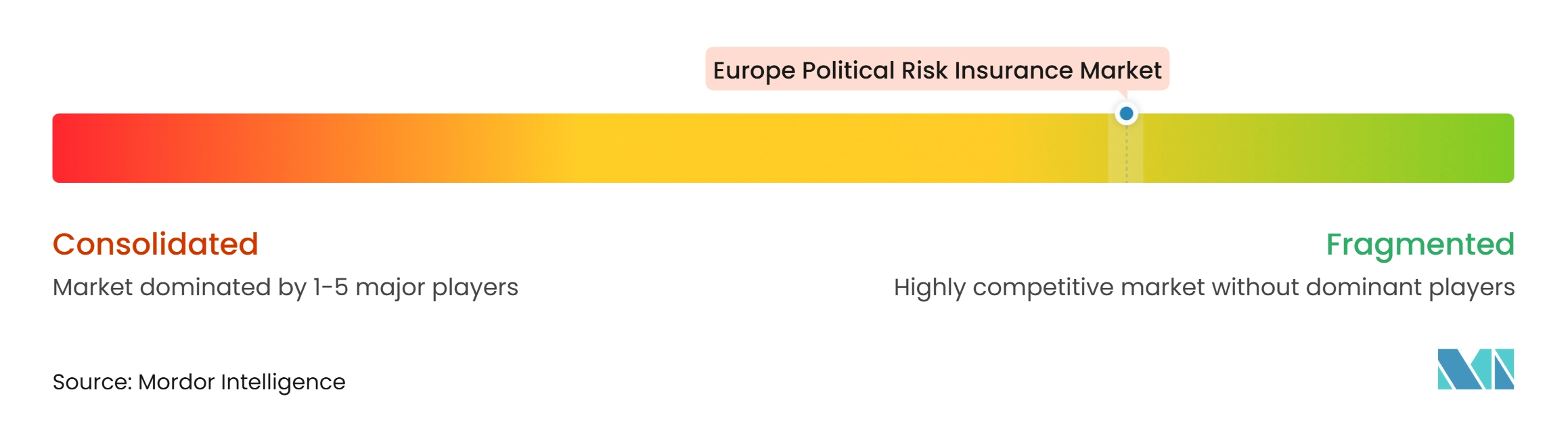
The Europe political risk insurance market has a measured level of concentration among primary underwriters. AIG, Chubb, AXA XL, Liberty Specialty Markets, Allianz Trade, Coface, Atradius, Lloyd's syndicates, and specialist managing general agents all participate across political risk and structured credit. ICISA reported 75 active credit and political risk insurance participants in 2025, up from 67 in the preceding year. New capacity is concentrated in structured credit and political risk rather than whole-turnover trade credit. This allows established trade credit providers to preserve their core positions while competition increases in more specialized placements.
Competition is increasingly based on underwriting capability, risk intelligence, policy flexibility, and access to public or reinsurance support. Carriers with strong sanctions-screening, anti-money laundering, know-your-customer, and country-risk capabilities can respond more effectively to complex placements. SACE and Euler Hermes have used their memorandum of understanding to pursue cooperation on Global Gateway projects, critical raw materials, and Ukraine reconstruction. MIGA expanded its guarantee for Credit Bank Ukraine in February 2026, demonstrating the role of multilateral providers in settings where private capacity may be limited. United Kingdom Export Finance also awarded its primary and reserve credit political risk brokerage contracts to Aon United Kingdom Ltd and Marsh Ltd through August 2029.
The strongest open opportunities are among European small and medium-sized enterprises and within digital facilities linked to banks and export-finance platforms. Smaller buyers often need affordable, modular cover but may find traditional placements too costly or difficult to understand. This gap gives brokers, insurers, and public institutions an opportunity to simplify product design without reducing underwriting discipline. Capacity is more competitive for diversified risks, while conditions remain more selective for China, Taiwan, Sudan, Israel, and parts of West Africa. The Europe political risk insurance market is therefore competitive in standardized risks but more constrained where exposures are politically sensitive or highly concentrated.
Europe Political Risk Insurance Industry Leaders
-
Lloyd's of London
-
Allianz Trade
-
Coface S.A.
-
Atradius N.V.
-
Zurich Insurance Group AG
- *Disclaimer: Major Players sorted in no particular order
Europe Political Risk Insurance Market Companies Covered in this Report
- Lloyd's of London
- Allianz Trade
- Coface S.A.
- Atradius N.V.
- Zurich Insurance Group AG
- AIG
- Chubb
- AXA XL
- Liberty Specialty Markets
- Sompo International
- Tokio Marine HCC
- AXIS Capital
- Markel
- Canopius
- Credendo
- SACE
- SERV
- Munich Re
- Hiscox Ltd
- Swiss Re
Recent Industry Developments in Europe Political Risk Insurance Market
- August 2026: United Kingdom Export Finance awarded its primary and reserve credit political risk brokerage contracts to Aon United Kingdom Ltd, trading as Maven Public Sector, and Marsh Ltd, respectively. The contract runs through August 2029 and covers reinsurance of United Kingdom Export Finance's credit political risk portfolio.
- July 2026: EIOPA published 8 sets of guidelines and draft technical standards that complete its Solvency II review mandate. The framework applies from January 30, 2027, and includes new macroprudential tools and revised risk-margin calculations.
- February 2026: MIGA extended and increased guarantees for 2 banks' mandatory reserves in Ukraine. Coverage for Credit Bank Ukraine increased from EUR 41 million (USD 47.8 million) to EUR 80 million (USD 93.2 million).
- October 2025: The European Commission and European Development Finance Institutions signed 3 guarantee agreements mobilizing EUR 742 million (USD 864.8 million) in private finance for renewable energy, value-chain strengthening, and private equity across partner countries.
Europe Political Risk Insurance Market Report Scope
Segmentation Overview
| Expropriation, Nationalization, and Deprivation |
| Currency Inconvertibility and Non-Transfer Restrictions |
| Political Violence |
| Breach of Contract and Non-Honoring of Sovereign Obligations |
| Multinational Corporations |
| Financial Institutions |
| Exporters and Importers |
| Project Developers and Sponsors |
| Public Sector and Development Institutions |
| Direct Sales |
| Brokers and Intermediaries |
| Bancassurance and Strategic Partnerships |
| Digital and Online Platforms |
| Private Insurers |
| Export Credit Agencies |
| Multilateral Institutions |
| Energy and Power |
| Infrastructure and Transportation |
| Mining, Oil & Gas, and Natural Resources |
| Manufacturing and Industrials |
| Financial Services and Banking |
| Other (e.g., Agribusiness, Healthcare, Technology, etc.) |
| United Kingdom |
| Germany |
| Italy |
| Spain |
| France |
| BENELUX |
| Nordics |
| Rest of Europe |
| By Coverage Type | Expropriation, Nationalization, and Deprivation |
| Currency Inconvertibility and Non-Transfer Restrictions | |
| Political Violence | |
| Breach of Contract and Non-Honoring of Sovereign Obligations | |
| By End User | Multinational Corporations |
| Financial Institutions | |
| Exporters and Importers | |
| Project Developers and Sponsors | |
| Public Sector and Development Institutions | |
| By Distribution Channel | Direct Sales |
| Brokers and Intermediaries | |
| Bancassurance and Strategic Partnerships | |
| Digital and Online Platforms | |
| By Provider Type | Private Insurers |
| Export Credit Agencies | |
| Multilateral Institutions | |
| By Sector | Energy and Power |
| Infrastructure and Transportation | |
| Mining, Oil & Gas, and Natural Resources | |
| Manufacturing and Industrials | |
| Financial Services and Banking | |
| Other (e.g., Agribusiness, Healthcare, Technology, etc.) | |
| By Country | United Kingdom |
| Germany | |
| Italy | |
| Spain | |
| France | |
| BENELUX | |
| Nordics | |
| Rest of Europe |
Key Questions Answered in the Report
What is the forecast growth rate for political risk insurance in Europe?
The Europe political risk insurance market is projected to grow at a CAGR of 5.2% from 2027 to 2032, reaching USD 9.4 billion by 2032.
Which coverage type leads political risk insurance demand in Europe?
Political Violence leads with 34.3% share in 2026 and is also the fastest-growing coverage type, with a 7.4% CAGR through 2032.
Why do project developers buy political risk insurance?
Project Developers and Sponsors held 29.9% share in 2026 because lenders often require coverage for infrastructure and energy financing exposed to state action or contract disruption.
Which providers hold the largest position in Europe?
Export Credit Agencies held 64.8% share in 2026, supported by their ability to cover long-tenor and difficult risks that private insurers may not retain.
What geographic area leads European demand?
The United Kingdom leads with 24.4% share in 2026 because London remains a major center for specialist underwriting and wholesale placement.
Which sector has the strongest outlook for political risk coverage?
Energy and Power held 29.2% share in 2026 and is forecast to grow at a 7.8% CAGR through 2032 as energy transition projects require long-dated protection.