
Europe Packaged Chia Seeds Market Size and Share
Market Overview
| Study Period | 2021 - 2031 |
|---|---|
| Forecast Data Period | 2026 - 2031 |
| Base Year Market Size (2025) | USD 226.89 Million |
| Market Size (2026) | USD 241.62 Million |
| Market Size (2031) | USD 346.07 Million |
| Growth Rate (2026 - 2031) | 7.45 % |
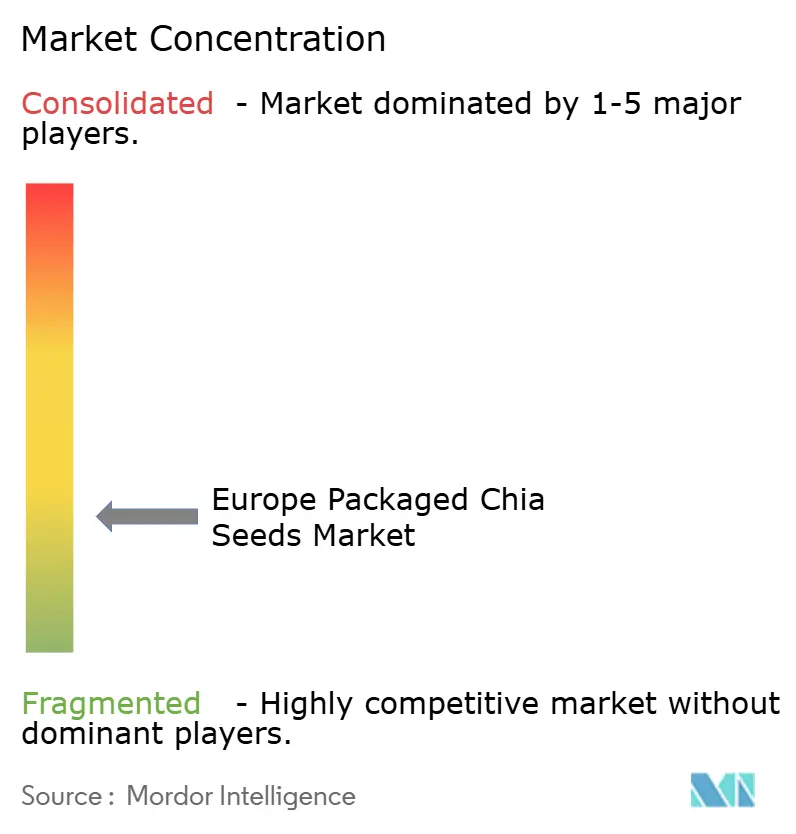
| Market Concentration | Low |
Major Players *Disclaimer: Major Players sorted in no particular order Image © Mordor Intelligence. Reuse requires attribution under CC BY 4.0. | |
Europe Packaged Chia Seeds Market Analysis by Mordor Intelligence
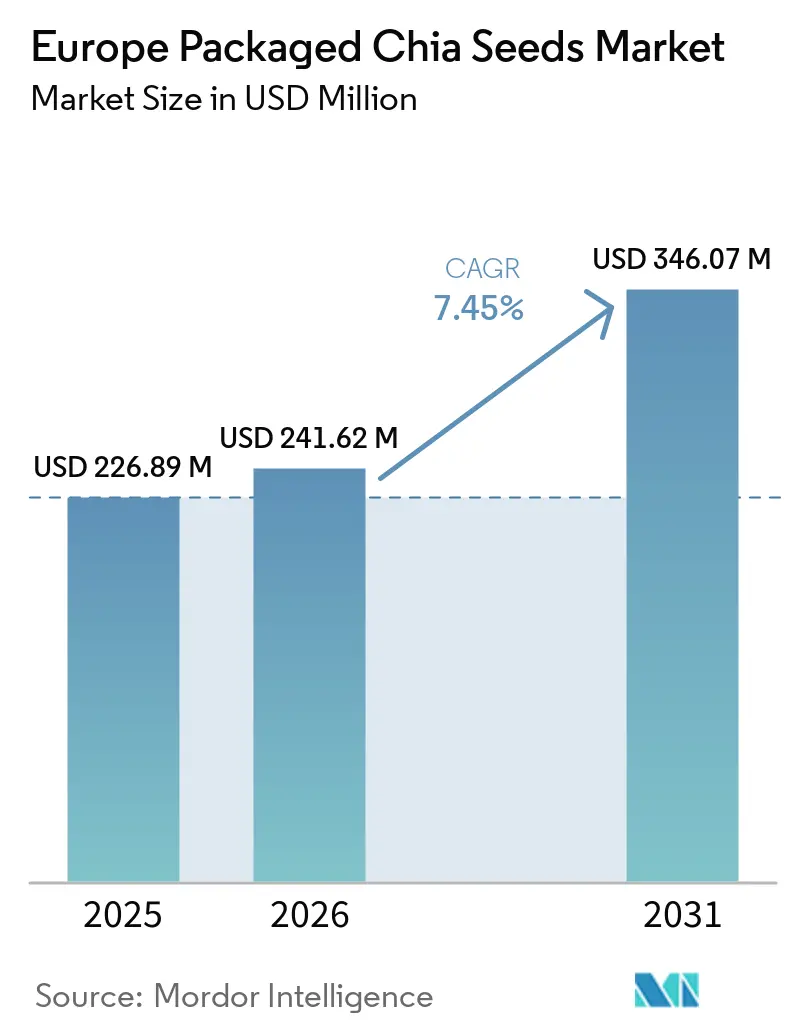
The European packaged chia seeds market is expected to grow from USD 226.89 million in 2025 to USD 241.62 million in 2026, reaching USD 346.07 million by 2031, at a CAGR of 7.45% during 2026–2031. Market growth is supported by the increasing integration of chia seeds into mainstream food consumption, rising consumer preference for natural and minimally processed ingredients, and greater familiarity with chia seeds as a versatile pantry product. The market is further driven by the growing preference for clean-label and organic food products, as consumers increasingly seek products with recognizable ingredients and limited artificial additives. Chia seeds align with these preferences as a single-ingredient product available in both conventional and certified-organic formats.
Key Report Takeaways
- By product type, black chia seeds held 52.45% of the Europe chia seeds market share in 2025, while white chia seeds are forecast to expand at an 8.51% CAGR through 2031.
- By nature, conventional chia seeds accounted for 81.34% of the Europe packaged chia seeds market share in 2025, while organic chia seeds are forecast to expand at a 9.19% CAGR through 2031.
- By packaging type, pouches held a 57.67% share in 2025, while resealable bags are forecast to expand at an 8.62% CAGR through 2031.
- By distribution channel, supermarkets and hypermarkets accounted for 48.55% of the market share in 2025, while online retail is forecast to expand at a 9.87% CAGR through 2031.
- By geography, Germany held a 35.67% share in 2025, while Poland is forecast to expand at a 9.11% CAGR through 2031.
Note: Market size and forecast figures in this report are generated using Mordor Intelligence’s proprietary estimation framework, updated with the latest available data and insights as of January 2026.
Europe Packaged Chia Seeds Market Trends and Insights
Drivers Impact Analysis*
| Driver | (~) % Impact on CAGR Forecast | Geographic Relevance | Impact Timeline |
|---|---|---|---|
| Expansion of convenient healthy breakfast formats | +1.7% | Western Europe, particularly United Kingdom, Germany, France | Short term (≤ 2 years) |
| Increasing focus on dietary fiber and digestive wellness | +1.5% | Pan-European, led by Germany and Scandinavia | Medium term (2-4 years) |
| Expansion of flexitarian and plant-based diets | +1.4% | Pan-European, especially Germany and France | Medium term (2-4 years) |
| Greater emphasis on traceability and food safety | +0.6% | Germany, Netherlands, United Kingdom | Medium term (2-4 years) |
| Expansion of private-label health-food ranges | +0.9% | Western and Eastern Europe | Short term (≤ 2 years) |
| Growing demand for sustainable sourcing practices | +0.5% | Germany, Belgium, Netherlands | Long term (≥ 4 years) |
| Source: Mordor Intelligence | |||
Expansion of Convenient Healthy Breakfast Formats
The growing preference for convenient breakfast options that require minimal preparation is creating opportunities for chia seeds to be incorporated into ready-to-prepare and packaged breakfast products. Consumers increasingly seek breakfast formats that can be prepared quickly while still incorporating nutrient-dense ingredients, encouraging brands to develop products combining oats, seeds, fruits, and other functional ingredients. For instance, Quaker offers overnight oats products containing chia seeds, providing consumers with a convenient breakfast option that can be prepared in advance with minimal effort. The integration of chia seeds into convenient formats such as overnight oats expands their usage beyond standalone packaged seed products and supports broader demand for packaged chia seeds as an ingredient in breakfast-oriented foods.
Increasing Focus on Dietary Fiber and Digestive Wellness
Growing awareness of diet-related health risks is increasing consumer attention toward healthier dietary choices and foods containing dietary fiber. This is supporting the consumption of fiber-rich ingredients such as chia seeds, which can be easily incorporated into everyday foods. For instance, the World Health Organization (WHO) Regional Office for Europe, in its updated nutrition recommendations published in July 2025, reported that more than 80% of deaths in the European Region are associated with noncommunicable diseases, with unhealthy diets identified as a major contributing factor[1]. The increasing focus on healthier dietary patterns is encouraging consumers to include more fiber-rich foods in their diets, supporting demand for packaged chia seeds as a convenient dietary fiber source.
Expansion of Flexitarian and Plant-Based Diets
The growing adoption of flexitarian and plant-based dietary patterns is encouraging consumers to incorporate more plant-derived foods and ingredients into their everyday diets, supporting the consumption of ingredients such as chia seeds. This shift is particularly relevant as consumers reduce their reliance on animal-based foods while including a broader variety of plant-based ingredients in regular meals. For instance, according to the Good Food Institute (GFI) Europe, 31% of consumers in the United Kingdom and 39% of consumers in Germany described themselves as flexitarians in 2025. This trend is supporting greater inclusion of plant-derived ingredients such as chia seeds in everyday food consumption and packaged food products.
Greater Emphasis on Traceability and Food Safety
The growing emphasis on traceability and food safety is strengthening requirements across the European packaged chia seeds market, particularly as chia seeds are commonly sourced through international supply chains. Greater scrutiny of product origin, supplier information, processing conditions, contamination controls, and batch-level documentation is driving stronger traceability across sourcing, processing, packaging, and distribution. The European Union requires food businesses to maintain traceability throughout the food supply chain, enabling products and ingredients to be tracked across different stages of production, processing, and distribution. These requirements are increasing the importance of documented sourcing, quality controls, and transparent supply chain management for packaged chia seeds, while supporting the adoption of stronger food safety practices across the market.
Restraints Impact Analysis*
| Restraint | (~) % Impact on CAGR Forecast | Geographic Relevance | Impact Timeline |
|---|---|---|---|
| Strict maximum residue limits for pesticides | -0.8% | Pan-European, European Union-wide compliance | Short term (≤ 2 years) |
| Supply-chain traceability challenges | -0.7% | Global supply chain, affecting all European Union importers | Medium term (2-4 years) |
| Competition from other nutrient-dense seeds | -0.5% | Pan-European, particularly Germany and Scandinavia | Long term (≥ 4 years) |
| Dependence on imported chia seed supplies | -1.5% | Pan-European, especially Germany, Netherlands, United Kingdom | Medium term (2-4 years) |
| Source: Mordor Intelligence | |||
Strict Maximum Residue Limits for Pesticides
Stringent pesticide residue requirements in the European market increase compliance and testing burdens for packaged chia seed suppliers. The European Union (EU) enforces legally defined Maximum Residue Levels (MRLs) for pesticide residues in food, including imported products. For example, in November 2024, the European Commission's EU Agri-Food Fraud Suspicions report flagged a chia seed consignment from Argentina containing chlorpyrifos-methyl at 0.019 mg/kg as non-compliant with European Union requirements. Such cases drive the need for residue testing, supplier verification, and compliance monitoring, increasing costs and the risk of shipment rejection for chia seed importers.
Supply-Chain Traceability Challenges
The packaged chia seeds market faces traceability challenges due to complex international supply chains involving multiple producers, processors, and distributors. Maintaining consistent records of product origin, batch details, processing activities, transportation, and supplier information across these stages increases administrative and compliance requirements. Limited visibility across fragmented supply networks makes it more difficult to verify product authenticity, quality, and safety, raising monitoring costs and creating additional barriers for market participants. These challenges are further compounded when supply chain disruptions occur, as identifying the source of quality or safety issues becomes more time-consuming and costly. Smaller market participants, in particular, may lack the resources to implement robust traceability systems, placing them at a disadvantage compared to larger, more established players with dedicated compliance infrastructure.
*Our forecasts treat driver/restraint impacts as directional, not additive. The impact forecasts reflect baseline growth, mix effects, and variable interactions.
Segment Analysis
By Product Type: Black Chia Seeds Anchor Volume; White Variants Attract Premiumization
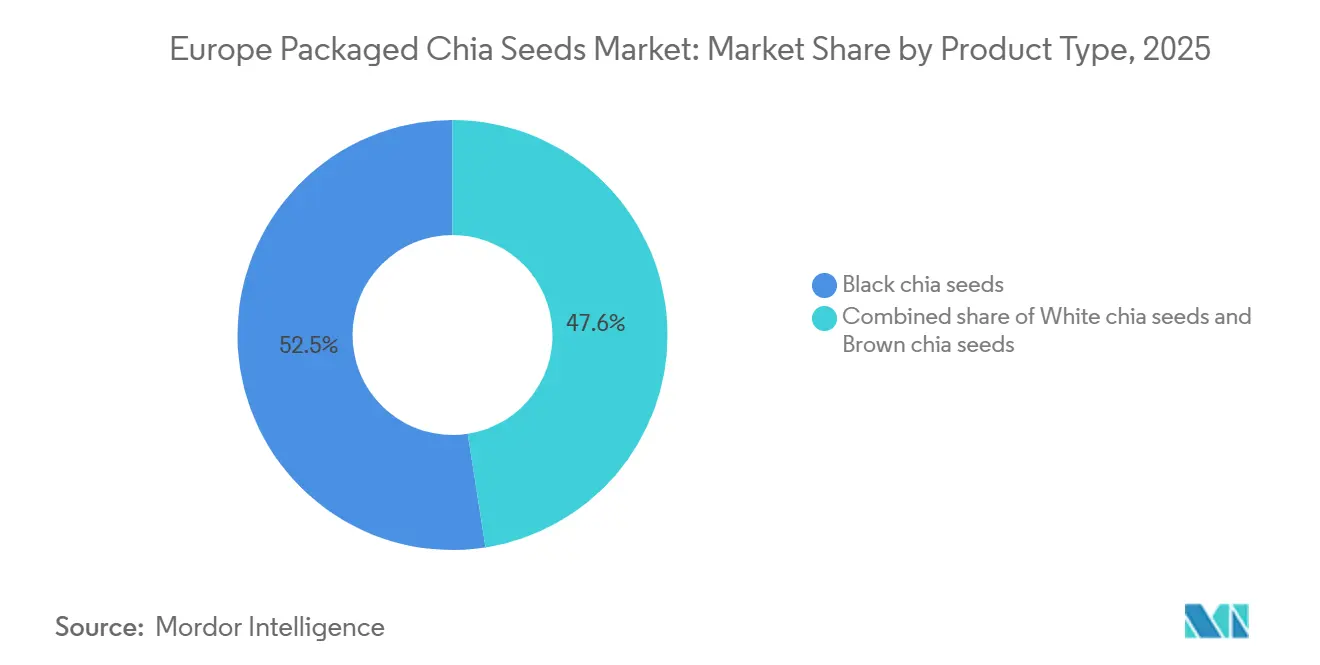
Black chia seeds accounted for 52.45% of the European packaged chia seeds market in 2025, making them the dominant product type. Established consumer familiarity with this naturally dark-colored chia variety, along with its alignment with broader European preferences for recognizable, minimally processed, nutrient-dense ingredients, supports its position. Black chia seeds contain substantial levels of dietary fiber, protein, and alpha-linolenic acid (ALA), supporting their positioning within Europe's growing health-oriented food culture. The nutritional profile of chia is a major driver of its popularity in Europe, while the seeds' relatively neutral flavor and crunchy texture allow them to be incorporated easily into everyday diets without substantially altering the sensory characteristics of foods.
White chia seeds are the fastest-growing product type in the market, projected to expand at a CAGR of 8.51% during 2026–2031. This growth is supported by increasing consumer interest in variety within nutrient-dense seed products and growing recognition of chia as a natural source of dietary fiber, plant-based omega-3 fatty acids, protein, and other nutrients. As European consumers increasingly prioritize foods with recognizable ingredients and nutritional value, white chia seeds benefit from the broader shift toward minimally processed, plant-based, and functional food ingredients. Their neutral flavor and nutritional profile, similar to conventional dark chia varieties, support their positioning as a versatile whole-food ingredient. Their lighter appearance also provides an additional point of differentiation for consumers seeking alternatives within the packaged chia seeds category.

By Nature: Conventional Supply Dominates; Organic Premiumization Accelerates
Conventional chia seeds held an 81.34% share of the European packaged chia seeds market in 2025, retaining a substantial lead due to their established position across the European supply chain and greater availability compared with certified alternatives. The segment benefits from a broader raw-material supply base, as conventional chia can be sourced from a wider pool of producers without the additional requirements associated with organic certification. This gives processors and packaged-seed suppliers greater flexibility in procurement, helping them maintain consistent volumes and product availability throughout the year. The relatively mature conventional supply network also supports standardized cleaning, grading, processing, and packaging operations, strengthening the segment's ability to serve large-volume retail requirements.
Organic chia seeds are the fastest-growing segment in the Europe packaged chia seeds market, projected to register a CAGR of 9.19% during 2026–2031. Organic chia benefits from the formal certification framework used across Europe, allowing products to differentiate through recognized organic labeling and production standards. Growth is supported by the continued expansion of organic food retail and the increasing availability of certified organic products across retail channels, strengthening the presence of organic chia within packaged seed offerings. For instance, according to the German Federation of Organic Food Producers (BÖLW), sales of organic food and beverages in Germany reached EUR 18.23 billion in 2025, compared with EUR 17.09 billion in 2024, reflecting the continued expansion of the organic food market and creating a favorable environment for certified organic packaged chia seeds[2].
By Packaging Type: Pouches Retain Shelf Dominance; Resealable Bags Capture Functional Premium
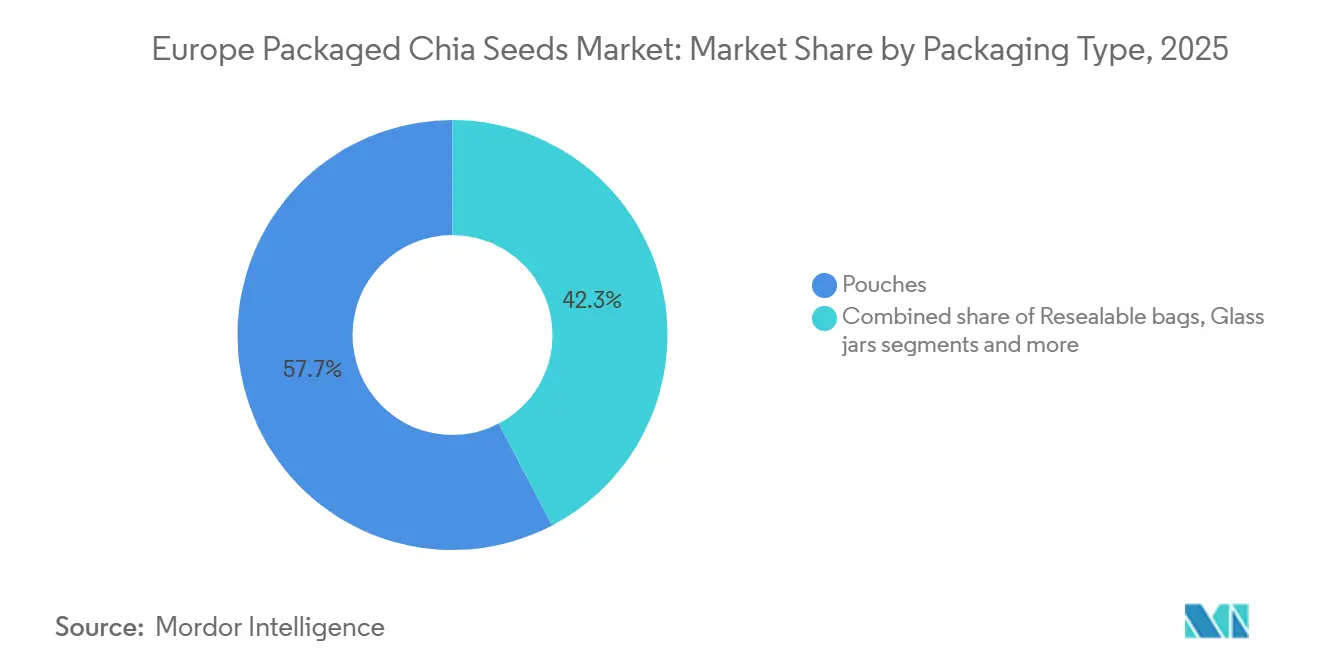
Pouches accounted for the largest share of the market at 57.67% in 2025. This segment's dominance is primarily driven by the practicality and versatility of pouch packaging for packaged seed products, particularly its lightweight structure, efficient storage, and ease of handling throughout distribution and retail operations. Pouches also require less packaging material than rigid containers, supporting efficient transportation and shelf stocking while allowing manufacturers to offer different pack sizes for varying purchasing requirements. The resealable formats commonly used for chia seeds further support product usability by allowing consumers to close the package after opening and store the remaining seeds conveniently.
Resealable bags are the fastest-growing packaging format in the Europe packaged chia seeds market, projected to expand at a CAGR of 8.62% during 2026–2031. This segment's growth is driven by the increasing preference for packaging formats that offer greater convenience after opening, particularly through integrated resealing mechanisms that allow consumers to close the pack between uses. This feature is especially relevant for chia seeds, which are typically consumed in small quantities and used repeatedly over an extended period. Resealable bags also offer flexibility in pack sizes, efficient storage, and easier handling compared with rigid packaging formats, while their flexible structure supports efficient shelf utilization and transportation.
By Distribution Channel: Supermarkets Lead Access; Online Retail Grows Fastest
Supermarkets and hypermarkets accounted for the largest share of 48.55% in the Europe packaged chia seeds market in 2025. The segment's leading position is supported by the broad shelf space available for packaged seed products, established grocery procurement systems, and the ability to offer chia seeds across multiple pack sizes, product varieties, and price points within a single retail environment. These stores also provide strong product visibility through dedicated health-food, breakfast, baking, and grocery sections, while established private-label programs enable retailers to expand their packaged seed portfolios. In addition, the availability of both conventional and specialty packaged chia seed products within large-format stores allows consumers to compare packaging, certifications, pack sizes, and product attributes before purchase, reinforcing supermarkets and hypermarkets as the primary distribution channel.
Online retail stores are the fastest-growing distribution channel in the Europe packaged chia seeds market, projected to register a CAGR of 9.87% during 2026–2031. Growth is supported by the ability of online platforms to offer a broader selection of packaged chia seed products than individual physical stores, including different varieties, pack sizes, organic options, and specialized formulations. Digital retail also enables consumers to compare product specifications, ingredients, certifications, packaging formats, and prices before purchase, while product reviews and detailed listings provide additional information during the buying process. Subscription and repeat-order features further suit chia seeds as a frequently replenished pantry product, while home delivery increases convenience for consumers purchasing packaged seeds as part of routine grocery shopping.
Geography Analysis
Germany holds the largest share in the European packaged chia seeds market, accounting for 35.67% in 2025. The country's position is supported by established demand, broad retail availability, and a well-developed food distribution infrastructure. Strong import activity further reinforces this position, with direct chia seed imports valued at USD 164.02 million in 2025, according to UN Comtrade[3]. Established packaged seed distribution, extensive grocery retail networks, and consistent import flows continue to underpin Germany's position in the European market.
Poland records the fastest growth in the European market, with packaged chia seeds projected to expand at a CAGR of 9.11% during 2026–2031. Growth is supported by increasing availability of packaged chia seeds through modern grocery retailers and online channels, a broader product selection, and improving access to specialty and health-oriented food products. Expansion in organized retail distribution is providing packaged chia seed products with greater shelf visibility and wider consumer reach, supporting continued market development during the forecast period.
The United Kingdom, Netherlands, Italy, Spain, Sweden, and the broader Nordic market represent other significant geographies within the Europe packaged chia seeds market. The United Kingdom has an established market for packaged and specialty food products, while the Netherlands serves as an important import and distribution hub for chia seeds entering the European market. Italy and Spain benefit from established grocery and specialty food channels, while Sweden and other Nordic countries are supported by developed retail systems and consistent demand for specialty seed products. Collectively, these markets contribute to regional growth, with differences in retail structures, product availability, organic offerings, and consumer preferences influencing growth across individual countries.
Competitive Landscape
The Europe packaged chia seeds market is fragmented, with competition distributed among specialized chia companies, health food manufacturers, and international seed suppliers. Key players include Linwoods Health Foods Ltd., The Chia Co., NOW Foods, Inc., Chia Charge Ltd., and Raab Vitalfood GmbH, alongside other regional and international participants. The market structure reflects the presence of both companies focused on chia-based products and broader health food companies offering packaged chia seeds through retail channels.
Competition is driven by product quality, organic certification, packaging formats, seed varieties, and product positioning. Companies are differentiating their offerings through whole and milled chia seeds, organic and conventional variants, different pack sizes, resealable packaging, and clean-label positioning. Retail availability across supermarkets, health food stores, and online channels is also an important factor influencing competitive positioning.
The competitive landscape is further shaped by product innovation, supply chain transparency, and quality assurance. Manufacturers are increasingly focusing on traceable sourcing, laboratory testing, sustainable sourcing practices, and convenient packaging to strengthen consumer confidence. The presence of both specialized chia suppliers and diversified health food manufacturers results in a broad range of products and pricing strategies, maintaining a fragmented competitive structure across the European market.
Europe Packaged Chia Seeds Industry Leaders
-
Linwoods Health Foods Ltd.
-
The Chia Co.
-
NOW Foods, Inc.
-
Chia Charge Ltd.
-
Raab Vitalfood GmbH
- *Disclaimer: Major Players sorted in no particular order
Recent Industry Developments
- August 2026: Chia Charge strengthened its Amazon presence through an ongoing partnership with B2 Agency, expanding beyond initial marketplace management to include broader Amazon strategy, product launches, listing optimization, and new product and bundle development.
- March 2026: Linwoods Health Foods Ltd. partnered with chef Stephen Beaddie for the Plate Up for Performance series. Linwoods' chia products were incorporated into live cooking demonstrations, specifically showcasing ways to use chia seeds in everyday meals.
- July 2025: LT Foods' organic business arm, Nature Bio Foods, entered the European business-to-consumer segment by opening a 20,000-square-meter facility in Maasvlakte, Rotterdam, Netherlands. The facility includes dedicated seed and grain processing lines, retail packaging lines with an annual handling capacity of 15,000 metric tons, and storage capacity for 15,000 pallets.
Europe Packaged Chia Seeds Market Report Scope
Chia seeds are derived from the Salvia hispanica plant and are small, nutrient-dense seeds containing dietary fiber, plant-based protein, omega-3 fatty acids, minerals, and other nutritional components. The European packaged chia seeds market is segmented by product type, nature, packaging type, and distribution channel. Based on product type, the market is segmented into white chia seeds, black chia seeds, and brown chia seeds. Based on nature, the market is segmented into organic chia seeds and conventional chia seeds. Based on packaging type, the market is segmented into pouches, resealable bags, glass jars, plastic containers/bottles, and others. Based on distribution channel, the market is segmented into supermarkets/hypermarkets, convenience and grocery stores, online retail stores, and other distribution channels. Based on geography, the market is segmented into the United Kingdom, Germany, France, Italy, Spain, the Netherlands, Poland, Belgium, Sweden, and the rest of Europe. For each segment, the market sizing and forecast have been done based on the value (in USD million).
| White chia seeds |
| Black chia seeds |
| Brown chia seeds |
| Organic chia seeds |
| Conventional chia seeds |
| Pouches |
| Resealable bags |
| Glass jars |
| Plastic containers/bottles |
| Others |
| Supermarkets/Hypermarkets |
| Convenience and Grocery Stores |
| Online Retail Stores |
| Other Distribution Channels |
| United Kingdom |
| Germany |
| France |
| Italy |
| Spain |
| Netherlands |
| Poland |
| Belgium |
| Sweden |
| Rest of Europe |
| By Product Type | White chia seeds |
| Black chia seeds | |
| Brown chia seeds | |
| By Nature | Organic chia seeds |
| Conventional chia seeds | |
| By Packaging Type | Pouches |
| Resealable bags | |
| Glass jars | |
| Plastic containers/bottles | |
| Others | |
| By Distribution Channel | Supermarkets/Hypermarkets |
| Convenience and Grocery Stores | |
| Online Retail Stores | |
| Other Distribution Channels | |
| By Geography | United Kingdom |
| Germany | |
| France | |
| Italy | |
| Spain | |
| Netherlands | |
| Poland | |
| Belgium | |
| Sweden | |
| Rest of Europe |
Key Questions Answered in the Report
What is the expected growth rate for chia seeds in Europe?
The category is forecast to grow at a 7.45% CAGR from 2026 to 2031, increasing from USD 241.62 million in 2026 to USD 346.07 million by 2031.
Which product type leads chia seed sales in Europe?
Black chia seeds led with 52.45% share in 2025 because of familiar use cases, broad availability, and established supply chains.
Why are organic chia seeds growing faster than conventional products?
Organic chia seeds are forecast to grow at a 9.19% CAGR through 2031, supported by certified demand and a strong organic retail base in Germany.
Which sales channel is growing fastest for chia seeds?
Online retail is forecast to grow at a 9.87% CAGR through 2031 because it can carry specialty, organic, and bulk formats efficiently.