
Europe Optical Ground Wire (OPGW) Market Size and Share
Market Overview
| Study Period | 2022 - 2032 |
|---|---|
| Forecast Data Period | 2027 - 2032 |
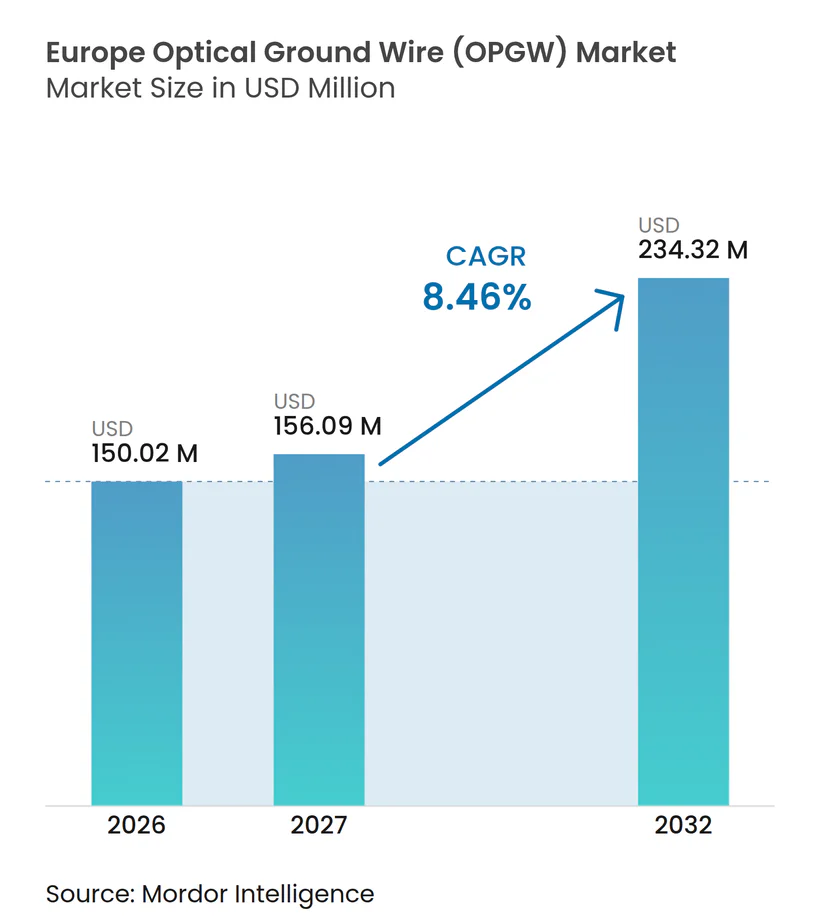
| Base Year Market Size (2026) | USD 150.02 Million |
| Market Size (2027) | USD 156.09 Million |
| Market Size (2032) | USD 234.32 Million |
| Growth Rate (2027 - 2032) | 8.46 % |
| Market Concentration | Medium |
Major Players *Disclaimer: Major Players sorted in no particular order Image © Mordor Intelligence. Reuse requires attribution under CC BY 4.0. | |
Europe Optical Ground Wire (OPGW) Market Analysis by Mordor Intelligence
The Europe Optical Ground Wire Market size was valued at USD 150.02 million in 2026 and is estimated to grow from USD 156.09 million in 2027 to reach USD 234.32 million by 2032, at a CAGR of 8.46% during the forecast period (2027-2032). The Europe OPGW market is supported by grid reinforcement, renewable integration, and cross-border power links across the region. European transmission owners increasingly use optical ground wire as both a protection component and a communications asset. Grid investment programs are also changing cable specifications, because new lines need more data capacity and more resilient communications. Competition centers on established utility relationships, qualified manufacturing capacity, and the ability to manage long procurement cycles. The Europe OPGW market also benefits when utilities use fiber for monitoring or lease spare capacity to telecommunications providers.
Key Report Takeaways
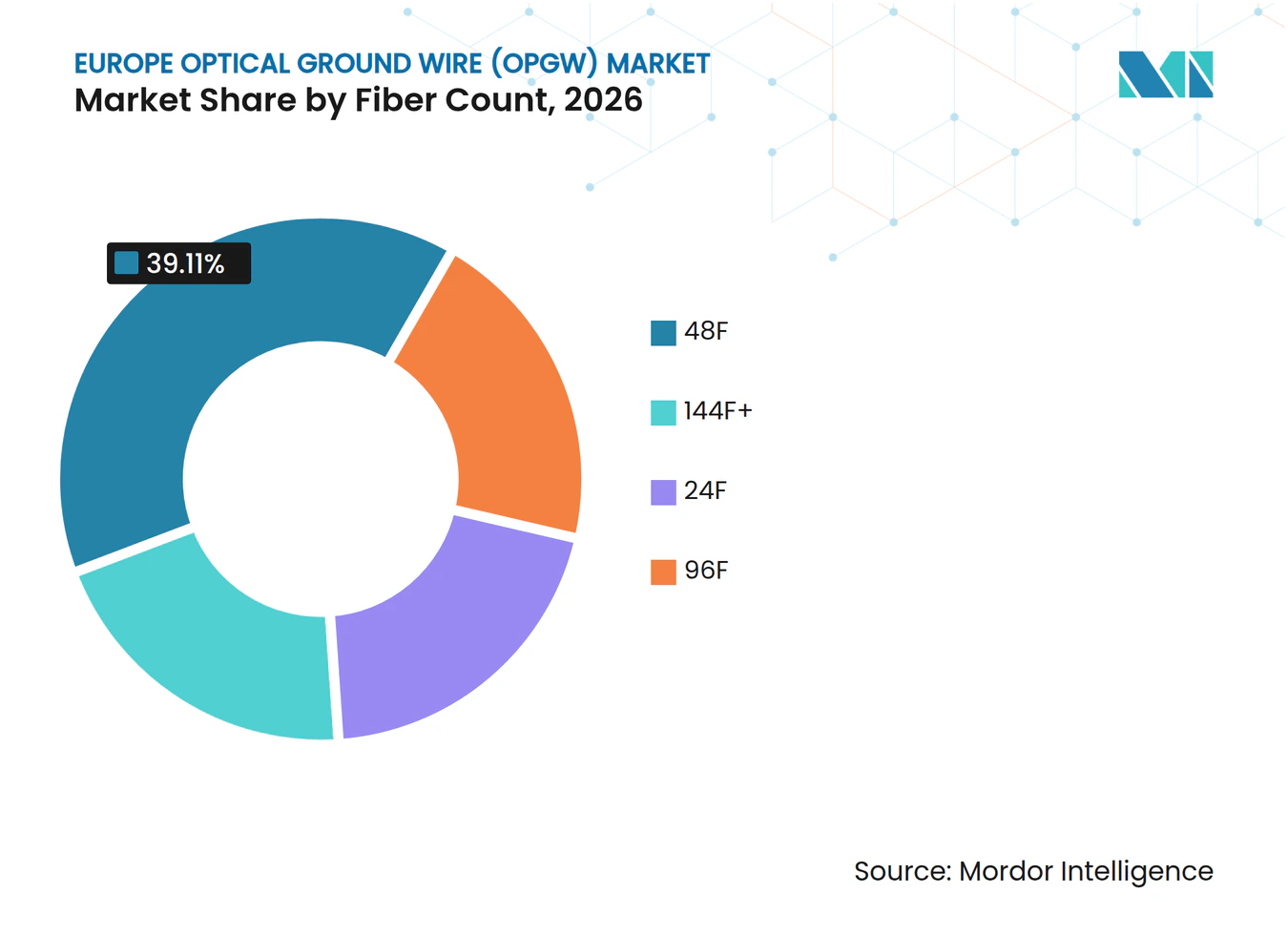
- By fiber count, 48F held 39.11% of the Europe OPGW market share in 2026, while 96F recorded the highest projected CAGR at 11.89% through 2032.
- By cable design type, Design A held 36.23% of revenue in 2026, while Design B recorded the highest projected CAGR at 9.21% through 2032.
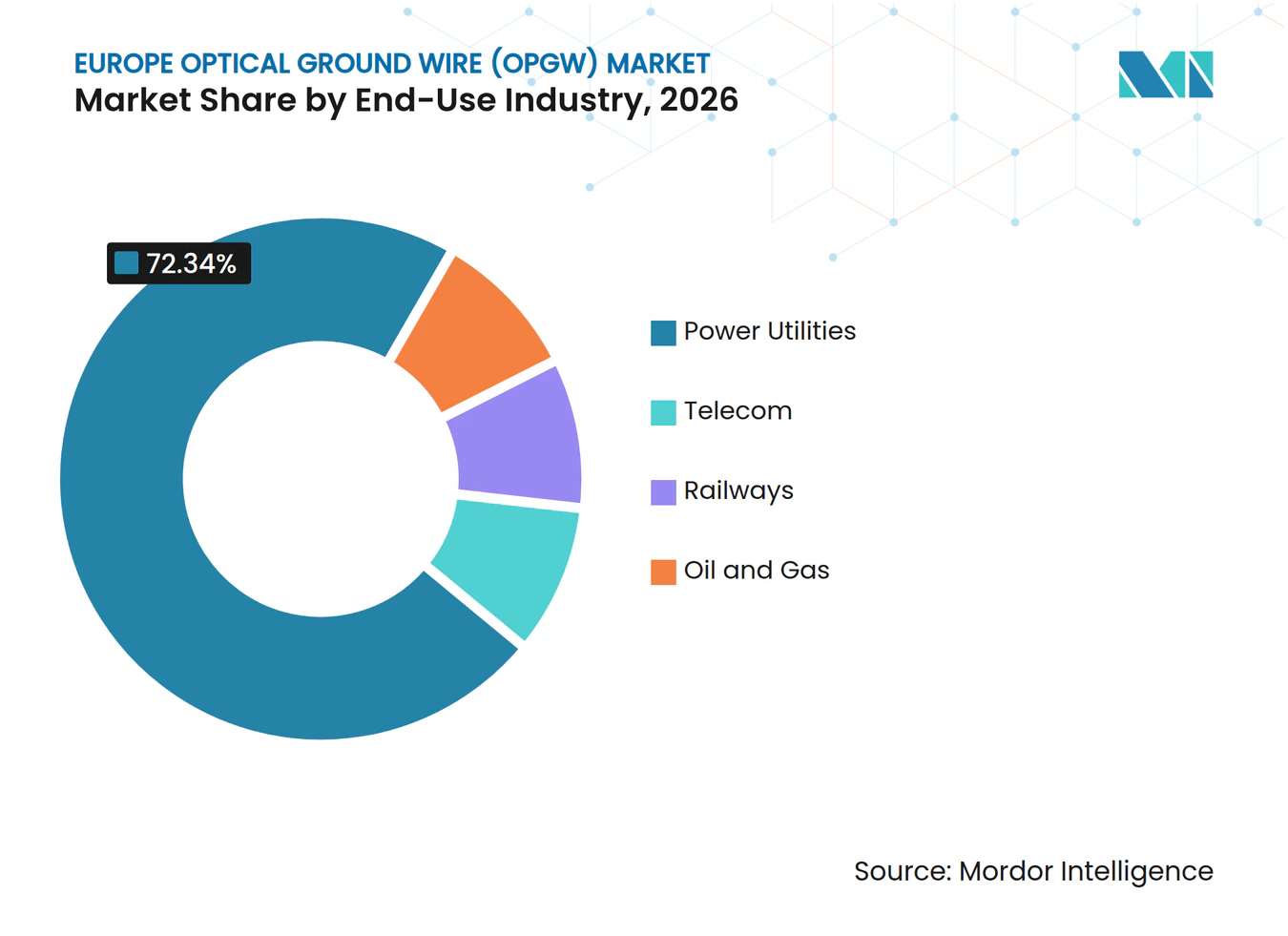
- By end-use industry, Power Utilities held 72.34% of the Europe OPGW market share in 2026 and recorded the highest projected CAGR at 9.03% through 2032.
- By geography, Germany held 24.12% of revenue in 2026, while Poland recorded the highest projected CAGR at 8.92% through 2032.
Note: Market numbers in this report are based on Mordor Intelligence's proprietary estimation framework, which combines nine months of actuals with Q4 projections for base year 2026.
Market Trends and Insights
Drivers Impact Analysis of Europe Optical Ground Wire (OPGW) Market*
| Driver | (~) % Impact on CAGR Forecast | Geographic Relevance | Impact Timeline |
|---|---|---|---|
| Renewable-Energy Integration and Cross-Border Interconnection Demand | +2.60% | Global, concentrated in EU core: Germany, France, Nordics, Poland | Short term (≤ 2 years) |
| Transmission-Grid Modernization and Aging Shield-Wire Replacement | +2.00% | EU-wide, with acute exposure in Western and Central Europe | Medium term (2–4 years) |
| Growth in Grid-Embedded Telecommunications Capacity | +0.80% | EU-wide, with early gains in Italy, Spain, Germany | Medium term (2–4 years) |
| Shared Fiber Capacity Leasing by Transmission Owners | +0.50% | Western and Southern EU; spill-over to CEE | Long term (≥ 4 years) |
| Demand for Real-Time Line Monitoring and Predictive Maintenance | +1.10% | EU-wide, with early adoption in Germany, France, Nordic markets | Medium term (2–4 years) |
| OPGW Deployment for Cybersecure Utility Communications and Grid Resilience | +0.60% | EU-wide, with critical urgency in Poland, Baltic States, Germany | Medium term (2–4 years) |
| Source: Mordor Intelligence | |||
Renewable Integration and Cross-Border Interconnection Demand
The Europe OPGW market gains from projects that connect renewable generation to major demand centers. The European Commission identified 8 Energy Highway bottlenecks in its December 2025 Grids Package, including Bornholm Energy Island, Harmony Link, and Iberian cross-border projects. New overhead corridors within these projects require protection and communications equipment, which supports optical ground wire demand. Bornholm Energy Island has a total project value of EUR 7 billion, including EUR 645 million from the Connecting Europe Facility[1]. More than 1,700 GW of renewable and hybrid projects are awaiting grid connection in Europe, which keeps pressure on transmission owners to upgrade their networks. Offshore wind integration also requires inland reinforcement, so network work extends beyond coastal landing points.
Grid Modernization and Aging Shield-Wire Replacement
Aging assets create recurring replacement work for the Europe OPGW market. The International Energy Agency reported that 40% of Europe’s distribution grids are more than 40 years old, while annual grid spending is set to exceed USD 70 billion in 2025. RTE announced a EUR 94 billion modernization program for 40,000 km of high-voltage lines through 2040. In December 2025, RTE completed renovation work on the 225 kV Champagnier-Cordéac line, including an integrated-fiber guard wire[2]. These projects make replacement demand more predictable than greenfield construction because they are embedded in recurring asset renewal plans. The Europe OPGW market therefore has a durable pipeline from France, Germany, Italy, and other countries upgrading established transmission networks.
Grid Telecommunications and Shared Fiber Leasing
The Europe OPGW market is also shaped by the communications value of installed fiber. Terna operates more than 46,000 km of high-voltage lines equipped with optical fiber and plans to invest more than EUR 2 billion in its fiber network through 2028[3]. Terna offers long-term fiber access to telecommunications and data center operators, giving utilities a path to monetize spare capacity. Reintel leases dark fiber across Spain’s transmission network and links international connection points with France, Portugal, Morocco, and Andorra. Fluxys also leases spare fiber capacity from its gas network to carriers serving major European routes. Leasing income can improve the business case for higher fiber counts, especially where regulation permits commercial use of utility infrastructure.
Real-Time Monitoring and Cybersecure Communications
Utilities can use OPGW fibers for sensing, protection, and secure communications, which raises the value of each installation. A 2025 peer-reviewed study found that optical fibers in OPGW can detect ice accretion, galloping, and sag through distributed sensing methods. Prysmian’s OPGWatch system uses a dedicated fiber to detect intrusion, vibration, temperature changes, and weather events from equipment located in a substation. This approach can avoid the need for additional conductor-mounted devices. The EU cybersecurity network code also requires stronger information-exchange practices for cross-border electricity flows[4]. The Europe OPGW market benefits because physically separated fiber can support communications needs that utilities assess as critical to network resilience.
Restraints Impact Analysis of Europe Optical Ground Wire (OPGW) Market*
| Restraint | (~) % Impact on CAGR Forecast | Geographic Relevance | Impact Timeline |
|---|---|---|---|
| High Retrofit Cost and Specialized Installation Requirements | -1.80% | EU-wide; most acute in UK, France, Germany where live-line installation is complex | Short term (≤ 2 years) |
| Long Utility Procurement and Transmission-Project Lead Times | -1.20% | EU-wide, with concentrated impact in regulated markets | Medium term (2–4 years) |
| Fiber Allocation and Cybersecurity Governance Complexity | -0.70% | EU-wide; earliest impact in cross-border TSO interconnections | Medium term (2–4 years) |
| Aluminum and Stainless-Steel Price Volatility | -1.00% | Global, with procurement exposure concentrated in European manufacturing hubs | Short term (≤ 2 years) |
| Source: Mordor Intelligence | |||
Retrofit Cost, Specialized Installation, and Long Project Lead Times
The Europe OPGW market faces installation constraints when utilities retrofit energized lines. Retrofit work can require specialized stringing equipment, certified live-line crews, and carefully managed outage windows. These requirements increase installed cost beyond the cable price, particularly on dense 400 kV networks in Germany and France. The International Energy Agency reported that component prices have more than doubled during the past decade and that China accounts for 60% of European transformer imports. Utility procurement cycles can also span multiple regulatory periods, so a rise in project need does not always translate into immediate orders. These conditions delay revenue recognition even when long-term replacement demand remains intact.
Fiber Governance, Cybersecurity Complexity, and Metal Price Volatility
Fiber allocation and cybersecurity governance can complicate cross-border projects in the Europe OPGW market. Transmission owners must decide how capacity is reserved for protection, operational data, sensing, and external lease customers. These decisions are more complex when several system operators share an interconnection. Aluminum and stainless-steel inputs also expose producers to cost changes, while long-term utility agreements can set selling prices before material costs are known. The draft cited aluminum prices of USD 2,657 per metric ton in late July 2025, but this estimate came from a non-qualifying commercial source and is not used in this rewrite. Manufacturers with stronger sourcing arrangements and hedging capabilities can manage this exposure more effectively.
*Our forecasts treat driver/restraint impacts as directional, not additive. The impact forecasts reflect baseline growth, mix effects, and variable interactions.
Europe Optical Ground Wire (OPGW) Market Segment Analysis
By Fiber Count:
Higher-Capacity Requirements Reshape New-Build SpecificationsThe 48F configuration held 39.11% of revenue in 2026. It fits many 110 kV to 220 kV replacement programs because it can support routine supervisory control, protection, and communications needs. Utilities replacing existing shield wire can also use 48F, where tower loading limits the scope for a heavier cable. The 24F option serves lower-complexity projects, including single-circuit rural lines and lower-voltage routes with limited bandwidth needs. These uses give 24F a stable role, although its addressable applications are narrower than those of 48F.
The 96F segment has the highest projected CAGR at 11.89% through 2032. The Europe OPGW market size for 96F is supported by new 220 kV to 500 kV corridors and offshore wind connections that require more capacity at installation. Higher fiber counts can support protection, supervisory control, distributed sensing, and spare capacity at the same time. The 144F+ tier remains concentrated in multi-circuit corridors that need redundant communications and potential dark-fiber leasing. Procurement in the Nordic region and Benelux increasingly reflects the benefit of selecting more fibers at the outset, because tower access and stringing dominate later upgrade costs.



By Cable Design Type:
Design B Gains on More Demanding RoutesDesign A accounted for 36.23% of revenue in 2026. Its established installed base reflects familiar mechanical structures, mature fitting systems, and broad acceptance under utility framework agreements. Installers understand the handling requirements for this configuration, which can reduce execution risk on conventional replacement work. Design A is therefore likely to remain important for standard grid reinforcement programs. The Europe OPGW market continues to use this design where existing tower conditions favor a well-tested specification.
Design B is projected to expand at a 9.21% CAGR through 2032. Multi-tube and double-layer armored structures associated with Design B can support high fiber counts, longer spans, ice loading, and more demanding high-voltage routes. A 2025 technical guide stated that multi-tube designs can accommodate 96F to 144F counts with strong tensile performance for large spans and heavy icing zones. Designs C through F serve more specific needs, including coastal crossings, lightweight applications, and locations with high short-circuit requirements. These designs have lower individual weight, but they give manufacturers an opportunity to supply specialized solutions where standard products are not suitable.
By End-Use Industry:
Utilities Remain the Core Source of DemandPower Utilities accounted for 72.34% of revenue in 2026 and are projected to grow at a 9.03% CAGR through 2032. Transmission system operators and other network owners drive demand through modernization, renewable integration, and interconnection programs. Higher fiber counts and sensing features can raise the value of the cable supplied under utility contracts. The Europe OPGW industry is most closely tied to utility capital spending because operators own the overhead lines where OPGW is installed. ACER’s 2025 guidance on cybersecurity information exchange adds a further communications consideration for cross-border electricity systems.
Telecommunications providers generally use fiber through long-term rights granted by utilities rather than buying OPGW directly. That relationship still influences utility investment because lease income can support a larger or more capable fiber installation. Railways create steady demand where electrification and signaling systems expand alongside overhead power infrastructure. Oil and gas applications are smaller and relate mainly to overhead lines supplying pipeline and compressor facilities. This structure keeps procurement concentrated among regulated network owners.

Geography Analysis
Germany Optical Ground Wire (OPGW) Market
Germany held 24.12% of revenue in 2026. Its demand base is supported by the need to move renewable power from northern generation areas to industrial centers in the south. Germany’s 2025 Network Development Plan identified EUR 360 billion to EUR 390 billion of grid investment through 2045. This scale supports demand across several planning cycles rather than a single procurement period. The Europe OPGW market also draws support from network upgrades by TransnetBW and 50Hertz.
Europe Optical Ground Wire (OPGW) Market
France is a major contributor because RTE plans to modernize 40,000 km of high-voltage lines through 2040. Italy benefits from Terna’s fiber investment plan and its established commercial fiber model. Spain has a related position through Reintel’s transmission-network fiber operations. These markets provide a combination of line replacement, fiber expansion, and commercial capacity use. The Europe OPGW market therefore has several large Western and Southern European demand centers with different but complementary drivers.
Poland and Norway Optical Ground Wire (OPGW) Market
Poland is forecast to record the highest geographic CAGR at 8.92% through 2032. PSE plans PLN 64 billion, equivalent to USD 16 billion, for more than 4,800 km of new 400 kV lines through 2034. The European Investment Bank also made an EUR 400 million-plus loan payment to Orlen Group for electricity-grid upgrades. Norway remains a regular buyer through hydropower integration and Nordic interconnection activity.
Competitive Landscape
Market Concentration
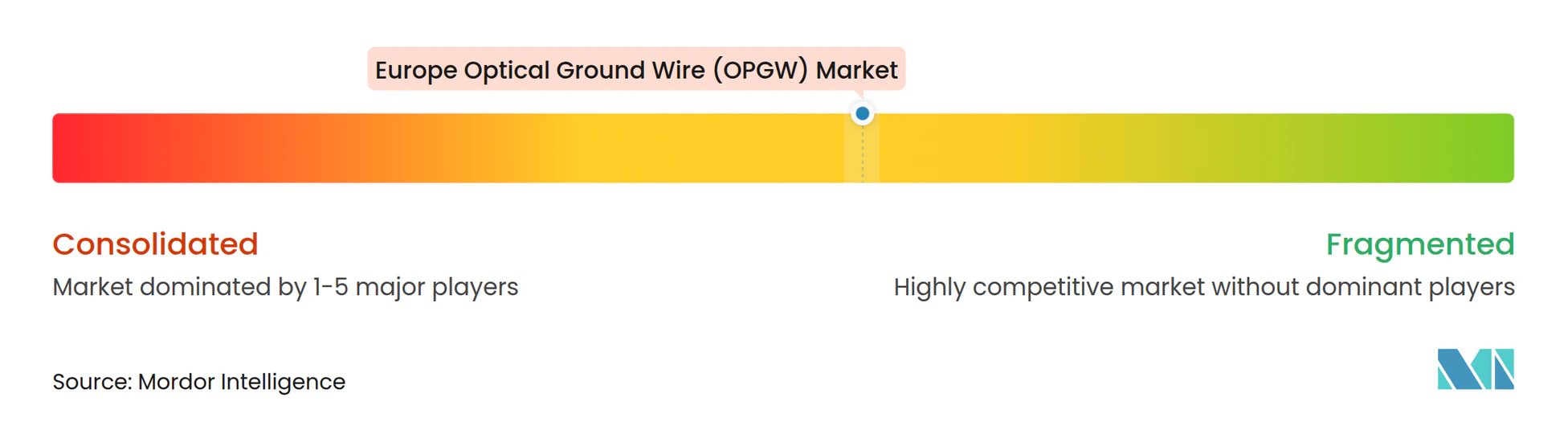
Europe Optical Ground Wire (OPGW) Market is moderately concentrated. Prysmian, NKT, and Nexans anchor the Europe OPGW market through manufacturing capacity, qualified utility relationships, and broader cable portfolios. Prysmian has installed more than 195,000 km of OPGW in over 100 countries and produces more than 25,000 km annually across its European, American, and Asian sites. The European Investment Bank agreed to provide Prysmian with EUR 300 million for research and development, with an initial EUR 200 million tranche signed in December 2025. NKT is advancing a EUR 2 billion capacity expansion program through 2028 covering Karlskrona, Cologne, and Portugal.
Prysmian’s OPGWatch system shows how suppliers are expanding from cable supply into monitoring services. Elia placed EUR 135 million of cable orders with NKT, Nexans, and Prysmian for 945 km of land cable, with deliveries planned for 2025 to 2027. These agreements show the advantage of suppliers already qualified in utility procurement frameworks. Design B products, higher fiber-count cables, and monitoring solutions remain important areas for differentiation. Asian manufacturers compete on pricing and delivery, particularly in public tenders.
Tratos Cavi has a specialized position in bespoke, high-specification cable designs for major transmission owners. Technical compliance with IEC 60794-1 and IEC 61089, together with ISO 9001 certification, provides a baseline for participation in European utility work. The Europe OPGW market is moderately consolidated because the largest suppliers have established production, qualification, and service capabilities. Competitive behavior remains shaped by framework agreements, delivery reliability, and the ability to supply cable and monitoring solutions.
Europe Optical Ground Wire (OPGW) Industry Leaders
-
Prysmian S.p.A.
-
Nexans S.A.
-
Tratos Cavi S.p.A.
-
AFL Telecommunications LLC
-
NKT A/S
- *Disclaimer: Major Players sorted in no particular order
Europe Optical Ground Wire (OPGW) Market Companies Covered in this Report
- AFL Telecommunications LLC
- APAR Industries Limited
- Caledonian Cables Limited
- Elsewedy Electric S.A.E.
- Fujikura Ltd.
- Furukawa Electric Co., Ltd.
- Hengtong Group Co., Ltd.
- Jiangsu Tongguang Electronic Wire & Cable Co., Ltd.
- Jiangsu Zhongtian Technology Co., Ltd.
- J-Power Systems Corporation
- LS Cable & System Ltd.
- Nexans S.A.
- NKT A/S
- Prysmian S.p.A.
- Shenzhen SDG Information Co., Ltd.
- Sterlite Electric Limited
- Sumitomo Electric Industries, Ltd.
- Taihan Cable & Solution Co., Ltd.
- Tongguang Cable Co., Ltd.
- Tratos Cavi S.p.A.
Recent Industry Developments in Europe Optical Ground Wire (OPGW) Market
- December 2025: The European Investment Bank approved a EUR 300 million R&D financing package for Prysmian, with the first tranche of EUR 200 million signed. Funds are directed at energy and digital network solutions, including OPGW and optical cable technologies, across R&D laboratories in Italy, France, Germany, the Netherlands, and Spain through 2028.
- September 2025: Siemens Energy was awarded the converter station contract for Bornholm Energy Island, a joint venture between Energinet and 50Hertz. The project has a total value of EUR 7 billion, while the Connecting Europe Facility granted EUR 645 million.
- September 2025: Prysmian was named the preferred bidder for National Grid’s Eastern Green Link 4 HVDC interconnector project between Scotland and England. The expected contract value is EUR 2 billion, and the project includes overhead-line sections where OPGW is integral to the design.
- July 2025: Prysmian was awarded a 3-year framework agreement, plus 1 optional year, with Terna for HVAC cable supply and high-voltage cable maintenance across Italy’s national transmission grid. The agreement is valued at up to EUR 382.5 million.
Europe Optical Ground Wire (OPGW) Market Report Scope
Optical Ground Wire (OPGW) is a specialized overhead ground wire installed on electric power transmission lines that combines lightning protection and fault-current grounding with optical fiber communication capabilities. It consists of optical fibers housed within a protective metallic structure and is used by utilities for high-speed data transmission, substation communication, grid monitoring, protection, and control. OPGW serves a dual function by protecting transmission lines against lightning strikes while enabling reliable communication between power system facilities.
Europe optical ground wire (OPGW) market is segmented by fiber count, cable design type, end-use industry, and geography. By fiber count, the market is segmented into 24F, 48F, 96F, and 144F and above. By cable design type, the market is segmented into Design A, Design B, Design C, Design D, Design E, and Design F. By end-use industry, the market is segmented into power utilities, telecommunications, railways, and oil and gas. The report also covers the market size and forecasts for the Europe optical ground wire (OPGW) market across 9 countries in the region. For each segment, the market sizing and forecasts are provided on the basis of value (USD).
Segmentation Overview
| 24F |
| 48F |
| 96F |
| 144F+ |
| Design A |
| Design B |
| Design C |
| Design D |
| Design E |
| Design F |
| Power Utilities |
| Telecom |
| Railways |
| Oil & Gas |
| Germany |
| France |
| Italy |
| Spain |
| United Kingdom |
| Poland |
| Netherlands |
| Norway |
| Russia |
| Rest of Europe |
| By Fiber Count | 24F |
| 48F | |
| 96F | |
| 144F+ | |
| By Cable Design Type | Design A |
| Design B | |
| Design C | |
| Design D | |
| Design E | |
| Design F | |
| By End-Use Industry | Power Utilities |
| Telecom | |
| Railways | |
| Oil & Gas | |
| By Geography | Germany |
| France | |
| Italy | |
| Spain | |
| United Kingdom | |
| Poland | |
| Netherlands | |
| Norway | |
| Russia | |
| Rest of Europe |
Key Questions Answered in the Report
How large is the Europe Optical Ground Wire (OPGW) market?
The report projects the value to rise from USD 156.09 million in 2027 to USD 234.32 million by 2032, at an 8.46% CAGR. The forecast reflects utility demand, higher fiber-count requirements, and expanding communications needs.
Which fiber count is growing fastest in Europe?
The 96F configuration is projected to grow at an 11.89% CAGR through 2032 because new high-voltage routes require greater communications and sensing capacity.
Which buyers account for the most OPGW demand?
Power Utilities held 72.34% of revenue in 2026 and are projected to grow at a 9.03% CAGR through 2032.
Which country has the largest 2026 revenue share?
Germany held 24.12% of revenue in 2026, supported by major grid investment and renewable power transmission needs.
Why do utilities install more fibers than immediate operations require?
Extra fibers can support protection, sensing, redundancy, and potential long-term leasing to telecommunications or data center customers.
How concentrated is supplier competition in Europe?
The market is moderately consolidated around established cable suppliers, although a quantitative concentration score cannot be calculated because combined supplier market shares were not provided.