
Europe Boiler Feed Pumps Market Size and Share
Market Overview
| Study Period | 2022 - 2032 |
|---|---|
| Forecast Data Period | 2027 - 2032 |
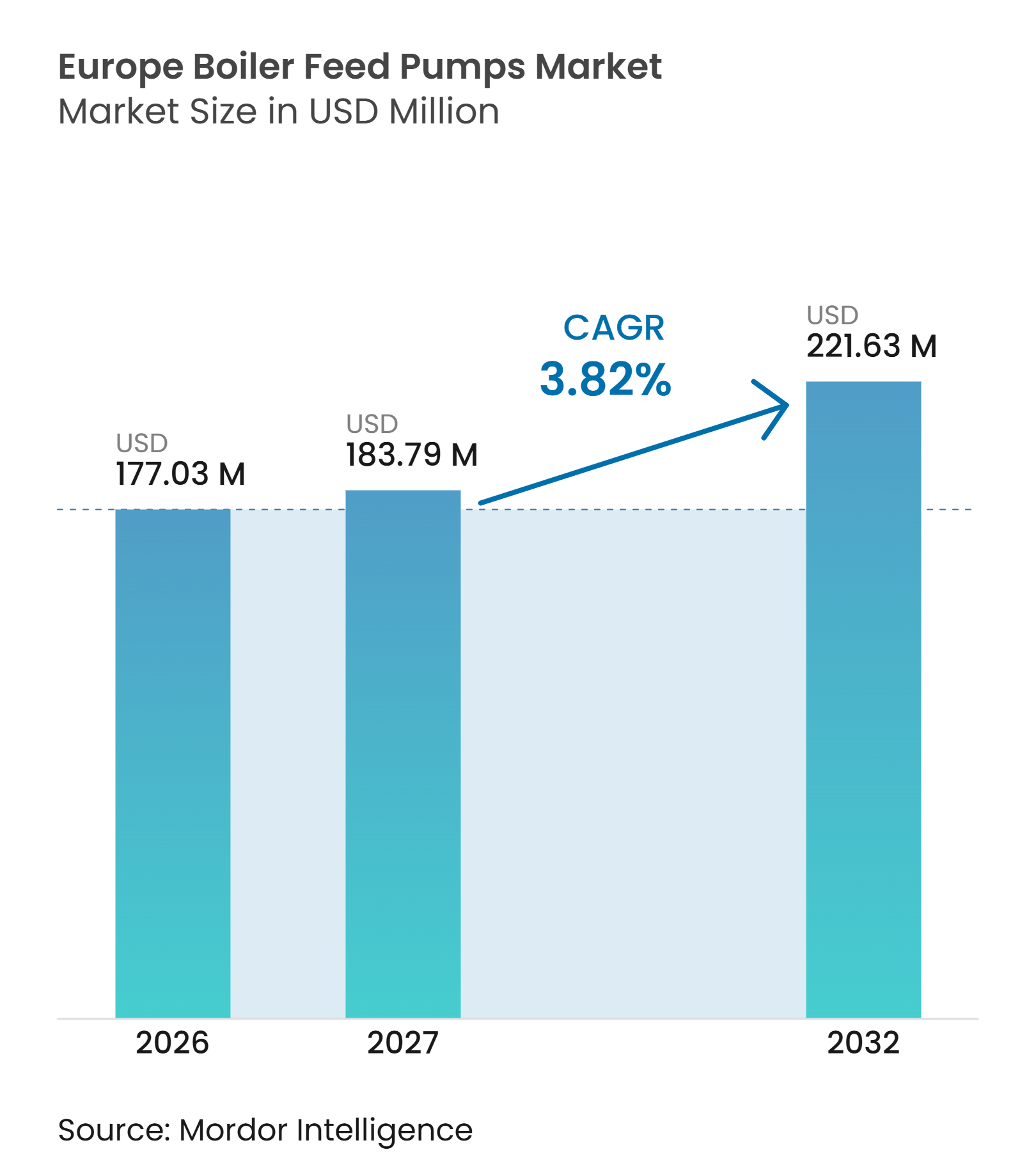
| Base Year Market Size (2026) | USD 177.03 Million |
| Market Size (2027) | USD 183.79 Million |
| Market Size (2032) | USD 221.63 Million |
| Growth Rate (2027 - 2032) | 3.82 % |
| Market Concentration | Low |
Major Players *Disclaimer: Major Players sorted in no particular order Image © Mordor Intelligence. Reuse requires attribution under CC BY 4.0. | |
Europe Boiler Feed Pumps Market Analysis by Mordor Intelligence
The Europe Boiler Feed Pumps Market size is projected to be USD 177.03 million in 2026, USD 183.79 million in 2027, and reach USD 221.63 million by 2032, growing at a CAGR of 3.82% from 2027 to 2032. Replacement demand from aging thermals and combined heat and power assets supports spending even as operators retire coal-fired capacity. New combined-cycle gas turbine, biomass, and waste-to-energy projects offset part of the decline in conventional thermal construction and require pumps built for specific pressure, head, and cycling conditions. Procurement decisions remain cautious because equipment costs, carbon pricing, and project schedules affect capital approvals. Qualified suppliers can benefit from demand for high-pressure equipment, retrofit services, and lifecycle monitoring, while long lead times for specialist materials and rotor machining can delay project delivery.
Key Report Takeaways
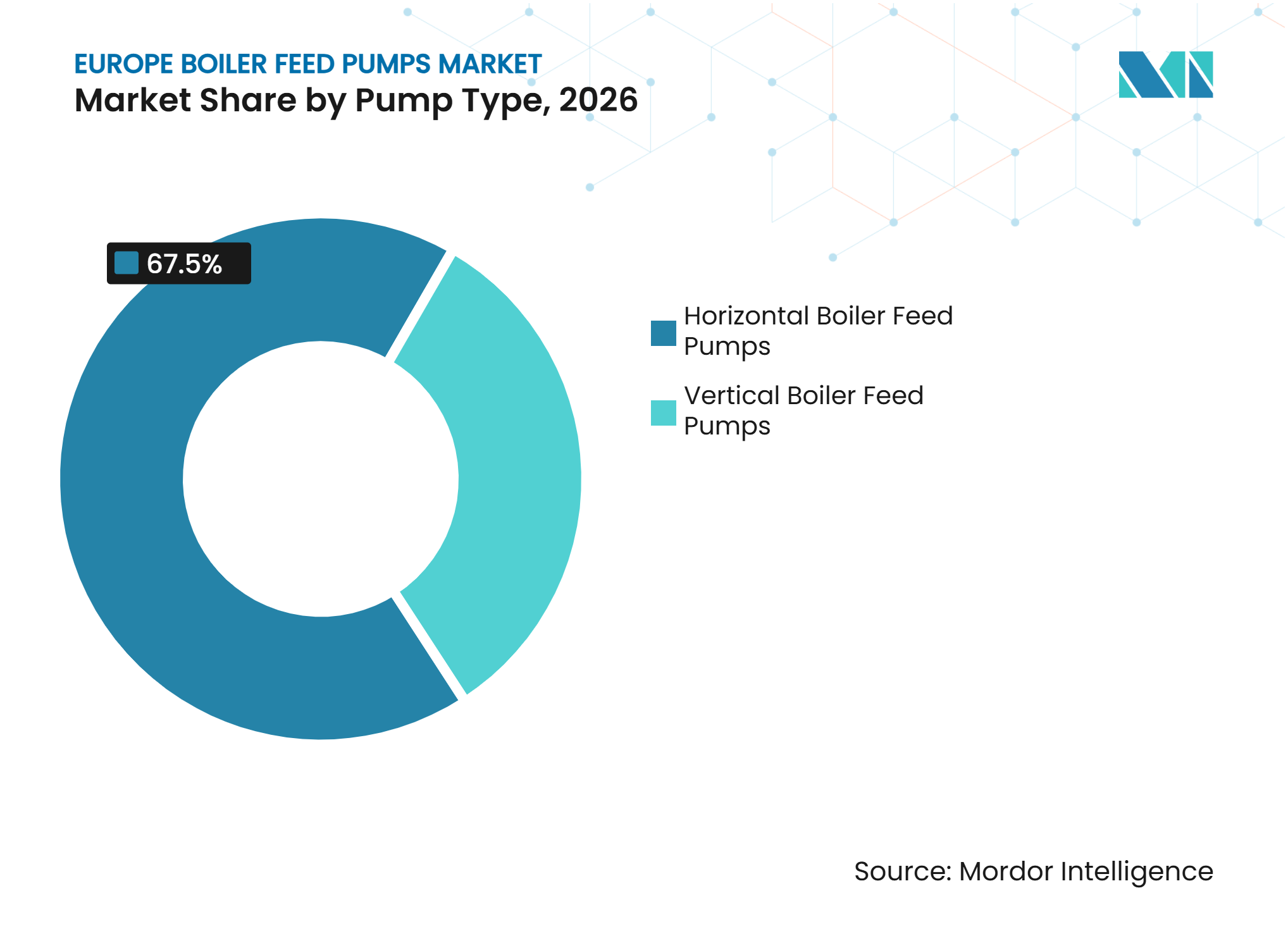
- By pump type, horizontal pumps held 67.5% of the Europe boiler feed pumps market share in 2026, while vertical pumps are forecast to grow at a CAGR of 4.1% through 2032.
- By pump design, multistage centrifugal pumps accounted for 54.5% of the Europe boiler feed pumps market size in 2026, while barrel-type pumps are forecast to grow at a CAGR of 4.3% through 2032.
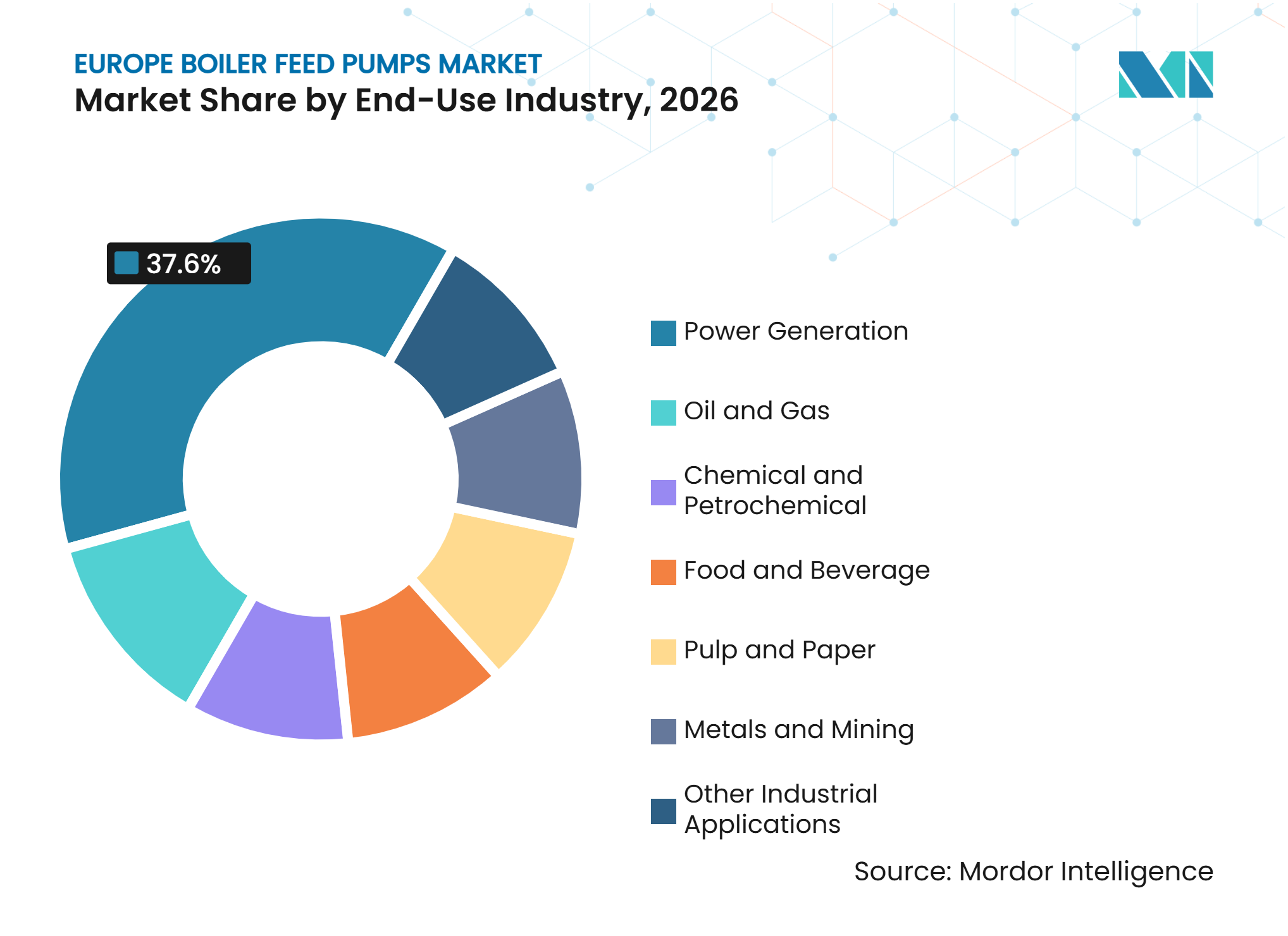
- By end-use industry, power generation held 37.6% of the market in 2026, while chemical and petrochemical applications are forecast to grow at a CAGR of 4.4% through 2032.
- By geography, Germany held 22.6% of the regional market in 2026, while Poland is forecast to grow at a CAGR of 4.9% through 2032.
Note: Market numbers in this report are based on Mordor Intelligence's proprietary estimation framework, which combines nine months of actuals with Q4 projections for base year 2026.
Market Trends and Insights
Drivers Impact Analysis of Europe Boiler Feed Pumps Market*
| Driver | (~) % Impact on CAGR Forecast | Geographic Relevance | Impact Timeline |
|---|---|---|---|
| Replacement Of Aging Thermal And CHP Assets | +1.0% | Western Europe core, including Germany, the United Kingdom, France, Italy, and Benelux | Short term (≤ 2 years) |
| Industrial Energy-Efficiency Retrofit Demand | +0.7% | Germany, France, and the Netherlands | Medium term (2-4 years) |
| Biomass And Waste-To-Energy Boiler Capacity Additions | +0.5% | Poland, Scandinavia, the United Kingdom, and Germany | Medium term (2-4 years) |
| High-Pressure CCGT And Process Demand | +0.4% | Poland, Belgium, Italy, and Germany | Medium term (2-4 years) |
| Carbon-Accounting And Pump Efficiency Auditability | +0.3% | EU-wide, with early gains in Germany, France, and the Netherlands | Long term (≥ 4 years) |
| Cycling Duty For Renewable Balancing | +0.2% | The United Kingdom, Germany, Denmark, and Spain | Long term (≥ 4 years) |
| Source: Mordor Intelligence | |||
Replacement of Aging Thermal and CHP Assets Sustains Near-Term Boiler Feed Pumps (BFP) Demand
Plants commissioned from the mid-1980s through the late 1990s are reaching the point where operators must choose between life extension and replacement. This installed base supports near-term demand in Germany, France, Italy, and the United Kingdom. Hot, low-conductivity feed water can accelerate corrosion-related wear in legacy carbon-steel units and make repeated component repair less attractive than a modern replacement.[1] KSB supplied a 2 MW HGI boiler feed pump at Stora Enso’s Skoghall mill in October 2025, with 327 m³/h capacity, 140 bar pressure, and 83% hydraulic efficiency, and the unit was installed without a plant shutdown.[2] The Europe boiler feed pumps market therefore draws support from replacement projects that are tied to asset condition rather than short-term electricity prices. Operators also place value on equipment and installation plans that reduce lost production during a cutover.
Energy-Efficiency Retrofits and Carbon-Accounting Requirements Expand Replacement Demand
Germany’s Federal Office for Economic Affairs and Export Control (BAFA) Modul 1 program provides support for pump systems that meet its stated efficiency conditions, including a minimum energy efficiency index of 0.70.[3] The February 2025 Energy Efficiency Act (EnEfG) update requires broad energy monitoring coverage at large industrial sites, making pump energy use more visible in plant management systems. Once consumption data is recorded and reviewed, inefficient equipment becomes a documented operating issue rather than an unmeasured cost. The European Committee for Standardization (CEN) published EN 17038-3:2026 in September 2026, extending energy-efficiency index requirements to pump sets as packages.[4] Comparable national programs in France and the Netherlands support a similar replacement case across the Europe boiler feed pumps market. These requirements also favor suppliers that can document pump performance, controls, and system-level efficiency.
Biomass and Waste-To-Energy Boiler Capacity Additions Create New Demand
Biomass and waste-to-energy projects add demand beyond the replacement cycle of conventional thermal plants. Poland’s National Fund for Environmental Protection and Water Management allocated PLN 6 billion, equivalent to USD 1.5 billion, from the EU Modernisation Fund for waste-to-energy development. Sumitomo SHI FW announced a EUR 100 million, equivalent to USD 108 million, biomass boiler conversion in Czestochowa. Fjernvarme Horsens commissioned 2 biomass boilers of 30 MW each in December 2025. These installations may operate at lower steam temperatures than coal facilities but can face more frequent cycling. Their water chemistry and silica-control requirements can require upgraded wetted materials and raise the value of the pump package.
High-Pressure CCGT, Process Demand, and Cycling Duty Support Premium Specifications
New combined-cycle gas turbine projects need high-pressure boiler feed pumps with performance that differs from standard industrial multistage equipment. Sulzer supplied MD200-400 pumps for the 840 MW Keadby 2 combined-cycle gas turbine plant in the United Kingdom, with 2,200 m head and 81% hydraulic efficiency. GE Vernova received the contract for the 1.2 GW Kozienice combined-cycle gas turbine project in Poland in November 2025. Energa signed a PLN 3.1 billion, equivalent to USD 770 million, contract for the Grudziądz II project in September 2025. As renewable capacity rises, flexible operation can also increase the need for variable-speed capability and hydraulic re-rating at partial loads. The Europe boiler feed pumps market benefits when these projects move from contract award into construction because premium units have higher technical requirements and fewer qualified suppliers.
Restraints Impact Analysis of Europe Boiler Feed Pumps Market*
| Restraint | (~) % Impact on CAGR Forecast | Geographic Relevance | Impact Timeline |
|---|---|---|---|
| Thermal Coal Retirements And Reduced Greenfield Opportunities | -0.2% | Germany, Poland, Czechia, and Bulgaria | Short term (≤ 2 years) |
| High Capital Costs And Qualification Cycles | -0.1% | EU-wide, particularly smaller industrial operators | Medium term (2-4 years) |
| Corrosion And Cavitation Risk Under Cycling Duty | -0.1% | The United Kingdom, Germany, and Denmark | Long term (≥ 4 years) |
| Scarcity Of Specialist Overhaul Capacity | -0.1% | National markets, with acute pressure in Poland and Eastern Europe | Medium term (2-4 years) |
| Source: Mordor Intelligence | |||
Thermal Coal Retirements Reduce Greenfield Opportunities
The retirement of coal-fired generation reduces the pool of new conventional boiler projects in several European countries. A plant closure removes the original pump installation, its maintenance agreement, the spare-parts requirement, and the later refurbishment opportunity. Germany’s industrial carbon dioxide pathway tightened from 157 Mt in 2025 toward 118 Mt by 2030, limiting the case for long-lived high-emissions boiler investment. This condition creates a flatter new-unit outlook for the older industrial areas that historically generated substantial thermal replacement demand. The Europe boiler feed pumps market is partly protected by gas, biomass, waste-to-energy, and industrial retrofit activity, but these applications do not fully mirror the former coal project pipeline. Suppliers consequently need to balance new-unit sales with service, modernization, and lifecycle work.
Qualification, Cycling Risks, and Service Constraints Increase Project Complexity
High capital cost and lengthy qualification processes can delay replacement decisions, especially at smaller industrial sites. Cycling operation can create fatigue, corrosion, and cavitation risks when installed pumps were designed for continuous baseload service. Variable-frequency drives and hydraulic re-rating can reduce some low-load operating risk, but they add engineering scope. Limited specialist overhaul capacity can extend repair windows, particularly in Poland and parts of Eastern Europe. Long lead times for forged stainless alloys and specialist rotor machining also reduce schedule flexibility for engineering contractors. These conditions shift customer attention toward suppliers with type-testing capability, application engineering, and dependable aftermarket support.
*Our forecasts treat driver/restraint impacts as directional, not additive. The impact forecasts reflect baseline growth, mix effects, and variable interactions.
Europe Boiler Feed Pumps Market Segment Analysis
By Pump Type:
Horizontal Units Retain Broad Use While Vertical Units Gain Compact ApplicationsHorizontal pumps accounted for 67.5% of the Europe boiler feed pumps market in 2026. Their position reflects long-standing use across thermal, combined-cycle gas turbine, and industrial boiler installations. Service access to shafts and mechanical seals can reduce the need for a full shutdown during routine work. KSB’s 2025 Skoghall installation showed how a high-pressure horizontal replacement could be completed without a production stoppage. This practical advantage matters at aging assets where unplanned downtime can have a direct cost. Horizontal designs also fit a wide group of end uses, including power generation, pulp and paper, chemicals, and district heating.
Vertical pumps are forecast to grow at a CAGR of 4.1% through 2032. They are used where site layout and civil works constraints favor a smaller footprint, including modular waste-to-energy plants, biomass boiler houses, and some process facilities. New bearing materials and improved seal designs support their suitability in these applications. European Committee for Standardization (CEN) work on FprEN ISO 15783:2026 covers seal-less rotodynamic pumps and supports clearer technical assessment for relevant configurations. Developers in Scandinavia and Poland may favor more compact plant layouts as new projects progress. Within the Europe boiler feed pumps industry, vertical equipment is therefore more closely associated with new-build specifications than with the replacement of standard horizontal units.



By Pump Design:
Multistage Centrifugal Pumps Lead Volume While Barrel-Type Pumps Grow FasterMultistage centrifugal pumps held 54.5% of the regional market in 2026. Their installed base is broad across thermal, combining heat and power, and mid-range industrial boiler systems. Design maturity supports established procurement practices, standardized spare parts, and access to multiple service providers. Single-stage centrifugal pumps continue to serve lower-pressure boiler duties where pressure requirements are more limited. Ring-section models serve a middle range of chemical, oil and gas, and process applications because the hydraulic stages can be adjusted without redesigning the full pump assembly. These characteristics keep multistage centrifugal pumps central to volume demand in the Europe boiler feed pumps market.
Barrel-type pumps are forecast to grow at a CAGR of 4.3% through 2032, the fastest pace among pump designs. High-pressure combined-cycle gas turbine installations require equipment that can sustain demanding pressure and thermal cycling conditions. Barrel casings support hydraulic integrity during rapid temperature changes and start-stop operation. Apollo Gosstnitz supplied BB4 and BB5 barrel and ring-section pumps to Berlin’s Reuter heat park in November 2025. As projects in Poland and Italy move into construction, first-fit orders for this equipment can increase. The Europe boiler feed pumps industry also uses ring-section and barrel products in specialized applications where qualification credentials matter more than initial price.
By End-Use Industry:
Power Generation Leads Demand While Chemical and Petrochemical Applications Grow FasterPower generation held 37.6% of the regional market in 2026. Combined-cycle gas turbine projects, biomass conversions, and upgrades to existing thermal assets support its leading position. The sector includes legacy units that remain in operation while newer gas and biomass facilities are commissioned. High-pressure boiler feed requirements in these facilities can favor engineered products with documented hydraulic performance. The Europe boiler feed pumps market size for power generation remains supported by both first-fit orders and aftermarket work. Its demand profile remains exposed to the pace of coal retirements, but it benefits from the pipeline of replacement generation and grid-balancing capacity.
Chemical and petrochemical applications are forecast to expand at a CAGR of 4.4% through 2032. This growth is associated with boiler-house upgrades and the need to document energy use under carbon pricing and efficiency requirements. Process facilities still depend on steam for high-temperature duties where electrification is less practical in the current operating setup. Oil and gas remain a steady secondary application for steam injection and refinery boiler systems. Pulp and paper producers manage specialized recovery boiler fleets, as illustrated by the Skoghall replacement project. Food and beverage, metals and mining, district heating, and other process users provide a diversified base across the Europe boiler feed pumps industry.

Geography Analysis
Germany: Efficiency Programs and Combined-Cycle Gas Turbine Projects Support Demand
Germany held 22.6% of the Europe boiler feed pumps market size in 2026. The country has a large installed base of combined heat and power and combined-cycle assets that require replacement, upgrades, and maintenance. Bundesamt für Wirtschaft und Ausfuhrkontrolle (BAFA) support and the 2025 Energieeffizienzgesetz (EnEfG) monitoring update encourage industrial operators to measure energy use and assess the need for high-efficiency pump replacements. The policy framework makes it easier for project teams to link equipment performance to compliance and operating costs. RWE’s planned combined-cycle gas turbine portfolio at Voerde, Werne, and Weisweiler points to future steam-cycle equipment demand. Germany’s carbon dioxide pathway also restricts investment in long-lived high-emissions assets. This keeps the emphasis on efficient replacements and lower-carbon generation rather than conventional coal expansion. European Committee for Standardization (CEN)’s package-level efficiency standard adds a further compliance factor for equipment specification.
Poland: Gas, Biomass, And Waste-To-Energy Projects Create Faster Growth
Poland is forecast to grow at a CAGR of 4.9% through 2032. Its project pipeline combines gas-fired generation with biomass and waste-to-energy development, creating demand across different pressure and duty requirements. The Kozienice combined-cycle gas turbine contract and the Grudziądz II project provide visible examples of upcoming generation investment. Poland’s waste-to-energy funding allocation adds a parallel route for boiler equipment procurement. The Czestochowa conversion shows that biomass projects can also support specialized feed-water requirements. These projects can change the country’s position in regional procurement as they proceed into construction. Pump providers need to match combined-cycle gas turbine requirements with metallurgy and water-chemistry needs in biomass applications. National funding and EU-linked modernization programs are important compliance and financing factors. The Europe boiler feed pumps market share held by Poland could increase if the announced projects proceed on schedule.
The United Kingdom, France, Italy, Spain, and Other Markets Show Different Demand Patterns
The United Kingdom is shaped by flexible generation requirements, including the Keadby 2 reference installation with 2,200 m head pump duty. France depends more on asset management in hydro and nuclear infrastructure, where specialized pump work supports maintenance demand. ANDRITZ received a contract from EDF for the Vouglans and Saut-Mortier hydropower schemes in July 2026. Italy combines combined-cycle gas turbine investment with service work in renewable heat applications. Termomeccanica Pompe completed a 25-ton pump overhaul at the Larderello geothermal plant in February 2025. Spain is more focused on aftermarket activity after KSB ended new sales of the ITUR product line in January 2025. Scandinavian biomass and district-heating projects favor designs that manage frequent cycling, as shown by the Horsens commissioning. Across these markets, ISO and European Committee for Standardization (CEN)-related performance and efficiency requirements can influence supplier qualification. Russia remains outside the accessible regional opportunity due to international sanctions. The Europe boiler feed pumps market therefore has a varied demand base rather than a single regional project cycle.
Competitive Landscape
Market Concentration
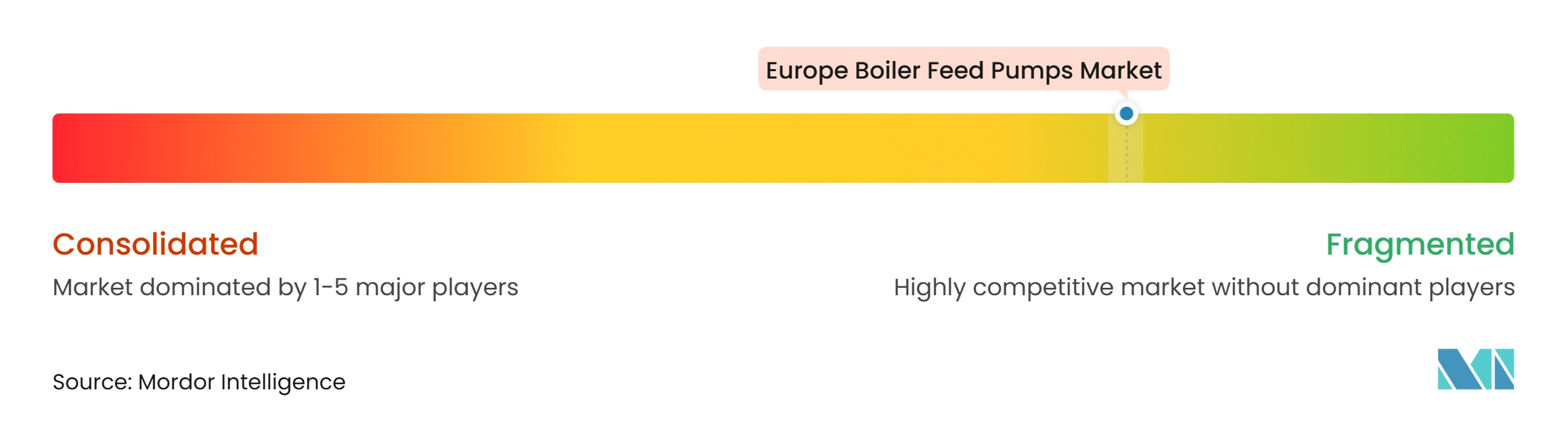
The Europe boiler feed pumps market has fragmented consolidation in engineered products for medium and large power and industrial applications. KSB, Sulzer, Flowserve, and ANDRITZ are established suppliers in these applications, while regional specialists compete where cycling duty, testing requirements, or nuclear-adjacent qualifications are important. KSB reported EUR 3.034 billion, equivalent to USD 3.3 billion, in revenue for 2025, and its energy segment increased 7.4%. The result indicates active demand in the energy-related end markets served by the company. Celeros Flow Technology expanded and upgraded its Cathcart, Glasgow test facility in January 2025, increasing capacity for full-performance testing of BB5 and BB3 products. Its Ontario facility obtained ASME N-stamp nuclear accreditation in June 2025. These credentials can be relevant where customers require witnessed testing and documented qualification.
Suppliers are extending their offer beyond the initial pump sale through variable-speed compatibility, lifecycle monitoring, and service arrangements. ANDRITZ reported cautious customer behavior and deferred investment decisions in its 2025 annual report. This favors vendors that can provide performance assessment, retrofit engineering, and flexible service support. Torishima described backlog pressure in combined-cycle gas turbine and heat-recovery steam-generator boiler feed pump orders in its 2025 reporting. Long lead times make manufacturing capacity, material procurement, and proven engineering processes relevant competitive factors. Flowserve’s investor disclosures describe a manufacturing footprint across Europe, which can support customer needs for local production and service. The Europe boiler feed pumps market is thus shaped by the ability to meet project schedules as well as pump performance requirements.
Specialist suppliers remain relevant where the application is too specific for a standard product. Apollo Gosstnitz supplies barrel and ring-section pumps for high-pressure service and supplied the Reuter heat park project in 2025. Sulzer’s Keadby 2 reference demonstrates its role in high-head combined-cycle gas turbine duty. KSB’s hot-cutover project at Skoghall demonstrates a service-led approach to replacement work at industrial sites. CEN and ISO performance frameworks raise the documentation required for new entrants in certain applications. For critical projects, the Europe boiler feed pumps market rewards suppliers with proven field references and service capability.
Europe Boiler Feed Pumps Industry Leaders
-
KSB SE & Co. KGaA
-
Sulzer Ltd.
-
Flowserve Corporation
-
Grundfos Holding A/S
-
ANDRITZ AG
- *Disclaimer: Major Players sorted in no particular order
Europe Boiler Feed Pumps Market Companies Covered in this Report
- ANDRITZ AG
- Apollo Gößnitz GmbH
- Bombas Itur, S.A.
- ClydeUnion Pumps
- DICKOW PUMPEN GmbH & Co. KG
- Ebara Corporation
- Flowserve Corporation
- Grundfos Holding A/S
- HERMETIC-Pumpen GmbH
- Klaus Union GmbH & Co. KG
- KSB SE & Co. KGaA
- Ruhrpumpen GmbH
- Speck Pumpen
- SPP Pumps
- Sulzer Ltd.
- Termomeccanica Pompe S.p.A.
- Torishima Pump Mfg. Co., Ltd.
- Weir Group PLC
- Wepuko PAHNKE GmbH
- Wilo SE
Recent Industry Developments in Europe Boiler Feed Pumps Market
- July 2026: ANDRITZ received a pump-turbine supply contract from EDF for the Vouglans and Saut-Mortier hydropower schemes in France, valued in the lower double-digit million EUR range. The award signals ongoing capital investment by EDF in its large hydro asset base and positions ANDRITZ for further French hydro-infrastructure contract flow.
- November 2025: GE Vernova was awarded the turbine and power island contract for the 1.2 GW Kozienice combined-cycle gas turbine project in Poland by Enea Group. The contract is among the largest single gas-power awards in Central Europe in 2025 and generates defined boiler feed pump procurement requirements across the construction and commissioning phases.
- October 2025: KSB supplied an HGI series boiler feed pump rated at 2 MW, 327 m³/h, 140 bar, and 83% hydraulic efficiency to Stora Enso’s Skoghall mill in Sweden, installed without plant shutdown. The case sets a documented efficiency and installation benchmark for high-pressure boiler feed pump hot-cutover in the biomass-fueled pulp and paper sector.
- September 2025: Energa signed a PLN 3.1 billion, equivalent to USD 770 million, Engineering, Procurement, and Construction (EPC) contract for the Grudziądz II combined-cycle gas turbine plant, with Siemens Energy as the main contractor. The project reinforces Poland’s pipeline of large gas-generation investments and creates boiler feed pump procurement demand over 2026-2028.
Europe Boiler Feed Pumps Market Report Scope
A boiler feed pump (BFP) is a specialized high-pressure device that supplies feedwater to a steam boiler to maintain the required water and steam generation levels.
Europe boiler feed pumps market is segmented into pump type, pump design, end-use industry, and geography. By pump type, the market is segmented into horizontal boiler feed pumps, and vertical boiler feed pumps. By pump design, the market is divided into multistage centrifugal pumps, single-stage centrifugal pumps, barrel-type boiler feed pumps, and ring-section boiler feed pumps. By end-use industry, the market is divided into power generation, oil and gas, chemical and petrochemical, food and beverage, pulp and paper, metals and mining, and other industrial applications. The report also covers the market size and forecasts for the Europe boiler feed pumps market across 7 countries. For each segment, the market sizing and forecasts have been provided on the basis of value (USD).
Segmentation Overview
| Horizontal Boiler Feed Pumps |
| Vertical Boiler Feed Pumps |
| Multistage Centrifugal Pumps |
| Single-Stage Centrifugal Pumps |
| Barrel-Type Boiler Feed Pumps |
| Ring-Section Boiler Feed Pumps |
| Power Generation |
| Oil and Gas |
| Chemical and Petrochemical |
| Food and Beverage |
| Pulp and Paper |
| Metals and Mining |
| Other Industrial Applications |
| Germany |
| France |
| Italy |
| Spain |
| United Kingdom |
| Poland |
| Russia |
| Rest of Europe |
| By Pump Type | Horizontal Boiler Feed Pumps |
| Vertical Boiler Feed Pumps | |
| By Pump Design | Multistage Centrifugal Pumps |
| Single-Stage Centrifugal Pumps | |
| Barrel-Type Boiler Feed Pumps | |
| Ring-Section Boiler Feed Pumps | |
| By End-Use Industry | Power Generation |
| Oil and Gas | |
| Chemical and Petrochemical | |
| Food and Beverage | |
| Pulp and Paper | |
| Metals and Mining | |
| Other Industrial Applications | |
| By Geography | Germany |
| France | |
| Italy | |
| Spain | |
| United Kingdom | |
| Poland | |
| Russia | |
| Rest of Europe |
Key Questions Answered in the Report
What is the forecast value of the Europe boiler feed pumps market by 2032?
The report projects a value of USD 221.63 million by 2032, from USD 177.03 million in 2026, at a 3.82% CAGR over 2027-2032.
Which pump type has the largest position in Europe?
Horizontal pumps held 67.5% in 2026 because they remain widely used in installed thermal, combined-cycle, and industrial boiler systems.
Which boiler feed pump design is growing fastest in Europe?
Barrel-type pumps are forecast to grow at a 4.3% CAGR through 2032, supported by high-pressure combined-cycle gas turbine requirements.
Which end-use application leads regional demand?
Power generation led with 37.6% in 2026, supported by combined-cycle gas turbine projects, biomass conversions, and thermal-asset upgrades.
Why is Poland expected to grow faster than other European countries?
Poland is forecast to grow at 4.9% through 2032 because gas, biomass, and waste-to-energy projects are advancing together.
What factors can delay boiler feed pump replacement projects?
High capital costs, qualification cycles, cycling-duty risks, limited overhaul capacity, and long lead times for specialist components can delay investment.