
Europe, Middle East, and Africa (EMEA) Biopesticides Seed Treatment Market Size and Share
Market Overview
| Study Period | 2021 - 2031 |
|---|---|
| Forecast Data Period | 2026 - 2031 |
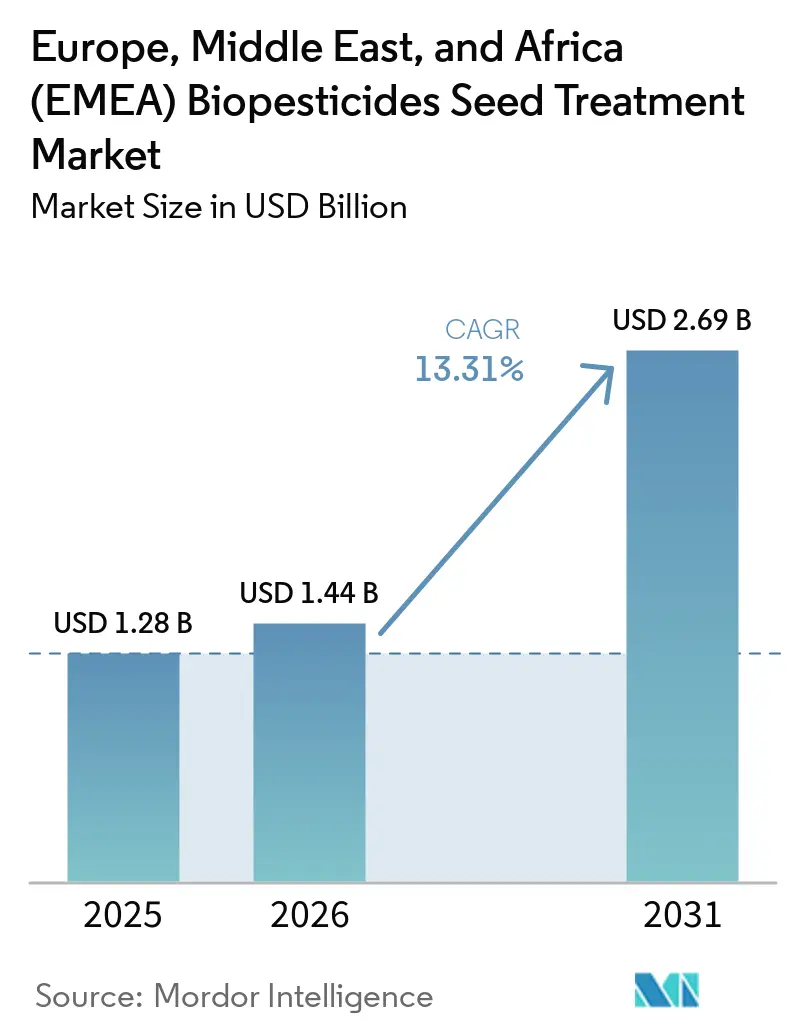
| Base Year Market Size (2025) | USD 1.28 Billion |
| Market Size (2026) | USD 1.44 Billion |
| Market Size (2031) | USD 2.69 Billion |
| Growth Rate (2026 - 2031) | 13.31 % |
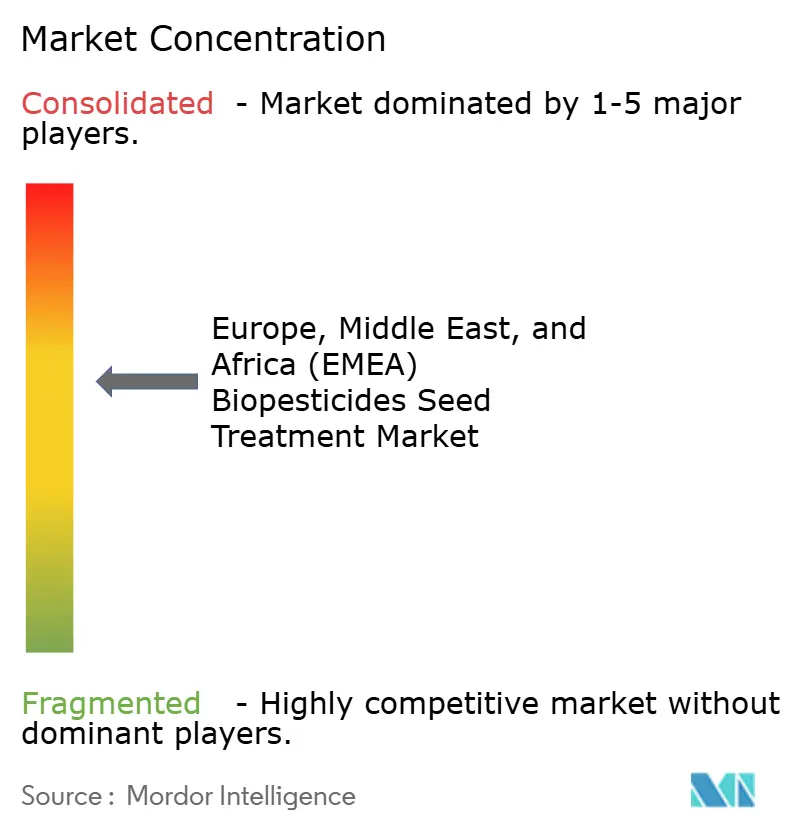
| Market Concentration | Medium |
Major Players *Disclaimer: Major Players sorted in no particular order Image © Mordor Intelligence. Reuse requires attribution under CC BY 4.0. | |
Europe, Middle East, and Africa (EMEA) Biopesticides Seed Treatment Market Analysis by Mordor Intelligence
The Europe, Middle East, and Africa (EMEA) biopesticides seed treatment market size was valued at USD 1.28 billion in 2025 and is projected to reach USD 1.44 billion in 2026 and USD 2.69 billion by 2031, growing at a CAGR of 13.31% from 2026 to 2031. Growth in the EMEA biopesticides seed treatment market is being driven by increasing regulatory scrutiny of synthetic seed treatment actives in Europe and a broader shift toward low-residue crop protection programs across export-oriented agricultural systems. The regulatory environment remains supportive, with the European Union’s Farm to Fork Strategy and the December 2025 Omnibus X proposal reinforcing the shift toward lower-risk biological crop protection solutions and supporting their broader integration into crop protection programs[1]Source: European Commission, “Farm to Fork Strategy, From Farm to Fork, Making Our Food System Fair, Healthy and Environmentally Friendly,” European Commission, food.ec.europa.eu. The market is also benefiting from the integration of biological actives into standard commercial seed-coating workflows, helping transition usage from pilot-stage trials to repeatable large-scale practices. Competitive dynamics are becoming more capacity-focused, with major suppliers expanding fermentation, formulation, and coating capabilities to secure supply and maintain margins as adoption increases. However, variability in field performance in warmer climates and the complexity of multi-country regulatory approvals continue to influence the pace of expansion across the Middle East and Africa.
Key Report Takeaways
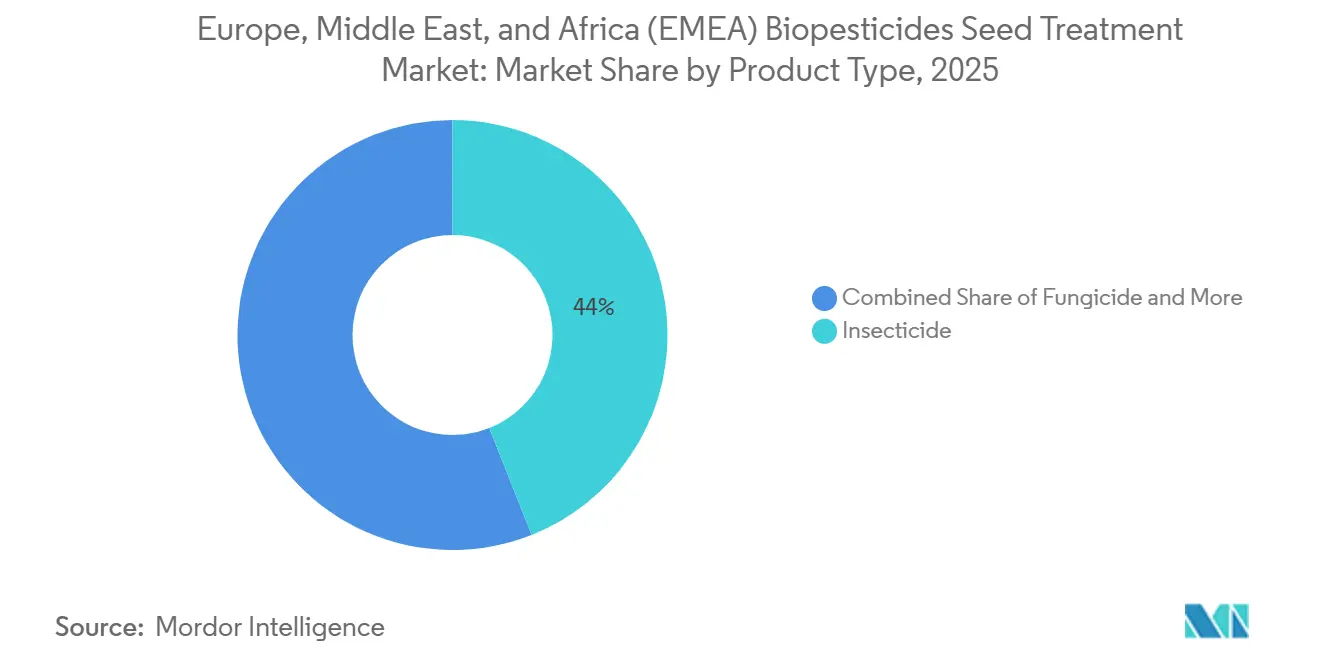
- By product type, insecticide accounted for 44.0% of the Europe, Middle East, and Africa biopesticides seed treatment market share in 2025, while the other pesticides segment is forecast to grow at a 14.8% CAGR from 2026 to 2031.
- By end user, the commercial segment accounted for 58.0% of the Europe, Middle East, and Africa biopesticides seed treatment market size in 2025 and is also the fastest-growing segment, which is forecast to grow at a 13.9% CAGR from 2026 to 2031.
- By application technique, seed coating accounted for the largest share of 41.0% in 2025, and is forecast to be the fastest-growing segment, with a CAGR of 15.6% from 2026 to 2031.
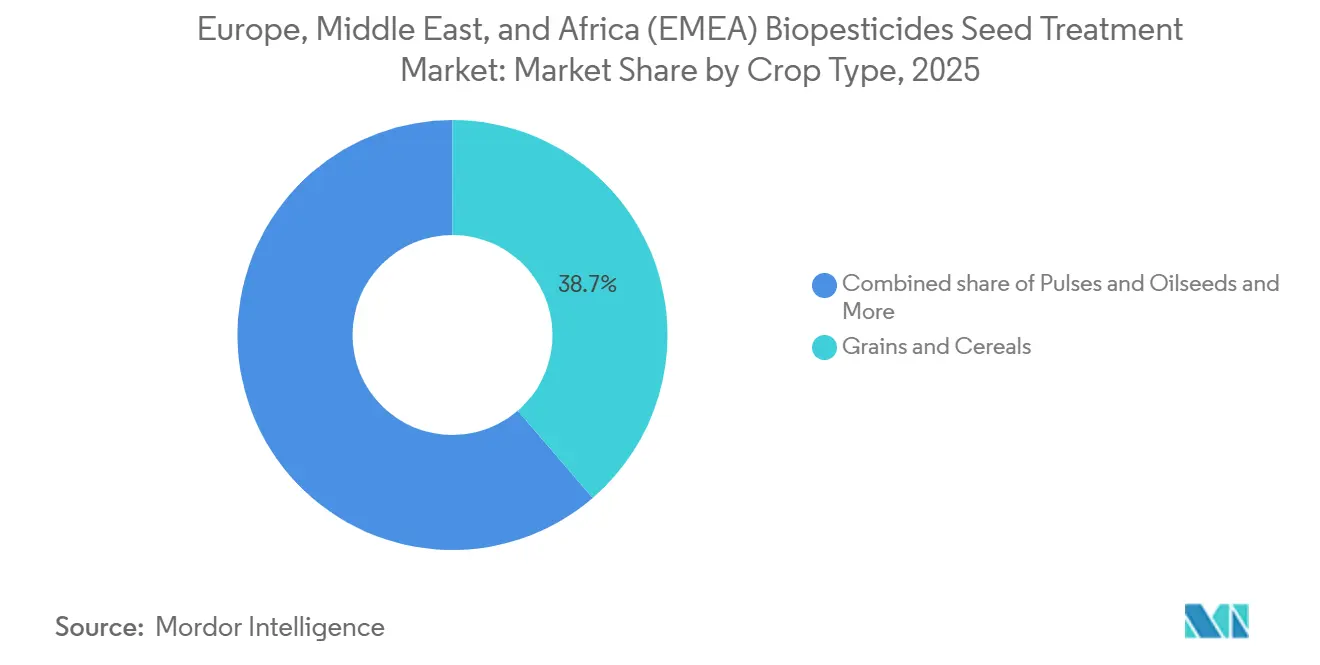
- By crop type, grains and cereals held a 38.7% share in 2025, while pulses and oilseeds are forecast to grow at a 14.2% CAGR between 2026 and 2031.
- By geography, Europe held a 61.0% share in 2025, while the Middle East is forecast to expand at a 15.4% CAGR from 2026 to 2031.
Note: Market size and forecast figures in this report are generated using Mordor Intelligence’s proprietary estimation framework, updated with the latest available data and insights as of January 2026.
Europe, Middle East, and Africa (EMEA) Biopesticides Seed Treatment Market Trends and Insights
Drivers Impact Analysis*
| Driver | (~) % Impact on CAGR Forecast | Geographic Relevance | Impact Timeline |
|---|---|---|---|
| Rising Demand for Low-Residue Crop Protection | +2.2% | Europe and Middle East, strongest in France, Germany, the Netherlands, and the UAE | Short term (≤ 2 years) |
| Expansion of Biologicals in Seed Coating Workflows | +1.8% | Europe-wide, with early adoption in Germany, France, and the Netherlands, with spillover to the Middle East | Medium term (2-4 years) |
| Grower Adoption of Preventive, Early-Season Crop Protection | +1.7% | Europe and South Africa, with early adoption in wheat and maize systems | Medium term (2-4 years) |
| Regulatory Pressure on Synthetic Seed Treatments | +2.0% | Europe, with spillover to the Middle East and North Africa | Short term (≤ 2 years) |
| Precision Seed Delivery and Micro-Dosing Compatibility | +1.2% | Central and Western Europe, with emerging use in Gulf controlled-environment agriculture | Long term (≥ 4 years) |
| Strain Stability and Seed-Handling Innovation | +1.1% | EMEA-wide, with high relevance in warm-climate logistics chains in the Middle East and Africa | Medium term (2-4 years) |
| Source: Mordor Intelligence | |||
Rising Demand for Low-Residue Crop Protection
Export-oriented farm systems are reshaping input decisions across the EMEA biopesticides seed treatment market. Buyers supplying European food chains continue to prioritize strict residue compliance, increasingly influencing seed treatment decisions before planting begins. This trend is particularly relevant in crop systems where growers seek to reduce later-stage chemical applications and start the season with cleaner, more sustainable crop protection programs. Policy direction continues to reinforce this transition, with regulatory strategies focusing on reducing reliance on conventional chemical pesticides and promoting safer alternatives. The Farm to Fork Strategy remains central to this shift, targeting a 50% reduction in chemical pesticide use and risk by 2030 in the European Union[2]Source: European Commission, “Farm to Fork Strategy, From Farm to Fork, Making Our Food System Fair, Healthy and Environmentally Friendly,” European Commission, food.ec.europa.eu. Recent policy developments also support the faster adoption of biocontrol solutions by creating a more favorable regulatory pathway for biological crop protection products. In the market, these developments strengthen the commercial case for microbial and biological seed treatments that align agronomic practices with residue-sensitive trade requirements. They also expand the overall addressable demand base, as adoption increasingly extends beyond certified organic production into mainstream commercial agriculture.
Expansion of Biologicals in Seed Coating Workflows
The EMEA biopesticides seed treatment market is gaining momentum as biological actives are increasingly incorporated into standard seed-coating workflows rather than remaining limited to niche trial programs. Once a seed company integrates a biological treatment into its routine coating process, adoption becomes more consistent and less dependent on farm-level handling. This transition is strengthening the commercial case for biologicals by improving scalability and operational efficiency. BASF SE states that Integral Pro, which is based on Bacillus amyloliquefaciens MBI600, has protected millions of hectares of oilseed rape in Europe. The company received its first sunflower registration in France in November 2025, with European Union (EU)-wide availability planned for the 2026 sowing season[3]Source: BASF SE Agriculture, “BASF Announces Integral Pro for Sunflowers Is Registered in France,” BASF SE Agriculture, agriculture.basf.com. At the same time, the shift toward advanced coating systems is increasing the importance of formulation compatibility and process integration. As a result, the market is becoming more closely linked to formulation expertise and coating performance rather than the simple availability of active ingredients. This dynamic favors suppliers that can align biological efficacy with the physical and operational requirements of industrial seed processing.
Grower Adoption of Preventive, Early-Season Crop Protection
The EMEA biopesticides seed treatment market is also supported by a shift toward preventive protection at planting. Growers increasingly prefer products that support root establishment and early vigor before pest or disease pressure becomes visible in the field. Corteva presented Ympact at Cereals 2026 in the United Kingdom as a seed treatment designed to support seedling growth and tolerance to abiotic stress through a nutrient- and humic-based formulation. This positioning aligns with farm preferences for front-loaded protection programs that can reduce the need for later interventions. It also reflects the operational reality of large commercial farms, which prefer to finalize treatment decisions before the sowing window narrows. The 2025 Alltech Agri-Food Outlook highlighted the importance of grain availability and cereal crops to regional feed markets, reinforcing the role of seed quality and early-season crop management in major grain-producing regions. In the market, preventive use patterns help biologicals gain traction because they align better with seed-treatment timing than many in-season biological applications. This driver is particularly relevant where labor, spray timing, and field access constraints make early intervention more valuable.
Regulatory Pressure on Synthetic Seed Treatments
Regulatory pressure remains one of the clearest demand drivers in the EMEA biopesticides seed treatment market. In 2024, the European Food Safety Authority (EFSA) tightened its risk assessments and removed clothianidin and thiamethoxam from approved seed treatment uses across major row-crop acreage, widening the substitution window for biological alternatives. This shift is significant because seed treatment programs are often revised quickly when established synthetic options lose approval. Political support for biocontrol strengthened further in late 2025, when the European Parliament adopted its own-initiative report on biocontrol substances with 90.8% support. At the same time, continued political and regulatory support for biocontrol solutions is improving suppliers' confidence and encouraging investment in biological product development. These changes are reshaping the competitive landscape by increasing the strategic importance of early regulatory approvals. As a result, companies that establish compliant biological solutions earlier are better positioned to secure long-term commercial relationships with seed processors.
Restraints Impact Analysis*
| Restraint | (~) % Impact on CAGR Forecast | Geographic Relevance | Impact Timeline |
|---|---|---|---|
| Variable Field Efficacy Across Soil and Climate Conditions | -1.5% | Middle East and Africa, with added exposure in Mediterranean Europe | Long term (≥ 4 years) |
| Limited Shelf Life and Storage Sensitivity of Biologicals | -1.2% | Africa and Middle East, with spillover to Eastern Europe | Medium term (2-4 years) |
| Higher Cost-to-Performance Perception Versus Conventional Chemicals | -1.0% | Pan-EMEA, most acute in Eastern Europe and Sub-Saharan Africa | Medium term (2-4 years) |
| Fragmented Registration and Seed Treatment Approval Complexity | -1.3% | Europe, Africa, and the Middle East | Long term (≥ 4 years) |
| Source: Mordor Intelligence | |||
Variable Field Efficacy Across Soil And Climate Conditions
Variable performance across soil and climate conditions remains a major constraint on the market. Biological activity during the short window between sowing and crop establishment depends heavily on soil temperature, moisture, pH, and the local microbial community. These conditions vary considerably across EMEA, particularly between temperate Europe and hot, arid production zones. A 2026 study in Plants evaluated bacterial biocontrol agents against olive mite pests under Saudi Arabian conditions, highlighting the importance of locally tested biological solutions for climate- and pest-specific applications. In the EMEA biopesticides seed treatment market, a single poor field result can have an outsized effect, as growers often rely on peer observation before adopting a new treatment approach. This makes locally generated trial data more important than efficacy claims from other geographies. Until suppliers build broader validation across hot and moisture-stressed cropping systems, climate-linked performance variability will continue to restrain adoption.
Limited Shelf Life And Storage Sensitivity Of Biologicals
Storage sensitivity continues to restrict the market, particularly outside well-established European distribution networks. Many biological seed treatments are more vulnerable to heat and handling conditions than conventional synthetic products. This creates risk in dealer channels where warehouse temperatures are elevated, and inventory turnover is inconsistent. Industry assessments have highlighted regulatory and commercialization barriers in parts of Africa, and these challenges are closely linked to the difficulty of moving sensitive biological products through fragmented local supply chains. Emphasis on maintaining product integrity under extreme temperature conditions demonstrates why stability has become a critical differentiating factor rather than a secondary formulation feature. In the EMEA biopesticides seed treatment market, shelf-life limitations directly influence dealer confidence, grower trust, and product availability at the point of use. Liquid systems remain attractive because they align with commercial treatment precision requirements, but they also increase pressure on formulation stability. Until more ambient-stable, high-concentration products become widely available, storage sensitivity will continue to constrain broader regional adoption.
*Our forecasts treat driver/restraint impacts as directional, not additive. The impact forecasts reflect baseline growth, mix effects, and variable interactions.
Segment Analysis
By Product Type: Insecticide Lead as Other Pesticides Accelerate
Insecticides accounted for 44.0% of the EMEA biopesticides seed treatment market share in 2025, making them the largest product type in the current mix. This leadership reflects the continued need for early-season pest protection in cereals, maize, sugar beet, and oilseed systems across Western and Central Europe. The gradual reduction in availability of certain synthetic seed treatment options has increased the relevance of biological insect control alternatives in these crop systems. As a result, the market continues to rely on insect control as a primary entry point into large-scale row-crop applications.
Fungicide is the second-largest segment, supported by the established use of microbial disease-control products in seed-stage protection programs. Products such as Koppert B.V.'s Cerall and Cedomon continue to support the adoption of biological control for seed-borne diseases in barley, oats, and related crops, keeping fungicidal biologicals closely aligned with integrated pest management practices. The other pesticides segment is forecast to register a 14.8% CAGR from 2026 through 2031 as suppliers expand into biochemical nematicides, biorepellents, and plant defense activators. This growth is supported by a regulatory environment increasingly favorable to lower-risk crop protection categories. Within the industry, this suggests the product mix will continue to diversify, even as insect control maintains its leading position.



By End User: Commercial Dominance Reflects Industrial Seed Processing Scale
The Commercial segment accounted for 58.0% of the EMEA biopesticides seed treatment market in 2025, reflecting strong reliance on professional seed treatment infrastructure. Large seed companies and conditioning facilities apply biological products with greater dosing accuracy, coating consistency, and handling reliability compared to farm-level operations. This operational advantage is important because biological seed treatments are more sensitive to application quality than conventional products. For this reason, commercial channels remain the most effective route for market scaling.
The Commercial segment is also forecast to grow at 13.9%, from 2026 through 2031, making it the fastest end-user profile, as suppliers prioritize environments with the strongest workflow control. Incotec B.V. (Croda International plc) work on microplastic-free coatings reflects a broader shift toward more advanced, regulation-ready processing systems in commercial treatment environments. Novonesis A/S also expanded its biosolutions distribution reach in 2026, covering seed treatment applications across major row and specialty crops, supporting the long-term development of formal commercial channels for biological products. Farm-level treatment remains relevant in parts of Africa where centralized treating infrastructure is less developed, but commercial processors remain the primary channel. Within the market, this pattern favors companies that can offer not only active ingredients, but also application reliability.
By Application Technique: Seed Coating Commands Both Scale and Growth
Seed Coating accounted for 41.0% of the EMEA biopesticides seed treatment market in 2025 and is also the fastest-growing application technique, with a forecast CAGR of 15.6% from 2026 through 2031. The segment leads because it provides a consistent method for attaching biological actives to the seed surface while maintaining flowability, visual quality, and handling performance. These attributes are particularly important in large-scale cereal and oilseed programs where uniformity and reliability are critical. As a result, coating systems remain central to the market's commercial expansion.
Europe's 2028 microplastics restriction adds further significance to this segment, as future coating systems must be both biologically compatible and regulation-compliant. Incotec B.V.'s (Croda International plc) published guidance on microplastic-free formulations indicates that this transition is already underway and requires early validation by seed companies before the regulation takes effect. Seed dressing remains relevant where simpler equipment is common, particularly in parts of Eastern Europe and Africa. Seed pelleting also retains a role in specialty seeds, where higher unit value supports higher processing costs. Overall, coating technologies that deliver both efficacy and compliance are anticipated to maintain a strong position in the market.
By Crop Type: Grains and Cereals Lead While Pulses and Oilseeds Post the Highest Growth
Grains and cereals accounted for 38.7% of the EMEA biopesticides seed treatment market share in 2025, making them the largest crop type segment. This reflects the scale of wheat, barley, and related crops across major European agricultural regions. The extensive cereal base provides access to well-established commercial seed-processing systems that support the adoption of biological seed treatments at scale. As a result, cereals continue to form the foundation of market demand.
Pulses and oilseeds are the fastest-growing segment, expanding with a forecast CAGR of 14.2% from 2026 through 2031, as nitrogen-fixing and root-health-oriented seed treatments expand in legumes and adjacent crops. BASF SE's continued rollout of Integral Pro in Europe demonstrates how biological seed treatment adoption in major field crops can create a commercial template for broader crop expansion. Lallemand Inc.'s LALFIX START PULSES GR further supports the pulse-focused biological treatment segment by combining rhizobium performance with phosphate solubilization in a seed treatment format. Fruits and vegetables remain smaller in volume but offer attractive demand where residue management and crop value justify premium treatment choices. In the market, crop mix expansion is anticipated to be driven by pulses, oilseeds, and high-value horticulture, rather than by a decline in cereal dominance.
Geography Analysis
Europe held 61.0% of the EMEA biopesticides seed treatment market in 2025 and continues to serve as the industry's central policy and commercial hub. The region remains the market's policy center, as regulatory decisions on synthetic actives and biocontrol approvals shape both demand and supplier strategy. Germany, France, the United Kingdom, and Italy remain the core commercial base because of their scale in cereals, oilseeds, and higher-value crop systems. The Farm to Fork strategy keeps Europe focused on reducing chemical pesticide use and risk, supporting ongoing substitution toward biological seed-stage protection. Political support for biocontrol also strengthened in late 2025, adding confidence to longer-term product planning in the region.
The Middle East is the fastest-growing geography, which is forecast to grow at a CAGR of 15.4% from 2026 to 2031. Demand is tied to food security policy, greenhouse and controlled-environment expansion, and the need for crop protection systems that align with residue-sensitive supply chains. The December 2024 memorandum of understanding between Silal and Bayer AG reflects how suppliers are linking biological and digital agriculture strategies to desert farming systems in the region. The region still faces technical constraints related to climate stress, formulation stability, and local validation requirements, which affect how quickly new products can scale.
Africa represented a meaningful share of the market and is projected to expand steadily. Export-oriented horticulture in South Africa and Egypt continues to support demand, as growers must maintain crop quality while meeting strict residue requirements in destination markets. Kenya and other East African markets are also relevant, as food security programs and pulse acreage growth are creating opportunities for microbial seed treatment products. At the company level, Andermatt's presence in East Africa and its distribution work around seed treatment products illustrate how suppliers are using regional operating platforms to build commercial access over time. Africa offers a meaningful growth path for the EMEA biopesticides seed treatment market, but actual scaling will depend on local trial work, registration clarity, and channel development.
Competitive Landscape
The EMEA biopesticides seed treatment market is moderately concentrated, with the top five players, such as Bayer AG, Syngenta AG, BASF SE, Corteva Agriscience, and Novonesis A/S, together accounting for a significant share in 2025. This structure provides leading companies with advantages in distribution networks, regulatory capabilities, and established relationships with commercial seed processors. At the same time, a significant portion of the market remains outside the top tier, allowing room for specialized players to compete effectively.
Leading companies are strengthening their positions through investments in production capacity, formulation capabilities, and integrated biological platforms. Expansion of fermentation infrastructure and portfolio development is helping ensure supply continuity and support increasing demand. A defining move in 2026 was BASF SE’s commissioning of its BioHub fermentation plant in Ludwigshafen, Germany, which brings industrial-scale biologically active production further in-house and strengthens control over supply continuity[4]Source: BASF SE, “BASF Agricultural Solutions Successfully Commissions New Fermentation Plant for Crop Protection Products in Ludwigshafen,” BASF SE, basf.com. These efforts are also reinforcing the importance of operational scale and technical expertise in maintaining a competitive advantage.
Specialized companies continue to capture opportunities through targeted innovation, regional expertise, and differentiated product offerings. Many focus on specific crops, microbial strains, or localized distribution strategies to build market presence. As a result, competition in the EMEA biopesticides seed treatment market is increasingly shaped by a combination of scale, product consistency, regulatory readiness, and execution across commercial channels.
Europe, Middle East, and Africa (EMEA) Biopesticides Seed Treatment Industry Leaders
Bayer AG
Syngenta AG
BASF SE
Corteva Agriscience
Novonesis A/S
- *Disclaimer: Major Players sorted in no particular order

Recent Industry Developments
- May 2026: BASF SE commissioned its BioHub fermentation plant in Ludwigshafen, Germany, with commercial production of key biological active ingredients. The facility produces biological fungicides and biological seed-treatment products, increasing production flexibility and supply-chain resilience.
- November 2025: BASF SE received official registration in France for Integral Pro biological fungicide seed treatment for sunflowers, its first EU sunflower approval, enabling broader regional availability from the following sowing season.
- August 2025: Provivi and Andermatt Biocontrol AG partnered to develop and distribute new solutions for fall armyworm and false codling moth management across East Africa. The partnership combines advanced biological crop protection technologies with regional distribution strength, improving access to sustainable pest management solutions in emerging agricultural markets.


Europe, Middle East, and Africa (EMEA) Biopesticides Seed Treatment Market Report Scope
application of biologically derived crop protection agents such as microorganisms, including bacteria and fungi, plant extracts, or naturally occurring compounds directly onto seeds before planting to protect them from pests and diseases and to support early plant growth.
The Europe, Middle East, and Africa (EMEA) Biopesticides Seed Treatment Market Report is Segmented by Product Type (Insecticide, Fungicide, and Other Pesticides), by End User (Commercial and Farm Level), by Application Technique (Seed Coating, Seed Pelleting, Seed Dressing, and Other Application Techniques), by Crop Type (Grains and Cereals, Pulses and Oilseeds, Fruits and Vegetables, and Other Crop Types), and by Geography (Europe, Middle East, and Africa). The Market Forecasts are Provided in Terms of Value (USD).
| Insecticide |
| Fungicide |
| Other Pesticides |
| Commercial |
| Farm Level |
| Seed Coating |
| Seed Pelleting |
| Seed Dressing |
| Other Application Techniques |
| Grains and Cereals |
| Pulses and Oilseeds |
| Fruits and Vegetables |
| Other Crop Types |
| Europe | United Kingdom |
| Germany | |
| Russia | |
| Spain | |
| Italy | |
| France | |
| Rest of Europe | |
| Middle East | Saudi Arabia |
| United Arab Emirates | |
| Oman | |
| Rest of Middle East | |
| Africa | Egypt |
| Ethiopia | |
| South Africa | |
| Rest of Africa |
| By Product Type | Insecticide | |
| Fungicide | ||
| Other Pesticides | ||
| By End User | Commercial | |
| Farm Level | ||
| By Application Technique | Seed Coating | |
| Seed Pelleting | ||
| Seed Dressing | ||
| Other Application Techniques | ||
| By Crop Type | Grains and Cereals | |
| Pulses and Oilseeds | ||
| Fruits and Vegetables | ||
| Other Crop Types | ||
| By Geography | Europe | United Kingdom |
| Germany | ||
| Russia | ||
| Spain | ||
| Italy | ||
| France | ||
| Rest of Europe | ||
| Middle East | Saudi Arabia | |
| United Arab Emirates | ||
| Oman | ||
| Rest of Middle East | ||
| Africa | Egypt | |
| Ethiopia | ||
| South Africa | ||
| Rest of Africa | ||


Key Questions Answered in the Report
What is the 2031 value of the EMEA biopesticides seed treatment market?
The EMEA biopesticides seed treatment market is projected to reach USD 2.69 billion by 2031, up from USD 1.44 billion in 2026.
What is driving growth in biological seed treatment across EMEA?
Growth is being supported by tighter limits on synthetic seed treatment actives, low-residue crop protection demand, and stronger use of biologicals in commercial seed coating workflows.
Which product type leads demand in this space?
Insecticide led the market in 2025 with a 44.0% share, reflecting strong demand for early-season pest management in major field crops.
Which application technique is growing the fastest?
Seed Coating is the fastest-growing technique, with a projected 15.6% CAGR through 2031, and it also held the largest share at 41.0% in 2025.
Which region within EMEA is expanding the fastest?
The Middle East is forecast to grow the fastest at a 15.4% CAGR through 2031, supported by food security programs and protected agriculture investment.
Page last updated on:


 Your data is secure and never sold or shared.


