
Europe Microgreens Market Size and Share
Market Overview
| Study Period | 2021 - 2031 |
|---|---|
| Forecast Data Period | 2026 - 2031 |
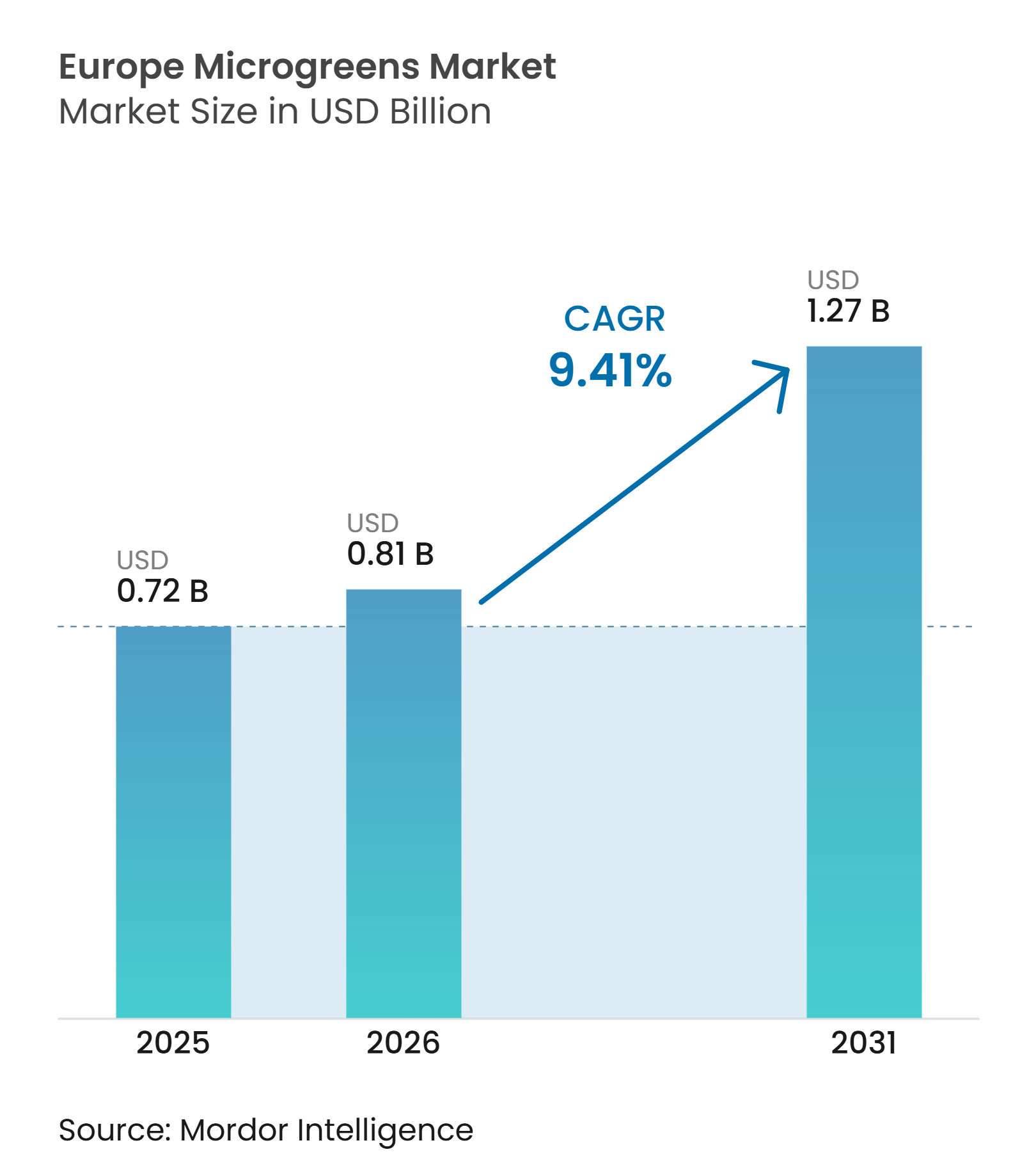
| Base Year Market Size (2025) | USD 0.72 Billion |
| Market Size (2026) | USD 0.81 Billion |
| Market Size (2031) | USD 1.27 Billion |
| Growth Rate (2026 - 2031) | 9.41 % |
| Market Concentration | Low |
Major Players *Disclaimer: Major Players sorted in no particular order Image © Mordor Intelligence. Reuse requires attribution under CC BY 4.0. | |
Europe Microgreens Market Analysis by Mordor Intelligence
The Europe microgreens market size is projected to expand from USD 0.72 billion in 2025 and USD 0.81 billion in 2026 to USD 1.27 billion by 2031, registering a CAGR of 9.41% between 2026 to 2031. Demand is moving beyond specialist outlets as supermarkets add packaged products and private-label ranges. Producers located close to consumers can limit time in transit and reduce product loss, which is important for a highly perishable crop. Controlled-environment farms are improving their cost position through renewable energy, geothermal systems, and tailored lighting programs. Fine-dining restaurants continue to support premium varieties and help producers test new formats before wider retail adoption. These conditions favor growers that can deliver consistent quality, traceable production, and frequent supply to both retail and foodservice buyers.
Key Report Takeaways
- By crop type, radish held 25.4% of the Europe microgreens market share in 2025, while basil is estimated to grow at the highest CAGR of 9.6% from 2026 to 2031.
- By farming method, indoor farming accounted for 45.6% of the Europe microgreens market share in 2025, while vertical farming is estimated to grow at the highest CAGR of 9.5% from 2026 to 2031.
- By growth medium, peat moss accounted for a 34.5% of the Europe microgreens market size in 2025, while coconut coir is estimated to grow at the highest CAGR of 9.1% from 2026 to 2031.
- By distribution channel, hypermarkets and supermarkets held 60.1% of the Europe microgreens market share in 2025, while online channels are estimated to grow at the highest CAGR of 9.8% from 2026 to 2031.
- By geography, Germany acounted for 20.3% of Europe microgreens market share in 2025. while France is estimated to grow at the highest CAGR of 10.2% from 2026 to 2031.
Note: Market size and forecast figures in this report are generated using Mordor Intelligence’s proprietary estimation framework, updated with the latest available data and insights as of January 2026.
Market Trends and Insights
Drivers Impact Analysis of Europe Microgreens Market*
| Driver | (~) % Impact on CAGR Forecast | Geographic Relevance | Impact Timeline |
|---|---|---|---|
| Health-conscious demand for nutrient-dense foods | +2.20% | Europe-wide, strongest in Germany, the United Kingdom, and Scandinavia | Medium term (2-4 years) |
| Expansion of urban, indoor, and vertical farming | +2.50% | Netherlands and Germany, with adoption in the United Kingdom, France, and Belgium | Long term (≥ 4 years) |
| Premium culinary and fine-dining adoption | +1.30% | Western and Southern Europe, especially France, Italy, Spain, and the Netherlands | Short term (≤ 2 years) |
| Retail and private-label product expansion | +1.00% | Germany, the United Kingdom, the Netherlands, and France | Medium term (2-4 years) |
| European preference for local production and shorter supply routes | +0.90% | Europe-wide, especially the Netherlands, Germany, the United Kingdom, and Belgium | Medium term (2-4 years) |
| Digital farm-to-consumer and subscription models | +0.70% | Germany, the Netherlands, and the United Kingdom, with growth in France and Spain | Medium term (2-4 years) |
| Source: Mordor Intelligence | |||
Health-Conscious Demand for Nutrient-Dense Foods
Health-focused food choices continue to support demand across the Europe microgreens market. The 2025 Nutritional Quality Profiles study reported broccoli microgreens with total phenolic content of 825.5 mg GAE per 100 g fresh weight. The same study measured ascorbic acid values from 32.7 mg to 80.5 mg per 100 g fresh weight across 6 species[1]. The 2025 Microgreens Functional Food study found that a serving can provide 28% to 116% of recommended daily vitamin C intake and 28% to 332% of vitamin E intake. These findings give retailers and restaurants a clearer basis for nutritional product communication. Buyers can use documented nutrient characteristics when comparing suppliers and varieties. Growers with reliable post-harvest testing can support these product claims more effectively. This strengthens the position of producers that pair fresh appearance with documented nutritional quality.
Expansion of Urban, Indoor, and Vertical Farming
Urban production is reshaping how microgreens reach customers across Europe. Growy operates 7,500 m² of indoor production space, supplying a broad retail network from a centralized facility in 2025. Year-round cultivation can shorten supply routes, improve product availability, and provide more consistent volumes for metropolitan retail and foodservice customers. At the farm level, growers are also refining light intensity and spectrum across crop stages rather than relying on a single fixed recipe. This approach can improve production control while reducing energy use per kilogram harvested. The KWIN Greenhouse Horticulture 2026 reference provides investment-cost and cost-price benchmarks for protected horticulture operations, supporting more disciplined planning as facilities scale[2]. As producers increasingly target supermarket contracts, consistent output, operational efficiency, and capital discipline are becoming more important than relying primarily on small-scale restaurant demand.
Premium Culinary and Fine-Dining Adoption
Fine-dining restaurants remain an important source of premium demand in the Europe microgreens market, where chefs use microgreens to add concentrated flavor, color, and texture to plated dishes. Their use is well established across French, Italian, Spanish, and Dutch foodservice settings. Koppert Cress introduces 3 to 4 culinary varieties each year based on feedback from chefs, allowing restaurants to refresh menus while providing growers with direct insight into evolving culinary preferences. Restaurants also serve as an early testing ground for new varieties before wider retail adoption. When a specific microgreen becomes part of a restaurant’s menu identity, maintaining consistent supply becomes important, supporting repeat orders and giving specialist growers a clearer pathway toward premium positioning..
Retail and Private-Label Product Expansion
Retail expansion is moving microgreens beyond niche foodservice channels and into more everyday shopping occasions across Europe. Supermarkets in Germany, the United Kingdom, and the Netherlands are adding private-label microgreens to their fresh-produce assortments, widening consumer access. Specialty greens have sold at three to five times the per-gram price of commodity lettuce in the supplied research, creating room for higher-value sales. Wider retail placement can increase volumes but also places greater pressure on production costs, consistency, and supply reliability. Germany had the largest area of organically farmed land in the European Union, supporting retailer interest in sustainably produced specialty foods. Established suppliers with traceable production systems are better positioned to meet retail audits and recurring orders. Private-label programs therefore favor growers with dependable quality control and sufficient capacity, creating opportunities for scaled producers while raising barriers for smaller growers seeking national retail accounts.
Restraints Impact Analysis of Europe Microgreens Market*
| Restraint | (~) % Impact on CAGR Forecast | Geographic Relevance | Impact Timeline |
|---|---|---|---|
| Short post-harvest shelf life and cold-chain requirements | -1.50% | Europe-wide, with greatest logistics friction in Eastern Europe and peripheral areas | Short term (≤ 2 years) |
| High energy and labor costs in controlled-environment farming | -1.80% | Northern and Western Europe, especially the Netherlands, the United Kingdom, Germany, and Belgium | Long term (≥ 4 years) |
| Food-safety risks from sanitation and pathogen-control failures | -1.00% | Europe-wide, with compliance pressure in European Union and European Economic Area export corridors | Medium term (2-4 years) |
| Inconsistent organic-certification treatment for soilless production | -0.70% | European Union-wide, especially Germany, the Netherlands, and Scandinavia | Long term (≥ 4 years) |
| Source: Mordor Intelligence | |||
Short Post-Harvest Shelf Life and Cold-Chain Requirements
Short shelf life is shaping how microgreens are distributed across Europe, limiting the practical distance between farms and end markets. Microgreens typically have a refrigerated shelf life of 3 to 10 days at 4°C, requiring frequent deliveries, smaller shipments, and careful temperature management. These requirements increase distribution costs when products must travel longer distances to reach stores. The challenge is greater in peripheral and emerging markets where cold-chain infrastructure is less established. Controlled-atmosphere and modified-atmosphere packaging can extend usability for some varieties, but also add costs. As a result, growers located near high-density retail and restaurant demand have a structural advantage. The constraint also limits how far a single farm can efficiently serve customers without increasing waste risk. Efficient local distribution is therefore becoming essential for producers seeking to protect product quality, service reliability, and margins.
High Energy and Labor Costs in Controlled-Environment Farming
Energy and labor costs remain significant constraints for controlled-environment producers across Europe. The 2025 Indoor Agriculture Energy Demand study indicated that energy expenditure can account for 20% to 35% of total operating costs in northern European controlled-environment operations[3]. The United Kingdom protected horticulture sector also warned of a proposed 94% increase in electricity-network standing charges from April 2026. Such exposure can quickly affect margins because retail supply contracts are often fixed for their duration, limiting producers’ ability to pass higher costs through to customers. Labor adds further pressure as production requires frequent harvesting, packing, and delivery. Koppert Cress has connected its Monster sites to geothermal supply, heat pumps, and heat-and-cold storage systems, reducing reliance on conventional energy sources. Producers with renewable or geothermal capacity are therefore better positioned to manage energy volatility and protect margins than operators dependent on purchased electricity.
*Our forecasts treat driver/restraint impacts as directional, not additive. The impact forecasts reflect baseline growth, mix effects, and variable interactions.
Europe Microgreens Market Segment Analysis
By Crop Type:
Radish Leads, but Flavor Varieties AccelerateRadish microgreens held a 25.4% share of the Europe microgreens market in 2025, representing the largest disclosed crop-type position. Their 7 to 10 day seed-to-harvest cycle supports frequent production and regular supply, while the 2025 Comprehensive Antioxidant Profiling study reported antioxidant activity of 7.9 mmol TE per 100 g for Sango radish. These characteristics support demand across foodservice and packaged retail. Broccoli followed as the next major crop type by volume in the supplied research, supported by consumer interest in sulforaphane and repeat purchasing among foodservice buyers. Lettuce and chicory, sunflower, peas, carrots, fennel, arugula, and other varieties further broaden the market by offering different flavors, textures, and visual characteristics. Radish maintains the leading disclosed position because it combines rapid cultivation with broad culinary applications.
Basil is estimated to grow the highest CAGR at 9.6% from 2026 to 2031 within the Europe microgreens market. Its established role in Mediterranean cuisine supports demand in Southern Europe, while specialty retailers provide opportunities for premium positioning in Northern Europe. Arugula and fennel serve established restaurant demand, particularly in Italy and France, while broccoli continues to attract functional-food buyers, with reported total phenolic content reaching 825.5 mg GAE per 100 g fresh weight. Carrot and fennel remain less developed in mainstream retail, creating opportunities for producers to diversify beyond Brassicaceae varieties. Lettuce and chicory, sunflower, peas, and other crops are also expanding retail choice. Future crop development will increasingly depend on culinary relevance, nutritional positioning, and reliable production cycles.
By Farming Method:
Technology-Led Indoor Production Reshapes SupplyIndoor farming accounted for 45.6% of the Europe microgreens market in 2025, making it the leading farming method by market share in the supplied research. Its controlled production environment supports year-round cultivation, consistent quality, and closer proximity to urban consumers. Commercial greenhouses remain important, particularly in established horticultural markets such as the Netherlands and Spain, where existing infrastructure and cultivation expertise support microgreen production alongside conventional crops. Indoor vertical farming is adding competitive pressure by enabling production closer to metropolitan demand and reducing transport time for a highly perishable product. Growy expanded distribution from its 7,500 m² Amsterdam facility to 500 Jumbo stores in April 2026, illustrating the potential for centralized indoor production to serve large retail networks. Open-field and contained systems continue to support farmers’ markets, direct sales, and chef-led demand.
Vertical farming is estimated to record the fastest CAGR of 9.5% from 2026 to 2031 in the Europe microgreens market. Its controlled environment allows producers to manage temperature, lighting, humidity, and crop cycles while locating farms closer to major consumption centers. This proximity can reduce transport time and support fresher deliveries, which is particularly valuable for microgreens with short refrigerated shelf lives. Other farming methods remain relevant where existing greenhouse infrastructure, lower capital requirements, or direct local sales provide advantages. Food-hygiene requirements apply across vertical, hydroponic, and greenhouse systems under European Union Regulation (EC) No. 852/2004, while organic-label restrictions on hydroponic production can limit access to some organic-focused channels[4]. Farming-method choices will therefore depend on local demand, energy costs, infrastructure, certification requirements, and the ability to deliver consistent quality.
By Growth Medium:
Substrate Diversity Reflects Technology DivergencePeat moss accounted for 34.5% of the Europe microgreens market in 2025, making it the leading growth medium in the supplied research. Its strong water retention, aeration, and dependable germination characteristics have supported widespread use in controlled-environment production across Europe. Soil-based systems also remain relevant among outdoor and semi-controlled growers, particularly in France, Italy, and Spain. Coconut coir is gaining traction as producers seek alternatives to peat amid sustainability concerns and changing raw-material availability. Each medium continues to serve different production requirements, with peat moss retaining an advantage where growers prioritize familiar handling, consistent moisture management, and reliable early crop development.
Coconut coir is estimated to record the fastest growth-medium CAGR of 9.1% from 2026 to 2031 in the Europe microgreens market. Its expanding use reflects growing interest in renewable and lower-peat production systems, while tissue paper, foam substrates, hemp fiber mats, and other soilless options remain relevant for vertical farms seeking lighter and more standardized growing platforms. Growy acquired FoamPlant in October 2025 and began supplying GrowFoam externally in 2026, illustrating how substrate development can become part of vertical-farming operations. Vervit’s Belgian vertical farm also tested substrate formulations for PachaGreens production across different growing levels. Such customization can help producers manage crop quality and production performance. Growth-medium choices will increasingly reflect sustainability requirements, automation needs, crop quality, and compatibility with specific production systems.
By Distribution Channel:
Retail Dominates, Digital Channels GainHypermarkets and supermarkets accounted for 60.1% of the Europe microgreens market in 2025, making them the leading distribution channel in the supplied research. Their broad store networks have moved microgreens beyond specialist outlets by increasing consumer visibility through packaged assortments and private-label products. Wider shelf presence also supports recurring household purchases and gives producers access to larger customer volumes. Restaurants remained the second-largest channel, continuing to provide an important setting for introducing new varieties and formats before broader retail adoption. Specialty food stores, organic retailers, health-food outlets, and farmers’ markets serve more targeted demand for premium and certified products. Hypermarkets and supermarkets maintained the leading position because they combine extensive consumer reach with established fresh-produce purchasing patterns.
Online channels are estimated to record the fastest distribution-channel CAGR of 9.8% from 2026 to 2031 in the Europe microgreens market. Subscription and direct-delivery models can support weekly or biweekly supply from growers to households while providing producers with closer relationships with end consumers. Online sales can also reduce dependence on conventional wholesale channels, although frequent deliveries remain important because of microgreens’ short shelf life. This route is particularly relevant for smaller urban growers that may not meet supermarket volume requirements. Restaurants will continue influencing varietal development through chef demand and menu applications, while specialty and organic outlets will retain relevance for premium and certified products. Farmers’ markets will remain useful for regional producers with established local relationships. Distribution strategies will increasingly balance scale, freshness, channel requirements, and the economics of frequent delivery.
Geography Analysis
Germany accounted for 20.3% of the Europe microgreens market in 2025, representing the largest disclosed country position. Its established organic food culture, dense retail network, and strong consumer interest in locally produced foods support demand for microgreens. Germany also has the European Union’s largest area of organically farmed land, reinforcing opportunities for sustainably positioned specialty produce. Urban farming activity in Berlin, Munich, and Frankfurt further supports localized supply for metropolitan buyers. The Netherlands remains a major production center rather than the largest consumer market, supported by its advanced horticultural infrastructure and producers such as Koppert Cress and Growy. The United Kingdom, France, and Belgium also maintain established demand through developed foodservice and organized retail channels.
France is estimated to record the fastest country-level CAGR of 10.2% from 2026 to 2031 in the Europe microgreens market. Its strong fine-dining culture and expanding organic retail network provide a favorable environment for premium microgreen consumption. Spain is developing production capacity near Alicante and Galicia to serve hotel, restaurant, and catering buyers, while Italy benefits from a dense base of quality-focused restaurants and specialty retailers. Mediterranean cuisine further supports demand for fresh and aromatic ingredients in both countries. Russia remains concentrated around Moscow and Saint Petersburg, where specialty-food retailers serve premium fresh-produce consumers. These markets have lower penetration than Germany but offer room for expansion as awareness, local production, and distribution improve.
The rest of Europe includes the Benelux countries, Scandinavia, and Central and Eastern Europe, where developing specialty-produce consumption creates opportunities for regional growers. Central and Eastern European cities can support localized production as retail and foodservice demand expands, while improving cold-chain infrastructure can help producers serve wider markets. The Netherlands can continue providing horticultural expertise and controlled-environment technology, while local facilities remain important for managing the short shelf life of microgreens. Geographic growth will therefore depend on proximity to consumers, retail development, production capacity, and the ability to maintain product quality from harvest through final sale.
Competitive Landscape
Market Concentration
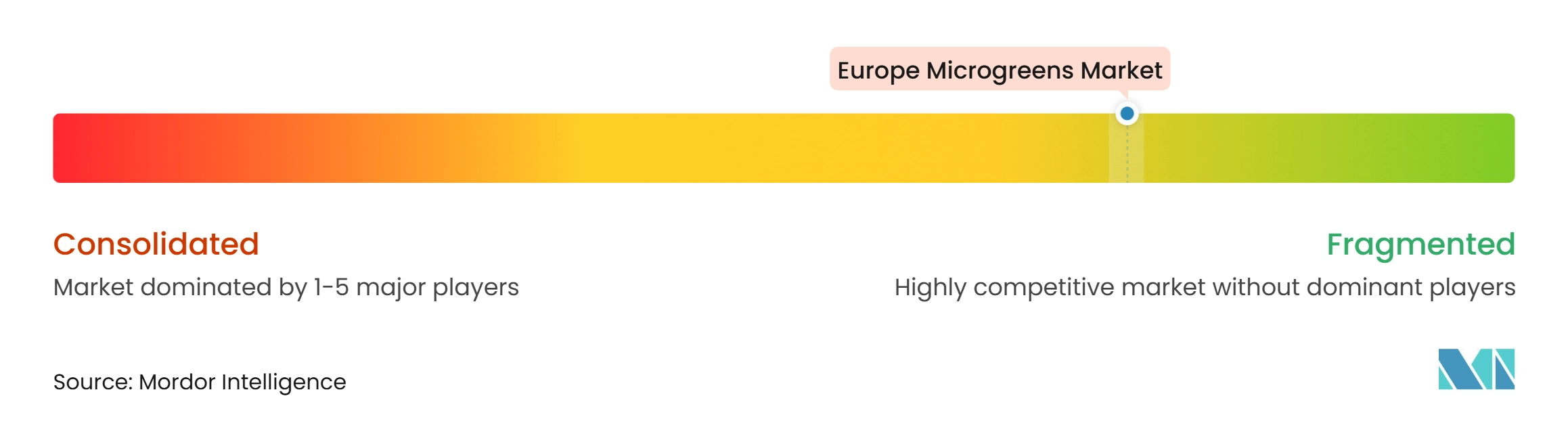
The Europe microgreens market remains highly fragmented, with local and regional growers serving geographically concentrated customer bases. The short shelf life of microgreens favors production close to consumption centers, limiting the advantages of highly centralized supply models. This allows smaller producers to compete through fresh products, reliable delivery, and varieties tailored to local foodservice and retail requirements. In 2026, Koppert Cress strengthened its sustainability position by switching its greenhouses to geothermal energy from the Polanen project, supporting fossil-free cultivation across its Monster sites. This development highlights how established producers are using energy innovation to improve operating resilience while maintaining consistent year-round supply.
Leading producers are differentiating through premium foodservice relationships, retail partnerships, cultivation technology, and product innovation. Growy expanded its vertically farmed produce across the Dutch retail market in 2026, demonstrating how indoor production can support large supermarket networks through short supply routes. Vervit has also developed a 1,029 m² automated vertical farm in Lochristi, Belgium, with dedicated layers for microgreen production and integrated lighting, irrigation, climate control, and automation. This approach enables different growing conditions within the same facility and supports greater production control. Planet Greens in Spain and MingaGreens GmbH in Germany represent additional regional production models, showing that competitive strategies vary according to market location, customer base, and cultivation system.
Competitive differentiation increasingly extends beyond cultivation capacity as organized retail places greater emphasis on food safety, traceability, consistent supply, and operational reliability. These requirements can raise entry barriers for informal and very small growers, while established producers can strengthen their positions through technology, certifications, and stronger customer relationships. Central and Eastern Europe remains less developed than established Northern and Western European markets, creating opportunities for growers that can build reliable regional distribution and cold-chain capabilities. Recent investments in geothermal energy, automated vertical farming, and retail-oriented indoor production indicate that producers are increasingly combining local supply models with technology and sustainability initiatives. Overall, competition remains driven by geographic proximity, customer relationships, production efficiency, and the ability to maintain consistent quality across retail and foodservice channels.
Europe Microgreens Industry Leaders
-
Koppert Cress
-
Vervit
-
Growy
-
Plant Greens
-
Herbeus Greens
- *Disclaimer: Major Players sorted in no particular order
Europe Microgreens Market Companies Covered in this Report
- Koppert Cress
- Growy
- Vervit
- Plant Greens
- Herbeus Greens
- Leafood
- Verdes Zagros
- MingaGreens GmbH
- Urban Microgreens Holland
- Mooy Microgreens
- Profarms
- Toms microgreens
- Frankenspross
- Taw Valley Microgreens
Recent Industry Developments in Europe Microgreens Market
- April 2026: Growy expanded its vertically farmed produce to all 500 Jumbo supermarket stores across the Netherlands. The expansion launched from a single 7,500 m² facility in Amsterdam. It followed 1 year of regional store pilots and demonstrated price competition with greenhouse-grown salad produce.
- November 2025: Vervit initiated a 1,000 m² four-level automated vertical farm at its Beervelde facility for PachaGreens microgreens. The facility supports 7 to 10 day growing cycles and per-level control of humidity, temperature, and light intensity.
- October 2025: Growy acquired FoamPlant, a Netherlands-based manufacturer of growing foam substrates, and rebranded the product as GrowFoam. The company began supplying GrowFoam to external vertical-farm operators in 2026
Europe Microgreens Market Report Scope
Our study defines the Europe microgreens market as the aggregate farm-gate value of freshly cut, vegetable, herb, and grain seedlings harvested between the cotyledon and first true-leaf stages and sold either loose or as living trays to retail, food-service, and direct-to-consumer channels.
Scope exclusions include sprout products, baby-leaf greens, powdered extracts, and sales of cultivation equipment, which are kept outside this value pool.
The Europe microgreens market report segmented by crop type (broccoli, lettuce and chicory, arugula, basil, fennel, carrots, sunflower, radish, peas, and other crop types), by farming method (indoor farming, vertical farming, and other farming methods), by growth medium (peat moss, soil, coconut coir, tissue paper, and other growth media), by distribution channel (hypermarkets and supermarkets, restaurants, online channels, and other distribution channels), and by geography (Netherlands, Germany, United Kingdom, France, Spain, Italy, Russia, and rest of Europe). The market forecasts are provided in terms of value (USD).
Segmentation Overview
| Broccoli |
| Lettuce and Chicory |
| Arugula |
| Basil |
| Fennel |
| Carrots |
| Sunflower |
| Radish |
| Peas |
| Other Types |
| Indoor Farming |
| Vertical Farming |
| Other Farming Methods |
| Peat Moss |
| Soil |
| Coconut Coir |
| Tissue Paper |
| Other Growth Media |
| Hypermarkets and Supermarkets |
| Restaurants |
| Online Channels |
| Other Distribution Channels |
| Netherlands |
| Germany |
| United Kingdom |
| France |
| Spain |
| Italy |
| Russia |
| Rest of Europe |
| By Crop Type | Broccoli |
| Lettuce and Chicory | |
| Arugula | |
| Basil | |
| Fennel | |
| Carrots | |
| Sunflower | |
| Radish | |
| Peas | |
| Other Types | |
| By Farming Method | Indoor Farming |
| Vertical Farming | |
| Other Farming Methods | |
| By Growth Medium | Peat Moss |
| Soil | |
| Coconut Coir | |
| Tissue Paper | |
| Other Growth Media | |
| By Distribution Channel | Hypermarkets and Supermarkets |
| Restaurants | |
| Online Channels | |
| Other Distribution Channels | |
| By Geography | Netherlands |
| Germany | |
| United Kingdom | |
| France | |
| Spain | |
| Italy | |
| Russia | |
| Rest of Europe |
Key Questions Answered in the Report
What is the 2026 value of the Europe microgreens market?
The Europe microgreens market size is valued at USD 0.81 billion in 2026.
What is driving demand for microgreens in Europe?
Nutritional product positioning, retail availability, local production, and restaurant demand are supporting adoption.
Which crop type held the largest share in 2025?
Radish microgreens held the largest crop-type share at 25.4% in 2025.
Which sales channel held the largest share in 2025?
Hypermarkets and supermarkets held 60.1% of sales channel segment in 2025.