
Europe Mechanical Presses Market Size and Share
Market Overview
| Study Period | 2021 - 2032 |
|---|---|
| Forecast Data Period | 2027 - 2032 |
| Base Year Market Size (2026) | USD 1.14 Billion |
| Market Size (2027) | USD 1.19 Billion |
| Market Size (2032) | USD 1.40 Billion |
| Growth Rate (2027 - 2032) | 3.30 % |
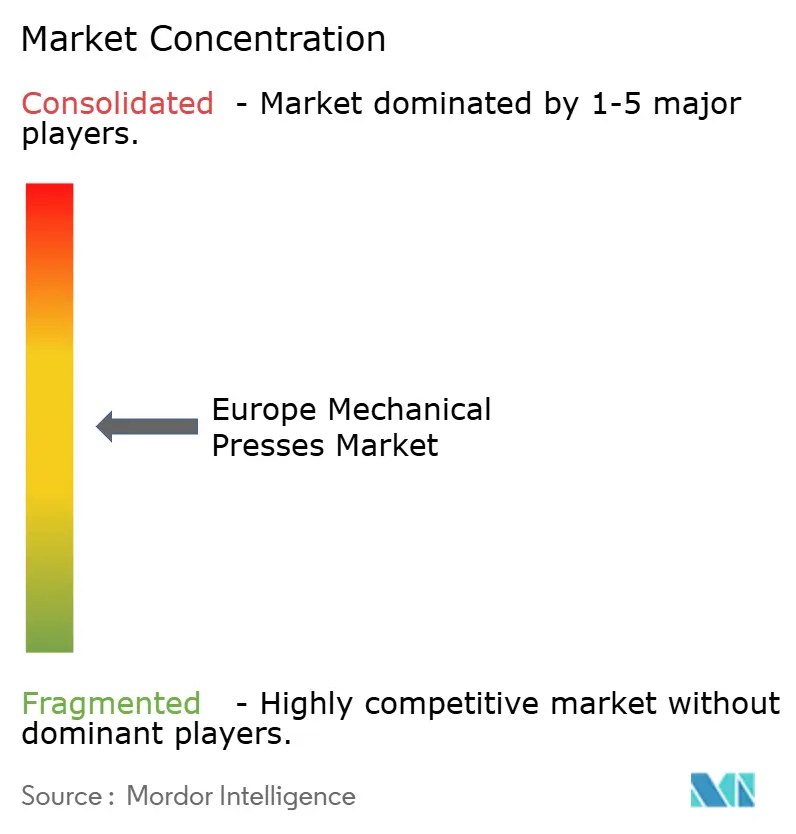
| Market Concentration | Medium |
Major Players *Disclaimer: Major Players sorted in no particular order Image © Mordor Intelligence. Reuse requires attribution under CC BY 4.0. | |
Europe Mechanical Presses Market Analysis by Mordor Intelligence
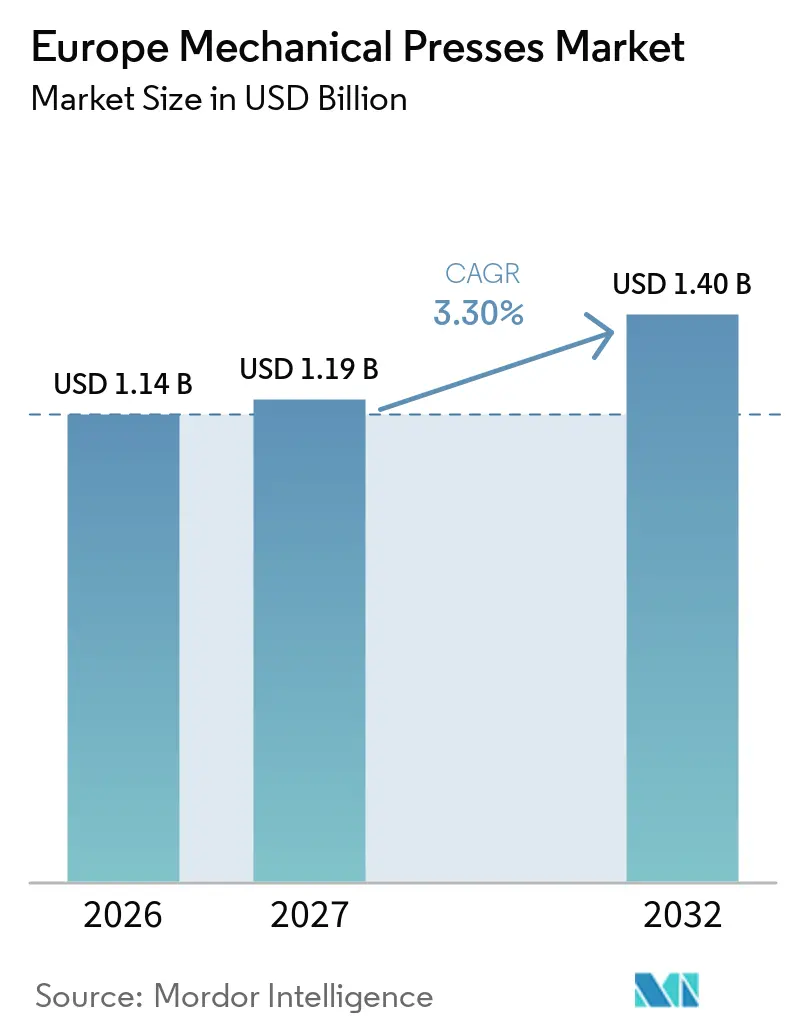
The Europe Mechanical Presses Market size was valued at USD 1.14 billion in 2026 and is estimated to grow from USD 1.19 billion in 2027 to reach USD 1.40 billion by 2032, at a CAGR of 3.30% during the forecast period (2027-2032).
Europe mechanical presses market is being shaped by battery-electric vehicle production and the replacement of aging equipment in established manufacturing centers. Battery-electric cars accounted for 17.4% of new EU registrations in 2025, while EU car output reached 11.47 million units, which kept demand focused on specialized tooling rather than broad capacity additions. This creates demand for battery enclosure forming, motor laminations, and other precision applications, although automotive plants operating below capacity remain cautious about general press replacement. The Europe mechanical presses market also benefits when manufacturers select larger and more rigid equipment for battery trays, chassis parts, and high-strength materials. Capital costs, limited skilled labor, and uneven automotive output continue to restrain purchasing decisions, particularly among smaller fabricators.
Key Report Takeaways
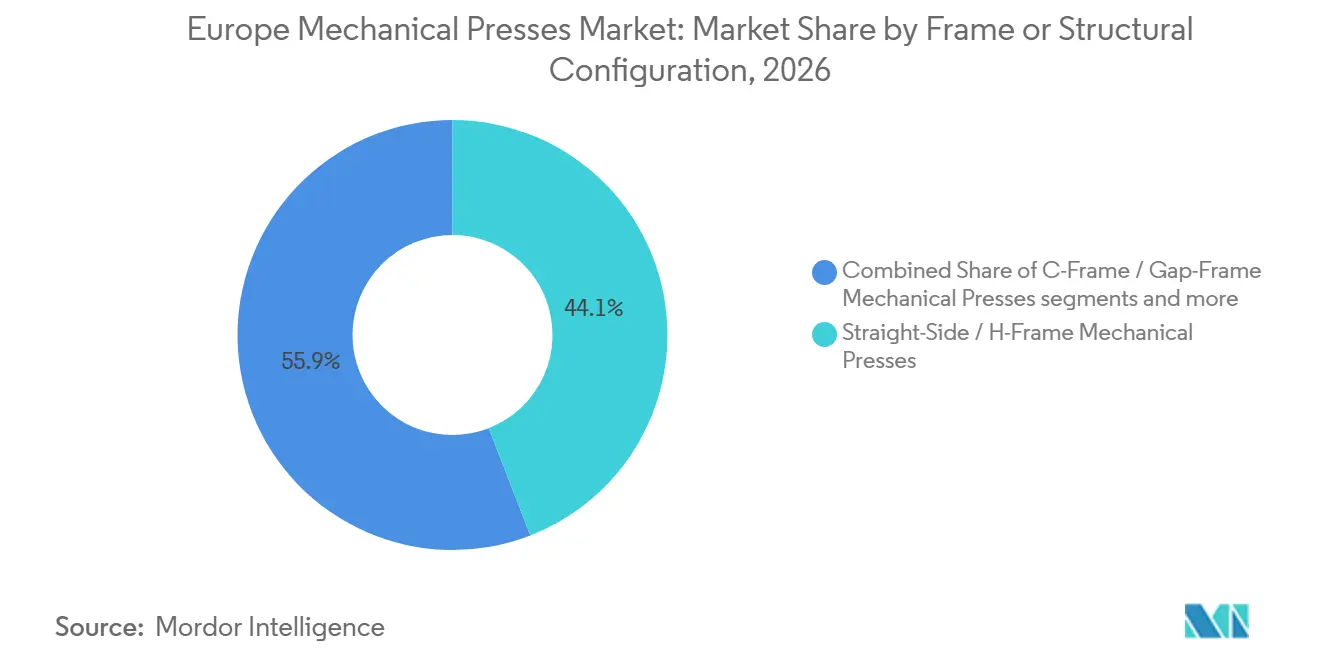
- By frame and structural configuration, straight-side and H-frame presses held 44.1% of the Europe mechanical presses market share in 2026, while C-frame and gap-frame presses are projected to grow at a 3.9% CAGR through 2032.
- By press force and capacity, the 101–500 ton segment accounted for 39.5% of the Europe mechanical presses market size in 2026, while the 501–1,000 ton segment is forecast to expand at a 4.2% CAGR through 2032.
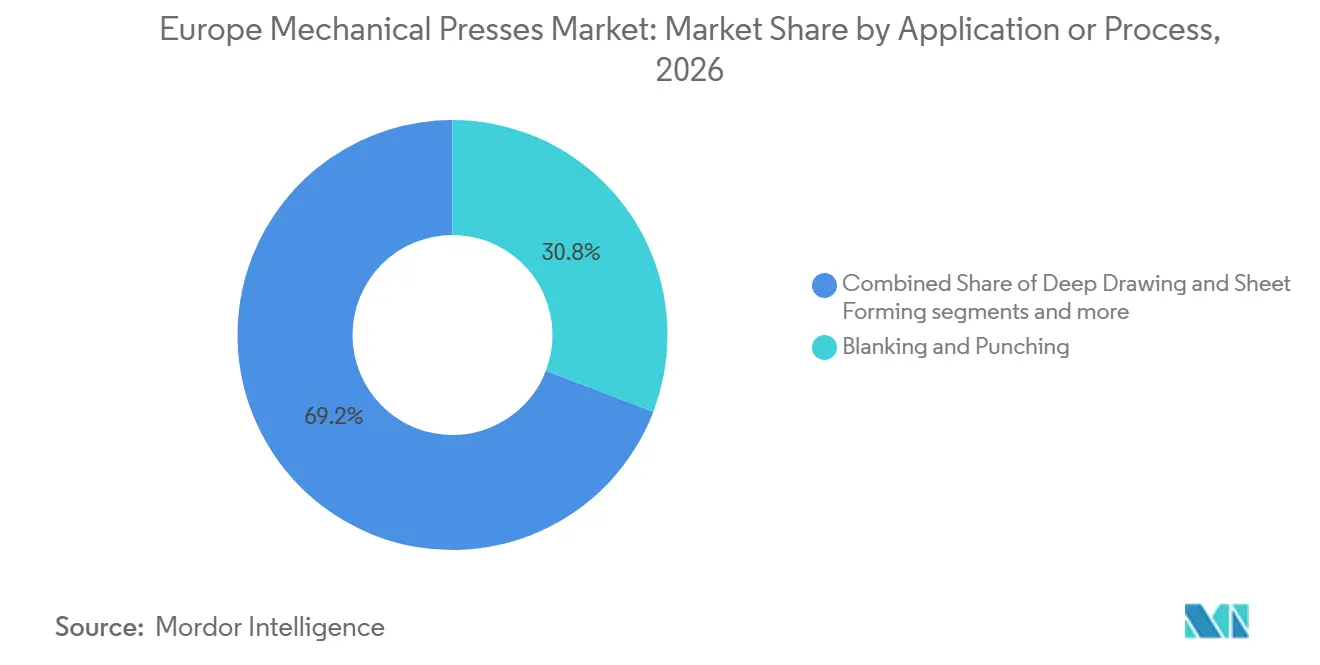
- By application and process, blanking and punching held 30.8% of the Europe mechanical presses market value in 2026, while high-speed and precision stamping is forecast to grow at a 4.6% CAGR through 2032.
- By end-use industry, automotive and transportation accounted for 34.7% of market value in 2026, while electrical and electronics is expected to grow at a 4.6% CAGR through 2032.
- By geography, Germany accounted for 27.8% of market value in 2026, while the Rest of Europe is projected to expand at a 4.8% CAGR through 2032.
Note: Market numbers in this report are based on Mordor Intelligence's proprietary estimation framework, which combines nine months of actuals with Q4 projections for base year 2026.
Europe Mechanical Presses Market Trends and Insights
Drivers Impact Analysis*
| Driver | (~) % Impact on CAGR Forecast | Geographic Relevance | Impact Timeline |
|---|---|---|---|
| Automotive Electrification and Battery-Enclosure Forming | +1.1% | Germany, France, Spain, Hungary, and the Czech Republic | Medium term (2-4 years) |
| Aging Press Fleet Replacement and Retrofit Demand | +0.8% | Germany, Italy, France, Poland | Short term (≤ 2 years) |
| Automated Press Lines and Labor Substitution | +0.6% | Germany, Italy, Spain, Rest of Europe | Medium term (2-4 years) |
| Lightweighting With Advanced High-Strength Steel and Aluminum | +0.5% | Germany, Sweden, France, Rest of Europe | Long term (≥ 4 years) |
| Central and Eastern European Manufacturing Localization | +0.4% | Poland, the Czech Republic, Hungary, Romania, and Slovakia | Medium term (2-4 years) |
| Aerospace and Defense Capacity Expansion | +0.3% | France, Finland, Belgium, the United Kingdom, Germany | Long term (≥ 4 years) |
| Source: Mordor Intelligence | |||
Automotive Electrification and Battery-Enclosure Forming
Battery enclosures are changing the equipment requirements of European press shops. Large battery trays require blanking, deep drawing, and precision hole punching in close sequence, while sealing requirements are tighter than for many internal-combustion vehicle stampings. Battery-electric cars represented 17.4% of new EU registrations in 2025, which supports a growing need for specialized forming equipment. Purem by Eberspaecher introduced a steel battery housing development program in October 2025 for next-generation electric vehicles, using high-strength steel for crash protection and sealing performance. Large, low-profile tray designs with side-wall stiffeners favor large-bed straight-side presses in the 500–1,500 ton range. This demand helps the Europe mechanical presses market move toward a smaller number of higher-value installations.
Central and Eastern Europe gives this demand a wider manufacturing base. Toyota announced a new battery-electric vehicle for European production, while BMW began ramping up assembly at its Debrecen plant in 2025. Rheinmetall opened a hybrid plant in Szeged, Hungary, in 2025, adding to the region’s industrial investment base. Press suppliers can benefit as vehicle and component production shifts closer to these new facilities. The opportunity is centered on equipment that can form battery housings, structural parts, and electric-drive components. The Europe mechanical presses market, therefore, gains from localized supply chains even when total vehicle output remains restrained.
Aging Press Fleet Replacement and Retrofit Demand
Europe has a large installed base of presses commissioned between 1980 and 1995. Many of these machines are nearing the point at which retrofit costs compete with the cost of a replacement press. The EU Machinery Regulation 2023/1230 applies from January 2027 and requires the machinery sector to meet updated safety and conformity requirements. Operators of older equipment must assess clutch, brake, guarding, and documentation requirements as they plan future capital spending. This pushes replacement decisions forward in Germany, Italy, France, and Poland. It also supports recurring demand for parts, service, and retrofit work.
ANDRITZ Schuler has a global installed base of more than 150,000 presses, and its service business grew 80% over the previous 3 years, indicating the scale of maintenance and modernization work associated with older equipment. The company’s 2025 rebranding within ANDRITZ underscored its broader offering across forming and handling solutions. ANDRITZ Kaiser acquired the technical documents, spare parts inventory, and trademark rights of the RASTER press product line in October 2025. The transaction preserves serviceability for an established precision-press base. Such aftermarket activity can delay some replacements, but it also gives operators a clearer path for staged modernization. The Europe mechanical presses market benefits when safety compliance, availability of service, and production reliability are evaluated together.
Automated Press Lines and Labor Substitution
Labor shortages are strengthening the case for automated press lines. The DIHK Skilled Labour Report 2025/2026 found that 42% of metal production and processing firms and 38% of mechanical engineering companies reported unfilled positions at the end of 2025.[1] Fraunhofer IGD expects Germany’s skilled workforce to decline by 3.5 million by 2035.[2] Manufacturers are responding with integrated packages that combine presses with robotic destacking, transfer, stacking, and inspection systems. These systems reduce dependence on manual material handling and support consistent cycle times. This strengthens demand for repeatable mechanical press motion that can be coordinated with automation.
Fagor Arrasate installed a fully automated tandem press line at Volkswagen Navarra in September 2026 to support future electric vehicle models. The line includes integrated presses, CNC transfer systems, and automation at the front and end of the line. This installation shows how press projects increasingly include a complete production-cell scope. The Europe mechanical presses market is also responding with digital control and monitoring tools that help operators improve uptime. Automation can be particularly relevant in smaller press rooms where labor availability has become a direct production constraint. The Europe mechanical presses market gains value when buyers procure integrated equipment rather than stand-alone machines.
Lightweighting With Advanced High-Strength Steel and Aluminum
Advanced high-strength steel requires more from frames, slide guidance, and clutch-brake systems than conventional grades. Materials above 1,200 MPa create higher snap-through forces, greater springback, and more demanding tooling conditions. Thyssenkrupp Steel presented MBW manganese-boron grades rated to 1,900 MPa for automotive door-ring applications at Blechexpo 2025. These requirements favor straight-side presses with high stiffness and robust force-management systems. The resulting equipment requirement can increase the value of each press installation. It also encourages manufacturers to select a capacity that provides a margin for future materials requirements.
WorldAutoSteel stated that the Steel E-Motive body concept can reduce structural vehicle weight by up to 25% through advanced steel design.[3] The EU-funded ALLIANCE project also set a target of 25% vehicle weight reduction at less than EUR 3 per kilogram (USD 3.5 per kilogram) for production above 100,000 units per year. Aerospace and defense capacity adds another demand channel for accurately formed, high-performance materials. GE Aerospace announced EUR 78 million (USD 91.8 million) of European manufacturing investment in 2025, while Safran opened a Belgian plant for compressor blades. This broadens the application base for precision forming equipment beyond automotive production. The Europe mechanical presses market is supported when demanding materials call for stronger, more controlled forming systems.
Restraints Impact Analysis*
| Restraint | (~) % Impact on CAGR Forecast | Geographic Relevance | Impact Timeline |
|---|---|---|---|
| High Capital Cost and Financing Constraints | -0.8% | EU-wide, acute for SMEs in Italy, Poland, and the Czech Republic | Short term (≤ 2 years) |
| Automotive Production Volatility and Plant Underutilization | -0.5% | Germany, France, the United Kingdom, and Spain | Medium term (2-4 years) |
| Skilled Commissioning and Tooling-Integration Shortages | -0.3% | Germany, Italy, Rest of Europe | Medium term (2-4 years) |
| Connected-Press Cybersecurity and Validation Burden | -0.2% | Germany, France, the Netherlands, and the Nordic countries | Long term (≥ 4 years) |
| Source: Mordor Intelligence | |||
High Capital Cost and Financing Constraints
Capital intensity remains a persistent limitation for press renewal, especially among small and medium-sized manufacturers. A large straight-sided mechanical press in the 800–1,500 ton range can require a multi-million-euro investment. Buyers increasingly seek performance-based leasing arrangements that reduce the initial capital outlay by 30–50%, while tying payments to equipment use. The OECD has emphasized that manufacturing SMEs need stable and accessible funding frameworks for long-cycle equipment investments. Financing conditions, therefore, influence whether operators repair, retrofit, or replace older presses. The constraint is most apparent in Italy, Poland, and the Czech Republic.
The European Investment Bank tripled intermediated financing to EUR 3 billion (USD 3.5 billion) for defense supply-chain SMEs during 2025. This support does not specifically address general-purpose metal-forming equipment replacement. As a result, many smaller operators remain dependent on commercial bank lending, which can slow renewal plans. The Europe mechanical presses market may see orders concentrated among buyers with stronger balance sheets or access to leasing. A shortage of commissioning and tooling-integration specialists compounds this issue because buyers must budget for installation and ramp-up support. Connected equipment also carries cybersecurity and validation responsibilities that add to project costs.
Automotive Production Volatility and Plant Underutilization
Automotive output has a direct effect on mechanical press procurement because automotive plants consume a substantial share of press capacity. EU van production fell 6.5% in 2025, and wider European car production declined 0.3%, while United Kingdom car production fell 8.4%. EU car output reached 11.47 million units, but it remained 3 million units below the 2019 level. Press shops operating below their planned utilization rate have less reason to add general capacity. Replacement projects can therefore be deferred, particularly in Germany, France, Spain, and the United Kingdom. This restrains near-term equipment orders from suppliers with high automotive exposure.
European industrial electricity prices were 151% above United States levels in the ACEA benchmark. Higher operating costs reduce the cash available for capital expenditure. This makes specialized applications more likely to secure approval than broad fleet renewal projects. The Europe mechanical presses market must therefore balance demand from electric-vehicle components against slower replacement cycles at underutilized automotive plants. NIS2 has also increased cybersecurity risk-management and incident-reporting obligations for relevant industrial entities since October 2024. These requirements can lengthen validation work for connected press installations.
*Our forecasts treat driver/restraint impacts as directional, not additive. The impact forecasts reflect baseline growth, mix effects, and variable interactions.
Segment Analysis
By Frame / Structural Configuration: Straight-Side Frames Serve Large-Tonnage Automotive Forming
Straight-side and H-frame presses commanded 44.1% of the Europe mechanical presses market share in 2026. Their position reflects the use of tandem and transfer lines for automotive body panels and chassis components. These presses provide the rigidity and tolerance for off-center loading that many large automotive tools require. Replacement needs at established Western European press shops support the Europe mechanical presses market size for this configuration. Straight-side designs are also well suited to large battery trays and structural-component tooling. Updated safety and conformity requirements may encourage operators of older systems to accelerate their replacement plans. Their role is strongest where high tonnage, long production runs, and complex dies are common.
C-frame and gap-frame presses are projected to expand at a 3.9% CAGR through 2032. Their three-sided access helps manufacturers arrange robotic feeders, vision systems, and part-removal equipment in constrained spaces. This feature is relevant to battery component and motor-lamination facilities expanding across Central and Eastern Europe. C-frame systems are also used by smaller fabricators that need flexible tooling access and mid-tonnage capability. Solid and monoblock frames retain a specialized role in fine blanking and coining, where tight tolerances are required. Siempelkamp’s Prod-IQ SmartPress development with SMARTECH illustrates the direction toward more autonomous process control in premium press designs. The Europe mechanical presses market benefits when digital controls improve the use of high-value frame configurations.

By Press Force / Capacity: Mid-Range Tonnage Underpins European Stamping Economics
The 101–500 ton range held 39.5% of the market value in 2026. It serves progressive-die automotive components, appliance casings, and electronics assemblies. This range remains useful because it combines broad applicability with manageable installation requirements. The Europe mechanical presses market size for 101–500 ton equipment is sustained by the large installed base of mid-sized fabrication operations. Sub-100-ton presses remain relevant for connector terminals and lamination stacks. The 1,001–2,000 ton and above-2,000 ton ranges are more concentrated in OEM-level body-side, door-panel, and transfer-line projects. Demand is therefore distributed across a broad base of smaller plants and a smaller number of very large buyers.
The 501–1,000 ton segment is forecast to grow at a 4.2% CAGR through 2032. Battery-tray forming and electric-vehicle structural components are moving press rooms toward the upper mid-tonnage range. ANDRITZ Schuler received an order for a 1,600-ton Triton mechanical transfer press with Metris Smart Monitoring in 2025, showing continued demand for large systems with digital monitoring. Operators replacing 300–500 ton presses from the early 1990s may select 600–800 ton models to process stronger materials. This increases average selling prices even when shipment volumes are stable. The higher capacity also provides flexibility for future component designs. The Europe mechanical presses market is therefore seeing a gradual shift toward equipment with more force and monitoring capability.
By Application / Process: Blanking Anchors Volume as Precision Stamping Commands Growth
Blanking and punching accounted for 30.8% of the market value in 2026. These processes are used in automotive body production, appliance manufacturing, and general metal fabrication. Their broad installed base gives them the largest application position in the Europe mechanical presses market. Blanking is often the first forming step for flat-metal components and remains important across most end-use sectors. The process supports high-volume production where repeatability and die performance are essential. It also provides a stable demand base when more specialized applications fluctuate. The segment’s scale reflects the continuing need for core sheet-metal operations across the region.
High-speed and precision stamping is expected to expand at a 4.6% CAGR through 2032. Electric motor rotor-stator laminations, high-voltage terminals, and busbars require fine control of material feed and dimensional accuracy. BRUDERER introduced the B3 machine control and BSP lamination stacking control at Blechexpo 2025, with availability for new BSTA presses from 2026 and retrofit availability from mid-2026. The system includes OPC-UA connectivity and strip-thickness measurement to ±0.01 mm. Fagor Arrasate received an order during June 2026 for three 600-ton HSP 4.3++ presses for rotor-stator lamination production. Fine blanking also benefits from the demand for precise electric-powertrain components. ANDRITZ Schuler expanded its fine blanking offering in early 2025 by taking on direct HFA press supply.
By End-Use Industry: Automotive Dominates Value, Electrical Sector Sets the Growth Agenda
Automotive and transportation held 34.7% of the market value in 2026. Germany, France, Spain, and the Czech Republic have substantial automotive press-shop infrastructure, which supports this leading role. Automotive production requires presses for body panels, chassis components, structural parts, and supplier-made subassemblies. The segment also has a large installed base that creates replacement and service demand. However, plant utilization and production volumes influence the timing of major capital projects. The Europe mechanical presses market remains closely linked to automotive investment cycles despite diversification into newer applications. This exposure explains why output volatility remains an important restraint.
Electrical and electronics is forecast to grow at a 4.6% CAGR through 2032. The segment is supported by European production of motor cores, bipolar plates, battery management hardware, and high-voltage components. AIDA Engineering presented its BEX Series press for bipolar plate production at Blechexpo 2025, illustrating the development of equipment tailored to hydrogen and electrification applications. Appliances and consumer durables continue to create steady demand for precise component forming under EU Ecodesign requirements. General metal products and machinery provide a broader replacement base across the region. Aerospace and defense also add demand for specialized components as investment rises. The Europe mechanical presses market is gradually becoming less dependent on conventional automotive body stamping alone.
Geography Analysis
Germany accounted for 27.8% of the market value in 2026 and remains the largest national market in the Europe mechanical presses market. It combines a large press manufacturing base with extensive automotive and industrial replacement demand. Germany’s producers are responding to higher-strength steel, automation needs, and tight labor conditions. Thyssenkrupp’s 1,900 MPa MBW grades raise the requirement for stiff press frames and controlled forming systems. The DIHK survey findings on unfilled roles reinforce the value of automation in German metalworking plants. This combination sustains demand for integrated lines, retrofits, and high-capacity press replacements.
Switzerland and Italy contribute strongly to high-speed and fine blanking applications. BRUDERER has an export-oriented operating model, while Italian suppliers compete through customization, manufacturing flexibility, and service proximity. France has demand from aerospace forming and automotive electrification. Safran’s Belgian compressor-blade plant and GE Aerospace’s European investment indicate continued manufacturing activity that can support precision forming demand. Spain is supported by automotive investment, including the automated Volkswagen Navarra line installed by Fagor Arrasate in 2026. The United Kingdom experienced an 8.4% car-production decline in 2025, which limits near-term automotive press orders. Defense and aerospace activity offers a partial offset in the United Kingdom.
The Rest of Europe is expected to grow at a 4.8% CAGR through 2032. This is the fastest geographic expansion rate in the Europe mechanical presses market. Poland, the Czech Republic, Hungary, Romania, and Slovakia are gaining importance as electric-vehicle and defense supply chains expand. Toyota’s Czech investment, BMW’s Debrecen ramp-up, and Rheinmetall’s Szeged facility point to sustained industrial activity in the region. POSCO INTERNATIONAL completed its drive motor core plant in Brzeg, Poland, in 2025, with an investment of KRW 94.1 billion (USD 65.3 million). This manufacturing localization supports press demand for electric-drive components and related metal parts. Lower-cost manufacturing locations are becoming more important in the regional equipment mix.
Competitive Landscape
The Europe mechanical presses market exhibits a medium level of market concentration in high-tonnage and highly automated equipment. Engineering complexity, lengthy project cycles, and service requirements create meaningful barriers in this part of the market. Competition is more fragmented below 300 tons, where Italian, Swiss, and German manufacturers compete on lead time, customization, and local service. ANDRITZ Schuler, AIDA Engineering, ANDRITZ Kaiser, BRUDERER, and Fagor Arrasate are prominent suppliers in high-capacity, high-speed, and precision categories. The Europe mechanical presses market also includes suppliers focused on fine blanking, automation, and complete press-shop systems. Customers often select suppliers on technical fit, lifecycle support, and integration capability rather than price alone.
ANDRITZ Schuler’s 2025 integration within ANDRITZ broadened its position across forming and handling solutions. The company’s installed base of more than 150,000 presses and 80% growth in service activity over the prior 3 years provide a substantial aftermarket position. AIDA Engineering consolidated its two German subsidiaries during February 2025 to strengthen operating efficiency and service quality for European customers. BRUDERER’s B3 control and lamination stacking systems address the demand for digital connectivity and precision in electric-motor applications. Fagor Arrasate’s high-speed press order and Volkswagen Navarra installation show a focus on electrification-linked forming and automated lines. These actions show that suppliers are differentiating through controls, service, automation, and application-specific engineering.
The competitive direction is also influenced by regulation and replacement demand. Machinery Regulation 2023/1230 encourages operators to examine whether modernization or replacement is the more workable route for older equipment. Suppliers that can combine safety upgrades, digital monitoring, spare parts, and commissioning support may have an advantage with owners of aging fleets. Specialist providers can compete effectively in mid-tonnage, high-speed, and fine-blanking niches even where larger companies lead complex turnkey projects. The Europe mechanical presses market remains varied because end users have different needs for tonnage, materials, automation, and production volume. Direct competition is therefore strongest within specific equipment classes rather than across every application.
Europe Mechanical Presses Industry Leaders
-
ANDRITZ Schuler
-
AIDA Engineering, Ltd.
-
Fagor Arrasate S. Coop.
-
BRUDERER AG
-
Komatsu Ltd.
- *Disclaimer: Major Players sorted in no particular order
Recent Industry Developments
- January 2026: ANDRITZ Schuler commissioned a 1.5-gigawatt battery cell mass formation line for a German premium car manufacturer, fully automated and measuring 22 m long by 10 m wide, positioning itself as a key player in EV battery cell production infrastructure alongside its press-manufacturing role.
- March 2025: ANDRITZ AG completed the strategic rebranding of Schuler Group as ANDRITZ Schuler, transforming the entity from a standalone press manufacturer into an integrated forming and handling solution provider while retaining the Schuler product brand for mechanical presses.
- February 2025: AIDA Engineering, Ltd. merged its two German subsidiaries, AIDA Germany GmbH and AIDA EUROPE GmbH, into a single entity to strengthen operational efficiency and service quality for European customers.
Europe Mechanical Presses Market Report Scope
The Europe Mechanical Presses Market is Segmented by Frame Configuration (C-Frame Mechanical Presses, Straight-Side Mechanical Presses, and More), by Press Force (101–500 Tons, and More), by Application (Blanking and Punching, Fine Blanking, and More), by End-Use Industry (Electrical and Electronics, Energy and Power, and More), by Geography (Germany, Italy, and More). The Market Forecasts are Provided in Terms of Value (USD).
| C-Frame / Gap-Frame Mechanical Presses |
| Straight-Side / H-Frame Mechanical Presses |
| Solid / Monoblock Frame Mechanical Presses |
| Other Mechanical Press Configurations |
| Up to 100 Tons |
| 501–1,000 Tons |
| 1,001–2,000 Tons |
| Above 2,000 Tons |
| Blanking and Punching |
| Deep Drawing and Sheet Forming |
| Coining and Embossing |
| Fine Blanking |
| High-Speed and Precision Stamping |
| Other Mechanical Press Applications |
| Automotive and Transportation |
| Electrical and Electronics |
| Appliances and Consumer Durables |
| Industrial Machinery and Equipment |
| Metal Products and General Manufacturing |
| Aerospace and Defense |
| Construction and Heavy Equipment |
| Energy and Power |
| Other End-Use Industries |
| Germany |
| Switzerland |
| Italy |
| France |
| United Kingdom |
| Spain |
| Rest of Europe (Poland, Czech Republic, Hungary, Sweden, Russia, Netherlands, Belgium, Austria, Portugal, Romania, etc.) |
| By Frame / Structural Configuration | C-Frame / Gap-Frame Mechanical Presses |
| Straight-Side / H-Frame Mechanical Presses | |
| Solid / Monoblock Frame Mechanical Presses | |
| Other Mechanical Press Configurations | |
| By Press Force / Capacity | Up to 100 Tons |
| 501–1,000 Tons | |
| 1,001–2,000 Tons | |
| Above 2,000 Tons | |
| By Application / Process | Blanking and Punching |
| Deep Drawing and Sheet Forming | |
| Coining and Embossing | |
| Fine Blanking | |
| High-Speed and Precision Stamping | |
| Other Mechanical Press Applications | |
| By End-Use Industry | Automotive and Transportation |
| Electrical and Electronics | |
| Appliances and Consumer Durables | |
| Industrial Machinery and Equipment | |
| Metal Products and General Manufacturing | |
| Aerospace and Defense | |
| Construction and Heavy Equipment | |
| Energy and Power | |
| Other End-Use Industries | |
| By Geography | Germany |
| Switzerland | |
| Italy | |
| France | |
| United Kingdom | |
| Spain | |
| Rest of Europe (Poland, Czech Republic, Hungary, Sweden, Russia, Netherlands, Belgium, Austria, Portugal, Romania, etc.) |
Key Questions Answered in the Report
What is the forecast for the demand for European mechanical presses through 2032?
The Europe mechanical presses market is forecast to reach USD 1.40 billion by 2032, expanding at a 3.3% CAGR from 2027 to 2032.
Which mechanical press configuration leads demand in Europe?
Straight-side and H-frame presses lead, with 44.1% of market value in 2026, due to their use in large-tonnage automotive and structural forming.
Why are electric vehicles important for mechanical press suppliers?
Battery enclosures, motor laminations, terminals, and structural parts require specialized blanking, drawing, and precision stamping equipment.
Which capacity range is growing fastest in Europe?
The 501–1,000 ton segment is forecast to grow at a 4.2% CAGR through 2032 as battery-tray and electric-vehicle structural applications increase.
Which European region is growing fastest for mechanical presses?
The Rest of Europe is forecast to expand at a 4.8% CAGR through 2032, supported by manufacturing investment in Central and Eastern Europe.
What is limiting press replacement investment in Europe?
High capital costs, limited financing access, technician shortages, cybersecurity requirements, and underutilized automotive plants are delaying some projects.