
Europe LTPS LCD Module In Automotive Market Size and Share
Market Overview
| Study Period | 2021 - 2032 |
|---|---|
| Forecast Data Period | 2027 - 2032 |
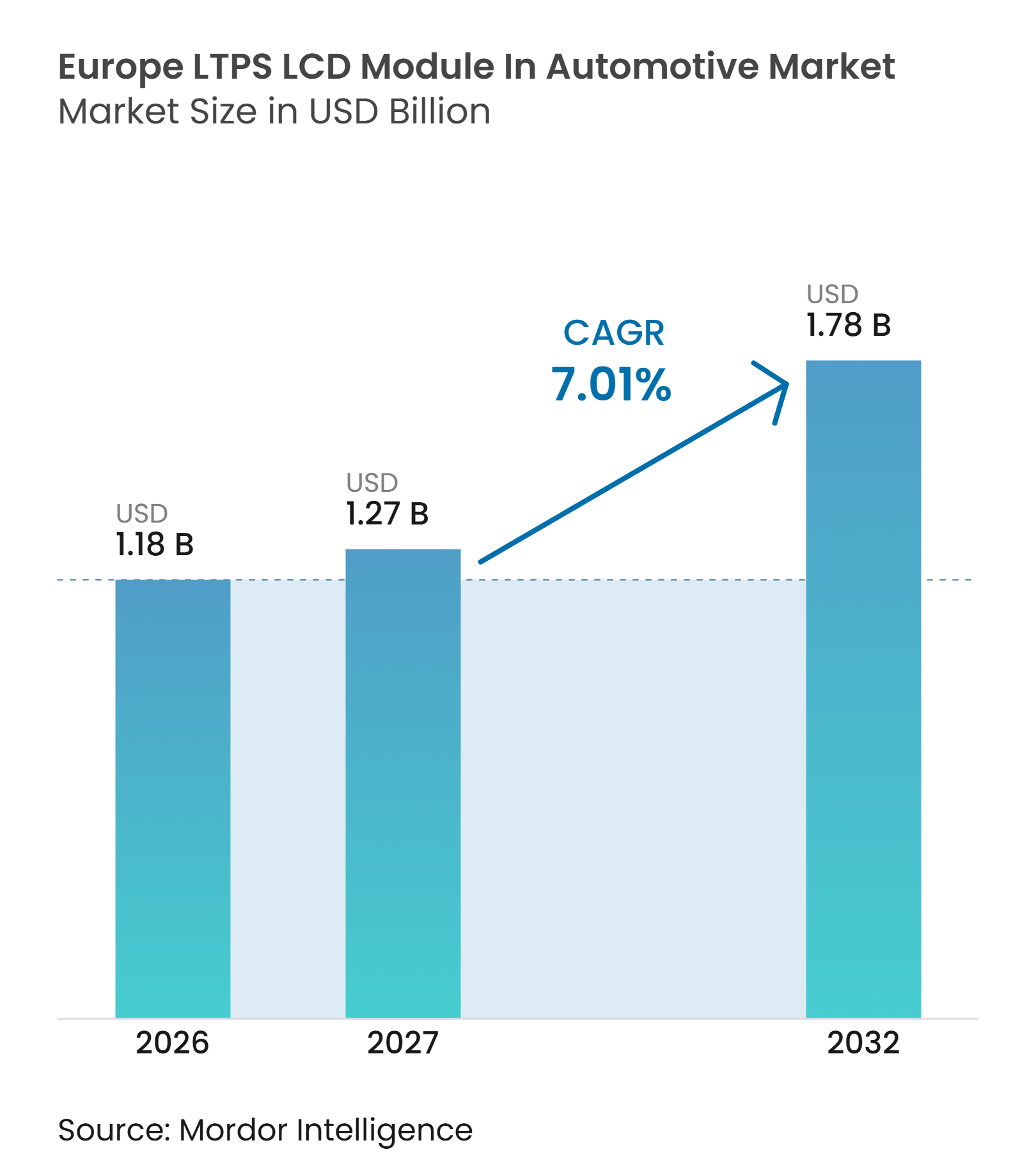
| Base Year Market Size (2026) | USD 1.18 Billion |
| Market Size (2027) | USD 1.27 Billion |
| Market Size (2032) | USD 1.78 Billion |
| Growth Rate (2027 - 2032) | 7.01 % |
| Market Concentration | High |
Major Players *Disclaimer: Major Players sorted in no particular order Image © Mordor Intelligence. Reuse requires attribution under CC BY 4.0. | |
Europe LTPS LCD Module In Automotive Market Analysis by Mordor Intelligence
The Europe LTPS LCD Module (LCM) in Automotive market size is projected to expand from USD 1.18 billion in 2026 and USD 1.18 billion in 2027 to USD 1.78 billion by 2032, registering a CAGR of 7.01% between 2027 to 2032. Automakers are replacing separate screens with larger displays that support connected vehicle functions and digital controls. This shift favors LTPS LCD modules because they offer high resolution, fast response, and a lower cost base than OLED alternatives. European suppliers are also placing greater value on display modules that integrate touch functions, optical performance, and software compatibility. The Europe LTPS LCD Module (LCM) in Automotive market therefore depends not only on vehicle output, but also on how quickly cockpit systems move toward larger and more integrated displays. Price pressure and long qualification periods will continue to shape supplier returns and the pace of technology adoption.
Key Report Takeaways
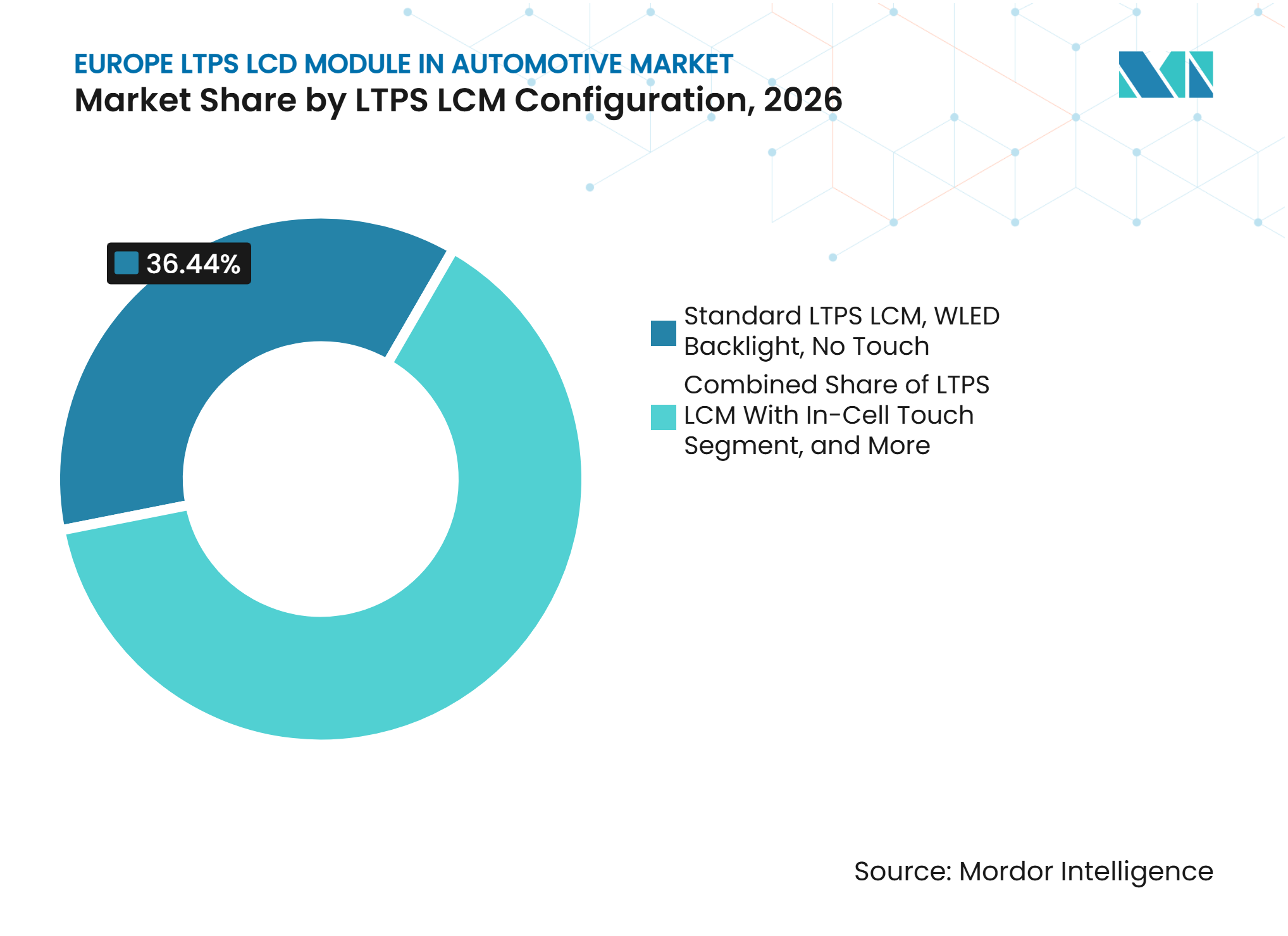
- By configuration, Standard LTPS LCM with WLED backlight and no-touch configuration held 36.44% of the Europe LTPS LCD Module (LCM) in Automotive market share in 2026, while LTPS LCM with mini-LED backlight and in-cell touch is projected to expand at an 8.97% CAGR through 2032.
- By application, Center Stack and Infotainment accounted for 42.82% of the Europe LTPS LCD Module (LCM) in Automotive market size in 2026, while Pillar-to-Pillar Center Console is projected to expand at an 8.74% CAGR through 2032.
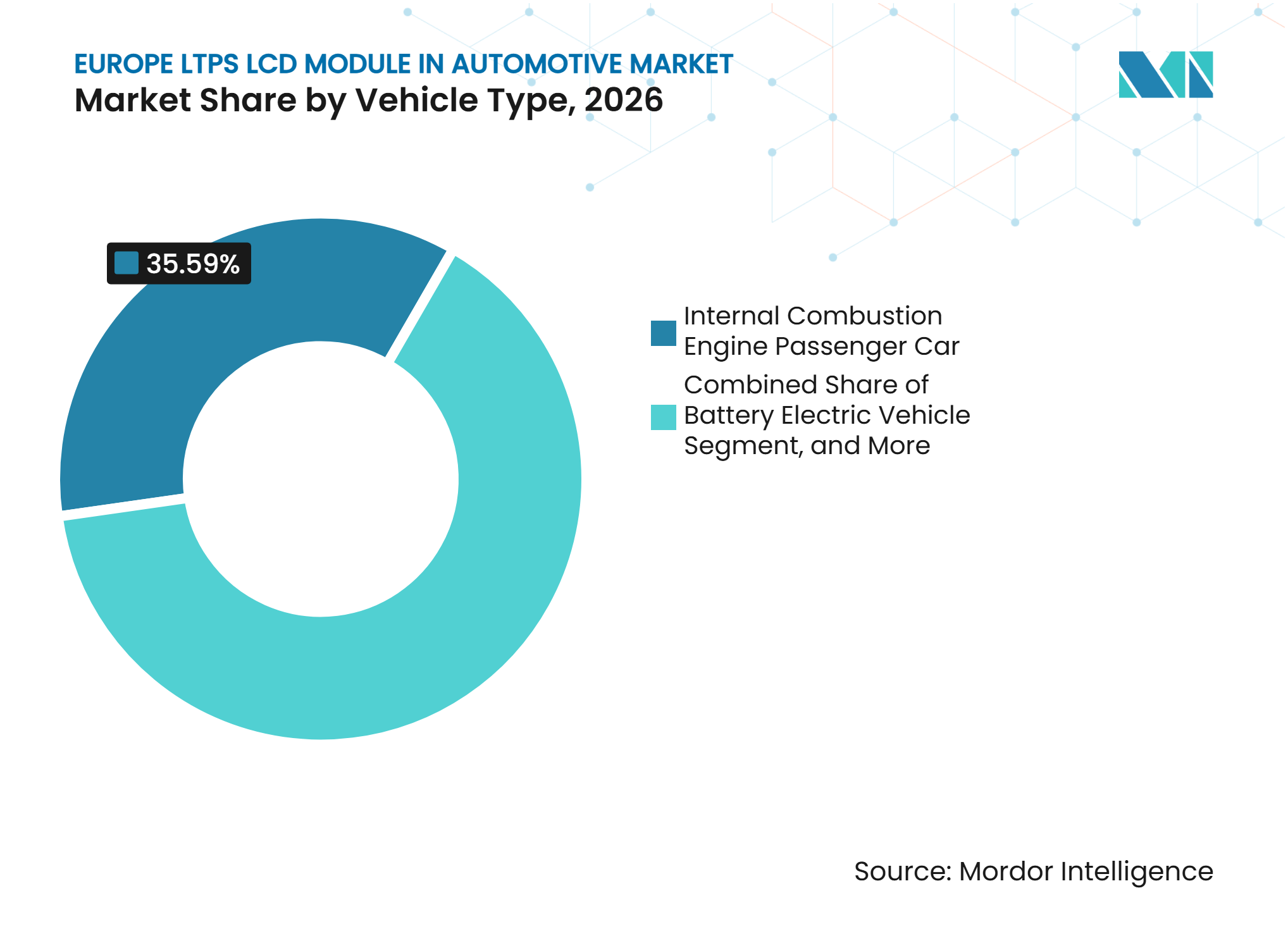
- By vehicle type, ICE passenger cars held 35.59% of the Europe LTPS LCD Module (LCM) in Automotive market share in 2026, while battery electric vehicles are projected to expand at an 8.84% CAGR through 2032.
- By bonding process, Film on Glass held 63.14% revenue share in 2026, while Chip on Glass is projected to expand at an 8.78% CAGR through 2032.
- By geography, Germany held 28.39% revenue share in 2026 and is projected to expand at an 8.96% CAGR through 2032.
Note: Market numbers in this report are based on Mordor Intelligence's proprietary estimation framework, which combines nine months of actuals with Q4 projections for base year 2026.
Market Trends and Insights
Drivers Impact Analysis of Europe LTPS LCD Module In Automotive Market*
| Driver | (~) % Impact on CAGR Forecast | Geographic Relevance | Impact Timeline |
|---|---|---|---|
| Rising Smart-Cockpit Content per Vehicle | +1.6% | Germany, United Kingdom, Rest of Europe | Medium term (2-4 years) |
| Higher LTPS Adoption in Electric and Hybrid Vehicles | +1.4% | Germany, France, Italy | Long term (≥ 4 years) |
| Demand for High-Brightness and High-Resolution Displays | +1.2% | Global, with early gains in Germany and United Kingdom | Medium term (2-4 years) |
| Expansion of In-Cell Touch Integration | +0.9% | Asia-Pacific core, spill-over to Europe | Short term (≤ 2 years) |
| European Premium Vehicle Display Upgrades | +0.7% | Germany, United Kingdom | Medium term (2-4 years) |
| Panel Supplier Migration Toward Automotive Revenue Pools | +0.5% | Global | Long term (≥ 4 years) |
| Source: Mordor Intelligence | |||
Rising Smart-Cockpit Content Per Vehicle
Cockpit domain consolidation is increasing demand for larger displays in the Europe LTPS LCD Module (LCM) in Automotive market. Automakers are bringing navigation, climate, media, and driver information into fewer display surfaces. This approach increases the importance of resolution, brightness, and dependable software connections. Visteon reported USD 3.5 billion in new display business wins during 2025, showing continued demand for display-centered cockpit programs.[1] The shift gives module suppliers a stronger reason to combine hardware with calibration and system integration capabilities. It also makes the quality of display-controller coordination more important during vehicle development.
Higher LTPS Adoption in Electric and Hybrid Vehicles
Battery electric and hybrid vehicles use more digital controls than traditional vehicle designs. Their cabin systems present battery status, range, regenerative braking, and software functions through digital interfaces. These requirements support demand for LTPS displays with clear images and touch-enabled operation. LG Display stated that its LTPS LCD automotive business maintained stable performance through key customer vehicle sales in 2026.[2] The Europe LTPS LCD Module (LCM) in Automotive market also benefits as automakers reuse cockpit architectures across battery electric, hybrid, and combustion vehicle platforms. This reuse can give suppliers longer production runs across related vehicle programs.
Demand for High-Brightness and High-Resolution Displays
European vehicle programs require displays that remain readable in changing light conditions. LTPS LCD technology supports high pixel density and brightness for center stack and driver information applications. Larger screens also raise expectations for uniform light output and low reflection. These needs create room for mini-LED backlighting in premium applications where contrast is a major purchasing factor. The Europe LTPS LCD Module (LCM) in Automotive market is therefore moving toward specifications that reward optical performance rather than panel price alone. Suppliers must also demonstrate stable image quality across different temperatures and driving conditions.
Expansion of In-Cell Touch Integration
In-cell touch integration reduces the number of layers in a display module. This can reduce thickness and remove a separate touch overlay from the assembly. It also supports the multi-touch and gesture functions requested in modern cockpit interfaces. The Society for Information Display describes automotive display design as increasingly shaped by advances in HMI and display integration.[3] For the Europe LTPS LCD Module (LCM) in Automotive market, this favors suppliers with qualified touch controllers and established automotive validation processes. It also allows designers to use more compact assemblies in space-constrained instrument panels.
Restraints Impact Analysis of Europe LTPS LCD Module In Automotive Market*
| Restraint | (~) % Impact on CAGR Forecast | Geographic Relevance | Impact Timeline |
|---|---|---|---|
| Automotive Display Price Erosion | -0.8% | Global, with disproportionate impact on Germany and France volume segments | Short term (≤ 2 years) |
| Long Automotive Qualification and Design-Win Cycles | -0.6% | Germany, United Kingdom, Italy | Medium term (2-4 years) |
| Concentration of Advanced Display Capacity in East Asia | -0.4% | Europe | Long term (≥ 4 years) |
| Limited LTPS Yield at Large and Complex Form Factors | -0.3% | Asia-Pacific core, spill-over to Europe | Long term (≥ 4 years) |
| Source: Mordor Intelligence | |||
Automotive Display Price Erosion
Falling panel prices place pressure on revenue per module in the Europe LTPS LCD Module (LCM) in Automotive market. The pressure is strongest for established WLED and entry LTPS configurations, where component choices are less differentiated. Module suppliers can protect margins more effectively when they offer advanced backlighting, touch integration, or system-level services. EU compliance factors, including REACH and RoHS requirements, add material and testing obligations to European supply programs. These requirements make cost control important even when vehicle display content rises. They also make specialty material sourcing and lifecycle documentation part of supplier selection.
Long Automotive Qualification and Design-Win Cycles
Automotive display systems require extended technical validation before production use. These processes can delay the commercial adoption of new LTPS backlight and touch designs. A platform decision made in 2026 can determine module choices for several later production years. Japan Display changed its organizational structure in 2026 to operate automotive activities within a unified business structure. In the Europe LTPS LCD Module (LCM) in Automotive market, slow supplier substitution makes early design wins and qualification status especially valuable. It also limits the ability of automakers to change display specifications during an active model cycle.
*Our forecasts treat driver/restraint impacts as directional, not additive. The impact forecasts reflect baseline growth, mix effects, and variable interactions.
Europe LTPS LCD Module In Automotive Market Segment Analysis
By LTPS LCM Configuration:
Standard WLED Retains Volume, Mini-LED Adds Premium DemandStandard LTPS LCM with WLED backlight and no-touch configuration held 36.44% of the Europe LTPS LCD Module (LCM) in Automotive market size in 2026. Its position reflects established production processes and cost suitability for broad vehicle programs. Instrument clusters remain an important outlet because durability and stable performance carry more weight than premium contrast in many applications. In-cell touch with WLED backlighting serves center stack and infotainment systems that need responsive touch interfaces. Mini-LED without touch has a narrower role in large displays where local dimming matters but touch is not needed.
LTPS LCM with mini-LED backlight and in-cell touch is projected to expand at an 8.97% CAGR from 2027 to 2032. The configuration combines touch input with contrast performance suited to premium cockpit systems. It offers a middle route for automakers that seek a stronger visual result than standard WLED without moving fully to OLED. Large European vehicle programs must still weigh module cost, thermal behavior, and supply continuity. The Europe LTPS LCD Module (LCM) industry will increasingly differentiate configurations through optical quality and integrated functions rather than through display size alone.



By Application:
Center Stack Remains Core, Pillar-to-Pillar Extends Display UseCenter Stack and Infotainment represented 42.82% of the Europe LTPS LCD Module (LCM) in Automotive market size in 2026. It remains the principal interface for navigation, climate settings, media, and vehicle functions. Automakers continue to introduce LTPS panels in this position across both premium and volume platforms. Instrument cluster applications also support demand as driver information systems become fully digital. Rear seat entertainment remains smaller in Europe because many vehicle programs prioritize driver-facing display functions.
Pillar-to-Pillar Center Console is projected to expand at an 8.74% CAGR through 2032. This design joins several functions across the dashboard and can simplify the visual layout of the cockpit. It also requires careful management of seams, curved surfaces, optical alignment, and module reliability. Visteon displayed triple-screen and pillar-to-pillar systems, including mini-LED LCD applications, at CES 2026. These programs create a higher-value opportunity for the Europe LTPS LCD Module (LCM) in Automotive market, but they also raise production complexity.
By Vehicle Type:
ICE Holds Current Volume, BEVs Raise Display ContentICE passenger cars held 35.59% of the Europe LTPS LCD Module (LCM) in Automotive market share in 2026. The installed base of combustion vehicle platforms and their long production cycles support this position. These vehicles are still receiving digital cockpit upgrades, particularly in center stack applications. Hybrid and plug-in hybrid vehicles offer a transition path because they use newer digital systems while retaining established vehicle architectures. Light commercial vehicles contribute a smaller opportunity through telematics and driver assistance displays.
Battery electric vehicles are projected to expand at an 8.84% CAGR from 2027 to 2032. Their cabins replace many physical controls with screens for vehicle functions and software services. Display efficiency also matters because electricity use affects vehicle range. LTPS modules support this need while providing brightness and resolution for detailed interfaces. The Europe LTPS LCD Module (LCM) industry gains from the use of common electronic architectures across electric and hybrid vehicle lines.

By Bonding Process:
FOG Leads Current Volume, COG Serves Premium RequirementsFilm on Glass held 63.14% of the Europe LTPS LCD Module (LCM) in Automotive market share in 2026. The process is well understood and works with flat or moderately curved screens used in mainstream vehicles. It provides a practical balance between performance, yield, and cost. Instrument cluster and center stack programs can use Film on Glass bonding without the expense of more advanced assembly methods. Its established production base also supports predictable procurement for European module assemblers.
Chip on Glass is projected to expand at an 8.78% CAGR through 2032. Direct driver mounting on the glass can help reduce module depth and support slimmer display layouts. This makes the process relevant to curved and wide display programs that require strong optical results. The added cost is more acceptable in luxury and near-premium vehicles than in high-volume entry models. As cockpit designs become more integrated, the Europe LTPS LCD Module (LCM) in Automotive market may see more Chip on Glass use in applications where thin construction and viewing quality are priorities.
Geography Analysis
Germany
Germany held 28.39% of the Europe LTPS LCD Module (LCM) in Automotive market share in 2026 and is projected to expand at an 8.96% CAGR through 2032. BMW, Mercedes-Benz, and Volkswagen Group continue to raise display requirements across premium and broader vehicle programs. The country also has a deep network of Tier 1 suppliers that can integrate modules with vehicle electronics and cockpit software. Germany remains dependent on imported panel supply, which increases the importance of supplier qualification and sourcing discipline.
United Kingdom
The United Kingdom is a high-value location for the Europe LTPS LCD Module (LCM) in Automotive market because luxury vehicle makers use significant display content per vehicle. Jaguar Land Rover, Bentley, Rolls-Royce, and Aston Martin seek differentiated cockpit design and high optical quality. Their programs can include multiple screens, rear-seat systems, and advanced head-up displays. The focus on high-value integration gives suppliers a reason to prioritize flexible module design and reliable software interfaces.
France, Italy, and Rest of Europe
France supports the Europe LTPS LCD Module (LCM) in Automotive market through Tier 1 display and lighting integration capabilities. Valeo and Ennostar launched an automotive exterior mini-LED high-definition display at IAA Mobility 2025, extending the use of advanced display technology beyond the cabin. Italy’s premium vehicle makers set demanding expectations for image quality and interior design. Samsung Display supplied 4 OLED display panels for Ferrari Luce in 2026, which illustrates the high-end display benchmark surrounding luxury vehicle programs. Spain and other European locations add demand through contract assembly and expanded electric vehicle manufacturing. These markets offer an opportunity for suppliers that can adapt LTPS modules to cost-sensitive volume vehicle programs.
Competitive Landscape
Market Concentration
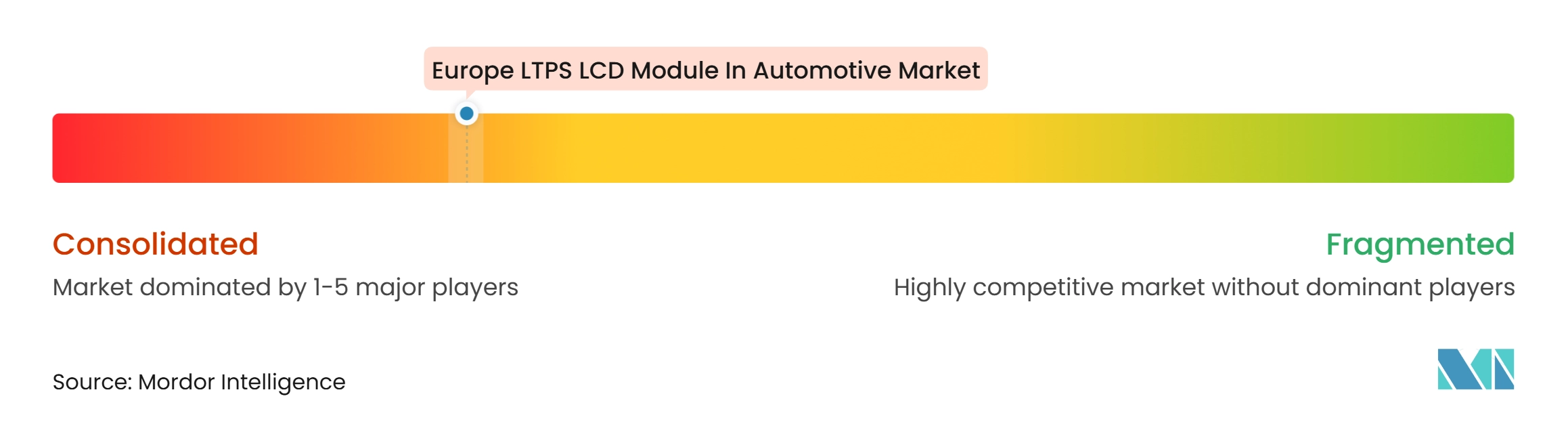
The Europe LTPS LCD Module (LCM) in Automotive market has a concentrated panel supply base and a broader group of system integrators. Competition centers on display quality, qualification history, touch integration, and the ability to work with cockpit software. Established Tier 1 suppliers retain an important role because automakers require modules to meet vehicle-level reliability and safety needs. ISO 26262 functional safety requirements can slow entry for suppliers without proven automotive programs. This makes established design wins valuable across the Europe LTPS LCD Module (LCM) in Automotive market.
Panel suppliers are moving toward broader automotive system roles. CarUX completed its acquisition of Pioneer in December 2025, combining display, audio, and human-machine interface capabilities. Japan Display integrated its automotive display activities into a unified business structure in 2026. These actions show how suppliers are seeking more value from cockpit systems rather than only selling panels.
European integrators must continue to match this broader offer with software support, optical engineering, and reliable program execution. Visteon’s 2025 display business wins show that established suppliers can maintain momentum through system expertise. CarUX and Pioneer provide an example of a combined cockpit offering that links displays with audio and interface software. The Europe LTPS LCD Module (LCM) in Automotive market will reward suppliers that can meet both component and system needs. Procurement teams will also place greater emphasis on long-term supply assurance and the ability to support platform changes.
Europe LTPS LCD Module In Automotive Industry Leaders
-
LG Display Co., Ltd.
-
Japan Display Inc.
-
Tianma Microelectronics Co., Ltd.
-
AUO Corporation
-
BOE Technology Group Co., Ltd.
- *Disclaimer: Major Players sorted in no particular order
Europe LTPS LCD Module In Automotive Market Companies Covered in this Report
- BOE Technology Group Co., Ltd.
- Tianma Microelectronics Co., Ltd.
- AUO Corporation
- Japan Display Inc.
- LG Display Co., Ltd.
- Innolux Corporation
- TCL China Star Optoelectronics Technology Co., Ltd.
- Sharp Corporation
- Samsung Display Co., Ltd.
- Kyocera Corporation
- Varitronix International Limited
- CarUX Technology Inc.
- Continental AG
- Robert Bosch GmbH
- Visteon Corporation
- Valeo S.A.
- Hyundai Mobis Co., Ltd.
- DENSO Corporation
- Nippon Seiki Co., Ltd.
- Marelli Holdings Co., Ltd.
Recent Industry Developments in Europe LTPS LCD Module In Automotive Market
- August 2026: Japan Display Inc. completed the transfer of its Tottori factory premises to Yawata Toei Estate, recording an estimated JPY 500 million fixed asset sale gain in the Q2 FY2027 interim period. The divestiture concludes the closure of the facility's a-Si LCD automotive panel production line, which halted in March 2025, and signals JDI's contraction from mass automotive LTPS panel manufacturing toward specialized substrate supply for mini-LED and micro-LED applications.
- July 2026: JDI implemented a new organizational structure effective July 1, 2026, integrating its AutoTech automotive display business division, previously slated for incorporation as a subsidiary, back into the parent organization under a unified C&I Business Division. The decision reverses the subsidiary spin-out plan announced in May 2025, citing changes in the business environment and the conclusion that integrated operations better maximize growth opportunities and production flexibility for automotive display programs.
- May 2026: Samsung Display announced exclusive supply of 4 OLED display panels, spanning 6.3-inch, 10.1-inch, 12-inch, and 12.9-inch sizes, for the Ferrari Luce, whose world premiere took place in Italy in May 2026. The Luce's binnacle applies a stacked dual-panel design combining 12.9-inch and 12-inch OLEDs, marking a first-in-industry multi-layer approach that sets a new optical performance benchmark for European ultra-premium automotive display programs.
- January 2026: Visteon Corporation presented at CES 2026 its most comprehensive showcase to date, featuring triple-screen and pillar-to-pillar display installations, mini-LED LCD modules, Under Panel Camera technology, and next-generation head-up display systems developed through its partnership with FUTURUS. The showcase highlighted Visteon's ability to deliver display-centric cockpit solutions from entry to luxury vehicle segments, reinforcing its approximately USD 3.5 billion design-win pipeline for display programs secured during 2025.
Europe LTPS LCD Module In Automotive Market Report Scope
The Europe LTPS LCD Module (LCM) in Automotive Market encompasses the development, manufacturing, and supply of automotive-grade display modules using Low-Temperature Polycrystalline Silicon (LTPS) technology. These modules deliver high-resolution visuals, enhanced display performance, and power efficiency for advanced vehicle interfaces. Market growth is driven by increasing vehicle digitalization, adoption of sophisticated cockpit systems, and demand for high-quality automotive displays.
The Europe LTPS LCD Module (LCM) in Automotive Market Report is Segmented by LTPS LCM Configuration (Standard LTPS LCM (WLED Backlight, No Touch), LTPS LCM with In-Cell Touch (WLED Backlight), LTPS LCM with Mini-LED Backlight (No Touch), and LTPS LCM with Mini-LED Backlight and In-Cell Touch), Application (Center Stack/Infotainment, Instrument Cluster, Pillar-to-Pillar Center Console, and Rear Seat Entertainment and Passenger Screen), Vehicle Type (Battery Electric Vehicle (BEV), Hybrid / Plug-in Hybrid Electric Vehicle (HEV/PHEV), Internal Combustion Engine Passenger Car (ICE), and Light Commercial Vehicle (LCV)), Bonding Process (Film on Glass (FOG), and Chip on Glass (COG)), and Geography (Germany, United Kingdom, France, Italy, and Rest of Europe). The Market Forecasts are Provided in Terms of Value (USD).
Segmentation Overview
| Standard LTPS LCM, WLED Backlight, No Touch |
| LTPS LCM With In-Cell Touch, WLED Backlight |
| LTPS LCM With Mini-LED Backlight, No Touch |
| LTPS LCM With Mini-LED Backlight and In-Cell Touch |
| Center Stack / Infotainment |
| Instrument Cluster |
| Pillar-to-Pillar Center Console |
| Rear Seat Entertainment and Passenger Screen |
| Battery Electric Vehicle |
| Hybrid / Plug-in Hybrid Electric Vehicle |
| Internal Combustion Engine Passenger Car |
| Light Commercial Vehicle |
| Film on Glass |
| Chip on Glass |
| Germany |
| United Kingdom |
| France |
| Italy |
| Rest of Europe |
| By LTPS LCM Configuration | Standard LTPS LCM, WLED Backlight, No Touch |
| LTPS LCM With In-Cell Touch, WLED Backlight | |
| LTPS LCM With Mini-LED Backlight, No Touch | |
| LTPS LCM With Mini-LED Backlight and In-Cell Touch | |
| By Application | Center Stack / Infotainment |
| Instrument Cluster | |
| Pillar-to-Pillar Center Console | |
| Rear Seat Entertainment and Passenger Screen | |
| By Vehicle Type | Battery Electric Vehicle |
| Hybrid / Plug-in Hybrid Electric Vehicle | |
| Internal Combustion Engine Passenger Car | |
| Light Commercial Vehicle | |
| By Bonding Process | Film on Glass |
| Chip on Glass | |
| By Geography | Germany |
| United Kingdom | |
| France | |
| Italy | |
| Rest of Europe |
Key Questions Answered in the Report
What is the Europe LTPS LCD Module (LCM) in Automotive market size?
The market is projected at USD 1.18 billion in 2026 and USD 1.78 billion by 2032, with a 7.01% CAGR from 2027 to 2032.
Which automotive LTPS LCD configuration is expanding fastest in Europe?
LTPS LCM with mini-LED backlight and in-cell touch is projected to expand at an 8.97% CAGR through 2032.
Which vehicle type creates the fastest demand for automotive LTPS LCD modules?
Battery electric vehicles are projected to expand at an 8.84% CAGR through 2032 because their cabins use more digital controls and display functions.
Why are European automakers using LTPS LCD modules in cockpits?
LTPS LCD modules support high-resolution, high-brightness, and touch-enabled displays for connected cockpit functions at a lower cost base than OLED.
Which application holds the largest share of automotive LTPS LCD demand in Europe?
Center Stack and Infotainment accounted for 42.82% in 2026, supported by navigation, climate, media, and vehicle-control functions.
Which country leads European automotive LTPS LCD demand?
Germany held 28.39% revenue share in 2026 and is projected to expand at an 8.96% CAGR through 2032.