
Europe Inspection Equipment Market Size and Share
Market Overview
| Study Period | 2021 - 2032 |
|---|---|
| Forecast Data Period | 2027 - 2032 |
| Base Year Market Size (2026) | USD 5.72 Billion |
| Market Size (2027) | USD 6.10 Billion |
| Market Size (2032) | USD 8.15 Billion |
| Growth Rate (2027 - 2032) | 5.97 % |
| Market Concentration | Medium |
Major Players *Disclaimer: Major Players sorted in no particular order Image © Mordor Intelligence. Reuse requires attribution under CC BY 4.0. | |
Europe Inspection Equipment Market Analysis by Mordor Intelligence
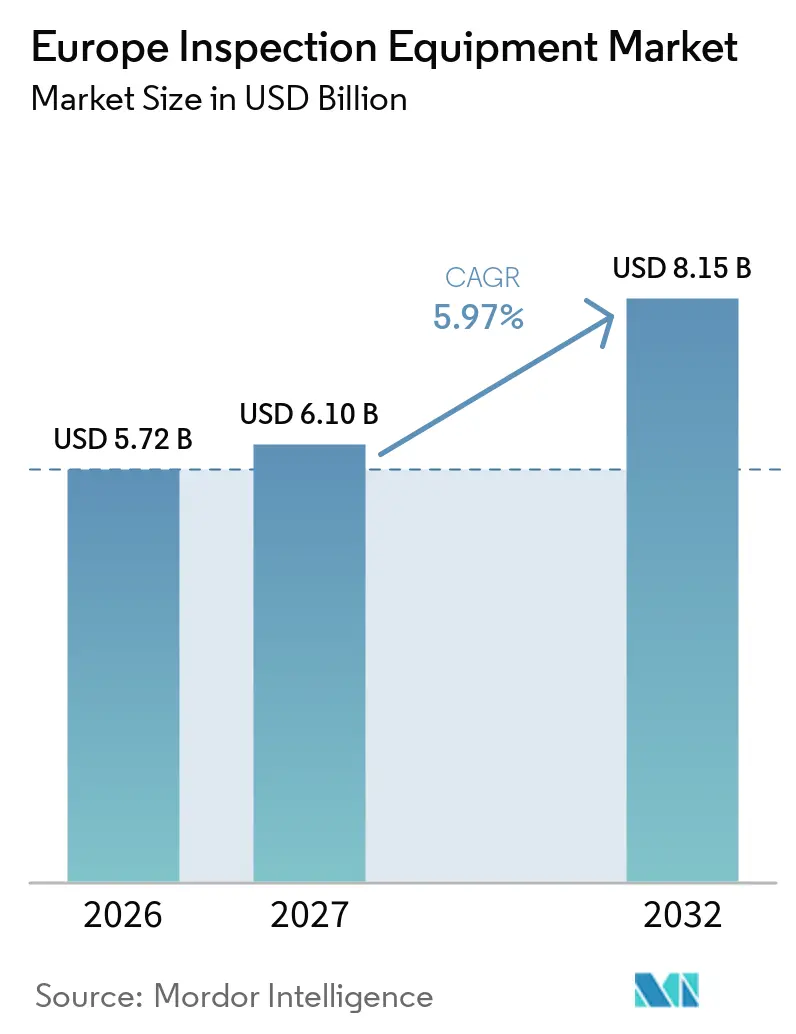
The Europe Inspection Equipment Market size is projected to expand from USD 5.72 billion in 2026 and USD 6.10 billion in 2027 to USD 8.15 billion by 2032, registering a CAGR of 5.97% between 2027 and 2032.
Demand is supported by persistent shortages of qualified manufacturing workers, stricter traceability rules, and capacity investment in semiconductors, batteries, aerospace, and renewable energy. Manufacturers are moving from sample-based checks toward continuous inspection across production lines, which raises equipment demand while replacing older systems. New compliance rules make verifiable inspection records more important for producers of regulated goods, especially where products must carry machine-readable information. Larger suppliers are responding through acquisitions, AI-enabled systems, and software-led delivery models, while smaller manufacturers face higher financing and integration barriers. The Europe inspection equipment market therefore offers its strongest opportunities where automation, audit readiness, and new industrial capacity overlap.
Key Report Takeaways
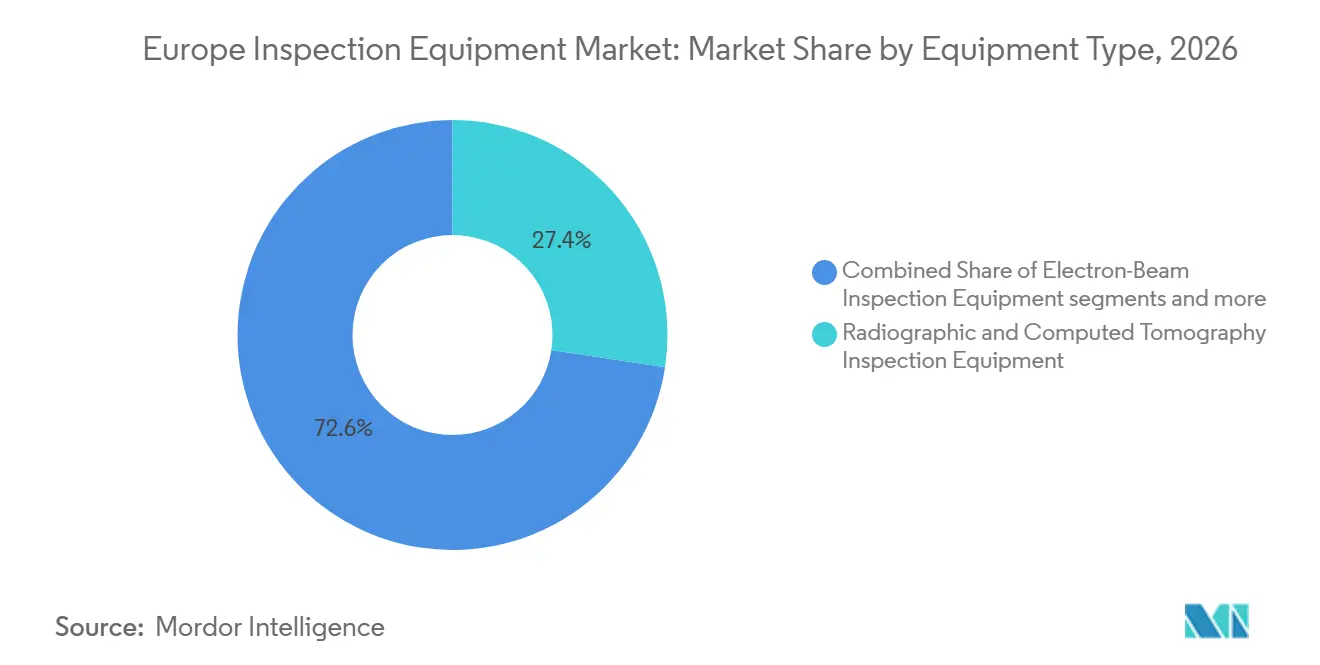
- By equipment type, radiographic and computed tomography inspection equipment held 27.4% of the Europe inspection equipment market share in 2026, while electron-beam inspection equipment is forecast to expand at an 8.4% CAGR through 2032.
- By primary inspection application, manufactured product and production-process inspection accounted for 53.3% of the Europe inspection equipment market size in 2026, while commodity, cargo, and trade inspection is projected to record the highest CAGR of 6.3% through 2032.
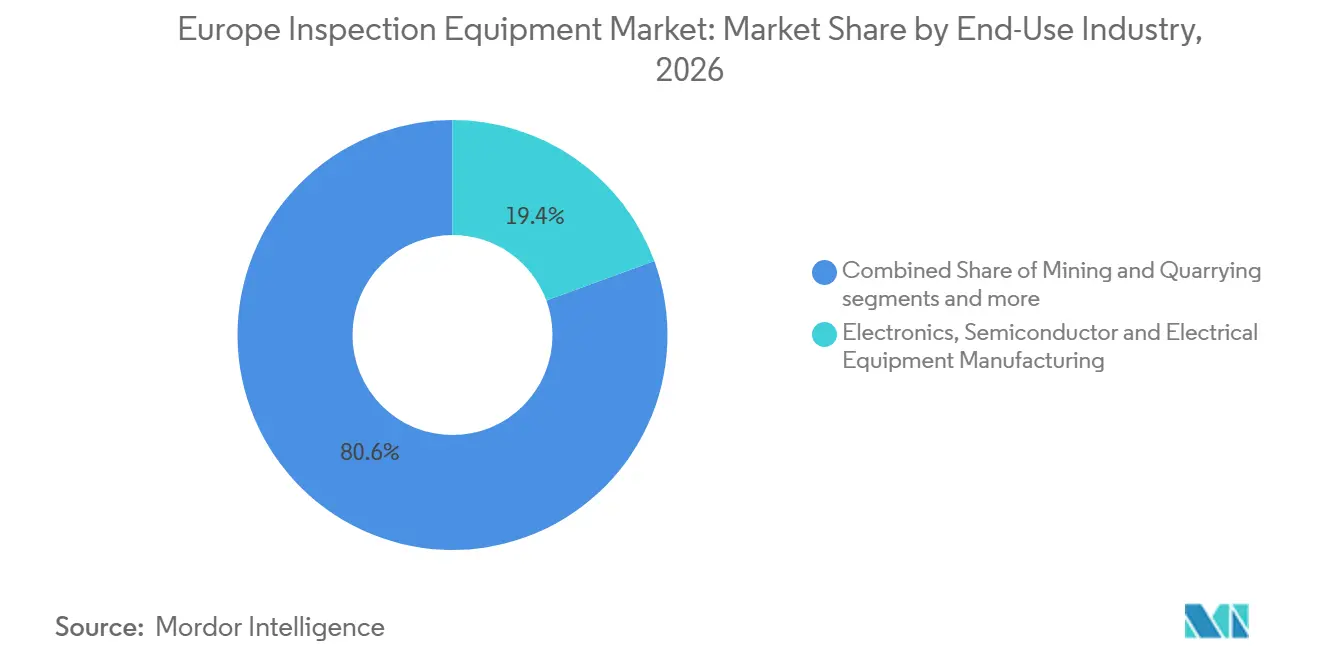
- By end-use industry, electronics, semiconductors, and electrical equipment manufacturing held a 19.4% revenue share in 2026 and is advancing at a 6.9% CAGR through 2032.
- By geography, Germany accounted for 24% of the Europe inspection equipment market share in 2026 and is projected to grow at a 6.8% CAGR through 2032.
Note: Market numbers in this report are based on Mordor Intelligence's proprietary estimation framework, which combines nine months of actuals with Q4 projections for base year 2026.
Market Trends and Insights
Drivers Impact Analysis of Europe Inspection Equipment Market*
| Driver | (~) % Impact on CAGR Forecast | Geographic Relevance | Impact Timeline |
|---|---|---|---|
| Automation of Quality Inspection Amid European Manufacturing Skills Shortages | +2.1% | Pan-European, acute in Germany, France, Italy, Poland | Short term (≤ 2 years) |
| Zero-Defect and Traceability Requirements in Regulated Production | +1.6% | EU-wide, strongest in Germany, Netherlands, Nordics | Medium term (2-4 years) |
| Expansion of Semiconductor, Battery, Aerospace, and Renewable-Energy Manufacturing | +1.3% | Germany, France, Spain, Poland, Netherlands | Long term (≥ 4 years) |
| Shift to Inline, AI-Enabled, Multimodal Inspection | +0.9% | Germany, France, Netherlands, United Kingdom | Medium term (2-4 years) |
| Inspection Intensity from Aging Infrastructure and Asset-Life Extension | +0.6% | Germany, United Kingdom, France, Italy, Netherlands | Short term (≤ 2 years) |
| Edge-AI Weld-Seam Inspection for High-Mix Production Lines | +0.4% | Germany, Northern Italy, Czech Republic | Medium term (2-4 years) |
| Source: Mordor Intelligence | |||
Automation of Quality Inspection Amid European Manufacturing Skills Shortages
The Europe inspection equipment market is benefiting from the difficulty of maintaining manual inspection at the scale planned for European manufacturing. Advanced manufacturing employs more than 30 million workers in the European Union, while 70% of employers report difficulty finding qualified technical talent.[1] A workforce with 25.3% of workers aged 55 or above also faces an estimated loss of 3.8 million workers by 2033. Digital occupations offer better pay in many cases, so training alone does not resolve the shortage of skilled inspection staff. Automated optical and metrology systems reduce dependence on specialist operators, while Hexagon positions its VISIUS optical CMM as requiring limited training in France, Italy, and the United Kingdom. This operating need supports continued investment across factories that must preserve output with smaller technical teams.
Zero-Defect and Traceability Requirements in Regulated Production
The Europe inspection equipment market is also being shaped by rules that make traceability a legal requirement rather than only a quality practice. The Digital Product Passport under Regulation (EU) 2024/1781 requires machine-readable information for batteries, electronics, and textiles from 2027, with wider coverage of goods entering the EU market by 2030.[2] CWA 18230 sets out five maturity levels for zero-defect manufacturing and identifies autonomous quality management, inline inspection, and end-to-end traceability as core elements of its higher levels. The Product Liability Directive, effective from December 2026, extends liability to software-embedded products and AI systems.[3] Manufacturers need reliable records that show how products were inspected and how defects were handled, making inspection data important for compliance, recalls, and customer assurance. This change widens the installed base for equipment that can capture, retain, and connect inspection results with production records.
Expansion of Semiconductor, Battery, Aerospace, and Renewable-Energy Manufacturing
Investment in strategic manufacturing is providing a durable demand base for the Europe inspection equipment market. The European Chips Act has catalyzed EUR 69 billion (USD 81.2 billion) in public and private investment by October 2025. ASML began construction of a second Brainport campus in September 2026, while the NanoIC pilot line in Leuven opened with EUR 2.5 billion (USD 2.9 billion) in investment. Battery manufacturing is expanding at the same time, including Verkor’s 16 GWh Dunkerque facility and the EUR 4.1 billion (USD 4.8 billion) CATL-Stellantis plant in Zaragoza. These facilities require continuous checks of parts, cells, assemblies, and production processes, while aerospace composites, turbine components, and renewable-energy assets add demand for ultrasonic, phased-array, and CT systems. The projects create demand linked to new production capacity rather than routine equipment replacement.
Shift to Inline, AI-Enabled, Multimodal Inspection
Audi deployed an edge-AI weld-spot system at Neckarsulm during the 2025 production cycle, inspecting 1.5 million weld points per shift compared with 5,000 manual ultrasound checks previously. The system was estimated to avoid USD 2.1 million in quarterly rework costs, and Volkswagen Group is extending the approach to Audi Brussels, VW Emden, and Audi Ingolstadt. Cognex launched the In-Sight 3900 in May 2026 with 25-megapixel resolution and processing at 4 times the prior generation’s speed. SICK released its Nova platform in August 2026, combining deep learning with 3D height data for configurable defect detection. These systems improve inspection coverage and shorten the feedback loop between defect detection and corrective action. The Europe inspection equipment market is gaining from applications where component-level savings can justify broader deployment across supplier networks.
Restraints Impact Analysis of Europe Inspection Equipment Market*
| Restraint | (~) % Impact on CAGR Forecast | Geographic Relevance | Impact Timeline |
|---|---|---|---|
| High Capital Cost and Integration Complexity | -1.4% | Pan-European, most acute for SMEs in Italy, Spain, Eastern Europe | Medium term (2-4 years) |
| Shortage of Certified NDT, Metrology, and Vision Specialists | -0.8% | Pan-European, acute in France, Netherlands, Czech Republic, Romania | Short term (≤ 2 years) |
| Fragmented Standards, Validation, and Cross-Border Acceptance | -0.5% | EU-wide, exacerbated by United Kingdom post-Brexit divergence | Medium term (2-4 years) |
| Insufficient Defect Data for High-Mix, Low-Volume AI Inspection | -0.3% | Germany, Northern Italy, Central and Eastern Europe | Long term (≥ 4 years) |
| Source: Mordor Intelligence | |||
High Capital Cost and Integration Complexity
Capital cost and integration work remain a material restraint for the Europe inspection equipment market, especially among smaller manufacturers. Inspection projects require spending on hardware, calibration, systems engineering, software validation, and links with manufacturing execution and enterprise resource planning systems. SMEs account for 99% of EU enterprises and generate 53% of industrial value added, making their adoption pace important to the regional outlook. Industrial CT and electron-beam systems can cost EUR 250,000 (USD 294,078) to EUR 2 million (USD 2.4 million) before integration. The Net-Zero Industry Act established EUR 20 billion (USD 23.5 billion) in state-aid corridors for net-zero manufacturing, which reflects the scale of investment needed for strategic industrial projects. This can widen the technology gap in Spain, Italy, Poland, and Romania, where smaller suppliers have less capacity to absorb capital costs.
Shortage of Certified NDT, Metrology, and Vision Specialists
The shortage of certified specialists limits the pace at which advanced systems can be installed and used across the Europe inspection equipment market. The European Labour Authority identified non-destructive testing specialists as a shortage occupation in 4 of the 8 European countries that assessed the role and forecasts 705,000 new openings through 2035 at a European level. France, the Netherlands, the Czech Republic, and Romania are among the countries facing this shortage. ISO 9712 requires at least 5 years of experience for Level III certification, which slows the expansion of the qualified workforce. Buyers can purchase equipment but may not be able to commission, operate, or validate it to the required standard. The European Parliament has raised the issue of cross-border recognition of technical inspection qualifications.
*Our forecasts treat driver/restraint impacts as directional, not additive. The impact forecasts reflect baseline growth, mix effects, and variable interactions.
Europe Inspection Equipment Market Segment Analysis
By Equipment Type:
CT Holds the Largest Share While Electron-Beam Systems Grow FastestRadiographic and computed tomography inspection equipment held 27.4% of the Europe inspection equipment market share in 2026. Its position reflects its use in non-destructive verification of complex castings, weld assemblies, and additive-manufactured components. Automotive, aerospace, and energy producers use CT systems to assess internal structures beyond the reach of surface inspection. Battery manufacturers also use industrial CT to assess internal voids, electrode alignment, and electrolyte fill. Optical and visual inspection equipment ranks second by share because it is deployed in high volumes across printed circuit board, semiconductor packaging, and consumer electronics production.
Dimensional and geometric inspection equipment, including coordinate measuring machines and laser scanning systems, has steady aerospace and precision-engineering demand. Electron-beam inspection equipment is projected to register an 8.4% CAGR from 2027 to 2032, making it the fastest-growing equipment type within the Europe inspection equipment market. The expansion is tied to sub-7 nm fabrication ramp-ups at European foundries supported by the Chips Act. KLA expects process diagnostics and control growth of more than 50% in 2026, with advanced packaging revenue approaching USD 1 billion. Phased-array ultrasonic systems support nuclear, oil and gas, and pipeline inspection, while other specialized systems serve food, pharmaceutical, and chemical compliance.

By Primary Inspection Application:
Production-Process Inspection Leads While Trade Inspection AcceleratesManufactured product and production-process inspection accounted for 53.3% of the Europe inspection equipment market size in 2026. This segment leads because it covers inline quality requirements across automotive, electronics, and industrial manufacturing. It ranges from automated optical inspection on surface-mount technology lines to full assembly verification in automotive body shops. Its broad application makes demand less dependent on any single customer industry. Civil infrastructure inspection and fixed-asset inspection form an important secondary group supported by programs that extend the operating life of bridges, plants, and other long-lived assets.
Commodity, cargo, and trade inspection is forecast to grow at a 6.3% CAGR through 2032. The segment benefits from Digital Product Passport implementation and stricter product-safety controls under Regulation (EU) 2024/1781. X-ray cargo screening, electromagnetic detection, and RFID-linked inspection systems are central technologies in this area. Building and property inspection is expanding alongside energy-performance audit requirements, while vehicle inspection benefits from European roadworthiness requirements. Inspection activity per asset is increasing even where asset numbers change little.
By End-Use Industry:
Electronics and Semiconductor Manufacturing Leads in Scale and GrowthElectronics, semiconductor, and electrical equipment manufacturing held 19.4% of 2026 revenue and is projected to grow at a 6.9% CAGR through 2032. This combination makes it the largest and fastest-growing end-use area in the Europe inspection equipment market. The result reflects new semiconductor capacity and a rising need for process control at smaller technology nodes. The AUDIRA project is developing fully automated subsurface metrology for semiconductor fabs at technology readiness level 8. The project addresses defect types that current optical tools cannot detect.
Automotive and automotive component manufacturing is the second-largest end-use industry, with battery module and pack inspection adding to existing powertrain inspection. Aerospace and defense require phased-array ultrasonic, digital radiography, and CT systems. Oil and gas, power generation, renewable energy, and utilities are increasing inspection intensity through asset-life extension. Healthcare, pharmaceuticals, and life sciences use automated vision and checkweighing equipment for serialization and product control. Construction, mining, agriculture, logistics, and government border agencies provide a diverse set of additional opportunities.
Geography Analysis
Germany Inspection Equipment Market
Germany accounted for 24% of the Europe inspection equipment market share in 2026 and is forecast to grow at a 6.8% CAGR through 2032. GlobalFoundries announced a EUR 1.1 billion (USD 1.3 billion) expansion of its Dresden facility in October 2025, targeting output of more than 1 million wafers per year by 2028. Fraunhofer IZFP presented results from the EUR 5.6 million (USD 6.6 million) ImaB-Edge project in October 2025, which applied intelligent multimodal edge-AI monitoring to bridges. Germany’s DIN 1076 bridge inspection standard and the EUR 3.8 million (USD 4.5 million) IDA-KI consortium support recurring inspection spending.
Western Europe Inspection Equipment Market
The United Kingdom, France, the Netherlands, and Italy make up the next demand cluster in the Europe inspection equipment market. More than half of England’s road bridges are expected to be older than 50 years by 2030, supporting demand for non-destructive testing platforms. KLA opened a USD 138 million research and manufacturing facility in Newport, Wales, in May 2025. France gains from Verkor’s 16 GWh Dunkerque gigafactory and semiconductor fabrication activity. The Netherlands is anchored by the ecosystem in Eindhoven, where the second Brainport campus reinforces semiconductor inspection supply-chain demand.
Southern and Eastern Europe Inspection Equipment Market
Spain, Poland, Turkey, and southern and eastern Italian regions form a growing secondary tier. Spain’s EUR 4.1 billion (USD 4.8 billion) CATL-Stellantis LFP plant in Zaragoza began construction in November 2025, while PowerCo is advancing a facility in Valencia. Poland’s LG Energy Solution complex in Wrocław supports ultrasonic and CT demand in battery and automotive assembly. Turkey adds demand for dimensional metrology and surface inspection in automotive and metals export manufacturing. Italy’s high-mix precision-machining and food-processing activities sustain demand for machine vision, checkweighing, and X-ray systems.
Competitive Landscape
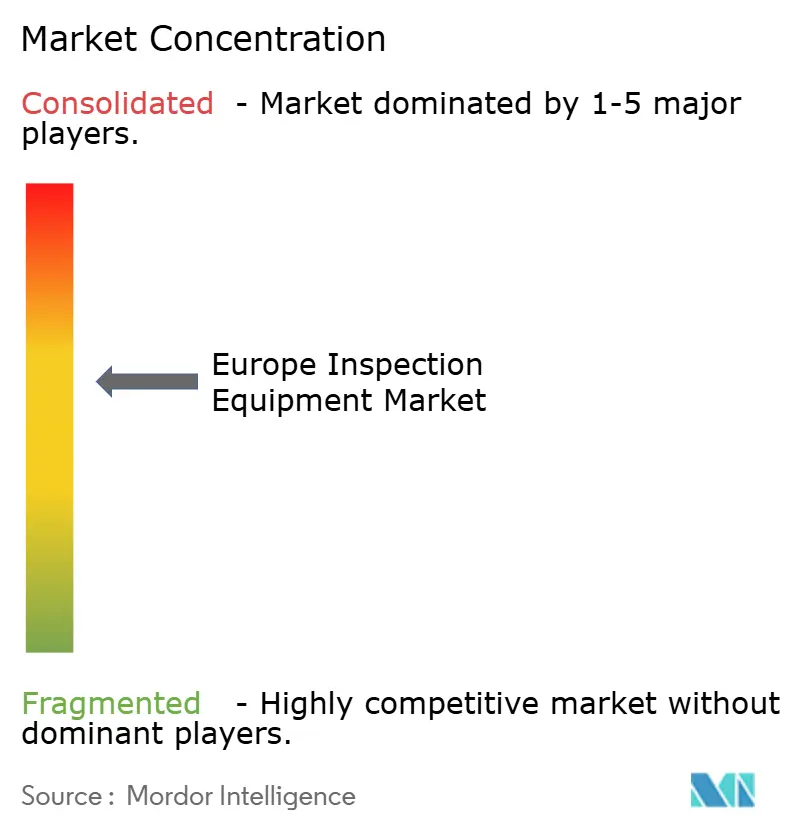
The Europe inspection equipment market exhibits a medium level of market concentration. Hexagon AB, Carl Zeiss AG, Cognex Corporation, and KEYENCE CORPORATION compete across precision metrology, machine vision, and optical inspection. Renishaw plc, Basler AG, Viscom SE, SESOTEC GmbH, Comet Yxlon GmbH, and ISRA VISION GmbH hold specialized positions in gauging, imaging, X-ray, CT, and surface inspection, while ultrasonic, electron-beam, and radiographic imaging remain more fragmented. Suppliers compete on accuracy, cycle time, data connectivity, application support, and the ability to integrate inspection methods.
Hexagon signed a definitive agreement in April 2026 to acquire Waygate Technologies from Baker Hughes for USD 1.45 billion in cash. Subject to regulatory clearance, the transaction would combine machine vision, laser scanning, CT, ultrasonic, and radiographic capabilities in one offering. Wabtec completed its acquisition of Evident’s Inspection Technologies division in July 2025, adding non-destructive testing, remote visual inspection, and analytical instruments to its Digital Intelligence business. Carl Zeiss acquired Pi Imaging Technology in December 2025, bringing single-photon avalanche diode sensor capabilities into its imaging and industrial inspection portfolio. These moves broaden technical coverage and make product interoperability more important for customers.
Opportunity remains in AI-validated inspection for high-mix, low-volume SMEs that cannot fund bespoke training datasets. Inspection-as-a-service models can help customers spread capital costs across operating periods. Cognex develops software-led delivery through OneVision, while SICK’s Nova platform supports configurable inspection across applications. ASML’s High-NA EUV deployment at IMEC’s NanoIC pilot line raises the required intensity of process control for semiconductor suppliers. ISO 9712 certification needs and the forthcoming Digital Product Passport support procurement preference for systems that generate standardized, audit-ready data.
Europe Inspection Equipment Industry Leaders
-
Hexagon AB
-
Carl Zeiss AG
-
Cognex Corporation
-
KEYENCE CORPORATION
-
Baker Hughes Company
- *Disclaimer: Major Players sorted in no particular order
Europe Inspection Equipment Market Companies Covered in this Report
- Hexagon AB
- Carl Zeiss AG
- Cognex Corporation
- KEYENCE CORPORATION
- Baker Hughes Company
- Waygate Technologies GmbH
- Nikon Corporation
- Evident Corporation
- Renishaw plc
- Mettler-Toledo International Inc.
- Basler AG
- SICK AG
- OMRON Corporation
- Teledyne Technologies Incorporated
- FARO Technologies, Inc.
- KLA Corporation
- ASML Holding N.V.
- Applied Materials, Inc.
- Antares Vision S.p.A.
- Syntegon Technology GmbH
- Viscom SE
- MINEBEA INTEC GmbH
- SESOTEC GmbH
- SGS SA
- Intertek Group plc
Recent Industry Developments in Europe Inspection Equipment Market
- September 2026: ASML broke ground on a second major industrial campus (BIC North) in the Brainport region, Netherlands, targeting space for up to 20,000 workers with the first phase completing by 2029.
- September 2026: Hexagon released the next-generation OPTIV S 4.4.3 Optical CMM at IMTS with AI-assisted measurement technologies, with additional AI-powered capabilities and expanded sizes planned through 2027.
- August 2026: SICK AG launched its AI-powered 3D industrial inspection platform via the Nova foundation software, combining deep learning with 3D height data analysis for defect detection across automotive, battery, logistics, and electronics sectors.
- August 2026: FARO CREAFORM launched MetraSCAN BLACK2, featuring 46 blue laser lines, 2.8 million measurements per second, and 56% faster data acquisition than its predecessor.
Europe Inspection Equipment Market Report Scope
The Europe Inspection Equipment Market Report is segmented by Equipment Type (Optical and Visual Inspection Equipment, and More), by Primary Inspection Application (Building and Property Inspection, Civil Infrastructure Inspection, and More), by End-Use Industry (Oil and Gas, Including Refining and Petrochemicals, and More), and by Geography (Germany, France, and More). The Market Forecasts are Provided in Terms of Value (USD).
Segmentation Overview
| Optical and Visual Inspection Equipment | Machine Vision and Automated Optical Inspection Systems |
| Borescopes and Remote Visual Inspection Systems | |
| Other Optical and Surface Inspection Equipment | |
| Dimensional and Geometric Inspection Equipment | Coordinate Measuring Machines |
| Laser Scanning and 3D Measurement Systems | |
| Other Dimensional and Surface Profiling Inspection Systems | |
| Ultrasonic and Acoustic Inspection Equipment | Conventional Ultrasonic Inspection Systems |
| Phased-Array and Advanced Ultrasonic Inspection Systems | |
| Acoustic Emission and Acoustic Imaging Systems | |
| Radiographic and Computed Tomography Inspection Equipment | Conventional and Digital Radiography Systems |
| Industrial Computed Tomography Systems | |
| Cargo and Consignment X-Ray Inspection Systems | |
| Electromagnetic and Magnetic Inspection Equipment | Eddy-Current Inspection Systems |
| Magnetic Particle and Magnetic Flux Leakage Inspection Systems | |
| Ground-Penetrating Radar and Other Electromagnetic Inspection Systems | |
| Thermal and Infrared Inspection Equipment | Handheld Thermal Imaging Systems |
| Fixed and Integrated Thermal Inspection Systems | |
| Electron-Beam Inspection Equipment | Electron-Beam Defect Inspection and Review Systems |
| Other Charged-Particle Inspection Systems | |
| Other Specialized Inspection Equipment | Leak and Pressure-Integrity Inspection Systems |
| Automated Checkweighing and Other Physical Conformity Inspection Systems | |
| Other Dedicated Inspection Instruments and Systems |
| Building and Property Inspection |
| Civil Infrastructure Inspection |
| Industrial Facilities and Fixed Asset Inspection |
| Manufactured Product and Production-Process Inspection |
| Transportation Vehicle and Mobile Asset Inspection |
| Commodity, Cargo and Trade Inspection |
| Other Operational Site and Process Inspection |
| Oil and Gas, Including Refining and Petrochemicals |
| Power Generation, Renewable Energy and Utilities |
| Automotive and Automotive Component Manufacturing |
| Aerospace and Defense Manufacturing |
| Electronics, Semiconductor and Electrical Equipment Manufacturing |
| Other Manufacturing and Industrial Processing |
| Construction, Real Estate and Civil Infrastructure |
| Transportation and Logistics Operations |
| Mining and Quarrying |
| Agriculture, Food and Beverage |
| Healthcare, Pharmaceuticals and Life Sciences |
| Wholesale, Retail and Commodity Trading |
| Government, Regulatory and Border Inspection Agencies |
| Other End Users |
| Germany |
| United Kingdom |
| France |
| Italy |
| Spain |
| Netherlands |
| Poland |
| Turkey |
| Rest of Europe |
| By Equipment Type | Optical and Visual Inspection Equipment | Machine Vision and Automated Optical Inspection Systems |
| Borescopes and Remote Visual Inspection Systems | ||
| Other Optical and Surface Inspection Equipment | ||
| Dimensional and Geometric Inspection Equipment | Coordinate Measuring Machines | |
| Laser Scanning and 3D Measurement Systems | ||
| Other Dimensional and Surface Profiling Inspection Systems | ||
| Ultrasonic and Acoustic Inspection Equipment | Conventional Ultrasonic Inspection Systems | |
| Phased-Array and Advanced Ultrasonic Inspection Systems | ||
| Acoustic Emission and Acoustic Imaging Systems | ||
| Radiographic and Computed Tomography Inspection Equipment | Conventional and Digital Radiography Systems | |
| Industrial Computed Tomography Systems | ||
| Cargo and Consignment X-Ray Inspection Systems | ||
| Electromagnetic and Magnetic Inspection Equipment | Eddy-Current Inspection Systems | |
| Magnetic Particle and Magnetic Flux Leakage Inspection Systems | ||
| Ground-Penetrating Radar and Other Electromagnetic Inspection Systems | ||
| Thermal and Infrared Inspection Equipment | Handheld Thermal Imaging Systems | |
| Fixed and Integrated Thermal Inspection Systems | ||
| Electron-Beam Inspection Equipment | Electron-Beam Defect Inspection and Review Systems | |
| Other Charged-Particle Inspection Systems | ||
| Other Specialized Inspection Equipment | Leak and Pressure-Integrity Inspection Systems | |
| Automated Checkweighing and Other Physical Conformity Inspection Systems | ||
| Other Dedicated Inspection Instruments and Systems | ||
| By Primary Inspection Application | Building and Property Inspection | |
| Civil Infrastructure Inspection | ||
| Industrial Facilities and Fixed Asset Inspection | ||
| Manufactured Product and Production-Process Inspection | ||
| Transportation Vehicle and Mobile Asset Inspection | ||
| Commodity, Cargo and Trade Inspection | ||
| Other Operational Site and Process Inspection | ||
| By End-Use Industry | Oil and Gas, Including Refining and Petrochemicals | |
| Power Generation, Renewable Energy and Utilities | ||
| Automotive and Automotive Component Manufacturing | ||
| Aerospace and Defense Manufacturing | ||
| Electronics, Semiconductor and Electrical Equipment Manufacturing | ||
| Other Manufacturing and Industrial Processing | ||
| Construction, Real Estate and Civil Infrastructure | ||
| Transportation and Logistics Operations | ||
| Mining and Quarrying | ||
| Agriculture, Food and Beverage | ||
| Healthcare, Pharmaceuticals and Life Sciences | ||
| Wholesale, Retail and Commodity Trading | ||
| Government, Regulatory and Border Inspection Agencies | ||
| Other End Users | ||
| By Geography | Germany | |
| United Kingdom | ||
| France | ||
| Italy | ||
| Spain | ||
| Netherlands | ||
| Poland | ||
| Turkey | ||
| Rest of Europe | ||
Key Questions Answered in the Report
What is the projected value of the Europe inspection equipment market by 2032?
The Europe inspection equipment market is forecast to reach USD 8.15 billion by 2032, from USD 6.06 billion in 2027, at a 5.97% CAGR.
Which inspection technology holds the largest share in Europe?
Radiographic and computed tomography inspection equipment leads with a 27.4% share in 2026 because it supports non-destructive examination of complex components.
Which equipment type is expected to grow the fastest through 2032?
Electron-beam inspection equipment is projected to grow at an 8.4% CAGR as European fabs expand advanced semiconductor production.
Why are manufacturers investing in inline inspection systems?
Inline systems raise coverage, provide traceable records, and reduce dependence on scarce inspection specialists.
Which application accounts for the most inspection equipment demand?
Manufactured product and production-process inspection accounts for 53.3% of 2026 revenue because it spans automotive, electronics, and industrial production lines.
Which country offers the largest opportunity in Europe?
Germany holds a 24% share in 2026 and is projected to grow at a 6.8% CAGR through 2032, supported by semiconductor, automotive, and infrastructure projects.