
Europe IC Design Services Market Size and Share
Market Overview
| Study Period | 2021 - 2032 |
|---|---|
| Forecast Data Period | 2027 - 2032 |
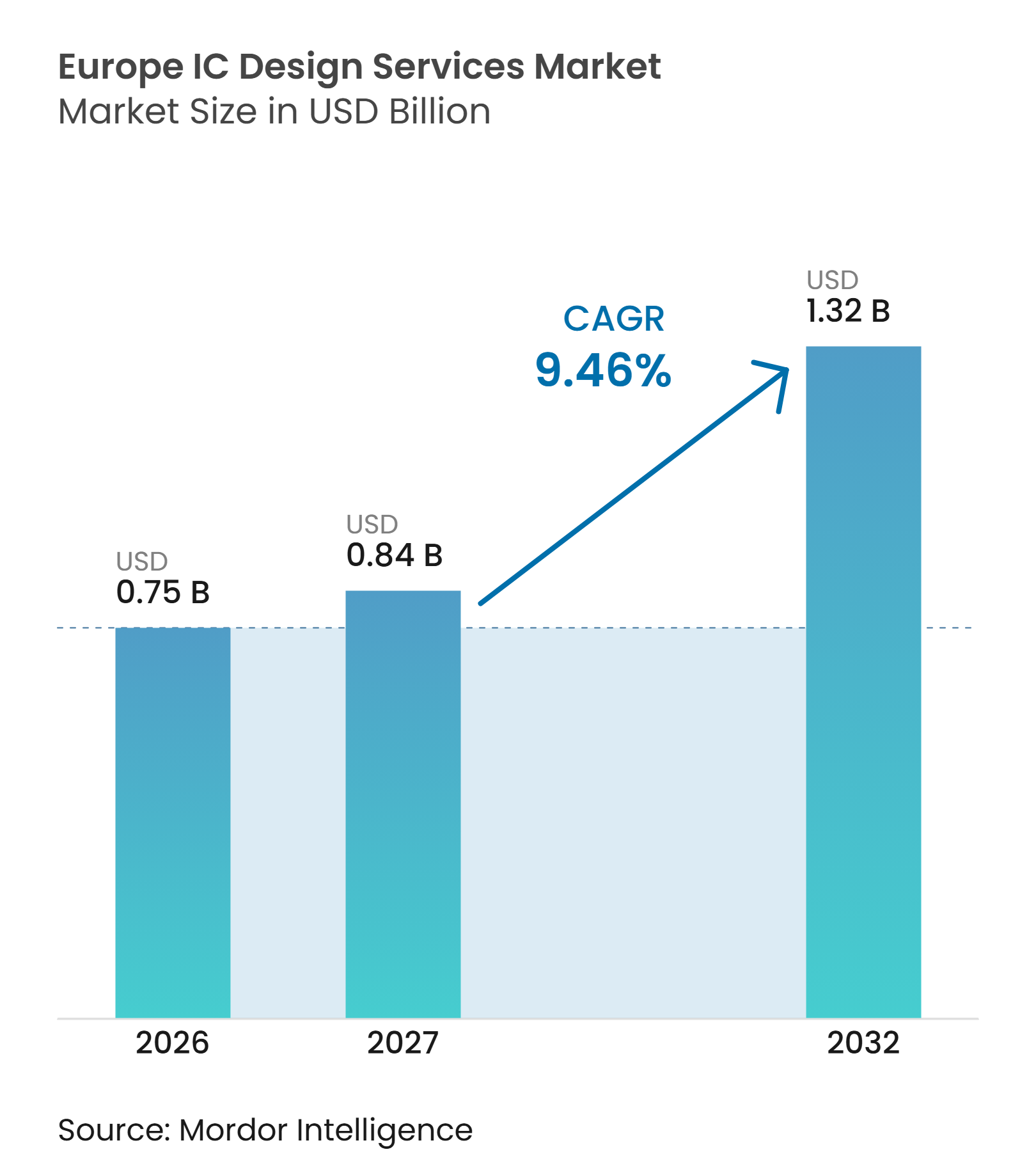
| Base Year Market Size (2026) | USD 0.75 Billion |
| Market Size (2027) | USD 0.84 Billion |
| Market Size (2032) | USD 1.32 Billion |
| Growth Rate (2027 - 2032) | 9.46 % |
| Market Concentration | Medium |
Major Players *Disclaimer: Major Players sorted in no particular order Image © Mordor Intelligence. Reuse requires attribution under CC BY 4.0. | |
Europe IC Design Services Market Analysis by Mordor Intelligence
The Europe IC design services market size was valued at USD 0.75 billion in 2026 and is estimated to expand from USD 0.84 billion in 2027 to reach USD 1.32 billion by 2032, at a CAGR of 9.46% during the forecast period (2027-2032). Public semiconductor programs are extending demand beyond fabrication capacity toward chip architecture, verification, and implementation work. Automotive electronics remains a dependable source of projects because vehicle programs require lengthy qualification cycles and specialized safety expertise. Demand from AI and high-performance computing is also shifting work toward advanced-node implementation and packaging-aware design. Providers that can support secure design workflows in line with European data rules may have a stronger position with defense, medical, and regulated infrastructure clients. The Europe IC design services market also faces a capacity constraint because experienced system architects, analog engineers, and verification specialists remain scarce.
Key Report Takeaways
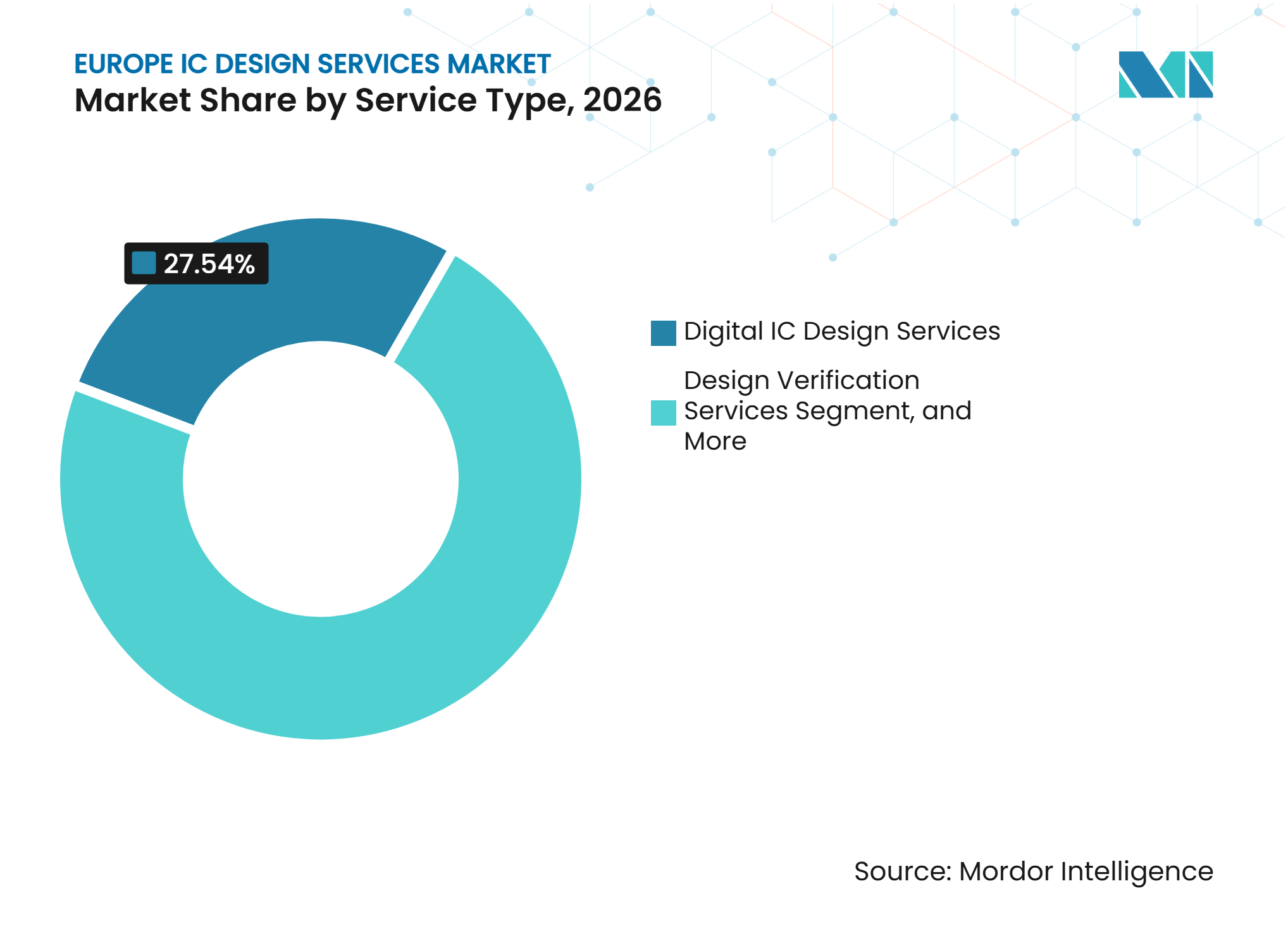
- By service type, Digital IC Design Services held 27.54% of the Europe IC design services market share in 2026, while Design Verification Services is projected to expand at a 10.83% CAGR through 2032.
- By end-user application, Automotive accounted for 31.21% of the Europe IC design services market size in 2026, while AI, HPC, and Data Centers are projected to record a 10.79% CAGR through 2032.
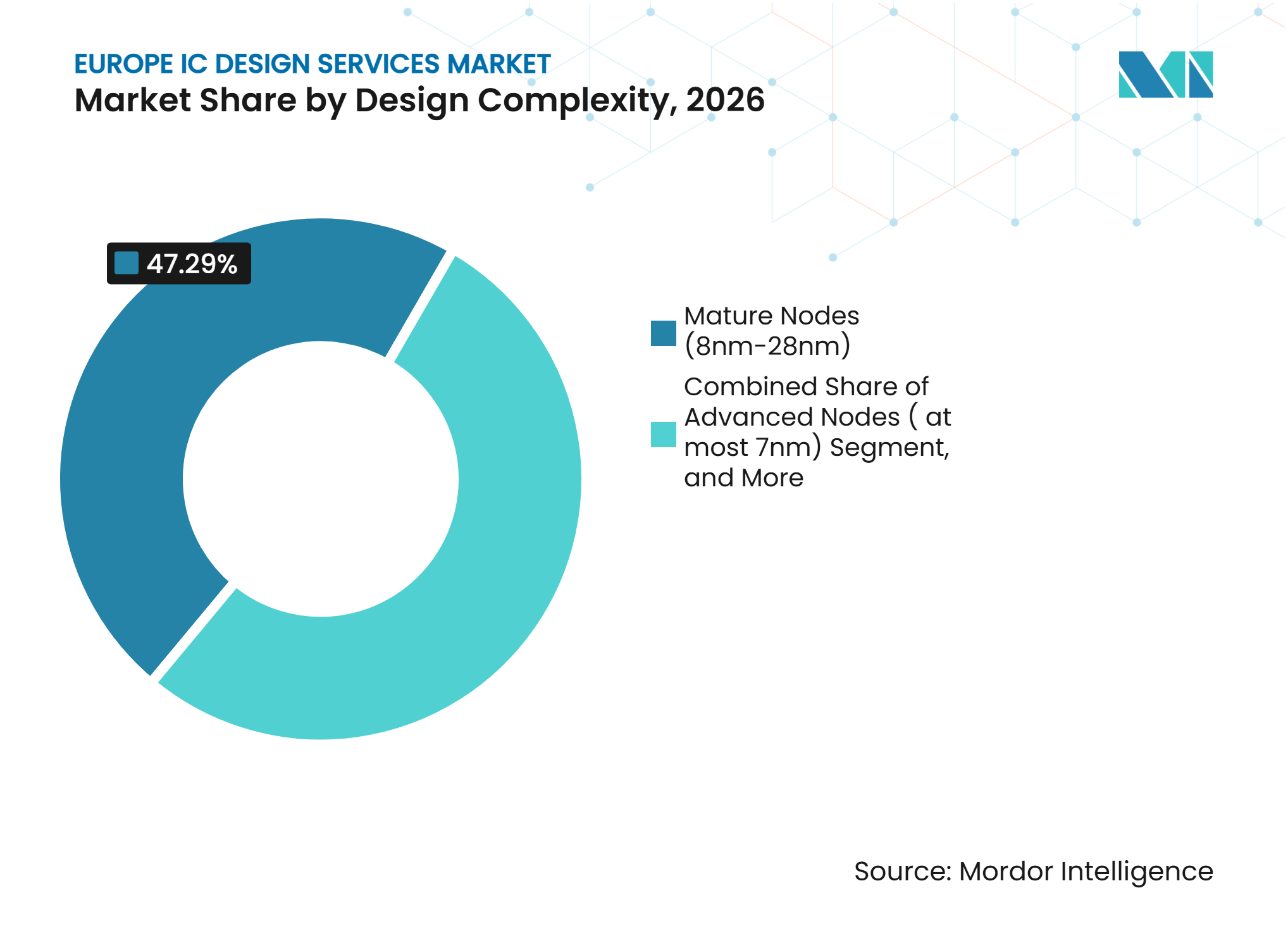
- By design complexity, Mature Nodes (8nm-28nm) held a 47.29% share in 2026, while Advanced Nodes (≤7nm) are projected to expand at a 10.04% CAGR through 2032.
- By geography, Germany held a 31.97% share in 2026, while the United Kingdom is projected to record a 10.39% CAGR through 2032.
Note: Market numbers in this report are based on Mordor Intelligence's proprietary estimation framework, which combines nine months of actuals with Q4 projections for base year 2026.
Market Trends and Insights
Drivers Impact Analysis of Europe IC Design Services Market*
| Driver | (~) % Impact on CAGR Forecast | Geographic Relevance | Impact Timeline |
|---|---|---|---|
| European Chips Act and National Semiconductor Investment Programs | +3.5% | EU-wide, Germany, France, and Italy lead investment absorption | Long term (≥ 4 years) |
| EV, ADAS, and Vehicle Electrification Adoption | +2.3% | Germany, France, Italy, and United Kingdom, aligned with OEM and Tier-1 supplier bases | Medium term (2-4 years) |
| AI, HPC, and Edge Computing Adoption | +1.4% | United Kingdom, France, and the Netherlands, with spillover to Germany and Nordic countries | Medium term (2-4 years) |
| Strong Automotive Semiconductor Ecosystem | +0.8% | Germany and France, with early gains in Italy and Eastern Europe | Long term (≥ 4 years) |
| European Expertise in Power Semiconductors, RF, Sensors, and Mixed-Signal Technologies | +0.5% | Germany, the Netherlands, and Italy | Long term (≥ 4 years) |
| Semiconductor Industry and Research Collaboration | +0.2% | EU-wide, with Belgium, France, Germany, and the Netherlands as primary nodes | Long term (≥ 4 years) |
| Source: Mordor Intelligence | |||
European Chips Act and National Semiconductor Investment Programs
The European Chips Act is broadening support from manufacturing projects to the wider design value chain. The act has catalyzed EUR 69 billion (USD 74.5 billion) in public and private investment by October 2025. The proposed Chips Act 2.0 identifies advanced chip design and access to design platforms as strategic priorities, alongside investment in fabrication. Germany adopted its Microelectronics Strategy in October 2025 and identified stronger chip design capability as its highest-priority action area.[1] In July 2026, Germany pre-notified 14 projects under IPCEI AST with up to EUR 3.8 billion (USD 4.1 billion) in federal support for AI chips, chiplets, photonic integrated circuits, and sensors. The EU Chips Design Platform, coordinated by imec, gives startups and small firms access to EDA tools, IP libraries, and fabrication routes, which can increase demand for specialist external design work
EV, ADAS, and Vehicle Electrification Adoption
Vehicle electrification is increasing the number and complexity of semiconductor functions designed for each platform. Powertrain control, battery management, in-vehicle networking, and ADAS sensor fusion all require tailored silicon and rigorous validation. EnSilica operates in accordance with ISO 26262 functional safety requirements and secured 6 new ASIC development and supply agreements in FY2025. Chiplet-based ADAS designs can require separate logic, interconnect, packaging, and cross-die verification tasks. CISSOID and EDAG Group formed a partnership in May 2025 to develop silicon-carbide traction inverters for electric mobility. Automotive customers also favor suppliers that have completed AEC-Q qualification, which can support longer service relationships in the Europe IC design services market.
AI, HPC, and Edge Computing Adoption
AI, HPC, and Data Centers are projected to expand at a 10.79% CAGR through 2032 in the Europe IC design services market. European programs are moving from research activity toward chips that require production-ready implementation and verification. The EU-funded EUPILOT project completed tape-out milestones for its VEC and MLS processors, which were developed for HPC and AI use. ETH Zurich and the Technical University of Munich received completed 7nm AI chips in early 2026, supporting the local base of designers trained on advanced flows. GUC supported VSORA's Jotunn8 tape-out in 2025 using a 5nm process and 2.5D packaging with HBM3E interfaces. This model lets European startups retain responsibility for system architecture while specialist service houses complete physical implementation.
Strong Automotive Semiconductor Ecosystem
Germany's automotive electronics cluster provides a relatively stable base of project work for design service providers. More than 150 active fabless design houses and captive teams operate within the country's automotive electronics network, according to the research provided. The German Chips Competence Center connects local design teams with European pilot lines for advanced packaging, photonic integrated circuits, and FD-SOI infrastructure. GlobalFoundries announced EUR 1.1 billion (USD 1.19 billion) for its Dresden expansion, which is expected to exceed 1 million wafers annually by 2028. Closer access to fabrication can shorten iteration cycles between design teams and manufacturing partners. Automotive silicon programs typically span 7-10 years from initial engagement through production end-of-life, creating a more predictable demand profile than short consumer cycles.
Restraints Impact Analysis of Europe IC Design Services Market*
| Restraint | (~) % Impact on CAGR Forecast | Geographic Relevance | Impact Timeline |
|---|---|---|---|
| Dependence on Non-European EDA and Semiconductor IP Providers | -1.5% | EU-wide, with Germany and United Kingdom most exposed in advanced-node programs | Long term (≥ 4 years) |
| Shortage of Specialized Semiconductor Design Engineers | -1.0% | EU-wide, with France, Italy, and Germany most affected by analog and system architecture gaps | Medium term (2-4 years) |
| Limited Scale of European Fabless Semiconductor Companies | -0.8% | EU-wide | Long term (≥ 4 years) |
| Fragmented Policies, Limited Growth Financing, and High R&D Costs | -0.5% | EU-wide, especially cross-border SME programs | Short term (≤ 2 years) and medium term (2-4 years) |
| Source: Mordor Intelligence | |||
Dependence on Non-European EDA and Semiconductor IP Providers
Most advanced IC design activity in Europe depends on EDA tools from United States-headquartered vendors. VDE has identified this dependency as a strategic vulnerability and called for European action, including investment in open-source design flows. The risks include USD-denominated license costs, potential export-control disruptions, and restrictions associated with third-party IP blocks. The EU Chips Design Platform is arranging access for its participants, but production design flows still rely heavily on Synopsys, Cadence, and Siemens EDA. Cadence's sovereign EDA platform in Munich addresses data residency requirements through ISO 27001, ISO 27017, and SOC 2 Type II certifications. It does not remove the underlying dependence on external software and semiconductor IP suppliers.
Shortage of Specialized Semiconductor Design Engineers
The shortage of specialized engineers limits how quickly providers can add capacity for concurrent tape-out programs. The ECSA 2025 Skills Strategy identifies system architects and analog specialists as among the most difficult positions to fill in European microelectronics. The strategy expects more than 155,900 openings in the European semiconductor sector through 2030. It also states that 30% of the current workforce is expected to retire between 2024 and 2030. SEMI projects a European shortfall of more than 100,000 engineers by 2030, with design and verification roles strongly represented. The United Kingdom's projected 10,400-worker gap by 2030 shows that public investment can increase project demand faster than the talent pipeline can respond.[2]
*Our forecasts treat driver/restraint impacts as directional, not additive. The impact forecasts reflect baseline growth, mix effects, and variable interactions.
Europe IC Design Services Market Segment Analysis
By Service Type:
Digital Volume Leads While Verification Drives Future GrowthDigital IC Design Services accounted for 27.54% of the Europe IC design services market share in 2026. Its scale reflects the high volume of ASIC programs for automotive networking, industrial motor control, and connectivity functions. These programs require RTL design, synthesis, and digital implementation. Design Verification Services is projected to expand at a 10.83% CAGR from 2027 to 2032. More complex automotive and AI chips require a larger share of engineering time for verification. The higher cost of silicon re-spins makes specialist verification support more attractive than maintaining a large internal team for intermittent projects.
AI-assisted assertion generation and coverage-closure tools can shorten selected verification tasks. They do not eliminate the need for experienced engineers to validate accelerator logic, cache-coherence controllers, and multi-die interfaces. Analog IC Design Services and Analog Mixed-Signal IC Design Services remain important because Europe has established strengths in power semiconductors, RF, sensor, and industrial designs. Physical Design and Layout Services are linked more closely to 7nm and sub-7nm tape-out activity. IP Development and Design Support Services are also gaining relevance as firms seek reusable proprietary blocks rather than licensing every component. ICsense opened an electrical wafer-sort cleanroom capable of supporting ASIC supply exceeding 500 million units annually, connecting front-end design activity with production support.



By End-User Application:
Automotive Anchors Demand While AI Accelerates GainsAutomotive accounted for 31.21% of the Europe IC design services market in 2026. EV powertrain silicon, ADAS sensor fusion, in-vehicle networking ASICs, and safety components support demand across lengthy vehicle development cycles. AI, HPC, and Data Centers are projected to record a 10.79% CAGR through 2032. European startups and sovereign-computing programs need custom accelerator and inference devices. The 5nm Jotunn8 program illustrates the role of specialist design partners in converting a local architecture into an advanced-node chip. Consumer electronics has a smaller regional role, although wearable medical devices and industrial Internet of Things nodes can create focused demand for compact, low-power custom silicon.
Industrial, defense and aerospace, medical and healthcare, and telecom and networking applications diversify the client base. Industrial customers use tailored chips for motion control, sensor integration, and factory edge computing where power use and latency matter. ICsense cites its ISO 13485 medical design flow as a contributor to demand for specialized analog and mixed-signal medical ASICs. Defense and aerospace applications are renewing interest in radiation-hardened designs. The EU-funded PUMA program is developing 7nm FinFET radiation-hardened ICs for European space-grade microelectronics. These applications have demanding qualification requirements, which can favor suppliers with proven sector knowledge.
By Design Complexity:
Mature Nodes Hold Structural Volume as Advanced Nodes ScaleMature Nodes (8nm-28nm) led with 47.29% of the Europe IC design services market share in 2026. Europe has a deep installed base in power management, RF, mixed-signal, and automotive-grade silicon that uses these process windows. Customer-specific IP libraries and long qualification histories make the segment difficult for new providers to replicate. Advanced Nodes (≤7nm) are projected to record a 10.04% CAGR from 2027 to 2032. AI-chip startups are accessing leading-edge processes for inference accelerators and high-performance computing devices. European research programs are also expanding familiarity with advanced-node workflows.
The completed 7nm AI chips from ETH Zurich and the Technical University of Munich show the development of advanced design capability in European academic teams. NanoIC released an A14 logic pathfinding process design kit and an eDRAM PDK in February 2026, providing teams with an early design environment for nodes beyond 2nm. Legacy Nodes (>28nm) remain useful in cost-sensitive industrial, automotive sensor, and medical applications. Average non-recurring engineering fees for designs at 7nm and below range from EUR 15 million to EUR 50 million (USD 16.2 million to USD 54 million) per tape-out. That cost is encouraging chiplet architectures and multi-project wafer access to reduce client exposure.

Geography Analysis
Germany
Germany held 31.97% of the Europe IC design services market share in 2026. Its position rests on an integrated base of automotive, industrial, and embedded semiconductor activity. The national Microelectronics Strategy made expanded chip-design capability its top action area in October 2025. In March 2026, Germany selected 38 IPCEI AST projects across 12 federal states in areas including photonic integrated circuits, AI chips, power electronics, and sensors. The G3C improves access to pilot-line infrastructure for mid-sized design houses. GlobalFoundries' planned Dresden expansion should improve local links between design and fabrication partners by 2028. Germany's regulatory influence comes through Chips JU rules that shape access to funded pilot lines and design platforms.
United Kingdom
The United Kingdom is projected to record a 10.39% CAGR from 2027 to 2032, the fastest country rate in the Europe IC design services market. The UK AI Hardware Plan committed more than GBP 1.1 billion (USD 1.39 billion) in public and private support for chip design and AI hardware. This includes GBP 400 million (USD 504 million) for advanced chip procurement and GBP 12 million (USD 15.1 million) for a Center for Doctoral Training in Chip Design. The 2026 sector study reported a 16% increase in sector revenue to GBP 1.73 billion (USD 2.18 billion). The country is concentrated in design and IP rather than high-volume manufacturing. EnSilica's Cambridge operation focuses on mmWave and RF design, demonstrating how activity across space, communications, and compound semiconductors can drive demand for specialist services. The projected skills shortfall makes effective use of external engineering capacity important for hardware firms.
France, Italy, and the Rest of Europe
France and Italy are building design foundations through investment, pilot-line access, and specialized national programs. Fondazione Chips-IT manages a EUR 225 million (USD 243 million) national design center program in Pavia that aims to train 100 IC design specialists by the end of 2026. France's FAMES pilot line has EUR 830 million (USD 896 million) in public backing for FD-SOI, embedded nonvolatile memory, and 3D integration capabilities. These facilities can reduce dependence on access to Asian foundries for selected design programs. The Netherlands benefits from imec's platform work and ASML's wider technology ecosystem. Belgium and Spain are also broadening the regional talent base. Aion Silicon expanded its Barcelona Design Center in November 2025 to cover architecture, RTL design, verification, physical implementation, and software integration. Central European locations, including Hungary and Romania, are increasingly hosting multinational design teams.
Competitive Landscape
Market Concentration
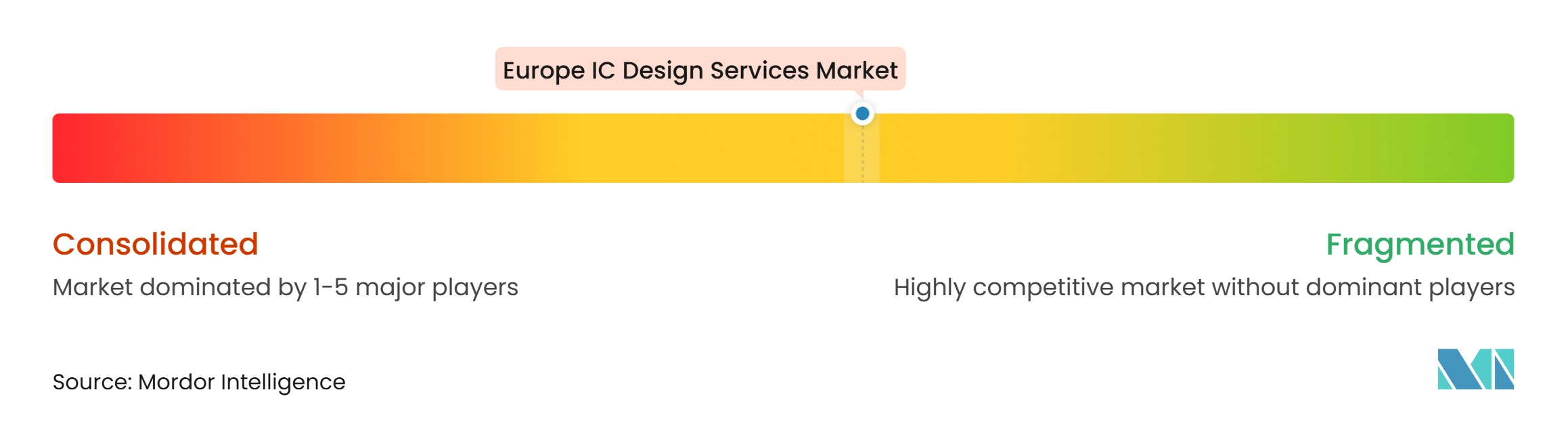
The Europe IC design services market has a moderately fragmented competitive structure. EnSilica, ICsense, and Racyics compete through analog, mixed-signal, and automotive-grade design expertise. Alchip Technologies and GUC serve European clients with advanced-node turnkey capabilities. Alchip joined Arm Total Design in October 2025, giving it access to pre-validated Arm Neoverse compute subsystems for 3nm and 2nm ASIC programs. This move supports clients who need a validated architecture and detailed implementation from a single provider.
Advanced packaging and system-level integration are becoming important bases of competition. GUC's work on VSORA's Jotunn8 included 2.5D integration and HBM3E interfaces, rather than only conventional layout execution.EnSilica partnered with Codasip to integrate CHERI and post-quantum cryptographic acceleration in automotive and defense ASICs. These capabilities can matter for clients facing hardware security requirements. ICsense reported 30% revenue growth and more than 50% profit growth in September 2026, linked to demand for independent custom IC supply. Its performance suggests that specialist providers can benefit from customers seeking fab-neutral support.
Data sovereignty is an additional competitive consideration for regulated clients. Cadence's Munich platform enables semiconductor design data to remain within European jurisdiction and carries ISO 27001, ISO 27017, and SOC 2 Type II certifications.[3] This may be relevant to defense, medical, and hyperscale clients managing GDPR and EU AI Act compliance factors. Opportunities remain in AI-native verification automation, industrial edge AI chips, and silicon carbide and gallium nitride power semiconductors. Providers that combine a local footprint, advanced-node readiness, and data-residency support can address several client requirements at once.
Europe IC Design Services Industry Leaders
-
Capgemini Engineering
-
HCL Technologies Limited
-
L&T Technology Services (LTTS)
-
Aion Silicon
-
EnSilica plc
- *Disclaimer: Major Players sorted in no particular order
Europe IC Design Services Market Companies Covered in this Report
- Sondrel Ltd.
- EnSilica plc
- Racyics GmbH
- ICsense
- Global Unichip Corp. (GUC)
- Alchip Technologies, Ltd.
- Faraday Technology Corporation
- VeriSilicon Microelectronics
- SEMIFIVE Inc.
- CoAsia SEMI
- eInfochips
- HCLTech
- L&T Technology Services (LTTS)
- MosChip Technologies
- Tessolve
Recent Industry Developments in Europe IC Design Services Market
- October 2026: The European Commission approved EUR 319 million (USD 351 million) in Austrian state aid for Infineon Technologies to co-fund a EUR 1.1 billion (USD 1.21 billion) upgrade of its Villach facility, establishing the world's first high-volume manufacturing line for next-generation gallium nitride power semiconductors on 300mm wafers. The investment creates a new advanced-node GaN IC design demand cluster in Austria and signals sustained European investment in power semiconductor design services linked to EV and industrial electrification.
- October 2026: Cadence Design Systems launched Europe's first sovereign AI data center in Munich for semiconductor, system, and AI factory design, integrating NVIDIA Blackwell-powered systems within an ISO 27001, ISO 27017, and SOC 2 Type II-certified cloud environment. The platform positions Cadence as the first EDA vendor enabling complete chip-design workflows within European data jurisdiction, directly responding to GDPR and emerging EU AI Act requirements for European IC design clients.
- September 2026: ICsense, a TDK Group company, reported its strongest financial year in its 22-year history with revenue rising 30% and profit increasing over 50%, driven by increasing demand for independent custom IC supply in medical, automotive, and industrial end markets as foundry consolidation makes specialized analog and mixed-signal production harder for customers to navigate independently.
- September 2026: EnSilica plc announced the opening of a Space and Communications Semiconductor Centre of Excellence in Milan, its third European engineering site alongside Budapest and Munich, targeting 20 specialist modem, mmWave, and DSP engineers over 6 months to support space and communications ASIC programs and proprietary ASSP developments.
Europe IC Design Services Market Report Scope
The Europe IC Design Services Market includes revenue earned by companies that provide outsourced and specialized integrated circuit (IC) design and engineering services to semiconductor manufacturers, fabless semiconductor companies, integrated device manufacturers (IDMs), original equipment manufacturers (OEMs), and other technology developers across the region. The market covers various services, including analog IC design, digital IC design, analog mixed-signal (AMS) IC design, physical design and layout, design verification, IP development, and other related design support services.
The Europe IC Design Services Market Report is Segmented by Service Type (Analog IC Design Services, Digital IC Design Services, Analog Mixed-Signal (AMS) IC Design Services, Physical Design and Layout Services, Design Verification Services, IP Development and Design Support Services, and Other Service Types), End-User Application (Automotive, AI, HPC, and Data Centers, Consumer Electronics, Industrial, Defense and Aerospace, Medical and Healthcare, Telecom and Networking, and Other End-User Applications), Design Complexity (Advanced Nodes (≤7nm), Mature Nodes (8nm–28nm), and Legacy Nodes (Above 28nm)), and Geography (Germany, United Kingdom, France, Italy and Rest of Europe). The Market Forecasts are Provided in Terms of Value (USD).
Segmentation Overview
| Analog IC Design Services |
| Digital IC Design Services |
| Analog Mixed-Signal (AMS) IC Design Services |
| Physical Design and Layout Services |
| Design Verification Services |
| IP Development and Design Support Services |
| Other Service Types |
| Automotive |
| AI, HPC, and Data Centers |
| Consumer Electronics |
| Industrial |
| Defense and Aerospace |
| Medical and Healthcare |
| Telecom and Networking |
| Other End-User Applications |
| Advanced Nodes (≤7nm) |
| Mature Nodes (8nm–28nm) |
| Legacy Nodes (Above 28nm) |
| Germany |
| United Kingdom |
| France |
| Italy |
| Rest of Europe |
| By Service Type | Analog IC Design Services |
| Digital IC Design Services | |
| Analog Mixed-Signal (AMS) IC Design Services | |
| Physical Design and Layout Services | |
| Design Verification Services | |
| IP Development and Design Support Services | |
| Other Service Types | |
| By End-User Application | Automotive |
| AI, HPC, and Data Centers | |
| Consumer Electronics | |
| Industrial | |
| Defense and Aerospace | |
| Medical and Healthcare | |
| Telecom and Networking | |
| Other End-User Applications | |
| By Design Complexity | Advanced Nodes (≤7nm) |
| Mature Nodes (8nm–28nm) | |
| Legacy Nodes (Above 28nm) | |
| By Country | Germany |
| United Kingdom | |
| France | |
| Italy | |
| Rest of Europe |
Key Questions Answered in the Report
What is the Europe IC design services market size?
The Europe IC design services market is estimated at USD 0.84 billion in 2027 and is forecast to reach USD 1.32 billion by 2032 at a 9.46% CAGR.
Which service type has the largest share in Europe IC design services?
Digital IC Design Services led with a 27.54% share in 2026. Design Verification Services is projected to record the fastest CAGR at 10.83% through 2032.
Why does automotive lead demand for IC design services in Europe?
Automotive held a 31.21% share in 2026 because EV powertrains, ADAS, networking, and functional-safety components require specialized silicon and long qualification cycles.
What is driving advanced-node IC design activity in Europe?
AI accelerators, high-performance computing, and research programs are increasing advanced-node work. Advanced Nodes (≤7nm) is projected to expand at a 10.04% CAGR through 2032.
Which European country is forecast to expand fastest for IC design services?
The United Kingdom is projected to record a 10.39% CAGR through 2032, supported by the UK AI Hardware Plan and a design-and-IP-focused semiconductor base.
What are the main constraints on European IC design service providers?
Dependence on non-European EDA and IP vendors and a shortage of specialized semiconductor engineers are the main constraints on capacity and project delivery.