
Market Overview
| Study Period | 2021 - 2031 |
|---|---|
| Forecast Data Period | 2026 - 2031 |
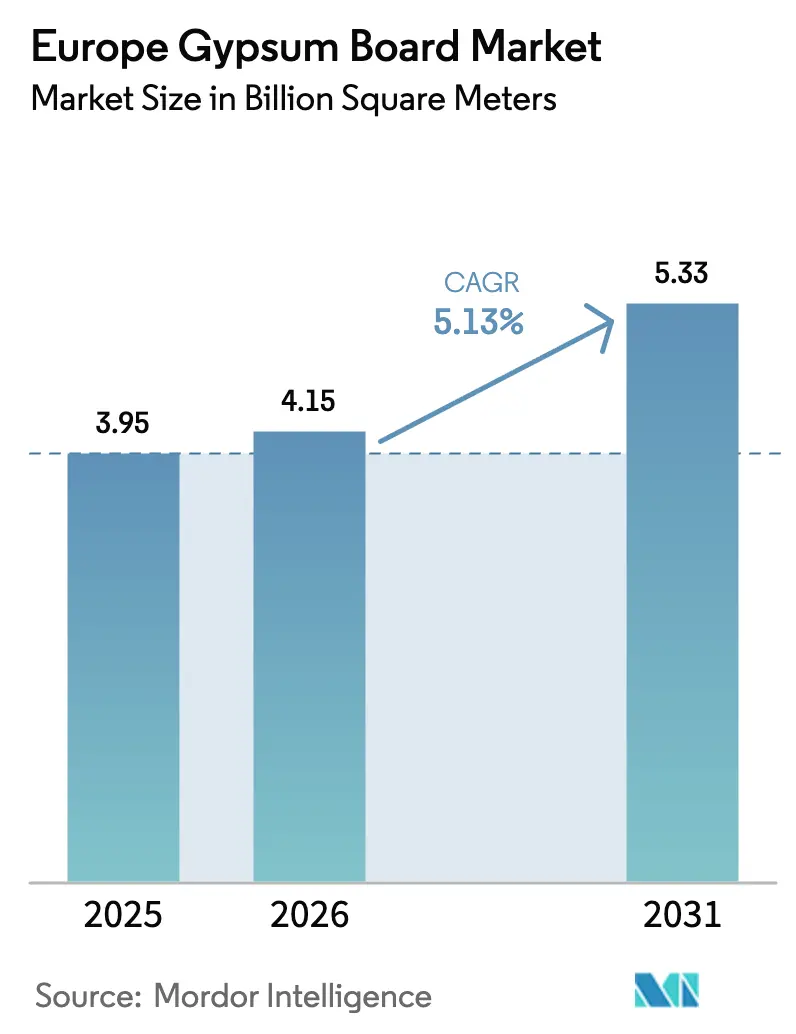
| Base Year Market Size (2025) | 3.95 Billion square meters |
| Market Volume (2026) | 4.15 Billion square meters |
| Market Volume (2031) | 5.33 Billion square meters |
| Growth Rate (2026 - 2031) | 5.13 % |
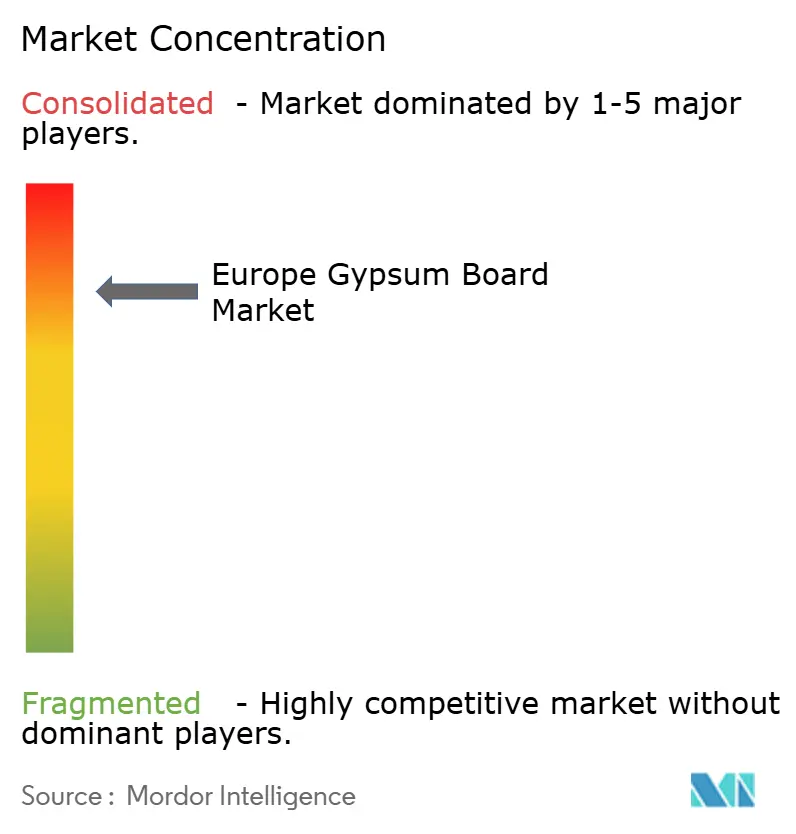
| Market Concentration | High |
Major Players *Disclaimer: Major Players sorted in no particular order Image © Mordor Intelligence. Reuse requires attribution under CC BY 4.0. | |
Europe Gypsum Board Market Analysis by Mordor Intelligence
The European Gypsum Board Market size is projected to be 3.95 billion square meters in 2025, 4.15 billion square meters in 2026, and reach 5.33 billion square meters by 2031, growing at a CAGR of 5.13% from 2026 to 2031. A measured rebound in renovation spending, the roll-out of national building‐renovation plans, and easing interest-rate pressures underpin the recovery after 2024’s construction slump. Regulatory compliance rather than speculative housebuilding is the prime demand trigger because the revised Energy Performance of Buildings Directive links renovation subsidies to mandatory life-cycle global-warming-potential disclosure. Deep energy retrofits that layer insulated plasterboard over existing substrates, rapid adoption of prefabricated interior systems, and stricter fire-plus-acoustic codes are pivoting volume toward high-performance wall boards. Competitive intensity is rising as multinationals accelerate recycled-content launches and expand regional footprints while cost-optimized local producers defend share in price‐sensitive Mediterranean markets.
Key Report Takeaways
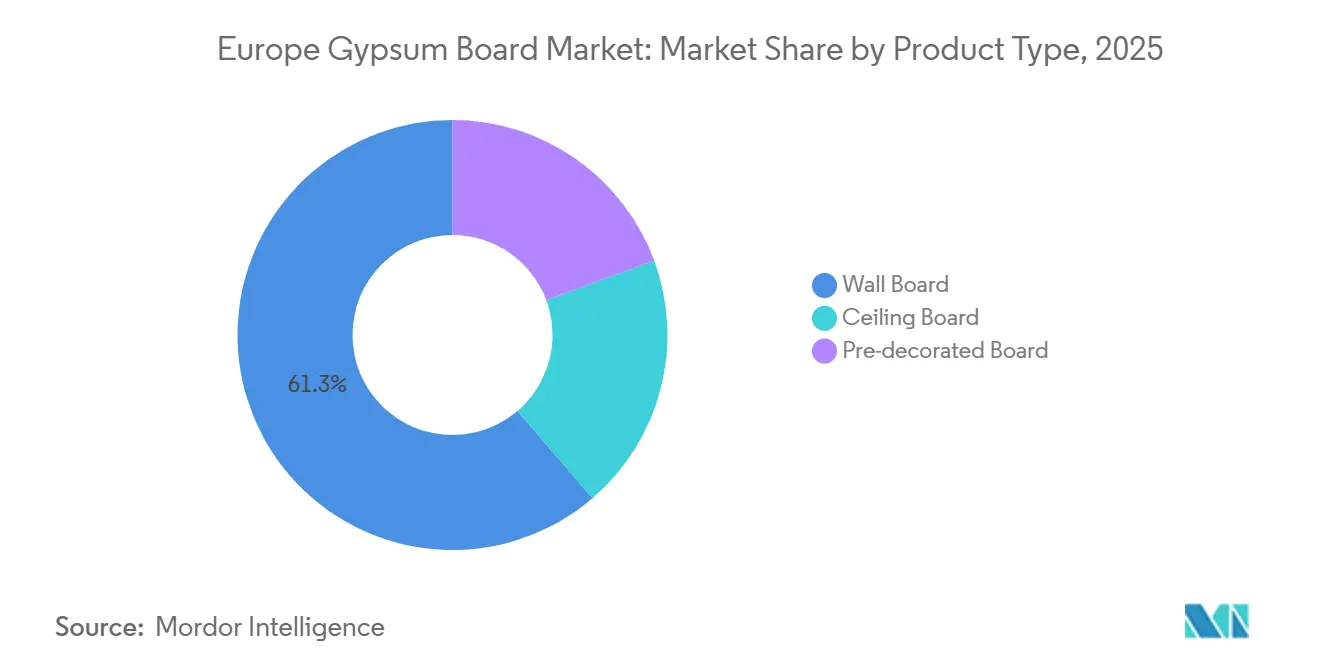
- By product type, wall board captured 61.28% of Europe gypsum board market share in 2025 and is advancing at a 7.85% CAGR through 2031.
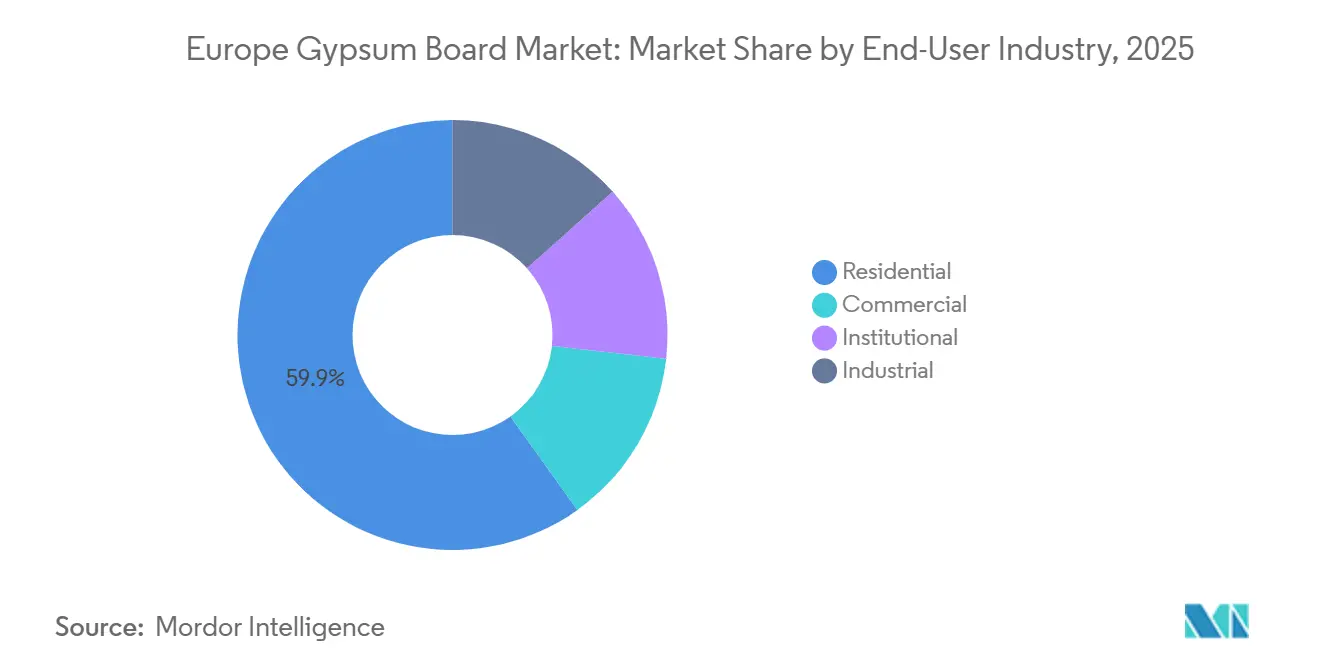
- By end-user industry, residential commanded 59.87% share of the Europe gypsum board market size in 2025, while commercial demand is growing at 7.90% CAGR to 2031.
- By geography, Germany led with 37.12% of Europe gypsum board market share in 2025; the NORDIC countries are expanding fastest at 6.20% CAGR to 2031.
Note: Market size and forecast figures in this report are generated using Mordor Intelligence’s proprietary estimation framework, updated with the latest available data and insights as of January 2026.
Market Trends and Insights
Drivers Impact Analysis of Europe Gypsum Board Market*
| Driver | (~) % Impact on CAGR Forecast | Geographic Relevance | Impact Timeline |
|---|---|---|---|
| EU Green-Deal Backed Renovation Incentives | +1.8% | EU-wide, strongest in Germany, France, Italy, Spain | Medium term (2-4 years) |
| Stricter EU Fire and Acoustic Codes for Lightweight Partitions | +0.9% | EU-wide, particularly NORDIC countries, Germany, UK | Long term (≥ 4 years) |
| Rapid Uptake of Prefabricated Interior Systems | +1.2% | Germany, NORDIC countries, Netherlands, Austria | Medium term (2-4 years) |
| Growing Adoption of Moisture- and Mold-Resistant Boards in Coastal Areas | +0.5% | Mediterranean (Spain, Italy, Greece), Atlantic (UK, France) | Long term (≥ 4 years) |
| Hybrid-Work Boosts Demand for Demountable Walls | +0.7% | Western Europe (UK, Germany, France, Benelux), NORDIC | Short term (≤ 2 years) |
| Source: Mordor Intelligence | |||
EU Green-Deal Backed Renovation Incentives
The Renovation Wave aims to upgrade 35 million buildings by 2030, with Member States obliged to submit final National Building Renovation Plans by December 2026[1]. Tying subsidies to life-cycle global-warming-potential limits pulls retrofit demand forward as owners pre-empt future penalties. Germany’s EUR 500 billion Climate and Transformation Fund illustrates the scale of public capital, yet its 18.9% drop in building permits through November 2024 shows that finance alone cannot lift private housing starts. Transaction-cost reductions—one-stop shops and technical-assistance centers—due in 2026 are expected to unlock small-owner projects where gypsum board dominates internal upgrades. Spain’s Recovery Fund outlays already lifted construction output 9.8% year-on-year by November 2024, reinforcing the renovation-first dynamic. Romania’s 21% jump in construction investment in 2025 underlines how EU funding determines country-level growth trajectories.
Stricter EU Fire and Acoustic Codes for Lightweight Partitions
The EPBD recast requires Member States to reference Euroclass fire ratings and ISO 717 acoustic thresholds when partitions are replaced, embedding performance mandates into every retrofit. Several countries already compel whole-building life-cycle assessments, and Iceland targets 43% emissions cut by 2030, making lightweight A2-rated gypsum systems the baseline. Achieving similar fire and acoustic performance with timber panels needs thicker assemblies that raise upfront cost and embodied carbon. Knauf’s multi-attribute GB-WRTX board epitomizes the product drift toward bundled compliance, though each added certification inflates testing overheads that regional producers struggle to absorb.
Rapid Uptake of Prefabricated Interior Systems
Labor shortages trimmed EU construction payrolls 5% below 2019 levels in 2024, intensifying interest in factory-made wall modules that slash on-site hours. Knauf’s EUR 80 million Fos-sur-Mer plant, opened March 2024, outputs gypsum boards pre-integrated with insulation, vapor barriers and conduits, cutting installation times 40%. Horizon 2020’s ELISSA project proved a 25% heating-energy saving using prefabricated gypsum façades embedded with phase-change materials, though scale-up remains limited by fragmented supply chains. Adoption is highest in high-wage Germany and NORDICs where labor economics favor factory assembly over wet trades.
Growing Adoption of Moisture- and Mold-Resistant Boards in Coastal Areas
Climate-driven humidity spikes are lifting failure rates of standard boards whose water uptake exceeds 10%, leading to premature mold and replacement cycles. Moisture-resistant H1 boards carry a 15–20% premium, curbing penetration to less than 25% of coastal installations in 2025. Insurance exclusions are now nudging UK specifiers toward H1 products after moisture-related claims jumped 12% in 2024. Etex recycled 590,000 tonnes of gypsum waste in 2024—much from damaged boards—highlighting the circular-economy upside of initial moisture protection.
Restraints Impact Analysis of Europe Gypsum Board Market*
| Restraint | (~) % Impact on CAGR Forecast | Geographic Relevance | Impact Timeline |
|---|---|---|---|
| Standard Boards' Water Vulnerability in High-Humidity Zones | -0.6% | Coastal Mediterranean, Atlantic regions, Baltic | Medium term (2-4 years) |
| Volatility in Gypsum and Liner-Paper Prices | -0.8% | EU-wide, acute in import-dependent markets (UK, Benelux) | Short term (≤ 2 years) |
| Emerging Bio-Based Wall Panels Stealing Sustainability Mindshare | -0.4% | NORDIC countries, Germany, Austria, Netherlands | Long term (≥ 4 years) |
| Source: Mordor Intelligence | |||
Standard Boards’ Water Vulnerability in High-Humidity Zones
Standard boards absorb more than 10% water by weight, causing swelling and mold within three years in coastal bathrooms and basements. Codes in Spain, Italy and Greece still lack mandatory H1 specifications, limiting moisture-resistant uptake to below 25% despite rising insurance exclusions. Etex’s 2024 waste data show moisture failures drive substantial replacement tonnage, undercutting circularity goals. While the issue is geographically limited, reputational spillover challenges gypsum’s suitability in any damp location.
Volatility in Gypsum and Liner-Paper Prices
Declining coal generation slashed synthetic gypsum supply, forcing greater reliance on natural gypsum or imports. Germany’s FGD gypsum output fell to 6.99 million t in 2019 from 11.25 million t in 2008 and is still dropping[2]. Spot liner-paper prices swung 25–30% during 2023–2024; vertically integrated producers recouped margin faster than converters buying on the open market. UK and Benelux plants, importing up to 40% of feedstock, face the sharpest cost swings, influencing new-plant location choices.
*Our forecasts treat driver/restraint impacts as directional, not additive. The impact forecasts reflect baseline growth, mix effects, and variable interactions.
Europe Gypsum Board Market Segment Analysis
By Product Type:
Wall Board Dominates Volume and GrowthWall board accounted for 61.28% of deliveries in 2025 and is forecast to grow 7.85% annually to 2031, keeping the Europe gypsum board market size expansion solidly tilted toward retrofit-friendly formats. Ceiling board trails because office new-build remains muted, while pre-decorated board stays niche outside high-wage Scandinavia and Germany. Manufacturers increasingly favor insulated wall boards that combine thermal, fire and acoustic performance in one sheet, aligning with EPBD thresholds. Knauf’s Fos-sur-Mer line produces 85% wall board, underscoring the segment’s pull.
Despite maturity, wall board remains the innovation hub of the Europe gypsum board market. Prefabricated wall modules reduce on-site labor by 40%, critical where wage rates exceed EUR 40 hourly. Digital passports embedded in wall boards support EPBD logbook requirements, facilitating recycling at end-of-life. Ceiling board upgrades focus mainly on acoustic tuning for hybrid offices, yet delayed tenant decisions cap growth. Pre-decorated boards gain traction where construction programs demand single-trade interior packages to compress schedules.
By End-User Industry:
Residential Leads, Commercial AcceleratesResidential industry consumed 59.87% of boards in 2025, reflecting the stock of legacy dwellings that require energy upgrades to meet 2030 targets. The Europe gypsum board market share of commercial industry is expanding fastest, achieving a 7.90% CAGR through 2031 as corporates reconfigure space for hybrid work. Institutional demand adds stability because healthcare and education facilities must hit zero-emission status by 2028, two years ahead of private buildings.
Renovation incentives shift residential consumption toward laminated insulation boards, softening the link with new housing starts. Spain’s residential expansion, buoyed by Recovery Fund inflows, illustrates how EU transfers offset local mortgage constraints. Commercial uptake is concentrated in technology and finance tenants that value demountability to avoid relocation costs. Industrial users curb demand as logistics developers pivot to prefabricated metal panels with lower gypsum intensity. Across all segments, recycled-content specifications are tightening, aligning procurement with circular-economy criteria.
Geography Analysis
Germany Gypsum Board Market
Germany dominated with 37.12% of shipments in 2025, yet its housing permits fell 18.9% year-on-year through November 2024 and residential output slid 4.9% in 2024 before a muted 1.1% rebound in 2025. Compliance-driven retrofits partly cushion demand, but the dwindling pipeline of new apartments constrains upside. Manufacturers respond by promoting prefabricated wall modules that compress labor overheads in Germany’s tight job market.
Nordics Gypsum Board Market
The NORDIC countries—Sweden, Norway, Denmark, Finland and Iceland—are the fastest-growing segment at 6.20% CAGR to 2031, driven by mandatory life-cycle assessment regimes and 43% carbon-reduction pledges that position low-embodied-carbon wall systems as default. Public procurement often requires Environmental Product Declarations and minimum recycled-content thresholds, pushing producers to route high-recycled-gypsum boards toward these markets. High labor costs also accelerate adoption of factory-finished wall panels, reinforcing volume growth.
Southern and Central Europe Gypsum Board Market
Southern Europe shows a mixed picture. Spain’s construction activity rose 9.8% year-on-year by November 2024, primed by Recovery Fund grants, while Italy and France’s construction activity contracted 5.3% and 3.9% respectively in 2024. Cost-sensitive buyers in the Mediterranean still prioritize low-priced standard boards, dampening rapid uptake of recycled-content options. Central-Eastern Europe is volatile: Romania’s construction activity surged 21% in 2025 on EU-co-financed projects, but Bulgaria’s construction activity swings from 13.9% growth in 2024 to a 1.4% dip in 2025. Manufacturers therefore tailor product mixes: premium boards with high recycled content flow north, while leaner specifications defend share in the south.
Regulatory Landscape
Europe's gypsum board regulatory environment is increasingly shaped by EU-level rules that connect product compliance with environmental disclosure. The Construction Products Regulation (EU) 2024/3110 strengthens harmonized conditions for CE marking, shifting attention from technical performance toward standardized sustainability-related information for construction products placed on the EU market. In parallel, the Energy Performance of Buildings Directive recast, Directive (EU) 2024/1275, requires Member States to build life-cycle global warming potential (GWP) calculation frameworks into national methodologies used for building assessments, which is tightening the information requirements behind renovation-related specifications.
Implementation is also moving through delegated acts: Commission Delegated Regulation (EU) 2026/52 (adopted in December 2025) sets the framework for calculating life-cycle GWP and references EN 15978 for environmental performance assessment of buildings. As these requirements flow into public procurement and renovation subsidy conditions, demand is shifting toward boards supported by Environmental Product Declarations and product-level data systems that can support life-cycle reporting and end-of-life management.
Value Chain Analysis
The Europe gypsum board value chain starts with gypsum sourcing, including natural gypsum and synthetic gypsum volumes that continue to decline in relative terms. It then moves through additives, liner paper, and energy inputs, followed by board manufacturing and conversion processes such as cutting, edge profiling, and laminated or insulated assemblies. Distribution typically relies on building material merchants, direct-to-project supply, and system installers. As synthetic gypsum availability tightens and imports become more important in some markets, feedstock security and logistics are becoming more strategic, increasing exposure to freight and currency swings.
Upstream and midstream integration shows up in company actions and in the data requirements buyers are asking for. Etex has strengthened access to gypsum raw materials through partnerships and acquisitions beyond the EU supply base, while multi-material players such as Holcim have expanded into adjacent walling and insulation platforms (for example, via Xella) to sell integrated wall solutions instead of standalone boards. On the information layer, Environmental Product Declarations have become a practical commercial requirement, with more than 320 valid gypsum-board-specific EPDs identified in Europe as of early 2026, reinforcing the role of verified environmental datasets from manufacturing through specification and recycling.
Competitive Landscape
Highly concentrated yet fiercely contested, the European gypsum board market sees the top five—Knauf, Saint-Gobain, Etex, Holcim, and James Hardie—control roughly 80% of volumes. Demand drops of up to 40% in selected markets during 2024 compressed margins, prompting cost-cutting and targeted capacity additions. Etex opened its Bristol plant, the group’s most efficient plasterboard line, to position for the next upcycle, while Knauf invested EUR 80 million in Fos-sur-Mer to serve the prefabrication boom.
Strategic moves extend beyond gypsum. Holcim’s pending acquisition of Xella signals convergence between insulation, AAC blocks, and gypsum boards into integrated walling solutions worth EUR 12 billion annually. James Hardie, best known for fiber-cement siding, is leveraging its fire-resistant credentials to penetrate European interior partitions, heightening competition for incumbents in high-performance niches.
Europe Gypsum Board Industry Leaders
-
Etex Group
-
Saint-Gobain
-
Knauf Group
-
Holcim
-
James Hardie Europe GmbH
- *Disclaimer: Major Players sorted in no particular order
Europe Gypsum Board Market Companies Covered in this Report
- BNBM
- CertainTeed, LLC
- Etex Group
- Georgia-Pacific
- Gyptec Iberica
- Holcim
- James Hardie Europe GmbH
- Knauf Group
- Mada Gypsum Company
- National Gypsum Services Company
- Pabco
- Pladur Gypsum, S.A.U.
- Saint-Gobain
- SG RIGIPS
- VANS Gypsum
- Volma
- YOSHINO GYPSUM CO.,LTD.
Market Opportunities and Future Outlook
Compliance-led renovation is creating room for boards and systems that bundle fire, acoustic, moisture, and thermal performance with documented environmental credentials. The move toward mandatory life-cycle GWP disclosure under Directive (EU) 2024/1275, supported by the calculation framework in Commission Delegated Regulation (EU) 2026/52 referencing EN 15978, increases the value of gypsum boards carrying EPD-backed data that can be used within whole-building assessment workflows. The Construction Products Regulation (EU) 2024/3110 also reinforces harmonized CE-marking conditions and sustainability-related information, giving manufacturers with consistent product datasets a stronger footing in public and institutional procurement.
Prefabrication and industrialized dry-lining are a second opportunity lane, with recent capacity and capability moves providing clearer signals on where producers are investing. James Hardie Europe commissioning an advanced fermacell fibre gypsum line in Orejo, Spain (March 2026) is aligned with supply for prefabrication and dry-lining segments, while Knauf Gips planning an EUR 88 million drywall facility in Huedin, Romania, points to producer interest in adding regional capacity closer to renovation and construction growth markets influenced by EU-funded programs. With over 320 gypsum-board-specific EPDs active in Europe as of early 2026, differentiation is increasingly tied to verified low-carbon claims, recycled content pathways, and traceability features that support end-of-life recycling management.
Recent Industry Developments in Europe Gypsum Board Market
- June 2026: Knauf Group completed a technologically advanced gypsum wallboard plant in Wheatland, Canada, to strengthen supply reliability in Western Canada. The capacity addition expands Knauf's North American footprint and mitigates regional supply risk while supporting local demand growth.
- June 2026: Etex Group acquired a majority stake in Global Gypse (Algeria) and activated its first operating site in Algeria for gypsum-based products. The acquisition broadens Etex's North Africa footprint and diversifies supply through vertical integration into a raw-material rich market.
- January 2026: Etex Group signed a deal to acquire 25 percent of Kunooz Gypsum activities in Oman and form a joint venture for local gypsum-based industrial activities. The partnership supports Etex's Middle East gypsum supply chain and establishes regional production with long-term raw-material access.
Europe Gypsum Board Market Report Scope and Research Methodology
Market Definition and Coverage
For this study, the market covers gypsum board demand across Europe measured in board area (square meters) used for interior walls and ceilings in buildings.
Scope exclusions: We exclude gypsum plasters, cement boards, and other non-gypsum interior lining materials, even if they are used in similar wall or ceiling applications.
Segments Covered in This Report
- By Product Type
- Wall Board
- Ceiling Board
- Pre-decorated Board
- By End-User Industry
- Residential
- Commercial
- Institutional
- Industrial
- By Geography
- Germany
- United Kingdom
- France
- Italy
- Spain
- NORDIC Countries
- Rest of Europe
Data Sources, Market Sizing, and Validation
Desk Research
Desk research starts by mapping the construction and renovation demand pool, and then translating it into gypsum board area using common application intensity patterns. Public sources such as Eurostat (construction output and building permits), the European Commission (building and renovation policy direction), and national statistical offices help us anchor the timing of cycles across key countries.
We also review trade and production signals where they are reported by customs authorities and industry bodies, such as UN Comtrade (trade flows), Eurogypsum publications (industry context and usage indicators), and peer reviewed papers on drywall systems and recycling rates. This is complemented by company annual reports, investor presentations, and reputable business press, and then cross checked with select paid subscriptions for company financials and patent databases to validate technology shifts. The sources listed here are illustrative only, and many other public and paid references were reviewed to collect, verify, and clarify inputs.
Primary Interviews and Surveys
Primary work is used to test what the data cannot directly show, such as board mix shifts, typical thickness and wastage, and how quickly premium boards are being adopted in refurbishment versus new build. We covered views across manufacturers, distributors, installers, and specifiers, and then reflected differences across major European markets so assumptions did not get pulled by one country's cycle.
Distribution of primary research fieldwork respondents
| Company type | Respondent position |
|---|---|
| Top tier: 37% | CXOs: 22% |
| Mid tier: 41% | Functional/Unit leaders: 28% |
| Smaller Players: 22% | Managers: 50% |
Market-Sizing & Forecasting
Sizing is built using a top-down demand reconstruction where construction and renovation activity is translated into interior wall and ceiling lining area, which is then converted into gypsum board square meters by application share. Results are then corroborated with selective bottom-up approximations, such as sampled country level board volume checks using typical board coverage rates, channel feedback on volumes, and sanity checks against known capacity and trade direction.
Key inputs that materially move the model include new residential completions versus refurbishment share, non-residential fit-out intensity, adoption of pre-decorated boards in faster-install systems, country level fire and acoustic code pull-through, and scrap and recovery rates that affect effective demand. For forecasting, scenario analysis is used around construction cycle recovery and renovation funding timing, and the path is then adjusted using expert expectations on pricing and mix, especially for value-added boards. Where bottom-up visibility is weaker in smaller countries, we fill gaps using proxy indicators from similar markets and then re-test the conversion factors in follow-up calls.
Data Validation & Update Cycle
Validation is handled through multiple checks, starting with internal consistency tests across countries so the model does not imply unrealistic per-capita board usage or sudden mix jumps. Analysts compare outputs with independent signals such as construction output direction, import and export movements, and known shifts in renovation activity, and then investigate variances before totals are signed off.
When a data point looks out of trend, we re-check unit conversions, timing alignment, and the assumed board intensity, and then re-contact selected respondents if the variance stays unresolved. Reports are refreshed annually, with interim updates when there are material events that can move demand or pricing. Before delivery, an analyst completes a fresh review pass so clients receive the latest updated view.
Mordor Intelligence's Europe Gypsum Board Market Size Compared Against Other Published Estimates
Published market sizes often differ even when they use the same market name, because the unit of measure, the included geographies, and the way renovation demand is counted can vary a lot. Differences in how fast prices or product mix are assumed to change can also widen gaps, especially when forecasts run out several years.
The main gap comes from unit choice and scope, where Mordor Intelligence sizes Europe gypsum board in square meters (2025: 3.95 B sq. m) and keeps the model tied to installed board area, while some publications convert to revenue and may fold in adjacent interior systems or broader gypsum based products. Another spread driver is the base case used for the construction cycle, because some estimates apply an aggressive rebound or a conservative freeze, and that choice changes near-term volumes quickly. Refresh cadence and currency timing also matter when revenue is used, since board pricing and exchange rates can swing the same year.
Benchmark comparison
| Source | Market Size | Gaps in Research Methodology |
|---|---|---|
| Mordor Intelligence | USD 3.95 B (2025) | |
| Industry Publisher A | USD 3.80 B (2025) | Uses a tighter country basket and applies a lower renovation conversion factor, which can undercount retrofit-driven board area in mature Western Europe markets. |
| Global Publisher B | USD 4.25 B (2026) | Reports a forward year with a faster rebound assumption and mixes revenue-like pricing logic into volume, which can lift totals when premium board share is assumed to rise early. |
The table shows that most of the spread can be explained by whether the estimate is anchored to installed board area, how renovation intensity is translated into board demand, and how the cycle recovery is timed. By keeping assumptions visible and checking them against independent construction and trade signals, the final number stays easier to trace and repeat when inputs are updated.
Key Questions Answered in the Report
How big is the Europe gypsum board market in 2026?
Volume reached 4.15 billion square meters in 2026 and is forecast to climb to 5.33 billion square meters by 2031.
What is the expected CAGR for gypsum board demand in Europe?
The market is projected to post a 5.13% CAGR between 2026 and 2031.
Which product type leads regional consumption?
Wall board dominates with 61.28% share in 2025 and is also the fastest-growing segment with a 7.85% CAGR from 2026 to 2031.
Why are NORDIC countries the fastest-growing sub-region?
Mandatory life-cycle assessment rules and ambitious carbon targets are driving 6.20% CAGR demand through 2031.