
Europe General Liability Insurance Market Size and Share
Market Overview
| Study Period | 2020 - 2031 |
|---|---|
| Forecast Data Period | 2026 - 2031 |
| Base Year Market Size (2025) | USD 58.80 Billion |
| Market Size (2026) | USD 60.64 Billion |
| Market Size (2031) | USD 72.02 Billion |
| Growth Rate (2026 - 2031) | 3.50 % |
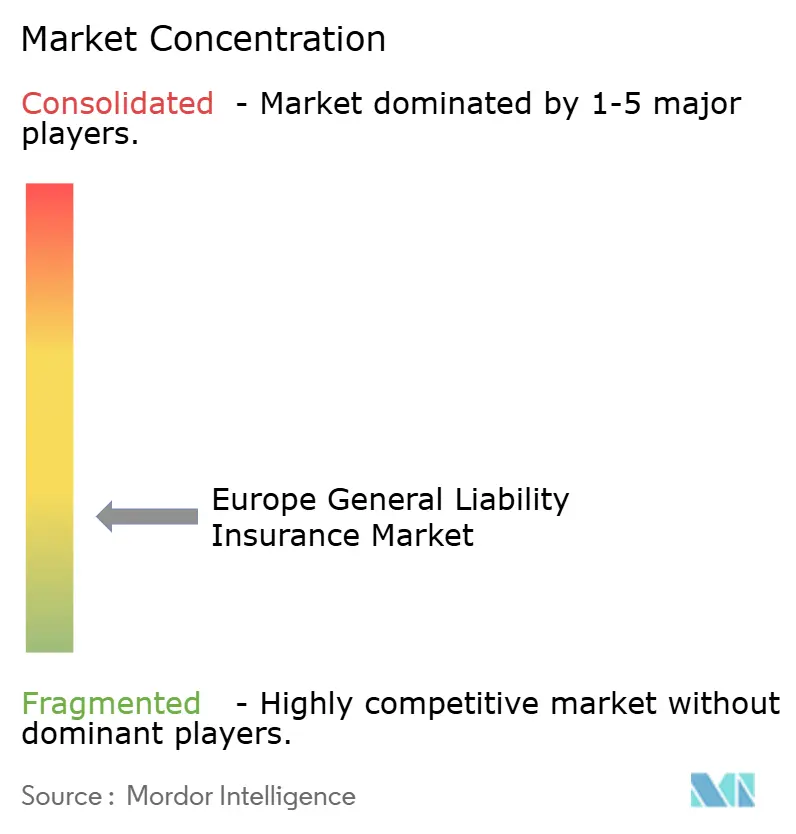
| Market Concentration | Low |
Major Players *Disclaimer: Major Players sorted in no particular order Image © Mordor Intelligence. Reuse requires attribution under CC BY 4.0. | |
Europe General Liability Insurance Market Analysis by Mordor Intelligence
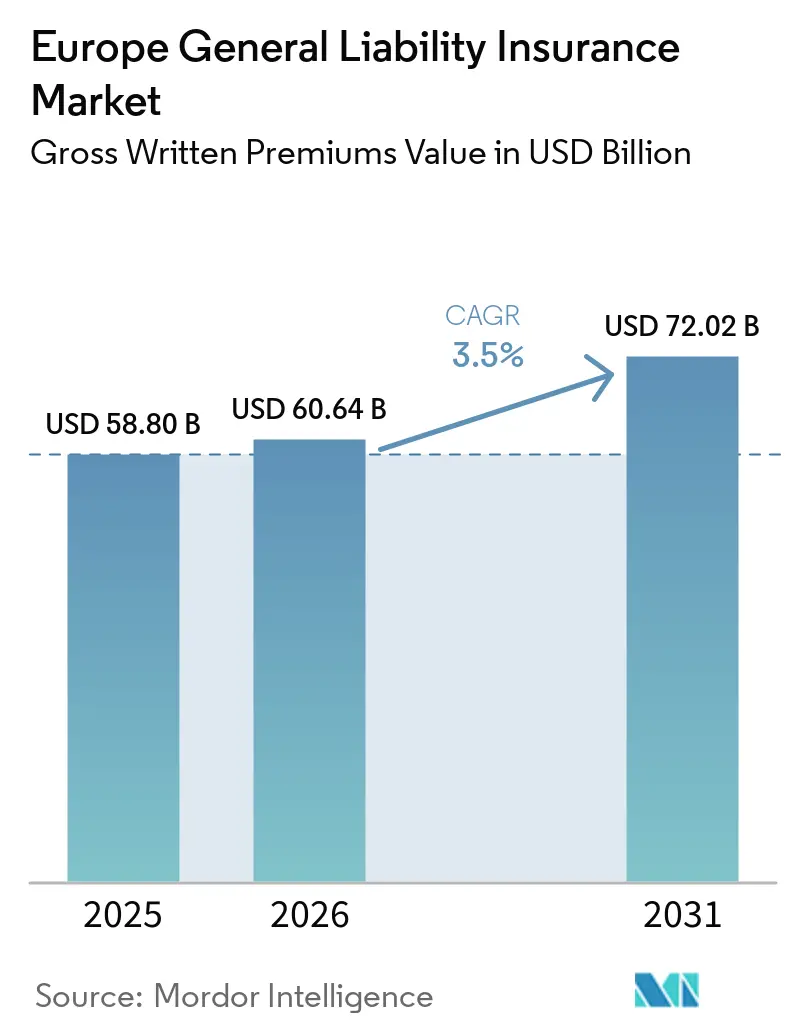
The Europe General Liability Insurance Market size in terms of gross written premiums value was valued at USD 58.80 billion in 2025 and is estimated to grow from USD 60.64 billion in 2026 to reach USD 72.02 billion by 2031, at a CAGR of 3.5% during the forecast period (2026-2031).
Mandatory cover in public procurement and private contracts supports a stable base of demand across the European general liability insurance market. Larger bodily injury awards, more complex supply chains, and risks associated with artificial intelligence-enabled products are expanding the range of exposures that insurers must price. Swiss Re expects general liability to retain selective repricing power in 2026 and 2027, even as competition increases in property and motor insurance. The revised European Union Product Liability Directive has increased the need for insurers to update policy language before the December 2026 transposition deadline. These conditions favor carriers that can combine legal review, disciplined underwriting, and cross-border service.
Key Report Takeaways
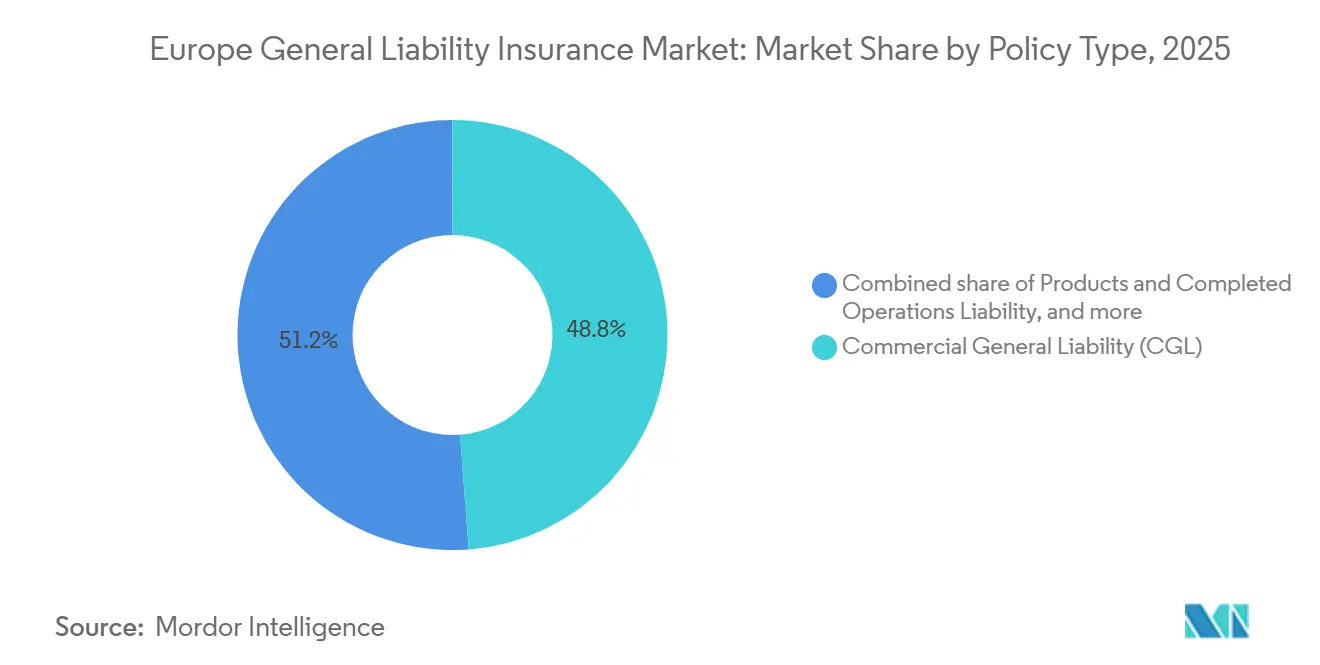
- By policy type, commercial general liability captured 48.8% of the European general liability insurance market share in 2025, while products and completed operations liability is projected to grow at a 4.8% CAGR through 2031.
- By policy trigger, occurrence-based policies captured 83.6% of the Europe general liability insurance market share in 2025, while claims-made policies are projected to grow at a 5.1% CAGR through 2031.
- By policyholder type, small and medium-sized enterprises captured 42.4% of the Europe general liability insurance market share in 2025, while large enterprises are projected to grow at a 4.9% CAGR through 2031.
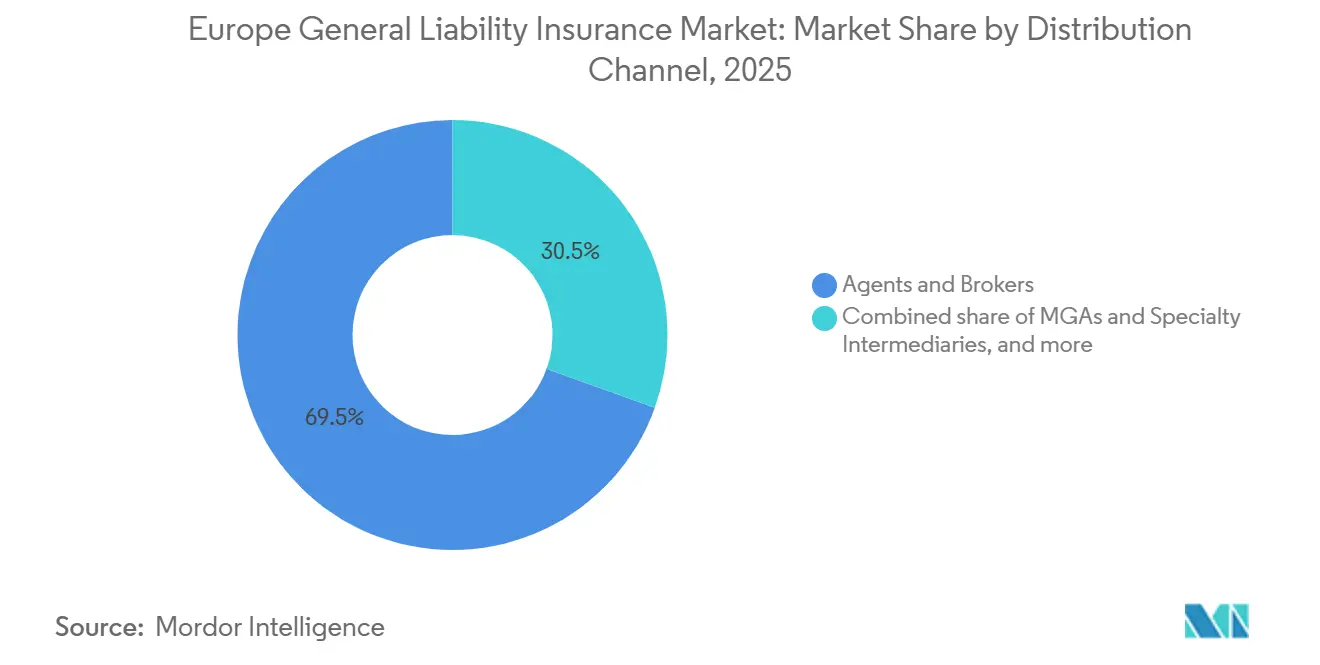
- By distribution channel, agents and brokers captured 69.5% of the European general liability insurance market share in 2025, while bancassurance, affinity, and embedded channels are projected to grow at a 6% CAGR through 2031.
- By industry vertical, construction and real estate captured 19.7% of the European general liability insurance market share in 2025, while information technology and telecommunications are projected to grow at a 5.5% CAGR through 2031.
- By geography, Germany captured 22.3% of the Europe general liability insurance market share in 2025, while the Rest of Europe is projected to grow at a 5% CAGR through 2031.
Note: Market size and forecast figures in this report are generated using Mordor Intelligence’s proprietary estimation framework, updated with the latest available data and insights as of January 2026.
Europe General Liability Insurance Market Trends and Insights
Drivers Impact Analysis*
| Driver | (~) % Impact on CAGR Forecast | Geographic Relevance | Impact Timeline |
|---|---|---|---|
| Mandatory and Contractual Liability Requirements | +0.8% | European Union-wide, concentrated in Germany, France, and the United Kingdom | Short term (≤ 2 years) |
| Rising Third-Party Claims and Compensation Costs | +0.6% | Western Europe, the Netherlands, Portugal, and the United Kingdom | Medium term (2-4 years) |
| Expansion of Small and Medium-Sized Enterprises and Commercial Activity | +0.7% | Pan-European, led by Southern and Eastern Europe | Medium term (2-4 years) |
| Growth in Construction, Infrastructure, Manufacturing, and Industrial Activity | +0.6% | Germany, France, Spain, and the rest of Europe | Short term (≤ 2 years) |
| Expansion of Artificial Intelligence-Enabled Products and Operations | +0.5% | United Kingdom, Germany, France, and the Nordic countries | Long term (≥ 4 years) |
| Complex Supply-Chain Liability Exposures | +0.4% | Germany, Italy, the Netherlands, and the DACH countries | Medium term (2-4 years) |
| Source: Mordor Intelligence | |||
Mandatory and Contractual General Liability Coverage Requirements
Public procurement rules and private contractual conditions create consistent demand for general liability cover across Europe. Contractors often need to prove that they hold specified third-party liability limits before they can win public projects. This requirement makes insurance a contractual cost rather than a discretionary purchase for many firms. Germany announced a EUR 500 billion (USD 540 billion) infrastructure and climate investment fund in 2025, and the project pipeline is reaching procurement activity in 2026[1]. Licensed professionals in Germany, France, and Italy also face continuing liability cover requirements under national rules and supervisory frameworks. These arrangements help the European general liability insurance market maintain demand when business conditions are less favorable.
Rising Third-Party Claims and Compensation Costs
Liability claims are changing as legal rules and collective redress mechanisms evolve across Europe. Swiss Re identifies liability excess inflation as a structural concern, particularly where opt-out collective redress is increasing claim severity in the Netherlands and Portugal. The revised Product Liability Directive expands the scope of strict liability to software and artificial intelligence systems, while also changing certain evidentiary rules[2]. Ireland showed that targeted reform can reduce some costs, as the Central Bank of Ireland reported lower settlement costs for injury claims in the first half of 2025. However, the wider legal direction in Europe is toward broader claimant access and more demanding claims handling. Insurers are therefore reviewing limits, exclusions, reserving practices, and legal expense assumptions.
Expansion of Small and Medium-Sized Enterprises and Commercial Business Activity
Small and medium-sized enterprises provide an important coverage opportunity because many businesses still have limited insurance protection. Traditional intermediaries continue to serve well-insured firms effectively, but they have weaker reach among businesses with limited engagement. Digital products offered through banking and accounting platforms can reduce the effort involved in purchasing basic cover. Growing turnover and employment in Southern and Eastern Europe also add to the addressable premium base. This combination supports further expansion in the European general liability insurance market without relying only on rate increases.
Growth of Construction, Infrastructure, Manufacturing, and Industrial Activity
Construction remains a major source of third-party exposure because projects combine multiple contractors, equipment providers, and property owners. European Union construction output is forecast to grow 1.5% in 2026 after a 1.5% decline in 2024 and no growth in 2025[3]. Germany, Spain, and Ireland lead the recovery, while France and the Netherlands remain below trend. Infrastructure investment creates demand for contractor liability cover, project policies, and specialist risk management. Data center projects also bring concentrated mechanical, electrical, and subcontractor exposures that differ from conventional infrastructure work. Insurers with specialist underwriting teams can use these projects to build a stronger position in the European general liability insurance market.
Restraints Impact Analysis*
| Restraint | (~) % Impact on CAGR Forecast | Geographic Relevance | Impact Timeline |
|---|---|---|---|
| Premium Affordability and Underwriting Tightening | -0.5% | Pan-European, pronounced among small and medium-sized enterprises | Short term (≤ 2 years) |
| Rising Claims Severity and Legal Defense Costs | -0.4% | United Kingdom, the Netherlands, and Western Europe | Medium term (2-4 years) |
| Limited Historical Data for Emerging Artificial Intelligence Liability Risks | -0.3% | European Union-wide, concentrated early in Germany and the United Kingdom | Long term (≥ 4 years) |
| Cross-Border Differences in Liability Rules and Insurance Requirements | -0.2% | European Union member states, especially Eastern European entry markets | Medium term (2-4 years) |
| Source: Mordor Intelligence | |||
Premium Affordability and Underwriting Tightening
Affordability is becoming more difficult for small and medium-sized enterprises in high-frequency sectors such as retail, hospitality, and construction subcontracting. Swiss Re forecasts real non-life premium growth of 1.5% in advanced Europe in 2026, down from 2.9% in 2025. Further price increases are harder to sustain when claims frequency does not rise at the same pace as claims severity. Narrower wording and lower sub-limits may reduce the immediate premium burden, but they can also make cover less useful to buyers. Buyers with stronger risk management resources may seek excess capacity from specialist providers when standard cover becomes restrictive. Clear policy triggers and modular product design can preserve underwriting discipline while making coverage easier to understand.
Rising Claims Severity and Legal Defense Costs
Legal and defense costs can absorb premium income without increasing the protection received by the policyholder. The Central Bank of Ireland reported that average legal costs of EUR 25,157 (USD 27,170) exceeded average compensation of EUR 24,379 (USD 26,329) for certain court-litigated claims below EUR 150,000 (USD 162,000) in the first half of 2025. The Product Liability Directive also creates more demanding disclosure and coordination requirements for claims with cross-border elements. These pressures are especially material where claims involve multiple suppliers, products, or legal jurisdictions. Centralized claims platforms and multilingual legal panels can help insurers manage cases more consistently. Higher operating costs may nevertheless limit the pace of expansion in the European general liability insurance market.
*Our forecasts treat driver/restraint impacts as directional, not additive. The impact forecasts reflect baseline growth, mix effects, and variable interactions.
Segment Analysis
By Policy Type: Commercial General Liability Remains the Core Product
Commercial general liability held 48.8% of premiums in 2025, making it the largest policy type in the Europe general liability insurance market. Mid-sized companies and large industrial policyholders use this cover for third-party risks arising from premises, products, and completed work. Its broad role reflects the use of commercial packages that combine liability, property, motor, and employer cover in Germany, the United Kingdom, and France. Broker-placed programs remain common in these countries because policyholders need coordinated protection across several risks. Products and completed operations liability is forecast to record a 4.8% CAGR through 2031. The revised Product Liability Directive is prompting manufacturers, technology providers, and importers to reassess limits and coverage structures.
Personal liability and other business liability categories serve households and several specialized commercial needs. Germany has a high personal liability penetration, while landlord, voluntary organization, and owner association policies cover more focused exposures. The European general liability insurance industry is also adjusting to the overlap between product liability, cyber cover, technology errors and omissions, and commercial general liability. Software can fall within product liability rules, which increases the need for more precise policy language. Standard forms that focus only on tangible property damage may need explicit provisions for digital assets and artificial intelligence outputs. Carriers that revise terms before December 2026 can reduce uncertainty for brokers and policyholders.
By Policy Trigger: Occurrence-Based Cover Remains Predominant
Occurrence-based policies represented 83.6% of premiums in 2025, the largest share within policy triggers. Manufacturers, contractors, and public-sector policyholders use occurrence cover because it responds to an incident that takes place during the policy period. This remains appropriate for construction defects and product injuries that can take years to develop. The structure is familiar across industrial sectors, although it creates complex reserving needs for insurers. Claims-made policies are forecast to grow at a 5.1% CAGR through 2031. Their use is expanding in professional services, technology liability, and artificial intelligence-related products, where long-term claims evidence remains limited.
Claims-made policies allow carriers to define retroactive dates and limit the aggregation of emerging exposures. This feature is useful when loss experience is still developing, and reinsurance support for long-tail limits is cautious. European insurers have long used claims-made structures for professional indemnity and directors and officers cover. General liability products are adopting the same approach in technically complex sub-lines. The European general liability insurance market can therefore offer more controlled coverage for new digital risks without waiting for a long history of claims. Policyholders will need clear explanations of reporting requirements and retroactive dates before selecting this form of cover.
By Policyholder Type: Small and Medium-Sized Enterprises Lead Premiums
Small and medium-sized enterprises held 42.4% of premiums in 2025, giving them the largest Europe general liability insurance market share by policyholder type. The segment covers a wide range of businesses, from local service firms to manufacturing suppliers. The 2025 study of 8,187 European businesses found that 44% were minimally insured and held fewer than 2 policies. This shows that distribution reach and product understanding remain important barriers to adoption. Large enterprises are forecast to expand at a 4.9% CAGR through 2031. Their growth reflects supply-chain restructuring, corporate governance requirements, and wider use of multinational insurance programs.
Multinational programs allow large enterprises to manage coverage across countries while maintaining local policies where they are required. This approach is useful because liability laws and claims processes vary across 27 European Union jurisdictions. Households and individuals remain important in Germany, where personal liability insurance is widely used. Take-up is lower in parts of Southern and Eastern Europe, where digital distribution may reduce acquisition costs over time. Public-sector bodies and nonprofit organizations also face rising exposure from data handling, infrastructure maintenance, and environmental matters. These groups can add demand for specialist cover within the European general liability insurance market as public procurement requirements reach supplier networks.
By Distribution Channel: Agents and Brokers Remain the Main Route
Agents and brokers generated 69.5% of premiums in 2025, giving them the largest share in the European general liability insurance market. Intermediaries remain important for complex commercial risks that require tailored limits and policy terms. Their role is particularly strong in Germany, the United Kingdom, and Nordic countries, where commercial relationships are often long-standing. Managing claims, renewals, and risk information also supports the broker model. Managing general agents and specialist intermediaries provide underwriting capacity for pollution, product recall, and artificial intelligence-related extensions. Direct sales are active for simpler small business products in France and Iberia, where insurer-owned digital portals compete on price and convenience.
Bancassurance, affinity, and embedded channels are forecast to grow at a 6% CAGR through 2031. These models connect banking or accounting platforms with insurance underwriting systems through application programming interfaces. They can offer basic liability cover during a small business banking or administrative journey. The European general liability insurance industry may gain access to firms that do not usually engage with a broker. Embedded policies often have lower average premiums than broker-placed commercial programs, which means providers need scale to earn sufficient commission income. The channel will therefore favor large platforms and insurers that can integrate underwriting decisions efficiently.
By Industry Vertical: Construction Holds the Largest Premium Position
Construction and real estate held 19.7% of premiums in 2025, representing the largest European general liability insurance market size within industry verticals. Public infrastructure, housing development, and industrial projects create sustained third-party exposure for contractors and property owners. Owner-controlled and contractor-controlled insurance programs can place project participants under a single policy. These structures increase the premium per project relative to separate contractor placements. European Union construction output is forecast to grow 1.5% in 2026, supported by infrastructure and energy-transition projects. Manufacturing, transport, logistics, retail, healthcare, energy, hospitality, financial services, and the public sector also give the market a broad risk base.
Information technology and telecommunications are forecast to grow at a 5.5% CAGR through 2031. Technology companies are seeking clearer protection for software errors, artificial intelligence failures, and data processing liabilities. The revised Product Liability Directive adds importance to wording that addresses software and related digital products. This demand creates a product development opportunity for carriers that can define triggers and exclusions clearly. Insurers must still account for the limited historical evidence available for newer artificial intelligence exposures. The European general liability insurance market will need careful underwriting standards as the use of technology expands across business activities.
Geography Analysis
Germany held 22.3% of premiums in 2025, the largest country position in the Europe general liability insurance market. The country has a large commercial base and extensive use of insurance across business and personal liability risks. Germany announced a EUR 500 billion (USD 545 billion) infrastructure and climate investment fund in 2025, with early disbursements supporting construction activity in 2026. ING forecasts German construction output growth of 2.5% in 2026. The United Kingdom is a major premium contributor and has exposure to litigation cost inflation. Swiss Re identifies the United Kingdom as the highest-risk European jurisdiction outside the United States for class actions.
France and Italy are the third and fourth national segments by premium volume. France benefits from a developing bancassurance channel and a growing commercial small and medium-sized enterprise insurance base. The country also faces a changing collective redress environment that insurers are incorporating into program pricing. Italy has sustained demand from engineering, construction, and healthcare activities. Its construction output is forecast to grow 0.5% in 2026 after consecutive years of contraction. Spain is forecast to record construction output growth of 2.5% in 2026, supporting general liability demand in Iberia.
The Rest of Europe is forecast to grow at a 5% CAGR through 2031, the fastest geographic rate in the Europe general liability insurance market. Central and Eastern European countries are benefiting from new business formation, foreign direct investment, and industrial activity. Poland, the Czech Republic, and Romania are key contributors to premium growth in this grouping. Nordic countries maintain high insurance sophistication and early use of embedded cover for commercial micro-risks. As trade and supply-chain integration deepen, businesses face liability exposures that increasingly resemble those in Western Europe. This supports premium growth linked to commercial expansion rather than only to pricing conditions.
Competitive Landscape
The European general liability insurance market is fragmented, with companies like Allianz, AXA, Zurich, Assicurazioni Generali, and HDI Global. These carriers have broad geographic coverage, multinational program capabilities, and claims operations that smaller competitors may find difficult to match. Allianz reported a record operating profit of EUR 17.4 billion (USD 18.1 billion) for fiscal 2025, driven primarily by its property-casualty segment. It set a 2026 operating profit target of EUR 17.4 billion (USD 18.1 billion) and announced a share buyback program of up to EUR 2.5 billion (USD 2.6 billion). HDI Global launched its Xcelerate29 strategy, which prioritizes artificial intelligence and data analytics in underwriting, risk engineering, and claims management. These investments support more responsive underwriting in the European general liability insurance market.
Specialist managing general agents and Lloyd 's-backed underwriters are gaining relevance in technology, environmental, and artificial intelligence-related liability lines. Their ability to focus on a narrow risk class can help them address exposures where standard carrier appetite is limited. Mid-sized insurers face pressure from the scale of leading carriers and the speed of specialist competitors. Updated commercial general liability wording has become an important point of competition before the December 2026 directive deadline. Insurers that provide clear digital-lifecycle cover can reduce uncertainty for technology and manufacturing buyers. Carriers with older language may face more difficult risk selection if informed buyers move to providers with clearer terms.
Growth opportunities include modular cover for small and medium-sized enterprises, embedded distribution, and cross-border programs for regional companies. Policyholders with operations in several countries want consistent coverage without having to manage a separate arrangement in every market. Leading insurers are using digital underwriting and claims tools to shorten response times and improve risk information. HDI Global is applying artificial intelligence and data analytics as part of its corporate and specialty insurance strategy. Allianz is also pursuing a 2025 to 2027 strategic cycle after its record 2025 results. These actions show why investment in specialist underwriting and cross-border delivery remains important across the Europe general liability insurance market.
Europe General Liability Insurance Industry Leaders
-
Allianz SE
-
AXA SA
-
Zurich Insurance Group Ltd.
-
Assicurazioni Generali S.p.A.
-
Chubb Limited
- *Disclaimer: Major Players sorted in no particular order
Recent Industry Developments
- July 2026: EIOPA published its final Solvency II Review Guidelines and draft technical standards, completing all legal instruments under the revised framework. The updated regime applies from January 30, 2027, and introduces a proportionality framework for small and non-complex undertakings, revised technical provisions, a revised risk margin, and updated reporting standards.
- June 2026: Beazley plc reported a profit before tax of USD 237.7 million and continued developing its Bermuda operations. Its European expansion progressed faster than anticipated, with large and multinational accounts identified as attractive.
- February 2026: Allianz SE reported a record operating profit of EUR 17.4 billion (USD 18.8 billion) for fiscal 2025, driven primarily by its property-casualty segment. The group announced a share buyback program of up to EUR 2.5 billion (USD 2.7 billion) and set a 2026 operating profit target of EUR 17.4 billion (USD 18.8 billion).
- December 2025: HDI Global reported profitable growth across revenue and earnings. The corporate and specialty insurer also introduced its Xcelerate29 strategy, which prioritizes artificial intelligence and data analytics in underwriting, risk engineering, and claims management.
Europe General Liability Insurance Market Report Scope
| Commercial General Liability (CGL) |
| Products and Completed Operations Liability |
| Personal Liability |
| Other General/Business Liability |
| Occurrence-Based |
| Claims-Made |
| Households and Individuals |
| Small and Medium-Sized Enterprises (SMEs) |
| Large Enterprises |
| Public Sector and Nonprofit Organizations |
| Agents and Brokers |
| MGAs and Specialty Intermediaries |
| Direct Sales |
| Bancassurance, Affinity and Embedded |
| Construction and Real Estate |
| Manufacturing |
| Transportation and Logistics |
| Retail and Wholesale Trade |
| Healthcare and Life Sciences |
| Information Technology and Telecommunications |
| Energy and Utilities |
| Hospitality, Leisure, and Entertainment |
| Financial Services |
| Public Sector and Nonprofit Organizations |
| Other Industry Verticals |
| United Kingdom |
| Germany |
| France |
| Italy |
| Spain |
| Rest of Europe |
| By Policy Type | Commercial General Liability (CGL) |
| Products and Completed Operations Liability | |
| Personal Liability | |
| Other General/Business Liability | |
| By Policy Trigger | Occurrence-Based |
| Claims-Made | |
| By Policyholder Type | Households and Individuals |
| Small and Medium-Sized Enterprises (SMEs) | |
| Large Enterprises | |
| Public Sector and Nonprofit Organizations | |
| By Distribution Channel | Agents and Brokers |
| MGAs and Specialty Intermediaries | |
| Direct Sales | |
| Bancassurance, Affinity and Embedded | |
| By Industry Vertical | Construction and Real Estate |
| Manufacturing | |
| Transportation and Logistics | |
| Retail and Wholesale Trade | |
| Healthcare and Life Sciences | |
| Information Technology and Telecommunications | |
| Energy and Utilities | |
| Hospitality, Leisure, and Entertainment | |
| Financial Services | |
| Public Sector and Nonprofit Organizations | |
| Other Industry Verticals | |
| By Country | United Kingdom |
| Germany | |
| France | |
| Italy | |
| Spain | |
| Rest of Europe |
Key Questions Answered in the Report
What is driving demand for general liability insurance in Europe?
Contractual insurance requirements, construction activity, more complex supply chains, and changing product liability rules support demand.
What is the forecast growth rate through 2031?
The Europe general liability insurance market is forecast to grow at a 3.5% CAGR from 2026 to 2031.
Which policy type has the largest premium share?
Commercial general liability was the largest policy type, with 48.8% of premiums in 2025.
Which distribution channel is growing fastest?
Bancassurance, affinity, and embedded channels are forecast to grow at a 6% CAGR through 2031.
Which European geography is expanding fastest?
Rest of Europe is forecast to grow at a 5% CAGR through 2031, led by Central and Eastern European economies.
Which sector leads general liability premium demand?
Construction and real estate held the largest industry vertical share at 19.7% in 2025.