
Europe Fresh Herbs Market Size and Share
Market Overview
| Study Period | 2021 - 2031 |
|---|---|
| Forecast Data Period | 2026 - 2031 |
| Base Year Market Size (2025) | USD 1.91 Billion |
| Market Size (2026) | USD 2.03 Billion |
| Market Size (2031) | USD 2.71 Billion |
| Growth Rate (2026 - 2031) | 5.95 % |
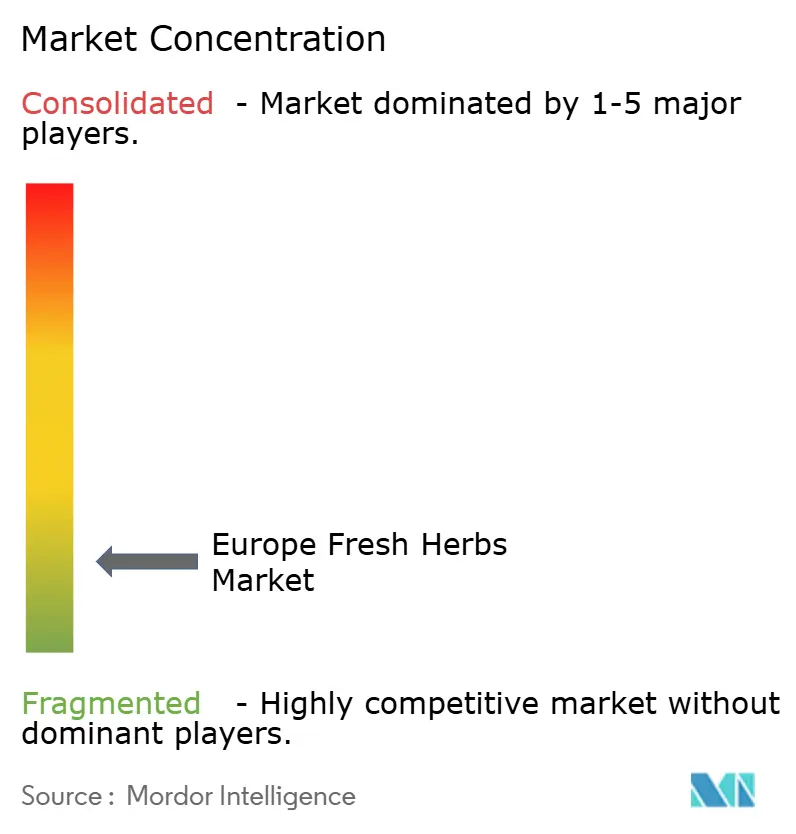
| Market Concentration | Low |
Major Players *Disclaimer: Major Players sorted in no particular order Image © Mordor Intelligence. Reuse requires attribution under CC BY 4.0. | |
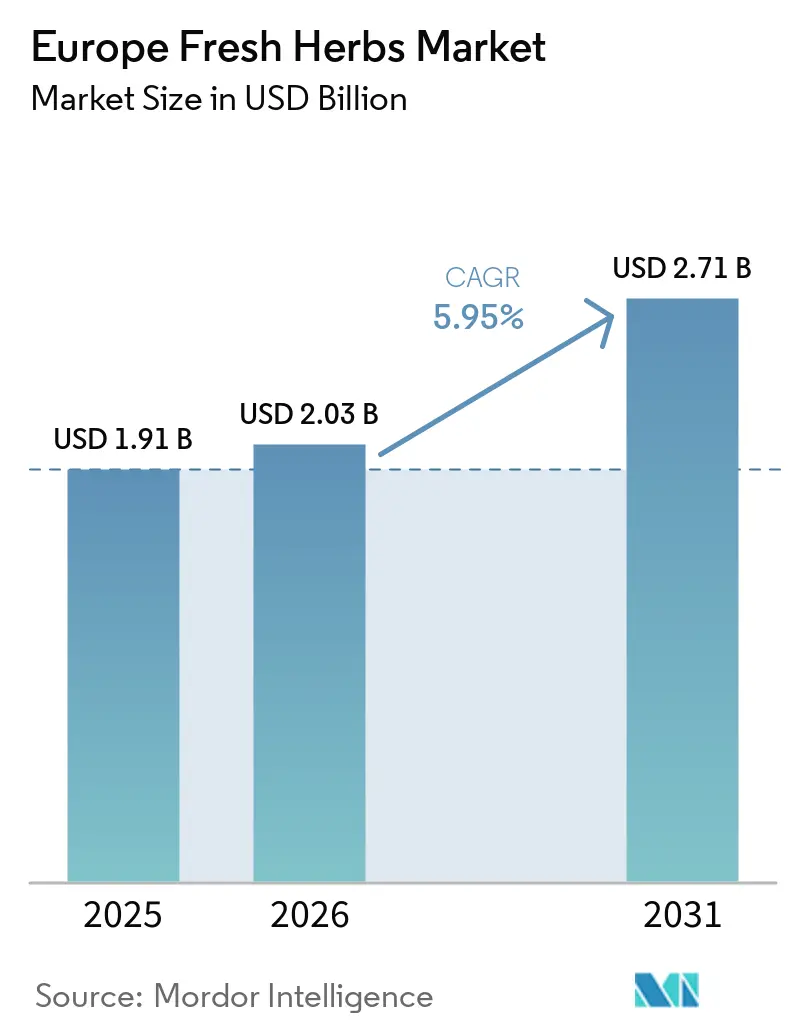
Europe Fresh Herbs Market Analysis by Mordor Intelligence
The Europe fresh herbs market size was valued at USD 1.91 billion in 2025 and is forecast to grow from USD 2.03 billion in 2026 to USD 2.71 billion by 2031, at a CAGR of 5.95% from 2026 to 2031. Consumer demand for minimally processed foods with familiar ingredients supports the market. Fresh herbs provide flavor and recognizable ingredients across retail and foodservice channels. Clean-label reformulation also supports the use of fresh herbs in selected food-processing applications, where manufacturers seek recognizable ingredients and natural flavor profiles. Producers are responding by adopting controlled-environment production, pursuing organic certification, improving packaging, and implementing local supply programs. Shelf life, product appearance, year-round availability, and consistent delivery remain central to repeat purchases and shelf availability at retailers.
Key Report Takeaways
- By product type, basil accounted for 40.8% of the Europe fresh herbs market share in 2025, while parsley is forecast to grow at a CAGR of 9.2% from 2026 to 2031.
- By category, conventional accounted for 70.0% of the Europe fresh herbs market size in 2025, while organic is forecast to grow at a CAGR of 7.8% from 2026 to 2031.
- By cultivation method, greenhouse cultivation accounted for 39.0% of the market share in 2025, while vertical indoor cultivation is forecast to grow at a CAGR of 10.0% from 2026 to 2031.
- By end user, food retail accounted for 40.1% of the market share in 2025, while pharmaceutical and nutraceutical applications are forecast to grow at a CAGR of 8.2% from 2026 to 2031.
- By geography, Germany accounted for 25.56% of the market share in 2025 and is forecast to grow at the fastest CAGR of 7.2% from 2026 to 2031.
Note: Market size and forecast figures in this report are generated using Mordor Intelligence’s proprietary estimation framework, updated with the latest available data and insights as of January 2026.
Market Trends and Insights
Drivers Impact Analysis of Europe Fresh Herbs Market*
| Driver | (~) % Impact on CAGR Forecast | Geographic Relevance | Impact Timeline |
|---|---|---|---|
| Clean-Label and Natural Ingredient Demand | +1.5% | EU-wide, with high relevance in Germany, France, the United Kingdom, Italy, and Spain | Medium term (2-4 years) |
| Organic and Sustainable Food Preference | +1.2% | EU-wide, with strong adoption in Austria, Sweden, Germany, and Denmark | Medium term (2-4 years) |
| Foodservice and Mediterranean Cuisine Penetration | +1.0% | Southern Europe, with expansion into Northern and Eastern Europe | Medium term (2-4 years) |
| Controlled-Environment Agriculture and Year-Round Supply | +0.8% | Netherlands, Germany, the United Kingdom, Belgium, and Nordic countries | Long term (≥ 4 years) |
| Hyper-Local Distribution and Micro-Fulfillment | +0.7% | Germany, Netherlands, the United Kingdom, with emerging activity in France and Spain | Long term (≥ 4 years) |
| Downy Mildew-Resistant and Cold-Tolerant Seed Commercialization | +0.5% | EU-wide, with the largest benefit in Italy, Germany, Netherlands, and Spain | Long term (≥ 4 years) |
| Source: Mordor Intelligence | |||
Clean-Label and Natural Ingredient Demand
More than 75% of consumers in France, Germany, Italy, Spain, and Poland actively avoided ultra-processed foods, according to the Centre for the Promotion of Imports from Developing Countries[1]. Consumer interest in minimally processed and recognizable ingredients is supporting demand for natural flavoring options in Europe. Fresh herbs offer recognizable flavor and ingredient positioning across household cooking, foodservice, and selected food-processing applications. Processed food manufacturers are also reformulating products to reduce the use of synthetic flavoring agents and simplify product labels. Herb-derived flavor systems, therefore, generate demand beyond retail produce displays and across prepared foods. Regulation on authorized food additives further supports interest in plant-based alternatives. Fresh herbs serve a clear role where buyers require a natural ingredient statement, a recognizable flavor source, and a product format suited to everyday meal preparation. This shift toward recognizable, natural ingredients is likely to support demand for fresh herbs across retail and food manufacturing applications in Europe.
Organic and Sustainable Food Preference
Growing consumer preference for organic and sustainably produced food supports the Europe fresh herbs market by strengthening demand for certified potted and cut herbs in premium retail ranges. According to the Research Institute of Organic Agriculture (FiBL), organic agricultural land in the European Union reached 18.1 million hectares in 2024, representing 11.1% of the EU's total agricultural land[2]. The EU organic retail market also grew by 3.6% compared with 2023, reaching EUR 49.5 billion (USD 53.5 billion). This growth reflects continued demand for certified organic products. For fresh herbs, organic certification can help retailers differentiate premium private-label offerings and appeal to consumers seeking products that meet established production standards. Regulation (EU) 2018/848 establishes common requirements for organic production, certification, and labeling across the European Union. These consumer preferences and regulatory standards create opportunities for organic fresh herbs across European retail channels.
Foodservice and Mediterranean Cuisine Penetration
Foodservice remains an important volume outlet for the Europe fresh herbs market, as restaurants require consistent flavor, origin, quality, and availability. Mediterranean cooking creates recurring use of basil, parsley, oregano, and mint in professional kitchens and familiar consumer recipes. Dried alternatives do not provide the same fresh flavor or appearance in many menu applications, particularly where herbs are visible in finished dishes. Vitacress reported supplying fresh herbs across retail and foodservice channels, including formats designed for convenient consumer use[3]. The channel therefore supports regular supply volumes, greater consumer familiarity with fresh herb formats, and continued demand for consistent quality. The continued use of fresh herbs in foodservice and Mediterranean-style cuisine is therefore projected to support recurring consumption and demand across the European market.
Controlled-Environment Agriculture and Year-Round Supply
Controlled-environment agriculture supports the Europe fresh herbs market by reducing dependence on seasonal field output and enabling production closer to major demand centers. The European Commission identified greenhouses, hydroponics, vertical farms, and aeroponics as priorities in its call for research on controlled-environment agriculture. Research published in Nature Food identified herbs and leafy greens as commercially relevant crops for indoor agriculture due to their value and production characteristics. Year-round basil production at Van Vugt Kruiden B.V., Ridderkerk glasshouses, demonstrates how glasshouse production can reduce reliance on airfreighted supply and improve delivery consistency. Controlled systems also allow producers to manage humidity, temperature, irrigation, and crop scheduling more closely, improving supply continuity for retail and foodservice buyers that require predictable deliveries and stable quality across seasons. The expansion of controlled-environment production is therefore projected to strengthen year-round fresh herb availability and support a more consistent supply across the European market.
Restraints Impact Analysis of Europe Fresh Herbs Market*
| Restraint | (~) % Impact on CAGR Forecast | Geographic Relevance | Impact Timeline |
|---|---|---|---|
| Short Shelf Life and Post-Harvest Losses | -1.2% | EU-wide, with the greatest effect on routes exceeding 24-hour transit | Short term (≤ 2 years) |
| Weather-Driven Yield and Price Volatility | -1.0% | All European growing regions, especially Spain, Italy, Netherlands, and the United Kingdom | Short term (≤ 2 years) |
| Stricter Maximum-Residue and Phytosanitary Requirements | -0.8% | Most acute for non-EU imports from Morocco, Kenya, and Israel, with compliance effects for EU producers | Medium term (2-4 years) |
| Authentication and Traceability Cost | -0.6% | Northern and Western Europe, particularly Germany, the United Kingdom, Netherlands, and France | Medium term (2-4 years) |
| Source: Mordor Intelligence | |||
Short Shelf Life and Post-Harvest Losses
Short shelf life remains a persistent constraint on the Europe fresh herbs market, as losses can occur before products reach consumers. Basil has a shelf life of 1 to 2 weeks, depending on water loss, and should be stored above 10°C (50°F) to minimize chilling injury. This requires a dedicated temperature-management approach that differs from standard refrigerated produce logistics, thereby complicating the distribution of mixed produce. A 2025 study published in the journal Open Agriculture identified losses associated with mishandling, transportation conditions, and technology gaps across fresh produce supply chains. Direct farm-to-retail supply can reduce the time available for quality loss to occur. Modified-atmosphere packaging can extend display life, although the added cost remains a challenge in price-sensitive retail programs.
Weather-Driven Yield and Price Volatility
Weather variability limits the Europe fresh herbs market by creating uneven yields, unstable costs, and inconsistent product quality. Excess humidity, heavy rainfall, and cold events can trigger fungal disease, reduce essential oil levels, and shorten post-harvest performance. Open-field production is particularly exposed, as it supplies lower-cost summer volumes and processing demand. Greenhouse operators face pressure when cold periods raise energy costs and affect controlled-environment production economics. Droughts and flooding can disrupt retailer promotions and encourage temporary switching to dried herbs. The European Union's coordinated pesticide monitoring program for 2025, 2026, and 2027 adds residue scrutiny during periods when disease management becomes more difficult.
*Our forecasts treat driver/restraint impacts as directional, not additive. The impact forecasts reflect baseline growth, mix effects, and variable interactions.
Europe Fresh Herbs Market Segment Analysis
By Product Type:
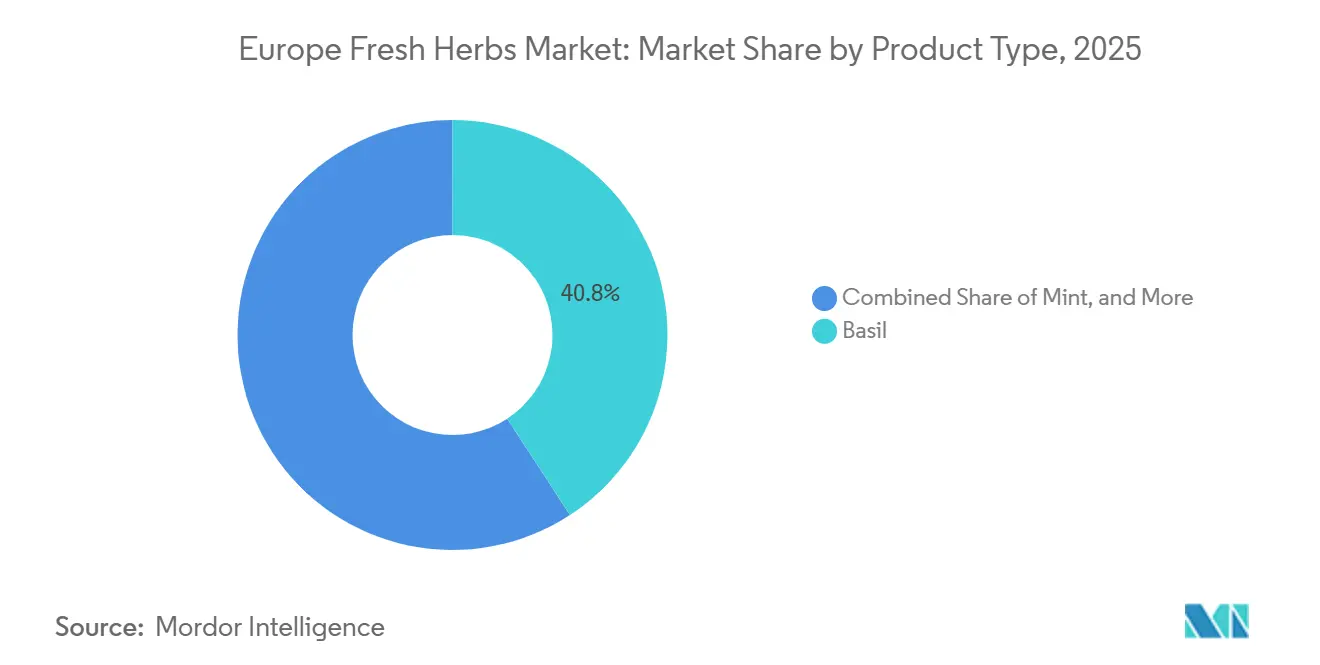
Basil Leads, While Parsley Grows FastestBasil accounted for 40.8% of the Europe fresh herbs market share in 2025, reflecting its presence across potted retail formats, hydroponic cut supply, foodservice, and food processing. Downy mildew-resistant varieties, including the Prospera Active series, address a key production risk for growers by reducing weather-related supply exposure associated with open-field Mediterranean production. Basil also benefits from its established role in household and restaurant cooking across European markets.
Parsley is forecast to grow at a CAGR of 9.2% from 2026 to 2031, driven by its use in Mediterranean, Eastern European, and Middle Eastern cuisines, as well as controlled-environment production in the Netherlands. Cilantro and coriander benefit from demand among South Asian and Middle Eastern communities in the United Kingdom, France, and Germany. Mint, rosemary, thyme, and oregano retain steady demand through Mediterranean cooking traditions. Sage, chives, dill, and other herbs preserve distinct regional preferences and higher-value foodservice needs.

By Category:
Conventional Leads, While Organic Registers the Fastest GrowthConventional fresh herbs accounted for 70% of the Europe fresh herbs market size in 2025, as mainstream retail and food-processing buyers continue to prioritize price competitiveness and dependable volumes. Conventional supply is supported by a broad-based demand for grocery distribution and processing. This does not indicate an absence of organic transition, as growers and retailers are expanding certification across selected products and price tiers.
The organic segment of the Europe fresh herbs market is forecast to grow at a CAGR of 7.8% from 2026 to 2031, supported by demand for certified products and premium private-label assortments. Retailers seeking consistent organic herb supplies can benefit from growers operating under established certification frameworks. For example, Gartenbauzentrale eG offers organic herbs certified under EU organic standards and additional schemes, including Naturland, Bioland, and Demeter. Product innovation also supports this segment, as Vegobel introduced a plastic-free organic living-herb format using a biodegradable soil plug in 2025. These developments operate within the broader regulatory framework established by Regulation (EU) 2018/848, which harmonizes rules for organic production, certification, and labeling across the European Union.
By Cultivation Method:
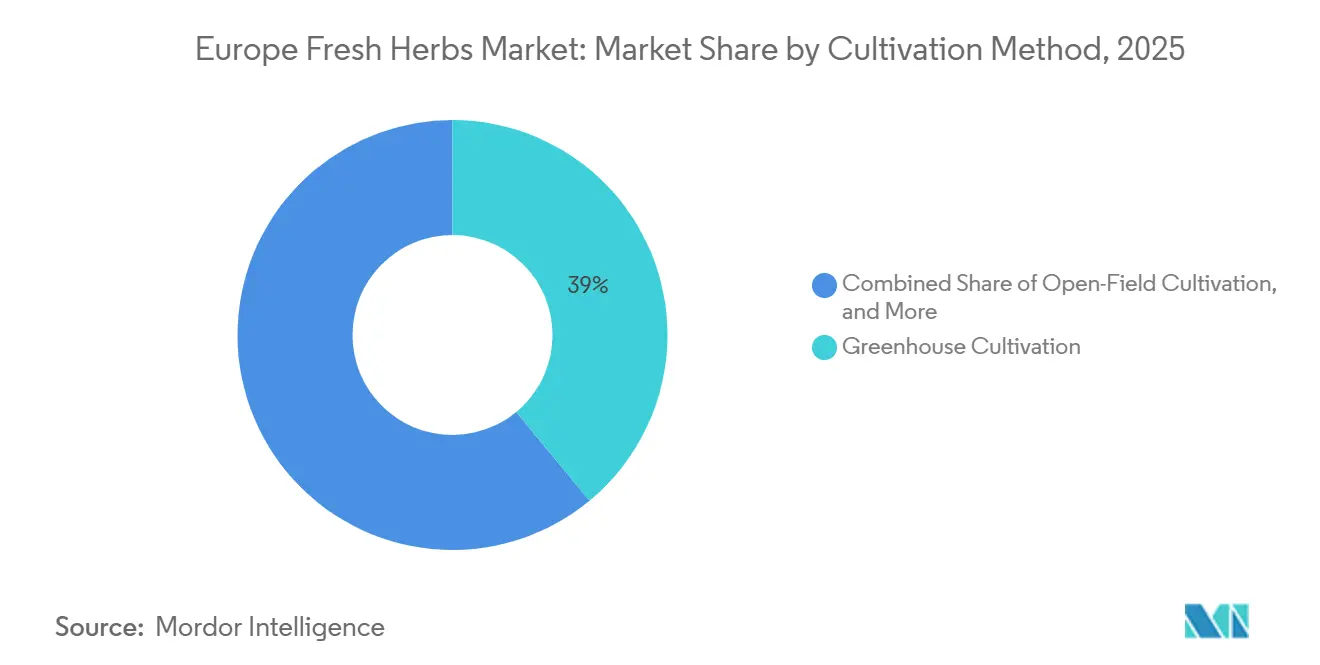
Greenhouse Cultivation Leads, While Vertical Indoor Cultivation Grows FastestGreenhouse cultivation accounted for 39% of the market share in 2025. The Europe fresh herbs market relies on glasshouse systems in the Netherlands, Germany, and the United Kingdom for commercial-scale year-round supply. Vitacress operates a 13.5-hectare greenhouse in West Sussex with more than 3 million herb pots. Van Vugt Kruiden B.V.’s Ridderkerk glasshouses supply basil, parsley, coriander, and chives throughout the year. Greenhouses provide climate control that limits exposure to wind, hail, pests, and temperature changes.
Vertical indoor cultivation is forecast to grow at a CAGR of 10% from 2026 to 2031, supported by LED cost reductions and automation investment. Green City Jungle produces basil year-round in Kraków using renewable energy. Deliplant reported yields 65 times higher per land area than single-level open-field cultivation. Open-field cultivation continues to supply lower-cost summer volumes, while hydroponic and aeroponic systems offer intermediate options for mint and basil.
By End User:
Food Retail Leads, While Pharmaceutical and Nutraceutical Applications Grow FastestFood retail accounted for 40.1% of the market share in 2025. Grocery chains support year-round programs for potted, cut, and living herb formats. Performance in food retail depends heavily on shelf life and display quality. Producers that extend display days can improve their position in retailer range reviews and promotional programs. Vitacress supplies more than 49 varieties through its SEASON Herbs range, while Spisa Group produces fresh-packed herbs for European retail and foodservice customers.
Pharmaceutical and nutraceutical applications are forecast to grow at a CAGR of 8.2% from 2026 to 2031, supported by interest in the bioactive compounds found in herbs such as oregano, rosemary, and thyme. Their antioxidant and antimicrobial properties create opportunities for herb extracts and essential oils in supplement formulations and other health-related products. While foodservice demand centers on consistent quality and reliable supply, food processing uses larger volumes of herbs for flavoring and product preservation. Cosmetics, aromatherapy, and beverages provide additional end-use applications for aromatic herbs.
Geography Analysis
Germany and the United Kingdom Fresh Herbs Market
Germany accounted for 25.56% of the market share in 2025 and is the fastest-growing country, with a CAGR of 7.2% from 2026 to 2031. Germany’s organic agricultural area represented 11.1% of its agricultural land in 2024, or nearly 1.8 million hectares. This base supports premium organic herb formats, while Gartenbauzentrale eG illustrates year-round certified production of potted and cut herbs. The United Kingdom remains shaped by large grocery chains and vertically integrated growers. Vitacress produces 18 million pots each year, and Langmead Herbs expanded its supply reach by acquiring R&G Fresh Limited in September 2026.
Mediterranean Europe Fresh Herbs Market
France, Italy, and Spain form the core Mediterranean production and consumption area. France saw pressure on organic demand during the inflation period, although fresh herb purchasing remained linked to established Mediterranean dietary patterns. Italy remains important for open-field basil and oregano production from areas including Sicily and Liguria. Spain is expanding controlled-environment production to serve European demand. Foodys announced a EUR 6 million (USD 6.6 million) investment plan in 2024 to expand hydroponic capacity and replace airfreighted African supply with European production.
Nordics, BENELUX and Central and Eastern Europe Fresh Herbs Market
The Rest of Europe region includes Nordic countries, Benelux, Poland, and Central and Eastern European markets. Poland is among Spisa Group’s three largest markets, highlighting its importance in the regional herb trade. In the Netherlands, Van Vugt Kruiden B.V. acquired a three-hectare horticultural site adjacent to its Ridderkerk facility in May 2026. The company plans to prepare the site for fresh herb cultivation during 2026, with initial sowing and planting scheduled for early 2027. This expansion is intended to increase cultivation capacity and strengthen supply reliability for retail and foodservice customers.
Competitive Landscape
The Europe fresh herbs market is highly fragmented, with Vitacress, Spisa Group, Greenyard, Langmead Herbs among the notable suppliers. Langmead Herbs strengthened its position in September 2026 by acquiring R&G Fresh. Retail buyers retain negotiating power because suppliers remain dispersed, which can restrict pricing and slow broad-based consolidation. Proprietary packaging, disease-resistant varieties, certified organic supply, and compliance with Regulation (EU) 2018/848 are important points of differentiation.
Strategic activity in 2025 and 2026 highlighted a focus on ownership consolidation, supply-chain integration, and operational restructuring across the European fresh produce sector. Garden S.à r.l. completed its acquisition of 100% of Greenyard in September 2025 following a simplified squeeze-out process. In September 2026, Langmead Herbs acquired R&G Fresh, adding fresh-cut herb packing capacity and expanding its capabilities in growing, importing, and distributing. In July 2026, Greenfood sold its Fresh Produce business to Dole Nordic and refocused on Picadeli and Food Solutions. These developments illustrate how companies across the fresh produce sector are reshaping their operations and value-chain positions.
Opportunities in the Europe fresh herbs market include lower-carbon winter production, affordable organic formats, and localized cultivation for northern markets. Controlled-environment operators such as Green City Jungle, Deliplant, and SemperVere illustrate approaches to improving freshness, shelf life, and product provenance. Crop innovation also addresses production risks: Genesis Seeds' Prospera Active basil series offers resistance to two races of downy mildew, a significant disease affecting basil cultivation. Across these opportunities, reliable year-round supply, consistent product quality, efficient packaging, and adequate production capacity remain important competitive factors.
Europe Fresh Herbs Industry Leaders
-
Vitacress Limited (RAR Group)
-
Spisa Group (Gavia Holdings Group)
-
Greenyard NV
-
Langmead Herbs Limited (Langmead Group)
-
Van Vugt Kruiden B.V.
- *Disclaimer: Major Players sorted in no particular order
Europe Fresh Herbs Market Companies Covered in this Report
- Vitacress Limited (RAR Group)
- Greenyard NV
- Enza Zaden Beheer B.V.
- Langmead Herbs Limited (Langmead Group)
- Organic Herb Trading Company Limited
- Spisa Group (Gavia Holdings Group)
- Greenfood AB
- Gartenbauzentrale eG
- Van Vugt Kruiden B.V.
- Vegobel
- Kruiden Claus
- GrowUp Farms Limited
- Hermann Kräuter
- Dreesen Kräuter
- VDV-Herbs
Recent Industry Developments in Europe Fresh Herbs Market
- September 2026: Langmead Herbs Limited acquired R&G Fresh Limited, a fresh-cut herb supplier established in 1958. The acquisition added R&G Fresh Limited's Farnborough packing facility to Langmead Herbs Limited’s existing glasshouse and cut-herb importing operations, expanding its fresh herb production and packing capabilities in the United Kingdom.
- June 2026: Dole Nordic AB completed the acquisition of Greenfood AB’s Fresh Produce division following clearance from the Swedish Competition Authority. The acquisition added a 26,500-square-meter distribution facility in Helsingborg, Sweden, to Dole Nordic AB’s network and expanded its fresh produce distribution capabilities in the Nordic region.
- May 2026: Van Vugt Kruiden B.V. acquired a three-hectare horticultural site adjacent to its existing facility in Ridderkerk, the Netherlands, to expand its fresh herb cultivation capacity. The site is being prepared for fresh herb cultivation during 2026, with the first herbs scheduled to be sown and planted from early 2027. The expansion is intended to strengthen locally grown herb supply and support year-round availability for retail and foodservice customers in Europe.
Europe Fresh Herbs Market Report Scope
The fresh herbs market refers to the production, cultivation, distribution, and commercialization of fresh culinary and aromatic herbs, such as basil, cilantro, mint, parsley, oregano, rosemary, and thyme. It includes conventionally and organically grown herbs supplied in fresh form to foodservice, food retail, food processing, and other end users.
The Europe fresh herbs market is segmented by product type (basil, cilantro/coriander, mint, parsley, chives, oregano, rosemary, thyme, sage, dill, and other fresh herbs), by category (conventional and organic), by cultivation method (open-field cultivation, greenhouse cultivation, hydroponic cultivation, aeroponic cultivation, and vertical indoor cultivation), by end user (foodservice, food retail, food processing, pharmaceutical and nutraceutical, and other end users), and by geography (Germany, United Kingdom, France, Italy, Spain, Russia, and rest of Europe). The market sizes and forecasts are provided in terms of value (USD).
Segmentation Overview
| Basil |
| Cilantro/Coriander |
| Mint |
| Parsley |
| Chives |
| Oregano |
| Rosemary |
| Thyme |
| Sage |
| Dill |
| Other Fresh Herbs |
| Conventional |
| Organic |
| Open-Field Cultivation |
| Greenhouse Cultivation |
| Hydroponic Cultivation |
| Aeroponic Cultivation |
| Vertical Indoor Cultivation |
| Foodservice |
| Food Retail |
| Food Processing |
| Pharmaceutical and Nutraceutical |
| Other End Users |
| Europe | Germany |
| United Kingdom | |
| France | |
| Italy | |
| Spain | |
| Russia | |
| Rest of Europe |
| By Product Type | Basil | |
| Cilantro/Coriander | ||
| Mint | ||
| Parsley | ||
| Chives | ||
| Oregano | ||
| Rosemary | ||
| Thyme | ||
| Sage | ||
| Dill | ||
| Other Fresh Herbs | ||
| By Category | Conventional | |
| Organic | ||
| By Cultivation Method | Open-Field Cultivation | |
| Greenhouse Cultivation | ||
| Hydroponic Cultivation | ||
| Aeroponic Cultivation | ||
| Vertical Indoor Cultivation | ||
| By End User | Foodservice | |
| Food Retail | ||
| Food Processing | ||
| Pharmaceutical and Nutraceutical | ||
| Other End Users | ||
| By Geography | Europe | Germany |
| United Kingdom | ||
| France | ||
| Italy | ||
| Spain | ||
| Russia | ||
| Rest of Europe | ||
Key Questions Answered in the Report
What is the Europe fresh herbs market size in 2031?
The Europe fresh herbs market is forecast to reach USD 2.71 billion by 2031, growing at a CAGR of 5.95% from 2026 to 2031.
Which fresh herb product leads European demand?
Basil led the European fresh herbs market, accounting for 40.8% of the market share in 2025. Its demand is supported by its widespread use in potted retail herbs, hydroponically grown cut herbs, foodservice, and food processing applications.
Which herb product will grow the fastest through 2031?
Parsley is forecast to be the fastest-growing herb product, with a CAGR of 9.2% from 2026 to 2031.
Which is the largest end-user segment for fresh herbs in Europe?
Food retail was the largest end-user segment in the Europe fresh herbs market, accounting for 40.1% of the market share in 2025. Demand is supported by grocery retailers offering potted, cut, and living fresh herbs, with shelf life and in-store display performance influencing supplier selection.
What factors limit the growth of European fresh herb suppliers?
The growth of European fresh herb suppliers is constrained by product perishability, weather-driven yield fluctuations, pesticide residue compliance requirements, and traceability costs.