
Market Overview
| Study Period | 2021 - 2031 |
|---|---|
| Forecast Data Period | 2026 - 2031 |
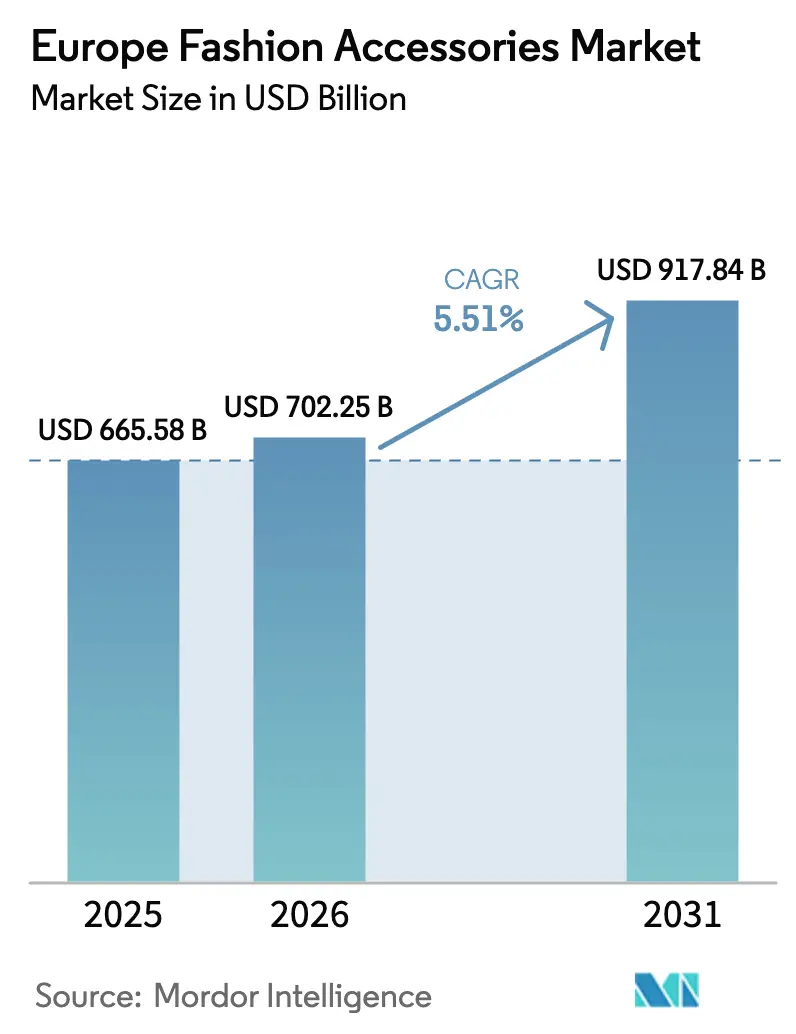
| Base Year Market Size (2025) | USD 665.58 Billion |
| Market Size (2026) | USD 702.25 Billion |
| Market Size (2031) | USD 917.84 Billion |
| Growth Rate (2026 - 2031) | 5.51 % |
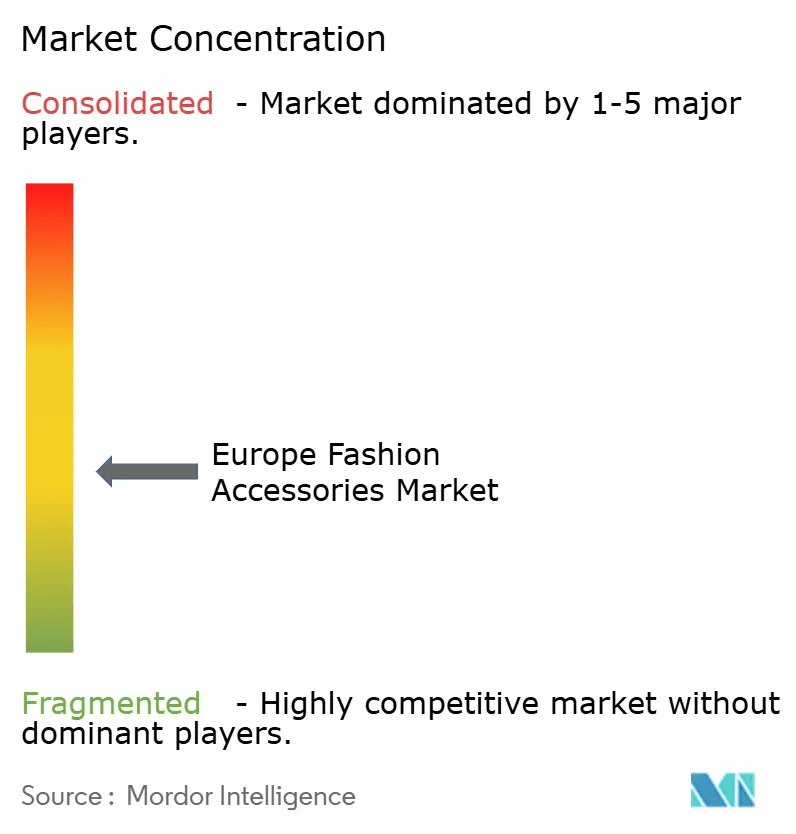
| Market Concentration | Medium |
Major Players *Disclaimer: Major Players sorted in no particular order Image © Mordor Intelligence. Reuse requires attribution under CC BY 4.0. | |
Europe Fashion Accessories Market Analysis by Mordor Intelligence
European Fashion Accessories market size in 2026 is estimated at USD 702.25 billion, growing from 2025 value of USD 665.58 billion with 2031 projections showing USD 917.84 billion, growing at 5.51% CAGR over 2026-2031. The market's expansion is driven by multiple factors, including changes in consumer lifestyles, increased household expenditure, favorable demographics, and rising demand for branded products. Europe maintains its position as a resilient luxury consumption hub despite global economic challenges, with the market benefiting from technological innovation and sustainability mandates. The sector demonstrates remarkable pricing power and brand loyalty, insulating it from typical discretionary spending cuts. The growing emphasis on eco-fashion further strengthens market growth, reflecting evolving consumer preferences toward sustainable and environmentally conscious products.
Key Report Takeaways
- By product type, apparel led with 59.02% of European fashion accessories market share in 2025, whereas watches are poised to grow the fastest at a 5.78% CAGR through 2031.
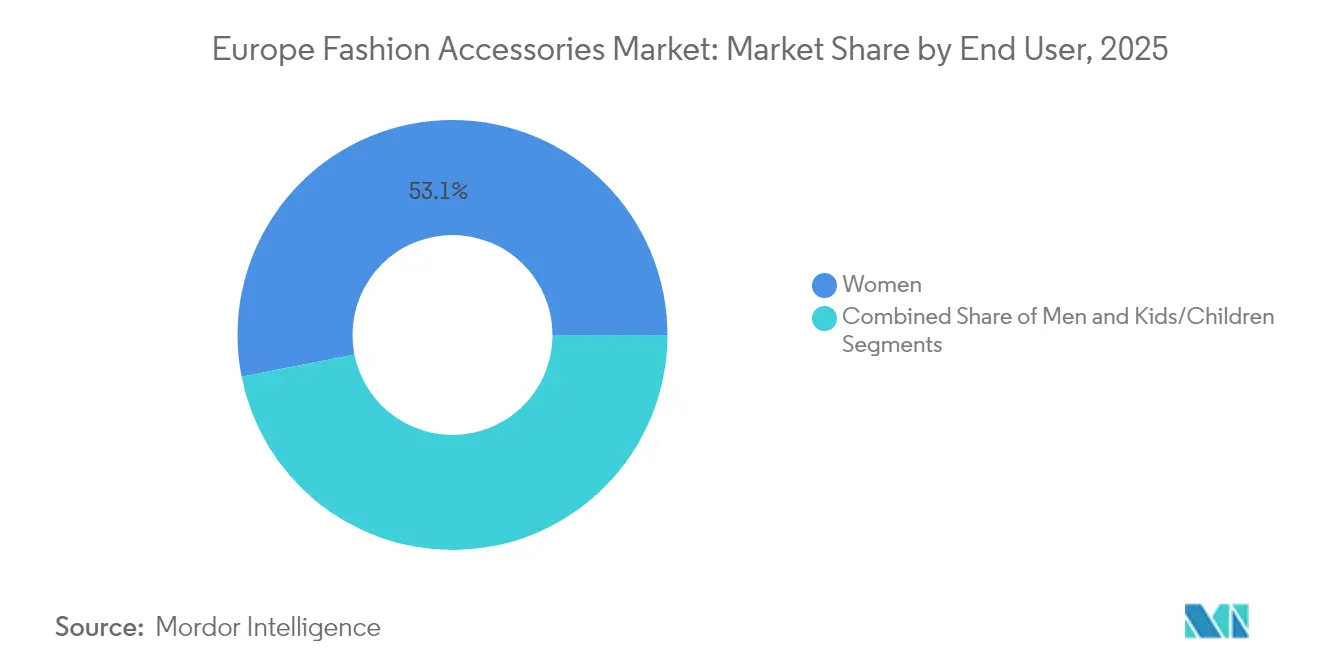
- By end user, women accounted for 53.11% of the European fashion accessories market in 2025; the children’s segment is projected to expand at a 6.14% CAGR to 2031.
- By category, mass accessories held 63.92% of the European fashion accessories market size in 2025, while premium offerings are advancing at a 6.45% CAGR through 2031.
- By distribution channel, offline stores retained 65.98% share of the European fashion accessories market in 2025, though online platforms are set to record a 6.86% CAGR to 2031.
- By geography, the United Kingdom captured 16.63% of the European fashion accessories market share in 2025 and Spain is expected to post the highest 7.25% CAGR by 2031.
Note: Market size and forecast figures in this report are generated using Mordor Intelligence’s proprietary estimation framework, updated with the latest available data and insights as of 2026.
Europe Fashion Accessories Market Trends and Insights
Drivers Impact Analysis*
| Driver | (~) % Impact on CAGR Forecast | Geographic Relevance | Impact Timeline |
|---|---|---|---|
| Technological Advancements in Terms of Design and Raw Material | 1.2% | Regional, with concentration in Germany and France | Medium term (2-4 years) |
| Strong Demand From Inbound Tourist | 1.8% | UK, France, Italy, Spain resort markets | Short term (≤ 2 years) |
| Increasing Demand For Luxury Products | 1.5% | UK, Germany, France core markets | Long term (≥ 4 years) |
| Rising Demand For Sportswear From Fitness-Conscious Consumers | 0.9% | Germany, Netherlands, Nordics | Medium term (2-4 years) |
| Sustainability and Ethical Production | 0.8% | EU-wide, strongest in Germany and Netherlands | Long term (≥ 4 years) |
| Influence of Social Media and Celebrity Endorsements | 1.1% | Regional, particularly strong in UK and France | Short term (≤ 2 years) |
| Source: Mordor Intelligence | |||
Technological Advancements in Terms of Design and Raw Material
The integration of artificial intelligence and 3D printing technologies is transforming the European fashion market by reducing product development cycles from months to weeks and minimizing material waste. 3D printing enables manufacturers to create intricate designs, prototype rapidly, and produce customized accessories with reduced material wastage. The technology allows for complex geometries and innovative material combinations that were previously impossible with traditional manufacturing methods. The convergence of technology and fashion continues with Dolce Vita's April 2025 partnership with HILOS for on-demand 3D printed footwear, highlighting the market's evolution toward mass customization. These technological integrations enable fashion brands to offer personalized experiences through connected accessories while creating additional revenue streams in traditional craft-based segments.
Strong Demand From Inbound Tourist
Tourism's resurgence in Europe has significantly influenced the fashion accessories market by creating a luxury spending multiplier effect. The shift in consumer preferences toward experiential luxury has positioned accessories as portable status symbols and travel mementos, driving demand for lightweight, versatile pieces suitable for various occasions. Duty-free retail has evolved with brands establishing flagship stores in airports and resort destinations to capture tourist spending before it disperses to local markets. According to UN Tourism, Europe recorded 747 million international arrivals in 2024, representing a 5% increase from 2023, supported by strong intraregional demand [1]Source: UN Tourism, “International tourism recovers pre-pandemic levels in 2024,” unwto.org . However, the geographic concentration of tourist spending exposes brands to risks from geopolitical tensions and travel restrictions, making diversification across tourist source markets essential for European fashion accessories brands.
Increasing Demand For Luxury Products
Luxury accessories market demonstrates remarkable resilience in Europe, driven by generational wealth transfer and increasing adoption among younger demographics. The region's rising disposable income and growing preference for luxury products, coupled with a GDP per capita of USD 59.05 thousand in 2024 according to IMF, fuel market expansion[2]Source: International Monetary Fund, “World Economic Outlook Database,” imf.org . The strong presence of established luxury fashion houses like Louis Vuitton, Gucci, and Prada influences consumer purchasing behavior, while the growing middle-class population's aspirations for premium fashion accessories further stimulate market growth across European countries. The digital transformation of luxury retail, including enhanced e-commerce platforms and virtual try-on experiences, has created additional channels for market penetration and customer engagement. Furthermore, the increasing focus on sustainable and ethically produced luxury accessories aligns with European consumers' environmental consciousness, driving demand for responsibly manufactured premium products.
Rising Demand For Sportswear From Fitness-Conscious Consumers
Consumer preferences for technology-integrated accessories are reshaping the European fashion accessories market. Market growth shows a notable shift beyond traditional athletic categories, with athleisure accessories such as performance watches and fitness-tracking jewelry becoming lifestyle statements. This evolution has created demand for sport-specific accessories that combine functionality with fashion appeal. Sustainability concerns are influencing product development, as brands focus on recycled and bio-based materials that meet performance requirements while addressing environmental consciousness. The integration of health monitoring capabilities with fashion is generating opportunities for accessories that provide biometric feedback while maintaining aesthetic appeal, positioning wellness as a luxury lifestyle category. This trend is exemplified by the December 2024 collaboration between Gucci and Ōura, which produced an 18-karat gold smart ring. The ring's ability to track vital health metrics, including heart rate, respiratory rate, temperature, and sleep stages, while maintaining premium aesthetics, demonstrates the market's evolution toward tech-integrated fashion accessories.
Restraints Impact Analysis*
| Restraint | (~) % Impact on CAGR Forecast | Geographic Relevance | Impact Timeline |
|---|---|---|---|
| Proliferation of Counterfeit Products | -0.8% | Regional, particularly affecting online channels | Short term (≤ 2 years) |
| Supply Chain Disruptions | -1.2% | Regional, with acute impact on Italy and Germany | Medium term (2-4 years) |
| Fluctuating Raw Material Prices | -0.6% | Regional, particularly affecting leather and textile segments | Short term (≤ 2 years) |
| Rising Trade Barriers and Tariffs | -1.1% | EU-US trade corridor, broader global impact | Medium term (2-4 years) |
| Source: Mordor Intelligence | |||
Proliferation of Counterfeit Products
Counterfeiting inflicts substantial damage on the fashion industry, as evidenced by the European Union Intellectual Property Office's (EUIPO) January 2024 report, which revealed annual losses of EUR 16 billion across Europe's clothing, cosmetics, and toy sectors, representing 5.2% of their total revenue [3]Source: European Union Intellectual Property Office, “Counterfeit goods cost EU industries billions of euros and thousands of jobs annually,” euipo.europa.eu .The proliferation of lower-priced counterfeit items appeals to cost-conscious consumers, weakening the market position of authentic luxury brands and diminishing their long-term brand equity. The challenge intensifies as counterfeit operations establish production facilities near target markets and employ advanced manufacturing methods that blur the distinction between genuine and fake products, thereby impeding market growth. The rise of e-commerce platforms has further complicated this issue, providing counterfeiters with additional channels to distribute their products while making it increasingly difficult for consumers to verify product authenticity. Additionally, the financial impact extends beyond direct sales losses, as legitimate brands must allocate significant resources to anti-counterfeiting measures and legal actions to protect their intellectual property rights.
Supply Chain Disruptions
Red Sea shipping disruptions have created significant inflationary pressures across European fashion supply chains, particularly affecting Italy's fashion sector, which heavily depends on Asian fiber and fabric imports worth over EUR 50 billion annually. The OECD projects these disruptions could contribute an additional 0.4 percentage points to consumer price inflation, affecting accessories pricing and consumer demand [4]Source: Organisation for Economic Co-operation and Development, “OECD Economic Outlook 2024,” oecd.org . Thesituation is particularly challenging for the accessories segment due to its complex supply chains spanning multiple countries for different components. While European brands are increasingly adopting nearshoring strategies to establish production facilities closer to consumption markets, the transition requires substantial investment and time to develop local manufacturing capabilities that can match the cost efficiencies of established Asian supply networks. The extended shipping times and increased freight costs have forced many fashion brands to maintain higher inventory levels, impacting their working capital and operational efficiency.
*Our forecasts treat driver/restraint impacts as directional, not additive. The impact forecasts reflect baseline growth, mix effects, and variable interactions.
Segment Analysis
By Product Type: Apparel Dominance Faces Watch Innovation
Apparel dominates the market with a 59.02% share in 2025, driven by athleisure trends and seasonal refresh cycles that generate consistent purchases across price segments. The footwear segment benefits from sneaker culture and performance-fashion convergence, while watches demonstrate the highest growth potential at 5.78% CAGR through 2031, combining traditional craftsmanship with smart technology. Handbags maintain premium positioning despite slower volume growth, and wallets adapt to digital payment trends through multi-functional designs.
The accessories market continues to evolve with changing consumer preferences, where jewelry shows resilience through investment appeal and personalization trends, including the rise of lab-grown diamonds and sustainable materials. Sunglasses maintain year-round relevance beyond seasonal utility, exemplified by successful collaborations like Saint Laurent x Ray-Ban. This transformation reflects broader lifestyle changes where accessories serve both functional and identity expression purposes, with technology integration enabling premium pricing and differentiation across all categories.




By Category: Mass Market Stability Versus Premium Growth
Mass category accessories dominate with a 63.92% market share in 2025, leveraging established retail networks and price-sensitive consumer segments to maintain volume stability. However, premium segments are growing at a 6.45% CAGR through 2031, driven by consumers' willingness to invest in quality, sustainability, and brand prestige. This market bifurcation creates strategic challenges for mid-market brands, which face increasing pressure from both value competitors and accessible luxury alternatives.
The growth in premium accessories is underpinned by consumers viewing high-quality items as long-term investments that maintain value while providing emotional satisfaction. Meanwhile, mass market players focus on rapid product cycles and value engineering to capture fashion trends at accessible price points. Both segments approach sustainability differently - premium brands emphasize craftsmanship and durability, while mass market manufacturers incorporate recycled materials and circular business models to meet regulatory requirements and consumer expectations.
By End User: Women Lead While Children Accelerate
Women constitute 53.11% of market demand in 2025, demonstrating higher consumption rates across handbags, jewelry, and fashion accessories. While men's accessories gain momentum through expanding fashion consciousness and evolving workplace dress codes, the kids/children segment shows the strongest growth potential with a 6.14% CAGR through 2031, driven by early luxury exposure and parents' investment in quality accessories for special occasions.
Generational preferences significantly influence product development, with Generation Z prioritizing sustainable materials and authentic brand narratives while maintaining luxury aspirations. This shift aligns with broader demographic trends, particularly in the children's segment, where delayed parenthood among affluent consumers who focus spending on fewer children creates opportunities for premium positioning in traditionally value-oriented categories.
By Distribution Channel: Offline Resilience Meets Digital Growth
Offline stores continue to dominate the accessories market with a 65.98% share in 2025, highlighting consumers' preference for physical retail experiences where they can touch products and receive personalized service. While online channels are projected to grow at 6.86% CAGR through 2031, this represents a complementary shift rather than a replacement, as successful brands integrate digital capabilities with traditional retail to enhance the overall shopping experience.
The retail landscape is evolving through technological integration, with e-commerce platforms implementing virtual try-on features, augmented reality tools, and social commerce capabilities to improve online engagement. Physical stores are simultaneously transforming into experiential spaces that prioritize brand storytelling and customer interaction. Despite accelerated digital adoption during the pandemic, the tactile nature of accessories and their significance in gift-giving maintain the relevance of brick-and-mortar locations, particularly in luxury and premium segments where personalized service remains a crucial component of the purchase journey.
Geography Analysis
The United Kingdom dominates with a 16.63% market share in 2025, leveraging London's position as a global fashion capital and its robust luxury retail infrastructure. The UK market demonstrates resilience through its high-net-worth consumer base and established shopping districts that drive tourist spending, while successfully adapting to post-Brexit trade adjustments through modified supply chains and pricing strategies.
Spain leads market growth with a projected 7.25% CAGR through 2031, driven by tourism recovery and increasing domestic affluence. This growth complements the established markets of Germany, France, and Italy, where strong economic fundamentals, heritage luxury brands, and manufacturing excellence continue to shape the accessories landscape, despite challenges like Red Sea shipping disruptions affecting Italian supply chains.
The market further diversifies through emerging opportunities in the Netherlands, Poland, Belgium, and Sweden. Poland's increasing leather accessories imports, the Netherlands' advanced e-commerce adoption, Belgium's luxury retail expertise, and Sweden's sustainability leadership collectively contribute to the market's evolution and growth potential.
Regulatory Landscape
The European fashion accessories industry operates under an intensifying EU sustainability and product-compliance agenda that is expanding from materials and chemicals into lifecycle rules and digital traceability. A key recent step is the European Commission making the Digital Product Passport (DPP) Registry operational on 20 July 2026, which provides a practical entry point for companies to prepare data systems supporting upcoming requirements under the EU Ecodesign for Sustainable Products Regulation (ESPR, Regulation (EU) 2024/1781).
Textile and accessories brands are also navigating tighter product and marketing constraints. Under ESPR, large enterprises face a prohibition (effective 19 July 2026) on destroying unsold textile products and apparel accessories, while chemical and safety expectations continue to tighten through frameworks and standards used by the sector, including REACH-linked restrictions (with a new formaldehyde limit applying from 6 August 2026) and OEKO-TEX limit values effective from 1 June 2026. Separately, France has a PFAS ban for textiles in force from 1 January 2026, adding national-level compliance complexity for brands and suppliers selling into that market.
Value Chain Analysis
Europe fashion accessories value creation spans materials and components (leather, textiles, metals, stones, trims, lenses), design and product development, manufacturing and finishing (including specialized ateliers and contract manufacturers), quality assurance and compliance, and then distribution through brand retail, department stores, specialty stores, travel retail, and e-commerce. Sector dynamics increasingly reflect multi-country sourcing, where performance, aesthetics, and compliance requirements intersect, and where disruptions in global logistics can translate into longer lead times and higher inventory needs for brands operating across Europe.
Large groups such as LVMH, Kering, and Richemont strengthen value-chain control and risk management through group-wide sustainability and reporting frameworks. These frameworks shape procurement standards, supplier onboarding, and auditing depth. As due diligence and traceability expectations expand, brands are pushing for more granular supplier data, including facility-level disclosures, and structured reporting alignment, illustrated by Richemont referencing GRI Standards (2021) and Swiss Code of Obligations (Art. 964a-c) in its non-financial reporting as of May 2026. This shift increases operational weight on upstream partners, including tanneries, textile mills, and component suppliers, to provide verifiable inputs for chemicals management, provenance, and emissions reporting.
Competitive Landscape
The European fashion accessories market demonstrates moderate fragmentation, with established luxury conglomerates like LVMH, Kering, and Richemont dominating premium segments through brand portfolio diversification and vertical integration. Mid-market players face increasing competition from direct-to-consumer brands that bypass traditional retail markups, while emerging disruptors gain market share through sustainability positioning and digital-native strategies, particularly among younger demographics who prioritize brand values over heritage.
Technology adoption has become a crucial differentiator in the market, with companies investing in blockchain authentication, AI-powered personalization, and augmented reality experiences to enhance customer engagement and operational efficiency. Strategic partnerships between fashion brands and technology companies are increasingly important for innovation, enabling the combination of traditional craftsmanship with modern capabilities to create distinctive value propositions.
The market is experiencing significant changes in retail strategy and distribution models. The emergence of rental and resale platforms presents both challenges and opportunities, requiring brands to balance exclusivity with accessibility while addressing circular economy demands. Companies continue to expand their physical retail presence, as exemplified by Birkenstock's new store opening on King's Road in Chelsea, London in March 2025, which focuses on providing comprehensive product experiences to customers.
Europe Fashion Accessories Industry Leaders
Inditex SA
Kering SA
Richemont SA
Chanel SA
LVMH Moët Hennessy Louis Vuitton SE
- *Disclaimer: Major Players sorted in no particular order

Market Opportunities and Future Outlook
Operational compliance is shifting the industry from sustainability pledges to implementation, creating room for solutions and partnerships that reduce the cost and complexity of traceability and product-data management across accessories categories. With the European Commission making the DPP Registry live on 20 July 2026, brands, retailers, and suppliers have a concrete mechanism to begin organizing product-level data flows. That enables opportunities around interoperable labeling, authentication, and supplier data platforms that can serve both mass and premium segments.
Material innovation and verified sourcing are also becoming commercial differentiators as large luxury groups harden supplier expectations. Public sustainability frameworks and targets disclosed by leading groups such as LVMH and Kering reinforce demand for traceable inputs and credible environmental claims, while tighter rules around product destruction and chemicals compliance, including ESPR-related requirements and REACH-linked limits, increase the value of circularity programs. This includes repair services, resale-ready product design, and inventory optimization. Brands that combine digital transparency for DPP readiness with supply chain resilience measures, such as nearshoring and improved supplier diversification, have clearer pathways to protect availability and defend brand equity in a market facing both counterfeits and higher compliance scrutiny.
Recent Industry Developments
- July 2026: Gucci and L'Oréal enter into a 50-year exclusive beauty license agreement for Gucci fragrance and beauty products. The licensing deal extends Gucci into fragrance and beauty with long term potential for higher margin products. The arrangement broadens Gucci's category footprint in Europe and anchors brand equity across luxury beauty channels.
- July 2026: Chanel acquires full ownership of Charvet, the historic French shirtmaker. Vertical integration strengthens Chanel's control over craftsmanship and flagship retail footprint across Europe. The move consolidates supply chain assets for Chanel's heritage apparel and accessories offerings.
- May 2026: LVMH Moet Hennessy Louis Vuitton (Marc Jacobs brand) enters into a definitive agreement to sell the Marc Jacobs brand to WHP Global and G-III Apparel Group. The divestiture refocuses the group on core luxury maisons and may shift distribution and cost structure within the portfolio. The sale enhances strategic focus on flagship luxury brands and optimizes portfolio performance.


Research Methodology Framework and Report Scope
Market Definition and Coverage
This market covers the value of fashion accessories sold to consumers across Europe, counting retail and online sales for items that are purchased mainly for style, personal use, and everyday wear.
Scope exclusions: We exclude core apparel and footwear, as well as non-fashion protective equipment and industrial accessories that are not bought as fashion products.
Segmentation Overview
- By Product Type
- Footwear
- Apparel
- Wallets
- Handbags
- Watches
- Sunglasses
- Jewelery
- By End User
- Men
- Women
- Kids/Children
- By Category
- Mass
- Premium
- By Distribution Channel
- Offline Stores
- Online Stores
- By Geography
- Europe
- Germany
- United Kingdom
- Italy
- France
- Spain
- Netherlands
- Poland
- Belgium
- Sweden
- Rest of Europe
- Europe
Data Sources, Market Sizing, and Validation
Desk Research
Desk research was used to set the market boundaries, establish the country-level demand context, and validate year-to-year shifts that can change accessory spending. We used public statistics and trade flows to map where relevant products are made and where they are sold, then used that to sanity check size and growth patterns.
Sources included official and non-paywalled references such as Eurostat (retail trade and external trade), national statistical offices across major European economies, the European Commission (consumer and macro indicators), and OECD datasets for household consumption. We also used sources such as UN Comtrade, industry and trade association publications (for example leather goods and textiles), company annual reports and investor presentations, and reputable business press. Where needed, paid subscriptions were used for company financials and intelligence, patent databases, and shipment-level import and export datasets to fill gaps that are not consistently available in one public place, and the sources listed here are illustrative rather than exhaustive.
Primary Interviews and Surveys
Primary work was used to pressure test the desk view and translate broad indicators into sizing assumptions, including category splits, channel mix, and typical pricing ladders across countries. We spoke with a mix of brands, distributors, retailers, and supporting experts across key European markets so the model reflects both premium and mass buying behavior, and we rechecked inputs where answers differed across countries.
Distribution of primary research fieldwork respondents
| Company type | Respondent position |
|---|---|
| Top tier: 27% | CXOs: 19% |
| Mid tier: 52% | Functional/Unit leaders: 22% |
| Smaller Players: 21% | Managers: 59% |
Market-Sizing & Forecasting
Sizing starts with a top-down build where consumer spend on accessories is reconstructed by country using household consumption signals and retail trade direction, then mapped back to accessory categories and channels. To keep totals realistic, we corroborate this with selective bottom-up approximations using sampled price points and volumes from retailers, import intensity checks for accessory-heavy categories, and a roll-up of visible revenues where company disclosures are available.
Inputs that mattered most included household discretionary spend trends, online penetration in accessories, average selling price movement by category (premium versus mass), seasonal shopping peaks tied to holidays and tourism flows, and country differences in distribution mix between specialty stores and multi-brand retail. For forecasting, scenario analysis was used and anchored with a light multivariate regression linking growth to consumer spending direction, price inflation, and e-commerce share shifts, and assumptions were reviewed with primary respondents before finalizing. When a country or category had thin datapoints, we filled gaps using peer-country proxies and then adjusted using channel checks so the model does not overstate smaller markets.
Data Validation & Update Cycle
Validation is done through triangulation across independent signals so one data series does not drive the outcome on its own. We run variance checks at country and category level, review outliers against trade data and retail indicators, and rework assumptions when the implied price or volume does not align with real-world buying patterns.
Before sign-off, the model goes through multi-step analyst reviews with reasonableness checks against macro trends and category-specific demand indicators, followed by re-contacts when new information contradicts earlier inputs. Reports are refreshed annually, and interim updates are made when material events affect demand, pricing, or channel structure. Right before delivery, a fresh data pass is completed so the published view reflects the latest available information.
Mordor Intelligence's Europe Fashion Accessories Market Size Measured Against Other Published Estimates
Published market sizes for Europe fashion accessories often vary because the included product set is not consistent, the year and currency timing are handled differently, and pricing assumptions are updated at different points. Differences also show up when one estimate relies more on trade flows, while another relies more on retail sell-out signals or consumer spend.
Footwear and full apparel bundles are the biggest exclusions that explain the spread, since those categories sit outside Mordor Intelligence's scope for this market and can materially inflate totals when grouped with accessories. We also see gaps when studies apply aggressive price progression across premium items without checking channel mix shifts, and when older base years are carried forward without revalidating post-inflation demand elasticity in major European countries.
Benchmark comparison
| Source | Market Size | Gaps in Research Methodology |
|---|---|---|
| Mordor Intelligence | USD 665.58 B (2025) | |
| Global Consultancy A | USD 214.22 B (2025) | Uses a narrower product basket that appears closer to select accessory types, and it can undercount mass-market categories and broader retail channels across Europe. |
| Trade Body B | USD 5.20 B (2024) | Represents import market value rather than total consumer market sales, which misses domestically produced and intra-region sold items, and it is also sensitive to re-export effects. |
Looking across the table, the higher figure aligns with a full consumer sales view across categories and channels, while the smaller figures reflect either a narrower accessory definition or an import-only lens. By keeping inclusions and exclusions explicit and tying growth to observable spend, pricing, and channel signals, the final number stays traceable to clear inputs that can be rechecked as conditions change.


Key Questions Answered in the Report
What is the current value of the European fashion accessories market?
The market is valued at USD 702.25 billion in 2026 and is projected to grow at a 5.51% CAGR to 2031.
Which product category holds the largest share?
Apparel leads with 59.02% of 2025 revenue due to constant wardrobe refresh cycles and athleisure popularity.
Which segment is forecast to grow the fastest?
Watches are expected to register the highest 5.78% CAGR through 2031, fuelled by smart-analog hybrids.
What role do online channels play in accessories sales?
Online accounted for 34.02% of 2025 sales and is set to rise at a 6.86% CAGR, complementing physical stores rather than replacing them.
Which country is the biggest market within Europe?
The United Kingdom holds 16.63% share thanks to London’s luxury retail concentration and resilient affluent consumer base.
How are brands mitigating supply chain disruptions?
Firms accelerate near-shoring to Eastern Europe, invest in digital inventory visibility and diversify suppliers to cushion freight volatility.
Page last updated on:


 Your data is secure and never sold or shared.


