
Europe Energy Retrofit Tools Market Size and Share
Market Overview
| Study Period | 2022 - 2032 |
|---|---|
| Forecast Data Period | 2027 - 2032 |
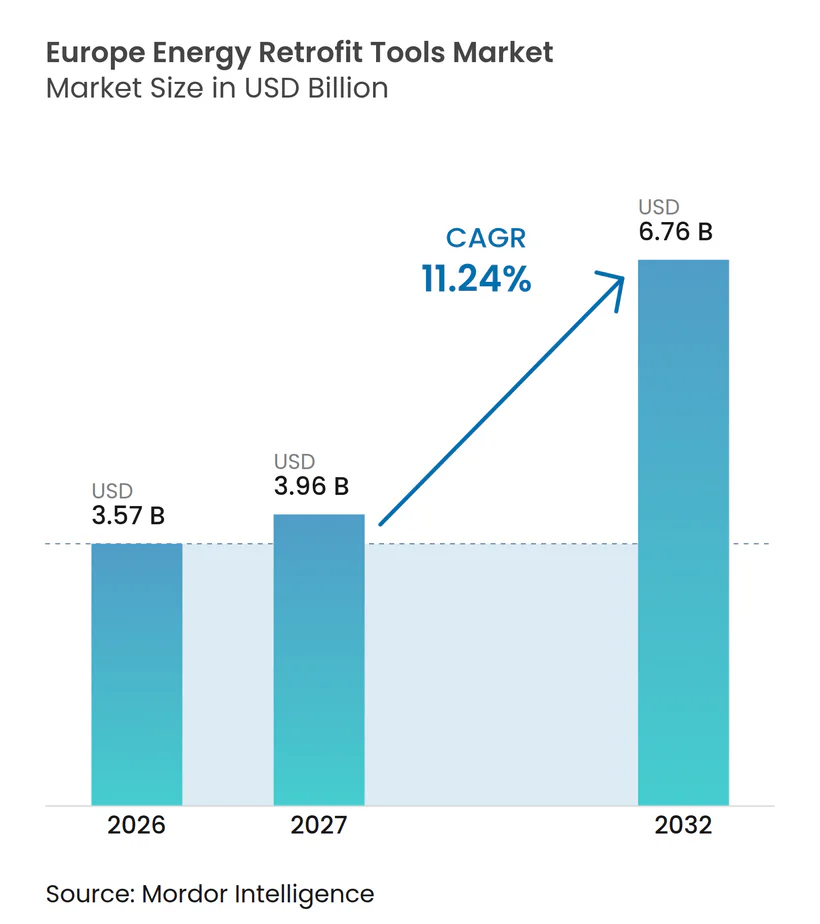
| Base Year Market Size (2026) | USD 3.57 Billion |
| Market Size (2027) | USD 3.96 Billion |
| Market Size (2032) | USD 6.76 Billion |
| Growth Rate (2027 - 2032) | 11.24 % |
| Market Concentration | Medium |
Major Players *Disclaimer: Major Players sorted in no particular order Image © Mordor Intelligence. Reuse requires attribution under CC BY 4.0. | |
Europe Energy Retrofit Tools Market Analysis by Mordor Intelligence
The Europe Energy Retrofit Tools Market size is expected to increase from USD 3.57 billion in 2026 to USD 3.96 billion in 2027 and reach USD 6.76 billion by 2032, at a CAGR of 11.24% over 2027-2032. The Europe energy retrofit tools market is supported by a large, inefficient building stock, since 85% of EU buildings were constructed before 2000 and 75% have poor energy performance ratings.[1] The recast Energy Performance of Buildings Directive requires national renovation plans and creates a regular need for modeling, assessment, and compliance documentation tools.[2] Rising construction costs have also made early-stage energy modeling more important before property owners commit capital to physical work.[3] Large building-technology companies are extending their software platforms, while specialist providers compete through audit automation, energy savings measurement, and support for older buildings.
Key Report Takeaways
- By tool type, Building Energy Modeling Software held 22.3% of the Europe energy retrofit tools market share in 2026, while Smart Building Analytics and Energy Management Platforms are projected to grow at a 12.9% CAGR through 2032.
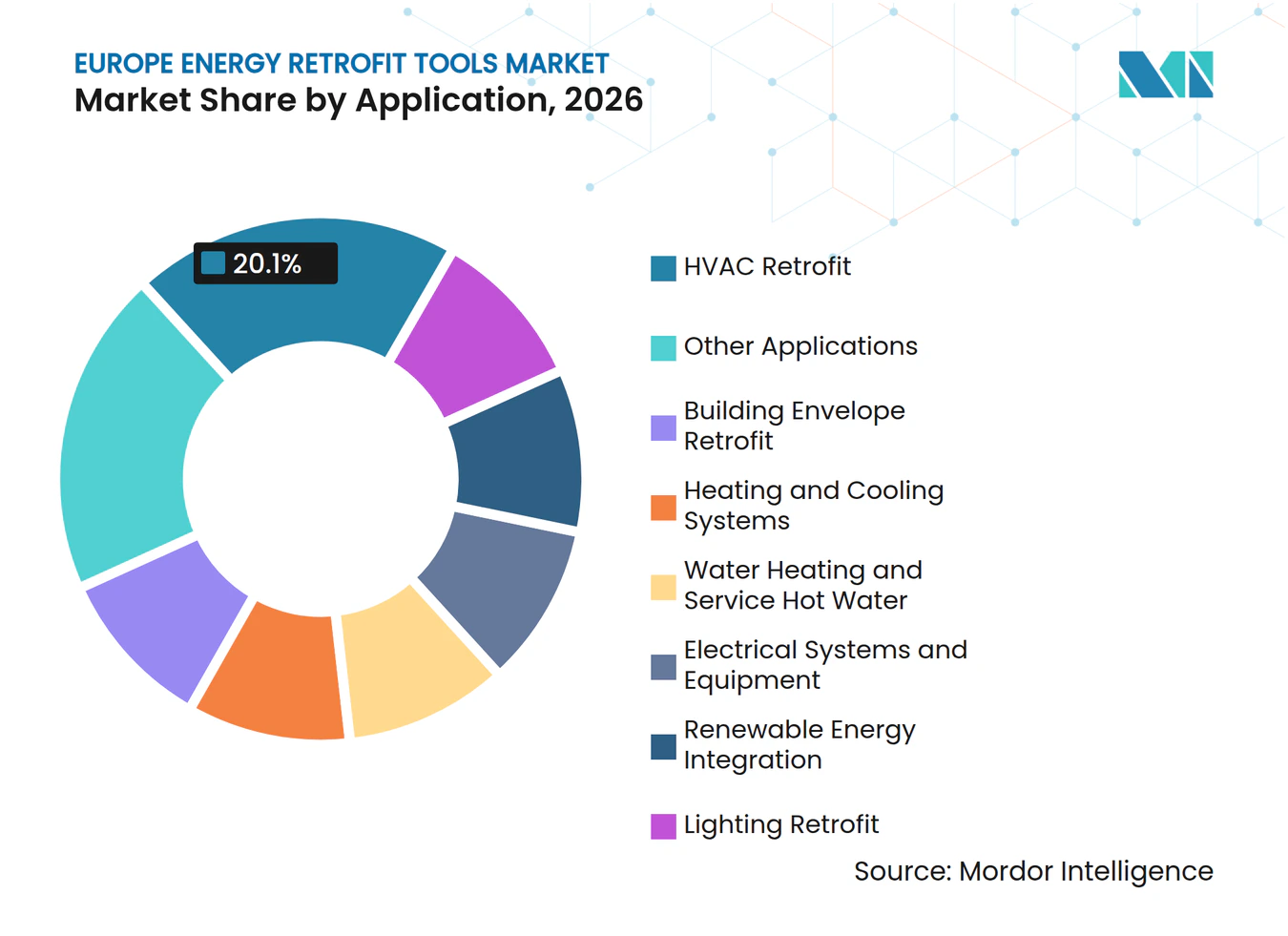
- By application, HVAC Retrofit accounted for 20.1% of the Europe energy retrofit tools market size in 2026, while Renewable Energy Integration is forecast to expand at a 12.5% CAGR through 2032.
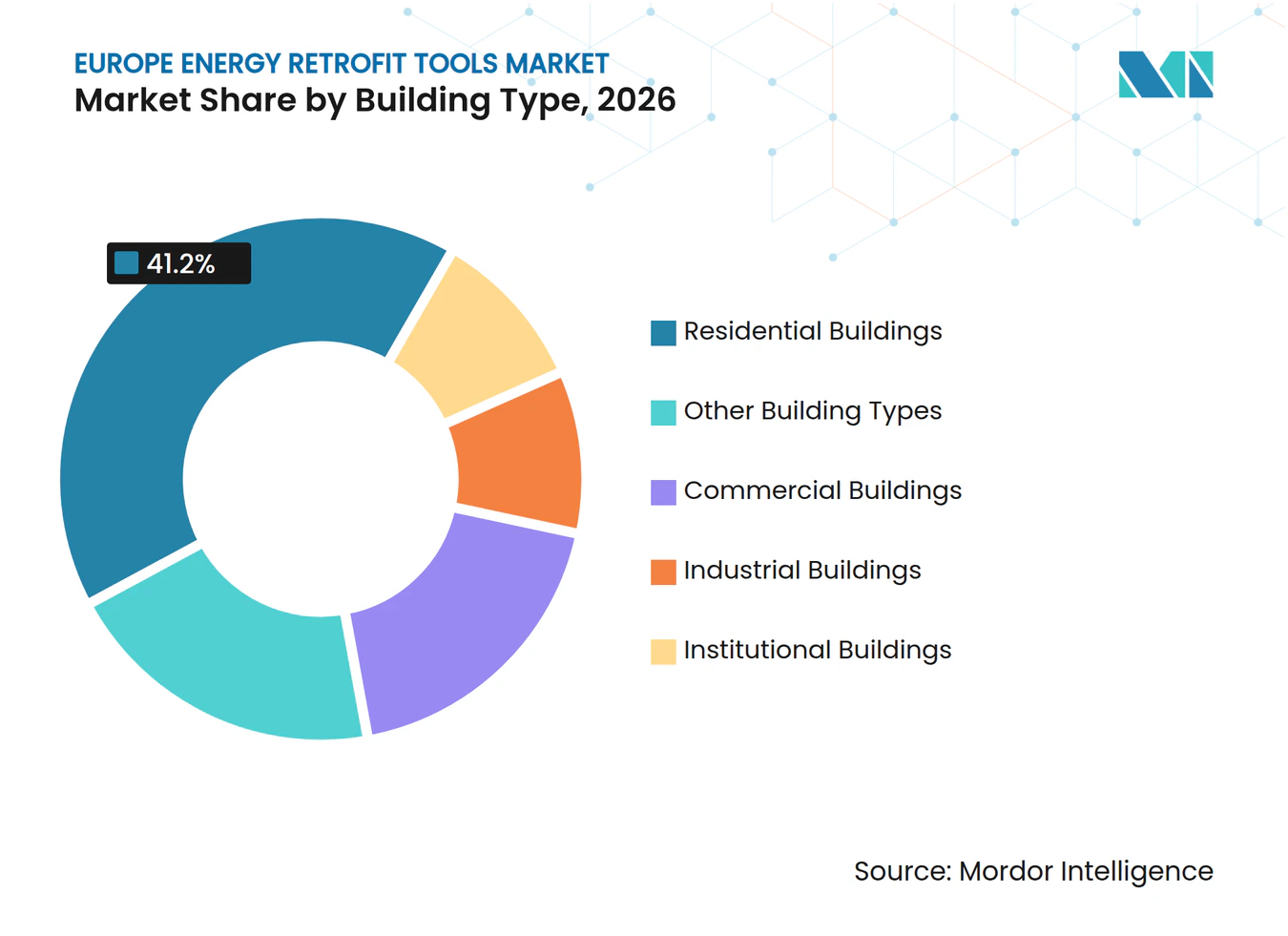
- By building type, Residential Buildings held 41.2% revenue share in 2026, while Commercial Buildings recorded the highest projected CAGR at 11.5% through 2032.
- By geography, Germany held 21.7% revenue share in 2026, while Spain is forecast to grow at an 11.9% CAGR through 2032.
Note: Market numbers in this report are based on Mordor Intelligence's proprietary estimation framework, which combines nine months of actuals with Q4 projections for base year 2026.
Market Trends and Insights
Drivers Impact Analysis of Europe Energy Retrofit Tools Market*
| Driver | (~) % Impact on CAGR Forecast | Geographic Relevance | Impact Timeline |
|---|---|---|---|
| EPBD-Triggered Renovation and Compliance Digitization | +2.5% | EU-wide, concentrated in Germany, France, Italy, Spain, and Poland | Short term (≤ 2 years) |
| Smart Readiness and Building Automation Assessment Demand | +1.8% | Western Europe, strongest in Germany, the Netherlands, and Nordic countries | Medium term (2-4 years) |
| Energy-Cost Volatility and Payback Visibility | +1.5% | EU-wide, most acute in Poland, Italy, and Spain | Short term (≤ 2 years) |
| Smart-Meter and Building-Data Availability | +1.2% | Western Europe, with expansion into Central and Eastern Europe | Medium term (2-4 years) |
| Retrofit-Specific Digital Twins for Legacy Building Stock | +1.0% | Germany, France, Italy, Spain, and EU-funded pilots across 10+ member states | Long term (≥ 4 years) |
| Financing and Performance-Contract Underwriting Requirements | +0.8% | EU-wide, strongest in France, Poland, and Italy | Medium term (2-4 years) |
| Source: Mordor Intelligence | |||
EPBD-Triggered Renovation and Compliance Digitization
The recast Energy Performance of Buildings Directive (EPBD) has made renovation planning a more structured policy requirement across the Europe energy retrofit tools market. Member states must prepare national building renovation plans that describe building categories, financing arrangements, and measurable milestones.[4] Draft plans were due by December 31, 2025, and final plans are due by December 31, 2026. This timetable gives public authorities, consultants, and building owners a reason to adopt systems that create and maintain auditable project records. Digital energy performance certificates also move assessment work from separate files into more standardized workflows. Whole-life carbon tools and renovation passport functions gain relevance because they can connect technical findings with the documentation required during a renovation program.
The directive also raises the importance of software that can compare building performance before and after work is completed. Its minimum energy performance standards require member states to renovate the worst-performing 16% of non-residential buildings by 2030 and 26% by 2033. Residential stocks must reduce average primary energy use by 16% by 2030 and by 20% to 22% by 2035. These requirements create a greater need for consistent baseline models, project scheduling tools, and evidence of expected savings. They also favor vendors that can turn policy rules into practical workflows for architects, auditors, and public administrators. In the Europe energy retrofit tools market, compliance capability can therefore influence purchasing even when physical renovation activity is delayed.
Smart Readiness, Data Availability, and Building Automation Assessment Demand
The Smart Readiness Indicator creates a clearer use case for systems that assess how building equipment responds to occupants, grid signals, and energy demand. Under the recast directive, the indicator is expected to become mandatory for qualifying non-residential buildings after a delegated act is adopted by June 30, 2027. The relevant threshold applies to non-residential buildings with heating, ventilation, or air-conditioning systems above 290 kW. Austria, Croatia, Cyprus, France, Portugal, and Spain completed national test phases through the SRI2MARKET program between 2022 and 2025. Those pilots give other countries examples for connecting assessment processes with national rules. The Europe energy retrofit tools market benefits as SRI assessments create demand for tools that gather and organize data on heating, cooling, lighting, shading, storage, and electric-vehicle readiness.
Smart meters, building management systems, and connected devices make this information more accessible than it was in older audit processes. Their data can feed building energy models and monitoring platforms, reducing the need to rebuild a record for every new project. This connection is important for portfolios that need recurring performance tracking instead of a one-time audit. Johnson Controls states that its OpenBlue platform can automate device discovery and reduce onboarding time through data classification. The wider implication is that vendors can compete on how quickly they turn site data into usable recommendations. This supports demand for integrated analytics in the Europe energy retrofit tools market, particularly where owners manage large groups of commercial or public buildings.
Energy-Cost Volatility, Payback Visibility, and Performance-Contract Requirements
Energy cost uncertainty has strengthened the need for tools that show expected savings in terms that property owners can use. In February 2026, 14.5% of surveyed euro-area consumers planned an energy-efficiency renovation, making it the most frequently cited planned expenditure after general repairs. The same analysis found that heating-season utility costs rose 9% for renovated dwellings in 2024 and 2025, compared with 11% for non-renovated dwellings. These results make the financial case for renovation easier to explain, although they do not remove project-specific uncertainty. Tools that combine energy estimates, investment costs, and payback views can help owners evaluate options before construction begins. In the Europe energy retrofit tools market, this gives modeling software a role in investment decisions as well as technical design.
The effect is also visible in financing and energy performance contracting. In Germany, applications for funding for building-envelope renovations increased 16% year on year during March through May 2026, while applications for heating investments rose 40%. Energy performance contracts depend on credible estimates of future savings because the financing structure is linked to measured results. This makes audit quality, baseline definition, and ongoing verification central to the value of the software used. Integrated payback calculators can also help smaller property owners understand choices that once appeared difficult to compare. The result is a stronger place for energy assessment and financial modeling tools in the Europe energy retrofit tools market.
Retrofit-Specific Digital Twins for Legacy Building Stock
Many European buildings lack the drawings and equipment records that conventional building information modeling workflows assume. This is a significant issue because much of the building stock was constructed before modern energy standards were introduced. Horizon-funded projects including CHRONICLE, REHOUSE, and DTERBIM have used sensor-based approaches in older residential and commercial properties in several European countries. These projects use collected operating data to establish a performance baseline when full as-built records are unavailable. This approach can reduce a practical barrier to using digital tools on existing buildings. It also widens the addressable project base for the Europe energy retrofit tools market beyond newer and well-documented assets.
Retrofit-specific twins can bring together geometry, sensor data, equipment information, and renovation scenarios in one working record. They are useful where building owners need to prioritize measures across a portfolio rather than only assess one facility. The potential is strongest where the system can remain useful after the initial retrofit by supporting commissioning and ongoing monitoring. Interoperable records may become more valuable as member states develop the digital building logbooks contemplated under Article 19 of the recast directive. However, product value will depend on whether vendors can make the workflow practical for buildings with incomplete records. This leaves room for software providers that can pair field data collection with clear recommendations for users who are not digital-modeling specialists.
Restraints Impact Analysis of Europe Energy Retrofit Tools Market*
| Restraint | (~) % Impact on CAGR Forecast | Geographic Relevance | Impact Timeline |
|---|---|---|---|
| Fragmented National Compliance and Data Regimes | -1.8% | EU-wide, most acute in Eastern Europe and markets with incomplete EPBD transposition | Short term (≤ 2 years) |
| Legacy-System Interoperability and Data Loss | -1.4% | Germany, France, and Italy, especially pre-2000 buildings with varied BMS protocols | Medium term (2-4 years) |
| Shortage of Retrofit Analytics and Commissioning Specialists | -1.0% | EU-wide, most acute in Central and Eastern Europe | Medium term (2-4 years) |
| Uncertain Realized Savings and Split Incentives | -0.7% | Multi-tenant residential markets including France, Germany, and Poland | Long term (≥ 4 years) |
| Source: Mordor Intelligence | |||
Fragmented National Compliance, Data Regimes, and Legacy-System Interoperability
The Europe energy retrofit tools market must operate across national regimes that use different certificate databases, data fields, labeling methods, and renovation passport formats. This variation limits the ability to deploy one software configuration across multiple countries. It also creates extra work for vendors that need to adapt workflows to national legal requirements. The INTEGRATES project identifies fragmented digital solutions as a barrier to wider adoption of sustainable practices among small and medium-sized construction enterprises. Fragmentation can increase implementation costs for suppliers and make procurement less simple for customers. These issues are especially difficult where transposition of EU rules remains incomplete or local guidance is still evolving.
Older building systems add a second operational challenge. Equipment may use several building management protocols, and the available data can be incomplete or inconsistent. A platform cannot provide a reliable recommendation if its inputs are missing or poorly aligned. Vendors therefore need connectors, data checks, and field processes that work with existing equipment rather than only with new installations. The constraint is most relevant in countries with substantial pre-2000 stock, including Germany, France, and Italy. It can slow rollout in the Europe energy retrofit tools market even when policy incentives favor renovation.
Shortage of Retrofit Analytics and Commissioning Specialists, Uncertain Savings, and Split Incentives
Digital tools still require people who can interpret outputs, advise clients, and carry recommendations into procurement and construction. The International Energy Agency reported continuing labor and skills shortages in energy efficiency, while EU construction prices had risen more than 20% since 2021. This shortage can lengthen project schedules and reduce the number of audits that can be completed. It is especially relevant in Central and Eastern Europe, where specialist capacity can be less available. Automated commissioning and clearer audit workflows may reduce part of the burden, but they do not replace the need for accountable project decisions. The Europe energy retrofit tools market therefore depends on both digital adoption and practical delivery capacity.
Savings uncertainty can also limit demand when tenants receive lower energy bills but owners bear the upfront cost. This split incentive is common in multi-tenant housing, particularly in France, Germany, and Poland. Performance claims need credible baseline data and methods that show results after the retrofit. Where a project cannot demonstrate its expected benefits clearly, financing approvals and owner decisions can take longer. Tools that connect modeling with measurement and verification can lessen this concern, but they cannot remove differences in property ownership structures. This restraint favors products that present results in understandable financial and operational terms.
*Our forecasts treat driver/restraint impacts as directional, not additive. The impact forecasts reflect baseline growth, mix effects, and variable interactions.
Europe Energy Retrofit Tools Market Segment Analysis
By Tool Type:
Building Energy Modeling Software Anchors Adoption as Analytics Platforms ScaleBuilding Energy Modeling Software held 22.3% of the Europe energy retrofit tools market share in 2026, making it the largest tool category. It supports energy simulation, renovation passport preparation, and financial analysis for energy performance contracts, often serving as the core project record. Energy audit and assessment tools provide the site data that modeling systems need, while HVAC diagnostic tools support operations and Smart Readiness Indicator assessments. Building envelope inspection tools are gaining relevance because minimum energy performance standards focus attention on weak fabric components. Renewable energy tools cover solar yield studies, heat-pump sizing, and hybrid-system analysis, supported by a requirement to increase the annual renewable share in heating and cooling by at least 1.1% points from 2026 through 2030. These products can bring roof conditions, electricity demand, heating equipment, and incentives into a shared renovation assessment, supporting demand for related products across the Europe energy retrofit tools industry. Suppliers that keep data usable across audit, modeling, and commissioning stages may be better placed to retain customers.
Smart Building Analytics and Energy Management Platforms are projected to be the fastest-growing tool category at a 12.9% CAGR from 2027 to 2032. The platform category expands as owners seek continuous monitoring instead of a report prepared only at the beginning of a project, combining building management, smart-meter, connected-device, and energy certificate data. This information supports continuing performance tracking under renovation passports and national renovation planning, while Article 14 provides a policy basis for automation and control in large non-residential buildings. Johnson Controls states that OpenBlue automates device discovery and classifies data against standard models to shorten onboarding. Faster onboarding can reduce disruption, although results still depend on data quality, installation capacity, and a clear use case for the building owner. In the Europe energy retrofit tools market, these products are most useful when users can connect data to maintenance, regulatory reporting, or measured energy savings. Their adoption remains tied to practical operating outcomes rather than software features alone.
By Application:
HVAC Retrofit Holds the Largest Use Case While Renewable Energy Integration Leads GrowthHVAC Retrofit accounted for 20.1% of the Europe energy retrofit tools market size in 2026, making it the largest application. Thermal systems directly affect energy use, indoor conditions, and the outcome of an efficiency upgrade, while the recast directive ended financial incentives for new stand-alone fossil-fuel boilers from January 2025. In Germany, heat pumps represented 44% of new heating systems installed during residential renovations in 2025, up from 21% in 2024. Diagnostic and commissioning tools must therefore address heat-pump requirements rather than only legacy boiler settings. Lighting retrofit, envelope retrofit, water heating, and service hot water require different tool sets for lighting analysis, thermal performance modeling, and system optimization. Electrical systems tools are gaining relevance as electric-vehicle charging and grid-responsive equipment add complexity to renovation plans. Together, these applications move the Europe energy retrofit tools market beyond individual equipment categories toward whole-building decision support.
Renewable Energy Integration is forecast to be the fastest-growing application at a 12.5% CAGR from 2027 to 2032. Solar and heat-pump assessments require roof geometry, shading, demand, and occupancy inputs that can also support a wider building energy model. Research published in 2025 found that photovoltaic-assisted heat-pump retrofits in multi-family buildings were technically feasible across European climate zones and achieved greenhouse-gas reductions of 65% to 84% relative to earlier heating systems. Validated modeling can affect access to public support and financing, making renewable integration a practical entry point for a deeper renovation assessment. Renewable Energy Directive III (RED III) requires a 1.1% point annual increase in renewable heating and cooling from 2026 through 2030, supporting recurring assessment needs. Property owners may begin with equipment but later need analysis of the envelope, storage, and control systems. Tools that carry data across those decisions and communicate results clearly to owners, installers, and financing partners have a useful position in the Europe energy retrofit tools market.


By Building Type:
Residential Buildings Lead Volume While Commercial Buildings Grow FasterResidential Buildings held 41.2% revenue share in 2026, giving the segment the largest position by building type. Much of Europe’s housing stock predates current energy rules, and the recast directive requires a 16% reduction in average residential primary energy use by 2030. This creates a need for portfolio tools that can compare renovation scenarios across common building archetypes. The segment also responds to subsidy design, with France recording 120,000 deep-renovation completions by 2025 under MaPrimeRénov'. Residential users need assessments that make the combined effects of insulation, heating, ventilation, and renewable systems understandable at building level. Standardization is important because owners, housing associations, and public agencies often manage many similar dwellings. Institutional buildings require measurement and verification tools for energy performance contracts, while industrial buildings need process-heat and compressed-air diagnostics at the boundary of building and industrial energy management.
Commercial Buildings are forecast to expand at an 11.5% CAGR from 2027 to 2032. The worst-performing 16% of non-residential buildings must be renovated by 2030, creating a near-term compliance deadline. Commercial properties require tools that assess several systems across large and often complex sites. A 2025 Rome office study found that non-renewable energy demand fell from 191,684 kWh/m²/year to 76,053 kWh/m²/year and carbon dioxide emissions fell 78% after renovation. This type of result requires reliable pre-retrofit data, careful assessment, and monitoring after construction. Commercial owners also face stranded-asset and sustainability-reporting concerns where energy performance is weak. The Europe energy retrofit tools industry has a strong opportunity in commercial property, but uptake depends on integration effort, specialist availability, local deadlines, and the quality of existing building data.

Geography Analysis
Germany Energy Retrofit Tools Market
Germany held the largest national share at 21.7% in 2026. The country combines a large building base, established building-technology suppliers, and public support for efficient buildings, including a EUR 16.7 billion allocation in 2024. Its residential renovation rate fell to 0.7% in 2025, against a required annual pace of 2%, with 260,000 units renovated against a target-aligned requirement of 460,000. The gap points to planning and delivery constraints even when funding is available. Funding activity strengthened in 2026, with 64,000 households and businesses seeking envelope support from March through May, up 16% year on year, while heating-investment applications increased 40%.
France and Southern Europe Energy Retrofit Tools Market
France and Italy are important contributors to demand in the Europe energy retrofit tools market. France’s subsidy framework has supported renovation passport and planning tools, while Italy’s pre-2000 social housing stock requires portfolio-level assessment under the Energy Performance of Buildings Directive (EPBD). Spain is the fastest-growing national market at an 11.9% CAGR from 2027 to 2032. Spain submitted its national building renovation plan in December 2025, targeting a 57% reduction in residential primary energy use and a 65% reduction in non-residential primary energy use by 2050. Real Decreto 659/2025 reformed Spain’s energy performance certification process in July 2025.
United Kingdom, Poland and Russia Energy Retrofit Tools Market
The United Kingdom has retrofit tool demand driven by its domestic decarbonization policies rather than the EU framework. Poland has potential for cost-effective audit and modeling tools because of its older homes, energy-poverty concerns, and eligibility for EU cohesion funding, while SRI2MARKET identifies it as relevant to regulatory integration. Russia’s contribution is constrained by geopolitical conditions that limit EU technology trade, though it remains within the study scope. In the rest of Europe, projects in Greece, Hungary, Slovenia, and Denmark are testing tools that may become commercially replicable. Geographic demand therefore rests on building need, national rulemaking, skills availability, and access to usable building data.
Competitive Landscape
Market Concentration
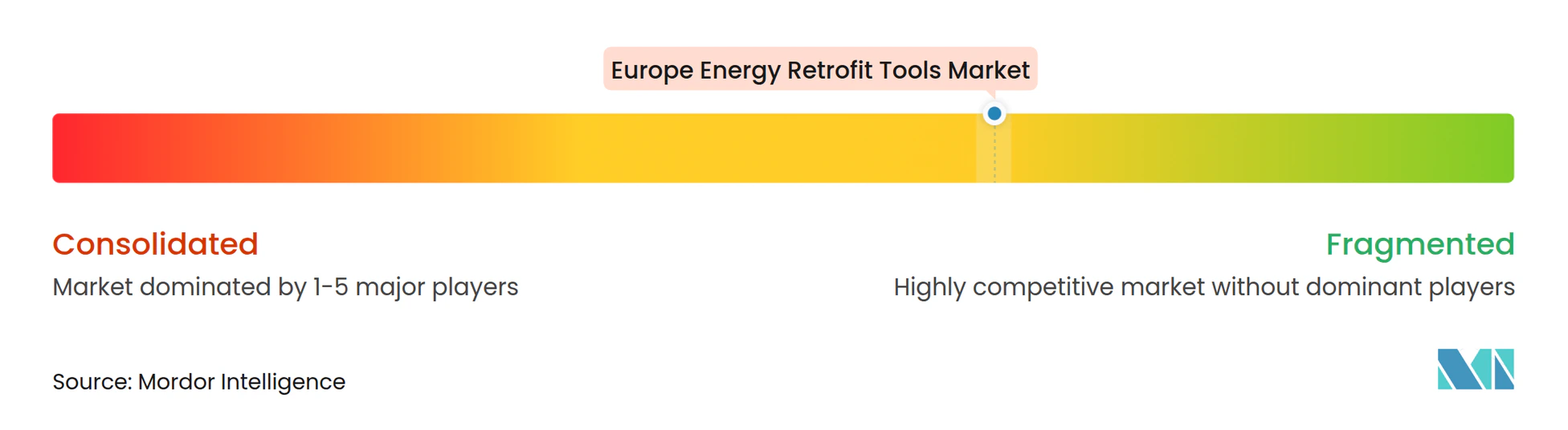
The Europe energy retrofit tools market has moderate concentration in large software platforms and greater fragmentation in specialist audit, modeling, and analytics products. Siemens, Schneider Electric, Johnson Controls, and Honeywell offer broad building technology platforms, while smaller vendors address audits, energy models, and data analysis. Large vendors are using open interfaces and faster data onboarding to ease deployment. Johnson Controls introduced Metasys 16.0 in June 2026 with visual integration tools that it says can cut deployment time by up to 80% and integration costs by 60% to 70%. This places pressure on specialist firms to demonstrate a clear advantage in analysis, service, or project outcomes.
Johnson Controls expanded OpenBlue in August 2026 with OBI, an artificial intelligence assistant intended to automate building operations workflows. Carrier acquired 75F in July 2026, adding cloud-based and wireless building automation capability to its intelligent building strategy. These actions show that established equipment suppliers are pursuing software that supports retrofit work and continuing operations. A platform’s competitive value depends on connecting older equipment and supporting a project from assessment through commissioning and monitoring. Acquisition and internal product development can shorten the time needed for large vendors to close capability gaps.
Opportunity remains in retrofit-specific digital twins for older properties, Smart Readiness Indicator assessment automation, and systems that use data from different national certificate registries. No supplier has established a dominant scalable offer for all legacy building data problems. Public-sector customers in Germany, France, and Nordic countries place greater weight on cybersecurity and data handling when assessing building platforms. These requirements can deter entrants while distinguishing suppliers with credible controls. Specialist suppliers can remain competitive when they provide clearer savings evidence or better compatibility with existing building systems.
Europe Energy Retrofit Tools Industry Leaders
-
Siemens AG
-
Schneider Electric SE
-
Johnson Controls International plc
-
Honeywell International Inc.
-
ABB Ltd.
- *Disclaimer: Major Players sorted in no particular order
Europe Energy Retrofit Tools Market Companies Covered in this Report
- Siemens AG
- Schneider Electric SE
- Johnson Controls International plc
- Honeywell International Inc.
- ABB Ltd.
- Daikin Industries, Ltd.
- Trane Technologies plc
- Carrier Global Corporation
- Danfoss A/S
- ENGIE SA
- Veolia Environnement S.A.
- Kingspan Group plc
- Saint-Gobain S.A.
- ROCKWOOL A/S
- Legrand SA
- Signify N.V.
- Robert Bosch GmbH
- Sika AG
- Ameresco, Inc.
Recent Industry Developments in Europe Energy Retrofit Tools Market
- August 2026: Johnson Controls unveiled expanded AI capabilities in its OpenBlue digital ecosystem, introducing OBI, an agentic AI assistant capable of automating building operations workflows and reducing system-onboarding implementation time by up to 95% through automated device discovery. Forrester research cited by the company projects up to 155% ROI for customers deploying the platform at scale.
- July 2026: Carrier Global Corporation acquired 75F, a cloud-native, wireless, AI-enabled building automation system developer. The acquisition strengthens Carrier's retrofit capabilities across light commercial, complex applied, and data center applications. Carrier plans to integrate 75F's agentic AI and auto-commissioning into its QuantumLeap thermal management suite.
- June 2026: Johnson Controls launched Metasys 16.0, its flagship building automation system update, featuring visual integration tools that reduce deployment times by up to 80% and cut integration costs by 60% to 70%, bringing new capabilities online in days instead of months.
- January 2026: Honeywell was selected by the US Army to modernize building automation systems at Fort Benning using its Niagara control platform across more than 3 million square feet, projected to save an additional USD 1.8 million annually for a total of USD 4.5 million in expected annual savings over 15 years.
Europe Energy Retrofit Tools Market Report Scope
Energy retrofit tools refer to the physical equipment, digital software, and diagnostic technologies used by engineers, contractors, energy auditors, and facility managers to assess, plan, install, and optimize energy-saving upgrades in existing buildings. The energy retrofit tools market (also recognized in the industry as the energy retrofit systems market) refers to the global commercial market dedicated to upgrading existing buildings, industrial plants, and infrastructure with modern, energy-efficient technologies.
The energy retrofit tools market is segmented by tool type, which includes building energy modeling (BEM) software, audit tools, heating, ventilation, and air conditioning (HVAC) diagnostic equipment, envelope inspection systems, smart analytics platforms, renewable energy integration tools, and other specialized devices. In terms of application, the market is divided into HVAC upgrades, lighting systems, building envelope improvements, heating and cooling enhancements, water heating modifications, electrical system optimizations, renewable integration, and other miscellaneous applications. Based on building type, the sector is categorized into residential, commercial, industrial, institutional, and other building classifications. The report also covers the market size and forecasts for the Europe energy retrofit tools market across 8 countries in the region. For each segment, the market sizing and forecasts have been provided on the basis of value (USD).
Segmentation Overview
| Building Energy Modeling (BEM) Software |
| Energy Audit and Assessment Tools |
| HVAC Diagnostic and Commissioning Tools |
| Building Envelope Inspection Tools |
| Smart Building Analytics and Energy Management Platforms |
| Renewable Energy Tools |
| Other Tools |
| HVAC Retrofit |
| Lighting Retrofit |
| Building Envelope Retrofit |
| Heating and Cooling Systems |
| Water Heating and Service Hot Water |
| Electrical Systems and Equipment |
| Renewable Energy Integration |
| Other Applications |
| Residential Buildings |
| Commercial Buildings |
| Industrial Buildings |
| Institutional Buildings |
| Other Building Types |
| Europe | Germany |
| France | |
| Italy | |
| Spain | |
| United Kingdom | |
| Poland | |
| Russia | |
| Rest of Europe |
| By Tool Type | Building Energy Modeling (BEM) Software | |
| Energy Audit and Assessment Tools | ||
| HVAC Diagnostic and Commissioning Tools | ||
| Building Envelope Inspection Tools | ||
| Smart Building Analytics and Energy Management Platforms | ||
| Renewable Energy Tools | ||
| Other Tools | ||
| By Application | HVAC Retrofit | |
| Lighting Retrofit | ||
| Building Envelope Retrofit | ||
| Heating and Cooling Systems | ||
| Water Heating and Service Hot Water | ||
| Electrical Systems and Equipment | ||
| Renewable Energy Integration | ||
| Other Applications | ||
| By Building Type | Residential Buildings | |
| Commercial Buildings | ||
| Industrial Buildings | ||
| Institutional Buildings | ||
| Other Building Types | ||
| By Geography | Europe | Germany |
| France | ||
| Italy | ||
| Spain | ||
| United Kingdom | ||
| Poland | ||
| Russia | ||
| Rest of Europe | ||
Key Questions Answered in the Report
What is the 2026 value of the Europe energy retrofit tools market?
The Europe energy retrofit tools market was estimated at USD 3.96 billion in 2027 and is forecast to reach USD 6.76 billion by 2032 at an 11.24% CAGR.
Which tool category held the largest share in 2026?
Building Energy Modeling Software led tool types with 22.3% share in 2026.
Which application is expected to grow fastest through 2032?
Renewable Energy Integration is forecast to grow at a 12.5% CAGR from 2027 to 2032.
Why are building retrofit tools becoming more necessary in Europe?
The recast EPBD requires national renovation plans, digital documentation, and action on inefficient buildings, increasing the need for assessment and modeling systems.
Which building type creates the largest demand?
Residential Buildings held 41.2% share in 2026, supported by a large older housing stock and national energy-use reduction requirements.
Which country has the strongest growth outlook through 2032?
Spain is forecast to grow at an 11.9% CAGR, supported by its national renovation plan and energy certification reform.