
Europe Energy Retrofit Market Size and Share
Market Overview
| Study Period | 2022 - 2032 |
|---|---|
| Forecast Data Period | 2027 - 2032 |
| Base Year Market Size (2026) | USD 137.29 Billion |
| Market Size (2027) | USD 148.96 Billion |
| Market Size (2032) | USD 223.64 Billion |
| Growth Rate (2027 - 2032) | 8.47 % |
| Market Concentration | Low |
Major Players *Disclaimer: Major Players sorted in no particular order Image © Mordor Intelligence. Reuse requires attribution under CC BY 4.0. | |
Europe Energy Retrofit Market Analysis by Mordor Intelligence
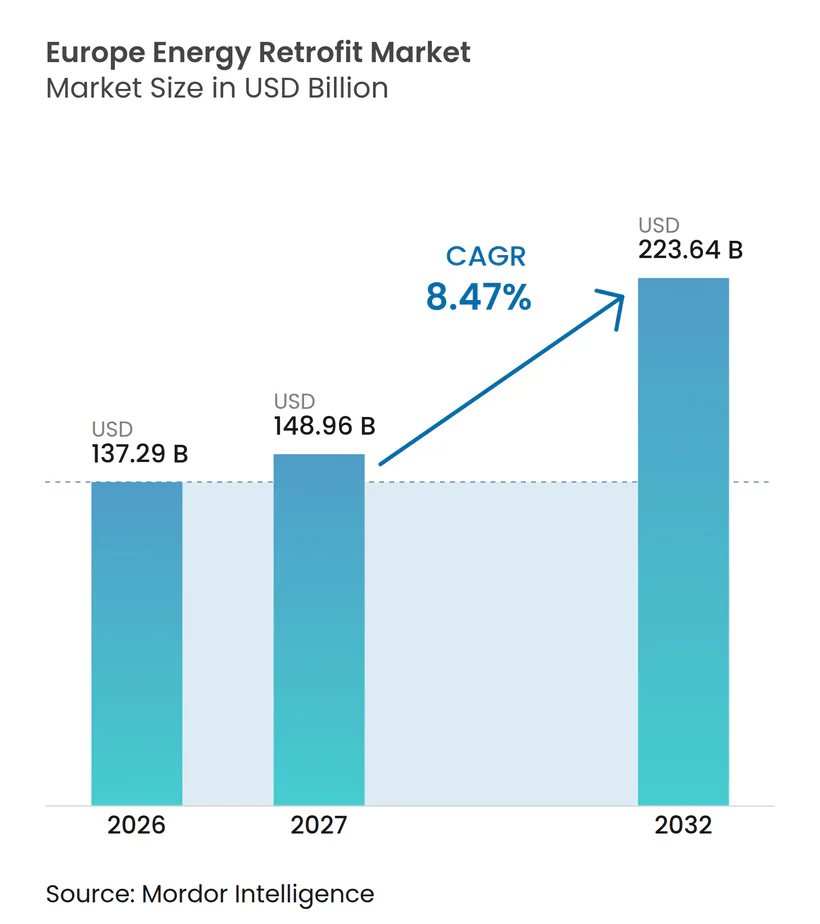
The Europe Energy Retrofit Market size is expected to increase from USD 137.29 billion in 2026 to USD 148.96 billion in 2027 and reach USD 223.64 billion by 2032, at a CAGR of 8.47% over 2027-2032. The recast Energy Performance of Buildings Directive, or EPBD, is setting a common compliance framework for renovations across the region, while national programs shape the pace of deployment. European buildings accounted for 36% of EU energy consumption and 40% of energy-related greenhouse gas emissions, and 75% of the existing building stock remained inefficient under current standards[1]. The Europe energy retrofit market also benefits from a large installed base because 85% to 95% of buildings now in use are expected to remain occupied through 2050. Financing remains the main limiting factor, as the European Commission identified a EUR 149 billion annual gap against building-efficiency investment needs of EUR 242 billion through 2030. Technology suppliers, material companies, and energy service providers are responding by combining equipment, digital controls, financing structures, and energy performance services.
Key Report Takeaways
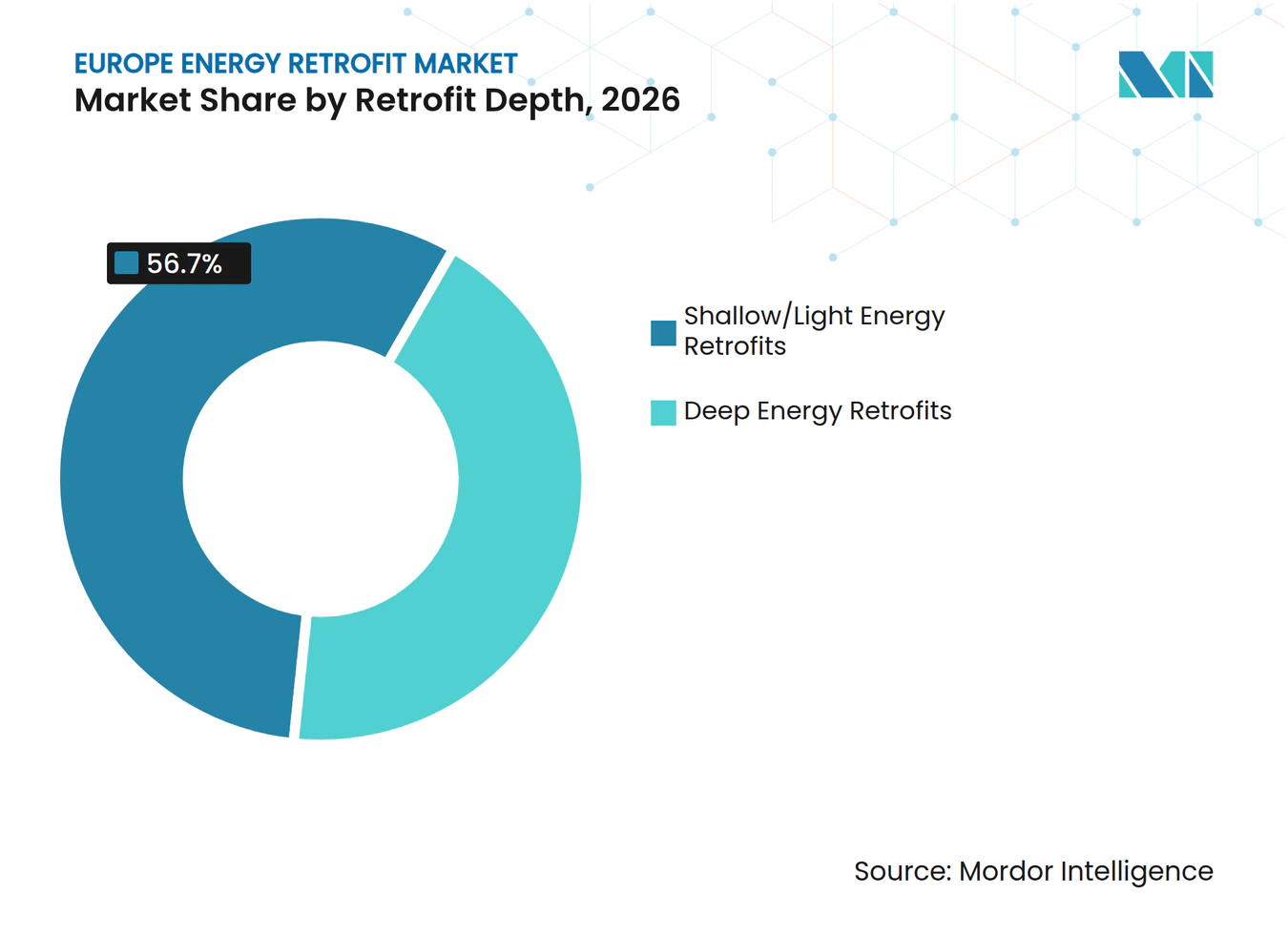
- By retrofit depth, Shallow/Light Energy Retrofits held 56.7% of the Europe energy retrofit market share in 2026, while Deep Energy Retrofits are forecast to grow at a 10.3% CAGR through 2032.
- By technology, HVAC Systems held a 28.4% revenue share in 2026, while Lighting Systems are forecast to grow at a 10.7% CAGR through 2032.
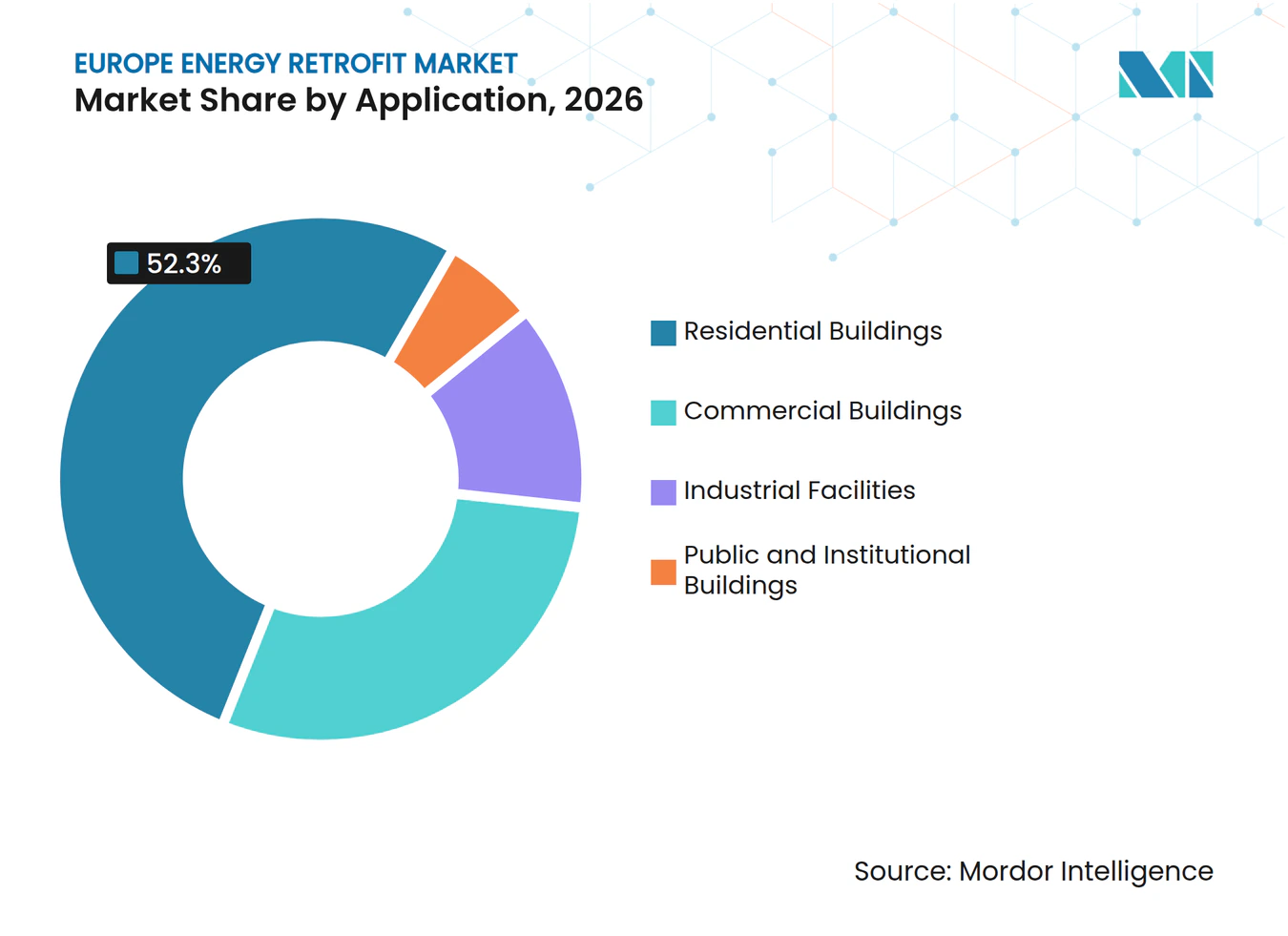
- By application, Residential Buildings held 52.3% of the Europe energy retrofit market size in 2026, while Industrial Facilities are forecast to grow at a 10.1% CAGR through 2032.
- By geography, Germany represented 22.4% of regional revenue in 2026, while France is forecast to grow at a 10.4% CAGR through 2032.
Note: Market numbers in this report are based on Mordor Intelligence's proprietary estimation framework, which combines nine months of actuals with Q4 projections for base year 2026.
Market Trends and Insights
Drivers Impact Analysis of Europe Energy Retrofit Market*
| Driver | % Impact on CAGR Forecast | Geographic Relevance | Impact Timeline |
|---|---|---|---|
| EPBD-Driven Renovation Compliance and Public Funding | +2.80% | EU-wide, concentrated in Germany, France, and Italy | Short term (≤ 2 years) |
| Replacement of Aging Heating and HVAC Assets | +1.50% | EU-wide, with particular intensity in Central and Eastern Europe | Medium term (2–4 years) |
| Energy-Cost Reduction and Building Operating-Efficiency Needs | +1.20% | Global, most acute in energy-import-dependent European economies | Short term (≤ 2 years) |
| Heat-Pump and Low-Carbon Heating Conversion | +1.00% | Germany, France, Poland, Nordics | Medium term (2–4 years) |
| Retrofit Analytics, Wireless Controls, and Performance-Based Services | +0.70% | North-western Europe — UK, Netherlands, Belgium | Long term (≥ 4 years) |
| Green-Finance Requirements and Building-Asset Value Preservation | +0.60% | EU-wide, with early gains in Germany, France, Netherlands | Medium term (2–4 years) |
| Source: Mordor Intelligence | |||
EPBD-Driven Renovation Compliance and Public Funding
The recast EPBD establishes a more demanding renovation framework for European buildings. Member States were required to submit draft National Building Renovation Plans by December 2025 and finalize them by December 2026[2]. The European Commission's Joint Research Centre had assessed 16 complete draft plans by June 2026. Building automation and control system requirements apply to non-residential buildings above 290 kW in 2026, and the threshold will fall to 70 kW in December 2029. Germany's revised BEG program, effective July 21, 2026, offers loans of up to EUR 150,000 per housing unit, while 182,114 heat pump approvals were recorded in the first half of 2026. The Europe energy retrofit market gains a clearer pipeline from these measures because standalone fossil fuel boilers have not received financial incentives under the EPBD since January 1, 2025.
Replacement of Aging Heating Assets and Low-Carbon Heating Conversion
Heating and HVAC systems installed during the 1990s and early 2000s are reaching replacement age as fossil heating support is withdrawn. In Germany, 194,500 heat pumps were sold in the first half of 2026, up 40% from the prior year period, and heat pumps represented 55% of new heating installations. Heat pumps were the primary heating technology in 73.6% of newly completed German residential buildings in 2025, compared with 69.4% in 2024. Across 21 European countries, 2.88 million heat pumps were sold in 2025, and 80% of installations were in existing buildings. The Europe energy retrofit market, therefore, draws demand from equipment replacement as well as new compliance requirements. Shorter replacement cycles for gas boilers can increase demand for HVAC upgrades when owners combine heating conversion with envelope and control improvements.
Energy-Cost Reduction and Building Operating Efficiency
Energy price volatility has changed the financial case for building upgrades. The installed European heat pump fleet avoided EUR 9.7 billion in import costs during 2025, according to the European Heat Pump Association[3]. This value linked electrified heating to operating-cost reduction, not only to compliance. Digital building controls can further improve the use of heating, cooling, and electricity within existing assets. Building owners can use verified energy savings to support financing discussions where lenders evaluate operating performance alongside asset risk. The Europe energy retrofit market can benefit when reduced utility costs and access to green mortgages reinforce each other. This relationship is particularly important for projects where grant funding does not cover the full upfront investment.
Retrofit Analytics, Performance Services, and Green Finance
Digital assessment tools and wireless controls are becoming more relevant as owners seek lower-disruption retrofit options. These technologies help operators monitor energy use, identify losses, and verify the results of installed measures. Energy performance contracts can align provider compensation with measured savings rather than equipment delivery alone. Green mortgages, guarantees, revolving funds, and on-bill repayment can also reduce the initial financing burden for eligible projects. The Europe energy retrofit market is likely to see more bundled offerings where equipment, controls, assessment, and financing are sold together. Such offerings are most developed in markets with established green finance frameworks and active building-service providers.
Restraints Impact Analysis of Europe Energy Retrofit Market*
| Restraint | % Impact on CAGR Forecast | Geographic Relevance | Impact Timeline |
|---|---|---|---|
| High Upfront Capital Requirements and Long Payback Periods | -2.00% | EU-wide, most acute in Southern and CEE Europe | Short term (≤ 2 years) |
| Landlord-Tenant Split Incentives and Occupied-Building Disruption | -1.20% | EU-wide, particularly dense rental markets in Germany, France, Netherlands | Medium term (2–4 years) |
| Skilled Retrofit Labor and Commissioning Capacity Shortages | -0.90% | EU-wide, with pronounced strain in Germany, Poland, and the Nordics | Medium term (2–4 years) |
| Heritage-Building Constraints, Permitting Complexity, and Retrofit Standardization Gaps | -0.60% | Southern and Western Europe — Italy, France, Spain, UK | Long term (≥ 4 years) |
| Source: Mordor Intelligence | |||
High Upfront Capital Requirements, Long Payback Periods, and Split Incentives
The financing structure of retrofits remains a material constraint on project volumes. Public and EU funding covered only 15% of building-efficiency investment needs, while green loans represented 4.5% of total European bank lending. The deep renovation rate remained at 0.2% of annual building stock through 2025, compared with a 2% rate needed for 2030 objectives. The Social Climate Fund was activated in 2026 with EUR 86.7 billion earmarked for energy efficiency and building renovation, but the expiry of the Recovery and Resilience Facility removes a program that financed EUR 103.9 billion in energy-efficiency investments since 2021. Landlords often fund the work while tenants receive much of the utility saving, which can delay decisions in rental markets. France recorded 41,409 MaPrimeRénov completions in the first half of 2026, down from 95,000 in the first half of 2025, following credit authorization delays that affected delivery continuity[4].
Labor Capacity, Heritage Constraints, Permitting, and Standardization Gaps
Retrofit delivery depends on sufficiently skilled labor for design, installation, testing, and commissioning. Capacity shortages are most visible where heat pump installation and deep renovation programs are expanding at the same time. Occupied buildings also create scheduling and disruption challenges for owners, tenants, and contractors. Heritage requirements and local permitting processes can limit the choice of façade, glazing, and heating measures, especially in older urban areas. Inconsistent project assessment and renovation standards can raise transaction costs and make results harder to compare. The Europe energy retrofit market must address these practical constraints if policy targets are to translate into completed projects.
*Our forecasts treat driver/restraint impacts as directional, not additive. The impact forecasts reflect baseline growth, mix effects, and variable interactions.
Europe Energy Retrofit Market Segment Analysis
By Retrofit Depth:
Incremental Upgrades Lead While Deep Projects Gain SupportShallow/Light Energy Retrofits held 56.7% of the Europe energy retrofit market in 2026. Lower initial costs, limited disruption, and faster visible payback have made these measures the usual choice for owners without extensive subsidy support. This category is supported by measures that can be completed in stages. Renovation passports create a structured route from smaller improvements toward deeper work by setting out a long-term plan for the property. This approach can help owners coordinate insulation, windows, heating, ventilation, and controls over several investment decisions.
Deep Energy Retrofits are forecast to grow at a 10.3% CAGR through 2032. The category benefits from rules focused on the worst-performing buildings and from Germany's serial renovation bonus for projects reaching EH70 efficiency through industrialized methods. Prefabricated façades and modular systems can reduce delivery time and improve consistency across repeated projects. Programs including AEGIR and INFINITE are advancing these methods across France, Italy, and the Netherlands. The 0.2% deep renovation rate reported through 2025 shows that a large part of the potential project pool has not yet been activated.



By Technology:
HVAC Leads While Lighting and Controls ExpandHVAC Systems accounted for 28.4% of the Europe energy retrofit market share in 2026. Replacement of aging boilers, heat pump adoption, and EPBD-related upgrades in non-residential properties support this position. Heat pump retrofits form an active part of the HVAC category because 80% of 2.88 million European heat pumps sold in 2025 were installed in existing buildings. The category also includes ventilation, distribution, and control measures that improve the performance of installed heating and cooling equipment. This broad system role makes HVAC central to both compliance-led and owner-led projects.
Lighting Systems are forecast to grow at a 10.7% CAGR through 2032. LED replacement economics and the EPBD requirement for automated control in larger non-residential buildings support demand for integrated lighting upgrades. Germany's revised BEG removed standalone eligibility for energy-efficient lighting in non-residential buildings in July 2026, which directs projects toward broader system packages. Building envelope measures, renewable integration, smart controls, IoT, and water heating each serve distinct compliance and building-use needs. ROCKWOOL reported a 10.4% increase in first-half 2026 insulation segment revenue and raised its full-year 2026 guidance to 5% to 7% local-currency growth, reflecting renovation demand in Western and Central Europe.
By Application:
Residential Volume Supports Demand While Industrial Sites Grow FasterResidential Buildings accounted for 52.3% of the Europe energy retrofit market size in 2026. Housing volume and homeowner-oriented subsidy programs support the segment's position. France funded 307,731 residential retrofits in 2025, including 120,306 qualifying deep renovation completions. Commercial buildings are another major application because they face building automation requirements and often have established facilities-management arrangements. Public and institutional buildings can be harder to upgrade because procurement procedures and heritage constraints add complexity.
Industrial Facilities are forecast to grow at a 10.1% CAGR through 2032. Exposure to ETS2 costs and the commercial case for electrified process heat support investment at manufacturing sites. Industrial heat pumps can increase the use of waste heat and reduce dependence on fossil-fuel equipment. Public portfolio programs, including aggregated procurement structures in the United Kingdom, can help institutions combine projects across multiple buildings. The Europe energy retrofit market benefits from these application pathways because they extend renovation activity beyond private housing into commercial, manufacturing, and public assets.

Geography Analysis
Germany Energy Retrofit Market
Germany held a 22.4% regional revenue share in 2026. The reformed BEG program took effect on July 21, 2026, expanded residential and non-residential eligibility, and offered maximum loans of EUR 150,000 per residential unit. Germany recorded 50% heat pump sales growth in 2025, and the first half of 2026 recorded 194,500 unit sales, up 40% year over year. Its draft National Building Renovation Plan estimated EUR 175 billion in investment needs through 2050, equal to EUR 440 per square meter.
Europe Energy Retrofit Market
France is forecast to grow at a 10.4% CAGR through 2032. The 2026 Anah budget was EUR 4.4 billion, while the rental restriction on F- and G-class properties supports the need for efficiency improvements. The Europe energy retrofit market size in France also reflects an estimated 3.9 million F- and G-class homes that remained eligible for mandatory improvement in January 2025. France led European heat pump sales with 528,000 units in 2025. Italy and Spain benefit from national recovery-plan funding, and Spain recorded 15% heat pump sales growth in 2025.
United Kingdom, Nordics and Central and Eastern Europe Energy Retrofit Market
The United Kingdom recorded a 9% year-over-year increase in retrofit heat pump installations in 2025, although the first half of 2026 showed a 22% decline after scheme eligibility changes. Poland and the wider Central and Eastern European region have lower renovation penetration and present a longer-term expansion opportunity. The European Investment Bank committed EUR 10 billion during 2025 to 2027 for energy efficiency and housing renovation across Europe, with Central and Eastern European markets positioned as priority recipients. Norway and Finland provide mature adoption reference points, with 650 and 540 heat pumps per 1,000 households, respectively. Russia remains within the geographic scope, although geopolitical conditions restrict cross-border capital flows and international supplier activity.
Competitive Landscape
Market Concentration
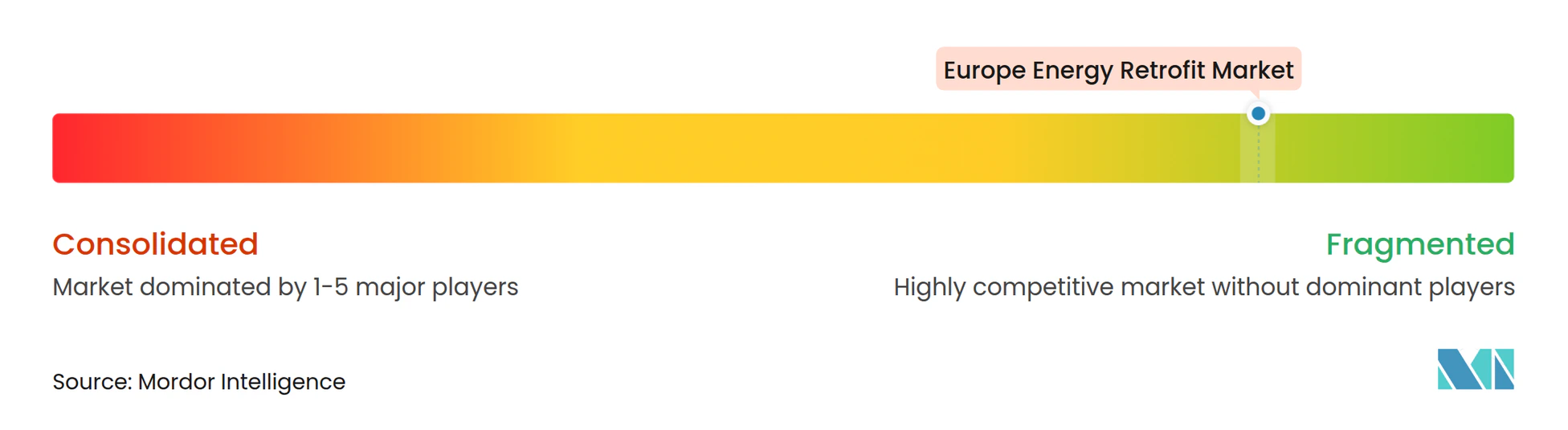
The Europe energy retrofit market is fragmented across technologies and applications. No single participant holds a dominant position across HVAC, controls, envelope materials, energy services, and retrofit delivery. Siemens, Schneider Electric, Johnson Controls, Honeywell, and ABB compete as building technology integrators. Their offers increasingly combine equipment, controls, monitoring, and service delivery around measured building performance.
ABB launched Ability BuildingPro Suites at Light+Building 2026 as a modular platform covering energy, operations, comfort, asset health, space, and grid interaction data. The company also positions wireless retrofit solutions for older buildings that cannot readily accommodate hardwired systems. These moves reflect competition around lower installation disruption and stronger building-data visibility. Envelope suppliers, including Kingspan, ROCKWOOL, and Saint-Gobain, compete through material performance, certification, supply capacity, and digital assessment tools. ROCKWOOL raised its 2026 guidance to 5% to 7% local-currency growth after insulation segment revenue increased 10.4% in the first half.
Energy service companies including ENGIE, Veolia, and VINCI Energies compete through energy performance contract experience and geographic delivery capacity. VINCI Energies reported 9% revenue growth in the second quarter of 2026 and completed 12 acquisitions during the first half of the year. This acquisition activity shows how providers can build scale in fragmented national markets. EU Taxonomy criteria and ISO 52000-series assessment standards influence procurement because owners need reliable documentation for green finance access. Competition therefore extends beyond product supply into project financing, design, implementation, measurement, and long-term service.
Europe Energy Retrofit Industry Leaders
-
Johnson Controls International plc
-
Siemens AG
-
Schneider Electric SE
-
ENGIE SA
-
Daikin Industries, Ltd.
- *Disclaimer: Major Players sorted in no particular order
Europe Energy Retrofit Market Companies Covered in this Report
- ABB Ltd.
- AECOM
- Ameresco, Inc.
- Bouygues Energies and Services
- Carrier Global Corporation
- Daikin Industries, Ltd.
- Danfoss A/S
- ENGIE SA
- Honeywell International Inc.
- Johnson Controls International plc
- Kingspan Group plc
- Legrand SA
- ROCKWOOL A/S
- Saint-Gobain S.A.
- Schneider Electric SE
- Siemens AG
- Skanska AB
- Trane Technologies plc
- Veolia Environnement S.A.
- VINCI Energies
Recent Industry Developments in Europe Energy Retrofit Market
- September 2026: LEONHARD KURZ and ENERGYNEST commissioned a power-to-heat plant with integrated thermal storage at KURZ's Sulzbach-Rosenberg, Germany site, one of the first industrial projects in Germany combining high-temperature electrified heat with integrated thermal energy storage. The project was funded by Germany's Federal Ministry for Economic Affairs and Climate Action as a scalable model for industrial heat decarbonization.
- July 2026: Germany's Federal Ministry for Economic Affairs and Energy launched the reformed Federal Funding for Efficient Buildings, or BEG, under three new guidelines covering residential, non-residential, and individual measures. The reform maintains KfW and BAFA mandates, raises maximum loans to EUR 150,000 per residential unit, and introduces a worst-performing-buildings bonus and a heat pump value-chain bonus from 2027.
- June 2026: Danfoss announced an additional EUR 10 million investment in its Reyrieux, France heat pump component manufacturing facility, bringing total planned 2026 investments to EUR 16 million. This builds on EUR 61 million invested in the site between 2015 and 2025, expanding European heat pump component capacity at a critical point in the regional electrification transition.
- May 2026: ABB launched ABB Ability BuildingPro Suites at Light+Building 2026 in Frankfurt, a modular software platform integrating energy, operations, comfort, asset health, space, and grid interaction data. Built on the acquired Eliona software platform, the suite targets building owners and system integrators deploying data-first retrofit strategies.
Europe Energy Retrofit Market Report Scope
Energy retrofit refers to the process of upgrading or modifying existing buildings, facilities, or energy systems to improve energy efficiency, reduce energy consumption and operating costs, and lower greenhouse gas emissions. Retrofits can involve replacing outdated equipment, improving building insulation and windows, upgrading HVAC and lighting systems, installing smart energy controls, and integrating renewable energy technologies such as solar PV.
The Europe Energy Retrofit Market is segmented by retrofit depth, technology, application, and geography. By retrofit depth, the market is segmented into deep energy retrofits and shallow/light energy retrofits. By technology, the market is segmented into HVAC systems, lighting systems, building envelope, renewable integration, smart building controls, IoT, and water heating and plumbing. By application, the market is segmented into residential, commercial, industrial, and public and institutional buildings. The report also covers the market size and forecasts for the Europe energy retrofit market across 7 countries in the region. For each segment, the market sizing and forecasts have been provided on the basis of value (USD).
Segmentation Overview
| Deep Energy Retrofits |
| Shallow/Light Energy Retrofits |
| HVAC Systems |
| Lighting Systems |
| Building Envelope (Insulation and Glazing) |
| Renewable Integration (Solar PV, Solar Thermal) |
| Smart Building Controls and IoT |
| Water Heating and Plumbing |
| Residential Buildings |
| Commercial Buildings |
| Industrial Facilities |
| Public and Institutional Buildings |
| Europe | Germany |
| France | |
| Italy | |
| Spain | |
| United Kingdom | |
| Poland | |
| Russia | |
| Rest of Europe |
| By Retrofit Depth | Deep Energy Retrofits | |
| Shallow/Light Energy Retrofits | ||
| By Technology | HVAC Systems | |
| Lighting Systems | ||
| Building Envelope (Insulation and Glazing) | ||
| Renewable Integration (Solar PV, Solar Thermal) | ||
| Smart Building Controls and IoT | ||
| Water Heating and Plumbing | ||
| By Application | Residential Buildings | |
| Commercial Buildings | ||
| Industrial Facilities | ||
| Public and Institutional Buildings | ||
| By Geography | Europe | Germany |
| France | ||
| Italy | ||
| Spain | ||
| United Kingdom | ||
| Poland | ||
| Russia | ||
| Rest of Europe | ||
Key Questions Answered in the Report
What is the projected value of the Europe energy retrofit market by 2032?
The Europe energy retrofit market is forecast to reach USD 223.64 billion by 2032, growing from USD 148.96 billion in 2027 at an 8.47% CAGR. The forecast reflects building renovation requirements and continued investment in energy efficiency.
Which retrofit depth category leads European demand?
Shallow/Light Energy Retrofits led with 56.7% share in 2026 because owners can limit disruption and spread investment across several measures. Deep Energy Retrofits are forecast to grow faster at a 10.3% CAGR through 2032 as compliance rules and industrialized delivery methods develop.
Which technologies are central to building retrofit projects in Europe?
HVAC Systems held 28.4% share in 2026, supported by boiler replacement and heat pump adoption. Lighting Systems are the fastest-growing technology category at a 10.7% CAGR, while controls, envelope improvements, renewable integration, and water heating support wider building upgrades.
Why are heat pumps important for European building upgrades?
Heat pumps are being installed largely in existing buildings, which accounted for 80% of installations among the 2.88 million units sold in 21 European countries during 2025. They can replace aging heating systems and help owners reduce fossil fuel use
Which country leads European retrofit activity?
Germany led with 22.4% share in 2026, supported by its revised BEG program and strong heat pump deployment. The program offers loans of up to EUR 150,000 per residential unit and includes measures for residential and non-residential buildings.
What is the largest barrier to deeper building renovation?
The main barrier is financing, as the European Commission identified a EUR 149 billion annual investment gap through 2030 and deep renovation activity remained at 0.2% of annual stock through 2025. Rental-market split incentives, delivery capacity, permitting, and heritage requirements can add further barriers.