
Europe Dumpsters Market Size and Share
Market Overview
| Study Period | 2021 - 2032 |
|---|---|
| Forecast Data Period | 2027 - 2032 |
| Base Year Market Size (2026) | USD 2.22 Billion |
| Market Size (2027) | USD 2.30 Billion |
| Market Size (2032) | USD 2.73 Billion |
| Growth Rate (2027 - 2032) | 3.49 % |
| Market Concentration | Medium |
Major Players *Disclaimer: Major Players sorted in no particular order Image © Mordor Intelligence. Reuse requires attribution under CC BY 4.0. | |
Europe Dumpsters Market Analysis by Mordor Intelligence
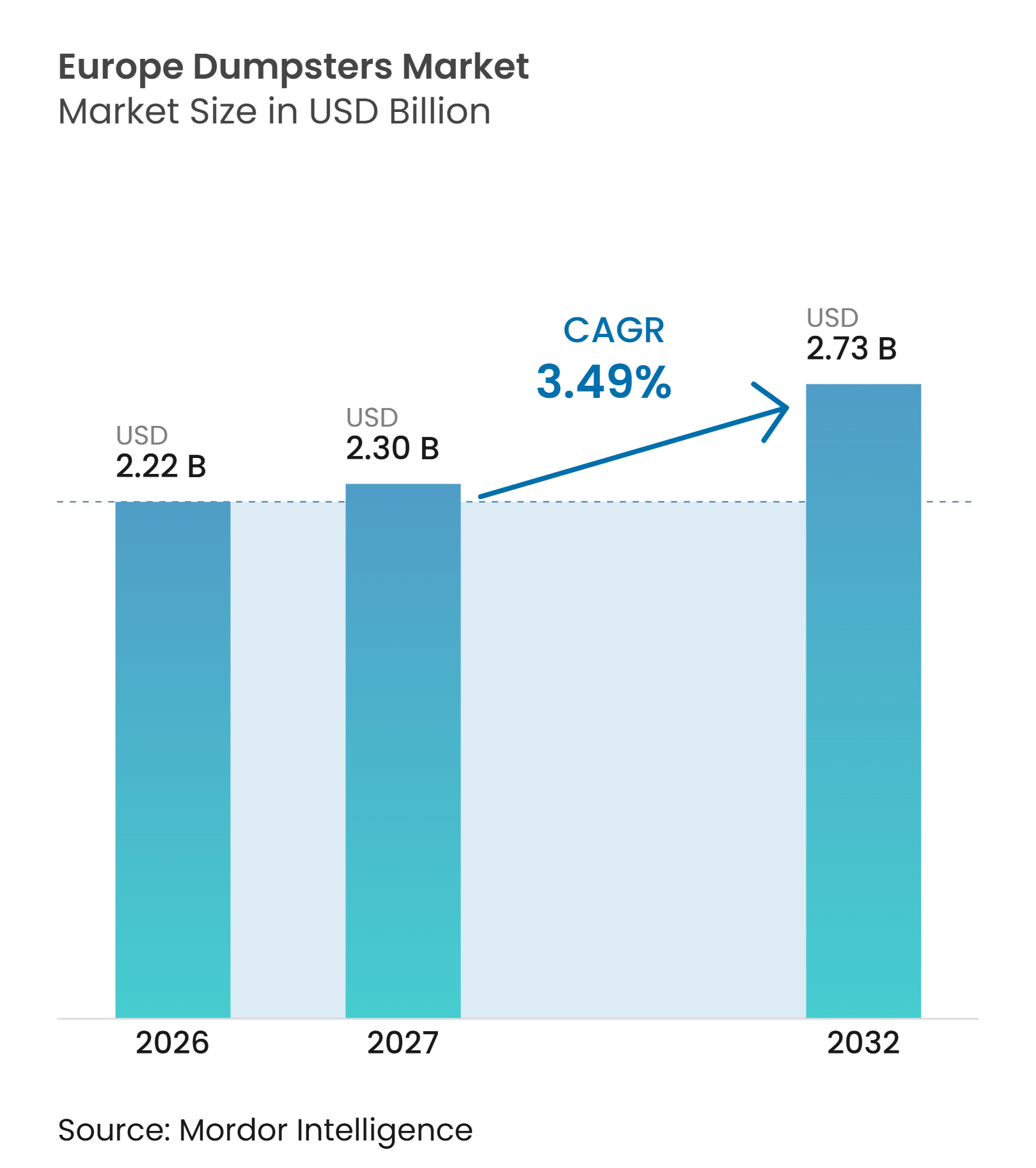
The Europe Dumpster Market size is projected to be USD 2.22 billion in 2026, USD 2.30 billion in 2027, and reach USD 2.73 billion by 2032, growing at a CAGR of 3.49% from 2027 to 2032.
Separate collection rules, aging municipal fleets, and construction and demolition activity support demand for containers across the region. The Europe dumpsters market has a policy base that is less dependent on commercial activity than many equipment categories because collection systems require physical containers. The revised Waste Framework Directive reinforced producer responsibility for textiles and separate collection infrastructure, increasing the number of waste fractions that municipalities must manage. Construction sites also need separate containment for recovery streams, while mature municipal systems continue to replace containers that have reached the end of their service life. Suppliers are responding through standard product platforms, recycled-content materials, digital identification, and underground systems that suit dense cities.
Key Report Takeaways
- By dumpster type, detachable bulk waste containers held 53% of the Europe dumpster market share in 2026, while other dumpster types are forecast to grow at a 4.3% CAGR through 2032.
- By end-user and buyer, waste collection and hauling companies held 38.3% of the Europe dumpster market size in 2026, while commercial and institutional establishments are forecast to grow at a 3.9% CAGR through 2032.
- By waste type, recyclable waste held 29.6% of revenue in 2026, while organic and green waste is forecast to grow at a 5.1% CAGR through 2032.
- By bin size, bins up to 3 cubic yards held 29.8% of revenue in 2026, while the 20 to 30 cubic yards segment is forecast to grow at a 3.7% CAGR through 2032.
- By geography, Germany held 20.9% of revenue in 2026, while the rest of Europe is forecast to grow at a 4.4% CAGR through 2032.
Note: Market numbers in this report are based on Mordor Intelligence's proprietary estimation framework, which combines nine months of actuals with Q4 projections for base year 2026.
Market Trends and Insights
Drivers Impact Analysis of Europe Dumpsters Market*
| Driver | (~) % Impact on CAGR Forecast | Geographic Relevance | Impact Timeline |
|---|---|---|---|
| Expansion of Municipal Waste Containerization | +0.9% | EU-wide, with highest intensity in Poland, Romania, Germany, and France | Short term (≤ 2 years) |
| Construction, Demolition, and Infrastructure Activity | +0.8% | Germany, United Kingdom, France, Poland, and Turkey, with spillover to Czechia and Austria | Medium term (2-4 years) |
| Replacement of Aging Dumpster Fleets | +0.6% | France, Germany, the Netherlands, Belgium, and the Nordic region | Medium term (2-4 years) |
| Source-Separated and Material-Specific Containers | +0.5% | EU-wide, with early gains in Sweden, the Netherlands, and Denmark | Medium term (2-4 years) |
| Smart, Underground, and Semi-Underground Systems | +0.4% | The Netherlands, Spain, Germany, and the Nordic region, with early adoption in Poland and Czechia | Long term (≥ 4 years) |
| Recycled and Low-Carbon Public Procurement | +0.3% | EU public procurement, especially Germany, France, and the Nordic countries | Long term (≥ 4 years) |
| Source: Mordor Intelligence | |||
Expansion of Municipal Waste Containerization
The Europe dumpsters market benefits from the extension of containerized municipal collection across waste streams. The revised Waste Framework Directive requires member states to maintain separate collection systems and strengthens extended producer responsibility for textiles.[1] Romania, Poland, and Turkey are extending container networks into peri-urban and rural areas, creating a near-term purchasing pipeline. Collection points need more units when households move from mixed collection to fraction-specific collection. The January 2025 requirement for separate household hazardous-waste collection also added to the minimum container requirement across the bloc. This pattern gives the Europe dumpsters market demand from network expansion as well as replacement activity.
Construction, Demolition, and Infrastructure Activity
Construction and demolition work sustains demand for detachable, skip, and roll-off containers in the Europe dumpster market. Construction and demolition waste accounts for more than one-third of total EU waste generation.[2] The EU recovery target requires site managers to separate material streams rather than place all waste in one container. Germany, France, the United Kingdom, Poland, and Turkey provide important construction-related demand. The EU protocol for construction and demolition waste management supports selective demolition, which requires separate units for concrete, wood, metals, gypsum, and other materials. Holcim recycled eight million tons of construction and demolition material in 2025, showing the scale of material handling that relies on source-separated containment.
Replacement of Aging Dumpster Fleets
Aging municipal fleets provide a replacement base for the Europe dumpsters market even when new-network deployment slows. SULO’s contract with Métropole Européenne de Lille covers nearly 820,000 container units, with an average fleet age above 14 years. Older containers can raise maintenance needs and reduce collection efficiency. Fleet renewal lets municipalities procure fraction-specific lids and containers with higher recycled content. HDPE containers commonly remain in use for 10 to 15 years, placing equipment installed during earlier containerization programs in Germany, France, and the United Kingdom within a broad replacement window.
Source-Separated and Material-Specific Containers
Material-specific collection is changing container specifications and purchasing decisions throughout the European dumpster market. The Waste Framework Directive required separate textile collection from January 2025, adding a new municipal container category to systems for paper, metal, plastic, glass, and bio-waste. Craemer Nordic entered Sweden to serve municipal preparation for a separate-collection directive expected in 2027. The company won a tender for nearly 70,000 two-compartment containers. Each additional collection stream needs a suitable container design. This expands physical unit demand beyond population growth and general urbanization. Smart, underground, and semi-underground systems support space-efficient collection in dense cities, including deployments in Rotterdam, Hamburg, and Barcelona. Public tenders are also increasing their attention to recycled content and product carbon information. These factors support manufacturers that can combine conventional collection hardware with digital readiness and low-virgin-material products.
Restraints Impact Analysis of Europe Dumpsters Market*
| Restraint | (~) % Impact on CAGR Forecast | Geographic Relevance | Impact Timeline |
|---|---|---|---|
| Steel, Recycled Plastic, and Energy Cost Volatility | -0.7% | Global inputs, with strongest transmission in Germany, Poland, Czechia, and the United Kingdom | Short term (≤ 2 years) |
| Long Product Replacement Cycles and Fleet Longevity | -0.5% | Germany, France, the Netherlands, Belgium, and the United Kingdom | Long term (≥ 4 years) |
| Fragmented National Standards and Certification Requirements | -0.3% | Cross-border EU trade, with highest friction in Romania, Turkey, and Russia | Medium term (2-4 years) |
| High Logistics Costs for Bulky Products | -0.2% | Remote and thinly populated areas, especially the Nordic countries and Turkey | Medium term (2-4 years) |
| Source: Mordor Intelligence | |||
Steel, Recycled Plastic, and Energy Cost Volatility
Steel, recycled plastic, and energy costs remain a margin risk for the Europe dumpsters market. European apparent steel consumption was expected to recover by 3.1% in 2025, subject to trade conditions that Eurofer described as uncertain.[3] Recycled HDPE supply changes with collection rates, which can complicate production planning for container makers. Galvanizing and injection molding require substantial energy input. Cost pressures are pronounced in Germany, Poland, and Czechia. Manufacturers producing EN 840-compliant containers have limited scope to substitute lower-grade structural inputs, while multiyear tenders can restrict price pass-through.
Long Product Replacement Cycles and Fleet Longevity
Long product lifetimes constrain annual replacement volumes in the Europe dumpsters market. Steel and HDPE dumpsters can operate for 10 to 20 years under European conditions when they are maintained. Municipal budget limits can extend service intervals beyond the intended design life. Mature markets with recently modernized installed bases therefore have limited room for rapid volume growth. EN 840 and EN 13071 compliance is necessary for tender eligibility, but durable products also reduce the frequency of replacement purchases. High logistics costs for bulky products add pressure in thinly populated regions, while national certification requirements can complicate cross-border supply.
*Our forecasts treat driver/restraint impacts as directional, not additive. The impact forecasts reflect baseline growth, mix effects, and variable interactions.
Europe Dumpsters Market Segment Analysis
By Dumpster Type:
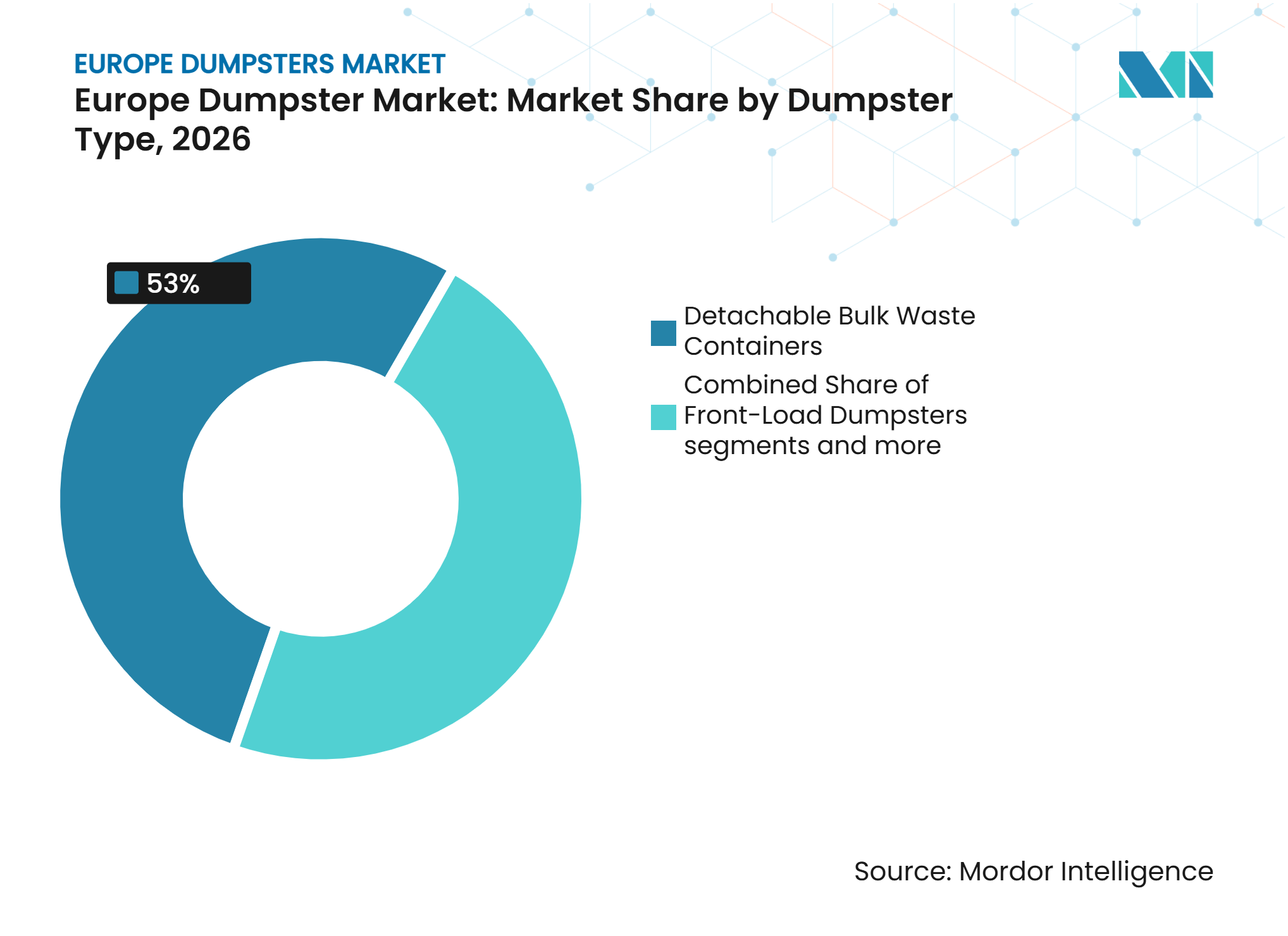
Detachable Systems Anchor Market RevenueDetachable bulk waste containers held 53% of Europe dumpsters market revenue by dumpster type in 2026. They serve construction and demolition sites and high-density municipal bulky-waste collection through cable-hoist, hook-lift, and skip-lift configurations. The Europe dumpsters market size for detachable systems reflects applications where large-volume containment is necessary. Front-load and rear-load containers retain demand in commercial and institutional settings. Their standard lifting interfaces suit fleets that need predictable collection frequency. Detachable systems remain central where containers need to move between construction sites, transfer points, and recovery facilities.
Other dumpster types are forecast to expand at a 4.3% CAGR from 2027 to 2032. This category includes underground, semi-underground, and specialized sorting systems. Cities facing limited space are adopting these formats because they can consolidate collection capacity while preserving surface space. Manufacturers that supply both detachable systems and mobile wheeled containers can serve municipal and construction channels from one production base. CONTENUR reported that its late-2025 Ostrava deployment included 370 OVAL side-loading containers in 2,000L and 3,000L formats with color-coded lids. The project shows the growing relevance of fraction-specific side-loading systems in Central Europe.



By End-User/Buyer:
Haulers Lead, Commercial Buyers AccelerateWaste collection and hauling companies accounted for 38.3% of revenue by end-user in 2026. These companies purchase standardized container lots that comply with EN 840 or EN 13071 specifications. Their buying plans are commonly tied to multiyear municipal collection contracts. Fixed-price collection contracts can make them sensitive to input-cost changes. Recycling and material recovery companies are also purchasing specialized containers as recycling requirements increase facility throughput. The Europe dumpsters industry depends on these buyers because they translate public service obligations into recurring equipment procurement.
Commercial and institutional establishments are forecast to grow at a 3.9% CAGR through 2032. Hospitality, retail, and healthcare operators are expanding sorting programs to meet producer responsibility obligations and internal sustainability requirements. Municipalities and public waste authorities use tender frameworks that increasingly include recycled-content thresholds, product carbon declarations, and EN-standard compliance. ESE World received a GBP 2.16 million (USD 2.9 million) contract from West Suffolk Council in September 2025 for 240L wheeled bins and kerbside recycling containers under the KCS Procurement Framework. Construction, demolition, and infrastructure contractors form a separate buyer group whose procurement changes with project schedules.
By Waste Type:
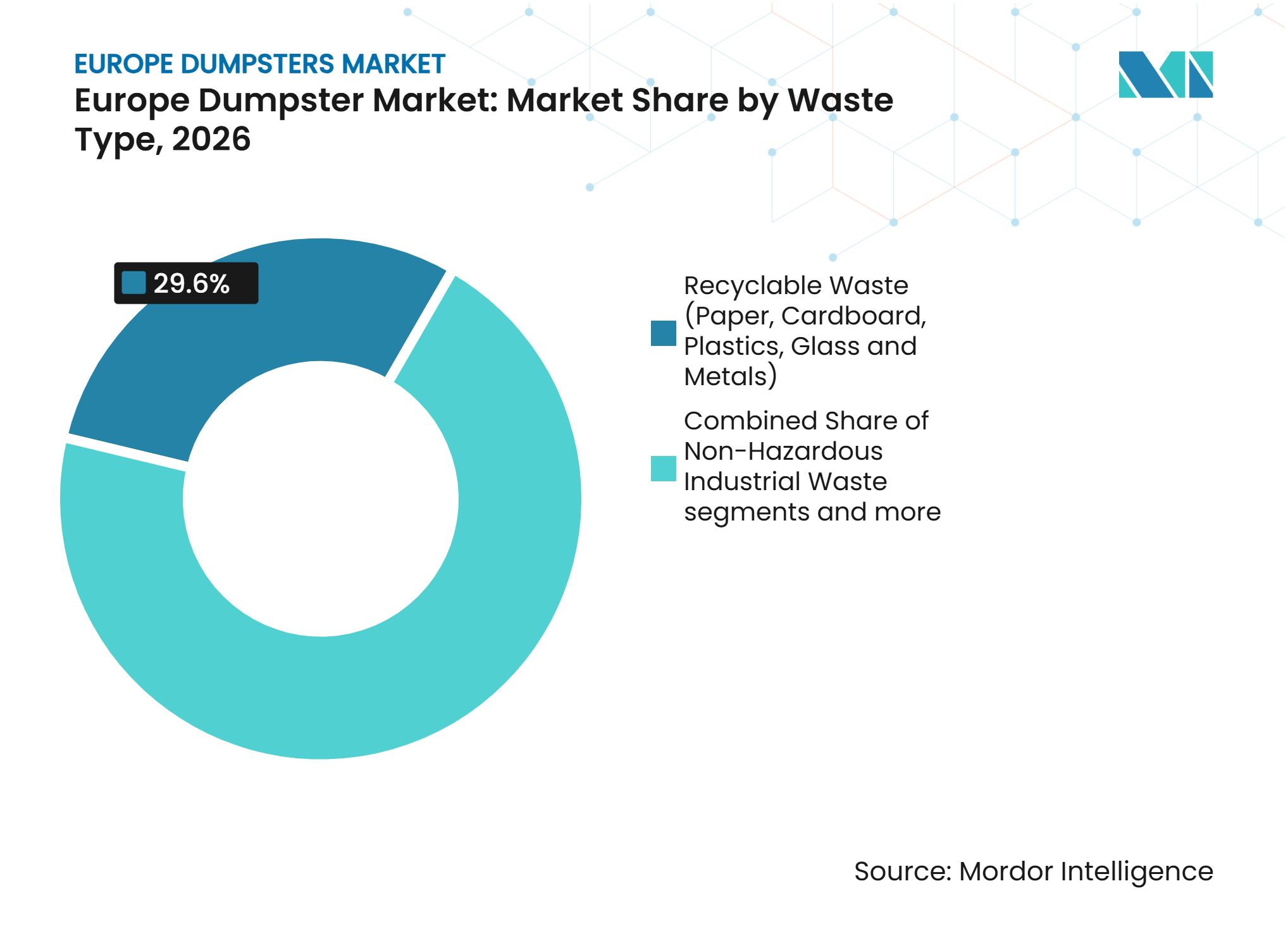
Recyclables Drive Volume, Organics Grow FastestRecyclable waste accounted for 29.6% of revenue in 2026, making it the largest waste-type segment. The Europe dumpsters market share for recyclable waste reflects requirements for separate collection of paper, cardboard, plastics, glass, and metals. The Waste Framework Directive set a 55% municipal waste recycling target for 2025 and a 60% target for 2030. Separate collection creates demand for dedicated containers across each material stream. This category has the highest physical unit requirements because municipalities need containers across broad residential and commercial networks. The Europe dumpsters market is therefore supported by recycling infrastructure even where mixed-waste volumes decline.
Organic and green waste is forecast to grow at a 5.1% CAGR from 2027 to 2032. The Waste Framework Directive required separate bio-waste collection or source separation by the end of 2023. Implementation gaps have encouraged municipalities to replace mixed-collection arrangements with brown-bin and food-caddy systems. Construction and demolition waste continues to support demand for skip and hook-lift containers because recovery targets favor on-site separation. General and mixed non-hazardous waste remains significant, but its share is declining as collection systems divert materials into separate streams. Bulky waste and cleanout material also require volume-intensive collection in dense urban areas.

By Bin Size (Capacity):
Small Bins Prevalent, Mid-Range Gaining TractionBins up to 3 cubic yards accounted for 29.8% of the revenue in 2026. The Europe dumpsters market size for this capacity band is supported by 120L to 240L wheeled bins used in residential and small-commercial collections. Door-to-door service contracts in Western Europe favor smaller units that fit constrained spaces and frequent collection schedules. SSI SCHÄFER Plastics produced more than 400,000 yellow bins for lightweight packaging collection in 2025. The company stated that these units represented nearly two-thirds of the relevant German market. High production volumes show the continuing importance of standard wheeled-bin formats.
The 20 to 30 cubic yards capacity band is forecast to expand at a 3.7% CAGR through 2032. Construction sites and industrial parks use this range for bulk material and compaction-ready waste handling. The 10 to 20 cubic yards range serves large housing estates and retail parks where collection needs exceed household levels. Containers above 40 cubic yards serve high-volume construction, demolition, and industrial streams through roll-off or hook-lift equipment. Craemer introduced its Zero Virgin recycled polyethylene granulate in 2025 and expanded storage capacity at Oelde to 4,000 tons. Recycled-content materials are becoming more relevant as tender specifications add environmental requirements.
Geography Analysis
Germany
Germany held 20.9% of the Europe dumpsters market share in 2026. Its established separate-collection system and large installed base create demand for maintenance and selective fleet replacement. The Kreislaufwirtschaftsgesetz and Verpackungsgesetz support separate access for paper, glass, metal, plastic, bio-waste, and textiles. Each required fraction adds a container specification to municipal procurement. SSI SCHÄFER Plastics produced more than 400,000 yellow bins during 2025 for lightweight packaging collection. Craemer supplied EN 840-compliant HDPE containers to Stadtwerke Delmenhorst in September 2025. ELKOPLAST also delivered hook-lift units to Nuremberg’s waste management service in November 2025. These orders show that regulated collection and construction-related needs operate together in Germany.
Rest of Europe
The rest of Europe is forecast to grow at a 4.4% CAGR from 2027 to 2032. This Europe dumpsters market size growth is tied to container infrastructure development in Eastern and Southeastern Member States. Hungary, Bulgaria, the Baltic states, and EU accession candidates in the Western Balkans are developing separate-collection systems to meet EU compliance requirements. First deployment can create higher city-level volumes than mature replacement programs. CONTENUR’s Ostrava pilot used 370 side-loading containers with OZO Ostrava and was intended to support a citywide rollout. Poland, Romania, and Turkey have strong potential because containerization rates remain lower than in mature Western European systems. Supplier success in this group depends on providing durable collection hardware that can support new material-specific networks.
Emerging Markets and Mature Peripheral Geographies
The United Kingdom continues to procure through national frameworks, as shown by ESE World’s September 2025 award from West Suffolk Council. France has a steady replacement base for underground collection systems that were installed in prior cycles. The Nordic countries are increasing dual-fraction container adoption, and Craemer’s Swedish order covered nearly 70,000 containers for separate-fraction collection. SULO’s acquisition of JOCA Trading strengthened its Scandinavian position in underground container systems. The Netherlands, Belgium, and Austria are mature settings where smart-sensing upgrades can generate incremental procurement. These different maturity levels require suppliers to balance replacement products in established systems with entry-level deployment products in emerging networks.
Competitive Landscape
Market Concentration
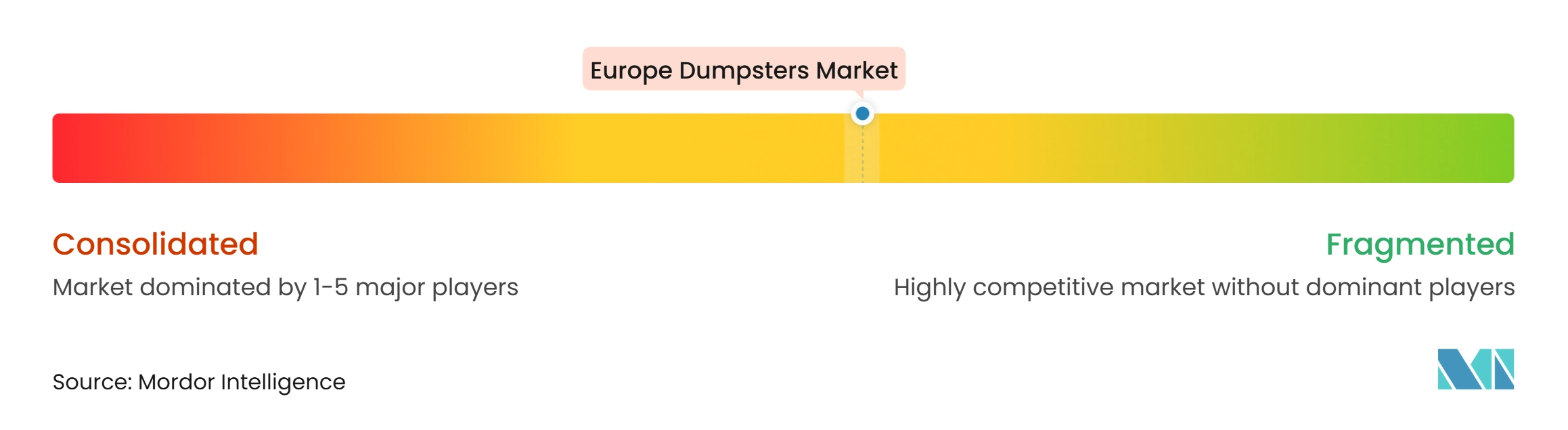
The Europe dumpsters market exhibits a medium level of market concentration. SULO Group reports revenue above EUR 600 million (USD 705.8 million) and serves more than 15,000 customers across 50 countries. Its March 2025 majority investment from Latour Capital IV provided equity for acquisition-led expansion. In December 2025, SULO acquired Danish underground-container specialist JOCA Trading A/S, which had revenue near EUR 35 million (USD 41.2 million) and municipal framework agreements. The transaction strengthened SULO’s presence in Denmark and expanded its access to underground collection systems. CONTENUR operates through 14 subsidiaries and four production plants, according to its investor disclosure.
Integrated manufacturers pursue standardized platforms that can support volume production and reduce cost pressure. ELKOPLAST, Meva, GES Group, and Helesi compete through local presence, customization, and targeted tender participation in Eastern Europe. The Europe dumpsters market also rewards companies that can meet EN 840 and EN 13071 requirements while supplying recycled-content products. SULO received Science Based Targets initiative validation in July 2025 for a 42% reduction in Scope 1 and 2 emissions by 2030 and a 51.6% reduction in Scope 3 intensity. Craemer broke ground on a 6.8MW wind turbine at its Oelde site in March 2025, targeting 16.5 million kWh of annual generation for injection-molding operations. These actions show how suppliers are addressing tender criteria that extend beyond container price and capacity.
Digital container management is becoming an important differentiator in the Europe dumpsters market. SSI SCHÄFER Plastics made Smart Tag UHF transponders standard on its waste-bin range in February 2025. The tags work with the company’s DISPONDO fleet-management and route-optimization platform. ESE World competes through its CL four-wheel container and CIRCULOGIC recycled-content program. Container suppliers must retain lifting compatibility when they add RFID or sensor interfaces. Opportunities remain in verified recycled-content containers, product carbon documentation, low-noise designs, and sensor-ready units for municipalities building new collection systems.
Europe Dumpsters Industry Leaders
-
SULO SAS
-
CONTENUR, S.L.
-
SSI Schäfer AG
-
ESE World B.V.
-
Craemer GmbH
- *Disclaimer: Major Players sorted in no particular order
Europe Dumpsters Market Companies Covered in this Report
- SULO SAS
- CONTENUR, S.L.
- SSI Schäfer AG
- ESE World B.V.
- Craemer GmbH
- Craemer UK Ltd.
- Weber GmbH & Co. KG
- ELKOPLAST CZ, s.r.o.
- Meva a.s.
- GES Group
- OTTO Environmental Systems GmbH
- Schaefer Systems International GmbH
- Toter, Incorporated
- Kingspan Group plc
- Nord Engineering S.p.A.
- Ecobins GmbH
- Ferro Corporation
- Geco GmbH
- Gerdau Recycling Products Europe
- Morandin Contenitori S.r.l.
- Ogepar GmbH
- Helesi S.A.
Recent Industry Developments in Europe Dumpsters Market
- April 2026: CONTENUR reported results of its Ostrava pilot, confirming the late-2025 deployment of 370 OVAL side-loading containers from 2,000L to 3,000L, color-coded by fraction, with OZO Ostrava as the foundation for a citywide side-loading rollout.
- December 2025: SULO Group closed the acquisition of JOCA Trading A/S, a Danish underground-container and crane-emptied-system specialist with annual revenue near EUR 35 million (USD 47.2 million) and long-term framework agreements across Danish municipalities and housing associations.
- October 2025: The revised EU Waste Framework Directive entered into force on October 16, strengthening extended producer responsibility for textiles and requiring collection arrangements across Member States.
- December 2025: ESE World Limited received a GBP 2.16 million (USD 2.9 million) award from West Suffolk Council for 240L wheeled bins and kerbside recycling containers under the KCS Procurement Framework, with a two-year delivery term to January 2028.
Europe Dumpsters Market Report Scope
The Europe Dumpsters Market Report is Segmented by Dumpster Type (Front-Load Dumpsters, Rear-Load Dumpsters, and More), by End-User/Buyer (Waste Collection and Hauling Companies, and More), by Waste Type (General and Mixed Non-Hazardous Solid Waste, and More), by Bin Size (Up To 3 Cubic Yards, and More), and by Geography (Germany, United Kingdom, France, and More). The Market Forecasts are Provided in Terms of Value (USD).
Segmentation Overview
| Front-Load Dumpsters | |
| Rear-Load Dumpsters | |
| Detachable Bulk Waste Containers | Cable-Hoist / Rail Roll-Off Containers |
| Hook-Lift Containers | |
| Skip-Lift / Chain-Lift Containers | |
| Other Detachable Container Configurations | |
| Other Dumpster Types |
| Waste Collection and Hauling Companies | |
| Dumpster Rental and Leasing Companies | |
| Municipalities and Public Waste Authorities | |
| Construction, Demolition and Infrastructure Contractors | |
| Commercial and Institutional Establishments | Retail and Shopping Centers |
| Hospitality, Restaurants and Food Service | |
| Offices and Commercial Buildings | |
| Healthcare and Educational Institutions | |
| Real Estate and Facility Management Companies | |
| Other Commercial and Institutional Establishments | |
| Industrial and Manufacturing Companies | |
| Recycling and Material Recovery Companies | |
| Other Direct Buyers |
| General and Mixed Non-Hazardous Solid Waste |
| Construction and Demolition (C&D) Waste |
| Recyclable Waste (Paper, Cardboard, Plastics, Glass and Metals) |
| Organic and Green Waste (Food, Yard, Landscape and Horticultural Waste) |
| Non-Hazardous Industrial Waste |
| Bulky Waste and Cleanout Materials |
| Other Non-Hazardous Waste |
| Up to 3 Cubic Yards |
| 3 to 6 Cubic Yards |
| 6 to 10 Cubic Yards |
| 10 to 20 Cubic Yards |
| 20 to 30 Cubic Yards |
| 30 to 40 Cubic Yards |
| Above 40 Cubic Yards |
| Germany |
| United Kingdom |
| France |
| Italy |
| Spain |
| Netherlands |
| Belgium |
| Sweden |
| Norway |
| Denmark |
| Poland |
| Czechia |
| Austria |
| Romania |
| Russia |
| Turkey |
| Rest of Europe |
| By Dumpster Type | Front-Load Dumpsters | |
| Rear-Load Dumpsters | ||
| Detachable Bulk Waste Containers | Cable-Hoist / Rail Roll-Off Containers | |
| Hook-Lift Containers | ||
| Skip-Lift / Chain-Lift Containers | ||
| Other Detachable Container Configurations | ||
| Other Dumpster Types | ||
| By End-User/Buyer | Waste Collection and Hauling Companies | |
| Dumpster Rental and Leasing Companies | ||
| Municipalities and Public Waste Authorities | ||
| Construction, Demolition and Infrastructure Contractors | ||
| Commercial and Institutional Establishments | Retail and Shopping Centers | |
| Hospitality, Restaurants and Food Service | ||
| Offices and Commercial Buildings | ||
| Healthcare and Educational Institutions | ||
| Real Estate and Facility Management Companies | ||
| Other Commercial and Institutional Establishments | ||
| Industrial and Manufacturing Companies | ||
| Recycling and Material Recovery Companies | ||
| Other Direct Buyers | ||
| By Waste Type | General and Mixed Non-Hazardous Solid Waste | |
| Construction and Demolition (C&D) Waste | ||
| Recyclable Waste (Paper, Cardboard, Plastics, Glass and Metals) | ||
| Organic and Green Waste (Food, Yard, Landscape and Horticultural Waste) | ||
| Non-Hazardous Industrial Waste | ||
| Bulky Waste and Cleanout Materials | ||
| Other Non-Hazardous Waste | ||
| By Bin Size (Capacity) | Up to 3 Cubic Yards | |
| 3 to 6 Cubic Yards | ||
| 6 to 10 Cubic Yards | ||
| 10 to 20 Cubic Yards | ||
| 20 to 30 Cubic Yards | ||
| 30 to 40 Cubic Yards | ||
| Above 40 Cubic Yards | ||
| By Geography | Germany | |
| United Kingdom | ||
| France | ||
| Italy | ||
| Spain | ||
| Netherlands | ||
| Belgium | ||
| Sweden | ||
| Norway | ||
| Denmark | ||
| Poland | ||
| Czechia | ||
| Austria | ||
| Romania | ||
| Russia | ||
| Turkey | ||
| Rest of Europe | ||
Key Questions Answered in the Report
What is the forecast growth rate for Europe dumpsters through 2032?
The Europe dumpsters market is forecast to grow at a 3.49% CAGR from 2027 to 2032 and is expected to reach USD 2.73 billion by 2032. Separate collection obligations, construction and demolition containment needs, and municipal fleet replacement support this outlook.
Which dumpster type holds the largest revenue position in Europe?
Detachable bulk waste containers lead with 53% of the 2026 revenue. They are used for construction and demolition material, municipal bulky waste, and collection systems that use cable-hoist, hook-lift, or skip-lift configurations.
Why are organic and green-waste containers expanding faster than other waste types?
Organic and green waste is forecast to grow at a 5.1% CAGR through 2032. Municipalities are expanding brown-bin and food-caddy systems to address separate bio-waste collection requirements. This work replaces mixed-collection infrastructure and adds dedicated container capacity at household, communal, and commercial collection points.
Which buyer group accounts for the highest share of container demand?
Waste collection and hauling companies account for 38.3% of the 2026 revenue. Their multiyear municipal service contracts create demand for standardized container lots that meet EN 840 or EN 13071 specifications.
Which European geography has the strongest current position?
Germany leads with 20.9% of the 2026 revenue. Its established fraction-specific collection system, large installed base, and continuing municipal replacement orders support its position.
How are manufacturers differentiating their container offerings?
Suppliers are combining RFID identification, fleet-management integration, recycled-content materials, underground formats, and low-noise or sensor-ready designs. These features can help them meet public tender requirements without compromising lifting compatibility. Standard product platforms also help larger producers serve both municipal collection programs and construction-related container demand.