
Europe Data Center Waste Heat Recovery Market Size and Share
Market Overview
| Study Period | 2021 - 2032 |
|---|---|
| Forecast Data Period | 2027 - 2032 |
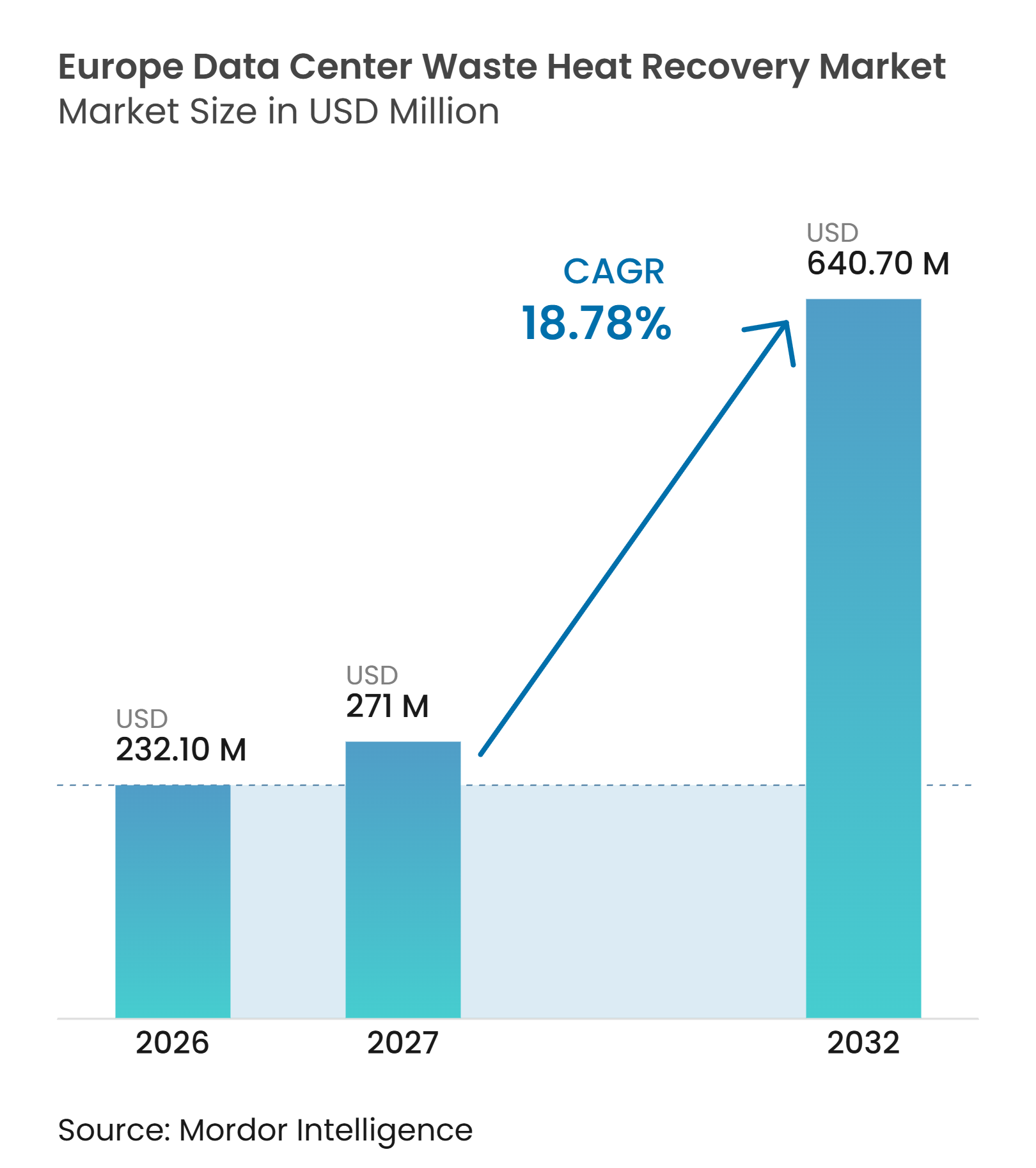
| Base Year Market Size (2026) | USD 232.10 Million |
| Market Size (2027) | USD 271 Million |
| Market Size (2032) | USD 640.70 Million |
| Growth Rate (2027 - 2032) | 18.78 % |
| Market Concentration | Medium |
Major Players *Disclaimer: Major Players sorted in no particular order Image © Mordor Intelligence. Reuse requires attribution under CC BY 4.0. | |
Europe Data Center Waste Heat Recovery Market Analysis by Mordor Intelligence
The Europe data center waste heat recovery market size was valued at USD 232.10 million in 2026 and is projected to reach USD 640.74 million by 2032, at a CAGR of 18.78% during 2027-2032. Higher rack densities are increasing the heat available from computing facilities, especially where AI workloads require more intensive cooling. Recovering that heat is becoming a practical option where data centers can connect to established district heating networks and secure long-term buyers. Compliance requirements are also shifting the discussion from voluntary sustainability targets toward measured energy performance. Project developers increasingly need a utility partner, a viable connection route, and a reliable offtake agreement before capital can be committed. This leaves room for suppliers that can combine equipment, controls, storage, and project delivery into a financeable proposal.
Key Report Takeaways
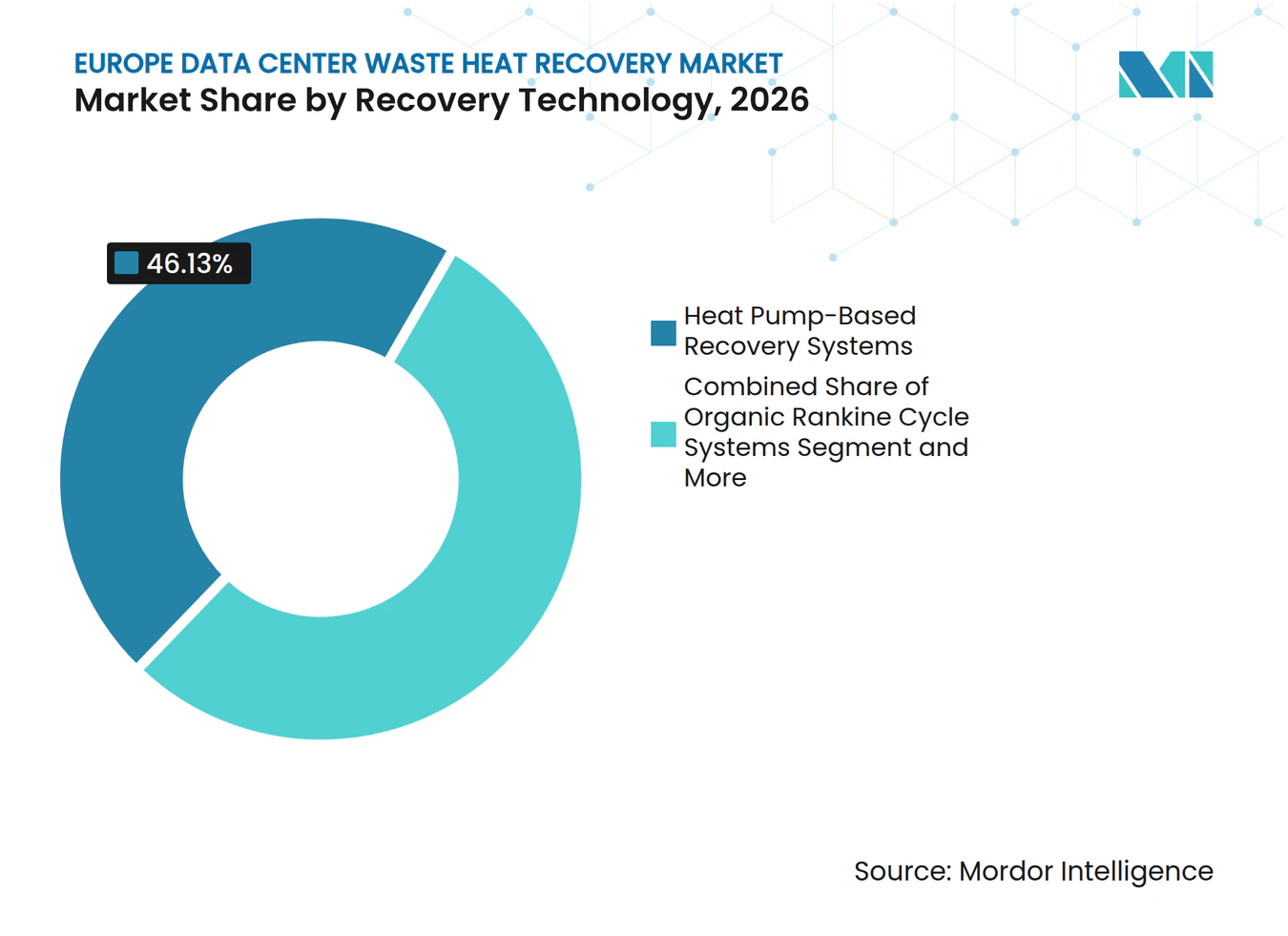
- By recovery technology, heat pump-based systems held 46.13% of the Europe data center waste heat recovery market share in 2026, while thermal energy storage-integrated systems are projected to expand at a 27.11% CAGR through 2032.
- By heat reuse application, district heating accounted for 61.73% of the Europe data center waste heat recovery market size in 2026, while greenhouse and agricultural heating is expected to advance at a 25.84% CAGR through 2032.
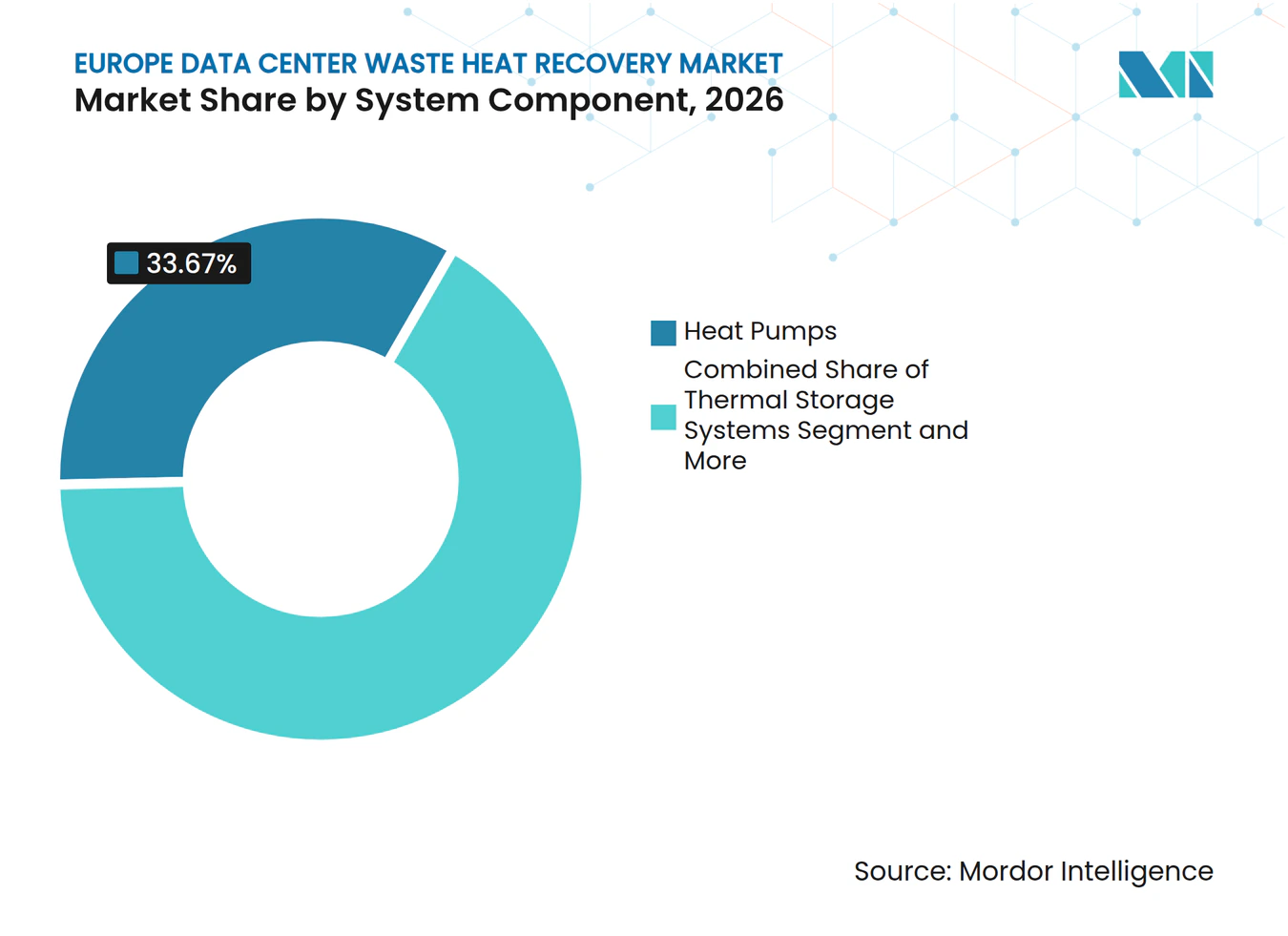
- By system component, heat pumps accounted for 33.67% of the market in 2026, while thermal storage systems are projected to expand at a 26.27% CAGR through 2032.
- By heat delivery model, district heating network offtake held 68.12% of the market in 2026, while direct off-site heat supply is projected to expand at a 24.83% CAGR through 2032.
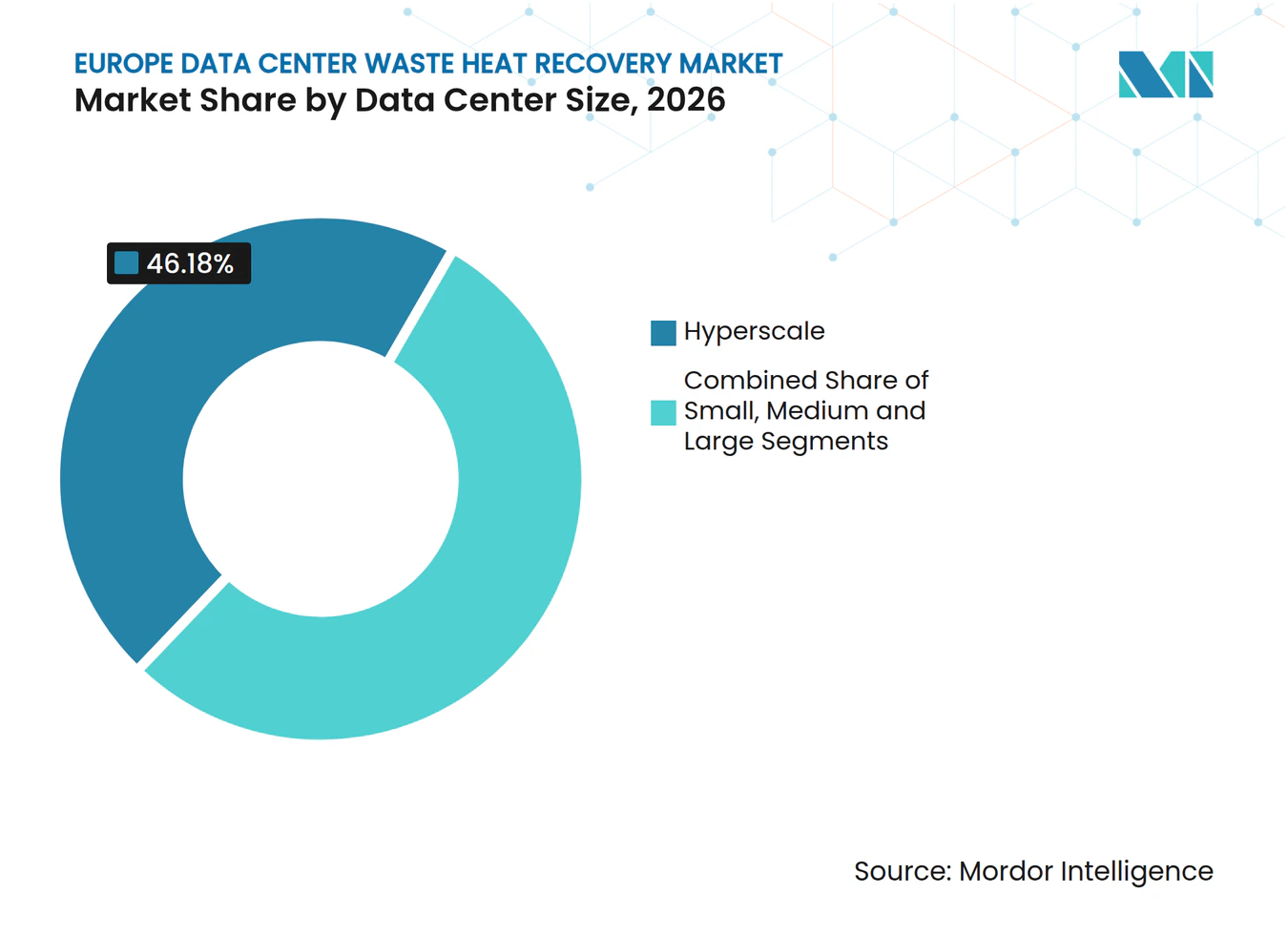
- By data center size, hyperscale facilities accounted for 46.18% of the market in 2026 and are projected to grow at a 21.78% CAGR through 2032.
- By data center type, cloud service providers held 46.93% of the market in 2026, while colocation providers are projected to expand at a 22.13% CAGR through 2032.
- By geography, Germany held 18.47% of the market in 2026, while Poland is projected to expand at a 25.53% CAGR through 2032.
Note: Market numbers in this report are based on Mordor Intelligence's proprietary estimation framework, which combines nine months of actuals with Q4 projections for base year 2026.
Market Trends and Insights
Drivers Impact Analysis of Europe Data Center Waste Heat Recovery Market*
| Driver | (~) % Impact on CAGR Forecast | Geographic Relevance | Impact Timeline |
|---|---|---|---|
| EU Waste-Heat Utilization Obligations for Data Centers Above 1 MW | +4.2% | EU-27, with binding national legislation led by Germany and France, and strong enforcement precedent in Nordic countries | Medium term (2-4 years) |
| EU Data Center Energy-Performance Reporting and Rating Scheme | +3.5% | EU-27, particularly Germany, the Netherlands, and Sweden where clients benchmark ERF | Medium term (2-4 years) |
| Existing District-Heating Infrastructure in the Nordics, Baltics, and Central Europe | +3.0% | Nordic and Baltic countries, with secondary gains in Poland, the Czech Republic, and Germany | Short term (≤ 2 years) |
| European Decarbonization of Fossil-Fuel Heat Networks | +2.5% | Germany, Denmark, and the Netherlands, with Baltic countries transitioning from legacy coal heat systems | Long term (≥ 4 years) |
| Nordic Heat-Offtake Platforms and Municipal Project Aggregation | +2.0% | Sweden and Finland, with adoption extending to Denmark, Norway, and Germany | Short term (≤ 2 years) |
| European Heat-Reuse Readiness as a Data-Center Siting Differentiator | +1.5% | Most visible in Germany, the Netherlands, and Ireland, while relevant to global site selection | Medium term (2-4 years) |
| Source: Mordor Intelligence | |||
EU Waste-Heat Utilization Obligations for Data Centers Above 1 MW Drive Compliance Investment
Germany’s Energy Efficiency Act requires data centers commissioned after July 1, 2026, to meet a minimum energy reuse factor of 15% for waste heat, with the threshold rising to 20% from July 1, 2028. France’s DDADUE law has been in effect since January 1, 2026, and requires facilities above 1 MW to conduct a cost-benefit analysis for new sites and major upgrades. These rules bring mid-scale colocation sites into the same planning discussion as large campuses. The resulting demand is not limited to heat pumps because projects also require connections, metering, controls, and arrangements with heat buyers. Compliance has greater commercial value where operators can turn recovered heat into a contracted revenue stream. The European data center waste heat recovery market, therefore, benefits when regulation is paired with practical local delivery infrastructure.
EU Data Center Energy-Performance Reporting and Rating Scheme Creates Investor Visibility
The EU Energy Efficiency Directive requires facilities with a capacity above 500 kW to report energy reuse factor data to a central database. The European Commission proposed a common data center rating scheme in September 2026, covering energy use, waste-heat reuse, and clean-energy contributions.[1] The first labels are expected in 2027, giving customers a consistent way to compare facilities. A visible score can make waste heat recovery relevant to both procurement and regulatory reporting. This can support operators that invest early in monitoring and verified performance. The Europe data center waste heat recovery market gains a clearer commercial basis when environmental performance can be reviewed alongside cost and capacity.
Existing District-Heating Infrastructure in the Nordics, Baltics, and Central Europe Reduces Connection Cost
Sweden, Finland, and Denmark have urban district heating penetration rates of 60%, 52%, and 64%, respectively. Modernized systems in Estonia, Latvia, and Lithuania cover 40%-60% of urban heating demand, creating a broad base for connecting nearby data centers.[2] Poland’s 15 largest cities operate networks that cover more than 60% of urban heating demand. Existing mains can lower the cost and time required to reach an end user compared with a project that must build a new thermal network. The commercial case improves when a utility can accept heat in accordance with established operating procedures. This infrastructure base gives the Europe data center waste heat recovery market its strongest near-term opportunities in northern, Baltic, and central European locations.
European Decarbonization of Fossil-Fuel Heat Networks Creates a Long-Term Demand Base
Heat networks in Germany, Denmark, and the Netherlands are reducing their reliance on fossil-fuel generation, while Baltic countries are modernizing older coal-based systems. These changes create a need for lower-carbon heat sources that can operate with urban networks. Data center waste heat can be integrated into that supply mix when temperature levels and network requirements are compatible. Heat pumps are important because they can raise the temperature of lower-temperature coolant to the level required by many district heating systems. The value proposition is stronger when utilities can use recovered heat across a long operating period rather than only during pilot projects. The Europe data center waste heat recovery market is positioned to benefit as utilities replace conventional heat sources and seek dependable local energy inputs.
Restraints Impact Analysis of Europe Data Center Waste Heat Recovery Market*
| Restraint | (~) % Impact on CAGR Forecast | Geographic Relevance | Impact Timeline |
|---|---|---|---|
| Uneven District-Heating Availability Across European Countries | -2.0% | EU-wide, with the greatest constraint in Spain, Italy, Portugal, and Greece and partial coverage in the United Kingdom and France | Long term (≥ 4 years) |
| EU and National Feasibility Exemptions for Waste-Heat Reuse | -1.5% | EU-27, especially markets without mature district heating connections in Central and Eastern Europe | Medium term (2-4 years) |
| Cross-Border and Municipal Fragmentation of Heat-Network Regulation | -1.2% | EU-wide, particularly Germany, where more than 900 municipal utilities operate under separate local conditions | Medium term (2-4 years) |
| Climate-Zone Mismatch Between Continuous Heat Supply and Seasonal Heat Demand | -1.0% | Nordic countries and Germany, with effects in the Netherlands and France | Long term (≥ 4 years) |
| Source: Mordor Intelligence | |||
Uneven District-Heating Availability Limits the Addressable Market Geography
District heating penetration across the EU-27 ranges from more than 60% in Nordic and Baltic countries to less than 3% in southern European markets such as Spain, Italy, and Greece. Data centers in these southern locations often lack a nearby network capable of buying and distributing recovered heat. This limits the immediate opportunity even as pressure on data center approvals in Ireland and the Netherlands directs interest toward other locations. Building a new network can require much more capital than connecting to an existing main. The uneven infrastructure base limits much of the addressable revenue in the European data center waste heat recovery market to northern and central Europe. Developers in other areas must find direct users or develop alternative heat-delivery arrangements.
EU and National Feasibility Exemptions Can Slow Project Conversion
Waste heat obligations may permit exemptions where recovery is not technically feasible or cannot be justified economically. These provisions matter most where a data center lacks access to a mature district heating connection. A required assessment does not necessarily create a recoverable heat project if the cost of the thermal link outweighs the expected benefit. This can delay equipment orders while operators, utilities, and municipalities test alternative designs. The issue is particularly relevant in parts of Central and Eastern Europe where data center capacity is growing faster than connected heat infrastructure. The Europe data center waste heat recovery market therefore depends on practical feasibility, not regulations alone.
*Our forecasts treat driver/restraint impacts as directional, not additive. The impact forecasts reflect baseline growth, mix effects, and variable interactions.
Europe Data Center Waste Heat Recovery Market Segment Analysis
By Recovery Technology:
Heat Pumps Lead While Storage-Integrated Systems Advance FastestHeat pump-based systems accounted for 46.13% of the Europe data center waste heat recovery market share in 2026. Their position reflects the ability to raise low-temperature server coolant, generally at 20-55°C, to the 70-125°C range used by existing district heating systems. The Green Rocks project in Mainz demonstrates this approach by using a large heat pump to raise data center heat to 125°C before it enters the city grid. Heat pumps can support projects where a utility network needs a higher delivery temperature than the data center can provide directly. Direct heat exchange systems are more relevant to facilities with higher-temperature liquid cooling. Heat recovery chiller systems integrate extraction into the refrigeration cycle and can support cooling designs that already use chilled-water equipment. The selected technology depends on the facility's cooling architecture, the delivery temperature, and the heat buyer's location.
Thermal energy storage-integrated recovery systems are projected to expand at a 27.11% CAGR from 2027 to 2032. Storage addresses the gap between continuous heat production at a data center and fluctuating seasonal demand from district heating customers. A German study found that 13 of 19 assessed data centers were in hydrogeologically suitable areas for aquifer thermal energy storage, with the identified sites capable of supplying 707 GWh annually. The same research found that Frankfurt facilities could meet up to 20% of residential heating demand when suitable storage is available.[3] ITU-T Recommendation L.1328, issued in September 2025, provides common waste heat reuse metrics that support consistent assessment across technology types. The Europe data center waste heat recovery market size for storage-linked systems is supported by the need to make heat supply more dispatchable and improve the bankability of offtake contracts.



By Heat Reuse Application:
District Heating Has the Broadest Base While Agriculture Moves QuicklyDistrict heating accounted for 61.73% of the European data center waste-heat recovery market share in 2026. Utility-led contracts in Nordic and German cities provide an established route for the distribution of recovered heat to residential and commercial buildings. Stockholm Exergi’s Open District Heating platform connects more than 30 data centers across 16 providers and supplies more than 30,000 households. The platform uses standardized arrangements that reduce the need for each operator to negotiate a separate commercial structure. Building heating also provides an important local application where developments sit close to a data center. NTT DATA’s Berlin-Spandau project is designed to provide up to 8 MW of heat for a 4,500-apartment development.[4]
Greenhouse and agricultural heating is projected to expand at a 25.84% CAGR from 2027 to 2032. The application fits the 30-55°C heat range that can be recovered from server cooling systems without the same temperature lift required by some urban networks. A Swedish study of data center-to-greenhouse arrangements reported energy-reuse factors ranging from 0.02 to 0.16, depending on climate and temperature alignment. ATNorth’s planned DEN02 campus in Varde, Denmark, is associated with a 40-hectare greenhouse campus supported by SEK 8 billion in financing. Agricultural customers can provide a direct local heat load where district heating infrastructure is limited. Their demand profile can also complement a data center’s steady thermal output. The Europe data center waste heat recovery market benefits when agricultural projects are designed alongside data center development rather than added after site selection.
By System Component:
Heat Pumps Anchor Systems While Thermal Storage ExpandsHeat pumps held 33.67% of the system component mix in 2026. They provide the temperature upgrade that allows low-grade heat to meet the operating needs of district heating networks. Heat exchangers remain essential interface equipment, transferring energy between data center cooling loops and external thermal systems. Alfa Laval committed SEK 1 billion to expand brazed heat exchanger production capacity in 2026. Danfoss launched the B3-260C brazed plate heat exchanger in February 2026 for low log mean temperature difference applications with a near-2 K log mean temperature difference and capacities up to 1 MW. The component mix must be designed as a system because equipment performance affects delivery temperature, energy use, and commercial returns.
Thermal storage systems are projected to expand at a 26.27% CAGR from 2027 to 2032. They retain heat during periods of rising network demand or when direct users need supply outside the data center’s immediate production cycle. Storage can improve annual demand coverage and make contracted supply more dependable for utilities. It also helps address summer periods when space-heating demand falls sharply in Nordic and Central European cities. Controls and monitoring platforms are gaining importance because utilities increasingly pay for measured thermal performance. These systems support performance-based contracts by recording delivered heat, temperatures, and operating availability. The Europe data center waste heat recovery market size for component suppliers is therefore shaped as much by integration needs as by individual equipment sales.

By Heat Delivery Model:
Network Offtake Provides Scale While Direct Supply Broadens AccessDistrict heating network offtake accounted for 68.12% of the market in 2026. Utilities favor this model because they control the distribution network and can treat data center heat as an additional source of supply under a standardized agreement. Stockholm Exergi’s approach includes temperature-indexed payments and utility-owned pipe connections. This structure is being considered as a reference for cities in Germany, the Netherlands, and Denmark. On-site reuse serves internal campus needs when a facility is not close to a district heating network. The model can reduce cooling costs but generally has a smaller external revenue opportunity than network offtake.
Direct off-site heat supply is projected to expand at a 24.83% CAGR from 2027 to 2032. Operators using this model build dedicated links to nearby industrial customers, greenhouses, or campuses. The Switch Datacenters arrangement in Uithoorn connects a new facility to a De Kwakel-Kudelstaart greenhouse cooperative via a closed-loop system supported by the grid operator Liander. Direct supply gives developers an alternative where a municipal network is absent, constrained, or unable to connect on the required timetable. It also requires close coordination among the data center, heat buyer, network provider, and other project participants. Long-term contracts are important because dedicated infrastructure is difficult to finance without predictable demand. The Europe data center waste heat recovery market can reach more locations when direct supply creates viable routes outside conventional district heating networks.
By Data Center Size:
Hyperscale Facilities Lead Share and ExpansionHyperscale facilities held 46.18% of the market in 2026 and are projected to expand at a 21.78% CAGR from 2027 to 2032. Their large-campus format concentrates AI computing capacity and generates substantial amounts of recoverable heat. This scale can support dedicated heat pump trains and longer thermal distribution mains. It can also support the planning and financing work required for multi-party heat recovery projects. Large facilities with 10-100 MW of IT load are another active group, particularly among colocation operators that use recovery as part of their sustainability offering. These sites may have enough heat volume to support utility interest but need well-positioned network connections.
Small data centers and edge facilities are increasingly served by modular recovery equipment. E-Heat connected a 1 MW containerized site in Honkajoki, Finland, to the Vatajankoski district heating network in January 2026. The system provides heat at 80°C and replaced a former grate boiler. Smaller installations can extend the Europe data center waste heat recovery market beyond major campuses when nearby networks can accept their output. Their commercial model depends on packaged equipment, efficient project design, and a short distance to the heat network. Edge sites are unlikely to replicate the same large-scale economics as hyperscale campuses. Even so, they can provide practical examples for municipalities that want distributed sources of lower-carbon heat.
By Data Center Type:
Cloud Service Providers Lead While Colocation Providers Gain MomentumCloud service providers accounted for 46.93% of the market in 2026. Their position reflects the scale of hyperscale campuses and their need to meet sustainability disclosure and EU compliance requirements. These operators can generate heat volumes that attract a utility or municipal partner. They can also include recovery provisions in initial campus planning. Verified energy reuse performance is likely to become more relevant as the EU’s rating scheme is implemented. Enterprise and edge facilities have smaller heat volumes, but they may still be viable where a local buyer is close to the site.
Colocation providers are projected to expand at a 22.13% CAGR from 2027 to 2032. Enterprise customers are including Scope 3 heat recovery expectations in procurement discussions, increasing the value of a credible recovery plan. Operators also compete for urban sites where a contract with an adjacent utility can support planning discussions. Heat recovery can reduce net cooling costs where a provider shares revenue with a heat buyer. This creates a potential operating advantage in locations where power and cooling are large cost items. The Europe data center waste heat recovery market has a broader customer base when colocation providers can adopt modular solutions and standardized utility contracts. The planned rating framework may help these operators demonstrate performance in a comparable format once labels are available in 2027.
Geography Analysis
Germany
Germany held 18.47% of the Europe data center waste heat recovery market share in 2026. The country combines binding energy-reuse-factor requirements under the Energy Efficiency Act with dense district-heating infrastructure. Frankfurt is an active cluster because 6 data centers were found to supply 541 GWh of heat, equal to 13% of local residential and commercial heating demand. The regulatory influence of the Energy Efficiency Act provides a defined compliance requirement for sites commissioned after July 2026. The country’s many municipal utilities can create different local commercial conditions, which adds complexity to project development. TU Dresden’s 3.9 MW heat pump installation generates up to 24,000 MWh of green heat annually and avoids 2,700 tonnes of CO₂. This project shows how university and city networks can complement commercial data center projects. Germany’s combination of regulation, network density, and technical demonstrations keeps it central to the Europe data center waste heat recovery market.
Poland
Poland is projected to expand at a 25.53% CAGR from 2027 to 2032. Installed data center capacity exceeded 220 MW in 2026, with Warsaw accounting for 74% of capacity and Krakow and Poznan emerging as secondary locations.[5] Microsoft announced PLN 2.8 billion in investment for its cloud and AI infrastructure in Poland in February 2025, which the supplied research states is USD 704 million. New hyperscale investment can generate predictable heat volumes useful for larger recovery projects. Poland’s broad city-level district heating coverage supports a possible connection path in major urban areas. The shift beyond Warsaw is important because it creates opportunities near secondary cities with existing heat networks. Recovery projects will still need local utility agreement, network capacity, and viable connection economics. Poland is becoming a major growth location within the Europe data center waste heat recovery market as digital infrastructure and thermal network availability intersect.
Nordic, Western, and Emerging European Markets
Finland provides a leading example of integrated data center and district heating development. Fortum’s Espoo and Kirkkonummi plants are expected to meet 40% of the region’s 2 TWh annual district heating demand for 250,000 users from 2027. The plants use 112 heat pumps and 800 MWh of thermal storage, which illustrates the role of storage in managing system demand. Denmark has a different application path through atNorth’s proposed Varde campus and associated greenhouse development. The Netherlands is developing demand around greenhouse horticulture near Aalsmeer, while France’s DDADUE law supports action around Île-de-France and Lyon. These markets use different commercial models, but each depends on aligning a stable thermal source with a nearby heat user. The Europe data center waste heat recovery market size across these mixed geographies will depend on local rules, connected heating assets, and the ability to structure practical offtake agreements.
Competitive Landscape
Market Concentration
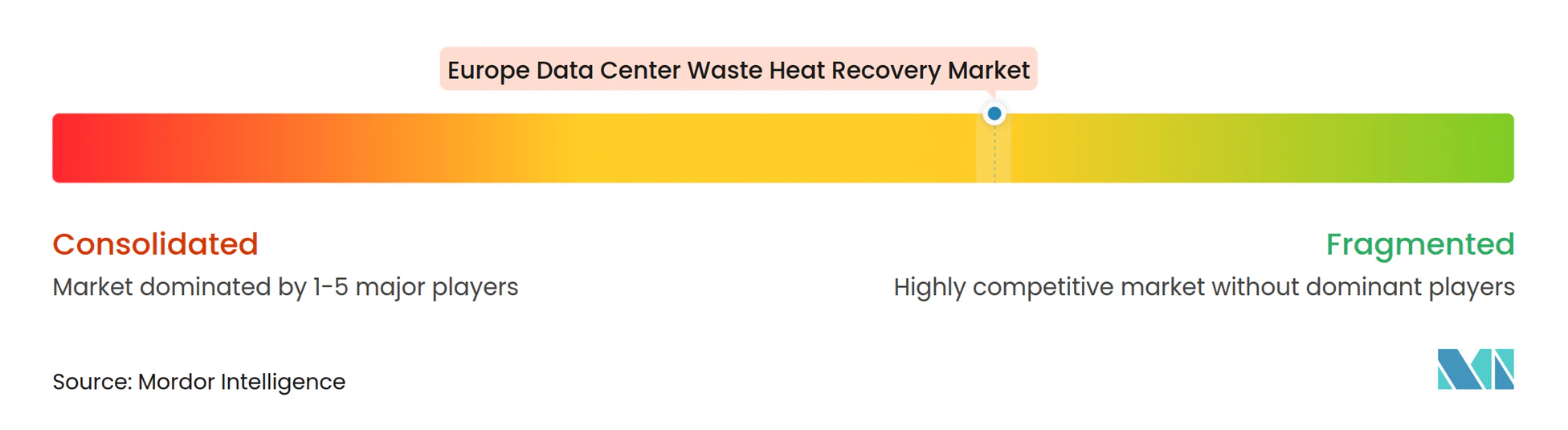
The Europe data center waste heat recovery market is moderately fragmented across heat transfer hardware suppliers, building technology integrators, district energy utilities, and specialist energy services firms. Danfoss, Alfa Laval, and Kelvion compete on thermal efficiency, product availability, and support for high-density cooling systems. Alfa Laval’s SEK 1 billion capacity commitment for brazed heat exchangers signals the supplier's preparation for higher data center cooling demand. Schneider Electric, Siemens, and Trane Technologies compete in controls and building integration. Vertiv introduced the CoolCenter Immersion system in EMEA in November 2025, featuring heat-reuse capability for AI and high-performance computing environments. This move reflects the growing link between liquid cooling design and the potential for heat reuse.
The key constraint is often not the availability of heat exchangers but a bankable project structure. A successful scheme needs a data center operator, a utility or network owner prepared to fund or recover connection costs, and an offtaker prepared to accept heat over time. Veolia launched its Ecothermal Grid offer in November 2025 and targeted EUR 350 million in annual turnover from low-carbon urban heating by 2030, alongside a GBP 1 billion project pipeline in the United Kingdom. This strategic move focuses on developing low-carbon urban heating projects rather than selling isolated equipment. Stockholm Exergi offers a second example through its standardized platform for trading recovered heat. These approaches can shorten negotiations and improve the commercial clarity required for investment.
Specialist providers such as Qarnot Computing, AFRY, GETEC, Heat Works, and Fenagy operate alongside larger equipment and utility groups. Qarnot’s distributed computing approach seeks to use heat close to the point of generation, reducing reliance on a district heating intermediary. GETEC highlighted a data center project in Rozzano that heats 5,000 households, showing the role of energy services firms in turning technical systems into operating urban infrastructure. Competition increasingly centers on the ability to originate, structure, and finance a multi-party transaction. Hardware remains necessary, but it does not secure a project without a viable thermal customer and a connection plan. The Europe data center waste heat recovery market is therefore more open to firms that combine engineering with commercial delivery.
Europe Data Center Waste Heat Recovery Industry Leaders
-
Danfoss A/S
-
Alfa Laval AB
-
Fortum Oyj
-
Trane Technologies plc
-
Kelvion Holding GmbH
- *Disclaimer: Major Players sorted in no particular order
Europe Data Center Waste Heat Recovery Market Companies Covered in this Report
- Danfoss A/S
- Alfa Laval AB
- Johnson Controls International plc
- Trane Technologies plc
- Carrier Global Corporation
- Vertiv Holdings Co.
- Schneider Electric SE
- Siemens AG
- Kelvion Holding GmbH
- SWEP International AB
- Munters Group AB
- Rittal GmbH & Co. KG
- Turboden S.p.A.
- Star Refrigeration Limited
- Fenagy A/S
- AFRY AB
- Fortum Oyj
- Veolia Environnement S.A.
- E.ON SE
- Vattenfall AB
- Stockholm Exergi AB
- E-Heat Oy
- Heat Works
- GETEC Group
- Qarnot Computing SAS
- Microsoft Corporation
- Amazon Web Services, Inc.
Recent Industry Developments in Europe Data Center Waste Heat Recovery Market
- September 2026: The European Commission proposed a common data center rating scheme for facilities above 500 kW, covering energy use, waste heat reuse, and clean energy contributions, with the first sustainability labels expected to be displayed in 2027.
- May 2026: Fortum Oyj commissioned two industrial-scale heat pump plants in Finland, featuring 112 heat pumps and 800 MWh of thermal storage, to recover waste heat from adjacent Microsoft data centers from 2027, targeting 40% of 2 TWh annual district heating demand for 250,000 users.
- May 2026: CSC, IT Center for Science, Finland, and Loiste Lämpö Oy agreed to redirect waste heat from the LUMI AI Factory data center in Kajaani into the city’s district heating network, with operational readiness expected in H2 2027.
- November 2025: Veolia Environnement S.A. launched Ecothermal Grid, targeting EUR 350 million in annual turnover by 2030 from low-carbon urban heating that incorporates data center waste heat, alongside a GBP 1 billion pipeline in the United Kingdom.
Europe Data Center Waste Heat Recovery Market Report Scope
The Europe Data Center Waste Heat Recovery Market covers the equipment, technologies, engineering solutions, and associated implementation services used to capture, upgrade, transfer, store, and reuse excess thermal energy generated by data center operations across the region. The market includes Heat Pump-Based Recovery Systems, Direct Heat Exchange Systems, Heat Recovery Chiller Systems, Thermal Energy Storage-Integrated Recovery Systems, Organic Rankine Cycle Systems, and Other Waste Heat Recovery Technologies. These solutions encompass heat extraction from air-cooled and liquid-cooled data center infrastructure, temperature upgrading through industrial heat pumps, thermal energy storage, heat transfer and distribution, automated thermal controls, and integration with district heating networks, commercial and residential buildings, industrial facilities, and agricultural applications. Market revenue includes heat recovery equipment sales, system integration, engineering and installation services, and directly associated project implementation charges, while excluding conventional data center cooling systems without heat recovery functionality, standalone district heating infrastructure unrelated to data center heat reuse, electricity and thermal energy sales, and ongoing facility operating expenses not directly attributable to waste heat recovery systems.
Segmentation Overview
| Heat Pump-Based Recovery Systems |
| Direct Heat Exchange Systems |
| Heat Recovery Chiller Systems |
| Thermal Energy Storage-Integrated Recovery Systems |
| Organic Rankine Cycle Systems |
| Other Waste Heat Recovery Technologies |
| District Heating |
| Commercial and Residential Building Heating |
| Industrial Process Heating |
| Domestic Hot Water |
| Greenhouse and Agricultural Heating |
| Other Heat Reuse Applications |
| Heat Exchangers |
| Heat Pumps |
| Pumps and Thermal Distribution Systems |
| Thermal Storage Systems |
| Heat Recovery Controls and Monitoring |
| Piping and Heat Transfer Infrastructure |
| Other Equipment, Engineering and Installation |
| On-Site Heat Reuse |
| Direct Off-Site Heat Supply |
| District Heating Network Offtake |
| Small |
| Medium |
| Large |
| Hyperscale |
| Colocation |
| Cloud Service Providers (CSPs) |
| Enterprise & Edge |
| Germany |
| Denmark |
| Finland |
| Sweden |
| Norway |
| United Kingdom |
| Netherlands |
| France |
| Poland |
| Russia |
| Rest of Europe |
| By Recovery Technology | Heat Pump-Based Recovery Systems |
| Direct Heat Exchange Systems | |
| Heat Recovery Chiller Systems | |
| Thermal Energy Storage-Integrated Recovery Systems | |
| Organic Rankine Cycle Systems | |
| Other Waste Heat Recovery Technologies | |
| By Heat Reuse Application | District Heating |
| Commercial and Residential Building Heating | |
| Industrial Process Heating | |
| Domestic Hot Water | |
| Greenhouse and Agricultural Heating | |
| Other Heat Reuse Applications | |
| By System Component | Heat Exchangers |
| Heat Pumps | |
| Pumps and Thermal Distribution Systems | |
| Thermal Storage Systems | |
| Heat Recovery Controls and Monitoring | |
| Piping and Heat Transfer Infrastructure | |
| Other Equipment, Engineering and Installation | |
| By Heat Delivery Model | On-Site Heat Reuse |
| Direct Off-Site Heat Supply | |
| District Heating Network Offtake | |
| By Data Center Size | Small |
| Medium | |
| Large | |
| Hyperscale | |
| By Data Center Type | Colocation |
| Cloud Service Providers (CSPs) | |
| Enterprise & Edge | |
| By Geography | Germany |
| Denmark | |
| Finland | |
| Sweden | |
| Norway | |
| United Kingdom | |
| Netherlands | |
| France | |
| Poland | |
| Russia | |
| Rest of Europe |
Key Questions Answered in the Report
What is the size of the Europe data center waste heat recovery market?
The Europe data center waste heat recovery market was valued at USD 232.10 million in 2026 and is projected to reach USD 640.74 million by 2032, at an 18.78% CAGR from 2027 to 2032.
What is driving data center waste heat recovery in Europe?
Mandatory energy reuse requirements, performance reporting, existing district heating networks, and efforts to replace fossil-fuel heat sources are supporting adoption.
Which recovery technology leads Europe's data center heat reuse space?
Heat pump-based systems led with 46.13% share in 2026 because they can raise low-temperature server coolant heat to district heating temperatures.
Which use case is expanding most quickly for recovered data center heat?
Greenhouse and agricultural heating is projected to expand at a 25.84% CAGR through 2032 because its temperature needs can align with recovered server heat.
Why is Poland important for data center heat recovery projects?
Poland is projected to expand at a 25.53% CAGR through 2032, supported by growing data center capacity and established district heating systems in major cities.
Why do thermal storage systems matter for waste heat projects?
Thermal storage systems are projected to expand at a 26.27% CAGR through 2032 because they help match steady data center heat output with seasonal customer demand.