
Europe Data Center Video Surveillance Market Size and Share
Market Overview
| Study Period | 2021 - 2032 |
|---|---|
| Forecast Data Period | 2027 - 2032 |
| Base Year Market Size (2026) | USD 411.21 Million |
| Market Size (2027) | USD 469.49 Million |
| Market Size (2032) | USD 930.23 Million |
| Growth Rate (2027 - 2032) | 14.65 % |
| Market Concentration | Medium |
Major Players *Disclaimer: Major Players sorted in no particular order Image © Mordor Intelligence. Reuse requires attribution under CC BY 4.0. | |
Europe Data Center Video Surveillance Market Analysis by Mordor Intelligence
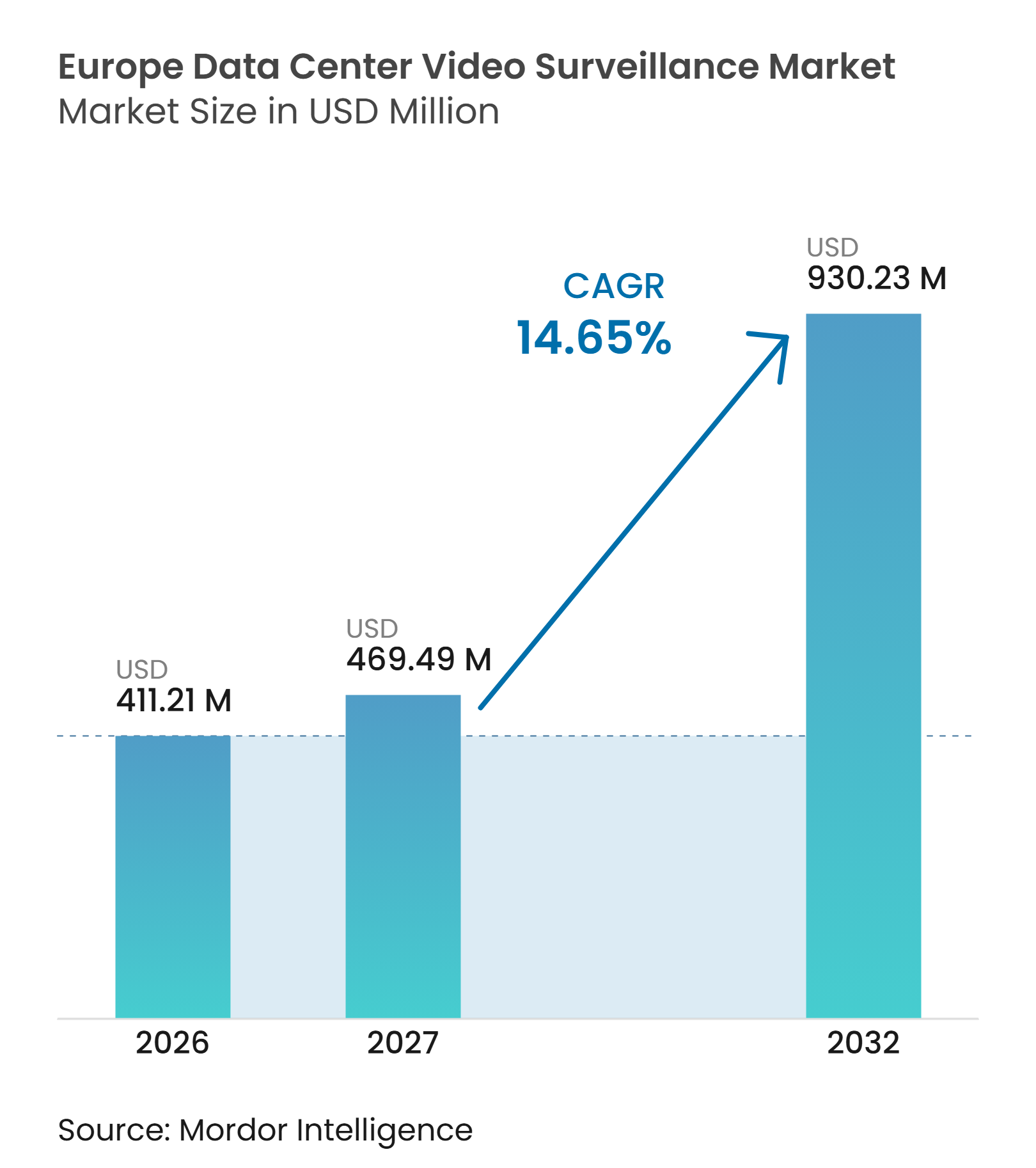
The Europe data center video surveillance market size was valued at USD 411.21 million in 2026 and estimated to expand from USD 469.49 million in 2027 to reach USD 930.23 million by 2032, at a CAGR of 14.65% during the forecast period 2027-2032. The Europe data center video surveillance market is supported by new capacity construction, particularly in large colocation and hyperscale campuses. Operators are incorporating cameras, video management software, storage, and analytics into site designs earlier in the construction cycle. AI-assisted video systems are changing security operations by helping teams prioritize verified events and oversee multiple facilities from centralized locations. Regulatory requirements are also directing procurement toward systems that support privacy controls, documentation, and European data hosting. Compliance costs and component availability may delay individual projects, but they are unlikely to change the longer-term need for modern surveillance across critical digital infrastructure.
Key Report Takeaways
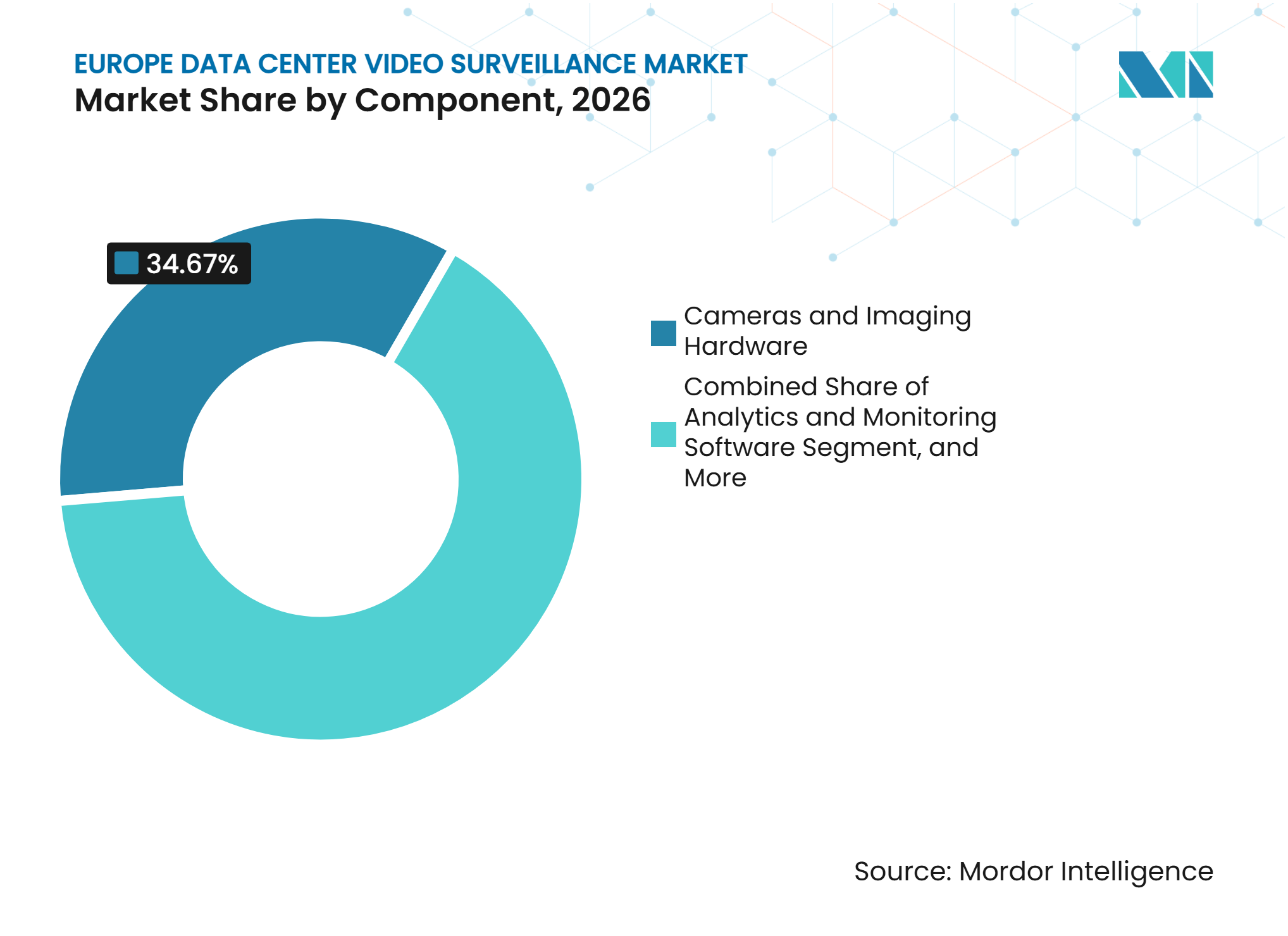
- By component, cameras and imaging hardware held 34.67% of the Europe data center video surveillance market share in 2026, while analytics and monitoring software is projected to expand at a 15.26% CAGR through 2032.
- By camera type, fixed cameras accounted for 63.28% of revenue in 2026, while PTZ cameras are expected to advance at a 15.92% CAGR through 2032.
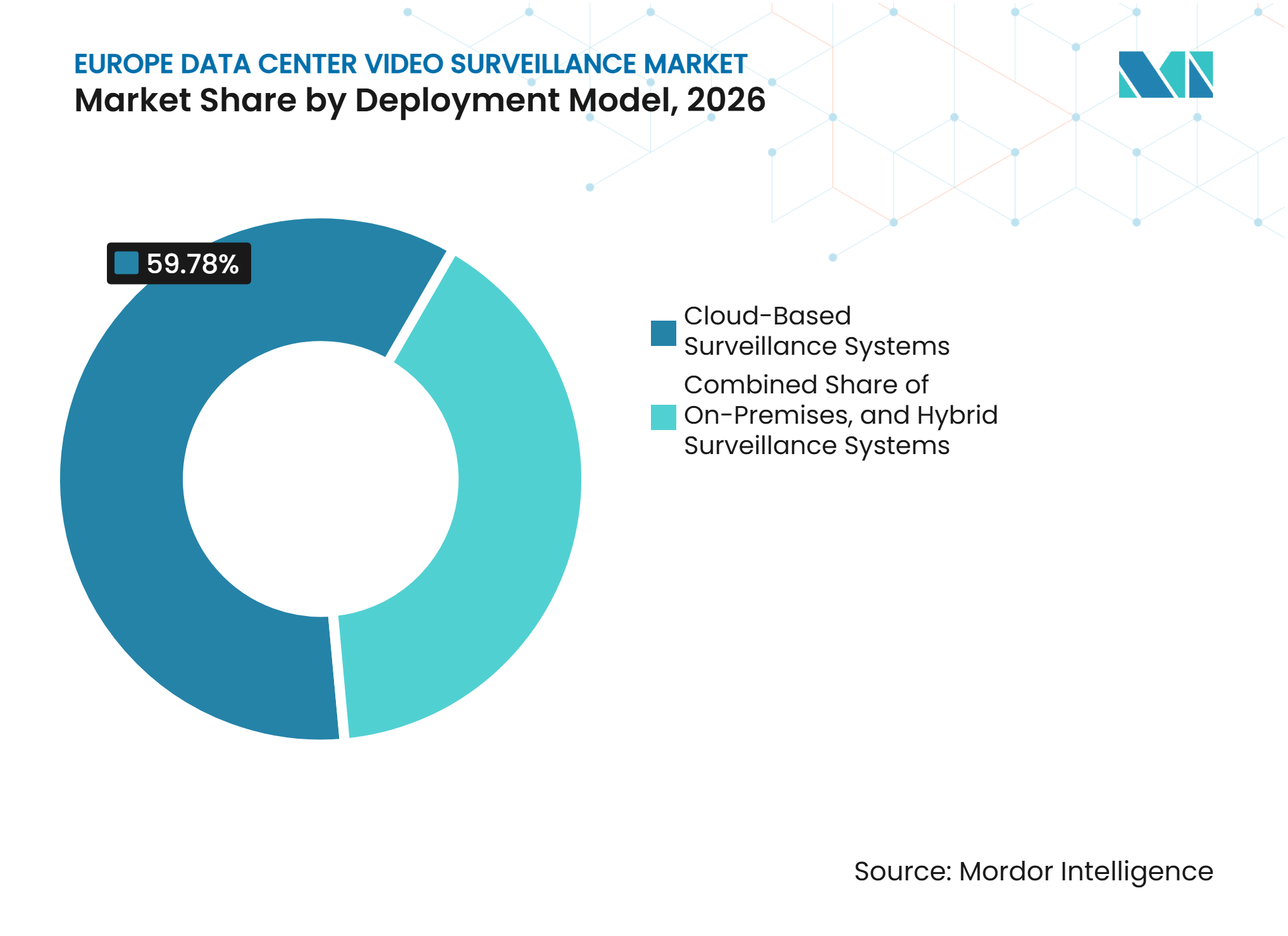
- By deployment model, cloud-based systems held 59.78% of revenue in 2026 and are projected to expand at a 17.39% CAGR through 2032.
- By application, perimeter and external area monitoring accounted for 26.54% of revenue in 2026, while data hall and internal corridor monitoring is expected to advance at a 16.59% CAGR through 2032.
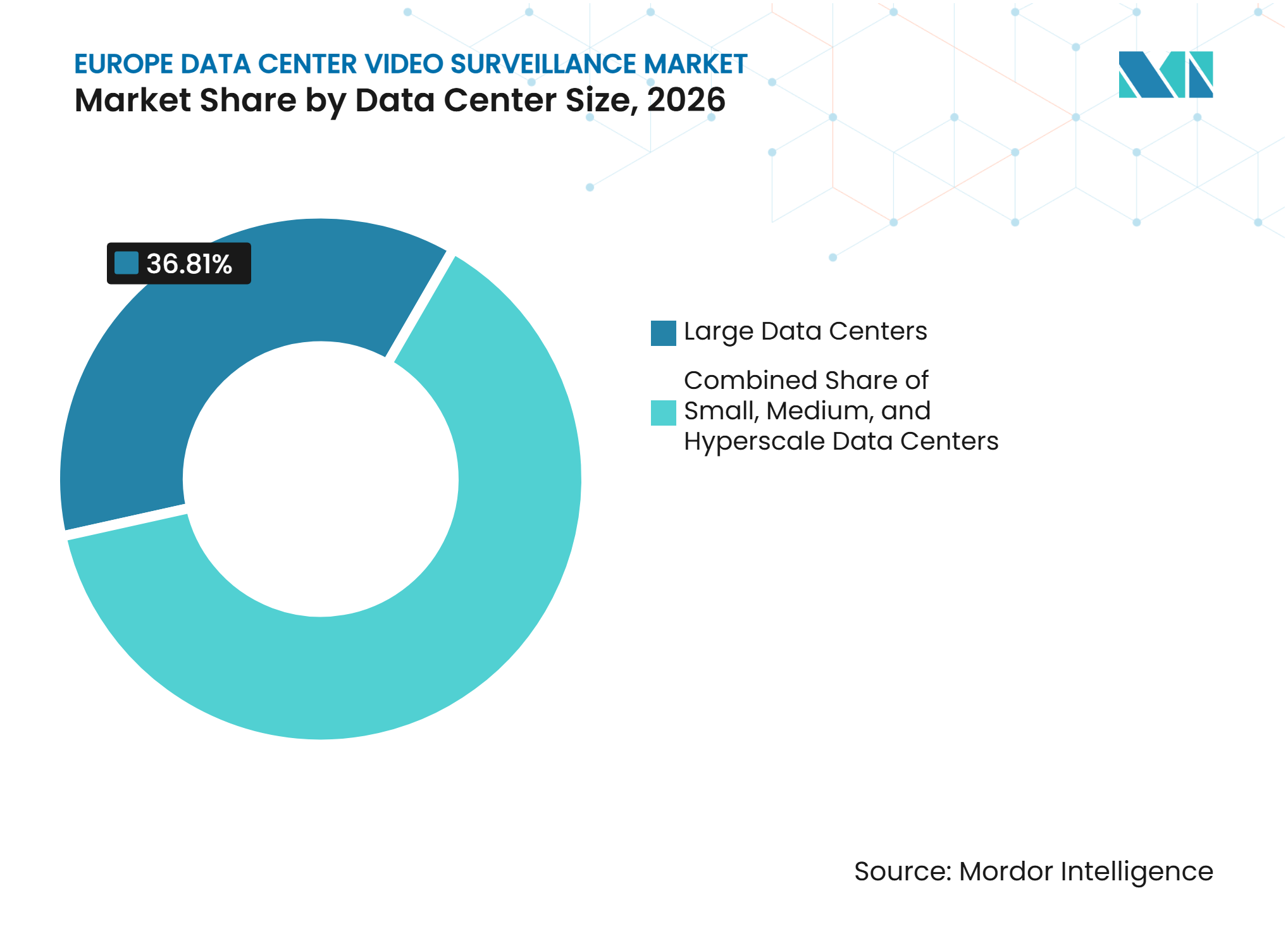
- By data center size, large data centers held 36.81% of revenue in 2026 and are projected to expand at a 15.27% CAGR through 2032.
- By data center type, colocation facilities accounted for 36.64% of revenue in 2026, while cloud service providers are expected to advance at a 15.38% CAGR through 2032.
- By geography, Germany held 34.58% of revenue in 2026, while the United Kingdom is projected to expand at a 16.91% CAGR through 2032.
Note: Market numbers in this report are based on Mordor Intelligence's proprietary estimation framework, which combines nine months of actuals with Q4 projections for base year 2026.
Market Trends and Insights
Drivers Impact Analysis of Europe Data Center Video Surveillance Market*
| Driver | (~) % Impact on CAGR Forecast | Geographic Relevance | Impact Timeline |
|---|---|---|---|
| Hyperscale and Colocation Build-Outs Across the FLAP-D Corridor | +3.8% | FLAP-D core, with spillover to Madrid, Warsaw, and Vienna | Short term (≤ 2 years) |
| AI Video Analytics for Remote Guarding and False-Alarm Reduction | +2.9% | FLAP-D and Nordic edge sites, extending to Southern and Eastern Europe | Medium term (2-4 years) |
| Regulation-Led Replacement of Noncompliant Surveillance Estates | +2.5% | EU-wide, particularly Germany, France, and the United Kingdom | Short term (≤ 2 years) |
| Physical and Logical Security Convergence | +1.8% | EMEA-wide, strongest at hyperscale and multi-tenant colocation sites | Medium term (2-4 years) |
| Edge Data Center Proliferation and Rack-Level Visibility | +1.4% | Urban 5G corridors, the Nordics, and Southern Europe | Medium term (2-4 years) |
| Renewable-Powered Campuses and Low-Energy Surveillance Architectures | +0.6% | The Nordics and Germany | Long term (≥ 4 years) |
| Source: Mordor Intelligence | |||
Hyperscale and Colocation Build-Outs Across the FLAP-D Corridor
The Europe data center video surveillance market gains demand as construction across Frankfurt, London, Amsterdam, Paris, and Dublin increases the number of sites requiring physical security systems. Live capacity across those locations reached 3.8 GW in H1 2026, compared with 1.8 GW in 2019, and 194 MW was added during H1 2026. Paris added 72.5 MW, London added 49 MW, and Frankfurt added 45 MW during that period.[1] New campuses need perimeter coverage during construction and permanent systems before operations begin. This creates demand for mobile solar-powered PTZ towers, thermal arrays, and connected video management platforms. The resulting opportunity favors suppliers that can support a common security architecture across several facilities.
The European Data Centre Association expects EUR 176 billion, equivalent to USD 198.9 billion, in cumulative European data center investment between 2026 and 2031.[2] Scale colocation campuses are expected to be the main source of capacity additions, with annual investment of EUR 25 billion to EUR 26 billion, equivalent to USD 28.3 billion to USD 29.4 billion using the supplied 2026 conversion relationship. Security design is increasingly included in campus blueprints rather than added after construction. That approach supports integrated surveillance systems and centralized operations centers from the first day of operation. The Europe data center video surveillance market therefore benefits when developers need consistent coverage across expanding regional footprints.
AI Video Analytics for Remote Guarding and False-Alarm Reduction
The Europe data center video surveillance market is shifting toward analytics that help security teams distinguish relevant events from routine movement. Video tools can identify tailgating, unusual after-hours activity, and objects left in sensitive areas. This reduces the number of unnecessary call-outs and allows remote teams to monitor a broader facility network. Axis Communications introduced ARTPEC-9-based cameras at GSX 2025 that process edge analytics and issue verified alerts before sending information to upstream systems.[3] Edge processing can reduce response time and control bandwidth use at sites that operate large camera fleets.
Genetec reported more than 35% revenue growth in fiscal year 2024/2025 without acquisitions and linked part of that performance to its Security Center SaaS capabilities. Its AI-powered investigation search was released in September 2025 and is designed to reduce evidence review time while maintaining an audit trail. Subscription-based analytics can be added as coverage expands, which gives operators greater budget flexibility than a hardware-only refresh. Once analytics are integrated into daily security workflows, replacing them can be difficult and disruptive. This supports the stronger projected expansion of analytics and monitoring software in the Europe data center video surveillance market.
Regulation-Led Replacement of Noncompliant Surveillance Estates
The Europe data center video surveillance market is also supported by replacement projects where installed systems no longer meet compliance requirements. The EU AI Act applies in full from August 2026 and introduces requirements for high-risk AI systems, including conformity assessment, technical documentation, registration, and post-market monitoring. These obligations affect AI-enabled surveillance used within critical digital infrastructure when the system falls within the applicable high-risk categories. NIS2 requirements also encourage stronger physical and logical controls within cybersecurity risk management. The Cyber Resilience Act adds vulnerability reporting obligations for connected products from September 2026.
Germany adds a demanding environment through the combined application of GDPR and the IT Security Act. This increases the appeal of privacy-by-design systems with anonymization, data minimization, and documented access controls. Milestone Systems acquired Berlin-based Brighter AI in April 2025 to add video anonymization technology for face and license plate redaction. The Europe data center video surveillance market can benefit because replacement budgets tied to audit requirements tend to be more predictable than discretionary hardware upgrades. Suppliers with clear compliance documentation and European hosting options are better placed to qualify for these purchases.
Physical and Logical Security Convergence
The Europe data center video surveillance market is influenced by the closer integration of physical security and cybersecurity controls. Data center operators increasingly compare remote login anomalies with badge activity and related video feeds. This can help teams identify a combined physical and digital threat before it develops further. Zero Trust practices are extending into access control through role-based entry rules, time-bound credentials, and logged access events. Surveillance platforms must preserve records that can support IT audits and physical security certifications. The need to connect these functions favors systems that can exchange data across camera, access, and network security layers.
Cisco Cyber Vision extends operational technology asset visibility and segmentation policies to facility systems, including camera infrastructure. The Security Industry Association established a Data Center Advisory Board in 2025 to develop practices that bring together physical, cyber, and operational technology security. This work indicates that integrated security has become an established operational priority for data center operators. The Europe data center video surveillance market benefits most where analytics and monitoring software manage correlation and response workflows. These systems can become central to how security teams investigate incidents across complex facilities.
Restraints Impact Analysis of Europe Data Center Video Surveillance Market*
| Restraint | (~) % Impact on CAGR Forecast | Geographic Relevance | Impact Timeline |
|---|---|---|---|
| Privacy and Biometric-Use Constraints Under GDPR and the EU AI Act | -1.2% | EU-wide, most restrictive in Germany and France | Medium term (2-4 years) |
| Retrofit Economics and Legacy-System Migration Complexity | -0.8% | Western Europe, concentrated in older colocation estates in Germany and the United Kingdom | Medium term (2-4 years) |
| Hardened Camera, Processor, and Storage Supply Constraints | -0.6% | Global supply chain effect, most acute for multi-site European operators | Short term (≤ 2 years) |
| Shortage of Multi-Vendor Integration and Security Operations Talent | -0.4% | EMEA-wide | Long term (≥ 4 years) |
| Source: Mordor Intelligence | |||
Privacy and Biometric-Use Constraints Under GDPR and the EU AI Act
Privacy and biometric-use constraints can slow deployments within the Europe data center video surveillance market, especially for advanced analytics. The AI Act can apply high-risk obligations to AI systems used within critical digital infrastructure when their use meets the legal scope. Providers must maintain risk management processes, data governance, technical documentation, event logging, transparency measures, and human oversight. GDPR data protection impact assessments do not replace AI Act conformity assessment and registration requirements. This can lengthen validation cycles for systems that combine video surveillance with biometric access functions.
The additional process burden is particularly relevant in Germany and France, where privacy expectations are high. It can raise project costs and create a preference for vendors that have already prepared compliant product documentation. Systems designed for GDPR compliance and local data hosting can command a premium. That narrows the initial pool of qualified suppliers and may reduce price competition. The constraint is procedural rather than a reduction in the underlying security need. Over time, established compliance practices can make procurement more consistent for the Europe data center video surveillance market.
Retrofit Economics and Legacy-System Migration Complexity
Legacy-system migration can defer upgrades in the Europe data center video surveillance market, particularly at older colocation sites. Many facilities were built around analog or early IP systems with proprietary recording hardware. Re-cabling, access point remediation, and IP network improvements can add costs beyond the camera replacement itself. Operators with limited capital budgets may adopt phased deployment plans rather than complete upgrades. This can leave coverage uneven during the transition. It can also delay the full use of cloud-connected analytics and modern video management tools.
The issue is most pronounced in Western Europe, including mature colocation estates in Germany and the United Kingdom. Genetec released Cloudlink 2210 in February 2026 to help enterprises adopt cloud-managed physical security without full infrastructure replacement. Such products can reduce migration barriers for installed camera fleets that lack direct cloud connectivity. Supply availability may still affect delivery schedules for surveillance-grade components. The Europe data center video surveillance market therefore faces a practical timing issue, even where operators have approved an upgrade budget.
*Our forecasts treat driver/restraint impacts as directional, not additive. The impact forecasts reflect baseline growth, mix effects, and variable interactions.
Europe Data Center Video Surveillance Market Segment Analysis
By Component:
Analytics Software Redefines the Revenue StackCameras and imaging hardware held 34.67% of the Europe data center video surveillance market share in 2026, while analytics and monitoring software is projected to expand at a 15.26% CAGR through 2032. Hardware remains central because new facilities need dense camera coverage across perimeters, entrances, data halls, and mechanical areas, and the installed base expands as FLAP-D campuses add buildings and secure zones. Analytics software is increasing faster because it can add recurring subscription revenue beyond the initial camera purchase. This software helps teams search events, classify alerts, and manage investigations across sites.
Video management software and storage hardware occupy the middle layer of the component mix. Suppliers are increasingly combining those functions in cloud-managed appliances that reduce the need for major upfront infrastructure changes. Genetec's Cloudlink 2210, released in February 2026, supports cloud-managed physical security while allowing organizations to retain existing infrastructure. Installation, integration, and support services remain important because multi-vendor systems need tailored configuration and alignment across cameras, access control, and network security policies. This complexity can protect service revenue even when camera hardware prices become more competitive. It also keeps analytics systems relevant after the initial physical coverage is fully installed.



By Camera Type:
PTZ Gains Ground at the Hyperscale Campus PerimeterFixed cameras accounted for 63.28% of the Europe data center video surveillance market in 2026, while PTZ cameras are expected to advance at a 15.92% CAGR through 2032. Fixed units remain appropriate for predictable internal areas such as data halls, entrance corridors, and electrical rooms. Their cost efficiency and reliable fixed field of view support extensive use inside facilities. PTZ cameras are gaining importance at large campus perimeters, where one unit can cover a wider arc and follow a subject.
Axis Communications introduced a bispectral PTZ camera at GSX 2025 that combines thermal and visible imaging, plus multilayer radar systems with 180° and 270° detection fields. These tools can combine detection and identification functions that previously required separate systems. Thermal cameras are useful in poor light, smoke, and fog at outdoor or mixed-environment locations. Hanwha Vision released a QVGA AI Thermal Surveillance Camera in September 2025 with built-in object detection, a noise equivalent temperature difference below 20 mK, and telephoto options up to 60 mm. Low-light and infrared models complete coverage at loading bays and remote boundaries where permanent lighting is limited. This mix lets operators match camera capability to the visibility requirements of each distinct security zone.
By Deployment Model:
Cloud Leads While Hybrid Meets Governance NeedsCloud-based systems held 59.78% of the Europe data center video surveillance market share in 2026 and are projected to expand at a 17.39% CAGR through 2032. This combination of leading share and leading expansion reflects demand for centralized management across dispersed data center estates. Cloud platforms bring together feeds from many facilities on shared dashboards. They reduce the operating burden at individual sites and enable centralized analytics processing. The Europe data center video surveillance market is moving toward services that help operators manage larger portfolios without matching increases in on-site staffing.
Data sovereignty requirements do not remove the case for cloud deployment, but they favor platforms that host data in European locations and provide clear residency controls. Genetec launched a dedicated United Kingdom data center for Security Center SaaS on Microsoft Azure in February 2026 to address data sovereignty and residency requirements. On-premises systems remain relevant at Tier IV enterprise facilities and sovereign cloud zones with strict contractual restrictions. Hybrid models let operators retain sensitive internal feeds locally while using cloud storage and analytics for exterior video. The Cloudlink 2210 appliance supports this approach for organizations that cannot replace their entire camera estate immediately.

By Application:
Perimeter Monitoring Anchors Demand While Data Hall Coverage AcceleratesPerimeter and external area monitoring accounted for 26.54% of the Europe data center video surveillance market size in 2026, while data hall and internal corridor monitoring is expected to advance at a 16.59% CAGR through 2032. Perimeter monitoring remains the largest application because preventing unauthorized access is the first layer of facility protection. Large campuses require coverage around buildings, gates, loading zones, and external infrastructure. AI workloads are increasing the value concentrated within each data hall, making detailed video coverage more important than it was in lower-density computing environments.
High-density AI racks require operators to monitor corridors and data halls closely without creating excessive staffing demands. Entrance and access point monitoring supports physical Zero Trust policies by identifying tailgating and unusual behavior at high-traffic points. Electrical and mechanical room monitoring has greater importance where power-dense facilities face elevated equipment and fire risks. Hanwha Vision introduced bi-spectrum early fire detection cameras in September 2025 that combine thermal radiometry, visible imaging, and SCADA compatibility through MQTT. Loading bay, delivery area, and remote campus monitoring extend the security footprint as operators develop larger sites and distributed edge facilities. The Europe data center video surveillance market must serve both the outside perimeter and sensitive internal operating areas.
By Data Center Size:
Large Facilities Drive Both Volume and VelocityLarge data centers held 36.81% of the Europe data center video surveillance market in 2026 and are projected to expand at a 15.27% CAGR through 2032. These sites need multi-zone surveillance across several building functions. Their procurement scale allows camera and video management suppliers to provide standardized systems at greater volume. Large facilities generally fall within the 20 MW to 100 MW range receiving much of the current European capacity investment, and their coverage needs extend from perimeter systems to data hall monitoring.
Hyperscale sites above 100 MW are more technically demanding because they combine broad perimeters, multiple structures, specialized AI security requirements, and strict uptime expectations. The European Data Centre Association identified scale colocation campuses as the main source of new capacity additions. It also reported annual construction investment of EUR 25 billion to EUR 26 billion, equivalent to USD 28.3 billion to USD 29.4 billion using the supplied 2026 conversion relationship. Small and medium facilities have a different requirement. Cloud-delivered video management software can extend advanced analytics to those sites without the server costs associated with older enterprise systems, giving software suppliers access to a previously underserved installed base. The same model helps operators apply consistent policies across both external and internal security zones.
By Data Center Type:
Colocation Anchors Volume While CSPs Pull Demand ForwardColocation facilities accounted for 36.64% of the Europe data center video surveillance market size in 2026, while cloud service providers are expected to advance at a 15.38% CAGR through 2032. Colocation operators serve many tenants within shared infrastructure. They need zone-based video analytics that can distinguish tenant areas and preserve privacy between customers. These requirements create continuing demand for access and video controls across corridors, cages, and common areas. The Europe data center video surveillance industry must support detailed authorization rules alongside broad campus coverage.
Cloud service providers are adding regions across Europe, and AI-optimized facilities increase surveillance needs with rack density as well as building size. Enterprise and edge facilities form a varied middle tier with different staffing and network capacity needs. The European Commission's Digital Decade agenda has a target of 10,000 climate-neutral edge nodes by 2030. Its 2026 annex estimated that 7,451 climate-neutral and highly secure edge nodes were deployed in the EU at the end of 2025. Remote-capable surveillance uses limited bandwidth and minimal local intervention, but incumbent enterprise vendors do not yet serve all of these requirements consistently.
Geography Analysis
Germany
Germany held 34.58% of the Europe data center video surveillance market share in 2026. Frankfurt remains a key demand center because constrained capacity supports ongoing new-build activity. Germany's combined GDPR and IT Security Act requirements support demand for systems that provide anonymization, data minimization, and access-log controls. These requirements make compliance documentation an important part of vendor selection.
Privacy-focused video anonymization is particularly relevant in the German procurement environment. Procurement cycles can be longer because operators need detailed validation and documentation. That pattern can favor suppliers with established European hosting and compliance credentials. The Europe data center video surveillance market in Germany is characterized by high compliance expectations and continued infrastructure demand.
United Kingdom
The United Kingdom is projected to grow at a CAGR of 16.91% through 2032, representing the fastest growth rate among the geographic markets covered. The restriction introduced in April 2025 on the installation of new Chinese-manufactured surveillance equipment at government-adjacent sites is expected to accelerate replacement demand. Affected facilities are likely to replace restricted equipment with compliant video surveillance systems, supporting market growth over the forecast period.
Rest of Europe
France is active in new construction and brownfield conversions, while Italy is emerging through colocation investment around Milan. Warsaw, Vienna, Oslo, Helsinki, Madrid, and other Nordic locations are receiving capacity that cannot be accommodated in constrained FLAP-D locations. Genetec's February 2026 United Kingdom data center launch shows the value placed on local hosting for British and European users.
Competitive Landscape
Market Concentration
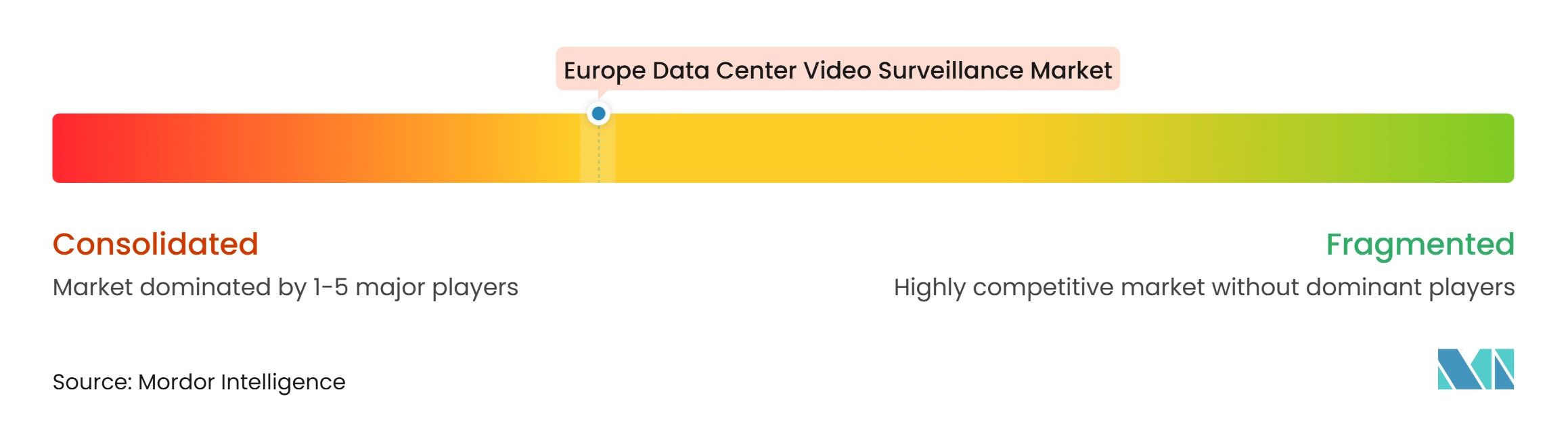
The Europe data center video surveillance market is moderately concentrated, with Johnson Controls, Honeywell through LenelS2, Axis Communications, Siemens through Siveillance Video, Genetec, and Motorola Solutions through Avigilon forming a leading group. These companies compete alongside specialized video management vendors and regional system integrators. Larger vendors seek to connect video, access control, and incident response on common platforms, responding to demand for closer coordination between physical security and cybersecurity processes. Specialist providers compete through cloud-native tools, AI functions, and compliance-oriented product designs.
Johnson Controls demonstrated exacqVision 26.2, C-CURE IQ 3.20, and AI-enabled managed services at GSX 2026 in September 2026. The company positioned these offerings for centralized security management in mission-critical locations. Genetec continues to add Security Center SaaS capabilities and has positioned its platform around integration and data sovereignty. Its February 2026 Cloudlink 2210 release offers a route to cloud-managed security for existing camera estates. These moves show that suppliers are competing on migration support as well as on new product features.
Edge data centers remain an area where large campus designs do not always fit lower staffing levels and constrained connections. Suppliers that run inference at the camera and send event metadata rather than continuous video can address this need. Replacement demand may also rise where operators reassess supply chain and compliance risks in installed camera fleets. Privacy-focused video technology remains important for suppliers operating in the European regulatory environment. The Europe data center video surveillance market also places importance on camera-edge AI inference and video anonymization capabilities.
Europe Data Center Video Surveillance Industry Leaders
-
Johnson Controls International plc
-
Honeywell International Inc.
-
Robert Bosch GmbH
-
Axis Communications AB
-
Schneider Electric SE
- *Disclaimer: Major Players sorted in no particular order
Europe Data Center Video Surveillance Market Companies Covered in this Report
- Johnson Controls International plc
- Honeywell International Inc.
- Robert Bosch GmbH
- Axis Communications AB
- Schneider Electric SE
- Motorola Solutions, Inc.
- Milestone Systems A/S
- Genetec Inc.
- Siemens AG
- ABB Ltd.
- ASSA ABLOY AB
- dormakaba Holding AG
- Securitas AB
- Convergint Technologies LLC
- Cisco Systems, Inc.
- Hangzhou Hikvision Digital Technology Co., Ltd.
- Zhejiang Dahua Technology Co., Ltd.
- Hanwha Vision Co., Ltd.
- Teledyne FLIR LLC
- Lanaccess Sistemas S.L.
Recent Industry Developments in Europe Data Center Video Surveillance Market
- September 2026: Johnson Controls showcased exacqVision 26.2 with AI-driven video insights, C-CURE IQ 3.20 with enhanced security workflows and deployment flexibility, and new AI-enabled Managed Services at GSX 2026 in Atlanta, September 14-16, 2026. The release consolidates Johnson Controls' unified platform position in mission-critical environments and directly targets data center operators managing security across distributed facilities who require centralized monitoring without bespoke on-premises server infrastructure at each site.
- February 2026: Genetec launched a dedicated United Kingdom data center for Security Center SaaS on Microsoft Azure, directly addressing data sovereignty and residency requirements for British and European operators. The deployment positions Genetec to serve organizations subject to United Kingdom and EU data localization obligations without routing video management traffic through non-European infrastructure.
- February 2026: Genetec released Cloudlink 2210, a high-density cloud-managed appliance enabling enterprise-scale deployments to adopt cloud-managed physical security without requiring cloud-only storage or full infrastructure replacement. The product targets large colocation operators managing existing camera estates that cannot connect directly to cloud platforms, eliminating a key migration barrier to Security Center SaaS adoption.
- September 2025: Axis Communications unveiled a bispectral PTZ camera combining thermal and visible imaging, AI-powered bullet cameras, and next-generation multilayer radars with 180° and 270° detection fields at GSX 2025. The product set targets perimeter surveillance at hyperscale data center campuses, where single integrated devices can replace multiple independent systems and reduce per-site installation complexity.
Europe Data Center Video Surveillance Market Report Scope
The Europe Data Center Video Surveillance Market encompasses technologies and services that enable visual security, monitoring, and surveillance of data center facilities. It includes solutions designed to enhance physical security, detect unauthorized activities, support incident response, and provide real-time operational visibility across critical infrastructure environments. The market is driven by increasing concerns over facility protection, asset security, business continuity, and the growing adoption of intelligent surveillance systems with advanced monitoring and analytics capabilities.
The Europe Data Center Video Surveillance Market is Segmented by Component (Cameras and Imaging Hardware, Video Management Software, Storage and Recording Hardware, Analytics and Monitoring Software, and Installation, Integration, and Support Services), Camera Type (Fixed Cameras, Pan-Tilt-Zoom Cameras, Thermal Cameras, and Specialized Low-Light and Infrared Cameras), Deployment (On-Premise Surveillance Systems, Cloud-Based Surveillance Systems, and Hybrid Surveillance Systems), Application (Perimeter and External Area Monitoring, Entrance and Access Point Monitoring, Data Hall and Internal Corridor Monitoring, Electrical and Mechanical Room Monitoring, Loading Bay and Delivery Area Monitoring, and Remote Site and Campus Monitoring), Size (Small, Medium, Large, Hyperscale), Data Center Type (Colocation, Cloud Service Provider(CSPs), Enterprise / Edge, and Edge Data Centers), and Country (Germany, United Kingdom, France, Italy, and Rest of Europe). The Market Forecasts are Provided in Terms of Value (USD).
Segmentation Overview
| Cameras and Imaging Hardware |
| Video Management Software |
| Storage and Recording Hardware |
| Analytics and Monitoring Software |
| Installation, Integration, and Support Services |
| Fixed Cameras |
| Pan-Tilt-Zoom Cameras |
| Thermal Cameras |
| Specialized Low-Light and Infrared Cameras |
| On-Premise Surveillance Systems |
| Cloud-Based Surveillance Systems |
| Hybrid Surveillance Systems |
| Perimeter and External Area Monitoring |
| Entrance and Access Point Monitoring |
| Data Hall and Internal Corridor Monitoring |
| Electrical and Mechanical Room Monitoring |
| Loading Bay and Delivery Area Monitoring |
| Remote Site and Campus Monitoring |
| Small |
| Medium |
| Large |
| Hyperscale |
| Colocation |
| Cloud Service Provider(CSPs) |
| Enterprise / Edge |
| Edge Data Centers |
| Germany |
| United Kingdom |
| France |
| Italy |
| Rest of Europe |
| By Component | Cameras and Imaging Hardware |
| Video Management Software | |
| Storage and Recording Hardware | |
| Analytics and Monitoring Software | |
| Installation, Integration, and Support Services | |
| By Camera Type | Fixed Cameras |
| Pan-Tilt-Zoom Cameras | |
| Thermal Cameras | |
| Specialized Low-Light and Infrared Cameras | |
| By Deployment Model | On-Premise Surveillance Systems |
| Cloud-Based Surveillance Systems | |
| Hybrid Surveillance Systems | |
| By Application | Perimeter and External Area Monitoring |
| Entrance and Access Point Monitoring | |
| Data Hall and Internal Corridor Monitoring | |
| Electrical and Mechanical Room Monitoring | |
| Loading Bay and Delivery Area Monitoring | |
| Remote Site and Campus Monitoring | |
| By Data Center Size | Small |
| Medium | |
| Large | |
| Hyperscale | |
| By Data Center Type | Colocation |
| Cloud Service Provider(CSPs) | |
| Enterprise / Edge | |
| Edge Data Centers | |
| By Country | Germany |
| United Kingdom | |
| France | |
| Italy | |
| Rest of Europe |
Key Questions Answered in the Report
What is the size of the Europe data center video surveillance market?
The Europe data center video surveillance market size is USD 411.21 million in 2026 and is projected to reach USD 930.23 million by 2032 at a 14.65% CAGR.
Which component is expanding fastest in Europe data center video surveillance?
Analytics and monitoring software is projected to advance at a 15.26% CAGR through 2032, faster than other components.
Why are cloud-based surveillance systems important for data centers?
Cloud-based systems held 59.78% of 2026 revenue and are projected to expand at a 17.39% CAGR because they support centralized monitoring across multiple sites.
Which application has the strongest outlook in data center video surveillance?
Data hall and internal corridor monitoring is expected to advance at a 16.59% CAGR through 2032 as AI racks raise the value of equipment located inside facilities.
Which country has the fastest forecast expansion in Europe?
The United Kingdom is projected to advance at a 16.91% CAGR through 2032, supported by capacity additions and replacement activity.
How do GDPR and the EU AI Act affect surveillance deployments?
They increase requirements for privacy controls, documentation, conformity assessment, and governance, which can extend validation cycles for AI-enabled systems.