
Europe Data Center Testing, Inspection, and Certification Market Size and Share
Market Overview
| Study Period | 2021 - 2032 |
|---|---|
| Forecast Data Period | 2027 - 2032 |
| Base Year Market Size (2026) | USD 0.64 Billion |
| Market Size (2027) | USD 0.91 Billion |
| Market Size (2032) | USD 2.48 Billion |
| Growth Rate (2027 - 2032) | 22.21 % |
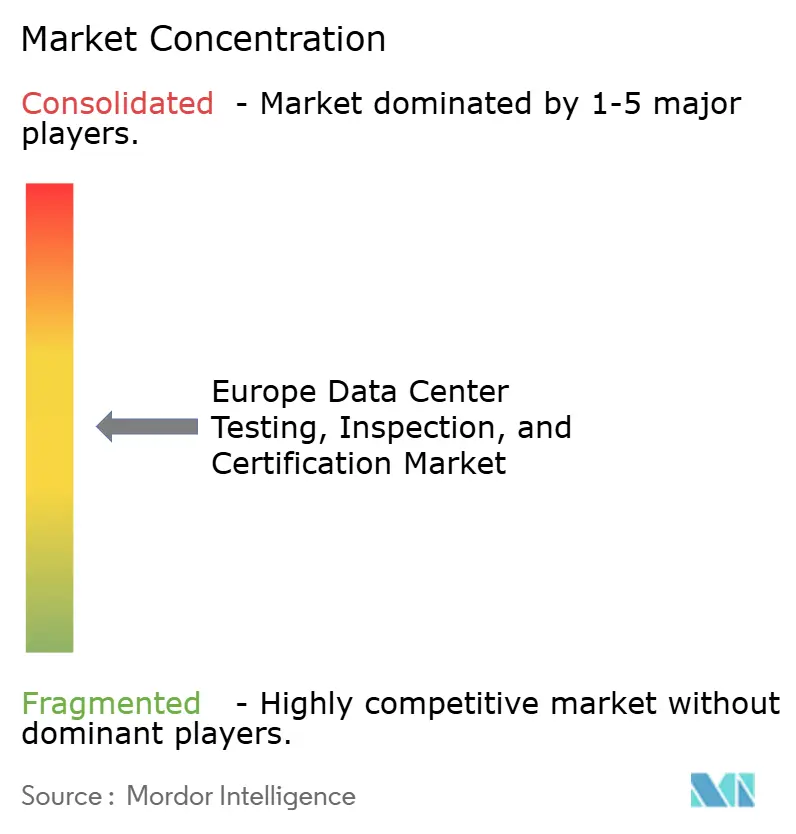
| Market Concentration | Medium |
Major Players *Disclaimer: Major Players sorted in no particular order Image © Mordor Intelligence. Reuse requires attribution under CC BY 4.0. | |
Europe Data Center Testing, Inspection, and Certification Market Analysis by Mordor Intelligence
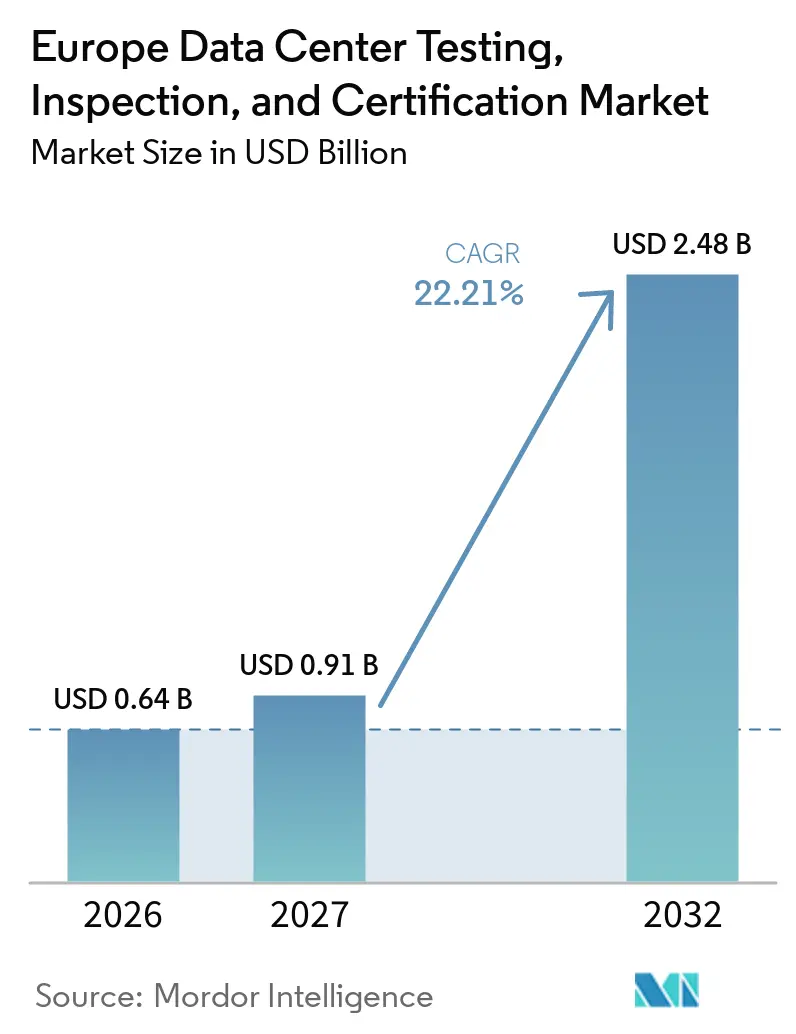
The Europe data center testing, inspection, and certification market size is projected to expand from USD 0.64 billion in 2026 to USD 2.48 billion by 2032, registering a CAGR of 22.21% during 2027-2032. AI workloads are increasing power density and making integrated checks of electrical, cooling, and fire-protection systems more important before a site enters service. New hyperscale and colocation projects are creating demand for commissioning, inspections, and recurring compliance reviews across the region. Sustainability reporting, cyber resilience rules, and data-residency requirements are also moving assurance work beyond a single pre-opening assessment. Larger providers are responding with full-lifecycle service models that combine technical review, testing, inspection, and certification under one contract. The Europe data center testing, inspection, and certification market therefore offers the strongest opportunities where complex facilities, regulatory obligations, and multi-country delivery needs overlap.
Key Report Takeaways
- By service type, testing led with 38.54% revenue share in 2026, while compliance and assurance services are expected to record the fastest expansion at a CAGR of 22.74% through 2032.
- By data center lifecycle, construction, installation, and commissioning held 55.63% of revenue in 2026, while retrofit and modernization are projected to advance at a CAGR of 22.83% through 2032.
- By infrastructure system, electrical infrastructure held the largest share in 2026, while IT, network, and cybersecurity infrastructure are projected to expand at a 22.93% CAGR through 2032.
- By data center type, hyperscale and cloud service provider data centers accounted for 40.32% of the Europe data center testing, inspection, and certification market in 2026, and is projected to expand at a 22.91% CAGR through 2032.
- By tier type, Tier 3 facilities held 62.16% revenue share in 2026, while Tier 4 facilities are expected to expand at a 23.11% CAGR through 2032.
- By geography, the United Kingdom led with 22.53% share in 2026, while Finland is expected to expand at a 23.14% CAGR through 2032.
Note: Market numbers in this report are based on Mordor Intelligence's proprietary estimation framework, which combines nine months of actuals with Q4 projections for base year 2026.
Europe Data Center Testing, Inspection, and Certification Market Trends and Insights
Drivers Impact Analysis*
| Driver | (~) % Impact on CAGR Forecast | Geographic Relevance | Impact Timeline |
|---|---|---|---|
| AI-Ready High-Density Facilities Require More Commissioning and Integrated Systems Testing | +5.8% | Global, concentrated in FLAP-D markets and the Nordics | Short term (≤ 2 years) |
| EU Energy Efficiency and Sustainability Reporting Expands Assurance Demand | +4.8% | EU-wide, led by Germany, France, and the Netherlands | Medium term (2-4 years) |
| Cloud, Colocation, and Digital Sovereignty Investment | +4.3% | United Kingdom, Germany, France, Ireland, Netherlands | Short term (≤ 2 years) |
| Cybersecurity and Resilience Compliance Requirements | +3.5% | EU-wide, concentrated in Germany, France, and the Nordics | Medium term (2-4 years) |
| Grid-Connection and Heat-Reuse Evidence Creates New Assurance Workflows | +2.0% | Netherlands, Nordics, Germany | Medium term (2-4 years) |
| Fragmented National Compliance Interpretation Increases Independent Verification Demand | +1.5% | Central and Eastern Europe, Southern Europe | Long term (≥ 4 years) |
| Source: Mordor Intelligence | |||
AI-Ready High-Density Facilities Require More Commissioning and Integrated Systems Testing
The Europe data center TIC market is being shaped by facilities that must prove performance across tightly linked systems before live operation. AI-focused sites use much higher rack densities than conventional facilities, which increases the importance of commissioning electrical distribution, cooling, and fire-safety systems as a coordinated process under realistic operating conditions. Direct-to-chip and immersion cooling add risks related to coolant condition, flow balance, hydraulic pressure, and leakage. These risks require pressure tests, leak checks, thermal-load validation, clear test records, and defined acceptance criteria before operators accept the equipment. The 2026 environmental-control standard for data centers raises the technical requirements for liquid-cooling validation, including work performed by ISO/IEC 17025-accredited laboratories.[1] Vertiv’s September 2026 agreement to acquire King Environmental Services shows that specialized fluid management, commissioning, and load testing have become competitive capabilities around high-density facilities.
EU Energy Efficiency and Sustainability Reporting Expands Assurance Demand
The recast Energy Efficiency Directive requires operators of data centers with an installed IT power demand of at least 500 kW to report sustainability information to the European database for data centers.[2] Reported measures include power usage effectiveness and water usage effectiveness, which makes the quality, traceability, retention, and internal review of facility records more important for operators preparing annual submissions. The proposed European rating scheme would introduce independently verified electronic labels, making sustainability evidence a recurring rather than one-time requirement. Bureau Veritas participates in the assessment framework supporting the EU Code of Conduct for Data Centre Efficiency through the TIC Council. TÜV NORD’s TSE.STANDARD combines the EU taxonomy, the Energy Efficiency Directive, and ISO 50001 requirements in a certification approach linked to Annex VII reporting obligations. This shifts part of the Europe data center TIC market toward annual verification work, more complete evidence trails, and longer client relationships.
Cloud, Colocation, and Digital Sovereignty Investment
Cloud, colocation, and sovereign cloud investments are increasing the number of sites requiring independent technical and compliance checks. AWS launched the AWS European Sovereign Cloud in Brandenburg in January 2026 with planned investment exceeding EUR 7.8 billion (USD 8.8 billion), and announced sovereign local zones in Belgium, the Netherlands, and Portugal.[3] These deployments require review of data-residency controls and access segregation alongside standard facility commissioning, creating separate evidence requirements for technical, operational, and governance teams. Amazon also announced EUR 33.7 billion (USD 37.8 billion) in investment in Spain, extending the project pipeline into Southern Europe. The European Data Center Association projects EUR 176 billion (USD 198 billion) in European data-center investment and 23.6 GW of capacity by 2031, EUDCA. The Europe data center TIC market benefits because each new facility needs review during design, commissioning at handover, and checks when it is extended into another jurisdiction.
Cybersecurity and Resilience Compliance Requirements
Cybersecurity and resilience requirements add recurring assessment work to physical facility assurance. The Digital Operational Resilience Act has been applied since January 2025 and requires EU financial entities to manage ICT risk, report incidents, and conduct threat-led penetration testing under the TIBER-EU framework. Data centers that support financial clients need to demonstrate that their systems can meet these obligations. Germany’s NIS2 implementation law entered into force in December 2025, adding risk-assessment and registration requirements for relevant operators. The uneven national adoption of NIS2 measures makes independent verification more valuable where operators cannot rely on a consistent local compliance approach. BSI’s Mark of Trust provides a modular framework for technical, operational, and compliance assurance in data-center facilities and services. The Europe data center TIC market is therefore extending into testing that joins physical resilience with network and operational controls.
Restraints Impact Analysis*
| Restraint | (~) % Impact on CAGR Forecast | Geographic Relevance | Impact Timeline |
|---|---|---|---|
| Shortage of Qualified Commissioning and Cybersecurity Specialists | -2.5% | United Kingdom, Germany, France, Netherlands | Short term (≤ 2 years) |
| High Cost of TIC Services for Smaller Enterprise and Edge Facilities | -1.8% | Central and Eastern Europe, Southern Europe | Medium term (2-4 years) |
| Localized Standards and Permitting Interfaces Increase Delivery Complexity | -1.2% | EU-wide, especially Southern and Eastern Europe | Long term (≥ 4 years) |
| Rapid Liquid-Cooling and High-Density Design Changes Outpace Standardized Test Protocols | -1.0% | FLAP-D markets and the Nordics | Short term (≤ 2 years) |
| Source: Mordor Intelligence | |||
Shortage of Qualified Commissioning and Cybersecurity Specialists
A shortage of experienced commissioning engineers and cybersecurity testers constrains the delivery capacity available to the Europe data center testing, inspection, and certification market. High-density cooling and cyber-resilience work both require specialist knowledge that is difficult to replace with general site labor. The shortage raises the cost of qualified engineers and can reduce the time available for structured test sequences. Shorter test windows increase the chance that a latent issue remains unresolved when a facility moves into operation. Digital commissioning systems can reduce some pressure by documenting functional tests, equipment status, test ownership, outstanding issues, and progress in a structured process. SGS’s System Start-up Matrix is designed to support real-time tagging, functional testing, and progress tracking during commissioning.
High Cost of TIC Services for Smaller Enterprise and Edge Facilities
Smaller enterprises and edge facilities can find full-lifecycle testing, inspection, and certification difficult to fund. For smaller facilities and operators in Central and Eastern Europe and Southern Europe, these services can represent a significant share of total project costs. This cost can leave some operators relying on self-assessed compliance instead of independent review, documented tests, formal records, and external assurance. The issue is more significant because sustainability reporting applies to larger facilities, while smaller facilities may not have the assurance budgets, internal technical staff, or procurement scale of hyperscale operators. Mobilization charges for sites outside established data center hubs can add further cost to a project. Regional providers may remain the practical choice for these clients even when they offer a narrower set of test protocols, less specialized equipment expertise, and fewer resources for multi-site assignments.
*Our forecasts treat driver/restraint impacts as directional, not additive. The impact forecasts reflect baseline growth, mix effects, and variable interactions.
Segment Analysis
By Service Type: Testing Anchors Revenue While Assurance Work Expands
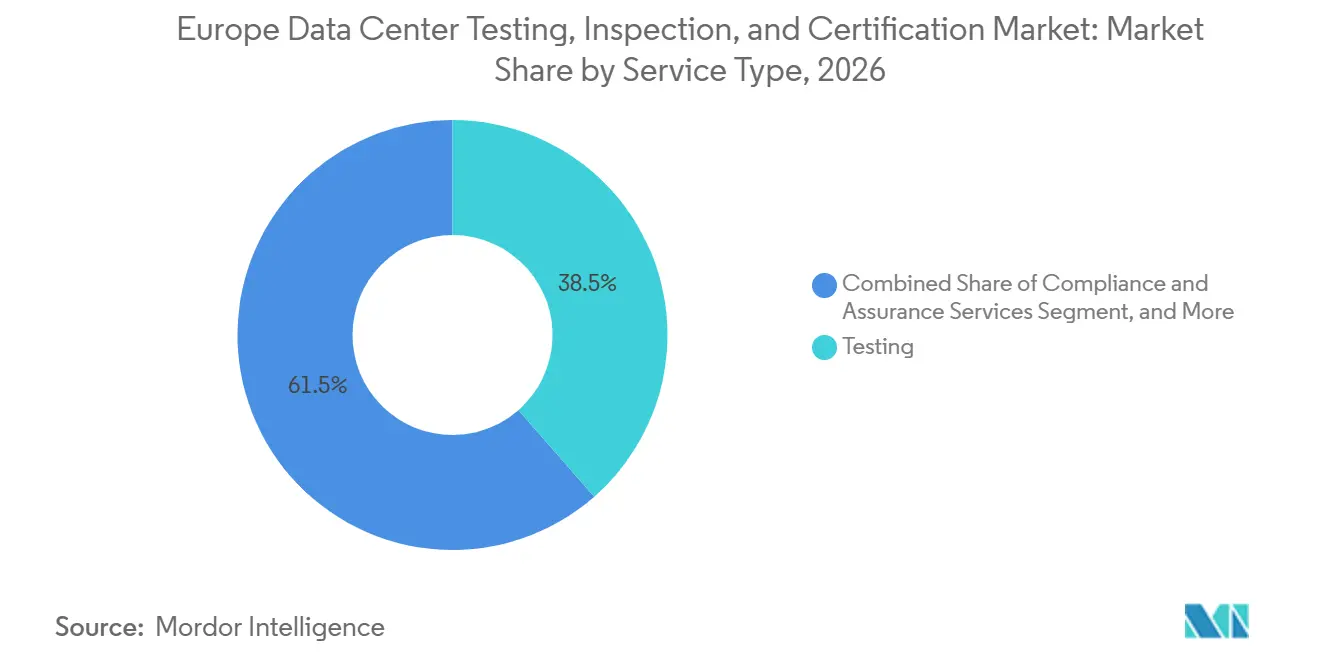
Testing held 38.54% of Europe data center testing, inspection, and certification market share in 2026. It includes factory acceptance tests, site acceptance tests, and integrated system validation carried out before major facilities enter service. These activities remain central because a data center cannot safely move into operation without proving that critical systems perform as intended. Testing becomes more complex when electrical, mechanical, cooling, and protection systems need to work under a combined load. Inspection addresses construction quality, periodic structural checks, and fire-safety reviews during and after development. Certification confirms alignment with EN 50600, ISO/IEC 22237, and TIA-942 requirements. Compliance and assurance services are the fastest-expanding stream because Energy Efficiency Directive reporting, NIS2, DORA, and EU taxonomy reviews require repeated evidence rather than a single commissioning event. The Europe data center testing, inspection, and certification industry is consequently placing more value on service models that continue through the operating life of a site.
SGS expanded a hyperscale service model in April 2026 that covers third-party commissioning, FAT and SAT testing, fire-safety inspection, and ESG certification SGS. This approach illustrates how major providers are joining previously separate services within one engagement. Bundling can make a provider harder to replace because design review, test records, and compliance evidence are already held in one delivery process. It also reduces coordination work for operators managing complex construction programs. Standalone test-only providers face a more difficult position where customers want one party to manage the handoff between technical validation and compliance reporting. At the same time, independent inspection remains important because it provides an external check on construction and operational quality. The Europe data center testing, inspection, and certification market continues to support specialized firms where they have deep expertise in a particular technical system. The broader commercial direction, however, favors providers able to cover design review, commissioning authority, inspection, and assurance without transferring responsibility between multiple contractors.

By Data Center Lifecycle: Construction Leads While Retrofit Work Becomes More Complex
Construction, installation, and commissioning accounted for 55.63% of the Europe data center testing, inspection, and certification market in 2026. New facilities require site checks and formal tests before equipment can be accepted and systems can be handed over to operations teams. The stage includes validation of installed power infrastructure, cooling, controls, physical security, and fire-safety equipment. Pre-construction and design services cover feasibility work, geotechnical review, and technical due diligence before investors commit to an AI-scale project. Operations, maintenance, and recertification then support periodic performance checks and ISO/IEC 22237-aligned reviews after a facility is live. These later services become more important as multi-year certification arrangements mature. Retrofit and modernization is expected to be the fastest-expanding lifecycle stage because older sites need upgrades for higher power density and liquid cooling. A site designed for 5-10 kW air-cooled racks may require new distribution equipment, cooling loops, and structural changes before it can support current workloads.
Retrofit projects are harder to manage than new construction because operators often need to keep live systems available. Test sequencing must account for contractor interfaces, unfamiliar thermal arrangements, and the risk of unplanned downtime. Independent commissioning authorities can help coordinate these activities and document whether the revised configuration meets the required performance level. The need for a fresh commissioning cycle after major changes creates sustained work across the Europe data center testing, inspection, and certification market. DEKRA offers services covering planning, construction, commissioning, and modernization under EN 50600, ISO/IEC 22237, and TIA-942 frameworks. Its portfolio reflects the importance of using a common technical approach through the full facility life cycle. Operators that delay modernization may face greater difficulty meeting efficiency, resilience, and reporting expectations. Providers that can work safely around live operations are well placed because this work cannot be approached in the same way as a vacant greenfield site.
By Infrastructure System: Electrical Work Leads While IT and Cybersecurity Accelerate
IT, network, and cybersecurity infrastructure is projected to record a 22.93% CAGR in the Europe data center testing, inspection, and certification market size during 2027-2032. This is the fastest rate among the infrastructure categories because the segment must address ISO/IEC 27001, NIS2 resilience assessments, DORA testing, and Cyber Resilience Act evaluations, each of which requires evidence that systems and controls operate as described. The work requires people who understand physical data-center conditions as well as software and network controls. That combination is less common than conventional electrical or mechanical testing expertise. Electrical infrastructure remains the largest category in 2026 because high-voltage distribution, UPS commissioning, and switchgear acceptance are required across nearly all large facilities. Mechanical, cooling, and fire-safety infrastructure is changing as liquid cooling takes a larger role in high-density designs. Liquid systems require checks of pressure, coolant purity, and thermal balance, and European testing practices are still developing around these configurations. Structural, building, and physical-security testing remains necessary but is more standardized than the electrical and cyber work.
The Europe data center testing, inspection, and certification industry is adapting to a link between component-level validation and whole-site performance. UL Solutions evaluates direct-to-chip liquid-cooling equipment, including cold plates, manifolds, and quick-disconnect assemblies, for coolant compatibility, pressure integrity, and durability. Component evidence does not remove the need to test how cooling equipment performs once it is installed within a facility. The route from individual equipment certification to an integrated site test can take several years to standardize. This keeps demand in place for tailored test methods during the transition, especially where operators are deploying new equipment designs before common procedures become widely adopted. Electrical infrastructure continues to provide the broadest base of work because it supports every facility type and every power-density level. Cybersecurity infrastructure is likely to command a premium where regulation requires specialist judgment and formal reporting. The combination of these needs gives large providers an incentive to develop teams that can assess electrical, cooling, physical, and digital systems without treating them as separate operational risks.
By Data Center Type: Hyperscale Facilities Drive the Largest Engagements
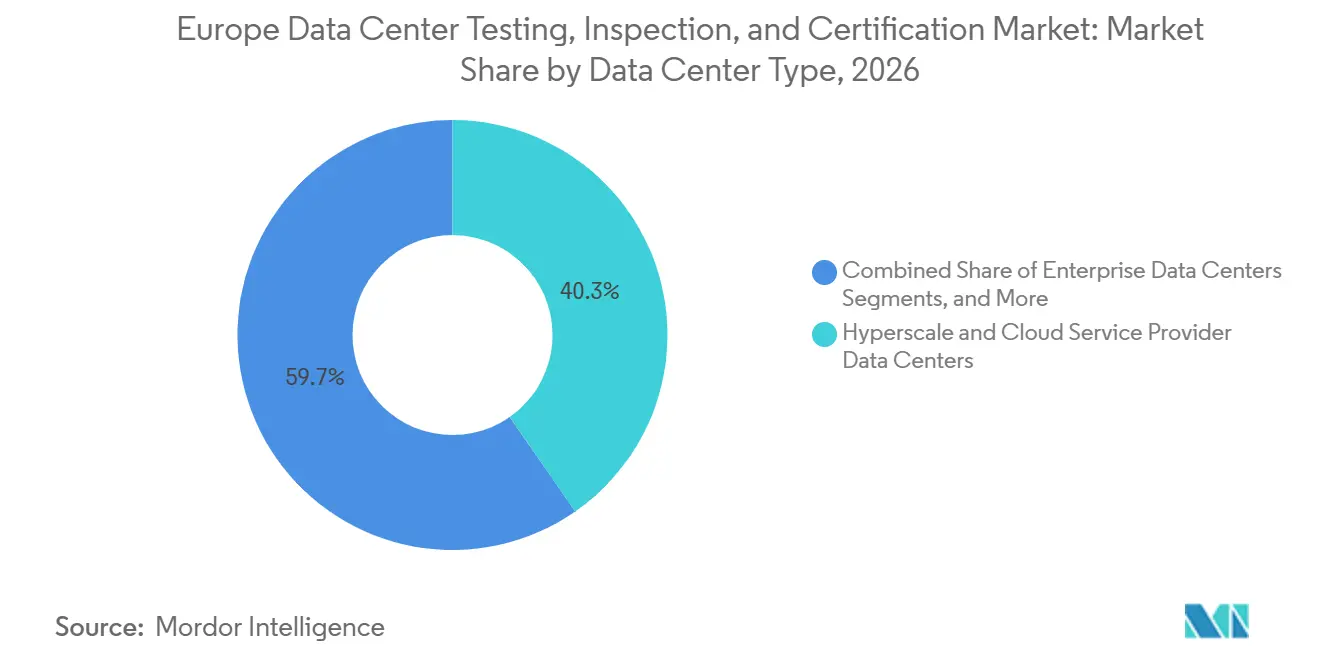
Hyperscale and cloud service provider data centers held 40.32% of the regional total in 2026. Their position reflects large capital programs, multi-site deployment plans, and commissioning processes that can take longer than those for smaller facilities. These operators need validation across many technical systems before moving high-value workloads into production. Colocation data centers generate recurring inspection and recertification work as new tenants arrive, capacity expands, and power density changes. Operators need to confirm that per-cabinet power and fire-safety zoning remain within the conditions of the original certification. Enterprise data centers are a moderating segment because companies are moving more workloads into cloud environments. Their demand shifts away from major greenfield commissioning and toward periodic operational audits. Edge and modular facilities create an opportunity for providers that can develop repeatable test procedures and shorten the cost and time required for acceptance.
The Europe data center testing, inspection, and certification market also requires providers to support operators across more than one country. Hyperscale programs may call for simultaneous commissioning at several locations, consistent documentation, and common reporting across teams. These requirements favor companies with broad delivery networks and digital systems for managing test evidence. The EUDCA expects European capacity to reach 23.6 GW by 2031, which points to continued infrastructure activity across both large campuses and regional facilities. Edge and modular facilities may not match hyperscale contract values, but they can support more standardized service delivery. This is valuable where operators want predictable timelines and a lower cost per megawatt. Providers must still preserve independent verification even when using repeatable procedures. The segment mix therefore combines large, customized hyperscale engagements with smaller deployments that reward disciplined, templated methods.
By Tier Type: Tier 3 Provides Volume and Tier 4 Supports Premium Work
Tier 3 facilities accounted for 62.16% of revenue in 2026. They are widely used by carrier-neutral colocation providers and enterprise cloud hosts because their N+1 design supports concurrent maintenance. This makes Tier 3 a common reference point for EN 50600 and ISO/IEC 22237 compliance reviews. The large installed base creates high volumes of certification and periodic audit work. Tier 1 and Tier 2 facilities are more concentrated among enterprise and public-sector users and mainly require periodic assurance work. Tier 4 is projected to expand at a 23.11% CAGR during 2027-2032. Its demand is supported by financial institutions subject to DORA requirements, security-sensitive operators, and hyperscalers building high-availability AI infrastructure. The higher resilience standard gives Tier 4 work a more specialized and labor-intensive character.
Tier 4 commissioning requires proof that systems remain available when planned failures occur. Testing can involve taking one live path out of service while the redundant path carries the full load. This must be managed carefully because the test itself can introduce operational risk. TÜV SÜD provides certification and resilience-level assessment across EN 50600, ISO/IEC 22237, and ANSI/TIA-942 requirements. These services align with the need for independent assessment in higher-availability facilities. The Uptime Institute Tier Certification process also remains a recognized third-party standard for this category. Tier 3 continues to anchor recurring revenue because it is broadly deployed and its reviews are more standardized. Tier 4 offers a smaller but higher-value opportunity where clients must demonstrate extreme availability and can support the cost of specialized testing teams.
Geography Analysis
The United Kingdom held 22.53% of Europe data center testing, inspection, and certification market share in 2026. London’s financial-services concentration and the country’s colocation base support steady demand for commissioning, resilience checks, and recurring compliance work. The United Kingdom also has a government target for 6 GW of AI-capable data-center capacity by 2030. Germany is the closest large-market challenger, supported by Frankfurt’s active development pipeline and the expected expansion of colocation capacity. The EUDCA expects Germany to overtake the United Kingdom as Europe’s leading colocation market by 2031. AWS’s planned EUR 7.8 billion (USD 8.8 billion) sovereign cloud investment in Brandenburg adds data residency and access segregation checks to conventional commissioning requirements. Ireland’s hyperscale base remains an important source of commissioning work, while changes to its planning framework are extending activity beyond Greater Dublin.
Spain is becoming more important to the European data center testing, inspection, and certification market after Amazon announced an investment of EUR 33.7 billion (USD 37.8 billion) in data-center infrastructure across Aragón. This program creates a sizable commissioning pipeline in a region with less historical large-campus activity than Northern Europe. Italy is also recording greater hyperscale activity around Milan. The Nordics have a distinct position because their climate supports free cooling and their facilities are increasingly relevant to AI infrastructure. Google committed at least EUR 13 billion (USD 14.6 billion) to AI infrastructure in Finland over 2027-2028. The investment covers 4 sites and will require work across construction, cooling, and operational validation. These projects support demand for providers capable of testing liquid-cooling systems and documenting energy and water performance.
Finland is expected to be the fastest-expanding country with a CAGR of 23.14%, supported by abundant renewable power, favorable climatic conditions, growing AI infrastructure requirements, and increasing hyperscale investment. Its growth highlights the shift of data-center development toward Nordic markets as established hubs face constraints related to power availability, grid capacity, land, and permitting. Sweden and Norway offer additional opportunities due to their renewable energy resources, cooling advantages, and suitability for large-scale facilities. Italy and Spain represent emerging growth markets as operators expand beyond traditional Northern European hubs, while the United Kingdom, Germany, the Netherlands, and Ireland continue to provide a substantial base of mature commissioning, inspection, compliance, and recurring assurance activity. The Europe data center testing, inspection, and certification market must therefore balance deep expertise in established markets with scalable field delivery across faster-growing locations. Providers that can apply consistent technical processes across countries can reduce the friction created by different permitting practices, local standards, contractor networks, language requirements, and variations in how project evidence is prepared, reviewed, retained, and presented to local authorities or client assurance teams.
Competitive Landscape
The Europe data center testing, inspection, and certification market is moderately fragmented at the national level, although large providers are consolidating their ability to serve clients across the region. SGS, Bureau Veritas, TÜV SÜD, TÜV Rheinland, TÜV NORD, DEKRA, DNV, Intertek, BSI Group, and UL Solutions offer combinations of testing, inspection, certification, and compliance services. Their common approach is to combine technical due diligence, commissioning authority roles, operational reviews, compliance assurance, testing records, and structured reporting within one client relationship, rather than asking the operator to coordinate separate teams with separate methods and document repositories. TÜV SÜD identifies continued global demand for TIC services as part of its POWER 2030 strategy. This approach can provide continuity from the earliest design review through live operations and reduce the need to hand technical evidence between separate assessment teams. It also gives providers a fuller set of records on which to base later audits and recertification work. The Europe data center testing, inspection, and certification market has a specific gap in DORA-related threat-led penetration testing because relatively few established providers hold TIBER-EU credentials.
Service development illustrates how competition is moving beyond conventional inspection. SGS expanded its hyperscale data-center offer in April 2026 to include third-party commissioning, FAT and SAT testing, fire-safety inspection, and ESG certification SGS. Bureau Veritas has positioned its sustainability offering within the EU Code of Conduct for Data Centre Efficiency assessment framework. BSI launched the Mark of Trust in January 2026 as a modular certification framework covering availability, protection, carbon usage, and water management. These moves address customer demand for a clearer connection between technical performance and compliance evidence. They also increase the range of organizations competing for work that once centered on physical construction testing. Independent verification remains important because certification requirements can limit the role of contractors that are directly responsible for delivery.
Smaller regional providers, including AENOR in Spain, Quality Austria, and RINA in Italy, retain advantages in domestic standards relationships and local pricing. They can be a practical choice for operators whose needs are limited to one country or a narrow group of services. Their constraints become clearer where a hyperscale operator requires simultaneous commissioning across 5 or more countries. Multi-country programs favor providers with regional delivery infrastructure and digital platforms for storing test records and tracking progress. Infrastructure-services companies entering commissioning roles further blur the line between construction delivery and independent verification. Standards such as EN 50600 help retain a role for independent assessment by setting recognized requirements that cannot be met through informal internal checks. The Europe data center testing, inspection, and certification industry is therefore consolidating around broad service capability while leaving room for regional specialists with trusted local relationships.
Europe Data Center Testing, Inspection, and Certification Industry Leaders
-
SGS SA
-
Bureau Veritas SA
-
Intertek Group plc
-
TÜV SÜD AG
-
DEKRA SE
- *Disclaimer: Major Players sorted in no particular order
Recent Industry Developments
- September 2026: Google announced a commitment of at least EUR 13 billion (approximately USD 14.6 billion) for AI data center infrastructure in Finland over 2027-2028, across four sites. The investment substantially expands the TIC addressable market in the Nordics over the next two construction cycles.
- June 2026: The European Commission adopted the Cloud and AI Development Act (CADA), targeting a tripling of EU data-center capacity by 2035 and streamlining permitting for qualifying projects, expanding the TIC addressable market across the full design-to-operations lifecycle.
- June 2026: SPIE commenced construction of an AI-enabled data center for firstcolo in Rosbach vor der Höhe, Germany, 16 MW IT capacity, rack densities of several hundred kilowatts per rack, and waste-heat reuse integration. The build requires specialized liquid-cooling commissioning and sustainability certification under EED requirements.
- May 2026: Bureau Veritas presented its testing, inspection, and certification capabilities for data-center infrastructure at Datacloud Global Congress 2026, including sustainability verification services covering facility design, construction, and operations.
Europe Data Center Testing, Inspection, and Certification Market Report Scope
The Europe Data Center Testing, Inspection, and Certification Market comprises third-party services that verify the safety, performance, reliability, and compliance of data center infrastructure across European countries from design review and commissioning through ongoing operations and modernization.
The Europe Data Center TIC Market Report is Segmented by Service Type (Testing, Inspection, Certification, and Compliance), Data Center Lifecycle (Pre-Construction and Design, Construction, Installation and Commissioning, Operations, Maintenance and Recertification, and Retrofit and Modernization), Infrastructure System (Electrical Infrastructure, Mechanical, Cooling and Fire-Safety Infrastructure, Structural, Building and Physical Security Systems, and IT, Network and Cybersecurity Infrastructure), Data Center Type (Hyperscale and Cloud Service Provider Data Centers, Colocation, Enterprise, Edge and Modular), Tier (1 and 2, 3, 4), and Geography (China, India, Japan, Australia, Singapore, Malaysia, and Rest of Asia-Pacific). The Market Forecasts are Provided in Terms of Value (USD).
| Testing |
| Inspection |
| Certification |
| Compliance and Assurance Services |
| Pre-Construction and Design |
| Construction, Installation and Commissioning |
| Operations, Maintenance and Recertification |
| Retrofit and Modernization |
| Electrical Infrastructure |
| Mechanical, Cooling and Fire-Safety Infrastructure |
| Structural, Building and Physical Security Systems |
| IT, Network and Cybersecurity Infrastructure |
| Hyperscale and Cloud Service Provider Data Centers |
| Colocation Data Centers |
| Enterprise Data Centers |
| Edge and Modular Data Centers |
| Tier 1 and Tier 2 |
| Tier 3 |
| Tier 4 |
| Germany |
| Netherlands |
| United Kingdom |
| Ireland |
| Spain |
| Italy |
| Sweden |
| Norway |
| Finland |
| Rest of Europe |
| By Service Type | Testing |
| Inspection | |
| Certification | |
| Compliance and Assurance Services | |
| By Data Center Lifecycle | Pre-Construction and Design |
| Construction, Installation and Commissioning | |
| Operations, Maintenance and Recertification | |
| Retrofit and Modernization | |
| By Infrastructure System | Electrical Infrastructure |
| Mechanical, Cooling and Fire-Safety Infrastructure | |
| Structural, Building and Physical Security Systems | |
| IT, Network and Cybersecurity Infrastructure | |
| By Data Center Type | Hyperscale and Cloud Service Provider Data Centers |
| Colocation Data Centers | |
| Enterprise Data Centers | |
| Edge and Modular Data Centers | |
| By Tier Type | Tier 1 and Tier 2 |
| Tier 3 | |
| Tier 4 | |
| By Geography | Germany |
| Netherlands | |
| United Kingdom | |
| Ireland | |
| Spain | |
| Italy | |
| Sweden | |
| Norway | |
| Finland | |
| Rest of Europe |
Key Questions Answered in the Report
What is the size of the Europe data center testing, inspection, and certification market?
The sector is valued at USD 0.64 billion in 2026 and is projected to reach USD 2.48 billion by 2032, with a 22.21% CAGR during 2027-2032.
What is driving demand for data-center testing and certification in Europe?
AI-ready power and cooling designs, energy reporting, cyber resilience rules, and sovereign-cloud investment are increasing the need for third-party validation.
Which service type has the largest role in Europe?
Testing leads with a 38.54% revenue share in 2026 because acceptance and integrated-system tests are required before major facilities enter service.
Which data-center lifecycle stage has the largest share?
Construction, installation, and commissioning holds 55.63% of revenue in 2026, reflecting the region's active development pipeline.
Which infrastructure area is expanding the fastest?
IT, network, and cybersecurity infrastructure is projected to expand at a 22.93% CAGR through 2032 as NIS2, DORA, and other resilience requirements add testing work.
Which country leads European demand for TIC services?
The United Kingdom leads with a 22.53% share in 2026, supported by London's financial-services concentration and established colocation base.