
Europe Data Center Switchgear Market Size and Share
Market Overview
| Study Period | 2021 - 2032 |
|---|---|
| Forecast Data Period | 2027 - 2032 |
| Base Year Market Size (2026) | USD 1.01 Billion |
| Market Size (2027) | USD 1.18 Billion |
| Market Size (2032) | USD 2.07 Billion |
| Growth Rate (2027 - 2032) | 11.90 % |
| Market Concentration | Medium |
Major Players *Disclaimer: Major Players sorted in no particular order Image © Mordor Intelligence. Reuse requires attribution under CC BY 4.0. | |
Europe Data Center Switchgear Market Analysis by Mordor Intelligence
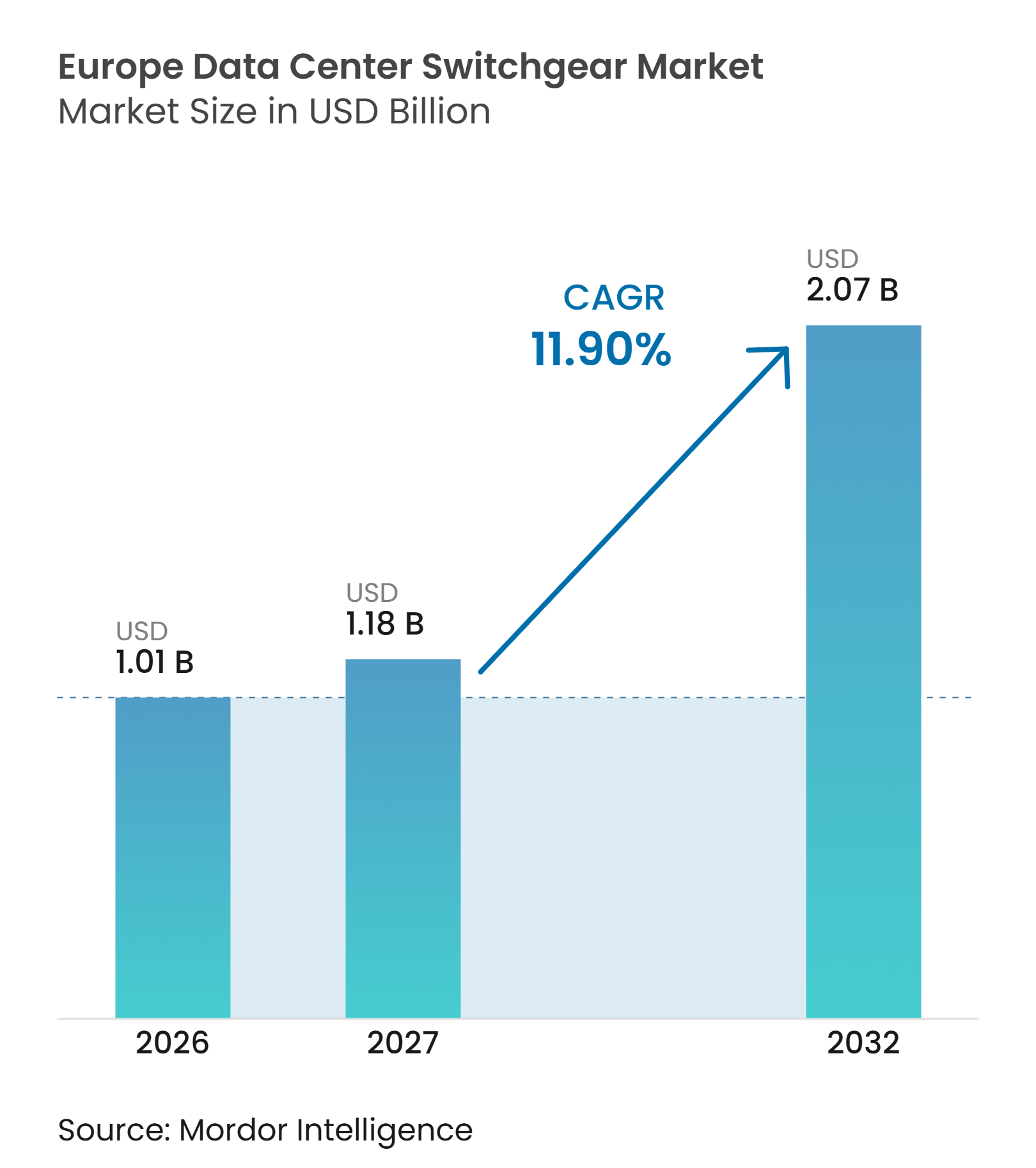
The Europe data center switchgear market size is projected to expand from USD 1.01 billion in 2026 to USD 2.07 billion by 2032, registering a CAGR of 11.90% between 2027 and 2032. AI workloads are raising power requirements inside data centers and increasing the need for reliable medium-voltage distribution. The shift toward larger campuses is also changing where equipment is installed, with more primary electrical infrastructure located near grid connections. Regulation (EU) 2024/573 is accelerating replacement planning because new medium-voltage equipment must move away from SF₆ under the stated deadlines. Manufacturers are responding with SF₆-free designs, modular assemblies, and connected equipment that can support condition-based maintenance. The Europe data center switchgear market is also affected by grid constraints and long delivery times, which encourage developers to secure equipment before construction decisions are finalized.
Key Report Takeaways
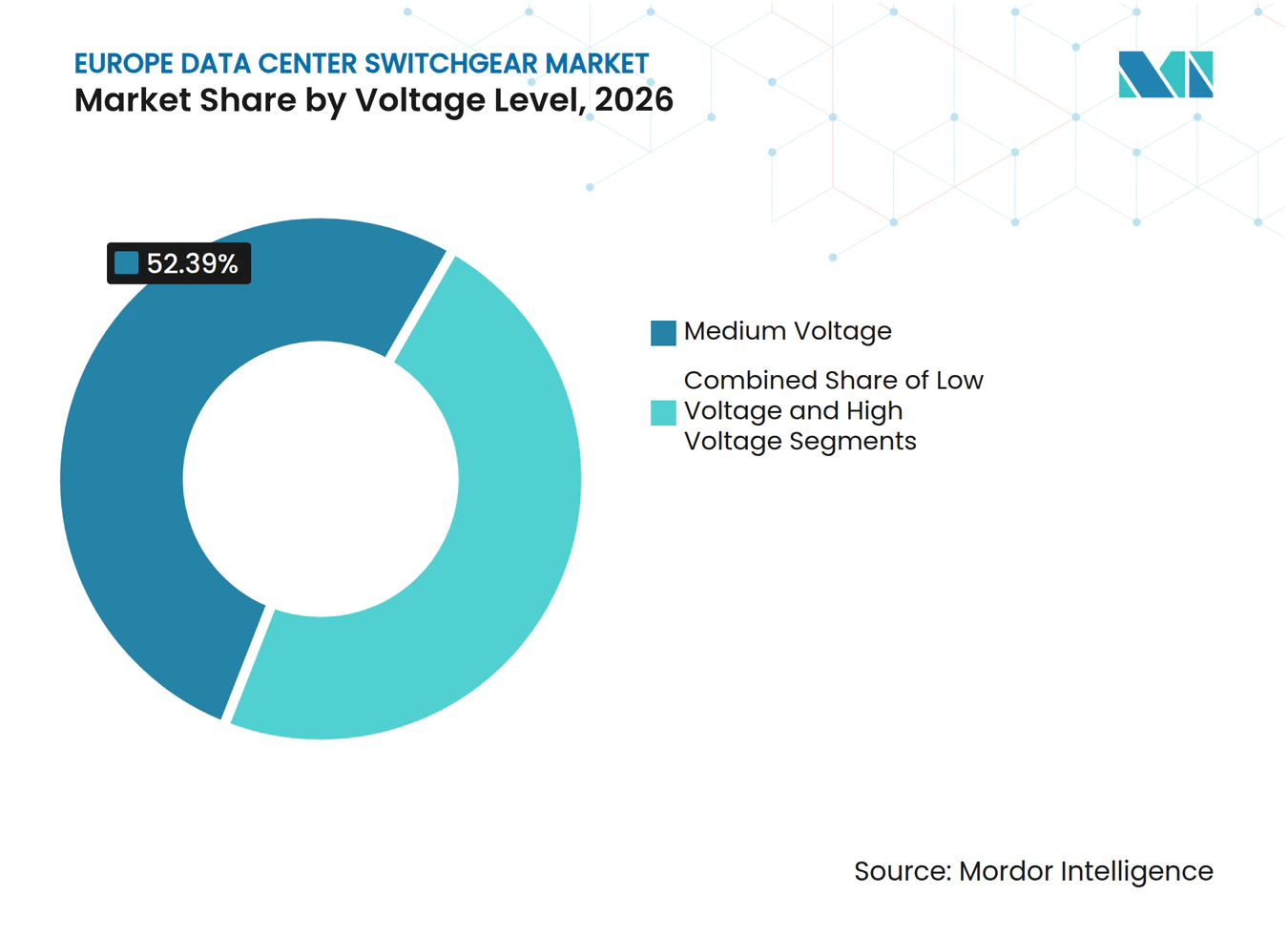
- By voltage level, medium voltage held 52.39% of the Europe data center switchgear market share in 2026, and is projected to expand at a 13.29% CAGR through 2032.
- By insulation type, gas-insulated switchgear held 42.81% share in 2026, while other insulation technologies are projected to expand at a 13.68% CAGR through 2032.
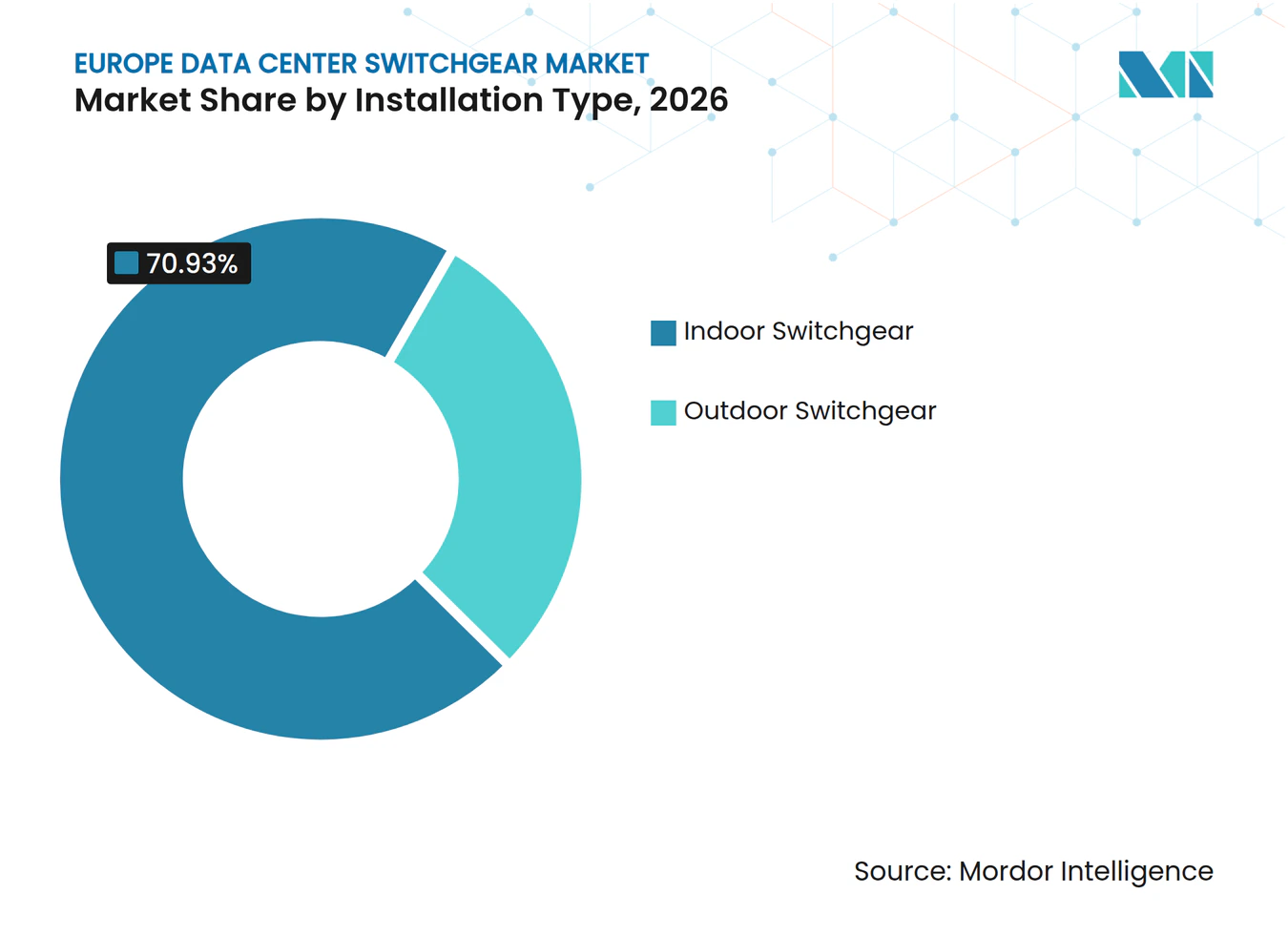
- By installation type, indoor switchgear held 70.93% of the Europe data center switchgear market share in 2026, while outdoor switchgear is projected to expand at a 13.10% CAGR through 2032.
- By configuration, withdrawable switchgear held 45.27% share in 2026, while modular switchgear is projected to expand at a 13.59% CAGR through 2032.
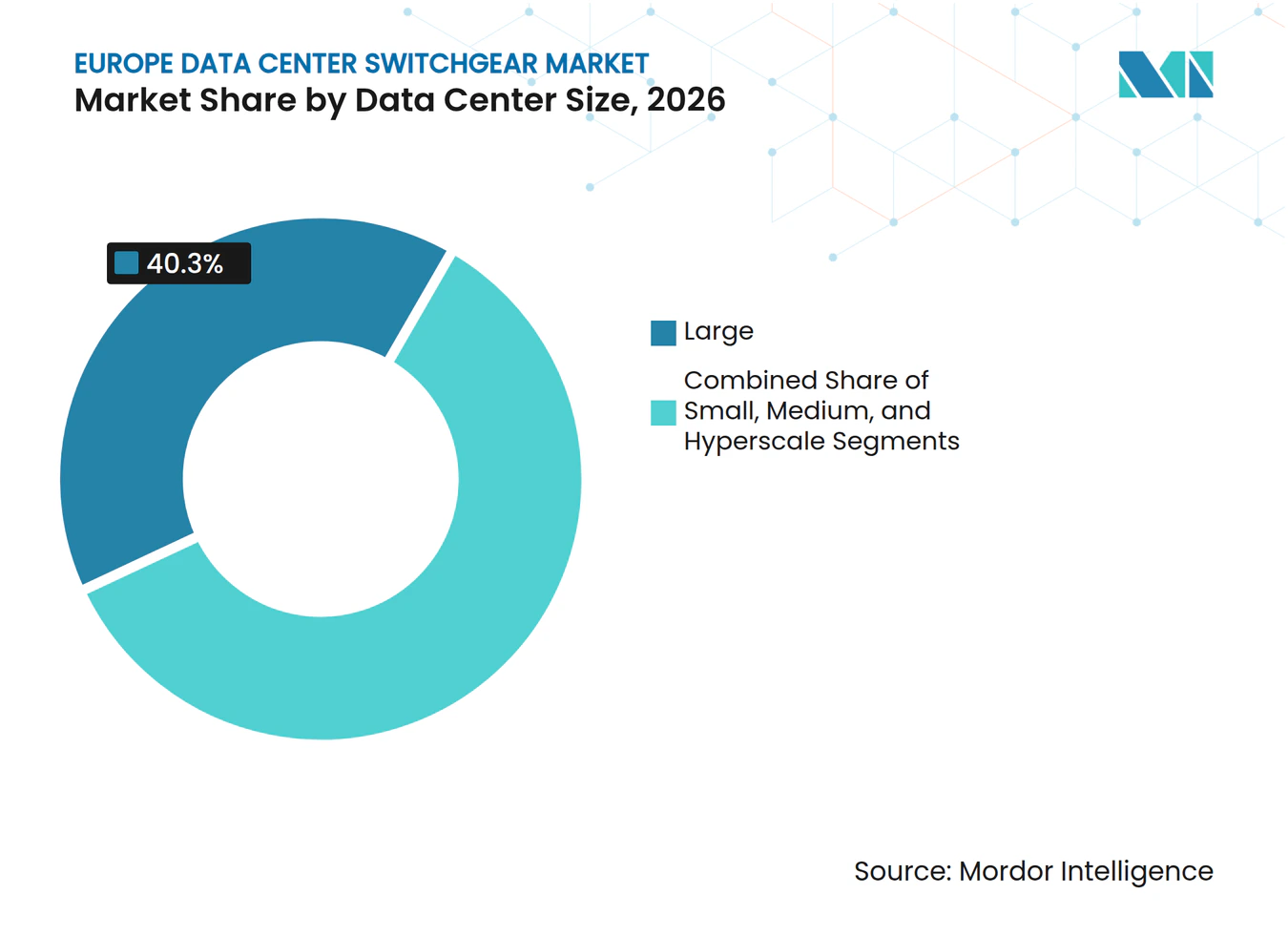
- By data center size, large facilities held 40.30% of the Europe data center switchgear market share in 2026, while hyperscale facilities are projected to expand at a 14.47% CAGR through 2032.
- By data center type, CSPs held 43.31% share in 2026 and are projected to expand at a 14.12% CAGR through 2032.
- By geography, Germany held 29.63% share in 2026, while Spain is projected to expand at a 14.68% CAGR through 2032.
Note: Market numbers in this report are based on Mordor Intelligence's proprietary estimation framework, which combines nine months of actuals with Q4 projections for base year 2026.
Market Trends and Insights
Drivers Impact Analysis of Europe Data Center Switchgear Market*
| Driver | (~) % Impact on CAGR Forecast | Geographic Relevance | Impact Timeline |
|---|---|---|---|
| AI Workload Growth and Rising Rack Power Density | +3.8% | Global, concentrated in Germany, United Kingdom, France, and Netherlands | Short term (≤ 2 years) |
| Hyperscale and Colocation Capacity Expansion | +2.8% | Pan-European, led by FLAP-D markets with spillover to Spain, Italy, and the Nordics | Short term (≤ 2 years) |
| EU SF₆ Phase-Out and SF₆-Free Switchgear Replacement | +1.9% | All 27 EU member states | Short term (≤ 2 years) |
| Digital Monitoring and Predictive Maintenance Adoption | +1.2% | Global, strongest in Germany and the United Kingdom | Medium term (2-4 years) |
| Factory-Tested Modular Power Blocks | +0.8% | Pan-European, initially France, United Kingdom, and Germany | Medium term (2-4 years) |
| Higher-Voltage Campus Distribution for AI Facilities | +0.6% | Germany, United Kingdom, Ireland, Spain, and Italy | Long term (≥ 4 years) |
| Source: Mordor Intelligence | |||
AI Workload Growth and Rising Rack Power Density
The Europe data center switchgear market is supported by AI workloads that require higher electrical capacity across data halls and campus distribution systems. ENTSO-E reported that European data center electricity consumption stood at 87 TWh in 2024 and could exceed 134 TWh by 2030. This increase places greater importance on upstream protection, fault management, and bus ratings. The same report identifies AI as a main factor behind the increased electricity requirement. More intensive computing loads can fluctuate quickly, so operators need electrical systems designed for demanding operating conditions. This moves switchgear selection earlier in facility design and raises the importance of equipment reliability.
Hyperscale and Colocation Capacity Expansion
New hyperscale and colocation projects create long procurement cycles for electrical equipment across the Europe data center switchgear market. European data center take-up reached a record 855 MW in 2025, and London and Frankfurt accounted for nearly half of this volume. Larger campuses require equipment that can link facilities to the local distribution network and then distribute power within the site. The IEA noted that energy constraints are an important obstacle to achieving Europe’s data center objectives. Developers, therefore, need to coordinate grid access, equipment orders, and building schedules much earlier. This favors suppliers with certified product ranges, manufacturing capacity, and established delivery programs.
EU SF₆ Phase-Out and SF₆-Free Switchgear Replacement
The phase-out of SF₆ in new switchgear adds a compliance-led replacement cycle to the Europe data center switchgear market. Regulation (EU) 2024/573 restricts new medium-voltage switchgear containing SF₆ at defined voltage levels, starting from 2026. Operators must evaluate new projects and replacement programs against the updated product rules. This shifts demand toward clean-air, vacuum, and other SF₆-free technologies. Siemens showed a clean-air switchgear installation in Austria that was completed in advance of the regulatory transition. The transition can also create service opportunities for equipment that remains in use during staged modernization.
Digital Monitoring and Predictive Maintenance Adoption
Connected switchgear is becoming more relevant as operators seek earlier notice of equipment condition and fewer interventions on energized assets. Research in IET Conference Proceedings describes smart medium-voltage switchgear using low-power instrument transformers and IEC 61850 sampled values for continuous diagnostics.[1] These systems can reduce wiring complexity while supporting data collection from equipment. An IEEE study found that condition monitoring aligned with NFPA 70B can improve maintenance planning and worker safety. For data center operators, this supports a shift from scheduled checks toward maintenance based on asset condition. The Europe data center switchgear market can therefore favor suppliers that provide sensors, controls, and service capabilities alongside core equipment.
Restraints Impact Analysis of Europe Data Center Switchgear Market*
| Restraint | (~) % Impact on CAGR Forecast | Geographic Relevance | Impact Timeline |
|---|---|---|---|
| Grid Connection Queues and Regional Power Scarcity | -1.6% | FLAP-D markets, extending to Italy, Spain, and Denmark | Short term (≤ 2 years) |
| Long Lead Times for Switchgear and High-Voltage Equipment | -1.2% | Global constraint, acute for European custom high-voltage equipment | Short term (≤ 2 years) |
| Limited Availability of Certified High-Voltage Technicians | -0.9% | Pan-European, especially Germany and the United Kingdom | Medium term (2-4 years) |
| Retrofit Complexity in Existing Live Data Centers | -0.6% | Western Europe, especially Frankfurt, London, Paris, and Amsterdam | Long term (≥ 4 years) |
| Source: Mordor Intelligence | |||
Grid Connection Queues and Regional Power Scarcity
Grid connection delays can slow data center construction and postpone related switchgear orders. The IEA reported that connection waits in European countries range from 2 years to 10 years. ENTSO-E also identified grid connection challenges as a central issue for European data centers. In Denmark, Energinet paused new connection agreements after requests greatly exceeded the country’s peak demand. These constraints affect both established hubs and alternative locations that had expected to benefit from redirected development. Developers may place orders earlier, but an unavailable connection can still defer final equipment installation.
Long Lead Times for Switchgear and High-Voltage Equipment
Long delivery periods for electrical equipment can limit project timing in the Europe data center switchgear market. The IEA reported that supply chain pressure has increased prices for important grid components, including cables and large power transformers. Data centers, renewable projects, and grid expansion programs are drawing on many of the same supplier base and technical labor pool. Buyers with confirmed designs and firm capacity plans are better positioned to secure production slots. Smaller developers can face greater exposure to changing prices and delayed delivery. The resulting environment increases the value of standardized products and early collaboration between developers, utilities, and manufacturers.
*Our forecasts treat driver/restraint impacts as directional, not additive. The impact forecasts reflect baseline growth, mix effects, and variable interactions.
Europe Data Center Switchgear Market Segment Analysis
By Voltage Level:
Medium Voltage Anchors Campus Power ArchitectureMedium voltage held 52.39% share in 2026. This position reflects the need to move larger amounts of power efficiently across expanding campuses. Medium-voltage systems are particularly important when data hall loads reach tens of megawatts. Low-voltage equipment remains necessary inside data halls and close to IT loads. It supports final distribution, protection, and coordination with UPS and metering systems. Medium voltage provides the connection between these functions and the broader campus electrical network. Regulation (EU) 2024/573 also creates a clear transition requirement for applicable new medium-voltage products. This makes compliance, equipment footprint, and service availability central purchasing factors.
Higher-voltage equipment is gaining relevance where very large campuses need direct transmission connections. Hitachi Energy secured an order in July 2026 for a dedicated 110 kV grid connection for a Frankfurt data center. Such projects require coordination between the operator, utility, and equipment supplier. They also increase the value of compact, high-reliability equipment near constrained urban networks. Low-voltage switchgear continues to serve vital internal distribution functions. Factory-integrated assemblies can combine low-voltage distribution, UPS systems, and metering in a more standardized format. This can reduce on-site work for projects facing tight construction schedules. The Europe data center switchgear market will therefore include demand across all voltage levels, although medium voltage remains the core campus category.



By Insulation Type:
SF₆-Free Alternatives Reshape the Installed BaseGas-insulated switchgear held 42.81% share in 2026. Its compact footprint and proven operating record remain useful in indoor locations where space and continuity are important. The category is changing because operators must select compliant technology for new installations. Regulation (EU) 2024/573 provides the central compliance framework for the shift away from SF₆ in covered equipment. Gas-insulated designs can remain relevant where suppliers offer alternatives to legacy SF₆-based products. This supports replacement orders as well as demand from new builds. It also places emphasis on product certification and technician training.
Other insulation technologies are projected to expand at a 13.68% CAGR through 2032. Clean air, nitrogen-oxygen mixture, vacuum, and solid-dielectric approaches offer different design choices for operators. Siemens’ clean-air deployment in Austria provides an example of a commercial installation completed ahead of the relevant regulatory deadlines. Air-insulated switchgear can remain attractive where equipment rooms or external sites have sufficient space. This is more feasible at greenfield campuses outside constrained central hubs. Schneider Electric extended its SF₆-free RM AirSeT technology to 38 kV in September 2026. The Europe data center switchgear market will increasingly evaluate insulation technologies alongside footprint, lifecycle service, and digital monitoring.
By Installation Type:
Indoor Retains Its Role While Outdoor Use ExpandsIndoor switchgear held 70.93% share in 2026. Data center operators often prefer to place critical electrical equipment inside protected and monitored areas. This arrangement can support security, controlled environmental conditions, and close access to maintenance teams. Indoor installations can also be integrated with building management and equipment monitoring platforms. These benefits remain significant for colocation facilities with multi-tenant uptime commitments. The format suits facilities where dense layouts require the electrical room to remain within the building envelope. It also supports a clear separation between external utility infrastructure and internal critical power distribution. This explains the segment’s substantial share of the Europe data center switchgear market.
Outdoor switchgear is projected to expand at a 13.10% CAGR through 2032. Larger greenfield campuses can require primary substations that are difficult to accommodate inside the main building. Outdoor pad-mounted or weatherproof equipment can reduce pressure on the internal floor area. It may also simplify the arrangement of primary electrical systems near the point of grid connection. This approach is particularly relevant for campuses with large IT loads and more available land. The IEA has noted that energy and grid constraints must be addressed if Europe is to meet its data center ambitions. Locating primary equipment outdoors does not resolve an unavailable grid connection, but it can provide developers with more design flexibility. The mix of indoor and outdoor systems will depend on site size, grid design, security needs, and local space constraints.

By Configuration:
Withdrawable Systems Lead as Modular Systems Gain AdoptionWithdrawable switchgear held 45.27% share in 2026. Its leading position reflects the value of isolating, testing, and replacing circuit breakers without interrupting adjacent circuits. This is important in facilities designed for high availability and redundant power paths. The format also benefits from an established European service base. Operators can plan maintenance around known equipment architectures and trained personnel. Existing enterprise and colocation sites provide a substantial installed base for this configuration. This creates opportunities for service work in addition to equipment replacement. The Europe data center switchgear market size for withdrawable systems is supported by these reliability and lifecycle requirements.
Modular switchgear is projected to expand at a 13.59% CAGR through 2032. Factory-validated power blocks can place switchgear within a preassembled electrical system. They can shorten field assembly tasks and create more consistent commissioning processes. IEC 61439 provides a relevant standard for low-voltage switchgear and controlgear assemblies.[2] Schneider Electric described RapidScale units that are pre-engineered, assembled, and validated at its Sant Boi de Llobregat facility before shipment. This model is useful where developers must standardize repeated campus designs. Fixed configurations continue to serve lower-cost applications where system-level redundancy is already built into the wider electrical design.
By Data Center Size:
Hyperscale Facilities Set the Fastest PaceLarge data centers held 40.30% share in 2026. These facilities support near-term demand through upgrades that accommodate higher tenant power density. Projects may require additional feeders, bus duct replacement, or upgrades to upstream protection. These changes can take place within an operating facility rather than during a complete new build. That makes careful sequencing and outage planning necessary. Large facilities also serve established colocation and enterprise users with critical continuity requirements. Equipment suppliers must therefore provide both new switchgear and replacement-compatible designs. This sustains the role of large facilities across the Europe data center switchgear market.
Hyperscale facilities are projected to expand at a 14.47% CAGR through 2032. These projects are typically planned as large campuses with standardized electrical designs and long procurement schedules. Their scale enables buyers to negotiate framework arrangements that reserve manufacturing capacity. This can give hyperscale operators more certainty during periods of limited equipment availability. Smaller operators may need to procure from available production slots instead. Large campuses also require close coordination with utilities because their grid demand is significant. ENTSO-E identifies data centers as a growing issue for power system planning across Europe. Hyperscale investment therefore creates both a strong demand base and a need for disciplined infrastructure planning.
By Data Center Type:
CSPs Combine Scale With Premium SpecificationsCSPs held 43.31% share in 2026 and are projected to expand at a 14.12% CAGR through 2032. Their large-scale requirements make them a major source of switchgear demand. A single campus can require more equipment than many smaller annual projects. CSPs often work with suppliers early in the design process. This enables them to define bus ratings, protection schemes, monitoring features, and delivery schedules. It also gives manufacturers a clearer demand outlook for capacity planning. The Europe data center switchgear market benefits when these buyers commit to multi-year facility programs. Colocation operators also serve CSP demand where direct self-build is less practical.
Enterprise and edge facilities remain relevant as AI inference and digital services spread across sectors. Their requirements are often smaller than hyperscale projects, but they can still require medium-voltage electrical architecture. Healthcare, financial services, and manufacturing sites can require resilient local processing capacity. Colocation providers bridge demand between these users and larger cloud platforms. They must upgrade equipment when tenant density exceeds original site specifications. Connected equipment is useful because operators can monitor assets across multiple facilities. IEEE research supports the role of condition monitoring in maintenance and safety management for medium-voltage switchgear. The buyer mix therefore broadens the application base while CSPs remain the leading customer group.
Geography Analysis
Germany
Germany held 29.63% of the Europe data center switchgear market share in 2026. Frankfurt remains central to demand because it is a major continental colocation hub. Bitkom and Borderstep Institut reported that installed German data center capacity reached 2,980 MW in 2025, following 9% growth.[3] The same publication expects AI data center capacity to rise from 530 MW to 2,020 MW by 2030. Google announced EUR 5.5 billion (USD 6.41 billion) of investment in Germany from 2026 to 2029, including a new Dietzenbach data center and continued investment in Hanau. These projects support demand for medium-voltage and high-voltage equipment. Germany’s Energy Efficiency Act, EnEfG, also increases attention to energy monitoring and accountable power use.[4] Grid constraints can redirect projects toward other German regions, while maintaining the need for compliant and monitored electrical systems.
Spain
Spain is projected to expand at a 14.68% CAGR through 2032, the highest national rate stated for the Europe data center switchgear market. The country offers available land, access to renewable energy, and locations beyond the most constrained northern European hubs. Colliers documented a pipeline of 14,000 MW IT in announced Spanish projects between October 2025 and March 2026. Its research identified growth in Barcelona and Aragón. Renewable power procurement can require grid-scale switching equipment at data center interconnection points. This makes power system design an important part of the opportunity, not a separate consideration. Spain’s permitting and power availability can attract campuses that need alternatives to congested markets. The country’s role will depend on continued coordination between data center developers, network operators, and renewable energy providers.
United Kingdom, France, Italy, and the Nordics
The United Kingdom supports major Western European demand through London’s established colocation base. France benefits from Paris’s role as a large data center hub and access to low-carbon nuclear electricity. TES Group secured a contract in August 2025 to supply more than 30 bespoke low-voltage switchgear units to a hyperscale campus in Paris. Italy is attracting interest as operators seek locations outside the most constrained northern hubs. The Nordic countries offer favorable climates and renewable power resources. However, Denmark’s connection pause shows that renewable supply does not eliminate network capacity constraints. Equinix’s acquisition of atNorth brought 1 GW of secured Nordic power capacity into its portfolio. Across these locations, grid access, local compliance factors, and credible delivery schedules shape the Europe data center switchgear market size more directly than broad site availability alone.
Competitive Landscape
Market Concentration
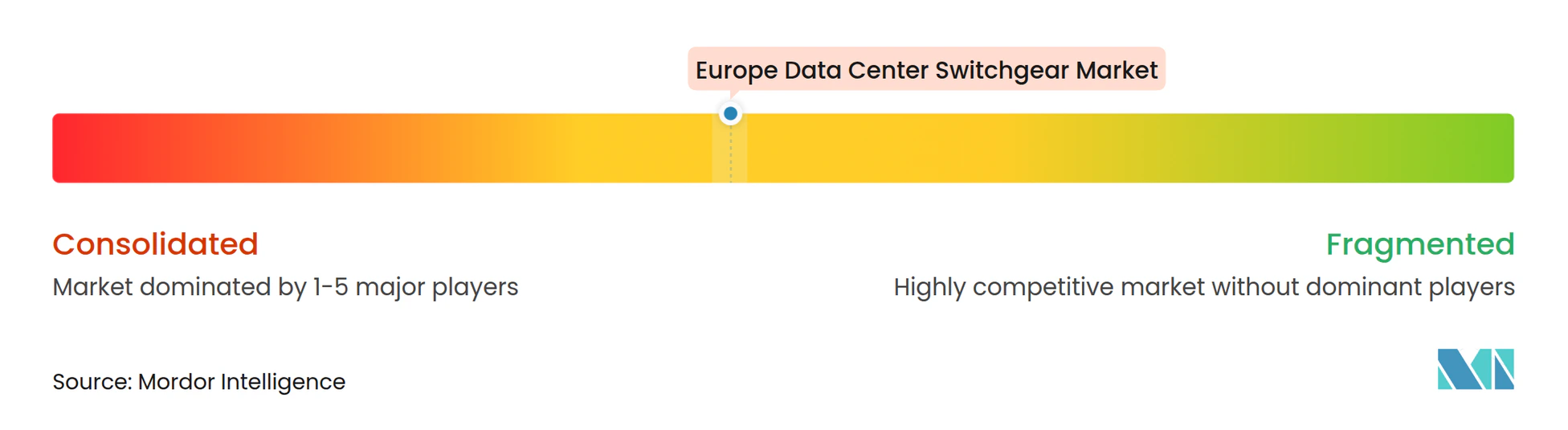
The Europe data center switchgear market is moderately consolidated. ABB Ltd., Schneider Electric SE, Siemens AG, and Eaton Corporation plc have broad product portfolios and established relationships with large infrastructure buyers. Their position is supported by manufacturing scale, certified equipment ranges, and service capabilities. ABB committed USD 200 million in May 2026 to expand medium-voltage manufacturing capacity across Europe. The program includes a USD 100 million facility in Dalmine, Italy, for air-insulated and SF₆-free switchgear. This investment is intended to address demand for air-insulated and SF₆-free equipment as well as related production capacity. Large suppliers can use these investments to improve delivery reliability for customers facing tight project schedules.
Schneider Electric introduced software-defined medium-voltage switchgear in September 2026 and extended SF₆-free RM AirSeT technology to 38 kV. The company stated that the deployment was piloted with Equinix in a live colocation facility. ABB also launched low-voltage equipment designed for AI-ready data centers in October 2025. Eaton and Siemens Energy announced a partnership in June 2025 for standardized, skid-based data center construction with integrated power equipment. These moves show competition around compliant technology, prefabrication, and faster project delivery.
Specialist suppliers can compete where projects require tailored configurations or early design support. Anord Mardix and Ormazabal Velatia can influence specifications by working with developers during the design stage. High-voltage systems for large AI campuses represent a more specialized requirement because grid connection design, insulation technology, and monitoring must work together. Hitachi Energy’s 110 kV Frankfurt order illustrates demand for dedicated transmission-distribution solutions. Competition therefore combines global scale with project-specific engineering capability. Availability, certification, and service support can be decisive in addition to price. The supplier landscape remains open enough for specialists to win individual programs, especially where custom design is required.
Europe Data Center Switchgear Industry Leaders
-
ABB Ltd.
-
Siemens AG
-
Vertiv Holdings Co.
-
Hitachi Energy Ltd.
-
Mitsubishi Electric Corporation
- *Disclaimer: Major Players sorted in no particular order
Europe Data Center Switchgear Market Companies Covered in this Report
- ABB Ltd.
- Eaton Corporation plc
- Schneider Electric SE
- Siemens AG
- Legrand SA
- Vertiv Holdings Co.
- Hitachi Energy Ltd.
- Mitsubishi Electric Corporation
- Socomec Group
- Rittal GmbH & Co. KG
- nVent Electric plc
- Anord Mardix
- Ormazabal Velatia
- Powell Industries, Inc.
- LS ELECTRIC Co., Ltd.
- Toshiba Energy Systems & Solutions Corporation
- Fuji Electric Co., Ltd.
- HD Hyundai Electric Co., Ltd.
- WEG Industries
- Lucy Electric
- CHINT Group
- Larsen and Toubro Ltd.
- Hager Group
- PowerSecure
- COL Group S.p.A.
Recent Industry Developments in Europe Data Center Switchgear Market
- October 2026: Schneider Electric unveiled modular power systems for AI data centers, manufactured and tested at its Sant Boi de Llobregat facility in Spain. The prefabricated RapidScale units targeted European hyperscale campuses initially, with North American supply planned for later in 2026 and broader regional rollout thereafter, positioning the Spanish facility as a global hub for standardized prefabricated power infrastructure.
- September 2026: Schneider Electric unveiled the world's first fully software-defined medium-voltage switchgear architecture at YOTTA 2026 in Las Vegas. Extending its SF₆-free RM AirSeT™ technology to 38 kV and piloted in a live colocation facility with Equinix, the system enables up to 3× faster ordering and manufacturing, up to 2× faster commissioning, and reduces on-site control wiring by 87% and copper by 85% versus conventional engineered-to-order switchgear.
- July 2026: Hitachi Energy secured an order for a dedicated 110 kV grid connection solution for Kauri CAB Digital Infrastructure's new data center in Frankfurt, Germany. The compact, high-reliability solution reinforces the transmission-distribution interface in a grid-constrained urban environment, addressing rising AI-driven power demand across the Rhine-Main region.
- May 2026: ABB committed USD 200 million over 3 years to expand medium-voltage manufacturing capacity across Europe. A new USD 100 million facility in Dalmine, Italy, addresses demand for air-insulated and SF₆-free switchgear, while an additional USD 100 million targets sites in Bulgaria, Finland, Germany, Norway, and Poland to scale gas-insulated switchgear, vacuum interrupters, and relay production.
Europe Data Center Switchgear Market Report Scope
The Europe data center switchgear market refers to the regional industry focused on the provisioning of low- and medium-voltage electrical switchgear designed to control, protect, and isolate European digital infrastructure. This market is heavily steered by stringent EU Eco-design regulations, the transition toward SF6-free gas alternatives, and the urgent need for advanced grid-stabilization equipment in both primary and emerging regional data hubs. It tracks market revenue, technological innovations, and deployment compliance across Western, Central, and Eastern Europe.
The Europe Data Center Switchgear Market Report is Segmented by Voltage Level (Low Voltage, Medium Voltage, and High Voltage), Insulation Type (Air-Insulated Switchgear, Gas-Insulated Switchgear, and Other Insulation Technologies), Installation Type (Indoor Switchgear and Outdoor Switchgear), Configuration (Fixed-Mounted Switchgear, Withdrawable Switchgear, and Modular Switchgear), Data Center Size (Small, Medium, Large, and Hyperscale), Data Center Type (Colocation, Cloud Service Providers [CSPs], and Enterprise / Edge), and Country (United Kingdom, Germany, France, Spain, Italy, and Rest of Europe). The Market Forecasts are Provided in Terms of Value (USD).
Segmentation Overview
| Low Voltage |
| Medium Voltage |
| High Voltage |
| Air-Insulated Switchgear |
| Gas-Insulated Switchgear |
| Other Insulation Technologies |
| Indoor Switchgear |
| Outdoor Switchgear |
| Fixed-Mounted Switchgear |
| Withdrawable Switchgear |
| Modular Switchgear |
| Small |
| Medium |
| Large |
| Hyperscale |
| Colocation |
| Cloud Service Providers (CSPs) |
| Enterprise / Edge |
| United Kingdom |
| Germany |
| France |
| Spain |
| Italy |
| Rest of Europe |
| By Voltage Level | Low Voltage |
| Medium Voltage | |
| High Voltage | |
| By Insulation Type | Air-Insulated Switchgear |
| Gas-Insulated Switchgear | |
| Other Insulation Technologies | |
| By Installation Type | Indoor Switchgear |
| Outdoor Switchgear | |
| By Configuration | Fixed-Mounted Switchgear |
| Withdrawable Switchgear | |
| Modular Switchgear | |
| By Data Center Size | Small |
| Medium | |
| Large | |
| Hyperscale | |
| By Data Center Type | Colocation |
| Cloud Service Providers (CSPs) | |
| Enterprise / Edge | |
| By Country | United Kingdom |
| Germany | |
| France | |
| Spain | |
| Italy | |
| Rest of Europe |
Key Questions Answered in the Report
How large is the Europe data center switchgear sector?
The Europe data center switchgear market size is USD 1.01 billion in 2026 and is projected to reach USD 2.07 billion by 2032 at an 11.90% CAGR. The stated forecast reflects demand for more robust electrical infrastructure in AI-focused and large-scale facilities.
What is driving demand for data center switchgear in Europe?
AI-related electricity demand, hyperscale construction, SF₆ replacement requirements, and monitoring needs support demand. Grid planning and early equipment procurement have also become central to project delivery because connection and supply constraints can delay construction.
Which voltage category leads European data center switchgear demand?
Medium voltage leads with 52.39% share in 2026 because larger campuses need efficient upstream distribution. Low-voltage equipment remains necessary inside data halls, while high-voltage systems become more relevant for very large grid-connected campuses.
Why are SF₆-free switchgear systems important in Europe?
Regulation (EU) 2024/573 restricts applicable new SF₆-containing equipment, leading buyers toward compliant alternatives. Clean-air, vacuum, and other alternative technologies are therefore being assessed alongside equipment footprint, operating needs, and lifecycle service support.
Which European country has the highest share of demand?
Germany held 29.63% share in 2026, supported by Frankfurt and broader investment in AI-related data center capacity. Germany’s energy efficiency requirements and grid constraints also increase the need for monitored, carefully planned electrical systems.
Which application group is expected to expand fastest?
Hyperscale data centers are projected to expand at a 14.47% CAGR through 2032, while CSPs are projected to expand at 14.12%. These buyers can use framework supply arrangements and standardized designs to manage their large and recurring electrical equipment requirements.