
Europe Data Center Security Services Market Size and Share
Market Overview
| Study Period | 2021 - 2032 |
|---|---|
| Forecast Data Period | 2027 - 2032 |
| Base Year Market Size (2026) | USD 1.06 Billion |
| Market Size (2027) | USD 1.22 Billion |
| Market Size (2032) | USD 2.41 Billion |
| Growth Rate (2027 - 2032) | 14.59 % |
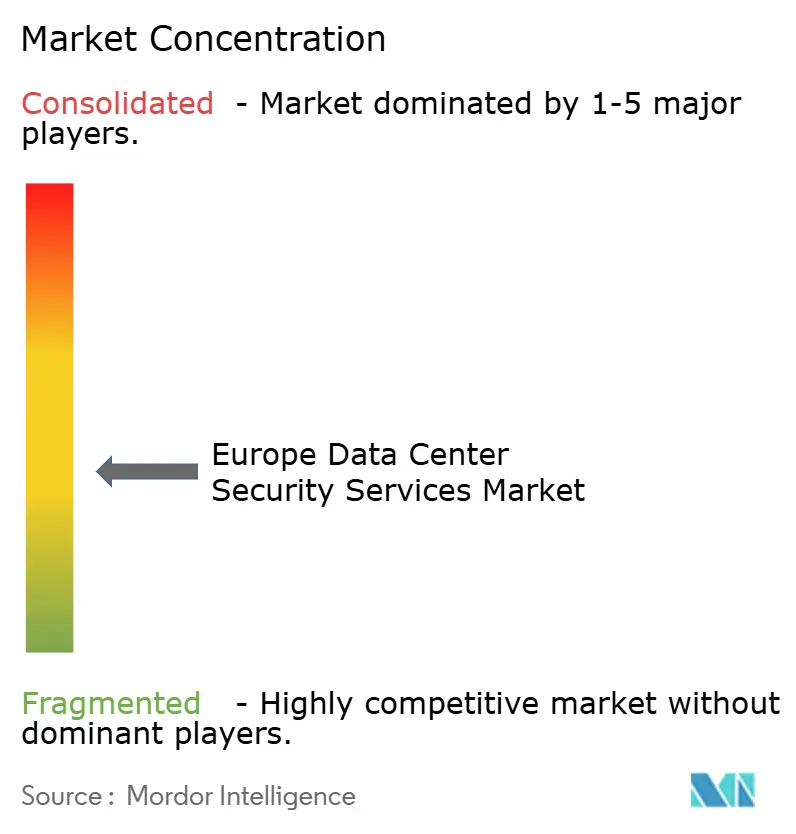
| Market Concentration | Medium |
Major Players *Disclaimer: Major Players sorted in no particular order Image © Mordor Intelligence. Reuse requires attribution under CC BY 4.0. | |
Europe Data Center Security Services Market Analysis by Mordor Intelligence
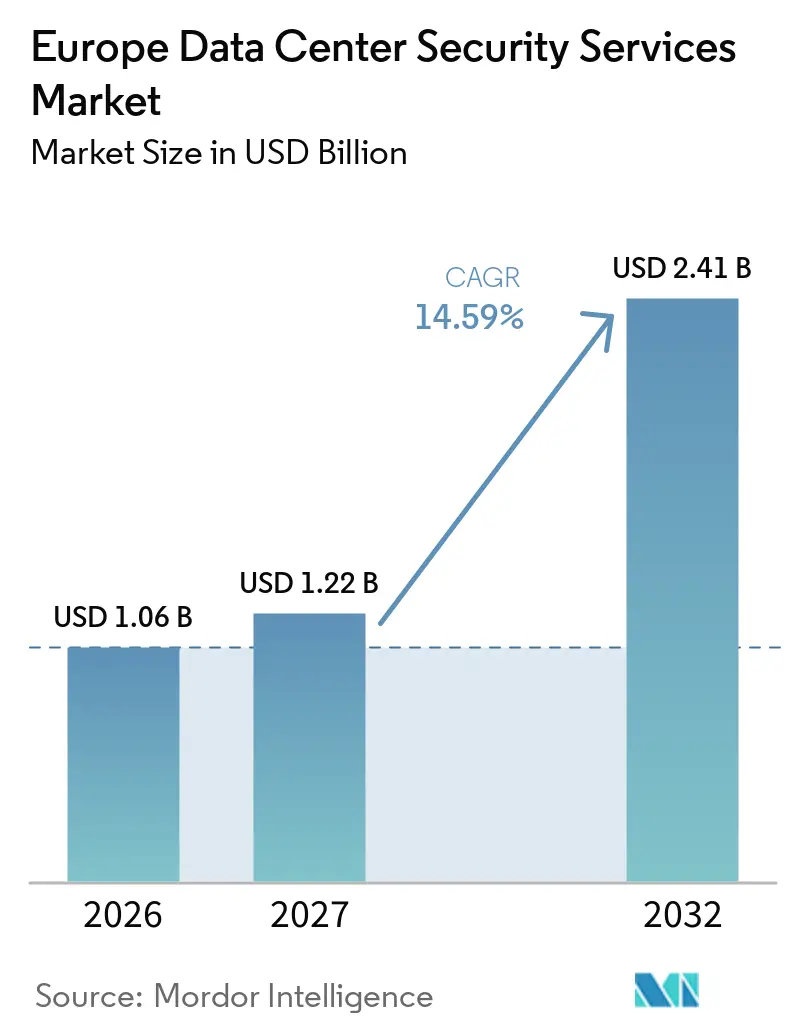
The Europe data center security services market size is projected to expand from USD 1.06 billion in 2026 and USD 1.22 billion in 2027 to USD 2.41 billion by 2032, registering a CAGR of 14.59% between 2027 and 2032. New hyperscale campuses, stricter digital resilience rules, and higher-value AI equipment are increasing the need for specialized protection across the Europe data center security services market. Data center projects are moving beyond the main FLAP-D hubs into secondary locations, where operators often need external teams with physical and digital security skills. Regulatory requirements are making documented access controls, environmental monitoring, incident response, and contractor oversight more important in procurement decisions. Providers are responding with integrated contracts that combine guarding, monitoring, technology maintenance, and risk support. The Europe data center security services market also faces practical limits from legacy facilities, limited specialist talent, and exposure to risks that originate outside the site perimeter.
Key Report Takeaways
- By service type, manned guarding and physical security held 32.71% of the Europe data center security services market revenue share in 2026, while security operations center services are projected to expand at a 15.26% CAGR through 2032.
- By service delivery model, on-site security services held 44.28% revenue share in 2026, while remote and centralized security services are projected to expand at a 16.92% CAGR through 2032.
- By contract type, dedicated site-level contracts held 38.74% revenue share in 2026, while managed service agreements are projected to expand at a 16.39% CAGR through 2032.
- By customer type, colocation providers held 46.54% of the European data center security services market revenue share in 2026, while cloud service providers are projected to expand at a 15.59% CAGR through 2032.
- By data center size, large data centers held 38.94% revenue share in 2026, while hyperscale facilities are projected to expand at a 17.27% CAGR through 2032.
- By country, the United Kingdom held 37.64% of the Europe data center security services market revenue share in 2026, while France is projected to expand at an 18.96% CAGR through 2032.
Note: Market numbers in this report are based on Mordor Intelligence's proprietary estimation framework, which combines nine months of actuals with Q4 projections for base year 2026.
Market Trends and Insights
Drivers Impact Analysis of Europe Data Center Security Services Market*
| DRIVER | (~) % IMPACT ON CAGR FORECAST | GEOGRAPHIC RELEVANCE | IMPACT TIMELINE |
|---|---|---|---|
| Hyperscale and Colocation Build-Outs Across FLAP-D and Tier 2 Cities | +3.5% | Pan-European, concentrated in FLAP-D with spillover to Milan, Iberia, and the Nordics | Medium term (2-4 years) |
| GDPR, NIS2, DORA, and CRA Compliance Spending | +3.1% | EU-27 core, with Germany, France, and Italy facing the strongest obligations, and the United Kingdom using comparable domestic frameworks | Short term (≤ 2 years) |
| Ransomware, Supply-Chain, and Data Center Targeting | +2.6% | Germany, the United Kingdom, France, and Italy | Short term (≤ 2 years) |
| AI Workloads and Higher-Value Asset Protection Requirements | +2.0% | Frankfurt, London, Paris, and emerging Nordic AI campuses | Medium term (2-4 years) |
| Physical-Cybersecurity Convergence for Zero-Trust Operations | +1.7% | FLAP-D and Tier 2 locations | Medium term (2-4 years) |
| Interdependent Utility and Telecommunications Risk Intelligence | +1.2% | National markets, with early adoption in Germany and the United Kingdom | Long term (≥ 4 years) |
| Source: Mordor Intelligence | |||
Hyperscale and Colocation Build-Outs Across FLAP-D and Tier 2 Cities
Hyperscale expansion is changing the security coverage needed across the Europe data center security services market. Projects in the 2026-2028 pipeline average 175 km from hub cities, compared with 46 km previously, because AI-scale power requirements are pushing development toward greenfield locations. These sites can have thinner pools of qualified workers and less mature supporting infrastructure. Large campuses require coverage for gates, multiple halls, substations, loading areas, and contractor access zones. Colocation facilities also need safeguards because a security failure can affect several tenants at once. Managed providers can use centralized support while retaining local teams for work that requires a physical presence.
GDPR, NIS2, DORA, and CRA Compliance Spending
European rules are making security services more closely tied to audit and governance obligations. DORA became applicable across EU member states on January 17, 2025, and the European Supervisory Authorities identified 19 critical ICT third-party providers in the Union list published in November 2025. NIS2 implementing regulation requires physical security and environmental monitoring measures that can be assessed in formal reviews.[1] Operators need suppliers that can evidence access records, risk processes, incident handling, and contractor screening. National implementation differences can affect timing, which increases the value of providers able to apply common controls in several countries. The Europe data center security services market is therefore seeing compliance become part of the service specification.
Ransomware, Supply-Chain, and Data Center Targeting
Ransomware and supplier risk are raising the security expectations placed on data center operators. European organizations accounted for nearly 22% of global ransomware and extortion victims in CrowdStrike's 2025 threat landscape. Germany, the United Kingdom, France, and Italy had the highest reported incident volumes in the cited 2025-2026 period.[2] ENISA found ransomware represented 40% of analyzed cybercrime events, increasing interest in coordinated monitoring of access, contractor activity, and cyber alerts. Providers can address the risk through supplier vetting, formal onboarding, continuous monitoring, and escalation plans. The Europe data center security services market is affected because third-party weaknesses can create operational risk without a direct breach of the primary site.
AI Workloads and Higher-Value Asset Protection Requirements
AI infrastructure is concentrating high-value equipment in facilities that need large, reliable power supplies. ENTSO-E projects that European data center electricity demand will increase by more than 50% between 2025 and 2030, led mainly by hyperscale development. AI training sites need contiguous power blocks of 100 MW or more, while GPUs and custom accelerators can cost tens of thousands of USD per unit. This increases the case for layered access controls, surveillance, role-based access, biometric authentication, and rapid response. Colocation providers also use security standards to support AI workload contracts. The Europe data center security services market needs skilled personnel and clear governance to deploy these integrated controls effectively.
Restraints Impact Analysis of Europe Data Center Security Services Market*
| RESTRAINT | (~) % IMPACT ON CAGR FORECAST | GEOGRAPHIC RELEVANCE | IMPACT TIMELINE |
|---|---|---|---|
| Legacy Retrofit ROI and Downtime Constraints | -2.9% | United Kingdom and Germany, where significant capacity was built in the 1990s-2000s | Medium term (2-4 years) |
| Skilled Integration and Security Operations Talent Shortage | -2.2% | Pan-European, particularly in Tier 2 and Tier 3 cities outside primary FLAP-D locations | Long term (≥ 4 years) |
| Cascading Dependency Risk Across Power, Fiber, Water, and Transport | -1.5% | National markets, with concentrated exposure in single-grid locations such as Ireland and the Netherlands | Long term (≥ 4 years) |
| Biometric, Video, and AI Governance Complexity | -0.9% | EU-27, with stronger friction in Germany and France | Medium term (2-4 years) |
| Source: Mordor Intelligence | |||
Legacy Retrofit ROI and Downtime Constraints
Legacy facilities can find it difficult to modernize security without disrupting live operations. Many active sites in Germany and the United Kingdom were built before converged physical and cybersecurity systems became common. Replacing access controls, cameras, and monitoring platforms can require narrow maintenance windows at Tier III and Tier IV facilities with 99.9%-99.999% uptime commitments. ENISA reported that 28% of organizations took more than 3 months to patch critical vulnerabilities in its NIS Investments 2025 report. Operators often use 7-10 year hardware refresh cycles and phased testing to limit downtime and contractor risk. This can slow the adoption of integrated systems in the Europe data center security services market.
Skilled Integration and Security Operations Talent Shortage
The shortage of people who understand physical protection and IT operations can limit service delivery. Converged environments need staff who can use security consoles, biometric systems, and security information and event management platforms. ENISA found that 30% of European organizations had not undertaken a cybersecurity assessment in the preceding 12 months, partly because qualified assessors were scarce. Traditional guarding labor is more available than command-center personnel, particularly in secondary cities receiving new development. Providers use training academies, remote SOC models, and AI-assisted triage to improve capacity, but local knowledge and escalation skills remain necessary. The Europe data center security services market depends on teams that can connect physical events with cyber and operational risk.
*Our forecasts treat driver/restraint impacts as directional, not additive. The impact forecasts reflect baseline growth, mix effects, and variable interactions.
Europe Data Center Security Services Market Segment Analysis
By Service Type:
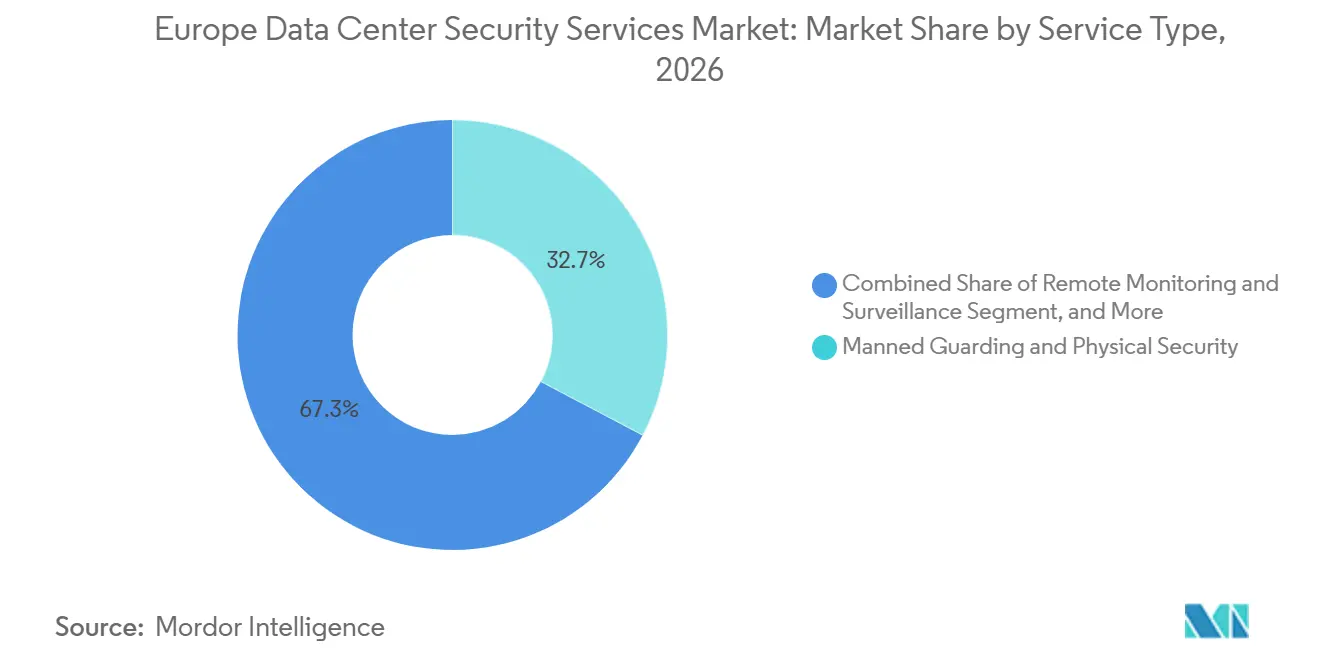
SOC Services Rise While Physical Guarding Anchors the BaseManned guarding and physical security accounted for 32.71% of the Europe data center security services market share in 2026. Human presence remains essential for perimeter access, tailgating prevention, visitor management, and on-site response at high-security facilities. Guards also provide judgment when an event needs escalation to site management or public authorities. Remote monitoring and surveillance are expanding as camera analytics and license plate recognition reduce the guard hours needed for routine perimeter observation. Access control and visitor management remain central to preventing unauthorized entry. Security system maintenance and support add recurring revenue through multiyear service arrangements.
Security operations center services are projected to expand at a 15.26% CAGR through 2032. These services bring together surveillance feeds, access events, and threat information in a common command environment. The model supports faster escalation and more consistent records for compliance reviews. Risk assessment and consulting also gain relevance as operators seek documented risk profiles for governance and insurance requirements. In September 2026, Convergint delivered a scalable physical security solution for a hyperscale Frankfurt data center that included surveillance, biometric authentication, anti-tailgating technology, intelligent key management, and alarm monitoring. Such bundled work illustrates the movement toward integrated delivery in the Europe data center security services market.

By Service Delivery Model:
Remote Models Accelerate as Site Footprints ExpandOn-site security services held 44.28% of revenue in 2026. Many high-security and multi-tenant facilities require continuous physical coverage at entrances, sensitive zones, and loading areas. On-site teams can respond immediately to access issues, incidents, or operational changes. They also provide assurance where a customer contract requires a visible security presence. Hybrid models combine this capability with remote coverage for perimeter, surveillance, and environmental systems. The approach can help operators manage costs without removing personnel from locations where judgment and immediate action matter.
Remote and centralized security services are projected to expand at a 16.92% CAGR through 2032. These models allow providers to monitor distributed Tier 2 locations from a centralized hub rather than build full teams at every site. AI-enabled video analysis can support routine perimeter monitoring and send staff only the events that require attention. Lights-out server halls can further reduce the need for continuous physical presence outside maintenance periods. The European data center security services market, therefore, has a practical reason to use centralized operating models as footprints become more dispersed. Effective remote delivery still requires reliable connectivity, clear escalation protocols, and site teams that can act when an alert needs physical intervention.
By Contract Type:
Managed Service Agreements Change Procurement PrioritiesDedicated site-level contracts held 38.74% of revenue in 2026. This format reflects the continued importance of individual-facility procurement among colocation providers. A single site may have distinct operational requirements, tenant commitments, and risk controls. Dedicated contracts can be tailored to the physical layout and operating rhythm of that facility. Multi-site and regional contracts are becoming more relevant as customers add sites in several countries. Integrated security service contracts can combine guarding, technology maintenance, SOC monitoring, and risk support under a shared accountability model.
Managed service agreements are projected to expand at a 16.39% CAGR through 2032. Buyers value multiyear arrangements that set clear outcomes for compliance reporting, technology management, and service performance. This structure can reduce the administrative burden of coordinating several separate vendors. Securitas has described its data center work across 570 facilities in 36 countries, which shows why multi-site frameworks are relevant for customers with broad portfolios.[3] Manguard Plus received an EMEA contract for Pinterest covering guarding, 24/7 monitoring, control room operations, and incident response across Dublin, London, Paris, and Berlin. These arrangements show how the Europe data center security services market is moving toward coordinated coverage across national boundaries.
By Customer Type:
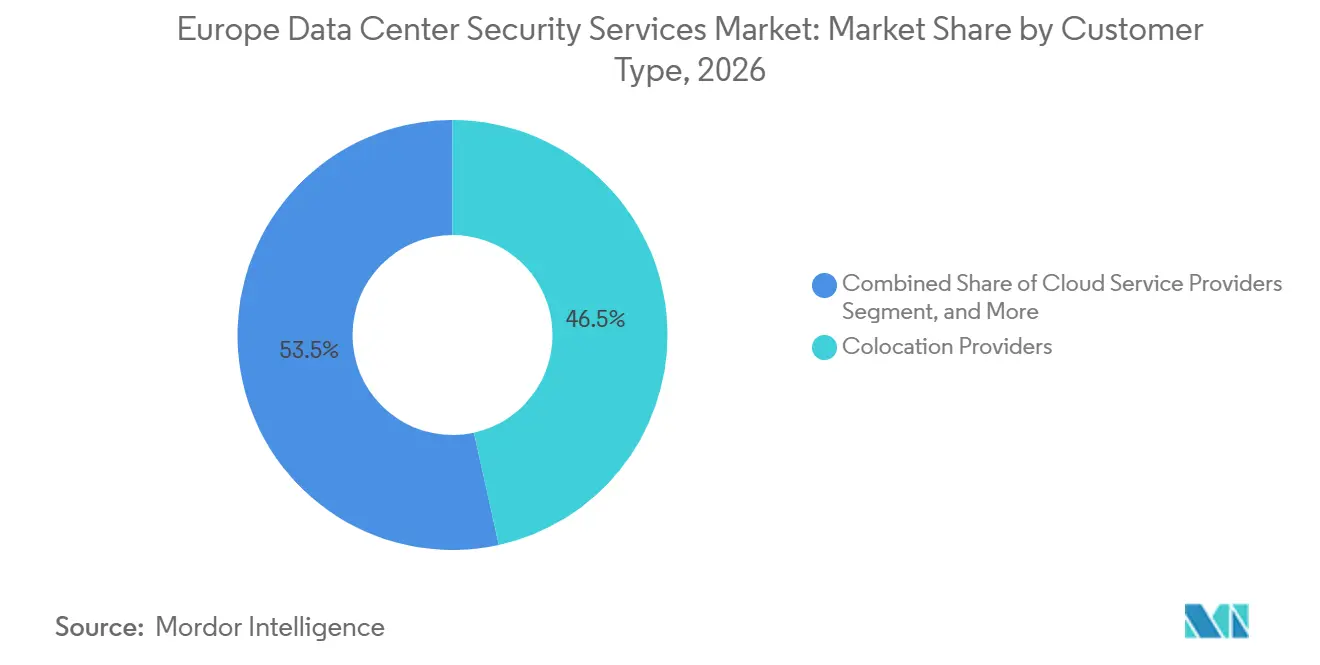
Colocation Leads While Cloud Providers ExpandColocation providers accounted for 46.54% of revenue in 2026. These operators protect shared buildings and infrastructure used by multiple enterprise tenants. A security failure can affect several customers at the same time, which strengthens the case for formal access controls and shared operating procedures. Colocation sites also have frequent visitor, contractor, and equipment movements that require detailed management. The Europe data center security services industry relies on providers that can balance common building controls with each tenant's particular needs. This creates steady demand for on-site services and integrated monitoring.
Cloud service providers are projected to expand at a 15.59% CAGR through 2032. Hyperscaler self-build strategies allow these customers to define technology architecture and integration standards directly. Their requirements can differ from inherited contract terms at a colocation facility. Enterprise and edge operators remain important because their sites are widely distributed, even when spending per location is lower. Standardized remote programs can help these operators manage several sites without increasing headcount at the same rate. The Europe data center security services market can serve this group through common processes that are adapted to local infrastructure conditions.
By Data Center Size:
Hyperscale Sets the Pace While Large Facilities Anchor RevenueLarge data centers held 38.94% of revenue in 2026. Established facilities concentrate a substantial share of commissioned capacity and continue to expand their protection requirements. Their security programs typically cover access routes, equipment areas, service corridors, and visitor procedures. Large sites also provide a base for system maintenance, guarding, and recurring monitoring contracts. Small data centers often use shared or outsourced coverage due to more constrained budgets. Medium facilities are becoming more important as edge computing expands across secondary European cities.
Hyperscale facilities are projected to expand at a 17.27% CAGR through 2032. FLAP-D delivered 453 MW of new capacity in 2026, increasing the number of sites requiring security programs designed for extensive campuses. A 100-200 MW campus can include several halls, substations, remote gates, containment zones, and AI environments. These locations need phased implementation and close coordination between technology and operational teams. Convergint's Frankfurt work expanded from the initial perimeter and first hall to multiple halls, illustrating how scope can increase as campuses develop. This scale supports the Europe data center security services market size for complex, long-duration engagements.
Geography Analysis
United Kingdom
The United Kingdom held 37.64% of the Europe data center security services market share in 2026. London had 1,189 MW of live capacity and 1,678 MW in the development pipeline in H1 2025. London added 49 MW in H1 2026, which supports ongoing demand for perimeter analytics, access management, and centralized SOC services. Domestic guidance from the National Cyber Security Center broadly aligns with the resilience expectations shaping EU markets. The United Kingdom remains important because it combines dense hyperscale activity with a large installed base that must maintain high availability.
France
France is projected to expand at an 18.96% CAGR through 2032, the fastest country rate in the Europe data center security services market. Investment commitments of EUR 5.4 billion (USD 6.1 billion) for Île-de-France data centers were announced at the Choose France summit in May 2025. Paris delivered 72.5 MW in H1 2026 and had already exceeded its full-year forecast. The French Senate identified the investment wave as relevant to physical security responsibilities under the Sécurité des Activités d'Importance Vitale framework. Germany presents a different demand profile because it experienced 370 publicly disclosed ransomware incidents during the period ending April 2026. This reinforces demand for detection, supplier vetting, and coordinated security operations.
Rest of Europe
Italy, the Nordics, Iberia, and Central and Eastern Europe extend the addressable base for the Europe data center security services market. Italy adopted Legislative Decree No. 138 on September 4, 2024, which established the Agenzia per la Cybersicurezza Nazionale as the supervisory body for relevant digital infrastructure. Colocation operators required to register from December 2024 must address the resulting compliance expectations. Helsinki, Lisbon, Oslo, Warsaw, and Madrid are in active expansion phases supported by power availability and lower land costs. Norway's data center regulation, effective January 1, 2025, requires security management systems, risk assessments, and incident response plans. These locations need security plans that reflect local power, telecom, and workforce conditions.
Competitive Landscape
The Europe data center security services market is moderately fragmented, with global providers, specialized integrators, and cybersecurity firms serving different parts of the value chain. Securitas, Johnson Controls, Honeywell, Siemens, Bosch Security Systems, and Mitie compete in guarding, on-site services, and managed contracts. They use geographic reach, operational process, and compliance documentation as important selling points. Axis Communications, ASSA ABLOY, Convergint, Genetec, and Milestone Systems are active at the physical technology and integration layer. Cisco, IBM, Palo Alto Networks, Fortinet, and CrowdStrike address converged monitoring through security platforms, threat intelligence, and managed detection capabilities. The competitive landscape is shaped by the need to combine reliable field operations with increasingly connected technology.
Providers are using acquisitions and partnerships to broaden their capabilities. ASSA ABLOY acquired Kentix GmbH in October 2025, adding access control and environmental monitoring capabilities for data centers to its Digital and Access Solutions portfolio. Securitas formalized a partnership with Rohde and Schwarz in September 2025 to use AI-based millimeter wave screening for non-contact personnel threat detection. Genetec introduced a UK-hosted Security Center SaaS deployment on Microsoft Azure in February 2026 to address data sovereignty and local compliance needs. These moves support differentiation in services where customers require integrated systems and local data controls.
The Europe data center security services market also has opportunities in protection beyond the traditional site boundary. Providers can bring together site controls with awareness of power, fiber, water, and transport dependencies that can disrupt operations. AI-cluster facilities create a further opportunity because their asset density requires stricter standards for access, monitoring, and response. ISO/IEC 27001 certification and SOC 2 Type II compliance are emerging as important credentials in large data center requests for proposals. These requirements can direct contracts toward firms that can demonstrate formal audit records and consistent processes.
Europe Data Center Security Services Industry Leaders
-
Securitas AB
-
Johnson Controls International plc
-
Schneider Electric SE
-
Honeywell International Inc.
-
Cisco Systems Inc.
- *Disclaimer: Major Players sorted in no particular order
Europe Data Center Security Services Market Companies Covered in this Report
- Securitas AB
- Johnson Controls International plc
- Schneider Electric SE
- Honeywell International Inc.
- Cisco Systems Inc.
- International Business Machines Corporation
- Palo Alto Networks, Inc.
- Fortinet, Inc.
- Check Point Software Technologies Ltd.
- Siemens AG
- Bosch Security Systems GmbH
- Axis Communications AB
- ASSA ABLOY AB
- dormakaba Holding AG
- Convergint Technologies LLC
- Genetec Inc.
- Milestone Systems A/S
- Motorola Solutions, Inc.
- Equinix, Inc.
- CrowdStrike Holdings, Inc.
- Legrand SA
- ADT Inc.
Recent Industry Developments in Europe Data Center Security Services Market
- September 2026: Manguard Plus was awarded an EMEA-wide security contract for Pinterest, delivering integrated security operations across the company's Regional Security Operations Center footprint in Dublin, London, Paris, and Berlin. The scope covers manned guarding, 24/7 monitoring, control room operations, and incident response under a single accountable operator.
- September 2026: Convergint delivered a complex, scalable physical security solution for a confidential hyperscale data center customer in Frankfurt, Germany. The project scope expanded from the initial perimeter and first data hall to multiple data halls, encompassing video surveillance, biometric authentication, anti-tailgating technology, intelligent key management, and alarm monitoring infrastructure.
- September 2026: Securitas and Microsoft deepened their sustainability-focused data center security collaboration across Europe, advancing security program co-design aligned with carbon reduction and operational resilience targets at Microsoft's hyperscale facilities.
- April 2026: Mitie acquired El Team Vest in Denmark and ABC Elektro in Norway for a combined initial consideration of GBP 8.1 million (USD 10.3 million), expanding its data center fire and security capabilities across the Nordics for clients including Microsoft, Google, and Equinix.
Europe Data Center Security Services Market Report Scope
The Europe data center security services market covers revenue from security services deployed in data centers across Germany, the United Kingdom, France, Italy, and other European countries. The market is shaped by strict data protection and critical infrastructure regulations, privacy and biometric governance requirements, and the growing demand for compliance auditing, SOC services, and integrated security operations.
The Europe Data Center Security Services Market Report is Segmented by Service Type (Manned Guarding and Physical Security, Remote Monitoring and Surveillance, Security Operations Center Services, Security Risk Assessment and Consulting, Access Control and Visitor Management Services, and Security System Maintenance and Support), Service Delivery Model (On-Site Security Services, Remote and Centralized Security Services, and Hybrid Security Services), Contract Type (Dedicated Site-Level Contracts, Multi-Site and Regional Contracts, Integrated Security Service Contracts, and Managed Service Agreements), Customer Type (Colocation Providers, Cloud Service Providers (CSPs), and Enterprise / Edge Data Center Operators), Data Center Size (Small, Medium, Large, and Hyperscale), and Country (Germany, United Kingdom, France, Italy, and Rest of Europe). The Market Forecasts are Provided in Terms of Value (USD).
Segmentation Overview
| Manned Guarding and Physical Security |
| Remote Monitoring and Surveillance |
| Security Operations Center Services |
| Security Risk Assessment and Consulting |
| Access Control and Visitor Management Services |
| Security System Maintenance and Support |
| On-Site Security Services |
| Remote and Centralized Security Services |
| Hybrid Security Services |
| Dedicated Site-Level Contracts |
| Multi-Site and Regional Contracts |
| Integrated Security Service Contracts |
| Managed Service Agreements |
| Colocation Providers |
| Cloud Service Providers (CSPs) |
| Enterprise / Edge Data Center Operators |
| Small |
| Medium |
| Large |
| Hyperscale |
| Germany |
| United Kingdom |
| France |
| Italy |
| Rest of Europe |
| By Service Type | Manned Guarding and Physical Security |
| Remote Monitoring and Surveillance | |
| Security Operations Center Services | |
| Security Risk Assessment and Consulting | |
| Access Control and Visitor Management Services | |
| Security System Maintenance and Support | |
| By Service Delivery Model | On-Site Security Services |
| Remote and Centralized Security Services | |
| Hybrid Security Services | |
| By Contract Type | Dedicated Site-Level Contracts |
| Multi-Site and Regional Contracts | |
| Integrated Security Service Contracts | |
| Managed Service Agreements | |
| By Customer Type | Colocation Providers |
| Cloud Service Providers (CSPs) | |
| Enterprise / Edge Data Center Operators | |
| By Data Center Size | Small |
| Medium | |
| Large | |
| Hyperscale | |
| By Country | Germany |
| United Kingdom | |
| France | |
| Italy | |
| Rest of Europe |
Key Questions Answered in the Report
What is the Europe data center security services market size?
The Europe data center security services market size is projected to expand from USD 1.06 billion in 2026 and USD 1.22 billion in 2027 to USD 2.41 billion by 2032, registering a CAGR of 14.59% between 2027 to 2032
What is driving demand for data center security services in Europe?
Hyperscale expansion, regulatory obligations, ransomware risk, and the higher value of AI equipment are increasing demand for integrated protection.
Which service type leads revenue in Europe?
Manned guarding and physical security leads with 32.71% share in 2026, supported by the need for on-site access control and incident response.
Which delivery model is expanding fastest?
Remote and centralized security services are projected to expand at a 16.92% CAGR through 2032 as operators monitor distributed locations from centralized hubs.
Which customer group has the largest share?
Colocation providers hold 46.54% of revenue in 2026 because they must protect shared infrastructure used by multiple tenants.
Which country is expanding fastest?
France is projected to expand at an 18.96% CAGR through 2032, supported by investment commitments and new data center capacity.