
Europe Data Center Renewable Energy Market Size and Share
Market Overview
| Study Period | 2021 - 2032 |
|---|---|
| Forecast Data Period | 2027 - 2032 |
| Base Year Market Size (2026) | USD 5.05 Billion |
| Market Size (2027) | USD 6.23 Billion |
| Market Size (2032) | USD 13.84 Billion |
| Growth Rate (2027 - 2032) | 17.31 % |
| Market Concentration | Medium |
Major Players *Disclaimer: Major Players sorted in no particular order Image © Mordor Intelligence. Reuse requires attribution under CC BY 4.0. | |
Europe Data Center Renewable Energy Market Analysis by Mordor Intelligence
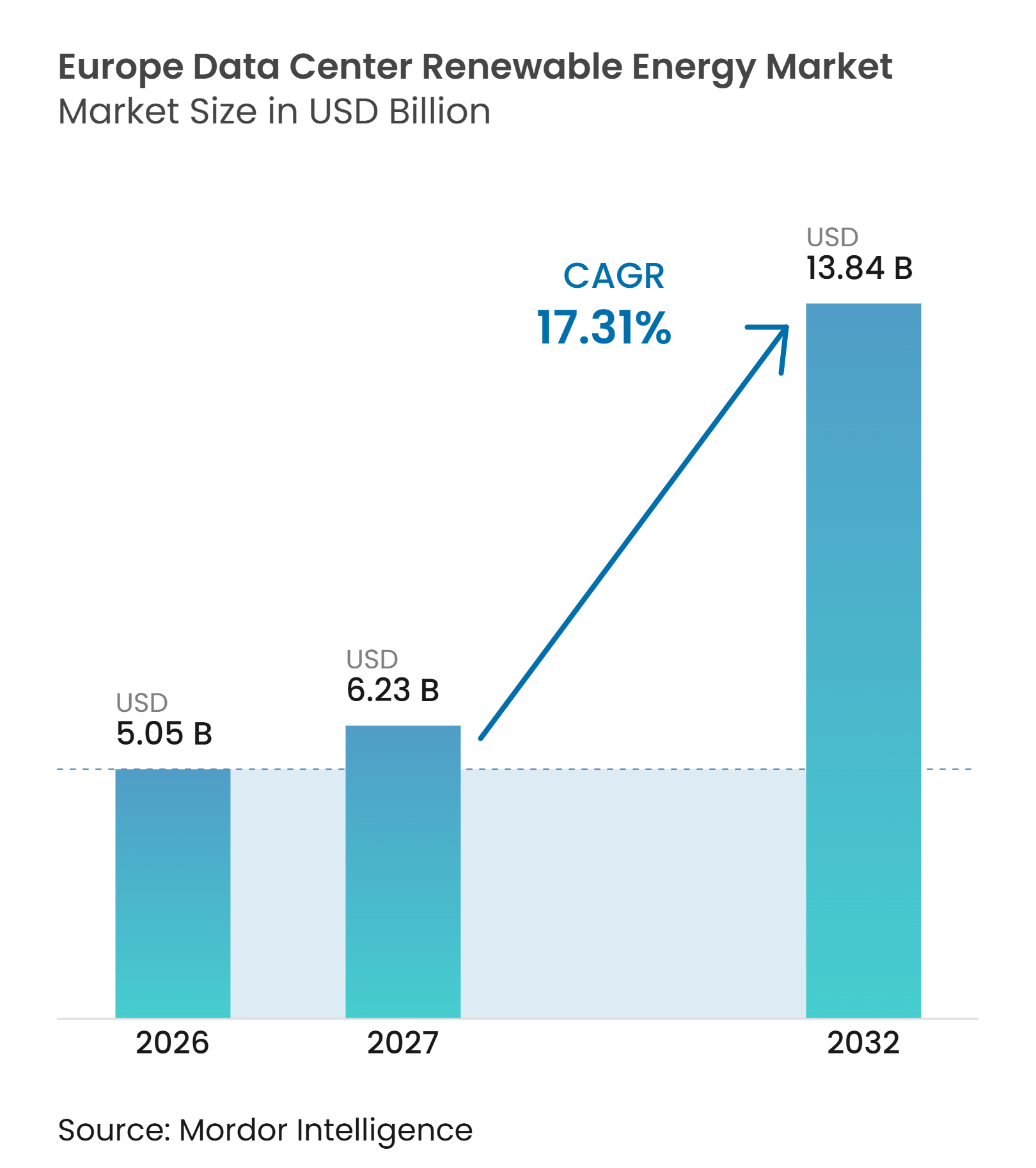
The Europe data center renewable energy market size was valued at USD 5.05 billion in 2026 and is estimated to expand from USD 6.23 billion in 2027 to reach USD 13.84 billion by 2032, at a CAGR of 17.31% during the forecast period (2027-2032). Market volume was 53.15 million MWh in 2026 and is estimated to increase from 65.58 million MWh in 2027 to 130.61 million MWh by 2032, at a CAGR of 14.77% during the forecast period (2027-2032). Artificial intelligence workloads are increasing power density and making reliable electricity supply a central site-selection issue for operators. This is moving procurement beyond annual renewable certificates toward long-term contracts that can support new generation and provide clearer evidence of renewable matching. Grid limitations in established hubs are also directing investment toward locations with available power and stronger renewable resources. Suppliers that can combine wind, solar, storage, and flexible-load services have a stronger position, while the Europe data center renewable energy market depends on the pace of data center construction, grid access, and more demanding reporting and efficiency requirements.
Key Report Takeaways
- By renewable energy source, wind power held 44.43% of the Europe data center renewable energy market share in 2026, while solar power is projected to expand at an 18.51% CAGR through 2032.
- By procurement model, virtual or financial PPAs held a 33.82% share in 2026 and are projected to expand at an 18.29% CAGR through 2032
- By project configuration, standalone renewable projects held a 49.74% share in the Europe data center renewable energy market in 2026, while battery-storage-enabled projects are projected to expand at an 18.09% CAGR through 2032.
- By contract duration, long-term contracts held a 55.03% share in 2026 and are projected to expand at a 17.92% CAGR through 2032.
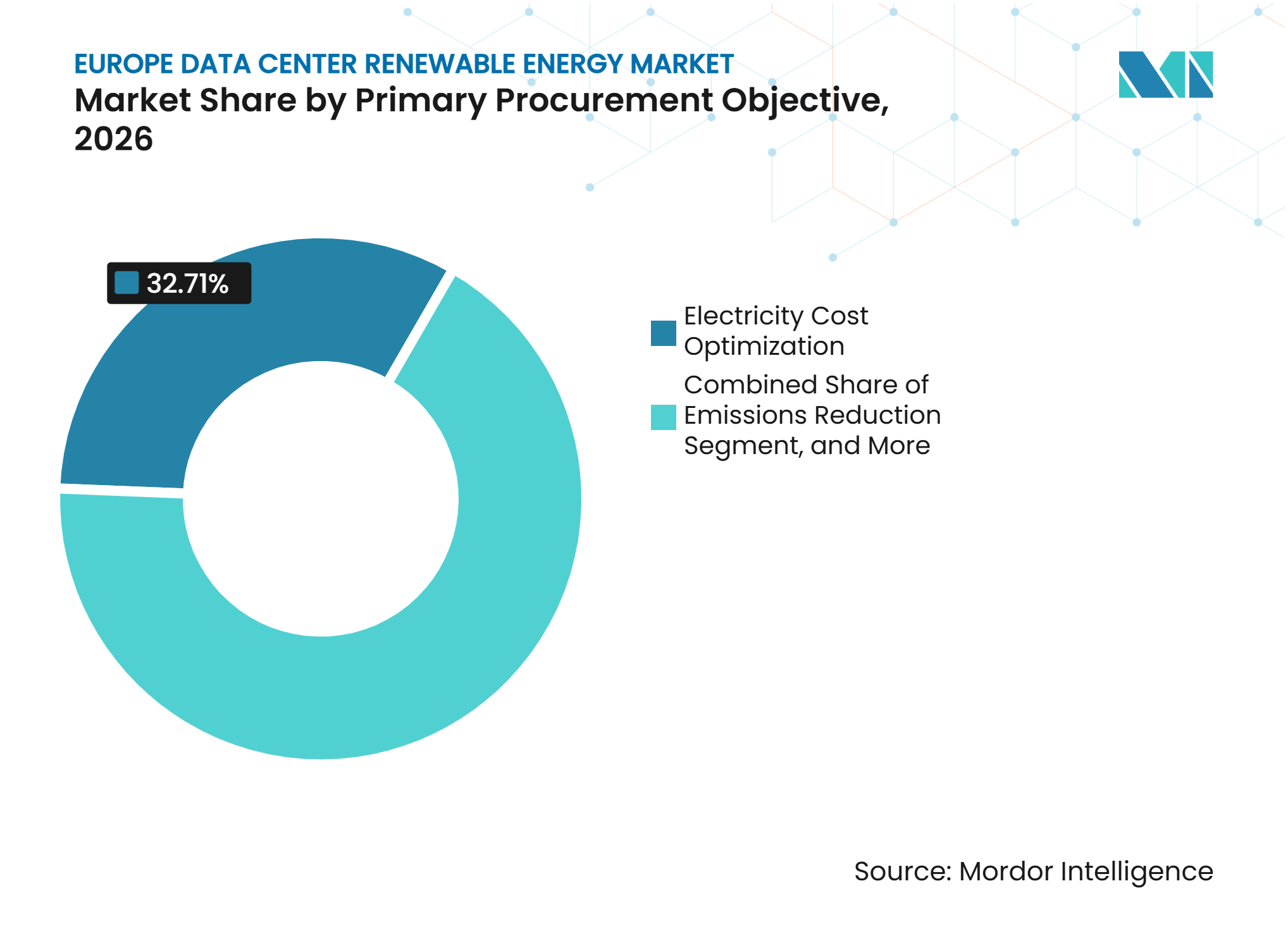
- By primary procurement objective, electricity cost optimization accounted for 32.71% in 2026, while renewable energy matching is projected to expand at an 18.07% CAGR through 2032.
- By data center size, hyperscale data centers held a 46.68% share in 2026 and are projected to expand at an 18.02% CAGR through 2032.
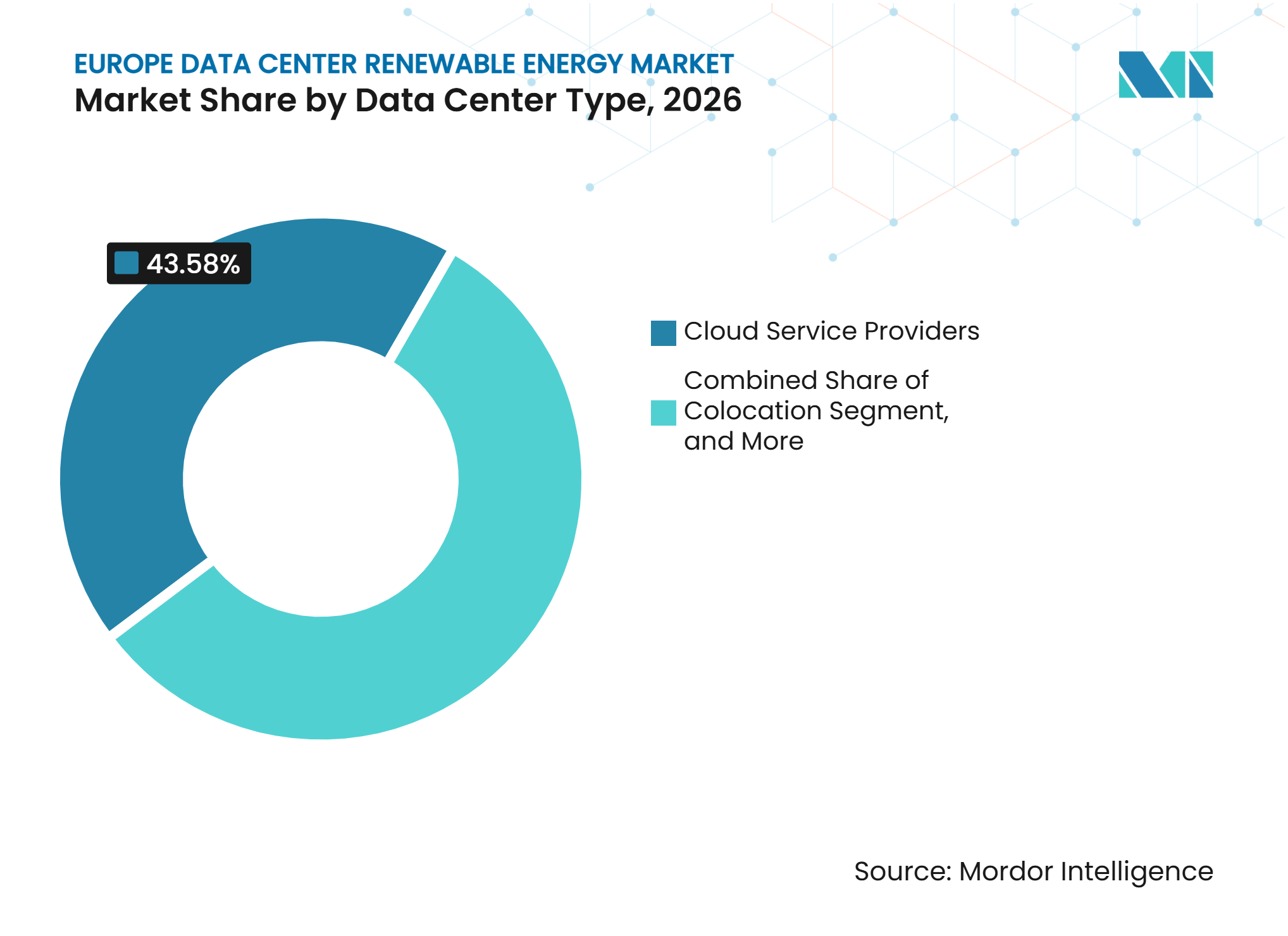
- By data center type, cloud service providers held a 43.58% share in Europe data center renewable energy market 2026, while the segment is projected to expand at a 17.88% CAGR through 2032.
- By geography, the Rest of Europe accounted for 21.76% of the market in 2026, while Italy is projected to expand at an 18.76% CAGR through 2032.
Note: Market numbers in this report are based on Mordor Intelligence's proprietary estimation framework, which combines nine months of actuals with Q4 projections for base year 2026.
Market Trends and Insights
Drivers Impact Analysis of Europe Data Center Renewable Energy Market*
| Driver | (~) % Impact on CAGR Forecast | Geographic Relevance | Impact Timeline |
|---|---|---|---|
| Artificial Intelligence Workloads Accelerating Data Center Power Demand | +4.8% | Europe, concentrated in FLAP-D hubs and Nordic growth markets | Short term (≤ 2 years) |
| Hyperscaler Demand for Long-Term Renewable Procurement | +3.9% | Europe, with significant activity in the UK, Germany, Spain, Ireland, and Nordics | Medium term (2-4 years) |
| European Decarbonization and Energy Efficiency Requirements | +2.6% | EU-wide | Medium term (2-4 years) |
| Expansion of Renewable-Rich Northern European Data Center Locations | +2.1% | Nordics, with spillover to Spain, Italy, and Portugal | Long term (≥ 4 years) |
| Solar and Wind Cost Competitiveness in Corporate PPAs | +1.7% | Europe, led by Italy, Spain, and Finland | Short term (≤ 2 years) |
| Data Center Participation in Renewable Grid Flexibility Markets | +0.9% | EU, Nordics, and UK | Long term (≥ 4 years) |
| Source: Mordor Intelligence | |||
Artificial Intelligence Workloads Accelerate Data Center Power Demand
AI training clusters can require more than 80 kW per rack, compared with 8-12 kW for conventional workloads, which changes how operators plan power supply. According to the European Commission, European data center IT power reached 14,784 MW by the end of 2025 and is expected to grow at a 17% CAGR through 2031.[1] EU data center electricity consumption reached 68 TWh in 2024 and is projected to reach 114 TWh by 2030. Training workloads favor locations with abundant power and shorter connection schedules, while inference workloads still require proximity to users. This split is encouraging operators to build renewable procurement portfolios across both core cities and emerging locations. The Europe data center renewable energy market benefits when those portfolios include supply that can serve variable AI demand, since procurement must address both the concentrated demand of training sites and the dispersed operational needs of user-facing facilities.
Hyperscaler Demand Supports Long-Term Renewable Procurement
Amazon Web Services, Google, Microsoft, and Meta signed 16,777 MW of corporate renewable contracts in 2025, representing 80% of global corporate PPA activity. Amazon had contracted more than 10 GW of renewable capacity across over 260 European projects by 2026. These commitments give developers revenue visibility for large generation projects and influence the contract terms available to other buyers. Demand is concentrated among a small group of purchasers, so changes in their procurement plans can quickly affect deal volumes. ENGIE signed 3.1 GW of PPAs in the first 9 months of 2025, including more than 1.9 GW in the third quarter. Integrated suppliers with renewable and battery portfolios can respond more effectively to demand for firm supply structures because they can offer a coordinated package, rather than leaving operators to negotiate separate arrangements for energy, storage, balancing, and contract management.
European Decarbonization and Energy Efficiency Requirements
The recast Energy Efficiency Directive requires data center transparency reporting across EU member states. The European Commission published a common Union sustainability rating scheme in September 2026 that uses Power Usage Effectiveness and Water Usage Effectiveness as core indicators. Electronic labels are expected to be issued annually through the European database on data centers, starting in August 2027. A Commission consultation on minimum performance standards remained open until December 14, 2026, ahead of a planned legislative proposal in the second quarter of 2027. These measures make it easier for investors, customers, and regulators to compare energy performance and renewable sourcing. They also give operators a reason to favor contracts that demonstrate additional renewable capacity and credible matching, particularly when energy performance may affect financing, permitting, tenant selection, and public claims about environmental progress.
Renewable-Rich Northern European Locations Expand
Grid connection schedules in Nordic markets are 3-5 years, compared with 7-10 years in several established European hubs. Finland, Sweden, and Norway offer large hydro and wind resources that can support data-intensive facilities. Google committed EUR 13 billion (USD 14.69 billion) to Finnish digital infrastructure for 2027 and 2028, as stated in the supplied research. Microsoft committed EUR 2.5 billion (USD 2.83 billion) to Swedish expansion. These projects show that low-carbon power is becoming a practical requirement for AI capacity rather than a secondary site attribute. This regional shift broadens the Europe data center renewable energy market beyond the traditional hub corridor and allows buyers to compare locations based on power quality, connection schedules, renewable availability, and the practical cost of meeting internal clean-energy commitments.
Restraints Impact Analysis of Europe Data Center Renewable Energy Market*
| Restraint | (~) % Impact on CAGR Forecast | Geographic Analysis | Impact Timeline |
|---|---|---|---|
| Grid Connection Queues and Transmission Constraints | -2.4% | EU-wide, critical in Frankfurt, London, Amsterdam, Paris, and Dublin | Long term (≥ 4 years) |
| Intermittency and Hourly Matching Limitations | -1.8% | Europe | Medium term (2-4 years) |
| Negative Capture Prices and PPA Price Mismatch | -1.3% | Solar-heavy markets including Germany, France, Spain, and the Netherlands | Short term (≤ 2 years) |
| Renewable Project Permitting and Supply Chain Delays | -0.9% | EU-wide, especially offshore-wind markets | Medium term (2-4 years) |
| Source: Mordor Intelligence | |||
Grid Connection Queues and Transmission Constraints
Power access was the leading challenge for 67% of operators in 2025, down from 76% in 2024. Connection waits in Frankfurt, London, Amsterdam, Paris, and Dublin can extend from 7 to 10 years, with some projects facing 13-year schedules. The constraint delays both facility construction and renewable procurement because buyers seek power in locations where new projects can connect. ACER reported EUR 4.3 billion (USD 4.86 billion) in direct grid congestion costs in 2024.[2] ENTSO-E has called for connection queues that prioritize grid-ready projects rather than relying only on chronological order. Faster network planning and clearer queue rules would reduce a major barrier to new clean-power capacity, while helping developers and operators make investment decisions with better visibility on when a project can connect and begin operating.
Intermittency and Hourly Matching Limitations
Long-term PPAs accounted for 34% of large-operator power use, while enhanced high-impact Guarantees of Origin covered 24.4% of the surveyed capacity. Annual certificate matching does not, by itself, address the need to power constant computing loads when wind and solar output change. The Climate Neutral Data Center Pact called for 75% hourly carbon-free energy by the end of 2025, but 70% of operators had met that target. A DCFlex demonstration in the United Kingdom showed that high-performance AI data centers could reduce demand by 30-40% within seconds without disrupting critical workloads. The International Energy Agency estimates that 30 hours of annual flexibility could more than double grid capacity available to European data centers IEA.ORG. Storage, flexible demand, and diversified generation therefore remain important for matching procurement with operating needs, particularly for AI facilities that must maintain reliable service even when renewable output, market prices, and network conditions change.
*Our forecasts treat driver/restraint impacts as directional, not additive. The impact forecasts reflect baseline growth, mix effects, and variable interactions.
Europe Data Center Renewable Energy Market Segment Analysis
By Renewable Energy Source:
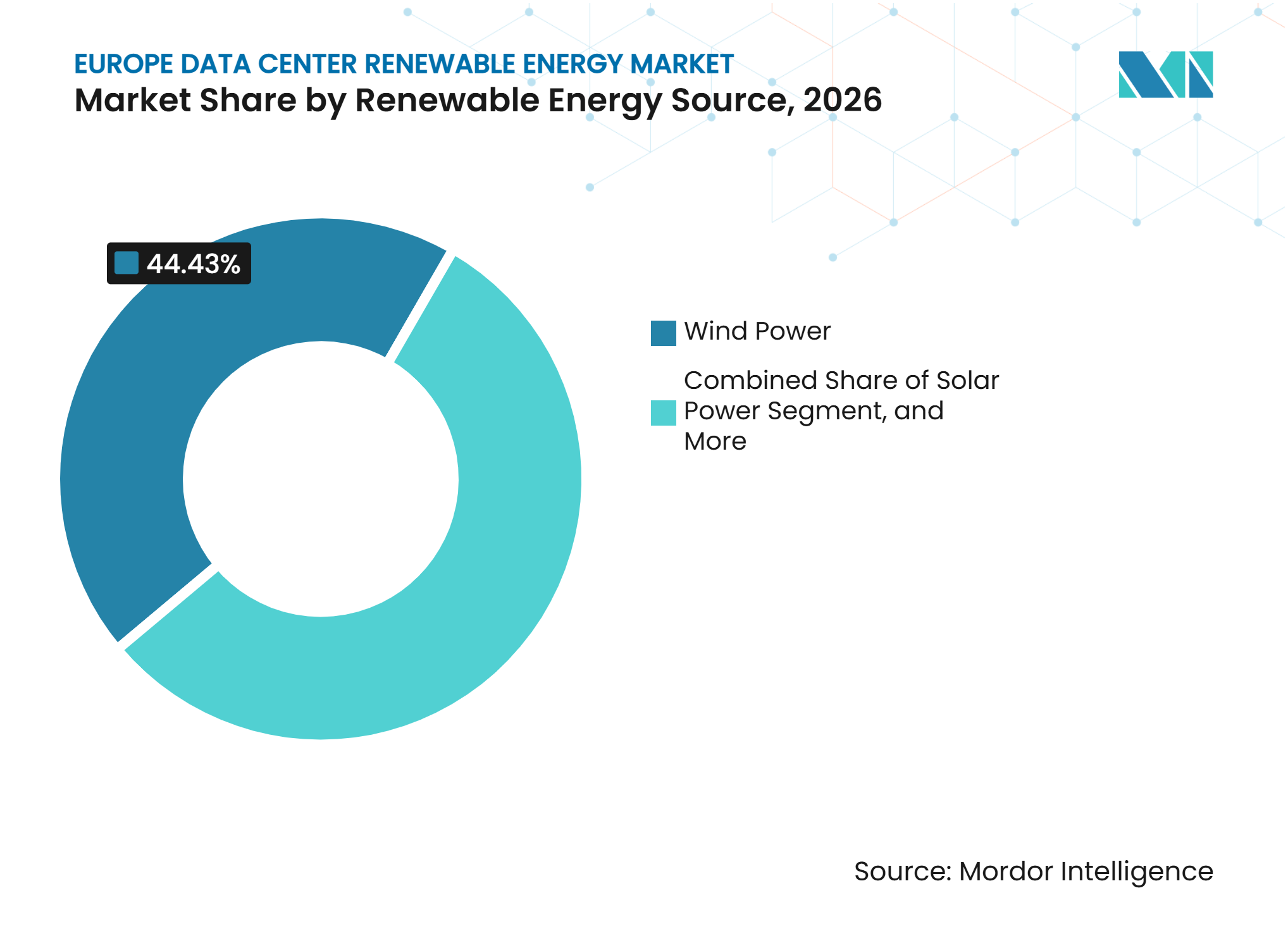
Wind Leads While Solar Gains MomentumWind power accounted for 44.43% of Europe's data center renewable energy market share in 2026. Established onshore and offshore wind markets in Ireland, the Netherlands, Germany, and the United Kingdom gave wind a procurement advantage. Wind projects can support large corporate contracts because they have a long record of utility-scale operation, established development processes, and familiar risk allocation for utility buyers, developers, lenders, and major power consumers. Solar power is projected to expand at an 18.51% CAGR through 2032, supported by shorter development schedules that can align with data center construction programs. Its increasing availability supports solar-anchored procurement at scale and provides developers with a technology that can be planned alongside new capacity requirements, even where buyers still need wind, storage, or other resources to balance supply.
Solar accounted for 22% of the EU electricity mix in the first half of 2025, becoming the region's largest electricity source for the first time. The Europe data center renewable energy market size for solar is supported by projects that can move from contract signing to generation more quickly than offshore wind. Hydropower provides dispatchable low-carbon electricity in Nordic portfolios, while geothermal, biomass, and biogas may provide local firm capacity. Nuclear offtake and SMR arrangements are also being considered where continuous clean electricity is required. Equinix signed letters of intent for a 250 MW nuclear PPA in the Netherlands and 500 MW of European SMR capacity



By Procurement Model:
Virtual PPAs Lead With Wider Risk Management NeedsVirtual or financial PPAs held 33.82% of Europe data center renewable energy market share in 2026 and are projected to expand at an 18.29% CAGR through 2032. These contracts allow an operator to support generation without receiving power at the same physical point. They can provide price hedging and additionality credentials for companies with facilities in several electricity markets. The model has become a common option for hyperscalers with large and dispersed power demand. It can also fund projects in areas with stronger renewable resources, which matters when an operator's facilities are located in several countries with different grid conditions, price signals, and renewable-generation profiles.
The structure can expose buyers to basis risk between contracted generation prices and local consumption prices. That risk becomes harder to manage when solar-heavy markets experience negative wholesale-price hours. Off-site physical PPAs remain relevant for concentrated loads and can better address locational additionality requirements. On-site generation, utility green tariffs, and Guarantees of Origin offer additional choices for operators with smaller demand. Procurement is nonetheless moving toward structures that demonstrate greater capacity and clearer temporal alignment, because corporate customers, investors, and regulators increasingly need credible evidence that procurement decisions drive real changes in the power system.
By Project Configuration:
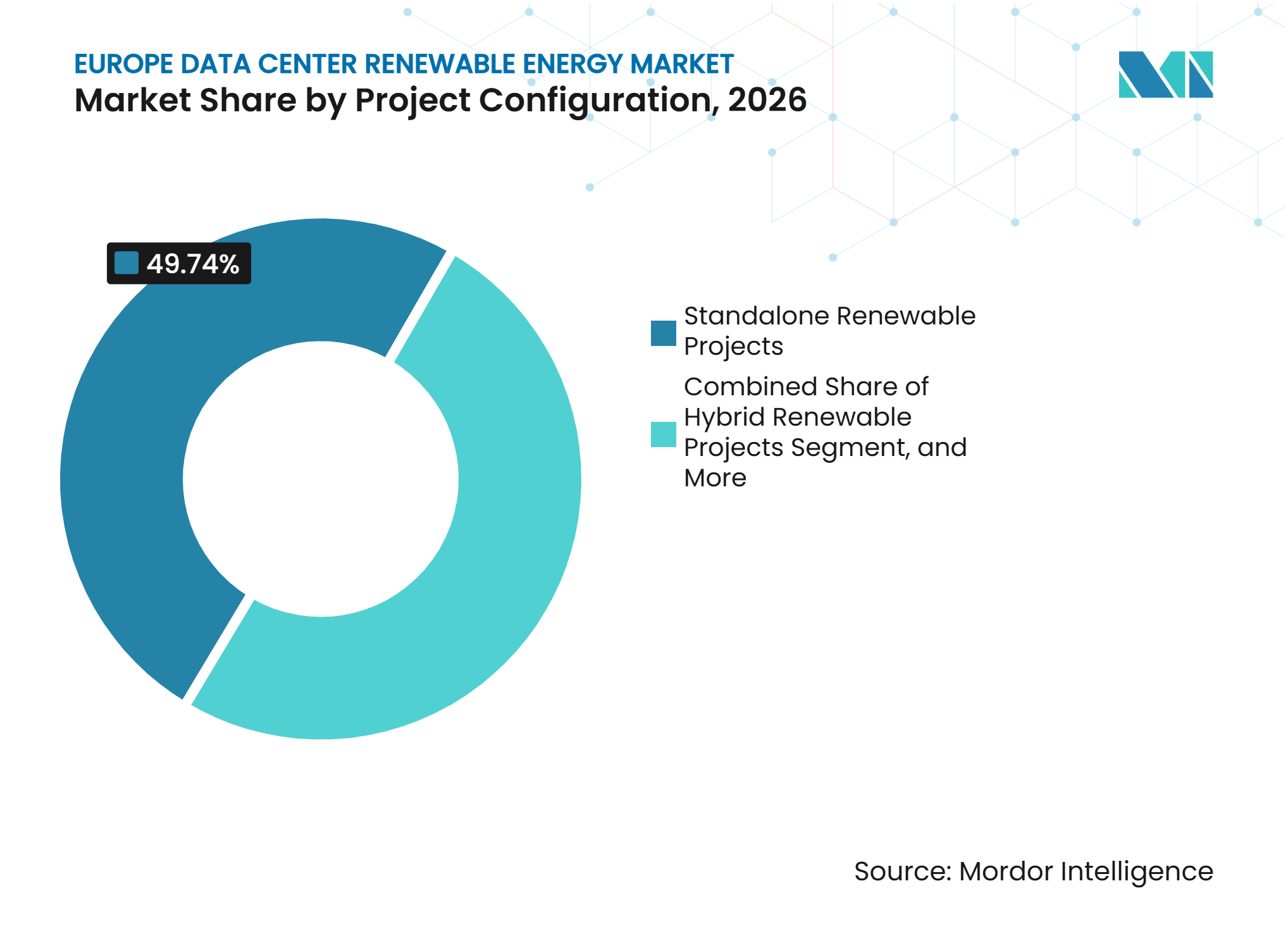
Standalone Projects Lead, Storage-Backed Projects AdvanceStandalone renewable projects accounted for 49.74% of Europe's data center renewable energy market share in 2026. Dedicated single-technology PPAs have historically been easier to structure than multi-asset arrangements. They provide a clear route for buyers seeking large volumes of renewable electricity. Renewable projects with battery storage are projected to expand at an 18.09% CAGR through 2032. Storage can reduce the gap between intermittent renewable generation and continuous data center demand by shifting electricity between periods of supply and use, while also improving the value of a solar or wind contract.
Battery energy storage system contracting reached 4.6 GW in the European corporate PPA market during the first half of 2025. Activity was concentrated in the United Kingdom and Germany, with initial storage-linked deals in Poland and Greece. Solar and wind combinations without storage can raise capacity factors but do not ensure firm supply. Demand response, virtual power plants, and nonfirm connections can provide additional flexibility. EPRI's DCFlex work is testing grid-responsive data center operations, while hybrid structures provide stronger renewable matching, more operational options during constrained periods, and greater confidence for buyers managing constant computing loads.

By Contract Duration:
Long-Term Contracts Anchor InvestmentLong-term contracts accounted for 55.03% of the contract-duration segment in 2026. They are projected to expand at a 17.92% CAGR through 2032. Data centers are long-lived assets, so operators need electricity arrangements that can extend over many years. Developers also use durable commitments to secure financing for new renewable generation. This makes contract duration central to the Europe data center renewable energy market, since a reliable revenue commitment can enable a renewable project to proceed and can help an operator secure supply before local capacity tightens.
A 213 MW solar-plus-storage agreement between Merlin Properties and Solaria Energia in Spain was reported to have a 40-year term. Medium-term arrangements, generally lasting 5-10 years, provide flexibility to operators that are still building their footprint. Short-term agreements remain a minor option for bridging coverage or temporary compliance needs. Uncertainty over power prices and grid access is reinforcing interest in durable commitments. Long-term terms provide price visibility, supply security, and a path for financing additional capacity, while giving both sides a framework to manage construction timing, generation uncertainty, and the needs of an evolving facility portfolio.
By Primary Procurement Objective:
Cost Optimization Leads, Matching AcceleratesElectricity cost optimization accounted for 32.71% in 2026. PPAs can offer more predictable pricing than spot-market purchases in a volatile European power system. Renewable energy matching is projected to expand at an 18.07% CAGR through 2032. Buyers increasingly seek contracts that offer price protection and credible emissions performance. This combined requirement is shaping the Europe data center renewable energy market because power procurement decisions now need to meet finance, operations, sustainability, tenant, and compliance needs rather than serving a single purchasing objective.
The Climate Neutral Data Center Pact has increased interest in matching electricity use to carbon-free supply on an hourly basis rather than annually. Operators with science-based targets need stronger evidence than generic annual certificates can provide. Long-term supply security matters where grid constraints may delay capacity additions. Renewable PPAs can reduce exposure to wholesale-price volatility while supporting decarbonization plans. Procurement teams are combining financial, operational, and reporting requirements into each decision, reflecting that a contract's commercial price, supply profile, emissions value, and location can all affect its suitability.
By Data Center Size:
Hyperscale Facilities Set Procurement RequirementsHyperscale data centers accounted for 46.68% of Europe data center renewable energy market share in 2026 and are projected to expand at an 18.02% CAGR through 2032. Their size enables individual contracts of 200 MW or more. This favors utilities and independent power producers with large, diversified portfolios. Hyperscale facilities also place the greatest demands on power availability and transmission access, making early coordination with network operators and generation suppliers important before a site is committed to construction. European data center investment is expected to reach EUR 176 billion (USD 198.88 billion) cumulatively between 2026 and 2031.
Large data centers serve finance, telecommunications, and regional cloud providers with significant but geographically concentrated requirements. Medium and small sites more often rely on green tariffs, Guarantees of Origin, and aggregated PPA structures. These routes can make additionality accessible to buyers that cannot contract at hyperscale volumes. Reporting rules may widen the gap between annual certificate coverage and hourly matching. Cooperative buying can help smaller facilities address that gap by pooling demand, sharing contract expertise, and providing a route to renewable projects that would otherwise require more volume than an individual site can offer.
By Data Center Type:
Cloud Service Providers Procure at ScaleCloud service providers held a 43.58% share in 2026 and are projected to expand at a 17.88% CAGR through 2032. Their geographic reach requires procurement strategies that work across several EU member states. Their portfolios include onshore wind, offshore wind, solar, storage, and, increasingly, nuclear structures. Their demand shapes supply availability and contract terms in the Europe data center renewable energy market. Regulatory scrutiny makes detailed reporting more important for this group, especially when customers require transparent disclosures about the source, timing, and environmental attributes of the electricity used by their digital services.
Colocation providers procure electricity for shared facilities while tenants may have separate renewable goals. Their ability to provide verified renewable supply can influence enterprise leasing decisions. Enterprise and edge facilities have smaller or more dispersed loads, which limits PPA access. Equinix had 29 PPAs totaling more than 1,400 MW across 12 countries, with 854 MW operational in 2025.[3] Procurement capability is becoming part of the core service offer for data center operators because tenants increasingly compare the availability, traceability, and credibility of renewable electricity alongside capacity, connectivity, and resilience.
Geography Analysis
Rest of Europe: Distributed Capacity Drives New Procurement Demand
The rest of Europe held 21.76% of Europe's data center renewable energy market share in 2026. Grid constraints are moving development beyond Frankfurt, London, Amsterdam, Paris, and Dublin to Nordic locations with shorter connection timelines. Finland sourced 95% of its electricity from carbon-dioxide-neutral sources in 2025, with hydro complementing wind and solar through dispatchable generation. Google committed EUR 600 million (USD 678 million) to a site in Skien, Norway, and documented low-carbon supply is becoming more commercially relevant under EU efficiency reporting. These factors are helping newer markets compete for AI and cloud investment, while allowing developers to link renewable projects, high-voltage connections, and data center construction within more coordinated regional development plans.
Italy: Solar Procurement and Data Center Development Converge
Italy is projected to expand at an 18.76% CAGR through 2032, the fastest rate among geographic segments. High-voltage connection requests reached 69 GW by December 2025, while Italy contracted 568 MW of data center PPAs and recorded 184% year-over-year growth in solar PPA volume in the first half of 2025. Milan had installed data center capacity of 200 MW and was expected to reach 2 GW within 5 years. New sites are connecting directly to high-voltage networks or power plants to avoid local constraints. The Europe data center renewable energy market size in Italy depends on connection delivery, solar development, and predictable permitting, because the pace of new digital infrastructure will depend on whether grid and generation projects can progress on aligned schedules.
United Kingdom, Germany, France, Netherlands, Ireland, and Spain: Uneven Power Conditions Shape Investment
London had 1.38 GW of operational capacity and a pipeline above 1.77 GW, while RWE signed supply agreements with Global Switch and Telehouse. Germany is expected to reach 2.6 GW in Frankfurt by 2031, while Paris moved ahead of Dublin in EMEA capacity during the first half of 2026. Amsterdam connection limits are redirecting activity, Ireland requires additional renewable supply, and Spain had more than 2 GW of PPA volume across 12 agreements. The Europe data center renewable energy market share across these markets will depend as much on connection access as on renewable resource potential, creating different opportunities for established hub cities, emerging locations, and regions with available low-carbon electricity.
Competitive Landscape
Market Concentration
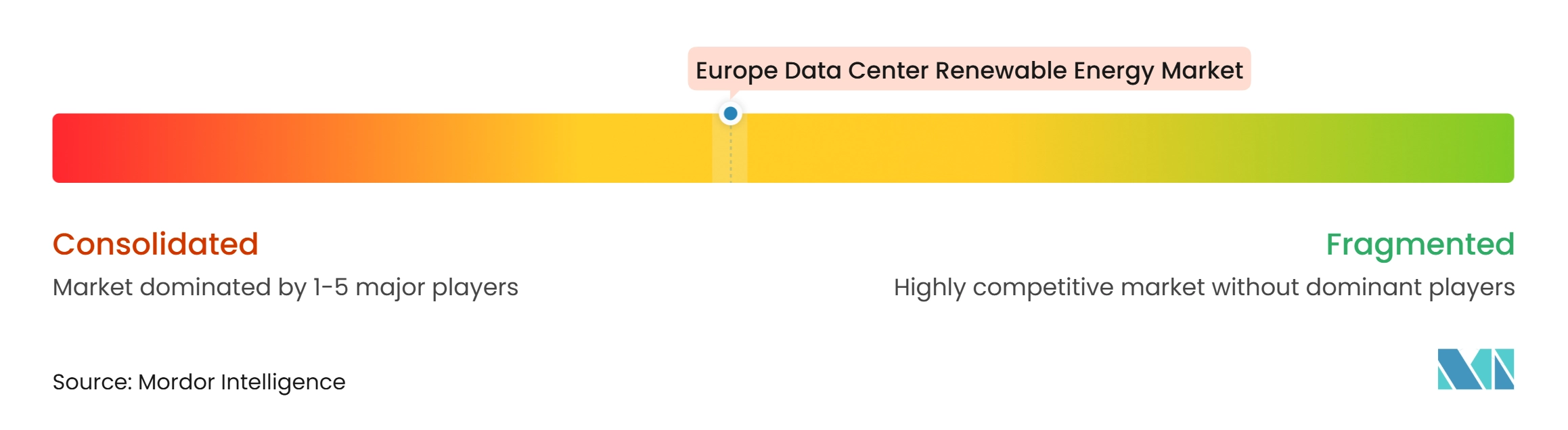
The European data center renewable energy market is moderately concentrated, with buyer demand and a broad base of renewable developers and utilities. Amazon, Google, and Microsoft influence PPA terms and additionality requirements because of their procurement scale. Amazon had more than 10 GW contracted across over 260 European projects by 2026. Google entered into a 100 MW, 15-year offshore wind PPA with EnBW for Germany's He Dreiht project in 2026. These moves show that leading buyers are diversifying technologies and locations.
Colocation operators are building comparable procurement capabilities to meet tenant expectations. Equinix had 29 PPAs totaling more than 1,400 MW in 12 countries, with 854 MW operational in 2025. Digital Realty reported 93% global renewable electricity coverage in 2025 and Carbon Neutral Certification across four European countries. Facility operators now compete on the quality and traceability of their power-sourcing plans. This reduces the value of purchasing generic certificates as a differentiator.
Suppliers are combining generation, storage, and flexible-load solutions. ENGIE signed 3.1 GW of PPAs in the first 9 months of 2025 and cited a renewable and battery pipeline exceeding 100 GW. Iberdrola partners with major operators across Spain, Portugal, and the United Kingdom, while Nordic suppliers use hydropower-backed supply. DCFlex showed that AI facilities can reduce load by 30-40% within seconds, creating grid-service potential. Competitive positions will depend on the ability to combine generation, storage, and flexibility in contracts that are understandable for customers and practical for power-system operators, especially as hourly matching and grid-responsive demand become more common.
Europe Data Center Renewable Energy Industry Leaders
-
Amazon Web Services, Inc.
-
Microsoft Corporation
-
Google LLC
-
Meta Platforms, Inc.
-
Equinix, Inc.
- *Disclaimer: Major Players sorted in no particular order
Europe Data Center Renewable Energy Market Companies Covered in this Report
- Amazon Web Services, Inc.
- Microsoft Corporation
- Google LLC
- Meta Platforms, Inc.
- Equinix, Inc.
- Digital Realty Trust, Inc.
- CyrusOne LLC
- NTT Global Data Centers Holding Corporation
- Global Switch Holdings Limited
- Iron Mountain Incorporated
- STACK Infrastructure
- Colt Data Centre Services
- OVH Groupe S.A.
- Green Mountain AS
- RWE AG
- ENGIE SA
- Iberdrola, S.A.
- Ørsted A/S
- Statkraft AS
- EnBW Energie Baden-Württemberg AG
Recent Industry Developments in Europe Data Center Renewable Energy Market
- October 2026: The European Commission launched a 12-week public consultation on minimum performance standards for EU data centers, with a legislative proposal planned for Q2 2027. The standards could set binding energy efficiency and renewable sourcing floors across all EU member states, directly reshaping how data center operators structure and verify renewable energy procurement.
- September 2026: The European Commission published the common Union rating scheme for data center sustainability under Delegated Regulation C(2026)3472, using PUE and WUE as core rating indicators. From August 2027, electronic sustainability labels will be issued annually via the European database on data centers, creating a publicly comparable benchmark for renewable energy claims across operators.
- February 2026: Microsoft announced its global energy strategy at its Dublin data center campus, committing to continue procuring renewable energy to match 100% of its electricity consumption globally. The company confirmed contracted capacity to add 40 GW of renewable energy to the grid, with 19 GW already online across its global portfolio.
- January 2026: RWE signed an 8-year PPA with Global Switch to supply 70 GWh of clean electricity annually from the Brechfa Forest West onshore wind farm (57.4 MW, Wales) to Global Switch's London Docklands data center, supporting Global Switch's 100% renewable energy target by 2030.
Europe Data Center Renewable Energy Market Report Scope
The Europe Data Center Renewable Energy Market refers to the market for renewable electricity generation, procurement, and supply solutions used to meet the growing energy requirements of data centers across Europe. It encompasses renewable electricity generated from solar, wind, hydropower, geothermal, biomass, and biogas sources, procured through on-site renewable energy installations or third-party arrangements, including off-site physical power purchase agreements (PPAs), virtual or financial PPAs, utility green power programs, and renewable energy certificates (RECs) and Guarantees of Origin (GOs).
The Europe Data Center Renewable Energy Market Report is Segmented by Renewable Energy Source (Solar Power, Wind Power, Hydropower, Geothermal Power, Biomass and Biogas Power, and Other Renewable Sources), Procurement Model (On-Site Renewable Generation, Off-Site Physical PPAs, Virtual or Financial PPAs, Utility Green Power Programs, and Renewable Energy Certificates and Guarantees of Origin), Project Configuration (Standalone Renewable Projects, Hybrid Renewable Projects, Renewable Projects with Battery Storage, and Renewable Projects with Other Firming Solutions), Contract Duration (Short-Term Contracts, Medium-Term Contracts, and Long-Term Contracts), Primary Procurement Objective (Electricity Cost Optimization, Emissions Reduction, Renewable Energy Matching, and Long-Term Supply Security), Data Center Size (Small, Medium, Large, and Hyperscale), Data Center Type (Colocation, Cloud Service Providers, and Enterprise and Edge), and Geography (United Kingdom, germany, France, Netherlands, Ireland, Spain, Italy, and Rest of Europe). The Market Forecasts are Provided in Terms of Value (USD), and Volume (MWh/GWh).
Segmentation Overview
| Solar Power |
| Wind Power |
| Hydropower |
| Geothermal Power |
| Biomass and Biogas Power |
| Other Renewable Sources |
| On-Site Renewable Generation |
| Off-Site Physical PPAs |
| Virtual or Financial PPAs |
| Utility Green Power Programs |
| Renewable Energy Certificates and Guarantees of Origin |
| Standalone Renewable Projects |
| Hybrid Renewable Projects |
| Renewable Projects with Battery Storage |
| Renewable Projects with Other Firming Solutions |
| Short-Term Contracts |
| Medium-Term Contracts |
| Long-Term Contracts |
| Electricity Cost Optimization |
| Emissions Reduction |
| Renewable Energy Matching |
| Long-Term Supply Security |
| Small |
| Medium |
| Large |
| Hyperscale |
| Colocation |
| Cloud Service Providers (CSPs) |
| Enterprise and Edge |
| Europe | United Kingdom |
| Germany | |
| France | |
| Netherlands | |
| Ireland | |
| Spain | |
| Italy | |
| Rest of Europe |
| By Renewable Energy Source | Solar Power | |
| Wind Power | ||
| Hydropower | ||
| Geothermal Power | ||
| Biomass and Biogas Power | ||
| Other Renewable Sources | ||
| By Procurement Model | On-Site Renewable Generation | |
| Off-Site Physical PPAs | ||
| Virtual or Financial PPAs | ||
| Utility Green Power Programs | ||
| Renewable Energy Certificates and Guarantees of Origin | ||
| By Project Configuration | Standalone Renewable Projects | |
| Hybrid Renewable Projects | ||
| Renewable Projects with Battery Storage | ||
| Renewable Projects with Other Firming Solutions | ||
| By Contract Duration | Short-Term Contracts | |
| Medium-Term Contracts | ||
| Long-Term Contracts | ||
| By Primary Procurement Objective | Electricity Cost Optimization | |
| Emissions Reduction | ||
| Renewable Energy Matching | ||
| Long-Term Supply Security | ||
| By Data Center Size | Small | |
| Medium | ||
| Large | ||
| Hyperscale | ||
| By Data Center Type | Colocation | |
| Cloud Service Providers (CSPs) | ||
| Enterprise and Edge | ||
| By Geography | Europe | United Kingdom |
| Germany | ||
| France | ||
| Netherlands | ||
| Ireland | ||
| Spain | ||
| Italy | ||
| Rest of Europe | ||
Key Questions Answered in the Report
What is the Europe data center renewable energy market size?
The Europe data center renewable energy market was valued at USD 5.05 billion in 2026 and is forecast to reach USD 13.84 billion by 2032 at a 17.31% CAGR. The estimate reflects increasing renewable procurement for new cloud and AI capacity across the region's expanding data center base.
What is driving renewable procurement by European data centers?
AI-related power demand, long-term hyperscaler procurement, efficiency reporting, and grid limits in major hubs are driving decisions. These factors make power availability and credible matching important site-selection considerations for operators and their customers.
Which renewable source leads European data center procurement?
Wind power led with a 44.43% share in 2026, while solar is projected to expand at an 18.51% CAGR through 2032. Buyers often combine both sources within wider supply portfolios to improve their electricity profile.
Why are virtual PPAs important for data center operators?
Virtual or financial PPAs held 33.82% share in 2026 because they allow operators to support renewable generation across different electricity markets. They can also provide price hedging and additionality credentials across a multi-country operating footprint.
Which European location is expanding fastest for renewable data center supply?
Italy is projected to expand at an 18.76% CAGR through 2032, supported by solar PPA activity and significant data center connection requests. Direct high-voltage connections are also supporting planned capacity.
How do grid constraints affect data center location decisions in Europe?
Long waits in established hubs are encouraging operators to assess Nordic and southern European locations with more available clean power and shorter connection schedules. This can shift both facility investment and renewable procurement toward locations with clearer development pathways.