
Europe Data Center Optical Connectivity Market Size and Share
Market Overview
| Study Period | 2021 - 2032 |
|---|---|
| Forecast Data Period | 2027 - 2032 |
| Base Year Market Size (2026) | USD 7.47 Billion |
| Market Size (2027) | USD 8.63 Billion |
| Market Size (2032) | USD 17.44 Billion |
| Growth Rate (2027 - 2032) | 15.11 % |
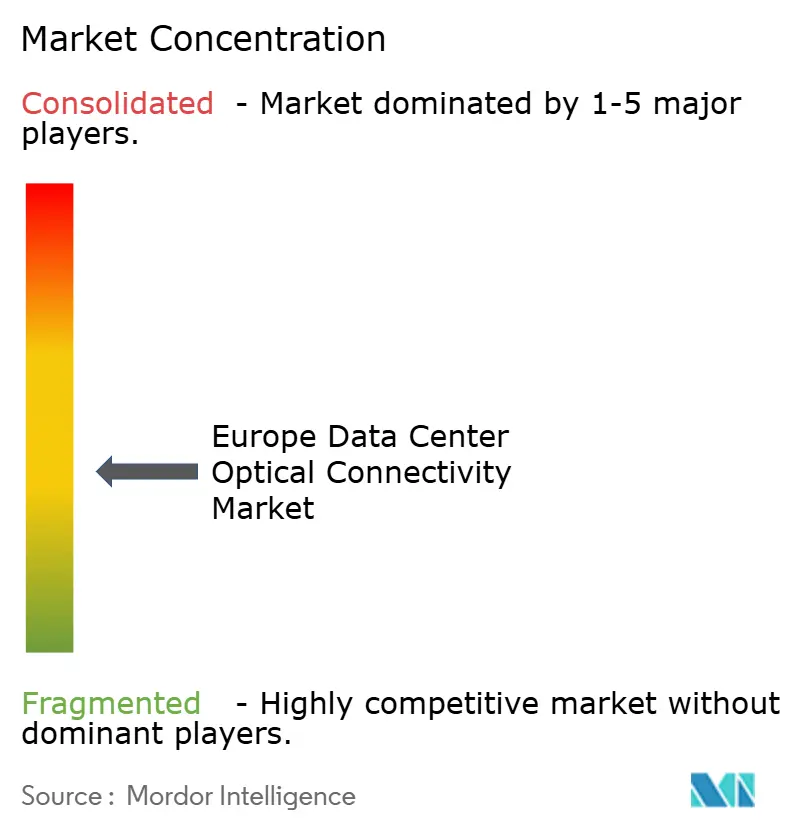
| Market Concentration | Medium |
Major Players *Disclaimer: Major Players sorted in no particular order Image © Mordor Intelligence. Reuse requires attribution under CC BY 4.0. | |
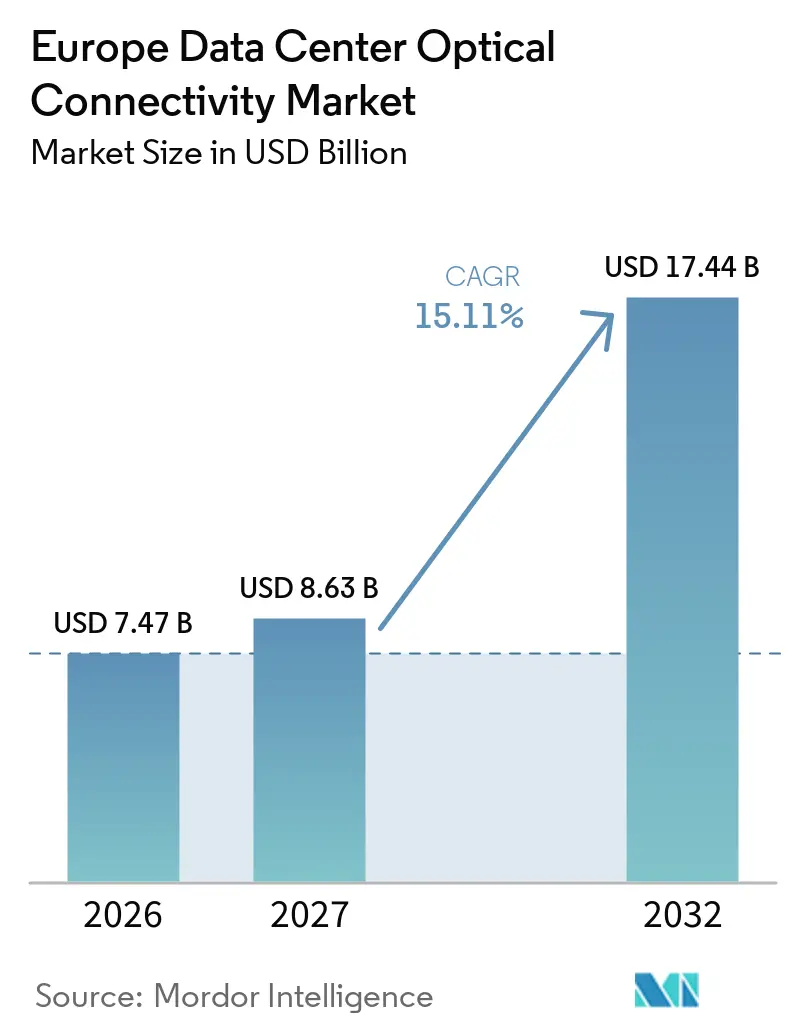
Europe Data Center Optical Connectivity Market Analysis by Mordor Intelligence
The Europe Data Center Optical Connectivity Market size is projected to be USD 7.47 billion in 2026, USD 8.63 billion in 2027, and reach USD 17.44 billion by 2032, growing at a CAGR of 15.11% from 2027 to 2032.
AI training clusters are increasing bandwidth requirements and shortening the replacement cycle for optical equipment. The simultaneous deployment of 800G equipment and qualification of 1.6T platforms is changing purchase plans for hyperscale operators and colocation providers. European data center investment is also broadening beyond the largest hubs, which supports demand for transceivers, fiber assemblies, connectors, and switching equipment. Energy reporting rules are making power consumption per bit a more important procurement factor. Supply availability, grid connections, and the serviceability of co-packaged optics will determine how quickly projects move from design to installation.
Key Report Takeaways
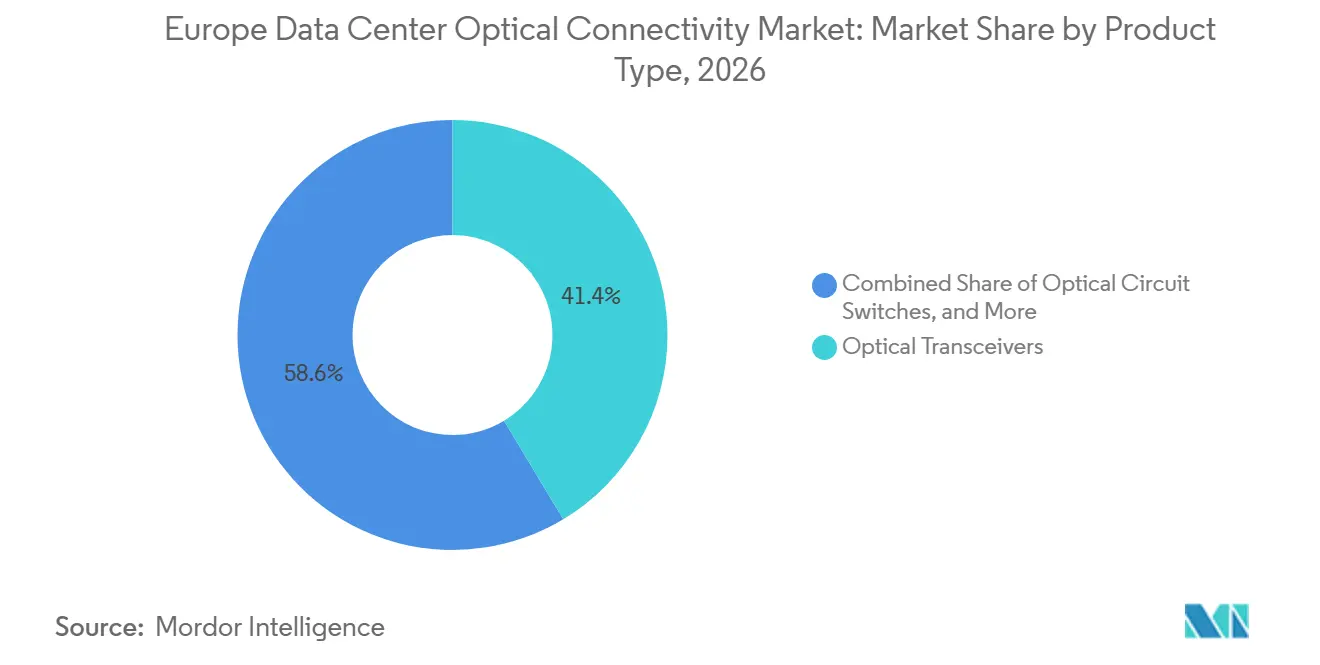
- By product type, optical transceivers held 41.38% of Europe data center optical connectivity market share in 2026, while optical circuit switches are projected to expand at a 26.12% CAGR through 2032.
- By connectivity architecture, conventional pluggable optics held 76.24% of the Europe data center optical connectivity market share in 2026, while co-packaged optics are projected to expand at a 29.41% CAGR through 2032.
- By data rate, 800 Gbps held 33.78% of revenue in 2026, while 1.6 Tbps is projected to expand at a 30.14% CAGR through 2032.
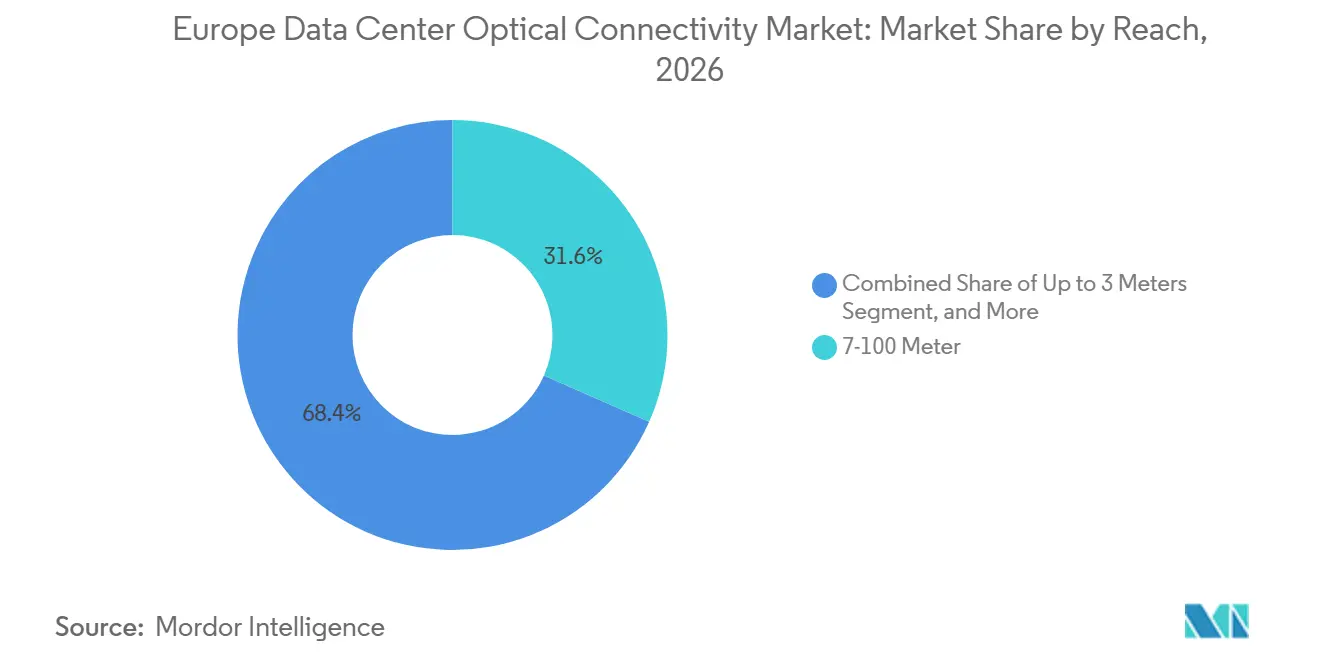
- By reach, the 7-100-meter category held 31.62% of revenue in 2026, while the up-to-3-meter category is projected to expand at a 26.68% CAGR through 2032.
- By application, switch-to-switch connectivity held 31.37% of revenue in 2026, while GPU-to-GPU connectivity is projected to expand at a 29.34% CAGR through 2032.
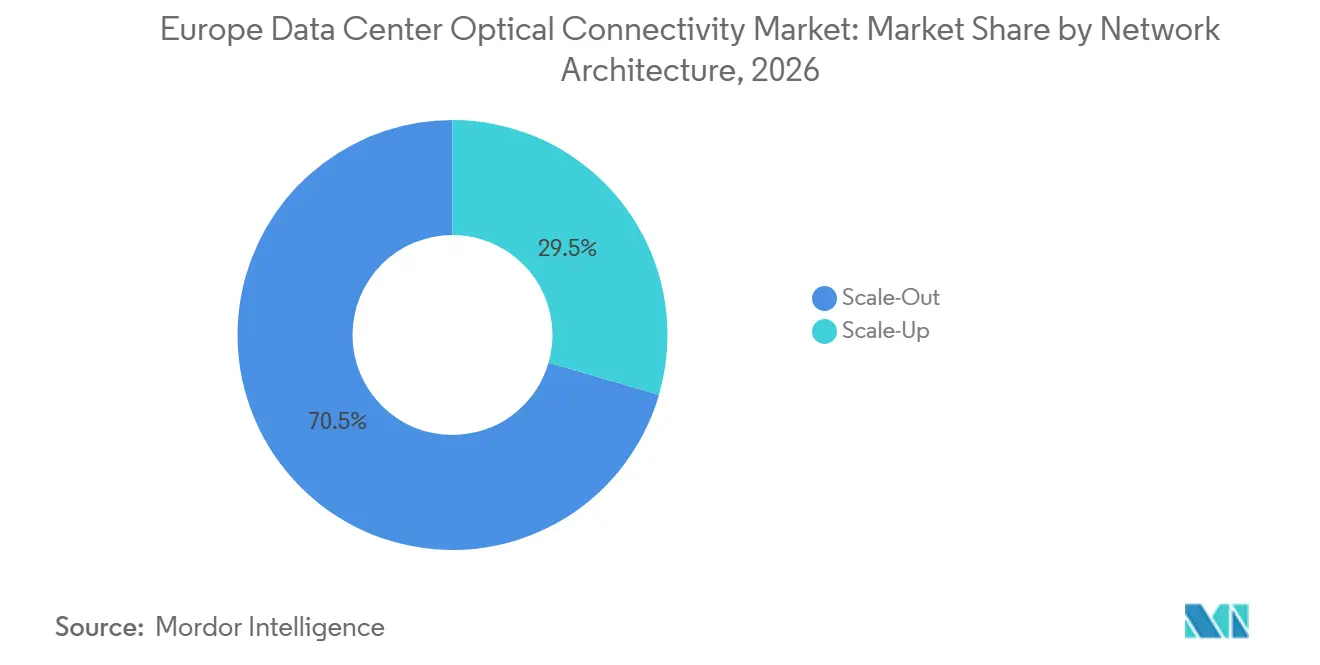
- By network architecture, scale-out held 70.52% of revenue in 2026, while scale-up is projected to expand at a 28.79% CAGR through 2032.
- By data center type, hyperscale facilities held 57.91% of revenue in 2026 and are projected to expand at a 24.63% CAGR through 2032.
- By country, Germany held 26.41% of revenue in 2026, while Spain is projected to expand at a 25.31% CAGR through 2032.
Note: Market numbers in this report are based on Mordor Intelligence's proprietary estimation framework, which combines nine months of actuals with Q4 projections for base year 2026.
Market Trends and Insights
Drivers Impact Analysis of Europe Data Center Optical Connectivity Market*
| Driver | (~) % Impact on CAGR Forecast | Geographic Relevance | Impact Timeline |
|---|---|---|---|
| AI Cluster Bandwidth and 800G-To-1.6T Upgrade Cycles | +4.5% | Global, with concentrated demand in Frankfurt, London, Amsterdam, Paris, and Dublin | Short term (≤ 2 years) |
| Hyperscale and Colocation Capacity Expansion Across Europe | +3.2% | Core European hubs, with expansion in the Nordic countries, Iberia, and Italy | Medium term (2-4 years) |
| Energy-Efficient Optical Interconnects Under European Sustainability Rules | +2.4% | European Union, with early relevance in Germany, the Netherlands, and Ireland | Medium term (2-4 years) |
| Sovereign AI, Data Residency, and Regional Cloud Infrastructure Investment | +2.0% | Germany, France, the Netherlands, Belgium, and Spain | Medium term (2-4 years) |
| Rack-Scale Scale-Up Architectures Increasing GPU-To-GPU Optical Demand | +1.8% | European operations of global hyperscale clusters, including the United Kingdom, Germany, and Sweden | Short term (≤ 2 years) |
| European Photonics, Silicon Photonics, and Advanced Packaging Ecosystem Development | +1.2% | The Netherlands, Germany, France, and the United Kingdom | Long term (≥ 4 years) |
| Source: Mordor Intelligence | |||
AI Cluster Bandwidth and 800G-To-1.6T Upgrade Cycles
The Europe data center optical connectivity market is being reshaped by the move from 400G to 800G and then toward 1.6T links. Each generation of AI accelerator requires more bandwidth at the GPU port, which increases the optical content of a training cluster. NVIDIA designed its Blackwell-based DGX GB300 systems for 1.6T InfiniBand XDR switch fabrics, linking compute choices directly to optical bills of materials. DE-CIX Frankfurt connected Deutsche Glasfaser to an 800 Gigabit Ethernet internet exchange port with Nokia 800G-ZR+ single-wavelength optics in November 2025. That deployment shows that 800G has moved beyond long-haul coherent links into peering and data center-edge use cases. Broadcom introduced its Taurus BCM83640 400G-per-lane optical PAM-4 DSP in March 2026, while Marvell expanded its 1.6T optical DSP portfolio, confirming that equipment suppliers are preparing for production deployments rather than distant trials.
Hyperscale and Colocation Capacity Expansion Across Europe
New hyperscale and colocation campuses are increasing demand for fiber paths, transceivers, and optical switching throughout the Europe data center optical connectivity market. Data4 confirmed a EUR 5 billion investment, equivalent to USD 5.65 billion, for a campus in Northern France that will include 4 next-generation data centers. The project illustrates the increasing importance of large AI-ready sites outside the most established facilities. Such sites require optical links that can support rack power densities above 100 kW, where copper becomes difficult to use beyond short distances. Colocation operators also need flexible physical-layer designs because tenants can add capacity in stages. Optical circuit switching, pre-terminated trunks, and high-density connectors can reduce installation work as halls are commissioned. The resulting construction activity supports demand across the optical stack rather than only for pluggable modules.
Energy-Efficient Optical Interconnects Under European Sustainability Rules
European Union reporting requirements are increasing attention to the energy used by data center networks. Directive (EU) 2023/1791 and Commission Delegated Regulation (EU) 2024/1364 require annual reporting for qualifying data centers with at least 500 kW of installed IT power. Operators therefore have a reason to select equipment that lowers power consumption per bit and supports Power Usage Effectiveness management. Linear pluggable optics can remove the DSP function and reduce power use per module compared with conventional DSP-based designs. STMicroelectronics began large-scale production of its PIC100 silicon photonics platform in 2026 for 800G and 1.6T optical modules. The EU-funded ADOPTION project is developing co-packaged photonics for high-efficiency cloud computing, which aligns research programs with these operating requirements.
Sovereign AI, Data Residency, and Regional Cloud Infrastructure Investment
Sovereign cloud programs are creating a separate source of demand for the European data center optical connectivity market. AWS launched the European Sovereign Cloud in January 2026, placing its first Region in Brandenburg and identifying sovereign Local Zones in Belgium, the Netherlands, and Portugal.[1] The company disclosed planned investment of more than EUR 7.8 billion, equivalent to USD 8.81 billion, in German cloud infrastructure. These environments require dedicated physical and logical infrastructure, which limits the reuse of shared network assets across jurisdictions. In the Netherlands, an AI factory in Groningen received EUR 201 million, equivalent to USD 227 million, from EuroHPC, the Dutch government, and regional sources. Regional computing programs can increase demand for in-country fiber systems and optical switching even when deployments are smaller than global cloud campuses.
Restraints Impact Analysis of Europe Data Center Optical Connectivity Market*
| Restraint | (~) % Impact on CAGR Forecast | Geographic Relevance | Impact Timeline |
|---|---|---|---|
| Power Availability, Grid-Connection Delays, and Data Center Deployment Constraints | -2.0% | Germany, the Netherlands, Ireland, Denmark, and other European Union markets | Short term (≤ 2 years) |
| CPO and NPO Manufacturing Yield, Serviceability, and Standardization Risk | -1.3% | Global supply chain, with European procurement exposure | Medium term (2-4 years) |
| Shortage Risk for InP Substrates, Lasers, Photodetectors, and Advanced Packaging Capacity | -1.0% | Global supply, with European operators exposed to overseas vendor dependencies | Short term (≤ 2 years) |
| Fragmented European Procurement, Standards, and Country-Level Permitting Requirements | -0.6% | European Union, especially Southern and Eastern Europe | Medium term (2-4 years) |
| Source: Mordor Intelligence | |||
Power Availability, Grid-Connection Delays, and Data Center Deployment Constraints
Power availability can delay the installation of equipment across the European data center optical connectivity market. AWS stated in 2026 that European grid connections can take up to 7 years, while a data center can be developed in 2 years. A Dutch court ruled in April 2026 that the grid in Haarlemmermeer was full, pausing connection work near Schiphol. Mainova has also stated that new high-power connections in Frankfurt will not be available until the mid-2030s. Denmark's transmission operator Energinet paused new connection agreements for large consumers and warned that projects may face timelines of 5-10 years. The European Commission's 2025 Grids Package proposes a 2-year authorization limit for grid infrastructure, but new substations and transmission upgrades still take time to build.
CPO and NPO Manufacturing Yield, Serviceability, and Standardization Risk
Co-packaged and near-packaged optics provide higher bandwidth density, but their manufacturing and repair processes remain challenging. A thermal issue affecting an optical engine can disrupt a complete switching node, unlike a failed pluggable module that can be removed quickly. Marvell's Ara X and Aquila M DSPs for co-packaged optics began customer sampling in the first quarter of 2026, which indicates that broad deployment had not yet started. The Optical Compute Interconnect Multi-Source Agreement was formed in March 2026 by AMD, Broadcom, Meta, Microsoft, NVIDIA, and OpenAI.[2] Its GEN1 and GEN2 specifications set out optical scale-up interfaces at 200 Gbps and 400 Gbps per direction. Operators still need reliable multi-vendor implementations before they can buy co-packaged solutions with the same confidence as pluggable optics.
*Our forecasts treat driver/restraint impacts as directional, not additive. The impact forecasts reflect baseline growth, mix effects, and variable interactions.
Europe Data Center Optical Connectivity Market Segment Analysis
By Product Type:
Transceivers Lead While Optical Circuit Switches AccelerateOptical transceivers captured 41.38% of product-type revenue in 2026. Their position reflects the established use of 400G and 800G pluggable modules in leaf-spine networks at hyperscale and colocation sites. The installed base also favors field-replaceable modules when operators need to restore a failed port quickly. Active optical cables support fixed-length GPU-to-switch and storage connections within AI pods. Fiber-optic cable assemblies and connectors provide the physical foundation for every new data hall. Optical interconnect assemblies are gaining use in pre-terminated trunk configurations that reduce installation time in dense deployments.
Optical circuit switches are projected to expand at a 26.12% CAGR through 2032. They allow operators to change high-capacity traffic paths without adding electrical routing overhead. That capability is relevant when AI workloads shift between GPU clusters and leave fixed network paths underused. The OPTINET project, supported by the European Commission, has developed hybrid optical and electronic switching for real-time traffic management. Product selection, therefore, depends on whether a customer needs a stable physical connection or a programmable fabric. The Europe data center optical connectivity market continues to need both approaches as new halls combine conventional cloud applications with variable AI workloads.

By Connectivity Architecture:
Pluggable Optics Remain Established While CPO AdvancesConventional pluggable optics held 76.24% of connectivity-architecture revenue in 2026. The format benefits from mature interoperability, established service practices, and a broad supplier base. Linear pluggable optics remove the DSP stage and can lower module power consumption where rack energy use is under pressure. Near-packaged optics offer a transition path by placing optical interfaces closer to the switch silicon without requiring full co-packaging. This can be attractive to operators that need greater density but remain cautious about serviceability. The Europe data center optical connectivity market retains a substantial installed base that supports pluggable procurement.
Co-packaged optics are projected to expand at a 29.41% CAGR from 2027 to 2032. Broadcom showcased a 102.4T Ethernet switch with co-packaged optics at OFC 2026. Marvell also demonstrated a 102.4T platform using 200G-per-lane silicon photonics at ECOC 2026. The ADOPTION project is targeting future switching capacity beyond 204.8 Tbps and port speeds of 6.4 Tbps. Hyperscalers are expected to qualify the early designs before enterprise and colocation customers deploy them at scale. This adoption sequence makes serviceability and yield performance central to the architecture decision.
By Data Rate:
800 Gbps Defines Current Procurement and 1.6 Tbps RampsThe 800 Gbps tier accounted for 33.78% of data-rate revenue in 2026. QSFP-DD and OSFP modules using 8 channels of 100G-per-lane PAM4 have become common specifications for new AI-oriented racks. Their use reduces power per bit compared with prior 400G equipment. Up to 400 Gbps continues to serve existing data centers, enterprise facilities, and links where traffic requirements do not justify an 800G upgrade. The above-1.6 Tbps category remains early in its development cycle. NVIDIA and Cisco announced the USFP form factor in October 2026 for 400G-per-lane signaling and modules supporting up to 12.8 Tbps.
The 1.6 Tbps segment is projected to expand at a 30.14% CAGR through 2032. Marvell stated that its Ara 3nm 1.6T DSP platform was shipping in volume for hyperscale applications. This equipment supports AI fabric builds that require more bandwidth at each switch and accelerator interface. Silicon-photonics designs using 200G-per-lane technology may avoid indium phosphide in their modulation stages. Coherent 1.6T links used for data center interconnect can still depend on indium-phosphide electro-absorption modulated lasers. This difference in component design can influence supply exposure and the pace of deployment in the Europe data center optical connectivity market.
By Reach:
Short-Reach Links Support Dense AI RacksThe 7-100-meter category held 31.62% of revenue in 2026. It covers server-to-leaf and leaf-to-spine connections within a data hall, which are central to scale-out network designs. Multimode fiber has historically served many short links. The move beyond 400G is increasing the use of single-mode fiber at some intra-hall distances because modal bandwidth limits become more restrictive. The 100-500-meter and above-500-meter groups serve links between buildings and across campuses. The 3-5-meter and 5-7-meter groups address direct connections from blades and racks to top-of-rack equipment.
The up-to-3-meter category is projected to expand at a 26.68% CAGR through 2032. This reflects the growing number of GPU-to-GPU and GPU-to-switch links inside high-density AI racks. NVIDIA GB300 NVL72 systems require a dense set of short connections between compute nodes and network equipment. Ayar Labs and Wiwynn announced a reference design for optically connected rack-scale AI systems in 2025.[3] Rack power density is increasing the need for optical links where copper faces signal-integrity and thermal constraints. Very-short-reach optics will therefore remain a direct measure of rack-scale AI density.
By Application:
GPU Fabrics Change Optical Purchasing PrioritiesSwitch-to-switch connectivity accounted for 31.37% of application revenue in 2026. It remains important because spine-layer links carry traffic across both hyperscale and colocation environments. Server-to-switch connectivity is increasing as AI servers use higher-speed network interface cards. Storage connectivity supports NVMe-over-Fabric designs that require low latency between compute and persistent storage. GPU-to-switch links form the front-end network for AI clusters and use high-speed modules at the GPU NIC and switch port. Data center interconnect links also connect distributed training sites when operators cannot place all capacity at a single power-constrained location.
GPU-to-GPU connectivity is projected to expand at a 29.34% CAGR through 2032. It forms the back-end network of training clusters using NVLink, InfiniBand, and other scale-up fabrics. NVIDIA uses NVLink-C2C silicon photonics within the GB300 NVL72 rack to support chip-to-chip communication. Each successive AI cluster design increases the optical links needed between GPU nodes. The revenue mix is therefore shifting toward the application with the fastest deployment rate. This change gives the Europe data center optical connectivity market a closer relationship with accelerator architecture than with conventional enterprise networking refresh cycles.
By Network Architecture:
Scale-Out Leads While Scale-Up Gains ImportanceScale-out networks held 70.52% of segment revenue in 2026. Their lead is based on long-standing investment in leaf-spine Ethernet fabrics that can support large fleets of servers. Scale-out demand continues because most AI environments need a front-end network for general traffic and external data movement. Enterprise and colocation customers also use scale-out designs for inference workloads that do not require a large multi-rack GPU mesh. Corning announced a multi-year USD 3.2 billion commitment from NVIDIA in March 2026 to supply fiber for AI data centers. Conventional Ethernet deployment will remain a major source of cable volume across the Europe data center optical connectivity market.
Scale-up architecture is projected to expand at a 28.79% CAGR through 2032. The OCI MSA GEN1 specification defines 200 Gbps-per-direction optical scale-up interfaces using 4-lambda NRZ and wavelength division multiplexing. This gives buyers a standard for equipment that connects GPUs directly across a cluster. Scale-up architecture moves optical decisions closer to the compute team because accelerator designers define the form factor and channel requirements. The result is greater influence for AI platform vendors over optical roadmaps. Scale-out and scale-up designs are expected to operate together rather than displace each other.
By Data Center Type:
Hyperscale Facilities Anchor DemandHyperscale facilities held 57.91% of segment revenue in 2026. They are also projected to expand at a 24.63% CAGR through 2032, making them both the largest and fastest-moving data center type. Microsoft, Google, AWS, Meta, and Oracle are pursuing European capacity programs for cloud and AI workloads. AWS launched a sovereign cloud region in Brandenburg with physical and logical separation from its existing Regions. This creates demand for dedicated optical systems instead of relying only on shared infrastructure. The Europe data center optical connectivity market benefits when new sovereign locations require separate transport and switching assets.
Colocation is the second-largest data center type by revenue. It serves enterprises that need AI capacity without building their own facilities. Enterprise data centers are adopting optical connectivity for inference workloads, although their port density is below that of large training clusters. Edge and micro data centers are smaller, but they need optical backhaul for distributed low-latency applications. The European Data Center Association projects European data center capacity to reach 23.6 GW by 2031. The broad spread of facility types supports varied demand for pluggable modules, structured cabling, and data center interconnect links.
Geography Analysis
Germany Data Center Optical Connectivity Market
Germany held 26.41% of regional revenue in 2026. Frankfurt remains a central connectivity hub because of DE-CIX and its concentration of colocation sites. DE-CIX reported that its Frankfurt data flow exceeded 45 exabytes annually in 2024, giving the country a large base for high-capacity network investment. AWS opened its sovereign cloud region in Brandenburg in January 2026 and disclosed more than EUR 7.8 billion, equivalent to USD 8.81 billion, in planned German cloud investment. Germany is also a priority area for energy-efficient optics because the European Union reporting regime raises the value of lower power-per-bit designs.
United Kingdom and France Data Center Optical Connectivity Market
The United Kingdom is the second-largest regional revenue contributor, supported by London's financial services users and hyperscale availability zones. The UK government identified silicon photonics as a priority within its 2026 AI Hardware Plan and committed GBP 2 billion, equivalent to USD 2.54 billion, for quantum and photonics manufacturing capabilities. France is expanding its AI-ready infrastructure through Data4's EUR 5 billion, equivalent to USD 5.65 billion, Northern France campus. The CanopAI project brings together Scintil Photonics, Presto Engineering, and CEA-Leti to develop photonic integrated circuits for AI data center interconnects. These programs increase local demand while also supporting European component development.
Southern and Northern Europe Data Center Optical Connectivity Market
Spain is projected to expand at a 25.31% CAGR through 2032, the highest country rate in the Europe data center optical connectivity market. SpainDC reported that hyperscale investment reached EUR 977 million, equivalent to USD 1.10 billion, in 2025 and forecast EUR 1.729 billion, equivalent to USD 1.95 billion, for 2026. The Iberian Peninsula has 35 submarine cables, 20 landing points, and 13 internet exchange points connecting more than 800 networks, supporting its position between Europe, Africa, and South America. Italy is gaining demand from enterprise cloud migration and availability-zone development in Milan. Finland is also attracting AI facilities, including Pure DC's EUR 1.5 billion-plus, equivalent to USD 1.70 billion, 110 MW campus in Seinäjoki and Sesterce's planned EUR 10 billion, equivalent to USD 11.3 billion, campus in Jämsä.[4] These projects broaden the Europe data center optical connectivity market across Nordic and Southern European locations.
Competitive Landscape
The Europe data center optical connectivity market is moderately fragmented at the system level and more fragmented across components and assemblies. Broadcom, Marvell, and Coherent hold important positions in optical DSPs and silicon photonics platforms. NVIDIA invested USD 2 billion each in Coherent and Lumentum in March 2026, with purchase commitments and funding for United States fabrication capacity. These arrangements can create preferred supplier relationships for AI photonics components. The OCI MSA gives the market a counterweight by defining open optical scale-up interfaces for multiple suppliers. Broadcom's co-packaged optics intellectual property and Marvell's late-2025 acquisition of Celestial AI demonstrate the importance of design ownership in the transition to higher-density optical systems.
New suppliers are targeting the shift from pluggable modules to co-packaged designs. Ayar Labs and Wiwynn announced a reference design for optically connected rack-scale AI systems, aimed at hyperscale evaluation cycles in 2026 and 2027. Lightmatter introduced its Passage L200 3D co-packaged optics product, which targets 6.4 Tbps per direction. ams OSRAM presented a thin-film VCSEL and multicore-fiber demonstrator with BizLink at ECOC 2026 for high-density short-reach links. STMicroelectronics began large-scale production of PIC100 for 800G and 1.6T transceivers. These moves show that competition involves form factor, packaging, photonic integration, and manufacturability rather than only transceiver pricing.
European manufacturing capability remains important to the competitive picture. SMART Photonics and GlobalFoundries announced an open-access foundry service that combines silicon and indium phosphide and is expected to be commercially available in the second half of 2027. It could reduce the reliance of European fabless companies on overseas supply for advanced components. At the same time, production yield, specialized packaging capacity, and qualified service models remain hurdles for co-packaged optics. Hyperscalers can absorb early engineering risk more readily than enterprise operators. This division may lead to a two-stage adoption path, with large cloud companies qualifying new optical architectures first. Market concentration score: 4/10, because the draft identifies strong positions for a small group of system-level suppliers but provides no combined-share evidence and describes the component and assembly tiers as fragmented.
Europe Data Center Optical Connectivity Industry Leaders
-
Broadcom Inc.
-
Coherent Corp.
-
NVIDIA Corporation
-
Lumentum Holdings Inc.
-
Ciena Corporation
- *Disclaimer: Major Players sorted in no particular order
Europe Data Center Optical Connectivity Market Companies Covered in this Report
- Broadcom Inc.
- Coherent Corp.
- NVIDIA Corporation
- Lumentum Holdings Inc.
- Cisco Systems, Inc.
- Marvell Technology, Inc.
- Ciena Corporation
- Infinera Corporation
- Intel Corporation
- Nokia Corporation
- Juniper Networks, Inc.
- TE Connectivity Ltd.
- Molex, LLC
- Corning Incorporated
- Sumitomo Electric Industries, Ltd.
- Furukawa Electric Co., Ltd.
- Ayar Labs, Inc.
- Amphenol Corporation
- Prysmian S.p.A.
- HUBER+SUHNER AG
Recent Industry Developments in Europe Data Center Optical Connectivity Market
- October 2026: NVIDIA and Cisco announced the Ultra-Dense Small Form Factor Pluggable, a 400Gb/s-per-lane optical module targeting up to 12.8 Tbps per transceiver for next-generation AI factory Ethernet fabrics. TE Connectivity and Amphenol are developing the connector and cage ecosystem.
- September 2026: Marvell showcased 38 technology demonstrations at ECOC 2026 in Málaga, including 2nm 400G-per-lane optical PAM-4, 800G ZR/ZR+ with MACsec, and 1.6T ZR and coherent-lite O-band demonstrations using 2nm DSPs.
- March 2026: The Optical Compute Interconnect Multi-Source Agreement was formed by AMD, Broadcom, Meta, Microsoft, NVIDIA, and OpenAI to establish an open specification and multi-vendor supply chain for optical scale-up interconnects in AI infrastructure.
- March 2026: Broadcom announced the Taurus BCM83640, a 400G-per-lane optical PAM-4 DSP on 3nm technology, enabling 1.6T pluggable modules with 102.4T switching capacity in a 1RU system.
Europe Data Center Optical Connectivity Market Report Scope
Europe data center optical connectivity refers to high-speed fiber-optic components, cables, and transceivers engineered to facilitate high-bandwidth, low-latency data transmission within and between data centers across the region.
The Europe Data Center Optical Connectivity Market Report is Segmented by Product Type (Optical Transceivers, Active Optical Cables, Fiber-Optic Cable Assemblies, Optical Connectors, Optical Interconnect Assemblies, and Optical Circuit Switches), Connectivity Architecture (Conventional Pluggable Optics, Linear Pluggable Optics (LPO/LRO), Near-Packaged Optics (NPO), and Co-Packaged Optics (CPO)), Data Rate (Up to 400 Gbps, 800 Gbps, 1.6 Tbps, and Above 1.6 Tbps), Reach (Up to 3 Meters, 3-5 Meters, 5-7 Meters, 7-100 Meters, 100-500 Meters, and Above 500 Meters), Application (GPU-to-Switch, GPU-to-GPU, Switch-to-Switch, Server-to-Switch, Storage Connectivity, and Data Center Interconnect), Network Architecture (Scale-Up and Scale-Out), Data Center Type (Hyperscale, Colocation, Enterprise, and Edge and Micro Data Centers), and Country (Germany, Netherlands, United Kingdom, France, Ireland, Spain, Italy, Sweden, Norway, Finland, and Rest of Europe). The Market Forecasts are Provided in Terms of Value (USD).
Segmentation Overview
| Optical Transceivers |
| Active Optical Cables |
| Fiber-Optic Cable Assemblies |
| Optical Connectors |
| Optical Interconnect Assemblies |
| Optical Circuit Switches |
| Conventional Pluggable Optics |
| Linear Pluggable Optics (LPO/LRO) |
| Near-Packaged Optics (NPO) |
| Co-Packaged Optics (CPO) |
| Up to 400 Gbps |
| 800 Gbps |
| 1.6 Tbps |
| Above 1.6 Tbps |
| Up to 3 Meters |
| 3-5 Meters |
| 5-7 Meters |
| 7-100 Meters |
| 100-500 Meters |
| Above 500 Meters |
| GPU-to-Switch |
| GPU-to-GPU |
| Switch-to-Switch |
| Server-to-Switch |
| Storage Connectivity |
| Data Center Interconnect |
| Scale-Up |
| Scale-Out |
| Hyperscale |
| Colocation |
| Enterprise |
| Edge and Micro Data Centers |
| Germany |
| United Kingdom |
| France |
| Ireland |
| Spain |
| Italy |
| Sweden |
| Norway |
| Finland |
| Rest of Europe |
| By Product Type | Optical Transceivers |
| Active Optical Cables | |
| Fiber-Optic Cable Assemblies | |
| Optical Connectors | |
| Optical Interconnect Assemblies | |
| Optical Circuit Switches | |
| By Connectivity Architecture | Conventional Pluggable Optics |
| Linear Pluggable Optics (LPO/LRO) | |
| Near-Packaged Optics (NPO) | |
| Co-Packaged Optics (CPO) | |
| By Data Rate | Up to 400 Gbps |
| 800 Gbps | |
| 1.6 Tbps | |
| Above 1.6 Tbps | |
| By Reach | Up to 3 Meters |
| 3-5 Meters | |
| 5-7 Meters | |
| 7-100 Meters | |
| 100-500 Meters | |
| Above 500 Meters | |
| By Application | GPU-to-Switch |
| GPU-to-GPU | |
| Switch-to-Switch | |
| Server-to-Switch | |
| Storage Connectivity | |
| Data Center Interconnect | |
| By Network Architecture | Scale-Up |
| Scale-Out | |
| By Data Center Type | Hyperscale |
| Colocation | |
| Enterprise | |
| Edge and Micro Data Centers | |
| By Country | Germany |
| United Kingdom | |
| France | |
| Ireland | |
| Spain | |
| Italy | |
| Sweden | |
| Norway | |
| Finland | |
| Rest of Europe |
Key Questions Answered in the Report
What is the size of the Europe data center optical connectivity market?
The market is projected to expand from USD 7.47 billion in 2026 and USD 8.63 billion in 2027 to USD 17.44 billion by 2032, at a 15.11% CAGR.
What is driving demand for optical connectivity in European data centers?
AI training clusters, 800G and 1.6T upgrade cycles, new hyperscale sites, and sovereign cloud programs are increasing demand for high-speed optical links.
Which product category leads European data center optical connectivity?
Optical transceivers lead with a 41.38% share in 2026, supported by the installed base of 400G and 800G pluggable modules.
Which optical architecture is expanding fastest in European AI facilities?
Co-packaged optics is projected to expand at a 29.41% CAGR through 2032, although conventional pluggable optics remain the largest architecture.
Which country is expanding fastest for data center optical connectivity in Europe?
Spain is projected to expand at a 25.31% CAGR through 2032, supported by data center investment and extensive subsea cable connectivity.
What risks could slow optical connectivity deployments in Europe?
Long grid-connection timelines, power constraints, and the yield and serviceability challenges of co-packaged optics can delay deployments.