
Europe Data Center Grid Infrastructure and Interconnection Market Size and Share
Market Overview
| Study Period | 2021 - 2032 |
|---|---|
| Forecast Data Period | 2027 - 2032 |
| Base Year Market Size (2026) | USD 8.42 Billion |
| Market Size (2027) | USD 9.83 Billion |
| Market Size (2032) | USD 18.34 Billion |
| Growth Rate (2027 - 2032) | 13.28 % |
| Market Concentration | Medium |
Major Players *Disclaimer: Major Players sorted in no particular order Image © Mordor Intelligence. Reuse requires attribution under CC BY 4.0. | |
Europe Data Center Grid Infrastructure and Interconnection Market Analysis by Mordor Intelligence
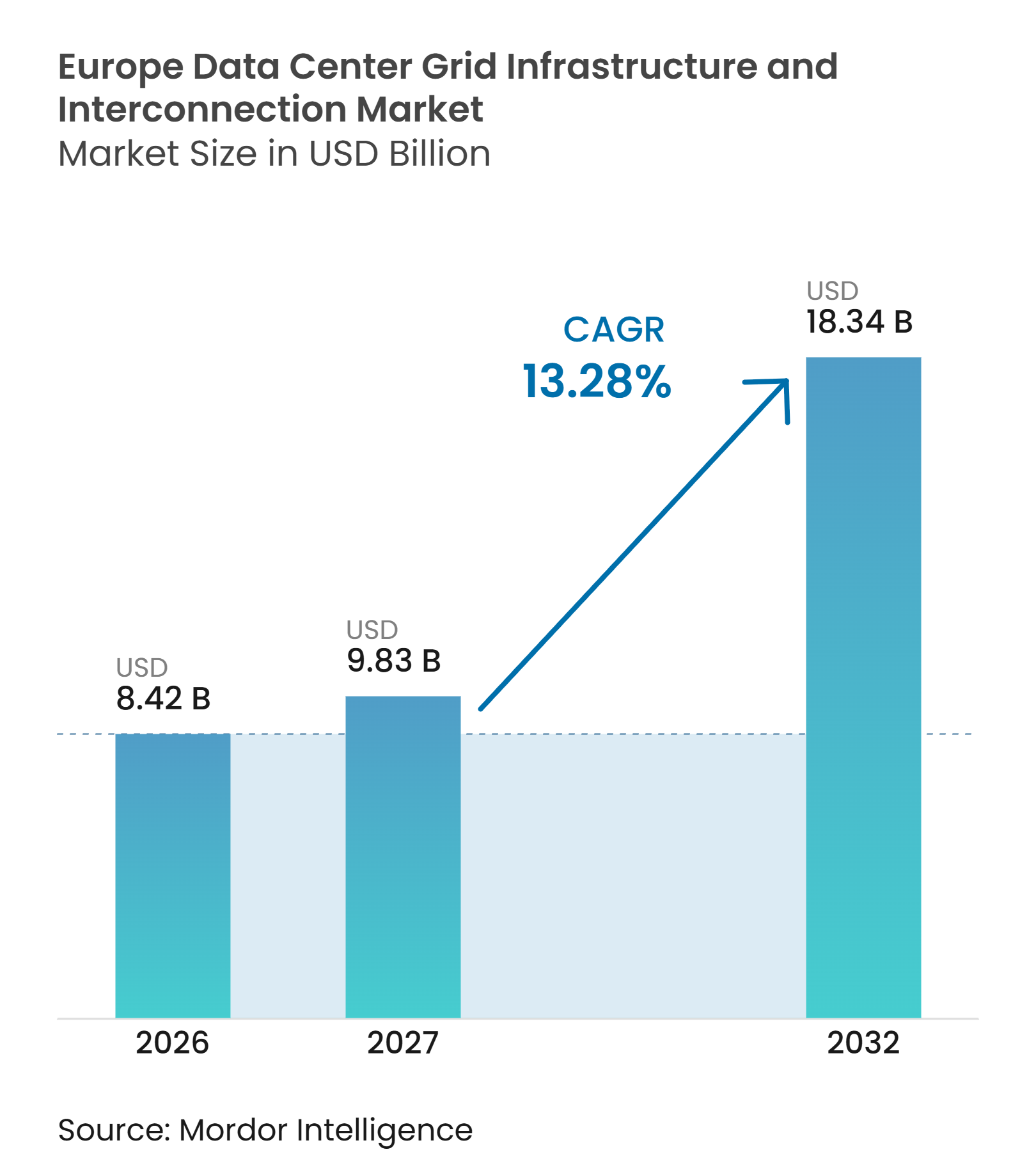
The Europe data center grid infrastructure and interconnection market size is projected to expand from USD 8.42 billion in 2026 to USD 9.83 billion in 2027, and to USD 18.34 billion by 2032, registering a CAGR of 13.28% between 2027 and 2032. Rising AI workloads and larger cloud campuses are increasing demand for high-voltage connections, substations, transmission assets, and monitoring systems across Europe. New projects are concentrating grid demand in established hubs, but long connection queues are shifting part of the investment pipeline toward Spain, Italy, and the Nordic countries. Suppliers with secured transformer, switchgear, and cable capacity are better placed to support projects with long delivery schedules. The Europe data center grid infrastructure and interconnection market is also being shaped by grid modernization programs, renewable power integration, and new connection rules that influence where operators can build. These conditions favor providers that can coordinate equipment supply, engineering, and grid compliance over long project cycles.
Key Report Takeaways
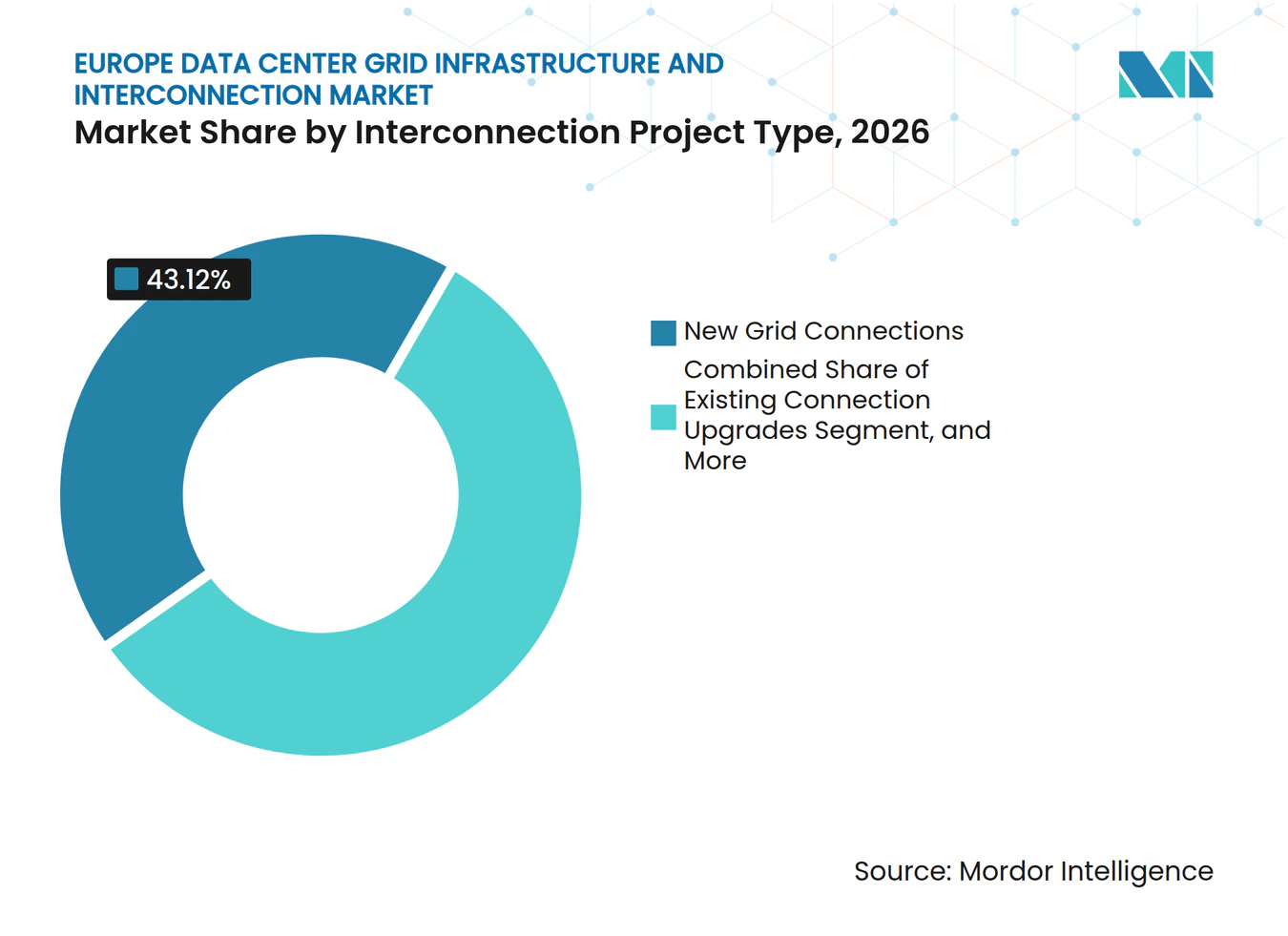
- By interconnection project type, new grid connections accounted for 43.12% of Europe data center grid infrastructure and interconnection market share in 2026, while transmission lines and cables are projected to expand at a 14.11% CAGR through 2032.
- By infrastructure component, substations and switchyards accounted for 29.84% of the Europe data center grid infrastructure and interconnection market size in 2026, while grid connection, control, and monitoring systems are projected to expand at a 14.29% CAGR through 2032.
- By voltage level, high voltage held 41.36% of the market in 2026, while extra-high voltage is projected to expand at a 13.92% CAGR through 2032.
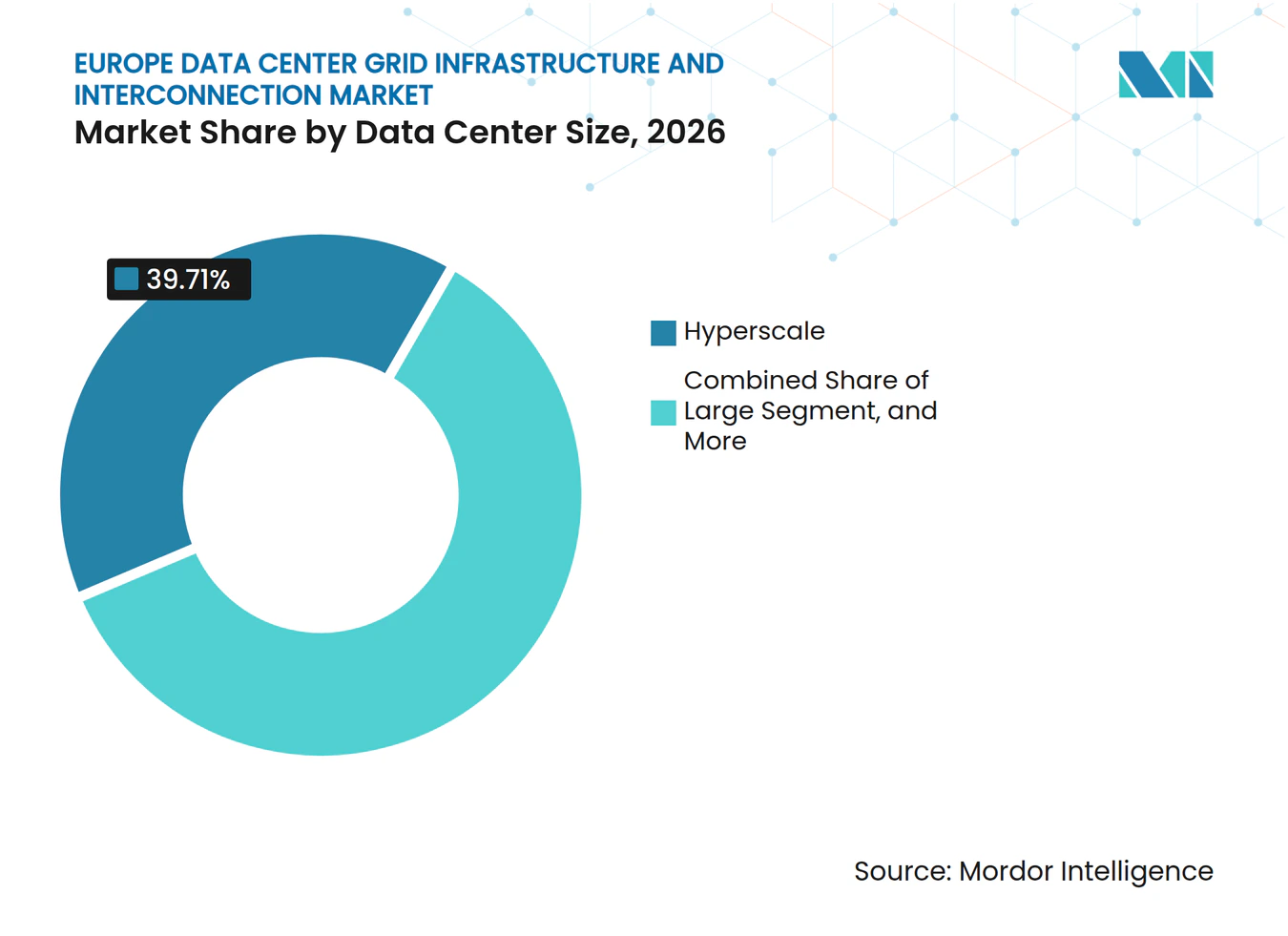
- By data center size, hyperscale facilities accounted for 39.71% of the market in 2026 and are projected to grow at a 14.09% CAGR through 2032.
- By data center type, colocation operators held 41.66% of the market in 2026, while cloud service providers are projected to expand at a 13.49% CAGR through 2032.
- By geography, the United Kingdom held 20.91% of the market in 2026, while Spain is projected to expand at a 15.11% CAGR through 2032.
Note: Market numbers in this report are based on Mordor Intelligence's proprietary estimation framework, which combines nine months of actuals with Q4 projections for base year 2026.
Market Trends and Insights
Drivers Impact Analysis of Europe Data Center Grid Infrastructure and Interconnection Market*
| Driver | (~) % Impact on CAGR Forecast | Geographic Relevance | Impact Timeline |
|---|---|---|---|
| AI and Hyperscale Load Expansion | +3.2% | Europe, concentrated in the United Kingdom, Germany, the Netherlands, the Nordics, and Spain | Short term (≤ 2 years) |
| Cloud Computing and Digitalization Growth | +2.5% | Europe-wide | Medium term (2-4 years) |
| Energy Efficiency and Renewable Integration Requirements | +1.8% | Europe, especially the Nordics and Germany | Medium term (2-4 years) |
| Accelerating Grid Modernization Investment | +1.6% | European Union-wide | Long term (≥ 4 years) |
| Flexible Connection Agreements and Smart Grid Adoption | +1.2% | Ireland, the United Kingdom, the Netherlands, and Nordic countries | Medium term (2-4 years) |
| AI-Driven Load Density Increasing Interconnection Spend per Site | +1.0% | Europe, concentrated in hyperscale locations | Short term (≤ 2 years) |
| Source: Mordor Intelligence | |||
AI and Hyperscale Load Expansion Is Reshaping Grid Connection Demand at Scale
AI workloads require more than 7 times the power of conventional data center operations. Data center electricity use increased 17% in 2025, while AI-focused facilities expanded faster. Rack densities are moving from 10 kW toward 40-100 kW per rack. New campuses, therefore, need high-voltage or extra-high-voltage connections, larger transformers, stronger switchgear, and wider cables. Grid connection, control, and monitoring systems are projected to expand at a 14.29% CAGR through 2032. ENTSO-E has identified stability risks that conventional supervisory systems may not detect quickly enough.[1]
Cloud Computing and Digitalization Sustain Baseline Grid Upgrade Demand
EU-27 installed data center capacity reached 9.9 GW of IT power supply in 2024. Cloud migration, public digital services, and legacy system replacement are creating connection requests outside major hubs. Many requests range from 5-50 MW and support upgrades to existing connections and substations. Older colocation facilities may need additional capacity as tenants add cloud and AI workloads. Schneider Electric reported accelerating data center orders in late 2025, with strength expected through 2026. This distributed demand supports work even when large greenfield projects face connection queues.
Energy Efficiency and Renewable Integration Requirements Drive Substation Redesign
Energy efficiency and renewable energy procurement requirements are changing substation design across Europe. The EU policy framework encourages renewable supply arrangements and detailed metering at the site level. These requirements add metering, control, and power-quality equipment to connection projects. Germany's colocation sector sourced 88% of its electricity from renewables in 2025, according to the supplied research. GE Vernova announced a 420 kV SF₆-free gas-insulated switchgear supply agreement for France's 1.4 GW Campus AI project. The Europe data center grid infrastructure and interconnection market benefits as each project carries a broader technical scope.
Accelerating Grid Modernization Investment Opens New Interconnection Opportunities
The European Commission presented the European Grids Package in December 2025 to improve coordination and accelerate permitting. It identified EUR 730 billion (USD 814.08 billion) of distribution and EUR 477 billion (USD 531.94 billion) of transmission development requirements through 2040. Network expansion can increase the capacity available for large data center loads. ENTSO-E identified more than 100,000 km of additional transmission lines planned by 2045. Statnett plans more than NOK 150 billion in Norwegian transmission investment over the next decade. These programs can open locations that would otherwise be unable to support new campus connections.
Restraints Impact Analysis of Europe Data Center Grid Infrastructure and Interconnection Market*
| Restraint | (~) % Impact on CAGR Forecast | Geographic Relevance | Impact Timeline |
|---|---|---|---|
| Grid Connection Queues and Transmission Capacity Shortages | -2.5% | Europe, most severe in the United Kingdom, Germany, the Netherlands, France, and Ireland | Short term (≤ 2 years) |
| Long Lead Times for High-Voltage Transformers and Switchgear | -1.8% | Europe and North America | Medium term (2-4 years) |
| Shortage of Certified High-Voltage Engineering Talent | -1.2% | Germany, the United Kingdom, France, and the Nordics | Long term (≥ 4 years) |
| Dynamic Load Instability From AI Workloads and UPS Disconnection | -0.7% | High-density AI campus locations | Medium term (2-4 years) |
| Source: Mordor Intelligence | |||
Grid Connection Queues and Transmission Capacity Shortages Compress Project Pipelines
Data center projects had requested 73 GW of grid capacity in the United Kingdom by mid-2025, compared with a peak demand of 45 GW. Not every project can therefore receive capacity on the requested timetable. Connection waits in major European hubs range from 7 to 10 years, with some delays reaching 13 years. Congestion cost the European Union EUR 4.3 billion (USD 4.80 billion) in 2024, excluding indirect project-delay costs.[2] Capacity access is increasingly affecting hyperscaler location decisions. This favors locations with workable connection rules and available network capacity.
Long Lead Times for High-Voltage Transformers and Switchgear Delay Energization
Generator step-up transformer lead times exceeded 160 weeks in the first quarter of 2026, compared with 143 weeks in 2024. High-voltage circuit breaker lead times reached 125 weeks in late 2025, compared with 77 weeks in 2023. Developers pursuing 2028 or 2029 energization need to make procurement decisions well in advance. Siemens Energy announced an investment of EUR 220 million (USD 245.34 million) in its transformer facility in Nuremberg. Hitachi Energy announced USD 1 billion of United States manufacturing investment in September 2025. Capacity additions will not provide substantial output immediately.
*Our forecasts treat driver/restraint impacts as directional, not additive. The impact forecasts reflect baseline growth, mix effects, and variable interactions.
Europe Data Center Grid Infrastructure and Interconnection Market Segment Analysis
By Interconnection Project Type:
New Connections Lead as Transmission Lines AccelerateNew grid connections held 43.12% of the Europe data center grid infrastructure and interconnection market share in 2026. The share reflects the volume of greenfield campuses entering development across Europe. Amazon committed EUR 33.7 billion (USD 39.8 billion) to a Spanish data center and AI infrastructure in March 2026. Blackstone also announced EUR 4.3 billion (USD 5.03 billion) for a further Aragón development phase in August 2025. These projects require dedicated grid connections, substations, and construction services.
Existing connection upgrades support demand as colocation and enterprise sites increase contracted capacity. Dedicated transmission infrastructure is more relevant for campuses distant from available network capacity. Transmission lines and cables are projected to expand at a 14.11% CAGR through 2032. In constrained hubs, the mix shifts toward costly upgrades and dedicated infrastructure. In emerging locations, new connections can have higher revenue per MW but require more engineering and permitting. The Europe data center grid infrastructure and interconnection industry serves both new campus construction and upgrades to established sites.



By Infrastructure Component:
Substations Anchor Spend While Grid Control Systems AccelerateSubstations and switchyards accounted for 29.84% of the Europe data center grid infrastructure and interconnection market size in 2026. Every large grid connection requires a substation or comparable switching installation. This supports the component's role across greenfield and upgrade projects. Power transformers are also critical, but their availability can affect delivery schedules. The supplied research reported a 30% supply deficit for large power transformers through 2027. Early procurement is therefore important for projects seeking firm energization dates.
Transmission lines and cables are gaining relevance as development extends beyond dense, established hubs. Nexans reported major data center cable contracts in Europe and the United States during 2026. Grid connection, control, and monitoring systems are projected to expand at a 14.29% CAGR through 2032. ENTSO-E has highlighted the need for detailed measurement of changing data center loads. Advanced metering and automated response systems support coordination between operators and transmission system operators. The Europe data center grid infrastructure industry can benefit from this activity even when physical construction slows.
By Voltage Level:
High Voltage Dominates as Extra-High Voltage Scales UpHigh voltage held 41.36% of the Europe data center grid infrastructure and interconnection market share in 2026. Connections in the 66 kV-132 kV range are established for large colocation and enterprise facilities. This tier can support substantial loads without full extra-high-voltage complexity. Low- and medium-voltage remain relevant for edge, small, and medium data centers. These projects are commonly located in secondary cities and industrial areas. They maintain demand for standardized equipment and local network upgrades.
Extra-high-voltage connections of 220 kV and above are projected to grow at a 13.92% CAGR through 2032. The segment is linked to hyperscale campuses that require 200-500 MW or more. Direct connections can reduce reliance on congested sub-transmission networks and limit the need for future upgrades. Norway's NVE approved a 420-kV direct connection for a 250-MW Narvik facility. The approval demonstrates the specialized engineering and regulatory work required for this voltage tier. The Europe data center grid infrastructure and interconnection market supports this shift through transformers, switchgear, and transmission assets.
By Data Center Size:
Hyperscale Drives Both Revenue and GrowthHyperscale facilities accounted for 39.71% of the European data center grid infrastructure and interconnection market in 2026 and are projected to expand at a 14.09% CAGR through 2032. This is the only data center size category that leads in both share and projected expansion. The position reflects the scale of AI and cloud investment programs. Amazon's commitment in Spain totaled EUR 33.7 billion (USD 39.8 billion). Individual hyperscale campuses may require infrastructure that exceeds the needs of many enterprise sites. Such projects require dedicated substations, high-voltage equipment, and direct transmission connections.
Large campuses in the 10-100 MW IT range remain an important demand base. They serve enterprise users and regional cloud providers needing dedicated infrastructure. Small and medium facilities also retain a role through edge deployments and secondary-city locations. These facilities support demand for low- to medium-voltage connections and for existing connection upgrades. Their individual grid requirements are smaller than those of hyperscale sites. Their wider distribution supports a more dispersed workstream for equipment suppliers and electrical contractors.

By Data Center Type:
Colocation Holds Share as Cloud Providers Expand FootprintColocation operators held 41.66% of the Europe data center grid infrastructure and interconnection market share in 2026. Enterprise customers continue to move workloads into professionally managed facilities to improve efficiency, ensure compliance, and enhance connectivity. The European Data Center Association identified colocation as a central part of the regional data center base. Colocation campuses require reliable utility connections and upgrades as tenant demand increases. Their installed base supports recurring work for substations, switchgear, and connection equipment. This demand is important even when a new campus activity is delayed.
Cloud service providers are projected to expand at a 13.49% CAGR through 2032. They are increasingly developing dedicated facilities rather than leasing all capacity from colocation operators. These projects require standalone grid connections and direct coordination with the utility. Enterprise and edge sites are another part of the demand base. Edge facilities usually connect at medium voltage and use standardized electrical designs. The Europe data center grid infrastructure and interconnection market benefits from this broader mix of connection requirements.
Geography Analysis
The United Kingdom held 20.91% of the European data center grid infrastructure and interconnection market share in 2026. London's cable landings, exchange points, and cloud interconnection base support its leading position. The United Kingdom designated data centers as Critical National Infrastructure in September 2024.[3] The government cited GBP 14 billion (USD 17.6 billion) in facilitated private investment. The country also faces major queue pressure, with 73 GW of data center requests against 45 GW peak demand. Grid reform is therefore central to the timing of new infrastructure projects.
Spain is projected to expand at a 15.11% CAGR through 2032. Commercial data center IT capacity in Spain reached 439 MW at the end of 2025, up 24% from the previous year. Amazon's March 2026 program identifies Aragón as a European location for AI operations. Germany remains important through Frankfurt, although the supplied research indicates growing constraints around the Rhein-Main area. The Netherlands has connection waits of up to 10 years in congested locations. France offers lower-carbon power and has a planned 1.4 GW Campus AI project in Seine-et-Marne.
Italy's 3-year connection timeline compares with 7-10 years in major FLAP-D hubs. The Nordics are attracting activity because of available low-carbon power and major transmission investment. Statnett plans more than NOK 150 billion of Norwegian transmission investment over the next decade. Belgium faced 56 GW of connection requests against available grid capacity in December 2025. These conditions show that connection pressure reaches beyond established hubs. The European data center grid infrastructure and interconnection market is benefiting from geographic diversification, but local approvals and equipment schedules remain decisive.
Competitive Landscape
Market Concentration
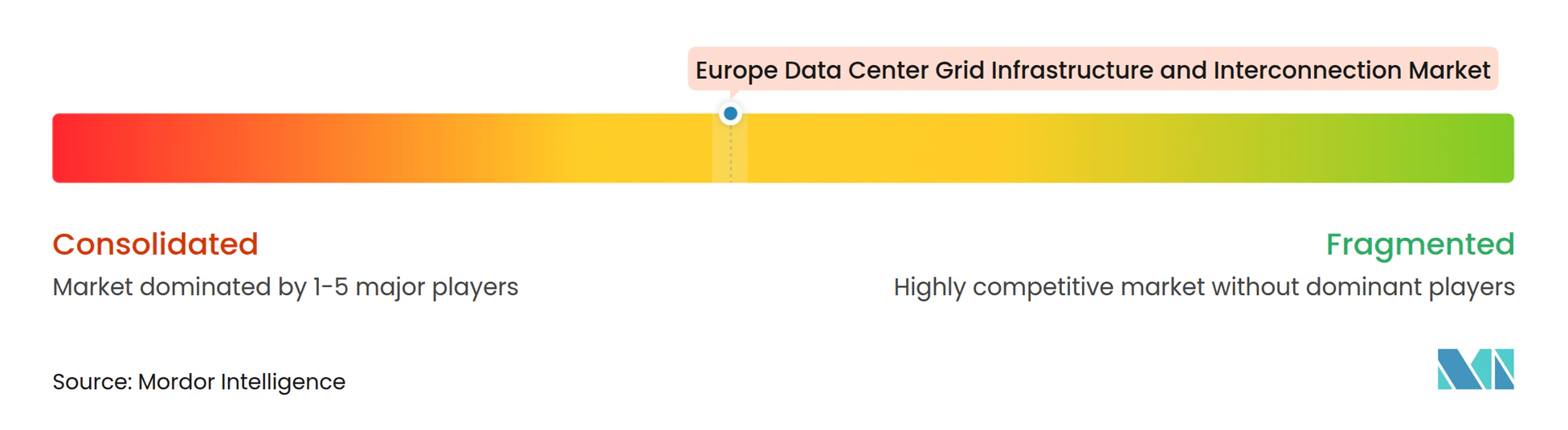
The European data center grid infrastructure and interconnection market is moderately concentrated in critical high-voltage equipment categories. ABB, Siemens Energy, Hitachi Energy, and GE Vernova supply key transformers, switchgear, and related equipment. Vertiv and Schneider Electric supply important data center power systems at the facility boundary. Regional electrical engineering firms and specialist EPC contractors compete for installation and systems integration. This creates more fragmented conditions in project delivery than in component manufacturing. Equipment capacity, engineering capability, and local execution coverage can provide an advantage.
ABB and Hitachi Energy announced support for NVIDIA's 800 VDC architecture in October 2025. The design centralizes AC-to-DC conversion at the substation level. GE Vernova reported more than USD 2 billion of direct data center orders in its Electrification segment during 2025. Vertiv agreed in September 2026 to acquire UtilityInnovation Group for USD 1.45 billion. The acquisition adds microgrid controls and behind-the-meter power capabilities.
Siemens Energy and Eaton formed a partnership in June 2025 for modular data center construction with on-site power. GE Vernova and AWS signed a March 2025 framework agreement covering data center substation solutions. These moves emphasize coordinated delivery rather than individual equipment sales. They also respond to grid queues and long equipment lead times. No supplier market-share data is provided for the top players. A quantitative concentration score would therefore require an unsupported estimate.
Europe Data Center Grid Infrastructure and Interconnection Industry Leaders
-
Schneider Electric SE
-
ABB Ltd.
-
Siemens Energy
-
Eaton Corporation plc
-
Hitachi Energy Ltd.
- *Disclaimer: Major Players sorted in no particular order
Europe Data Center Grid Infrastructure and Interconnection Market Companies Covered in this Report
- ABB Ltd.
- Schneider Electric SE
- Siemens Energy AG
- Eaton Corporation plc
- Hitachi Energy Ltd.
- GE Vernova Inc.
- Vertiv Holdings Co.
- Legrand SA
- Mitsubishi Electric Corporation
- Toshiba Energy Systems and Solutions Corporation
- SGB-SMIT Group
- Hyosung Heavy Industries Corporation
- Delta Electronics, Inc.
- Socomec Group
- Piller Power Systems
- Riello UPS S.p.A.
- AEG Power Solutions B.V.
- Bloom Energy Corporation
- Caverion Corporation
- Nexans S.A.
Recent Industry Developments in Europe Data Center Grid Infrastructure and Interconnection Market
- October 2026: Nexans reported a leading position in data center cable supply across Finland and Norway in its Q3 2026 update, with ongoing investments in PWR-Grid Accessories to expand medium-voltage production capacity across Europe and the United States, reinforcing its strategic positioning across both the grid infrastructure and data center interconnection supply chains.
- September 2026: Vertiv announced an agreement to acquire UtilityInnovation Group for USD 1.45 billion in cash at closing, with up to USD 1.15 billion in additional consideration tied to earnings milestones. The acquisition extends Vertiv's portfolio from grid interconnect to chip-level power management, incorporating microgrid controls, on-site generation orchestration, and behind-the-meter power architecture that reduces dependence on queued grid connections for data center energization.
- May 2026: GE Vernova announced the supply of a 420 kV SF₆-free gas-insulated switchgear system for the Campus AI project in Seine-et-Marne, France, based on an agreement signed in January 2026. The project is expected to become Europe's largest AI campus at 1.4 GW of planned capacity, representing a direct validation of SF₆-free high-voltage technology for utility-scale data center interconnection in Europe.
- March 2026: Amazon announced an additional EUR 18 billion (USD 21 billion) investment in Spain, bringing its total data center and AI infrastructure commitment in the country to EUR 33.7 billion (USD 39.8 billion). The investment designates Aragón as Amazon's AI operations epicenter for Europe, driving dedicated transmission and substation infrastructure requirements across 3 Aragón provinces.
Europe Data Center Grid Infrastructure and Interconnection Market Report Scope
The Europe Data Center Grid Infrastructure and Interconnection Market comprises the infrastructure, equipment, and systems required to connect data centers to the electrical grid and ensure reliable, efficient, and high-capacity power delivery across the region.
The Europe Data Center Grid Infrastructure and Interconnection Market Report is Segmented by Interconnection Project Type (New Grid Connections, Existing Connection Upgrades, Dedicated Transmission Infrastructure, and Substation and Grid Interconnection Upgrades), Infrastructure Component (Substations and Switchyards, Power Transformers, Transmission Lines and Cables, Switchgear and Protection Systems, and Grid Connection, Control and Monitoring Systems), Voltage Level (Low and Medium Voltage, High Voltage, and Extra-High Voltage), Data Center Size (Small, Medium, Large, and Hyperscale), Data Center Type (Colocation, Cloud Service Providers [CSPs], and Enterprise and Edge), and Geography (United Kingdom, Germany, France, Netherlands, Ireland, Spain, Italy, Nordics, and Rest of Europe). The Market Forecasts are Provided in Terms of Value (USD).
Segmentation Overview
| New Grid Connections |
| Existing Connection Upgrades |
| Dedicated Transmission Infrastructure |
| Substation and Grid Interconnection Upgrades |
| Substations and Switchyards |
| Power Transformers |
| Transmission Lines and Cables |
| Switchgear and Protection Systems |
| Grid Connection, Control, and Monitoring Systems |
| Low and Medium Voltage |
| High Voltage |
| Extra-High Voltage |
| Small |
| Medium |
| Large |
| Hyperscale |
| Colocation |
| Cloud Service Providers (CSPs) |
| Enterprise and Edge |
| United Kingdom |
| Germany |
| France |
| Netherlands |
| Ireland |
| Spain |
| Italy |
| Nordics |
| Rest of Europe |
| By Interconnection Project Type | New Grid Connections |
| Existing Connection Upgrades | |
| Dedicated Transmission Infrastructure | |
| Substation and Grid Interconnection Upgrades | |
| By Infrastructure Component | Substations and Switchyards |
| Power Transformers | |
| Transmission Lines and Cables | |
| Switchgear and Protection Systems | |
| Grid Connection, Control, and Monitoring Systems | |
| By Voltage Level | Low and Medium Voltage |
| High Voltage | |
| Extra-High Voltage | |
| By Data Center Size | Small |
| Medium | |
| Large | |
| Hyperscale | |
| By Data Center Type | Colocation |
| Cloud Service Providers (CSPs) | |
| Enterprise and Edge | |
| By Geography | United Kingdom |
| Germany | |
| France | |
| Netherlands | |
| Ireland | |
| Spain | |
| Italy | |
| Nordics | |
| Rest of Europe |
Key Questions Answered in the Report
What is the size of the Europe data center grid infrastructure and interconnection market?
The Europe data center grid infrastructure and interconnection market is projected to expand from USD 8.42 billion in 2026 and USD 9.83 billion in 2027 to USD 18.34 billion by 2032, at a 13.28% CAGR.
What is driving demand for data center grid infrastructure in Europe?
AI workloads, cloud expansion, renewable integration requirements, and grid modernization are increasing demand for substations, high-voltage connections, cables, and monitoring systems.
Which interconnection project type has the largest share in Europe?
New grid connections held 43.12% of the market in 2026 because greenfield campuses require dedicated connection and substation infrastructure.
Which voltage level is expanding fastest for European data centers?
Extra-high voltage is projected to expand at a 13.92% CAGR through 2032 as large hyperscale campuses require 220 kV and higher connections.
Which European country is expanding fastest for data center interconnection projects?
Spain is projected to expand at a 15.11% CAGR through 2032, supported by its data center pipeline, renewable energy access, and large AI infrastructure commitments.
What constrains new data center connections in Europe?
Grid connection queues, transmission shortages, and long lead times for transformers and switchgear can delay project energization and redirect development to locations with greater available capacity.