
Europe Data Center Energy Storage and Microgrids Market Size and Share
Market Overview
| Study Period | 2021 - 2032 |
|---|---|
| Forecast Data Period | 2027 - 2032 |
| Base Year Market Size (2026) | USD 1.66 Billion |
| Market Size (2027) | USD 1.99 Billion |
| Market Size (2032) | USD 4.79 Billion |
| Growth Rate (2027 - 2032) | 19.21 % |
| Market Concentration | Medium |
Major Players *Disclaimer: Major Players sorted in no particular order Image © Mordor Intelligence. Reuse requires attribution under CC BY 4.0. | |
Europe Data Center Energy Storage and Microgrids Market Analysis by Mordor Intelligence
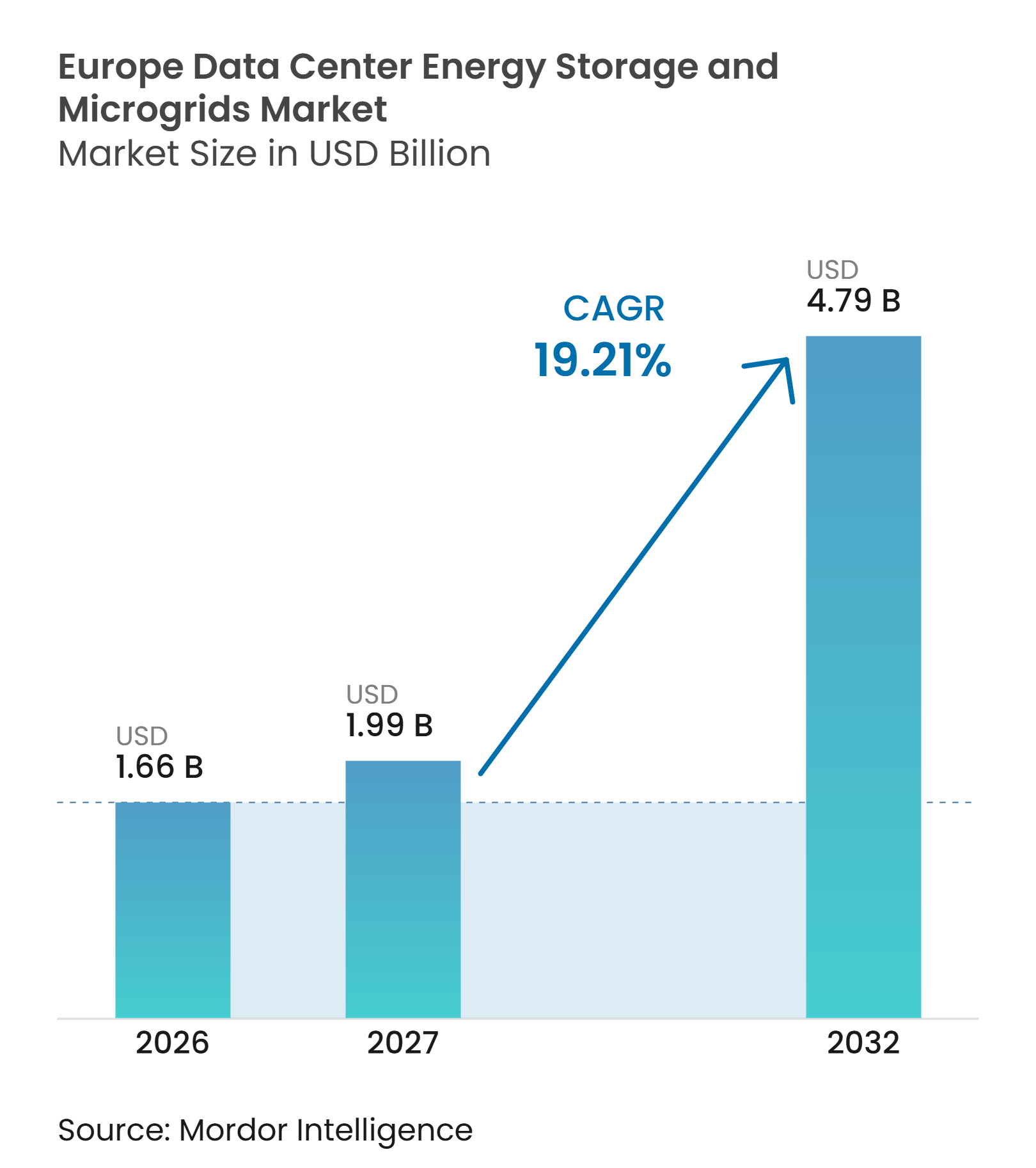
The Europe data center energy storage and microgrids market size is projected to be USD 1.66 billion in 2026, USD 1.99 billion in 2027, and reach USD 4.79 billion by 2032, at a CAGR of 19.21% from 2027 to 2032. AI workloads are increasing the power requirements of new campuses and placing pressure on grid connections designed for steadier demand patterns. Energy reporting and sustainability rules across the European Union are also making site-level control of electricity use more important. Storage can enhance reliability, reduce peak demand, and enable operators to use more renewable electricity when it is available. These factors are shifting procurement toward integrated systems that combine batteries, power controls, distributed generation, and microgrid software. The Europe data center energy storage and microgrids market also offers operators a route to use battery capacity for balancing services while protecting critical operations.
Key Report Takeaways
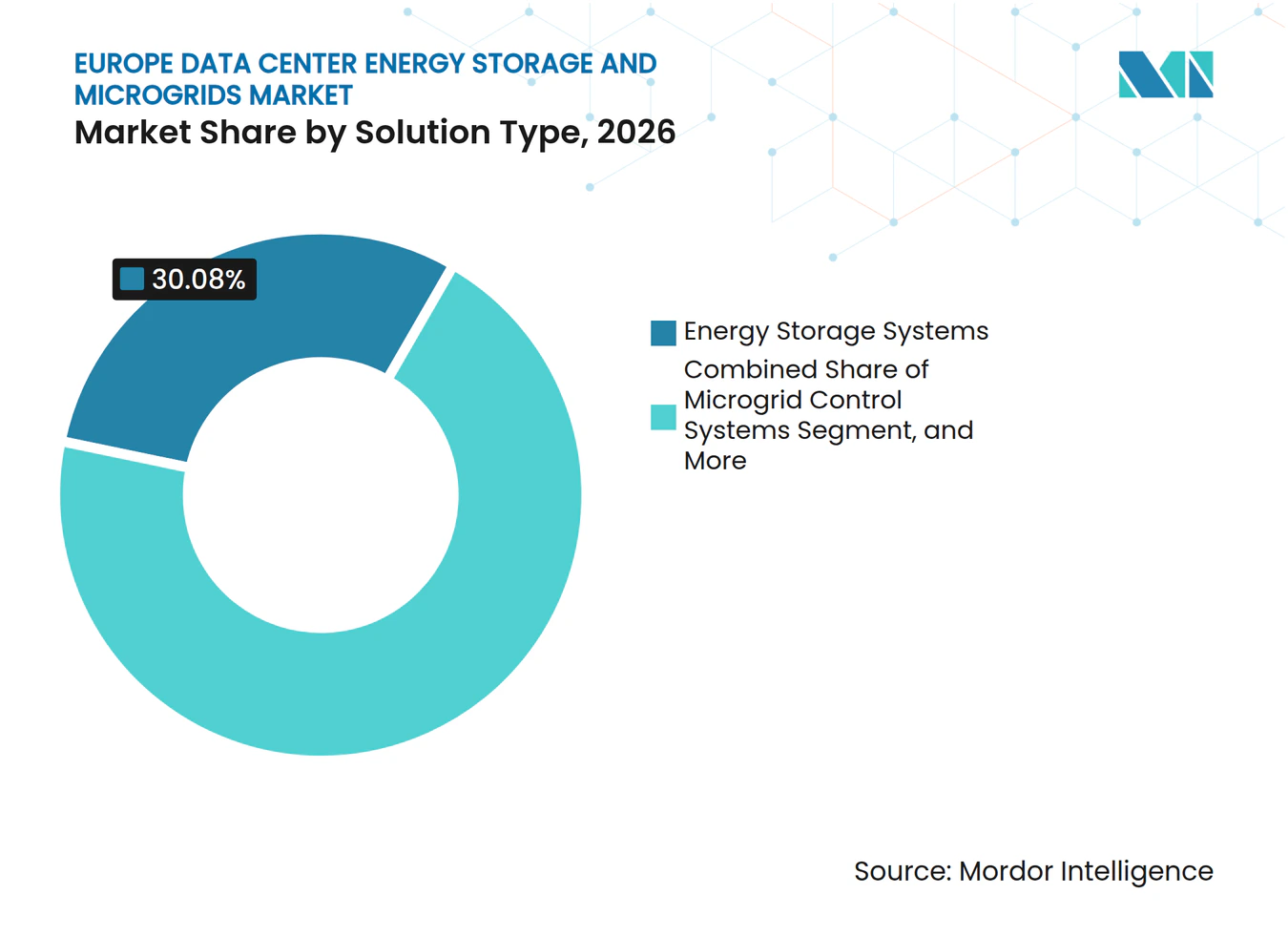
- By solution type, energy storage systems held 30.08% of the Europe data center energy storage and microgrids market share in 2026 and are projected to expand at a 20.21% CAGR through 2032.
- By storage technology, lithium-ion batteries held a 56.21% share in 2026, while flow batteries are projected to expand at a 20.19% CAGR through 2032.
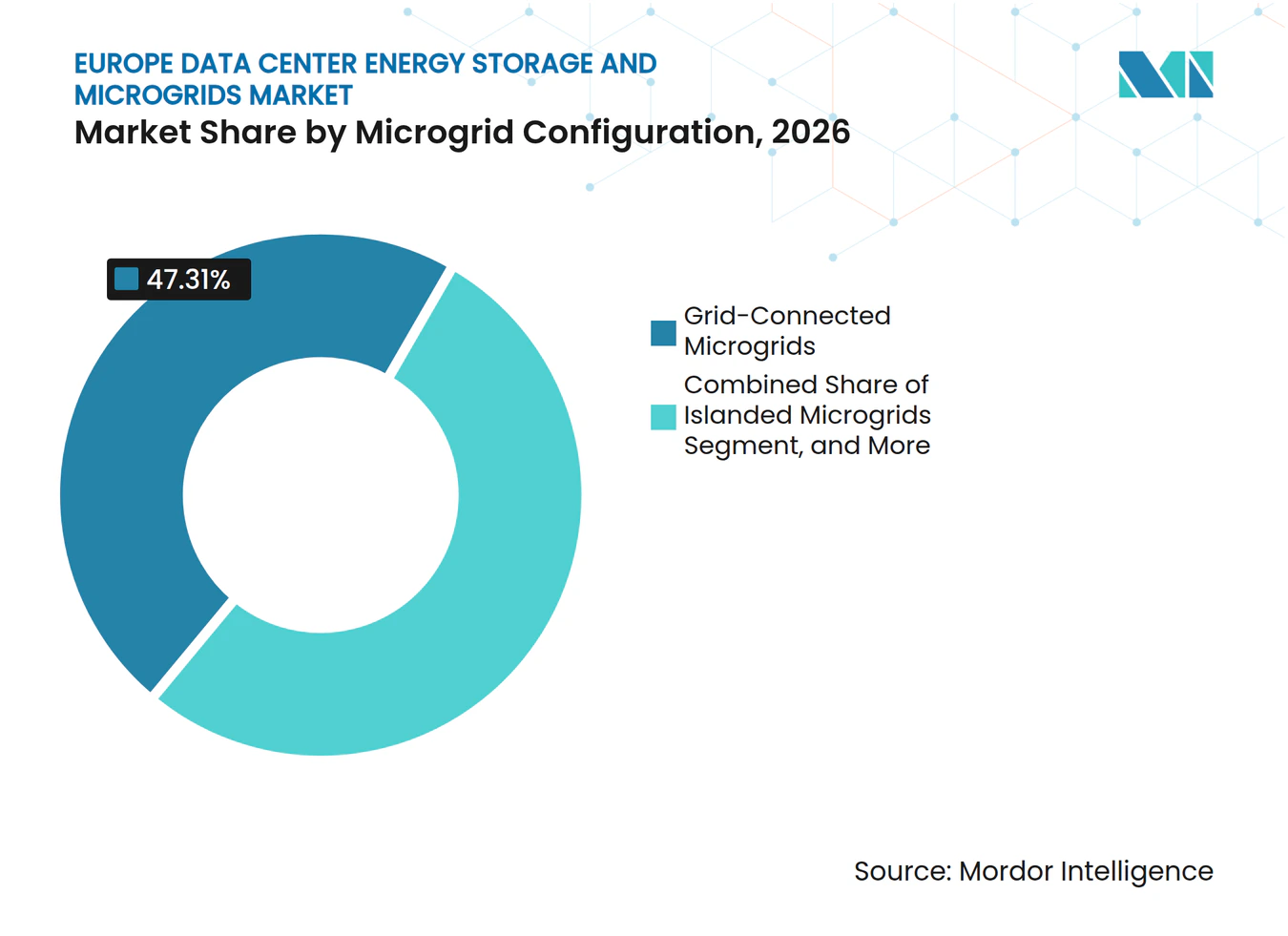
- By microgrid configuration, grid-connected microgrids accounted for 47.31% of revenue in 2026, while islanded microgrids are expected to expand at a 19.78% CAGR through 2032.
- By primary energy source, grid electricity accounted for 43.92% of revenue in 2026, while fuel cells are projected to grow at a 20.39% CAGR through 2032.
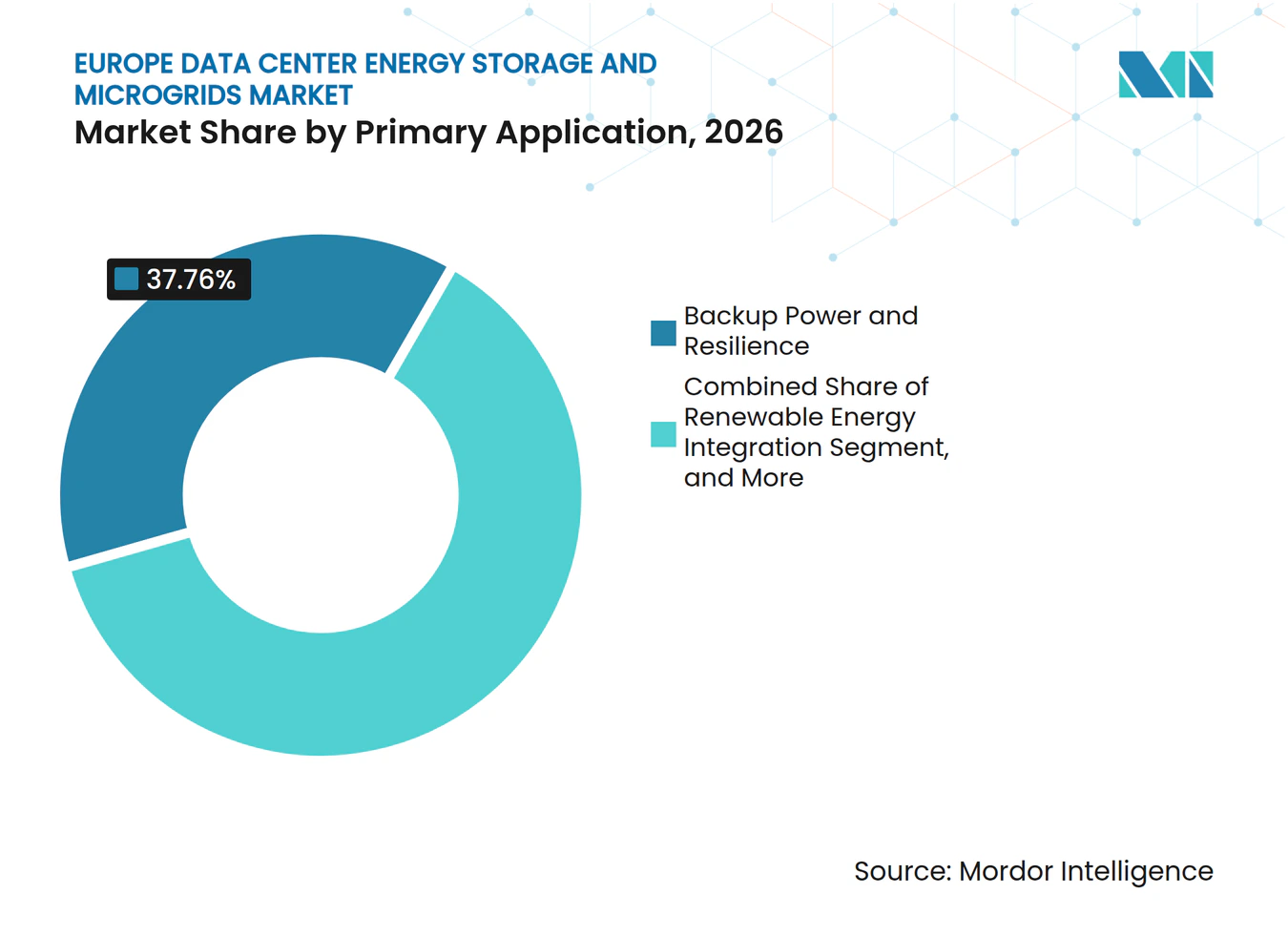
- By primary application, backup power and resilience accounted for 37.76% of revenue in 2026, while grid services are projected to grow at a 20.18% CAGR through 2032.
- By data center size, hyperscale facilities accounted for 41.82% of revenue in the Europe data center energy storage and microgrids market in 2026 and are expected to grow at a 19.87% CAGR through 2032.
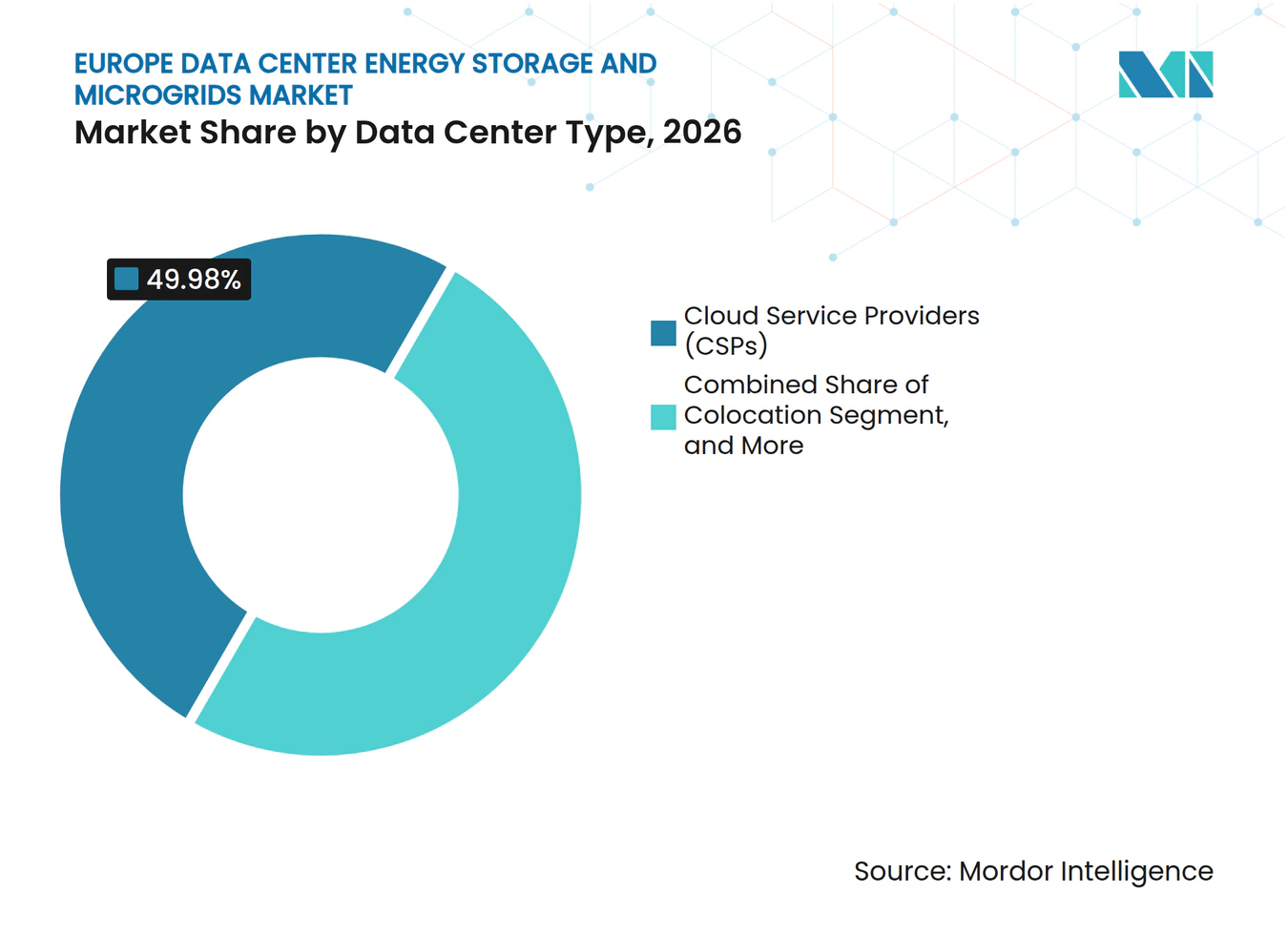
- By data center type, cloud service providers accounted for 49.98% of revenue in 2026 and are projected to expand at a 19.73% CAGR through 2032.
- By geography, the United Kingdom held 21.06% of revenue in 2026, while Spain is projected to expand at a 20.48% CAGR through 2032.
Note: Market numbers in this report are based on Mordor Intelligence's proprietary estimation framework, which combines nine months of actuals with Q4 projections for base year 2026.
Market Trends and Insights
Drivers Impact Analysis of Europe Data Center Energy Storage and Microgrids Market*
| Driver | (~) % Impact on CAGR Forecast | Geographic Relevance | Impact Timeline |
|---|---|---|---|
| Artificial Intelligence and Hyperscale Data Center Expansion | +2.5% | Global, concentrated in the United Kingdom, Germany, Netherlands, and Ireland | Short term (≤ 2 years) |
| EU Energy Efficiency and Carbon-Reduction Requirements | +1.8% | EU27, particularly FLAP-D markets | Medium term (2-4 years) |
| Renewable Power Procurement and Time-Shifting Demand | +1.5% | Spain, Nordics, and Germany | Medium term (2-4 years) |
| Grid-Connection Queues and Local Power Constraints | +2.2% | FLAP-D markets, with spillover to Spain, Italy, and the Nordics | Short term (≤ 2 years) |
| Data Center Dispatchable Capacity as a Grid Resource | +1.3% | United Kingdom, Ireland, and the Nordics | Medium term (2-4 years) |
| Grid-Interactive UPS and Battery Flexibility Monetization | +1.0% | United Kingdom, Ireland, Netherlands, and the Nordics | Long term (≥ 4 years) |
| Source: Mordor Intelligence | |||
Artificial Intelligence and Hyperscale Data Center Expansion
AI-related demand is increasing the need for storage and microgrids at European data centers. European data center power demand is expected to rise from 10 GW to 35 GW by 2030, representing a 250% increase, according to a 2025 Wärtsilä and AVK analysis. The European Commission’s 2025 AI Continent Action Plan aims to triple European Union data center capacity within 5-7 years and identifies energy availability as a central constraint. GPU clusters can create irregular and high-amplitude demand peaks that conventional utility feeds and legacy UPS systems were not designed to absorb. Behind-the-meter batteries can manage those fluctuations while reducing exposure to peak demand periods. This makes energy storage a core part of design for AI facilities rather than an optional resilience addition in the Europe data center energy storage and microgrids market.
Grid-Connection Queues and Local Power Constraints
Long connection timelines are accelerating the use of on-site power systems across Europe. Connection queues in the FLAP-D markets of Frankfurt, London, Amsterdam, Paris, and Dublin can average 7-10 years, while wait times across European countries range from 2-10 years. The Agency for the Cooperation of Energy Regulators recorded EUR 4.3 billion (USD 4.79 billion) in direct European Union grid congestion costs during 2024. Wärtsilä and AVK project that 40% of existing AI data centers could face operational constraints from power availability by 2027. Developers are therefore considering Spain, the Nordics, and other locations with greater grid headroom. Islanded and hybrid systems can shorten the route to commissioning where grid capacity is unavailable within commercial timelines.
EU Energy Efficiency and Carbon-Reduction Requirements
European Union requirements are making energy measurement and management part of normal data center operations. Directive 2023/1791 requires data centers with installed IT power of 500 kW or more to report energy performance and sustainability information. Commission Delegated Regulation 2024/1364 defines the reporting framework and the indicators used for data centers.[1] Commission Regulation C(2026)3472 sets rules for turning collected indicators into an electronic label-based rating. Operators seeking stronger ratings can use microgrid controls to reduce grid draw during high-carbon periods. They can also use storage to align renewable electricity use with available generation, which supports additional investment in on-site energy management.
Data Center Dispatchable Capacity as a Grid Resource
Battery-backed UPS systems are creating a revenue opportunity alongside their reliability role. A 2025 peer-reviewed study found that high-capacity data center batteries can provide primary frequency response and ancillary services, with field response times of 30-40 milliseconds at Nordic facilities. Enel X deployed 6 MW of UPS critical frequency balancing support at Digital Realty sites in Dublin for EirGrid. The case shows that equipment once reserved for emergency use can support normal grid operations when its control systems permit it. Larger battery systems and advanced microgrid controls can then serve backup, peak reduction, and balancing functions. This additional use case strengthens the commercial case for storage in markets where ancillary services are active.
Restraints Impact Analysis of Europe Data Center Energy Storage and Microgrids Market*
| Restraint | (~) % Impact on CAGR Forecast | Geographic Relevance | Impact Timeline |
|---|---|---|---|
| High Installed Costs for Integrated Storage and Microgrid Systems | -2.8% | Global, acute in Spain, Italy, and Eastern Europe | Short term (≤ 2 years) |
| Fire-Safety and Thermal-Management Requirements for Lithium-Ion Systems | -1.5% | Global, with varied European Union member-state compliance frameworks | Medium term (2-4 years) |
| Transformer, Battery, and High-Voltage Equipment Supply Constraints | -1.8% | United Kingdom, Germany, Netherlands, and Ireland | Short term (≤ 2 years) |
| Legacy Backup Architectures and Retrofit Disruption | -1.2% | United Kingdom, Germany, and France | Long term (≥ 4 years) |
| Source: Mordor Intelligence | |||
High Installed Costs for Integrated Storage and Microgrid Systems
High upfront costs remain the main commercial barrier for integrated battery energy storage systems and microgrids. Wärtsilä and AVK modeled the levelized electricity cost of an optimized microgrid for an 80 MW data center at EUR 108 per MWh, which the source converted to USD 122 per MWh. Most projects require bespoke engineering, site-specific permits, and integration with existing electrical equipment. These requirements increase both cost and schedule uncertainty. Battery-as-a-Service and Energy-as-a-Service models may shift expenditure from capital budgets to operating budgets. However, smaller colocation and enterprise facilities still have fewer financing options than hyperscale and cloud operators.
Fire-Safety and Thermal-Management Requirements for Lithium-Ion Systems
Lithium-ion systems require detailed safety design, which adds cost and complexity to data center projects. A 2025 ITU-T paper states that thermal runaway can release high-temperature, toxic, and combustible gases and can cause losses beyond the direct impact of a fire. The forthcoming 2026 edition of NFPA 855 includes proposed large-scale fire tests, updated explosion-control protocols, and water-spray suppression requirements.[2] European Union member states do not apply a harmonized large-scale BESS safety standard for critical infrastructure. This creates differences in site design and procurement for operators that work across several countries. Alternative chemistries can be beneficial when operators want to limit fire-safety requirements and delivery risk.
*Our forecasts treat driver/restraint impacts as directional, not additive. The impact forecasts reflect baseline growth, mix effects, and variable interactions.
Europe Data Center Energy Storage and Microgrids Market Segment Analysis
By Solution Type:
Energy Storage Systems Lead Scale and ExpansionEnergy storage systems held 30.08% of the European data center energy storage and microgrids market share in 2026 and are projected to expand at a 20.21% CAGR through 2032. Their position reflects the role of batteries in maintaining power quality, reducing peak demand, and supporting the use of renewable electricity. Storage must be available before an integrated microgrid can manage fluctuations in local generation or utility supply. Integrated microgrid solutions remain important for operators seeking controls, generation, and storage on a single platform. Microgrid control systems are becoming a higher-value part of the offer because they can allocate stored power across resilience, peak shaving, and grid services. Power conversion systems and distributed generation are generally procured as components of wider campus energy projects.
The shift from a single-function UPS to a multi-use energy asset is changing purchase specifications. Operators are considering storage capable of discharging for hours rather than designing only for 5-15 minutes of backup. Longer duration enables participation in frequency regulation and allows renewable electricity to be used later in the day. The reporting framework under Commission Delegated Regulation 2024/1364 includes indicators of systemic efficiency and flexibility. This creates a commercial reason to deploy controls that can manage site assets beyond basic backup use. The Europe data center energy storage and microgrids industry is consequently placing greater value on systems that can support several operational functions. Vendors that can demonstrate reliable coordination between these functions have a stronger position in large-campus projects.



By Storage Technology:
Lithium-Ion Leads While Flow Batteries Gain InterestLithium-ion batteries held 56.21% of storage technology revenue in 2026. Established supply chains, falling manufacturing costs, and high energy density support their use in short-duration backup applications. Lead-acid batteries continue to serve some retrofit projects that use established legacy designs. Flywheels address limited-frequency-response applications where a very fast response is needed without the risk of electrochemical fire. Flow batteries are projected to expand at a 20.19% CAGR through 2032 as hyperscale operators assess long-duration renewable time shifting and multi-hour grid services. FlexBase Group began construction in June 2025 of an 800 MW, 1.6 GWh vanadium redox flow battery site in Laufenburg, Switzerland.
The Laufenburg project sits near the Swiss, German, and French transmission networks and is intended to support grid stability and serve as a power source for a colocated AI data center. It also includes a district heating network, which demonstrates how large storage projects can connect multiple local energy uses. Flow battery chemistry can offer a different safety profile for sites that require long discharge periods. This matters because data center operators must respond to varying fire safety rules across European Union member states. Interest in storage capable of operating beyond conventional UPS durations supports long-duration applications. The German Institute for Economic Research estimated that Europe may require 351 TWh of long-duration storage to address extended periods of low renewable generation, underscoring the need for technologies suited to longer discharge cycles.
By Microgrid Configuration:
Grid-Connected Systems Remain Established While Islanded Systems AccelerateGrid-connected microgrids accounted for 47.31% of revenue in 2026. Established facilities prefer this design because they can retain utility supply while using local generation and batteries during high-tariff or high-demand periods. Hybrid systems that can remain grid-connected or operate independently are gaining attention in projects across continental Europe. They offer the cost benefits of utility supply with black-start capability during extended outages. Islanded microgrids are projected to expand at a 19.78% CAGR through 2032 as connection delays require new projects to plan for greater energy independence. Wärtsilä and AVK found that islanded systems combining renewables, balancing engines, and storage could serve 80 MW-scale data centers.
Islanded designs are not only a response to a delayed grid connection. They can enable operators to enter into longer-term power purchase agreements with renewable developers. This approach can reduce exposure to volatile spot electricity prices and improve visibility for long-term capacity planning. A 2025 feasibility study validated hybrid renewable and battery configurations for hyperscale off-grid loads and found that grid-forming battery controls can maintain frequency within data center operating limits. Spain and the Nordics have conditions that support this model because renewable resources and available development sites can be more favorable. Operators still need to consider fuel availability, permitting, and equipment lead times before selecting a fully islanded architecture.

By Primary Energy Source:
Grid Electricity Leads While Fuel Cells AdvanceGrid electricity accounted for 43.92% of Europe's data center energy storage and microgrids market revenue in 2026, making it the leading primary energy source. It remains the simplest operating model for facilities that already have dependable utility connections. Diesel and natural gas systems continue to provide backup capacity and transitional primary power for projects awaiting full grid service. Solar power is gaining relevance in Spain and Italy, where developers can link campus plans to photovoltaic capacity through power purchase agreements. Wind resources remain relevant in Ireland and the Nordics, where onshore and offshore generation can help meet local renewable energy needs. Fuel cells are projected to expand at a 20.39% CAGR through 2032, the highest rate among the primary energy sources.
In April 2026, the Net Zero Innovation Hub for Data Centers and INNIO demonstrated 3 MW of 100% hydrogen backup power at INNIO Jenbacher’s Austrian research facility. Microsoft, Google, and Data4 observed the test, which used AI training load profiles. Centrica and Ceres Power announced a partnership in March 2026 to deploy multi-gigawatt solid oxide fuel cell solutions across the United Kingdom and Europe. These systems can use natural gas initially while providing a pathway to hydrogen and biogas. The European Union’s Renewable Fuels of Non-Biological Origin framework also gives operators a policy basis for procuring certified renewable hydrogen. Fuel-cell deployment will still depend on local fuel infrastructure and the economics of low-carbon hydrogen.
By Primary Application:
Backup Power Leads While Grid Services Reshape ReturnsBackup power and resilience accounted for 37.76% of Europe's data center energy storage and microgrids market revenue in 2026, the largest primary application. Colocation and cloud operators require high availability, and Tier-III or Tier-IV expectations make reliable standby capacity a basic requirement. Peak shaving and load shifting constitute the next major application group, as operators can discharge batteries during expensive grid periods. Renewable integration is also increasing as facilities seek to match consumption with available clean generation. Grid services are projected to advance at a 20.18% CAGR through 2032. This rate reflects the value of fast-response assets in frequency response and balancing markets.
A 2025 Energy Reports study found that data center UPS systems equipped with bidirectional converters achieved 30-40 millisecond response times suitable for fast frequency response. The result indicates that some services can be delivered without a separate stand-alone BESS. Vertiv, Conapto, and Fever Energy introduced a grid-support service in Sweden that uses lithium-ion UPS systems in Fast Frequency Response and Frequency Containment Reserve Demand programs. This model enables operators to generate income from equipment installed for resilience. It can lower the effective capital burden of larger battery systems over their service life. Participation depends on transmission system operator rules, local market access, and operational safeguards that protect the availability of critical load.
By Data Center Size:
Hyperscale Facilities Lead InvestmentHyperscale facilities held 41.82% of revenue in 2026 and are projected to expand at a 19.87% CAGR through 2032. Their scale supports investment in systems that combine on-site generation, storage, and advanced power controls. A single hyperscale campus can require 500 MW or more of capacity over its development life. Large data centers with IT loads above 10 MW also deploy BESS for peak shaving and ancillary services when their scale supports dedicated energy management infrastructure. Medium and small facilities often face higher engineering costs per MW and receive less vendor attention than campus-scale sites. This leaves them with fewer options for complete microgrid deployments.
Eaton and Siemens Energy announced a June 2025 collaboration around a standard modular 500 MW on-site power configuration for data centers. The design uses SGT-800 gas turbines, battery storage, and optional hydrogen capability. The companies stated that the model can reduce time to market by up to 2 years compared with conventional utility connection processes. Battery-as-a-Service models are beginning to reduce upfront capital requirements for some operators. Their viability below hyperscale load levels remains dependent on contracted energy volumes and local access to ancillary service revenues. As a result, small and medium data centers may remain comparatively underserved in the Europe data center energy storage and microgrids market.
By Data Center Type:
Cloud Providers Consolidate Their PositionCloud service providers accounted for 49.98% of Europe data center energy storage and microgrids market revenue in 2026 and are projected to expand at a 19.73% CAGR through 2032. Their scale gives them access to long-term renewable power purchase agreements and internal energy engineering teams. These providers also face investor and customer expectations to meet Science-Based Targets, thereby raising the strategic value of storage and microgrid investments. Colocation operators constitute the second-largest group and are responding to tenant requests for renewable-energy certification and power redundancy. Enterprise and edge sites represent a smaller but growing segment as telecommunications infrastructure and distributed AI inference expand. Compact storage and modular microgrid systems are becoming more relevant for these distributed deployments.
Cloud providers are increasingly competing on their ability to provide lower-carbon electricity around the clock. This makes energy infrastructure quality part of the wider service offer alongside connectivity and latency. Vertiv and GreenScale announced a December 2025 collaboration to provide factory-integrated AI-ready data center platforms in Europe. The platform includes battery monitoring and site-wide grid integration as standard elements. This reflects the importance of visibility and control across facility power assets. It also gives cloud-adjacent operators a more standardized route to integrating energy features into new AI-oriented capacity.
Geography Analysis
United Kingdom, Germany, Netherlands, and Ireland
The United Kingdom accounted for 21.06% of regional revenue in 2026. London and the M4 corridor combine a large colocation base with active ancillary service markets, which makes battery-backed facilities commercially relevant beyond emergency power. In October 2025, Innova submitted 10 data center proposals to the National Energy System Operator totaling 4.4 GW, including 5 sites colocated with BESS. Germany remains a key location because Frankfurt is a major internet exchange hub, while the Netherlands faces major grid saturation and is developing grid-interactive facility models. Ireland’s Dublin cluster has been a leading setting for grid-interactive UPS, including Digital Realty’s 6 MW frequency-balancing service delivered with Enel X technology.
France and Spain
France is expanding its storage footprint as EED reporting requirements and RTE market signals encourage flexible data center operation. Data4, RTE, and Schneider Electric launched the DCFLEX project at Data4’s Marcoussis site in October 2025 to test demand flexibility and use digital twins for grid-stress scenarios. Spain is projected to expand at a 20.48% CAGR through 2032, the highest regional rate. Amazon Web Services announced EUR 33.7 billion (USD 39.8 billion) for its AWS Europe (Spain) Region in Aragón during 2026. Spain’s solar resources and renewable development pipeline offer a basis for pairing new facilities with local clean-energy supply, while both countries must align projects with European Union reporting and national grid-connection procedures.
Italy and the Nordics
Italy is attracting attention as a Mediterranean connectivity hub, supported by renewable energy development in the south and increasing hyperscale interest. The Nordics offer a different operating environment because hydropower, wind, and geothermal resources can provide competitively priced low-carbon electricity. Scandinavian Data Centers launched ScandiDC I in Eskilstuna, Sweden, in February 2025, combining a BESS, data center operations, and a municipal district heat-recovery network. Nordic transmission system operators are examining battery assets for inertia and frequency stability, which could create an additional compensated service stream.
Competitive Landscape
Market Concentration
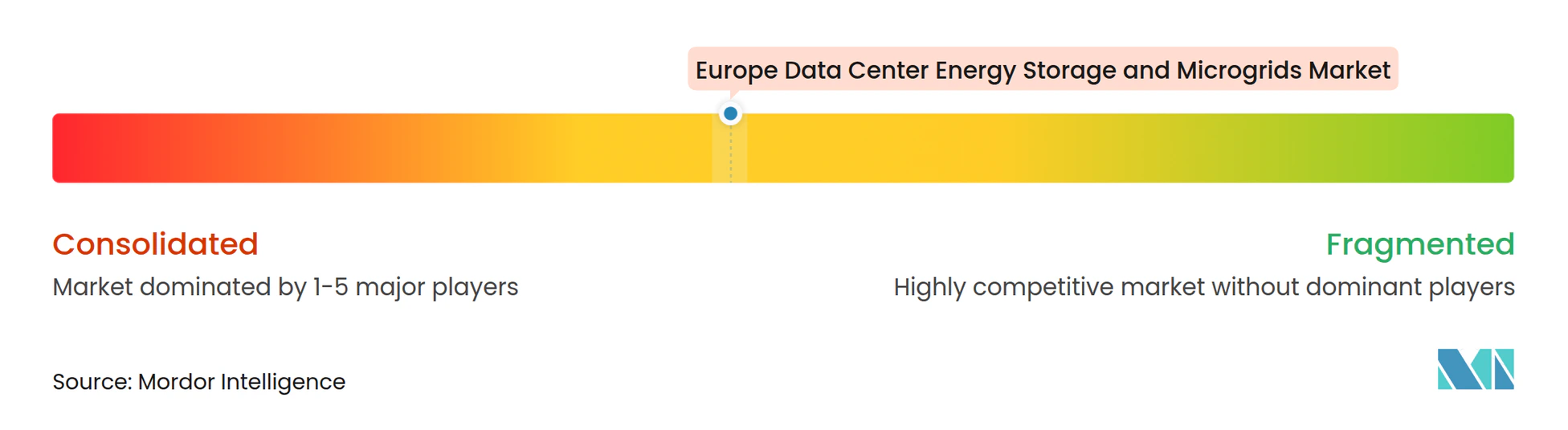
The European data center energy storage and microgrids market is moderately concentrated among providers capable of supplying end-to-end campus systems. Schneider Electric, ABB, Eaton, Siemens, Vertiv, and Hitachi Energy compete for large turnkey projects. The Europe data center energy storage and microgrids market also includes a fragmented storage technology layer with Fluence Energy, Tesla, EnerSys, Saft, and Skeleton Technologies. Vendors are moving from single-product sales toward coordinated systems that integrate battery storage, controls, generation, and facility equipment. This favors established power-management companies when customers want one accountable provider for a complex site.
Siemens Smart Infrastructure announced a March 2026 partnership with Fluence Energy and Emerald AI that combines BESS, microgrid controls, and workload-aware energy management. Within the Europe data center energy storage and microgrids market, ABB’s 2026 medium-voltage architecture for AI data centers highlights grid-forming capability, black-start functionality, and low-voltage ride-through compliance as core design needs. Eaton and Siemens Energy are pursuing modular on-site generation for fast campus delivery. These examples show that leading suppliers are combining equipment and software rather than selling isolated hardware. Battery-as-a-Service and Energy-as-a-Service arrangements can preserve customer capital for computing equipment while using long-term power-asset service contracts.
Long-duration storage for islanded systems, hydrogen-ready fuel cells, and software that manages several assets are the main specialist openings in the Europe data center energy storage and microgrids market. Flow-battery suppliers can compete where operators seek longer discharge duration or reduced fire-safety exposure. Compliance factors under the EN and IEC frameworks are becoming more relevant in procurement decisions. European Union Taxonomy criteria also increase the value of documented safety and lifecycle carbon information for sustainable data center investment in the Europe data center energy storage and microgrids market.[3]
Europe Data Center Energy Storage and Microgrids Industry Leaders
-
Schneider Electric SE
-
ABB Ltd.
-
Eaton Corporation plc
-
Vertiv Group Corporation
-
Legrand SA
- *Disclaimer: Major Players sorted in no particular order
Europe Data Center Energy Storage and Microgrids Market Companies Covered in this Report
- Schneider Electric SE
- ABB Ltd.
- Eaton Corporation plc
- Vertiv Group Corporation
- Legrand SA
- Siemens AG
- Siemens Energy AG
- Huawei Technologies Co., Ltd.
- Delta Electronics, Inc.
- Cummins Inc.
- Caterpillar Inc.
- Rolls-Royce Holdings plc
- Mitsubishi Electric Corporation
- Hitachi Energy Ltd.
- Fluence Energy, Inc.
- Tesla, Inc.
- EnerSys
- Saft Groupe S.A.
- Socomec Group S.A.
- Piller Power Systems GmbH
- Riello UPS Manufacturing S.p.A.
- Wärtsilä Corporation
- Ingeteam S.A.
- Skeleton Technologies Group OÜ
Recent Industry Developments in Europe Data Center Energy Storage and Microgrids Market
- April 2026: The Net Zero Innovation Hub for Data Centers and INNIO demonstrated 3 MW of 100% hydrogen-powered backup generation at INNIO Jenbacher's research facility in Austria, with Microsoft, Google, and Data4 serving as technical observers. The test used standard AI training load profiles and validated hydrogen internal combustion engine generators for mission-critical data center power applications, advancing the technology from laboratory demonstration to MW-scale operability.
- March 2026: Centrica and Ceres Power announced a strategic partnership to deploy multi-gigawatt solid oxide fuel cell solutions across the United Kingdom and Europe. The collaboration targets data centers facing grid-connection delays by offering fuel-flexible, high-efficiency on-site generation operable on natural gas with a direct pathway to hydrogen and biogas.
- March 2026: Siemens Smart Infrastructure announced a strategic investment in Emerald AI alongside the integration of Fluence Energy battery storage solutions into its data center ecosystem. The combined offering connects AI compute management, microgrid controls, and BESS to help operators accelerate grid connection by shaping large AI-scale demand loads and making them more predictable for utility assessment.
- February 2026: Amazon Web Services announced plans to invest EUR 33.7 billion (USD 39.8 billion) in Spain's AWS Europe Region in Aragón at MWC26 Barcelona, adding EUR 18 billion (USD 20.3 billion) to a previously announced EUR 15.7 billion (USD 17.7 billion) commitment. The investment supports cloud and AI infrastructure serving European customers, with renewable energy supply integral to the project's energy strategy.
Europe Data Center Energy Storage and Microgrids Market Report Scope
The South America Data Center Energy Storage and Microgrids Market refers to the market for energy storage technologies, microgrid control systems, distributed generation systems, and integrated power solutions designed to enhance the reliability, resilience, and energy efficiency of data centers.
The South America Data Center Energy Storage and Microgrids Market Report is Segmented by Solution Type (Energy Storage Systems, Microgrid Control Systems, Distributed Generation Systems, Integrated Microgrid Solutions, and Power Conversion Systems), Storage Technology (Lithium-Ion Batteries, Flow Batteries, Lead-Acid Batteries, Flywheel Energy Storage, and Other Storage Technologies), Microgrid Configuration (Grid-Connected Microgrids, Islanded Microgrids, and Hybrid Grid-Connected and Islandable Microgrids), Primary Energy Source (Grid Electricity, Solar Power, Wind Power, Fuel Cells, and Other Energy Sources), Primary Application (Backup Power and Resilience, Peak Shaving and Loaf Shifting, Renewable Energy Integration, Energy Cost Optimization, and Grid Services), Data Center Size (Hyperscale, Large, Medium, and Small), Data Center Type (Cloud Service Providers, Colocation, and Enterprise and Edge Data Centers), and Geography (United Kingdom, Germany, Netherlands, Ireland, France, Spain, Italy, Nordics, and Rest of Europe). The Market Forecasts are Provided in Terms of Value (USD).
Segmentation Overview
| Integrated Microgrid Solutions |
| Energy Storage Systems |
| Microgrid Control Systems |
| Distributed Generation Systems |
| Power Conversion Systems |
| Lithium-Ion Batteries |
| Lead-Acid Batteries |
| Flow Batteries |
| Flywheel Storage |
| Other Storage Technologies |
| Grid-Connected Microgrids |
| Islanded Microgrids |
| Hybrid Grid-Connected and Islandable Microgrids |
| Grid Electricity |
| Diesel and Natural Gas |
| Solar Power |
| Wind Power |
| Fuel Cells |
| Other Energy Sources |
| Backup Power and Resilience |
| Peak Shaving and Load Shifting |
| Renewable Energy Integration |
| Grid Services |
| Energy Cost Optimization |
| Small |
| Medium |
| Large |
| Hyperscale |
| Colocation |
| Cloud Service Providers (CSPs) |
| Enterprise and Edge |
| United Kingdom |
| Germany |
| Netherlands |
| Ireland |
| France |
| Spain |
| Italy |
| Nordics |
| Rest of Europe |
| By Solution Type | Integrated Microgrid Solutions |
| Energy Storage Systems | |
| Microgrid Control Systems | |
| Distributed Generation Systems | |
| Power Conversion Systems | |
| By Storage Technology | Lithium-Ion Batteries |
| Lead-Acid Batteries | |
| Flow Batteries | |
| Flywheel Storage | |
| Other Storage Technologies | |
| By Microgrid Configuration | Grid-Connected Microgrids |
| Islanded Microgrids | |
| Hybrid Grid-Connected and Islandable Microgrids | |
| By Primary Energy Source | Grid Electricity |
| Diesel and Natural Gas | |
| Solar Power | |
| Wind Power | |
| Fuel Cells | |
| Other Energy Sources | |
| By Primary Application | Backup Power and Resilience |
| Peak Shaving and Load Shifting | |
| Renewable Energy Integration | |
| Grid Services | |
| Energy Cost Optimization | |
| By Data Center Size | Small |
| Medium | |
| Large | |
| Hyperscale | |
| By Data Center Type | Colocation |
| Cloud Service Providers (CSPs) | |
| Enterprise and Edge | |
| By Geography | United Kingdom |
| Germany | |
| Netherlands | |
| Ireland | |
| France | |
| Spain | |
| Italy | |
| Nordics | |
| Rest of Europe |
Key Questions Answered in the Report
What is the size of the Europe data center energy storage and microgrids market?
The market size is projected to be USD 1.66 billion in 2026, USD 1.99 billion in 2027, and USD 4.79 billion by 2032, at a 19.21% CAGR from 2027 to 2032.
Which country is projected to expand fastest for data center energy storage and microgrids in Europe?
Spain is projected to expand at a 20.48% CAGR through 2032, supported by renewable electricity potential and major cloud infrastructure commitments.
Which solution type leads European data center energy infrastructure spending?
Energy storage systems held 30.08% of revenue in 2026 and are projected to expand at a 20.21% CAGR through 2032.
Why are batteries being installed at European data centers?
Batteries provide backup power, manage peak demand, support renewable electricity use, and can participate in grid balancing services where local rules allow.
Which storage technology is most widely used at European data centers?
Lithium-ion batteries held 56.21% of storage technology revenue in 2026, while flow batteries are projected to advance at a 20.19% CAGR through 2032.
How do grid connection delays affect new data center projects?
Long connection queues can lead developers to use hybrid or islanded microgrids so that new capacity can be commissioned without waiting for full utility service.