
Europe Data Center Disaster Resilience and Business Continuity Market Size and Share
Market Overview
| Study Period | 2021 - 2032 |
|---|---|
| Forecast Data Period | 2027 - 2032 |
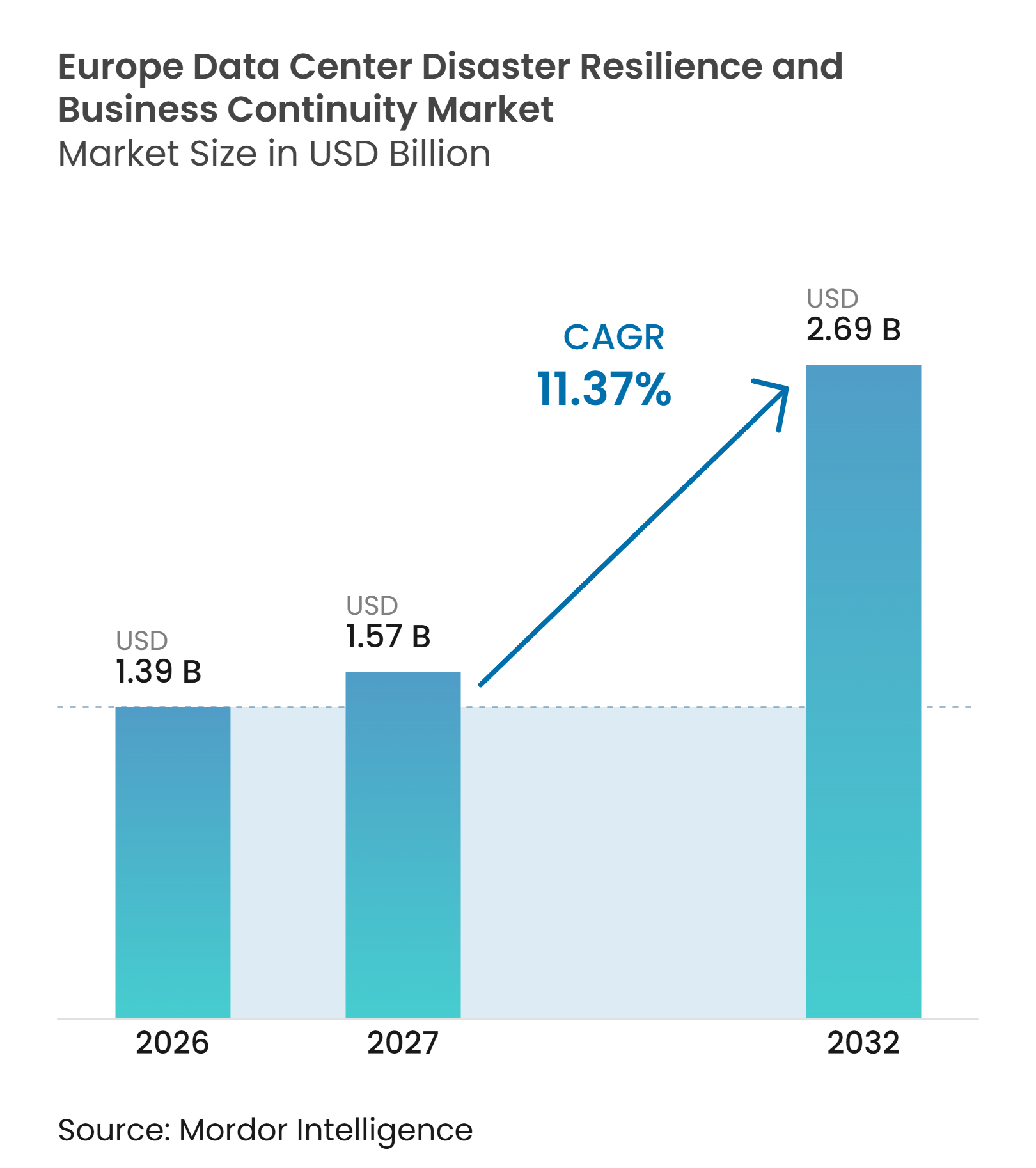
| Base Year Market Size (2026) | USD 1.39 Billion |
| Market Size (2027) | USD 1.57 Billion |
| Market Size (2032) | USD 2.69 Billion |
| Growth Rate (2027 - 2032) | 11.37 % |
| Market Concentration | Medium |
Major Players *Disclaimer: Major Players sorted in no particular order Image © Mordor Intelligence. Reuse requires attribution under CC BY 4.0. | |
Europe Data Center Disaster Resilience and Business Continuity Market Analysis by Mordor Intelligence
The Europe data center disaster resilience and business continuity market size is projected to be USD 1.39 billion in 2026, USD 1.57 billion in 2027, and reach USD 2.69 billion by 2032, growing at a CAGR of 11.37% from 2027 to 2032. Regulatory requirements, cyber incidents, and wider use of hybrid and multi-cloud systems are making downtime more costly for European organizations. Buyers are placing greater value on tested recovery processes, managed continuity services, and recovery tools that work across several environments. The Europe data center disaster resilience and business continuity market is also being shaped by data sovereignty requirements, particularly among financial institutions, public bodies, and operators of critical infrastructure. Competition is moving beyond backup capacity toward verified recovery, clean-room environments, and documented evidence that recovery plans can operate under stress. This favors vendors and service providers that can combine technical recovery capabilities with practical support for testing, governance, and supplier oversight.
Key Report Takeaways
- By component, services held 59.97% of the Europe data center disaster resilience and business continuity market share in 2026 and are projected to expand at an 11.77% CAGR through 2032.
- By deployment mode, cloud held 49.66% revenue share in 2026, while hybrid deployment is projected to expand at an 11.73% CAGR through 2032.
- By data center type, cloud service provider facilities accounted for 41.13% of revenue in 2026, while enterprise and edge deployments are projected to expand at an 11.96% CAGR through 2032.
- By end-user industry, BFSI held a 24.12% revenue share in 2026, while energy and utilities are projected to expand at a 12.92% CAGR through 2032 in the Europe data center disaster resilience and business continuity market.
- By geography, the United Kingdom held 25.48% revenue share in 2026, while Italy is projected to expand at a 12.81% CAGR through 2032.
Note: Market numbers in this report are based on Mordor Intelligence's proprietary estimation framework, which combines nine months of actuals with Q4 projections for base year 2026.
Market Trends and Insights
Drivers Impact Analysis of Europe Data Center Disaster Resilience and Business Continuity Market*
| Driver | (~) % Impact on CAGR Forecast | Geographic Relevance | Impact Timeline |
|---|---|---|---|
| Rising Ransomware and Cyber-Disruption Exposure | +2.5% | Global, concentrated in the United Kingdom, Germany, France, Italy, and Spain | Short term (≤ 2 years) |
| Stricter Digital Operational Resilience and Critical-Infrastructure Requirements | +2.1% | EU-wide, with early adoption in BFSI hubs including Frankfurt, Amsterdam, Paris, London, and Dublin | Short term (≤ 2 years) |
| Hybrid and Multi-Cloud Workload Expansion | +1.8% | North America and Europe, with spillover to Southern Europe | Medium term (2-4 years) |
| Demand for Sovereign and In-Region Recovery | +1.6% | Germany, France, the Netherlands, and the United Kingdom | Medium term (2-4 years) |
| Hyperscale and AI Data Center Capacity Growth | +1.4% | FLAP-D core markets, with expansion to Italy, Spain, Poland, and the Nordic countries | Long term (≥ 4 years) |
| Automated Recovery Orchestration and Continuous Recoverability Validation | +1.1% | Global, with regulatory pull across the EU and the United Kingdom | Medium term (2-4 years) |
| Source: Mordor Intelligence | |||
Rising Ransomware and Cyber-Disruption Exposure
Ransomware is increasing the need for recovery plans that can restore systems after an attack without reintroducing compromised data. ENISA identified ransomware deployment in 40% of the cyber events it analyzed in the EU during 2025, showing that the threat remains central to operational resilience planning.[1] The Europe data center disaster resilience and business continuity market benefits when organizations treat recovery as a business requirement rather than an IT task. Recovery programs now need to cover suppliers, hosted applications, cloud services, and internal systems because a disruption can move through connected organizations. This requirement supports spending on immutable backups, recovery testing, dependency mapping, and managed response arrangements. It also favors providers that can demonstrate recovery in a controlled environment before a customer resumes normal operations.
Stricter Digital Operational Resilience and Critical-Infrastructure Requirements
DORA has strengthened the link between technology resilience and financial-sector supervision across the EU. The European Supervisory Authorities designated 19 critical ICT third-party providers in November 2025, including Equinix, Interxion, IBM, NTT DATA, Microsoft, and Amazon Web Services EMEA. The designation increases the need for providers and their financial customers to maintain evidence of service continuity, controls, and recovery readiness. The Europe data center disaster resilience and business continuity market therefore gains from recurring testing, documentation, contract reviews, and third-party oversight work. Equinix has stated that its designation requires it to meet expectations related to physical security, availability, continuity, cybersecurity, and business continuity planning. The same regulatory direction also raises demand among organizations that depend on designated providers but must retain accountability for their own operational resilience.
Hybrid and Multi-Cloud Workload Expansion
Hybrid and multi-cloud systems widen the number of locations, providers, and interfaces that must be included in a recovery design. UpCloud reported that 42% of European and US organizations used a hybrid approach that combined European and US cloud service providers in 2026. A recovery plan must coordinate applications and data across cloud platforms, SaaS services, on-premises systems, and edge environments, rather than restoring a single site. The Europe data center disaster resilience and business continuity market is responding with services that assess dependencies and validate failover procedures across these environments. Commvault introduced Cloud Unity in November 2025 to bring data security, cyber recovery, and identity resilience together across cloud, SaaS, on-premises, and hybrid environments. This approach helps customers reduce the operational gaps that can arise when separate teams manage separate recovery tools.
Demand for Sovereign and In-Region Recovery
Organizations in regulated fields are increasingly seeking recovery systems that keep data, metadata, and operating controls within defined jurisdictions. AWS made Elastic Disaster Recovery available in the AWS European Sovereign Cloud in April 2026, supporting in-region recovery options for eligible customers. Rubrik made its Security Cloud available on that environment in July 2026 and stated that it supports Germany's BSI C5 catalog, DORA, and NIS2 requirements. The Europe data center disaster resilience and business continuity market is supported by the need to combine jurisdictional control with rapid recovery. Sovereign recovery services are especially relevant where public-sector, financial, health, or critical infrastructure workloads cannot be restored through an unrestricted cross-border model. This requirement is also encouraging service providers to offer localized recovery environments rather than relying solely on centralized cloud regions.
Restraints Impact Analysis of Europe Data Center Disaster Resilience and Business Continuity Market*
| Restraint | (~) % Impact on CAGR Forecast | Geographic Relevance | Impact Timeline |
|---|---|---|---|
| High Cost and Scarcity of Resilient Power and Grid Capacity | -1.2% | FLAP-D hubs including Frankfurt, London, Amsterdam, Paris, and Dublin, with spillover to national markets | Long term (≥ 4 years) |
| Fragmented National Regulation and Cross-Border Compliance Complexity | -0.9% | EU-wide, with acute pressure in cross-border financial and healthcare operations | Medium term (2-4 years) |
| Shortage of Resilience Engineering and Recovery Testing Talent | -0.8% | The United Kingdom, Germany, the Netherlands, France, and Ireland | Medium term (2-4 years) |
| Recovery Dependency on Concentrated Cloud, Connectivity, and Technology Suppliers | -0.7% | Global, concentrated in EU financial and public-sector markets | Short term (≤ 2 years) |
| Source: Mordor Intelligence | |||
High Cost and Scarcity of Resilient Power and Grid Capacity
Grid constraints can delay both production capacity and the secondary sites needed for disaster recovery. The International Energy Agency reported that connection wait times in major European data center hubs can run from 7 to 10 years.[2] This issue affects recovery planning because production and recovery facilities often compete for the same power connections. ENTSO-E has also noted that data centers can affect power-system operation because large uninterruptible power supply systems may disconnect substantial loads during disturbances. The Europe data center disaster resilience and business continuity market faces higher project costs and longer deployment schedules when resilient power cannot be secured. These constraints make site selection, power diversity, and coordination with utilities more important parts of continuity planning.
Fragmented National Regulation and Cross-Border Compliance Complexity
Organizations operating across Europe must align their resilience practices with several legal and supervisory expectations. BaFin has identified risks linked to the concentration of ICT outsourcing among providers headquartered outside the EU, including concerns about security, DORA compliance, and potential government access to data. This creates additional work for companies that must confirm where systems, data, subcontractors, and recovery controls are located. The Europe data center disaster resilience and business continuity market can be slowed when service designs need separate legal and technical treatment for multiple jurisdictions. The burden is particularly significant for mid-sized organizations that lack large in-house teams for resilience engineering, vendor oversight, and regulatory monitoring. Providers that can document compliance boundaries clearly are better placed to reduce this complexity for customers.
*Our forecasts treat driver/restraint impacts as directional, not additive. The impact forecasts reflect baseline growth, mix effects, and variable interactions.
Europe Data Center Disaster Resilience and Business Continuity Market Segment Analysis
By Component:
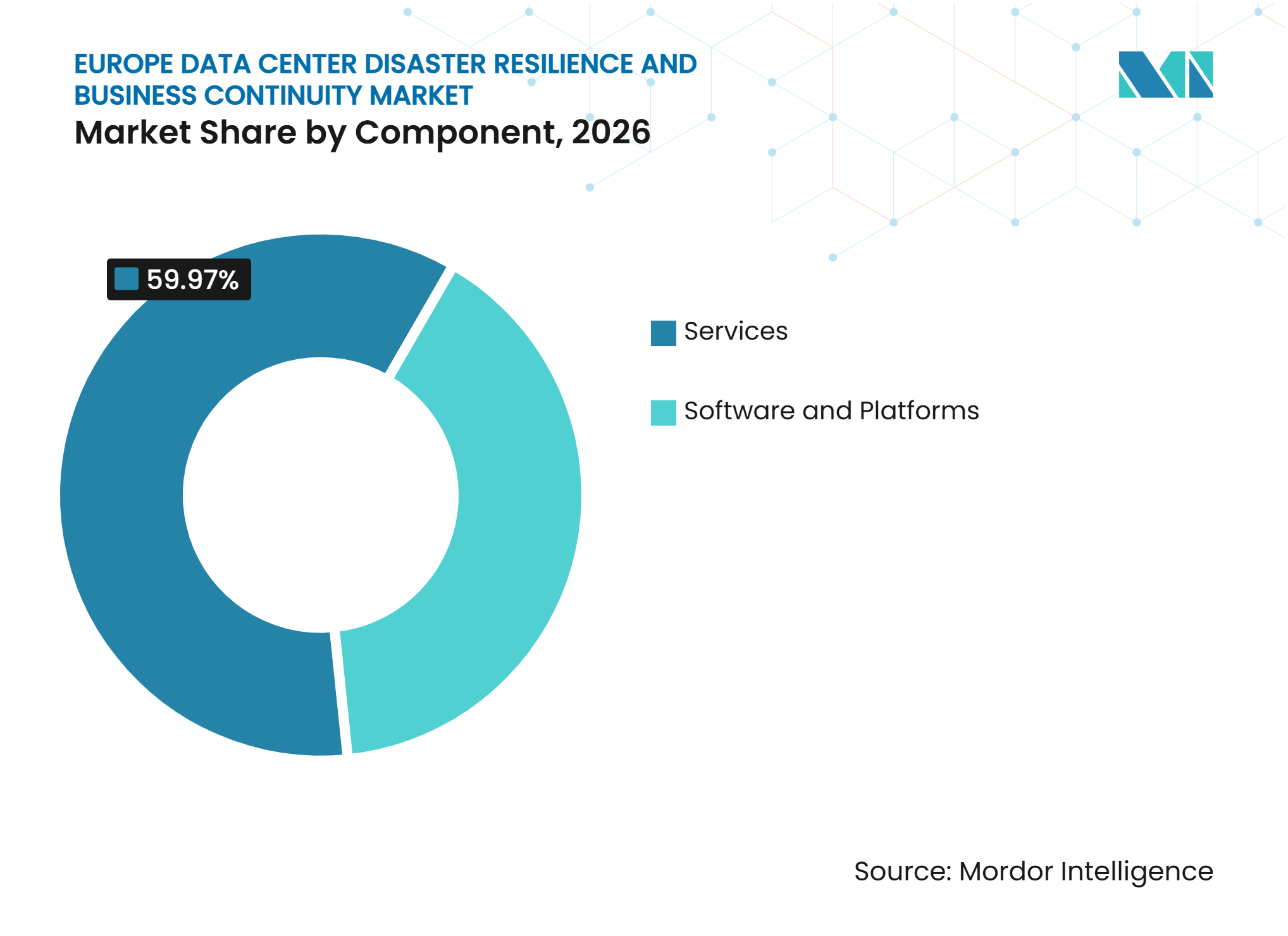
Services Lead Demand for Continuous Resilience SupportServices held 59.97% of the Europe data center disaster resilience and business continuity market share in 2026 and are projected to expand at an 11.77% CAGR through 2032. Organizations are buying support for recovery outcomes, including shorter restoration times, documented tests, and prepared crisis processes. Managed continuity programs, resilience testing, simulations, and employee training are receiving attention because they address the recurring work required to keep plans usable. The market's service demand also reflects that many organizations lack internal specialists to design, test, and maintain multi-environment recovery arrangements. Service contracts can also help customers schedule regular reviews as applications, suppliers, and compliance obligations change.
DORA-related oversight has increased the importance of formal resilience evidence in the financial sector. The EIOPA DORA Oversight Guide, published in July 2025, sets out supervisory processes for critical third-party providers of ICT. Business impact analysis and resilience assessments help organizations identify which systems should be restored first and which external dependencies can delay recovery. Cognizant and Rubrik introduced Business Resilience-as-a-Service in October 2025, combining Rubrik's platform with a subscription-based delivery model for enterprise cyber recovery. Software and platforms remain important because they centralize planning, response coordination, documentation, and recovery management, but customers often need service support to turn those tools into repeatable operating practices.


By Deployment Mode:
Hybrid Systems Extend the Recovery BoundaryCloud deployment accounted for 49.66% of revenue in 2026, while hybrid deployment is projected to expand at an 11.73% CAGR through 2032. The large cloud position reflects the widespread use of hosted infrastructure, but that use does not eliminate the need for recovery planning. Instead, it requires customers to understand how data, identities, applications, and vendor controls interact across different environments. Hybrid designs address this requirement by combining cloud resources with on-premises systems, colocation sites, or sovereign facilities. The model can also give organizations more options when a service, location, or network path becomes unavailable.
The European data center disaster resilience and business continuity market is being shaped by organizations seeking to limit exposure to a single provider or location. UpCloud's 2026 findings on hybrid use show that many organizations already combine European and US providers. Commvault's Cloud Unity release shows how vendors are adapting their products to support recovery across cloud, SaaS, on-premises, and hybrid settings. Hybrid models can pair sovereign copies that support operational recovery with other storage arrangements for longer-term retention. This setup makes coordination, testing, and visibility central requirements, rather than optional features added after deployment.
By Data Center Type:
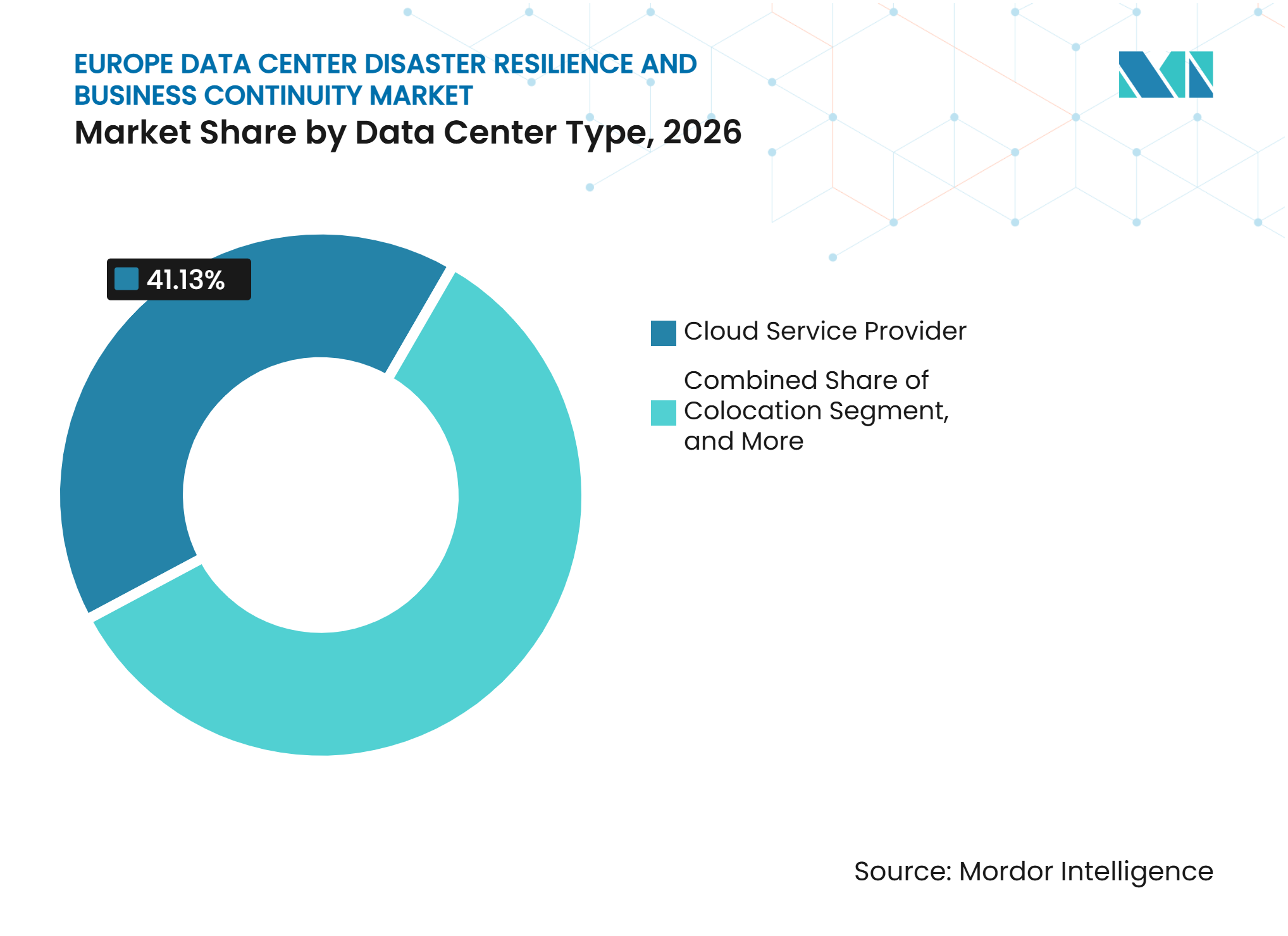
Enterprise and Edge Systems Broaden Recovery RequirementsCloud service provider facilities accounted for 41.13% of revenue in 2026, while enterprise and edge deployments are projected to expand at an 11.96% CAGR through 2032. The position of cloud service provider facilities reflects the concentration of enterprise workloads in large hosted environments. Recovery coverage is therefore needed for applications and data located in hyperscale infrastructure, as well as the connections that link those resources to customer systems. Enterprise and edge systems are expanding the number of smaller locations that must be included in continuity plans. Their operational importance means that local failures can still affect a broader service or production process.
In July 2025, Oracle announced a USD 2 billion investment over 5 years in AI and cloud infrastructure in Germany. As infrastructure becomes more distributed, recovery planning must account for local systems used in industrial, retail, healthcare, and other operating environments. The European Data Center Association expects EUR 176 billion in cumulative data center investment from 2026 to 2031, which supports continued activity across colocation and related facilities. Colocation providers can differentiate through power redundancy, diverse connectivity, physical security, and documented continuity measures. The Uptime Institute reported in 2026 that 1 in 10 outages was serious or severe, reinforcing the value of recovery plans that are tested under realistic conditions.


By End User Industry:
BFSI Leads While Energy and Utilities AccelerateBFSI held 24.12% revenue share in 2026, while energy and utilities are projected to expand at a 12.92% CAGR through 2032. Financial organizations face direct pressure to demonstrate that essential ICT services can withstand and recover from disruptions. The European Supervisory Authorities' designation of critical ICT providers has reinforced the attention given to operational continuity across the financial supply chain. This favors services and platforms that can record testing, control evidence, incident procedures, and supplier dependencies. It also increases the value of suppliers that can explain recovery responsibilities clearly to both business and technology leaders.
Energy and utilities organizations are expanding their use of digital systems across generation, networks, and customer operations. The Council of the European Union's 2026 roadmap on digitalization and AI in the energy sector calls for cybersecurity and resilience to support the sector's digital transition. The Europe data center disaster resilience and business continuity industry has opportunities where IT systems connect more closely with operational technology and grid infrastructure. Government and public administration, healthcare, manufacturing, and retail also require different forms of continuity support. These users need recovery arrangements that account for their operating constraints, including public service availability, clinical continuity, industrial process safety, and transaction availability.
Geography Analysis
United Kingdom: Regulation and Sovereign Recovery Support Demand
The United Kingdom held 25.48% of the Europe data center disaster resilience and business continuity market share in 2026. Financial services activity, data center capacity, and cyber resilience spending support its position. TechUK reported continued progress in the United Kingdom's data center sector through its Data Center Program in 2025. The proposed Cyber Security and Resilience Bill adds regulatory attention to data center operators and essential services. Rubrik and Rackspace Technology launched the UK Sovereign Cyber Recovery Cloud in March 2026, linking local data control with automated recovery.
Italy: Infrastructure Expansion Creates New Recovery Requirements
Italy is projected to expand at a 12.81% CAGR through 2032, the highest rate among the geographies covered. The Italian Data Center Association projected national installed capacity would exceed 1 gigawatt by 2028 and 2 gigawatts by 2031. This buildout increases the need for site resilience, backup capacity, recovery testing, and supplier readiness. Lombardy approved a law in June 2026 to regulate data center development, improving the framework for planned projects.
Germany, France, the Netherlands, Ireland, Spain, and Other European Markets: Capacity Patterns Shape Local Demand
Germany's enterprise base and cloud infrastructure make it a major recovery services location. Oracle announced a USD 2 billion investment in German AI and cloud infrastructure in 2025.[3] BaFin's 2026 work on ICT outsourcing highlights the importance of concentration and sovereignty for German users. France, the Netherlands, and Ireland remain important cloud and connectivity locations despite capacity and power constraints. Spain, Poland, Portugal, Belgium, and the Nordic countries can draw investment seeking alternatives to constrained core hubs.
Competitive Landscape
Market Concentration
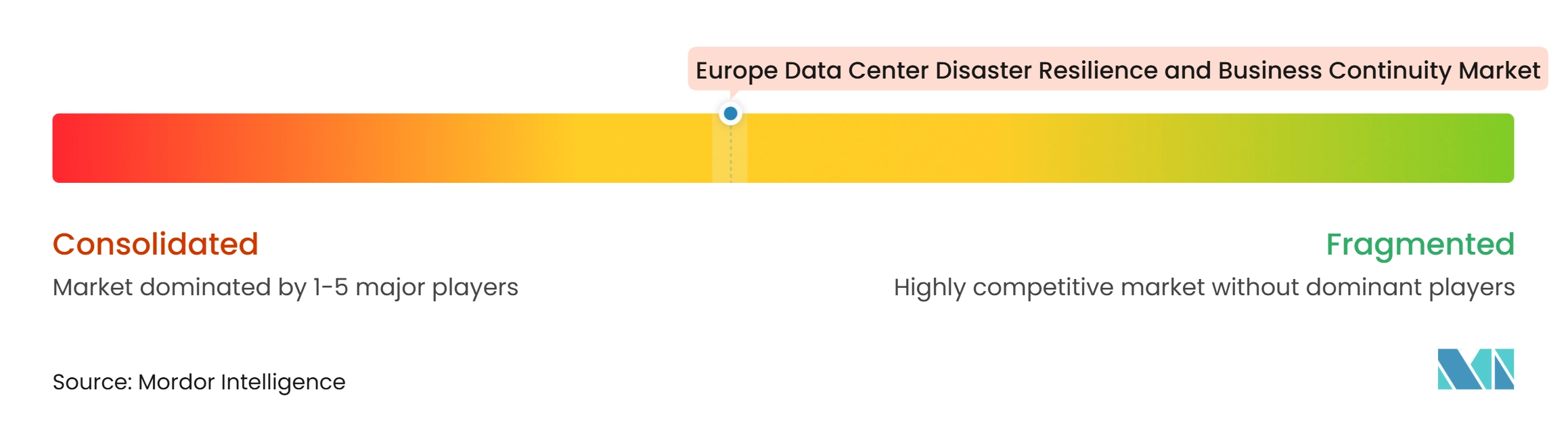
The Europe data center disaster resilience and business continuity market has a moderately consolidated platform layer and a more fragmented services layer. Commvault, Rubrik, Microsoft, and IBM compete for larger enterprise mandates, while regional managed service providers compete on proximity, local support, and regulatory knowledge. Platform providers are emphasizing cyber recovery, identity resilience, threat detection, and support for cloud and on-premises environments. Commvault signed a multi-year partnership with Microsoft in June 2026 to make its AI and cyber resilience platform available as a native ISV service on Microsoft Azure. The partnership links recovery capabilities more closely to existing Azure use.
Rubrik announced Security Cloud Sovereign in January 2026 with controls designed to keep data, metadata, the control plane, and management within customer-designated boundaries. It followed this in July 2026 with availability on the AWS European Sovereign Cloud for EU public-sector and regulated customers. These actions address the demand for jurisdictional control alongside cyber recovery. Equinix has outlined commitments related to security, availability, continuity, cybersecurity, and business continuity planning after its critical ICT third-party provider designation. Regional providers such as Databarracks, DARZ, Ekco Cloud Services, and Claranet can compete where local implementation support is valuable.
Mid-sized enterprises, energy and utilities organizations, and customers seeking in-country recovery services are important opportunity areas. ISO 22301 and BSI C5 can help providers demonstrate business continuity management and cloud security practices. Rubrik's sovereign cloud deployment cited alignment with BSI C5, DORA, and NIS2 expectations.
Europe Data Center Disaster Resilience and Business Continuity Industry Leaders
-
Acronis International GmbH
-
Amazon Web Services, Inc.
-
Microsoft Corporation
-
International Business Machines Corporation
-
VMware, Inc.
- *Disclaimer: Major Players sorted in no particular order
Europe Data Center Disaster Resilience and Business Continuity Market Companies Covered in this Report
- Acronis International GmbH
- Amazon Web Services, Inc.
- Microsoft Corporation
- International Business Machines Corporation
- VMware, Inc.
- 11:11 Systems, Inc.
- Cable & Wireless Communications Limited
- Proact IT Group AB
- M247 Ltd
- Ekco Cloud Services Limited
- Claranet Limited
- Daisy Corporate Services Trading Limited
- Databarracks Limited
- DARZ GmbH
- Node4 Limited
- GigaCloud Technology Inc.
- Commvault Systems, Inc.
- Rubrik, Inc.
- Dell Technologies Inc.
- Equinix, Inc.
- Digital Realty Trust, Inc.
- NTT DATA Corporation
- KDDI Corporation
- Global Switch Holdings Limited
- CyrusOne LLC
Recent Industry Developments in Europe Data Center Disaster Resilience and Business Continuity Market
- October 2026: Rubrik released enhancements to its Security Cloud Private (RSC-P) platform, introducing fully air-gapped, internet-free operation with FIPS 140-3 compliant encryption key management, a capability designed specifically for government and regulated enterprise deployments where data and metadata must not traverse vendor cloud infrastructure, reinforcing the platform's compliance posture under DORA and NIS2.
- September 2026: CrowdStrike's security agents were integrated to trigger automated recovery actions across Commvault, Rubrik, and VAST Data platforms, enabling joint customers to initiate cyber recovery workflows directly from active threat-detection events, reducing the gap between threat identification and recovery initiation in enterprise environments.
- July 2026: Rubrik announced the availability of Rubrik Security Cloud on the AWS European Sovereign Cloud, providing EU public sector agencies and regulated industries, including banking, utilities, healthcare, and government, with sovereign cyber resilience certified under Germany's BSI C5 catalogue, DORA, and the NIS2 Directive, with all data remaining within EU borders.
- June 2026: Commvault signed a multi-year strategic partnership with Microsoft, under which Commvault's AI and cyber resilience platform will be embedded as a native ISV service on Microsoft Azure, providing Azure customers unified access to Commvault's recovery capabilities directly from the Azure cloud platform without separate infrastructure or manual integrations.
Europe Data Center Disaster Resilience and Business Continuity Market Report Scope
The Europe Data Center Disaster Resilience and Business Continuity Market comprises the solutions and services designed to help data center operators and organizations maintain critical IT operations, protect data, and restore infrastructure and business processes during disruptive events.
The Europe Data Center Disaster Resilience and Business Continuity Report is Segmented by Component (Software and Platforms, and Services), Deployment Mode (Cloud, On-Premises, and Hybrid), Data Center Type (Cloud Service Provider, Colocation, and Enterprise and Edge), End User Industry (BFSI, IT and Telecom, Government and Public Administration, Healthcare and Life Sciences, Manufacturing, Energy and Utilities, and Other End User Industries), and Geography (United Kingdom, Germany, France, Netherlands, Ireland, Spain, Italy, and Rest of Europe). The Market Forecasts are Provided in Terms of Value (USD).
Segmentation Overview
| Software and Platforms | Integrated Continuity and Resilience Management Platforms |
| Standalone Business Impact Analysis and Dependency Mapping Software | |
| Standalone Continuity Planning and Documentation Software | |
| Standalone Crisis Response and Incident Coordination Software | |
| Others (Standalone Resilience Exercise and Testing Management Software, etc) | |
| Services | Advisory, Business Impact Analysis, and Resilience Assessment Services |
| Continuity and Crisis Response Plan Development Services | |
| Software Implementation and Systems Integration Services | |
| Resilience Testing, Simulation, and Training Services | |
| Managed Continuity Program Services |
| Cloud |
| On-Premises |
| Hybrid |
| Cloud Service Provider |
| Colocation |
| Enterprise and Edge |
| IT and Telecom |
| BFSI |
| Government and Public Administration |
| Healthcare and Life Sciences |
| Manufacturing |
| Retail and E-Commerce |
| Energy and Utilities |
| Other End User Industries |
| United Kingdom |
| Germany |
| France |
| Netherlands |
| Ireland |
| Spain |
| Italy |
| Rest of Europe |
| By Component | Software and Platforms | Integrated Continuity and Resilience Management Platforms |
| Standalone Business Impact Analysis and Dependency Mapping Software | ||
| Standalone Continuity Planning and Documentation Software | ||
| Standalone Crisis Response and Incident Coordination Software | ||
| Others (Standalone Resilience Exercise and Testing Management Software, etc) | ||
| Services | Advisory, Business Impact Analysis, and Resilience Assessment Services | |
| Continuity and Crisis Response Plan Development Services | ||
| Software Implementation and Systems Integration Services | ||
| Resilience Testing, Simulation, and Training Services | ||
| Managed Continuity Program Services | ||
| By Deployment Mode | Cloud | |
| On-Premises | ||
| Hybrid | ||
| By Data Center Type | Cloud Service Provider | |
| Colocation | ||
| Enterprise and Edge | ||
| By End User Industry | IT and Telecom | |
| BFSI | ||
| Government and Public Administration | ||
| Healthcare and Life Sciences | ||
| Manufacturing | ||
| Retail and E-Commerce | ||
| Energy and Utilities | ||
| Other End User Industries | ||
| By Geography | United Kingdom | |
| Germany | ||
| France | ||
| Netherlands | ||
| Ireland | ||
| Spain | ||
| Italy | ||
| Rest of Europe | ||
Key Questions Answered in the Report
What is the size of the Europe data center disaster resilience and business continuity market?
The sector is projected at USD 1.39 billion in 2026, USD 1.57 billion in 2027, and USD 2.69 billion by 2032, with an 11.37% CAGR over 2027-2032. These figures cover resilience and business continuity spending across the defined European scope.
Why are European organizations investing in data center disaster resilience?
Ransomware exposure, regulatory oversight, cloud complexity, and sovereign recovery requirements are increasing the need for tested recovery capabilities. Buyers also need clearer accountability for suppliers and critical applications.
Which component leads spending in this sector?
Services held 59.97% revenue share in 2026 and are projected to expand at an 11.77% CAGR through 2032. Managed continuity, testing, simulation, and advisory support drive this position.
Which deployment model is expected to expand fastest?
Hybrid deployment is projected to expand at an 11.73% CAGR through 2032 as organizations combine cloud, on-premises, and sovereign infrastructure. It can provide more recovery options across environments.
Which end user group is projected to expand fastest?
Energy and utilities is projected to expand at a 12.92% CAGR through 2032, supported by digitalization and stronger resilience needs across connected infrastructure. IT and operational technology links are increasing planning needs.
Which European geography is projected to expand fastest?
Italy is projected to expand at a 12.81% CAGR through 2032 as data center infrastructure investment increases and regional development rules become clearer. Recovery services must develop alongside new capacity.